Wednesday, December 28, 2016

2521. Pregnancy Changes the Brain in Ways That May Help Mothering

By Paul Belluck, The New York Times, December 19, 2016


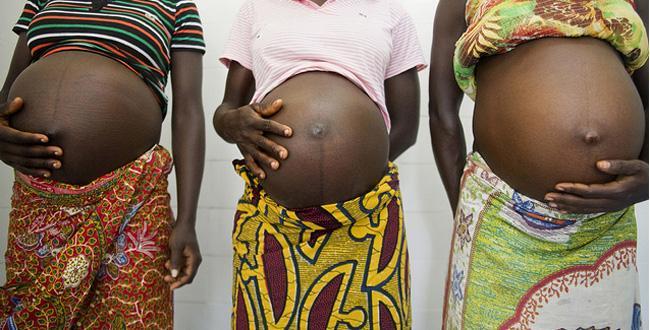
Pregnancy changes a woman’s brain, altering the size and structure of areas involved in perceiving the feelings and perspectives of others, according to a first-of-its-kind study published Monday.

Most of these changes remained two years after giving birth, at least into the babies’ toddler years. And the more pronounced the brain changes, the higher mothers scored on a measure of emotional attachment to their babies.

“Just fascinating,” said Dr. Ronald E. Dahl, director of the Institute of Human Development at the University of California, Berkeley, who was not involved in the study, published in the journal Nature Neuroscience. He said the researchers’ interpretation that changes in the brain enhance women’s maternal responses is “provocative, and I think it’s likely to be true.”

In the study, researchers scanned the brains of women who had never conceived before, and again after they gave birth for the first time. The results were remarkable: loss of gray matter in several brain areas involved in a process called social cognition or “theory of mind,” the ability to register and consider how other people perceive things.

What might the loss mean?

There are three possibilities, said Paul Thompson, a neuroscientist at the University of Southern California who was not involved in the study. “The most intuitive is that losing gray matter is not beneficial, that later on there may be negative consequences.”

Or, he said, it could be just a “neutral” reflection of pregnancy-related “stress, diet, lack of sleep.”

A third possibility is that the loss is “part of the brain’s program for dealing with the future,” he said. Hormone surges in pregnancy might cause “pruning or cellular adaptation that is helpful,” he said, streamlining certain brain areas to be more efficient at mothering skills “from nurturing to extra vigilance to teaching.”

The study strongly leans toward the third possibility.

“We certainly don’t want to put a message out there on the lines of ‘pregnancy makes you lose your brain,’ as we don’t believe this is the case,” said Elseline Hoekzema, a researcher at Leiden University in the Netherlands, who led the study at the Universitat Autonoma de Barcelona in Spain.

“Gray matter volume loss does not necessarily represent a bad thing,” she said. “It can also represent a beneficial process of maturation or specialization.”

Pregnancy, she explained, may help a woman’s brain specialize in “a mother’s ability to recognize the needs of her infant, to recognize social threats or to promote mother-infant bonding.”

The study, which took more than five years, involved 25 women in their 30s in Spain who had never been pregnant but were hoping to conceive. Their brains were scanned before becoming pregnant and within few months after giving birth. For comparison, 20 women who had never been pregnant were also scanned twice, about the same number of months apart.

Only the pregnant women showed gray matter reduction, thinning and changes in the surface area of the cortex in areas related to social cognition. Changes were so clear that imaging results alone could indicate which women had been pregnant. The researchers said they did not yet know what was being reduced in size: neurons, other brain cells, synapses or parts of the circulatory system.

Many of the women had been recruited for the study at a fertility clinic, and the 16 who conceived after fertility treatment were compared with nine who conceived naturally. The treatments caused no difference in brain changes; nor did the sex of the babies.

The researchers also scanned the brains of 17 men who were not fathers and 19 first-time fathers before and after their partners’ pregnancies. The two male groups showed no difference in brain volume.

Researchers wanted to see if the women’s brain changes affected anything related to mothering. They found that relevant brain regions in mothers showed more activity when women looked at photos of their own babies than with photos of other children.

Six months after giving birth, the mothers answered questions on the Maternal Postnatal Attachment Scale, used to assess a woman’s emotional attachment, pleasure and hostility toward her baby. The degree of changes in the mothers’ gray matter volume predicted the degree of hostility and attachment, Dr. Hoekzema said.

Experts said more research was required, involving more women and clearer assessments of social cognition to substantiate whether gray matter loss is truly linked to “theory of mind” and improved mothering skills.

But there are some precedents for making that connection. A 2014 study showed “people with better spontaneous ‘theory of mind’ also have less gray matter volume in pretty much exactly these regions,” said Rebecca Saxe, a professor of cognitive neuroscience at the Massachusetts Institute of Technology, who was not involved in the new research.
During another period of roiling hormonal change — adolescence — gray matter decreases in several brain regions that are believed to provide fine-tuning for the social, emotional and cognitive territory of being a teenager.

“We think it is creating plasticity for learning, not that adolescent brains are wacko or making them crazy,” said Dr. Dahl of the University of California, Berkeley. Perhaps there is “a similar turbulent period around pregnancy,” he said.

In the study, the women’s cognitive abilities were tested before and after pregnancy, and “there was no loss of memory, verbal skills or working memory,” Dr. Saxe noted, providing “evidence against the common myth of ‘mommy brain.’ ”

Two years after they gave birth, scans of the brains of 11 women who had not had second children showed the same gray matter loss in the same areas, except for an area in the hippocampus, which had regained volume. Dr. Thompson said it was notable that the hippocampus, important in memory, appeared to recover, possibly because of all the learning and activity required of new mothers.

“That boost in the memory system is something that many of us in neuroscience would give our eyeteeth to achieve,” he said. Brain areas lose volume “like the erosion of the coast, but there are not many things that put the coast back.”

Many questions remain. Pilyoung Kim, an assistant professor of developmental psychology at the University of Denver, who was not involved in the study, said her research had found that some brain regions increased in size in the months after giving birth. She said she wondered if maternal brain areas waxed and waned during and after pregnancy.

Dr. Hoekzema is continuing the research, including in one very personal way. “I was pregnant with my first child when analyzing these data, but unfortunately I couldn’t get the before and after M.R.I. scans of my first pregnancy,” she said.

Now, she is 20 weeks pregnant, with her second child. “Yes, I’ve certainly scanned myself before getting pregnant,” she said, “and will go into the scanner again after birth!”

Tuesday, December 27, 2016

2520. India Plans Nearly 60% of Electricity Capacity from Non-Fossil Fuels by 2027

Michael Safi, The GuardianDecember 22, 2016

The Indian government has forecast that it will exceed the renewable energy targets set in Paris last year by nearly half and three years ahead of schedule.
A draft 10-year energy blueprint published this week predicts that 57% of India’s total electricity capacity will come from non-fossil fuel sources by 2027. ThParis climate accord target was 40% by 2030.

The forecast reflects an increase in private sector investment in Indian renewable energy projects over the past year, according to analystsThe draft national electricity plan also indicated that no new coal-fired power stations were likely to be required to meet Indian energy needs until at least 2027, raising further doubts over the viability of Indian mining investments overseas, such as the energy company Adani’s Carmichael mine in Queensland, the largest coal mine planned to be built in Australia.
India’s energy minister, Piyush Goyal, has been appealing to wealthier nations to provide capital to invest in renewable energy projects to help the country reach and exceed the targets agreed in Paris in November 2015.
Significant state investment has not been forthcoming, but Tim Buckley, a director at the Institute for Energy Economics and Financial Analysis, said India had made up the shortfall with an influx of capital from the domestic and overseas private sectors in the past 12 months.
Japan’s Softbank has committed to invest $20bn (£16.2bn) in the Indian solar energy sector, in conjunction with Taiwanese company Foxconn and Indian business group Bharti Enterprises.
In September the largely French state-owned energy company EDF announced it would invest $2bn in Indian renewable energy projects, citing the country’s enormous projected demand and “fantastic” potential of its wind and solar radiation.
Adani opened the world’s largest solar plant in Tamil Nadu earlier this year, and in October the energy conglomerate Tata announced that it would aim to generate as much as 40% of its energy from renewable sources by 2025.
Buckley said India’s “absolutely transformational” forecast was also driven by technological advancements that have led to the price of solar energy falling by 80% in the past five years.
“India is moving beyond fossil fuels at a pace scarcely imagined only two years ago,” he said. “Goyal has put forward an energy plan that is commercially viable and commercially justified without subsidies, so you have big global corporations and utilities committing to it.”
In the 2027 forecasts, India aims to generate 275 gigawatts of total renewable energy, in addition to 72GW of hydro energy and 15GW of nuclear energy. Nearly 100GW would come from “other zero emission” sources, with advancements in energy efficiency expected to reduce the need for capacity increases by 40GW over 10 years.
About 50GW of coal power projects being developed in India would be “largely stranded” under the forecast, Buckley said, with official modeling showing that “none of these plants are required before 2022 and only possible before 2027”.

Monday, December 26, 2016

2519. Where’s the Love for Donkeys?

By James Gorman, The New York Times, October 31, 2016

About 5,000 years ago, 10 donkeys were laid to rest in painstakingly constructed brick grave chambers at a site connected with one of the earliest Egyptian kings.

They were buried in a place of importance, “where the highest lords would be,” said Fiona Marshall, an archaeologist at Washington University in St. Louis who studies the domestication of donkeys. Because of their importance in trade across the Sahara, she said, donkeys had “superhigh status.”

Unfortunately, even the most passionate defenders of donkeys recognize that the animal they love gets little respect in the wider world today.

Veterinarians, donkey rescuers and donkey defenders gathered recently for the fourth annual Donkey Welfare Symposium at the Cornell University veterinary school in Ithaca, N.Y., to talk about the problems faced by an animal often at the bottom of the ladder of human regard.

“Donkeys are the least of the least,” said Eric Davis, the veterinarian from the University of California, Davis, who started the symposium. He travels with other vets to provide free care to donkeys in many places where none is available. Donkeys are sometimes abused and, in the worst cases, slaughtered for gelatin and for meat.

Fortunately, as the symposium made clear, the animals are not friendless. Their benefactors may not be large in number (conference attendance was 77), but they are as fierce in their loyalty as donkeys are in defense of their territories (more about donkey fierceness later). They are also devoted to debunking donkey myths.

You may have heard, for instance, that donkeys are stubborn. But Ben Hart, a trainer who works for the Donkey Sanctuary in Britain, put it this way: “Anybody who says a donkey is stubborn has been outsmarted by a donkey.”

They are cautious, he said, not contrary. They like to think before they act. The reason may be that their ancestor, the African wild ass, is not a herd animal. Wild asses have individual territories, and each must decide where to go and when to eat, run or fight. Donkeys have retained some of that thoughtful intelligence, said Dr. Marshall, who was not at the symposium. They like to decide for themselves.

So if you try to lead a donkey over a shadow on the ground that looks a bit like the edge of a cliff, the donkey may balk.

That’s what Balaam’s donkey did in the Bible. It refused three times to go forward even though its master had insisted. He beat it for its apparent balkiness, and the donkey, the only animal in the Bible other than the serpent to speak, said, “What have I done unto thee, that thou hast smitten me these three times?”

The donkey was quite sensibly avoiding a very threatening angel with a sword, who explained to Balaam after the fact that if it had not been for the animal’s sagacity, Balaam himself would have died by the angel’s sword.

Although donkeys may avoid armed angels and can run when threatened, that isn’t their usual reaction to predators. That’s when they become fierce. “A donkey will stand and fight,” said Mark Meyers, who runs Peaceful Valley Donkey Rescue in Miles, Tex., and had brought donkeys to the symposium for adoption. He and others at the meeting said donkeys would attack dogs, coyotes or foxes. There has been at least one report of a donkey attacking a mountain lion.

That is why donkeys are kept to protect sheep, goats and other animals. That’s right. Guard donkeys. Google them.

Their history with humans, of course, is as the ultimate beasts of burden. And among the earliest. The donkey, not the camel, opened up the Sahara, Dr. Marshall said, enabling trade between Egypt and Mesopotamia. That is why those 10 were buried with a king. Camel caravans did not appear until about 3,000 years ago. The first donkeys were probably domesticated about 6,000 years ago, and their importance was evident in those 5,000-year-old burials.

Since then, donkeys have carried building stones, food, trade goods, ammunition and people, including Jesus when he rode into Jerusalem on the day Christians celebrate as Palm Sunday. And yet museums are full of celebrations of horses, not donkeys.

“It’s so galling, when you become an eccentric donkey person,” Dr. Marshall said.
True, they are not the most exciting animals. Unlike their equine cousins, “donkeys have two speeds: slow and slower,” the saying goes. But the gap in prestige between the elegant horse and the dumpy donkey is of human doing.

African wild asses — of which there are perhaps 600 left in nature — are “magnificent wild animals,” Dr. Marshall said, “really elegant and fast and feisty as anything.” And they are the animals from which the first donkeys were bred.

The first horses, she said, “were short, stubby little things, sort of like a barrel on legs.” People bred them to be long-legged racers and great jumpers, just as the lithe wild ass was bred to become a stubby little donkey.

One nonscientific claim about donkeys is that they are lovable, and they are. I stood in a corral with Ben Hart while he spent half his time scratching the ears of one donkey that chased away 10 or so others who wanted to get in on the petting.

Kimberly Brockett, who keeps mammoth donkeys at Tripledale Farm in Guilford, Conn., said, “It’s a dog you can ride.”

In the United States and Britain, a number of organizations work to rescue donkeys that are poorly cared for or abused. Groups like the Donkey Sanctuary in England and Brooke: Action for Working Horses and Donkeys support education and veterinary care.
But many donkeys are not kept as pets or working animals, but slaughtered for their meat or hides. Philip Mshelia, a veterinarian from Nigeria, spoke at the symposium about the suffering of donkeys in Africa. They have been slaughtered without regulation in several countries for food and for shipment to China, where a gelatinlike substance, or ejiao, from their hides is used in medicines. Because tens of thousands of donkeys have been killed, Burkina Faso and Niger banned the export of donkeys this year.

Dr. Davis warned those at the conference that the future may hold more such horrors. Even though the number of donkeys is increasing, he said, global economic development might well mean that tractors, cars and trucks will become available to the poor who now depend on donkeys. What happens to donkeys then may be what happened to horses in developed countries as cars and trucks replaced them — widespread slaughter. If that happens, he added, donkey lovers might have to work to make their inevitable deaths as humane as possible.

Dr. Davis spoke by telephone at 7 a.m. one recent morning, fresh from feeding the five donkeys that he and his wife keep. Asked why people who do not have or know donkeys should care about them, he said, “Much of human civilization was created because there were donkeys to move pastoralists and traders around the world.”

“I think that we as a species owe something to donkeys.”

Saturday, December 24, 2016

2518. Christmas in the Technosphere: How to Lift the Weight of the World

By David Suzuki, DesmugCanada.ca, December 22, 2016


How much stuff will you give and receive this holiday season? Add it to the growing pile — the 30-trillion-tonne pile. That’s how much technology and goods humans have produced, according to a study by an international team led by England’s University of Leicester. It adds up to more than all living matter on the planet, estimated at around four trillion tonnes.

Scientists have dubbed these times the “Anthropocene”, because humans are now the dominant factor influencing Earth’s natural systems, from climate to the carbon and hydrologic cycles. Now they’re labelling our accumulated goods and technologies — including houses, factories, cars, roads, smartphones, computers and landfills — the “technosphere” because it’s as large and significant as the biosphere, atmosphere and hydrosphere. Researchers estimate it represents 50 kilograms for every square metre of Earth’s surface and is 100,000 times greater than the human biomass it supports.

As CBC science commentator Bob McDonald wrote, “Our technology is a super-organism that competes with the biosphere for resources, and is winning that competition by taking over the surface of the planet.”

Report co-author Mark Williams explained the significance: “The technosphere can be said to have budded off the biosphere and arguably is now at least partly parasitic on it. At its current scale the technosphere is a major new phenomenon of this planet — and one that is evolving extraordinarily rapidly. Compared with the biosphere, though, it is remarkably poor at recycling its own materials, as our burgeoning landfill sites show. This might be a barrier to its further success — or halt it altogether.”

Living systems renew and recycle. Organisms die, get eaten or absorbed by other organisms, and other life takes their place.

But much of what we produce takes enormous amounts of natural, mostly finite resources to make and breaks down slowly, if at all. It covers the land and fills oceans, and even extends into space.

As the human population continues to grow and consumerism shows no signs of abating, the technosphere expands, causing pollution, contamination and resource depletion, further upsetting the delicate natural balance that keeps our planet habitable for humans and other life forms.

Many things we’ve invented have made our lives easier in some ways. But much is unnecessary and, we’ve learned, a lot comes with consequences we didn’t foresee — such as climate-altering greenhouse gas emissions from our obsession with private automobiles and cheap energy. 

If this pace continues, we’ll leave a fascinating fossil record for any intelligent species that comes across our planet in the future. But that may be all. If we want to survive as a species, we must get a handle on population growth and consumerism. It’s something to consider this time of year, when so much time and energy are spent on acquiring new stuff, for ourselves and others.

Although population growth is starting to stabilize, curtailing growth requires greater access to effective, voluntary family planning and birth control, increased women’s rights including the right to make decisions about their bodies and reproduction, and reducing poverty.

We can all do our part to reduce consumption. We might find we’re happier when we do. At the end of his life, my father didn’t talk about accomplishments or possessions or wealth. He talked about connections to friends and family and shared experiences. Although he didn’t have a lot of material possessions, he felt wealthy and happy.

That’s what life is about. A new car or smartphone won’t make you happier in the long run. Nor will it fill gaps caused by loneliness or lack of connection to others.

That doesn’t mean we should live without material goods, but we should consider what we really need, and make sure we recycle items we can no longer use. Reduce, re-use and recycle! And reconsider what really makes us happy.

More important, during the holiday season, we should nurture our connections to friends and family, and give gifts that won’t add to the technosphere. We can share time, experiences and food. Those who find themselves alone might consider volunteering to help others during what can be a difficult time.

May you all have a joyous season, focused on the important things in life. And may the New Year bring humanity a greater understanding of what truly makes life worthwhile.
David Suzuki is a scientist, broadcaster, author and co-founder of the David Suzuki Foundation. Written with contributions from David Suzuki Foundation Senior Editor Ian Hanington.

Learn more at www.davidsuzuki.org.

Friday, December 23, 2016

2517. Smog Refugees Flee Chinese Cities as 'Airpocalypse' Blights Half a Billion

By Tom Phillips, The Guardian, December 21, 2016
First ever "Red Alert"
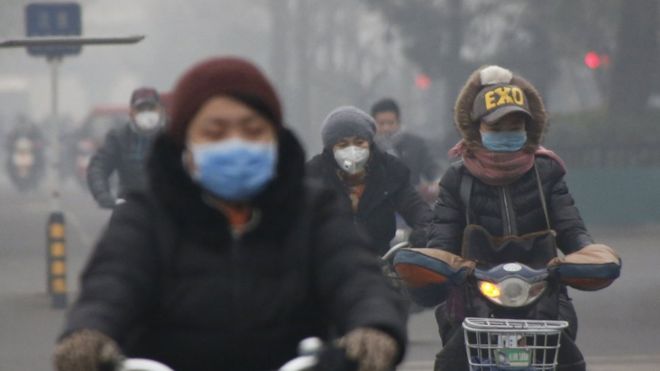
Tens of thousands of “smog refugees” have reportedly fled China’s pollution-stricken north after the country was hit by its latest “airpocalyse” forcing almost half a billion people to live under a blanket of toxic fumes. 

Huge swaths of north and central China have been living under a pollution red alert since last Friday when a dangerous cocktail of pollutants transformed the skies into a yellow and charcoal-tinted haze.

Greenpeace claimed the calamity had affected a population equivalent to those of the United States, Canada and Mexico combined with some 460m people having to breathe either hazardous pollution or heavy levels of smog in recent days.

Lauri Myllyvirta, a Beijing-based Greenpeace activist who has been chronicling the red alert on Twitter, said that in an attempt to shield his lungs he was avoiding going outside and using two air purifiers and an industrial grade dust mask “that makes me look like Darth Vader”. 

“You just try to insulate yourself from the air as much as possible,” said Myllyvirta, a coal and air pollution expert.

According to reports in the Chinese media, flights to some pollution-free regions have been packed as a result of the smog. 

Ctrip, China’s leading online travel agent, said it expected 150,000 travellers to head abroad this month in a bid to outrun the smog. Top destinations include Australia, Indonesia, Japan and the Maldives. 

Jiang Aoshuang, one of Beijing’s “smog refugees”, told the state-run Global Times she had skipped town with her husband and 10-year-old son in order to spare their lungs.
Jiang’s family made for Chongli, a smog-free ski resort about three hours north-west of the capital, only to find it packed with other fugitives seeking sanctuary from the pollution.

“It really felt like a refugee camp,” she was quoted as saying. 

Yang Xinglin, who also fled to Chongli, said she had requested time off from her job at a state-owned real estate firm so she did not have to inhale the smog. 

“You ask me why I left Beijing? It’s because I want to live,” Yang, 27, told the Guardian. 
Emma Zhang, a third “smog refugee”, told the South China Morning Post she and her young son had swapped their home in the western city of Chengdu, which has also been blighted by severe pollution, for a hotel in the temperate south-western province of Yunnan.

“I finally saw the blue sky. It was wonderful!” she said.

Li Dongke, a 27-year-old Beijinger, said her entire family had decamped to Kunming, capital of Yunnan province, or the tropical island of Hainan in the South China Sea. “It’s terrible,” she complained of the current pollution crisis.

Fleeing the danger zone has not been completely straightforward for China’s environmental exiles.

The China Daily reported that smog had paralysed airports in Beijing and across the country’s northern industrial heartland in cities such as Tianjin and Shijiazhuang, making escape impossible.
Beijing’s domestic Nanyuan airport cancelled all flights on Tuesday while the Beijing Capital international airport cancelled at least 273 flights.

Myllyvirta, the Greenpeace activist, said his group had been warning of a winter smog crisis since July when it began noticing the government was pumping economic stimulus into heavily-polluting industries such as cement and steel.

“A big part of what happened is that the steel price went up when the government started a huge wave of construction projects to stimulate the economy,” he said.

One consequence was that a large number of smaller, poorly-regulated steel producers had “gone on a tear” leading to increased emissions that were now blackening the skies over northern China.

Myllyvirta said he was convinced the future looked brighter for China’s environment, despite its latest airpocalypse.

A fall in the use of coal and air pollution were likely over the next three to five years as more urgent steps were taken to restructure the economy and preserve the environment.
For now, however, some locals saw temporary or permanent exile as their only option while many outsiders refused to come at all.

“People are definitely thinking about how to get out and … companies are complaining that it is hard to recruit talent [to come to China],” Myllyvirta said. 

“People don’t want to live in places with terribly polluted air.”

Tuesday, December 20, 2016

2516. Donald Trump Should Know: This Is What Climate Change Costs Us

By Michael Greenstone and Cass R. Sunstein, The New York Times, December 15, 2016


Last week, Donald J. Trump’s transition team sent a startling questionnaire to the Department of Energy. Among other things, the questionnaire asked for the names of all employees and contractors who attended meetings of the Interagency Working Group on the Social Cost of Carbon, as well as all emails associated with those meetings, and the department’s “opinion” on the underlying issues — a request it essentially refused.
Though Mr. Trump’s transition team later said that the questionnaire was sent in error, it should be understood in tandem with a memorandum, leaked last week, from Thomas Pyle, the leader of the transition’s energy team and president of the American Energy Alliance, which promotes “free market” policies. Mr. Pyle described the steps the Trump administration will probably take to reduce environmental regulations, including “ending the use of the social cost of carbon in federal rule makings.”

If that happens, it will defy law, science and economics.

In 2009, the two of us — one from the Council of Economic Advisers and the other from the Office of Management and Budget — convened the first meetings of the working group to which the questionnaire referred. Our aim was to quantify the social cost of carbon for the United States government by drawing from the latest research in science and economics. This comprehensive measure would reflect the monetary cost of the damage caused by the release of an additional ton of carbon dioxide into the atmosphere, accounting for the destruction of property from storms and floods, declining agricultural and labor productivity, elevated mortality rates and more.

The working group, which consists of officials from agencies throughout the federal government, now estimates that cost at about $36 per ton of carbon dioxide. This figure plays a central role in the cost-benefit analyses that agencies use in deciding whether to issue regulations to limit greenhouse gas emissions, and how stringent such regulations should be. Thus far, it has been used for 79 regulations, including energy-efficiency rules for refrigerators and washing machines, fuel-economy rules for cars and trucks, and the Clean Power Plan, which requires reductions in greenhouse gas emissions from existing power plants.
Without it, such regulations would have no quantifiable benefits. For this reason, the social cost of carbon can be seen as the linchpin of national climate policy.

And yet not everyone is a fan of this concept. Those who think that climate change is a hoax, or who oppose regulation as a rule, have a major problem with the social cost of carbon, because it indicates that limits on emissions can deliver significant benefits. Others believe that the $36 per ton figure is too high, overstating the benefits of regulations.

But the working group’s process and output have been validated by the courts. In August, a federal court of appeals rejected a legal challenge to the social cost of carbon by a trade association of refrigerator companies. The association contended that the government lacked the legal authority to consider the social cost of carbon and that its judgments were arbitrary.

The court responded that it had “no doubt that Congress intended” to allow consideration of the social cost of carbon and that the government’s judgments were reasonable.

In fact, in 2008, a federal court of appeals ruled that the government essentially had to specify a social cost of carbon: It was not permitted to ignore harms from climate change, the court said, when setting regulatory policy.

The federal government is also required to quantify environmental damages under prevailing executive orders. President Ronald Reagan started the practice in 1981, when he required federal agencies to analyze the benefits and costs of their regulations; his Democratic and Republican successors have followed his lead.

New scientific and economic evidence suggests that climate change probably poses an even greater risk than the $36 figure reflects. For example, the West Antarctica ice sheet appears to be retreating faster than we thought, raising the specter of multimeter sea level rise in the next century. Recent research also found that climate change will lead to shorter and sicker lives, primarily because of the harmful effect of more extremely hot days on health. Extreme heat is also projected to reduce worker productivity and increase energy consumption, while changes in temperature and precipitation globally are expected to increase food prices and violence. Thus, there is a strong case that if anything, the government’s estimate of the social cost of carbon should be higher than it is.

To be sure, the exact number is uncertain, and the Trump administration will make its own judgment. But a credible assessment must be based on the best science and economics, not politics. And there is no justification for a chilling investigation of civil servants who are just doing their jobs.

Ultimately, the social cost of carbon provides a necessary guidepost in decisions about how to balance costs to our economy today with the coming climate damages. Wishing that we did not face this trade-off will not make it go away.

Any effort to eliminate the social cost of carbon would reflect a neglect of science and economics — and it would be quickly struck down in court.

Michael Greenstone is a professor of economics at the University of Chicago. Cass R. Sunstein is a professor at Harvard Law School.