Showing posts with label Solar Energy. Show all posts

Tuesday, December 27, 2016

2520. India Plans Nearly 60% of Electricity Capacity from Non-Fossil Fuels by 2027

Michael Safi, The GuardianDecember 22, 2016

The Indian government has forecast that it will exceed the renewable energy targets set in Paris last year by nearly half and three years ahead of schedule.
A draft 10-year energy blueprint published this week predicts that 57% of India’s total electricity capacity will come from non-fossil fuel sources by 2027. ThParis climate accord target was 40% by 2030.

The forecast reflects an increase in private sector investment in Indian renewable energy projects over the past year, according to analystsThe draft national electricity plan also indicated that no new coal-fired power stations were likely to be required to meet Indian energy needs until at least 2027, raising further doubts over the viability of Indian mining investments overseas, such as the energy company Adani’s Carmichael mine in Queensland, the largest coal mine planned to be built in Australia.
India’s energy minister, Piyush Goyal, has been appealing to wealthier nations to provide capital to invest in renewable energy projects to help the country reach and exceed the targets agreed in Paris in November 2015.
Significant state investment has not been forthcoming, but Tim Buckley, a director at the Institute for Energy Economics and Financial Analysis, said India had made up the shortfall with an influx of capital from the domestic and overseas private sectors in the past 12 months.
Japan’s Softbank has committed to invest $20bn (£16.2bn) in the Indian solar energy sector, in conjunction with Taiwanese company Foxconn and Indian business group Bharti Enterprises.
In September the largely French state-owned energy company EDF announced it would invest $2bn in Indian renewable energy projects, citing the country’s enormous projected demand and “fantastic” potential of its wind and solar radiation.
Adani opened the world’s largest solar plant in Tamil Nadu earlier this year, and in October the energy conglomerate Tata announced that it would aim to generate as much as 40% of its energy from renewable sources by 2025.
Buckley said India’s “absolutely transformational” forecast was also driven by technological advancements that have led to the price of solar energy falling by 80% in the past five years.
“India is moving beyond fossil fuels at a pace scarcely imagined only two years ago,” he said. “Goyal has put forward an energy plan that is commercially viable and commercially justified without subsidies, so you have big global corporations and utilities committing to it.”
In the 2027 forecasts, India aims to generate 275 gigawatts of total renewable energy, in addition to 72GW of hydro energy and 15GW of nuclear energy. Nearly 100GW would come from “other zero emission” sources, with advancements in energy efficiency expected to reduce the need for capacity increases by 40GW over 10 years.
About 50GW of coal power projects being developed in India would be “largely stranded” under the forecast, Buckley said, with official modeling showing that “none of these plants are required before 2022 and only possible before 2027”.

Sunday, February 7, 2016

2189. Solar Energy Outlook in Cuba

By Sash Kolopic, Havana Times, February 6, 2016
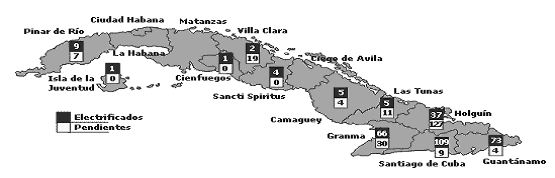
Distribution of photovoltic installations in Cuba

On the outskirts of Havana, in the neighborhood of San Miguel de Padron, the electricity was cut off for an entire day last week. Local residents already fear that the blackout may signal the preparations for an upcoming energy shortage due to the recent political changes in Venezuela and the likely end to the oil subsidy program with Cuba.

Cuba’s electricity supply is still highly dependent on oil imports from neighboring Venezuela. But, like most Caribbean nations, Cuba has immense potential for energy generation from renewable alternatives, including solar energy, which can be utilized to meet domestic and small business needs.

Cuba’s renewable energy output is small, estimated to be at about 4% of its overall production in 2012. The government claims that it wants to increase its renewable energy generating capacity to 24% by 2030 through an investment of $3.5 billion. In order to reduce its dependence on fossil fuel imports, Cuba has instituted a wide-reaching energy efficiency program in 2006, which has overseen various energy saving initiatives for households, including the replacement of old and inefficient domestic appliances.

Another aspect of the improvement program was a switch to a more distributed country-wide network of energy generation with smaller power plants in order to reduce the potential for damages and blackouts that were previously the result of hurricanes affecting a more centralized network. Looking ahead, with the recently introduced economic reforms and a looming end to the US embargo, Cuba needs to act on the next phase of improvements to accommodate the economic growth and the rising energy demand for domestic and industrial use.

For solar energy to have a long-term impact on Cuba’s energy demand and production, projects must expand beyond off-grid usage. The focus should shift toward urban applications of solar systems and the further development of solar-powered domestic appliances.

Solar energy potential in Cuba is high when considering that the country’s geographic position can enable a generation of 5kWh per square meter – about the average daily usage of one household. Although solar energy projects have thus far been limited to remote areas, capacity has increased considerably in recent years.

In 2013 Cuba’s first solar farm opened in Cantarrana, near Cienfuegos, with a capacity of 2.6 MWp. The Santa Teresa solar plant (4.5 MWp capacity) near the U.S. naval base at Guantanamo has started operating recently as well. The government has built a manufacturing plant that has produced 14,000 photovoltaic solar panels, also near Cienfuegos. Currently, the Granma Province has the largest percentage of renewable energy generation within Cuba at about 37% in 2013. By the end of 2014, over 1,500 off-grid solar systems were powering clinics, schools, community centers, and homes located in remote areas of Granma Province. The Cuban government has stated that it wants to have 700 MW of solar energy capacity installed by 2030.

Cuba can rely on local expertise to help support the growth of solar energy around the country. It has a well-educated labor force and local organizations, such as the Centro de Investigaciones de Energía Solar (CIES), that are working on the research, development, and implementation of various solar energy projects and solutions. Additionally, CIES is developing the academic and technical capacity in all of Cuba’s provinces through training workshops paired with solar installations that are easily maintained by the community. They have designed a multitude of prototypes including PV controllers, solar energy water heaters, solar kitchens, solar dryers and other appliances.

Unfortunately, CIES is limited by insufficient funding which is vital for further product testing and improvement, as well as for planning a potential international market presence to meet the growing global demand for solar-powered solutions and appliances.

Working closely with CIES is the local NGO Cubasolar, which is run by local engineers, scientists and planners who have been very active in pushing for the advancement of renewable energy in Cuba. One of their major successes has been the creation of a countrywide network of experts in various sectors and they foster the cooperation and knowledge transfer with international actors in the field of solar energy. Cubasolar publishes a quarterly magazine, “Energía y Tu”, featuring articles about research, projects, and initiatives in the field of renewable energy.

For solar energy to have a long-term impact on Cuba’s energy demand and production, projects must expand beyond off-grid usage. The focus should shift toward urban applications of solar systems and the further development of solar-powered domestic appliances. Particularly the latter category offers Cuba a lot of potential to develop into a global actor, as the international demand for high-quality, affordable solar appliances is strong.

The element preventing Cuba from achieving that position is a financial one. Despite recent economic reforms, Cuba is still not a very attractive option for foreign direct investment, with or without the obstacles presented by the US embargo. Even if the embargo were to end soon, it doesn’t guarantee that international finance mechanisms will immediately be able to (or allowed to) proverbially take off.

To support the development of the renewable energy sector in Cuba, a cautious small-scale entry into the complex world of international finance could likely start by initially incorporating small energy projects by international NGOs or via corporate social responsibility (CSR) programs from major global corporations – an unlikely scenario given the recent rebuke by the Cuban government towards Google’s proposal to provide internet access throughout the country and instead turning to partners from China.

Another financing option includes tapping into international development funds which focus on advancing renewable energy such as the UN’s Solar Energy For All program. An example of that approach is the recent $15 million loan that the Cuban government has received from the Abu Dhabi Fund for Development (ADfD) that was created together with the International Renewable Energy Agency (IRENA).

The loan should partly help finance four 10 MW solar power plants. Beyond that, the Cuban government has a long way to go if it is to build the planned 700 MW of solar capacity and secure the $3.5 billion that are necessary to fund its vision of a countrywide energy transformation. How the government aims to achieve that, with whom, and under what conditions is still a mystery.

Monday, September 14, 2015

2015. Green Energy for the Poor in Africa

By Ngozi Okonjo-Iweala, The New York Times, September 9, 2015


An innovative business model combining solar power and cellphones is electrifying parts of rural Africa that are far from the grid.

It’s called M-KOPA. The “M” stands for “mobile,” and “kopa” means “to borrow.” The company’s customers make an initial deposit, roughly $30, toward a solar panel, a few ceiling lights, and charging outlets for cellphones — a system that would cost about $200. Then they pay the balance owed in installments through a widely used mobile banking service, based on how much energy they use. The solar units are cheaper and cleaner than kerosene, the typical lighting source, and once they’re fully paid for after about a year the electricity is completely free. More than 200,000 homes in Kenya, Tanzania and Uganda use M-KOPA’s solar systems.

Creative, bottom-up solutions like M-KOPA are emerging across Africa and the developing world. Scaling them, and quickly, is the challenge. Around 1.3 billion people worldwide still lack access to electricity, including two out of three sub-Saharan Africans. An enormous divide exists between the global rich and the global poor, from energy access and technology to wealth and infrastructure. But the divide is not immutable, and momentum for solutions to bridge it are emerging from all over the world.

Later this month, the United Nations will aim to take another important step to close that gap by agreeing on Sustainable Development Goals, including goals on ending extreme poverty and ensuring adequate access to energy. It is important that the word “sustainable” has been given a prominent place in the agenda, because while many global trends are going in the right direction, one is certainly not: the climate. Without acting on climate change, we risk undermining the development gains that we have achieved so far and widening the gap between the rich and the poor. The economic growth we have seen to date will be unsustainable in the face of increasing climate disasters.

Climate change hits the poorest people the hardest. The poor are more likely than the rich to live in places vulnerable to climate-related weather events and more frequently suffer from diseases that can be exacerbated by climate change. The World Health Organization predicted last year that in 2030 climate change will lead to 48,000 additional deaths due to diarrhea, 60,000 from malaria, and 95,000 from childhood undernutrition. The vast majority of these will take place in sub-Saharan Africa and South Asia.

It is clear that we cannot tackle poverty successfully without also tackling climate change. That’s why enterprises like M-KOPA are so important: They help to bridge the divide between the global rich and global poor in a low-carbon way. Small-scale solar is only a start. Africa attracted $8 billion of investment in renewables last year, and the International Renewable Energy Agency estimates that its potential for wind and solar power amounts to more than 1.5 trillion gigawatt hours per year. There’s plenty of room for both bottom-up innovation and top-down support for green energy.

In addition to energy access, better land use can make a real difference as well. For example, farmers in Niger are using new agroforestry techniques to produce more grain than ever before. By interplanting trees on cropland and allowing extra shrubs to grow, the farmers restore degraded land, lower greenhouse gas emissions and increase agricultural productivity. And they are directly reaping economic benefits, with gross annual incomes going up for over a million households by an average of $1,000, more than doubling real incomes.

Today this is in Niger; tomorrow, if this were global, restoring just 12 percent of degraded lands to production could raise farmers’ incomes by $40 billion per year and feed another 200 million people.

Investing in sustainable infrastructure in areas like energy, land use and cities is a no-brainer. But the biggest obstacle is coming up with the initial financing for these investments, even though we know that they will pay for themselves in the long run.
Much of the financing needs can be met through more effective mobilization of private investment. For example, a renewable energy procurement program in South Africa has mobilized $14 billion in domestic and international private financing for sustainable infrastructure. When the market fails in providing private finance, development banks can step in by providing technical assistance and guarantees. Better mobilization of countries’ own domestic resources is also critically important.

Low-carbon investment is gathering momentum around the world, and the founders of M-KOPA aren’t the only ones being creative. Investors are increasingly turning to new, more efficient forms of finance. “Green bonds” that support low-carbon and climate resilient infrastructure more than tripled in 2014 to reach $37 billion.

The global divide between the rich and the poor is far from closed. But with smarter anti-poverty and energy-access measures and a focus on sustainable finance, the future for Africa and the rest of the developing world can be bright, in more ways than one.

Ngozi Okonjo-Iweala is a former finance minister of Nigeria and was a managing director at the World Bank from 2007 to 2011.

Monday, May 5, 2014

1406. Krugman's Illusion: We Becoming Richer, But Not Damaging The Environment

By Saral Sarkar, April 28, 2014


About a week ago I read/ heard German media stories on the fifth IPCC report on climate change, especially on the third and last part of it. In the meantime we have all got used, almost insensitive, to the regular bad tidings coming from the IPCC. But a statement made by Ottmar Edenhofer, one of the three co-chairs of its third working group, made us sit up and take notice. He said: “It would not cost the world to save the planet;” the cost of limiting global warming to 2 degrees Celsius would be only 0.06 percent less yearly growth than what would otherwise be possible. 

Then, a few days later, I read an article by Paul Krugman (Nobel Laureate in Economics) in the New York Times (17.04.2014) entitled Climate Change:Salvation Gets Cheap. Referring to the glad tidings on the cost of saving the planet coming from the IPCC, Krugman wrote he thinks the climate threat is solved. He went even further. He wrote: “… there’s no reason we can’t become richer while reducing our impact on the environment.”

One could perhaps be hopeful about humanity somehow solving the climate threat at the last moment. But I think it is impossible that we can all become richer while reducing our impact on the environment. These are two different things, though related.

Are the renewable energies emissions free?

Krugman refers to a study of the Department of Energy entitled Revolution Now and comments: “That sounds like hyperbole, but you realize that it isn’t when you learn that the price of solar panels has fallen more than 75 percent just since 2008.” Let us assume that this particular piece of information is reliable. But what has that to do with solving the climate threat? In all cases of industrial production, there are costs, called externalities, that are not borne or not borne fully by the firms that produce the commodities in question and are therefore also not passed over to the buyers through higher prices. Atmospheric and maritime pollution are best examples thereof. Such costs are either not borne at all, by nobody, or they are socialized, i.e. borne by all members of a community – a village, a country, a region, neighboring communities, or the whole world community. As German ecologists say, prices do not tell the whole truth about costs. Socialized costs may involve some immediate money costs for the affected community, but it may also be that the future generations would someday have to bear these costs in some form or other – either as some money costs (e.g. for repairing the damages done) or as deteriorating health and/or as environmental destruction of various kinds.

Since in the case of climate change we are today suffering the negative impact of large-scale externalization of costs, both past and present, i.e. emission of green house gases in the atmosphere, it is particularly important to ask whether or not all the industries involved in the production (or extraction) of the raw materials and equipments used for producing the renewable energies – solar panels, wind turbines, rotors, palm oil etc. etc. – themselves emit green house gases into the atmosphere. There is no doubt that they do, because such industries mostly (if not wholly) use conventional energy generated by burning fossil fuels.

We also know that in the case of photovoltaic-solar and wind energy, at the very last stage of production, in which sunshine and wind are converted directly into electricity, no green house gas emission takes place. But the process of delivering that electricity to the consumers again generates green house gases, because copper cables, transformers, storage facilities like batteries etc. etc. are produced by industries that use mostly (if not wholly) conventional energy produced by burning fossil fuels.

It may be argued that, on the whole, for producing and delivering a given quantity of electricity, the renewable energy technologies emit less green house gases than the fossil fuel burning power plants (because the former do not burn fossil fuels at the last stage of production). That may or may not be true. I do not know of any comparative figures on this question. It must be very difficult to work out reliable figures on this question. But we may get some indication when we consider the energy cost of production of renewable energies.

Price versus energy cost of energy, or the EROEI

Any economist knows that the price of a commodity depends on many factors: supply and demand, cost of production, the state of competition at the relevant markets, normal profit expectation, whether or not firms producing the commodity are getting subsidies and other favors (e.g. through protective duty) from their state etc. Cost of production of a commodity depends largely on the state of technology, wages and salaries, scale of production, prices of the needed raw materials and intermediate goods ( such as energy),which in turn depend on all these factors.

    But when we talk about production of energy, then we have to consider another matter. We want light in the evening, for which we spend energy (in the form of electricity or a flame on an oil lamp). Light and energy are two different things. We may be willing to spend any amount of energy to get the desired intensity of light. But when we want to produce energy by spending energy, then it would not make any sense if we produce, say, 9 units of energy by spending 10 units of energy.

    We also have to differentiate between different forms of energy. In thermal (or nuclear) power plants, electrical energy is produced by using heat energy obtained by burning coal, oil or gas (or by splitting atoms). Since we absolutely need electrical energy for hundreds of kinds of work – e.g. using a computer – we may be willing to spend any amount of heat energy to get the required quantity of electrical energy. We also produce electrical energy by using the energy of falling water (hydroelectricity). After electrical energy is produced in these ways, it is delivered to millions of factories, households etc, where it is used for various kinds of work.

    Now comes the point relevant to our present topic. Factories that produce photovoltaic panels or wind turbines or rotors use electricity. Even if they need some heat energy for particular steps in the production process, they generally use electricity to produce that heat. Since photovoltaic panels, wind turbines etc. produce electrical energy, i.e. the same form of energy that is used to produce these equipments, they only make sense if they produce in their lifespan of ca. 15 to 20 years more energy than what is needed to manufacture them – in other words, if their energy balance is positive. In our days, one also speaks of EROEI to indicate the ratio between energy return on energy invested.

    There is much uncertainty about the energy balance (EROEI) of both photovoltaic and wind-turbine technology for producing electricity. There are people (including myself) who doubt that the energy balance of photovoltaic technology is at all positive. As for wind energy technology, these people think that its energy balance is positive (2– ?/1), but not positive enough to successfully compete with thermal power plants.

    These uncertainties and doubts persist because it is very difficult, possibly even impossible, to work out exact figures on the EROEI of these technologies. Too many aspects of the studies made to arrive at the currently known figures had to be based on assumptions and guess work. I have been reading reports on these studies since about the early 1990s. I found that in 1991, some researchers asserted that, in European climates, the energy pay- back time (EPBT) of photovoltaic technology – the time it takes for a photovoltaic panel to harvest the quantity of energy that was invested in manufacturing it – was 1.2 to 2.1 years. These figures were by and large comparable to those of large-scale thermal and nuclear power plants; i.e. they were ostensibly already then competitive. But in 1995 – after four years of further research and development – another researcher stated that this figure (i.e. EPBT of photovoltaic panels in European climates) was 9 years. Similarly, while a study made in 1984 found that the EROEI of photovoltaic technology was 1.7/1 to 10/1 (obviously in different areas), another study ascertained in 1996 that it was 0.41/1 (that is, negative). The latest figure I have is from an article written by Ted Trainer (in April 2014), who too has been studying this matter since long. He writes cautiously: “… several recent studies have found that when all relevant factors are included, the ratio of energy produced by a PV[photovoltaic] module in its lifetime to the energy needed to produce it is not 10/1 as is commonly thought, or 60/1 as some advocates have claimed, but probably between 4/1 and 2.4/1. (EROEI and EPBT figures are from Sarkar 1999: chapter 4; Heinberg 2003: 152f., Trainer 2014)

    These results are inexact not only because they had to be largely based on guesswork and many assumptions, but probably also because the researchers did not use the same methodology. Also time (relevant for technological development) and place (relevant for quantity and intensity of sunshine) of the studies varied. In such a situation, I think it is permissible to apply logic and common sense in order to get an approximately true picture of the prospects and promises of renewable energies. Then one can’t help asking a few questions:

    If solar panels have become so cheap since 2008, why do energy companies still insist on building new coal- or oil-fired thermal power plants? And why do oil companies are still searching for oil at enormous costs deep under the ocean bed in the Atlantic or the Arctic Ocean? Why does the Japanese government want to recommission the nuclear power plants that had been shut down in the wake of the Fukushima catastrophe? Why hasn’t India, which is very rich in sunshine and wind and has a long coastline, yet decided to bid farewell to conventional coal and uranium based power technologies? Why is it still paying every year a huge oil import bill? And why must renewable electricity producers of Germany still demand and enjoy the privilege of guaranteed sale and guaranteed prices that are much higher than the prices of conventionally produced electricity? Obviously, renewable energy technologies cannot yet compete with conventional energies.

Prospects for renewable energies

But will they soon be able to outcompete the conventional energy technologies? Or can they in near future make the latter superfluous and supply all the energy needs of our industrial societies? I think the prospects are negative. We know that easily accessible and easily exploitable sources of raw materials, particularly those of conventional fossil fuels, are getting exhausted and new finds are unable to compensate for the exhausted quantities. The geographical and geological conditions under which these resources are being found and exploited are progressively worsening. We cannot change them. Think of extracting oil from the bottom of the Arctic Ocean! As a result, more and more energy has to be invested for extracting raw materials – coal, oil, gas, uranium, metal ores, rare earths etc. That means, their energy cost of production (also partly reflected in their financial costs) is steadily rising. Now it is exactly with such raw materials that all the equipments of all renewable energy industries –solar and wind power plants as well as bio fuel factories – are built. That means, the energy investment required for building such power plants is continuously rising. But the average energy content of sunshine and the fact that the sun does not shine in the night are cosmological constants. Climate scientists are predicting (and we are noticing it already) that, with climate change, wind velocity during storms will strongly rise. But that will be of little use to wind power plants, because in such cases the generators must be shut off. Such being the facts, the EROEI of renewable energy technologies cannot rise in future. It will rather go down – in spite of small technological developments that might still take place. Miracles do not happen.

    But one question still remains: How come prices of solar panels have sharply fallen? As stated above, prices of commodities depend on several factors. In the case of solar panels, it is well known that the main cause of the drop-off in price is that Chinese producers have entered the world market in a big way. They haven’t achieved any technological breakthrough. But their wages are much lower than those in Europe and America, they have less environmental and other conditions imposed on them, and the state is granting them subsidies and other favors. What is more, they are offering their products at dumping prices. The five or six German producers that recently went bankrupt and those that are threatened with bankruptcy, give these reasons for their misery. They complained to the European Commission and asked it to impose restrictions on Chinese exports of the product to Europe. The case ended with a compromise, but that did not help the German companies that were already bankrupt. Another explanation for the drop in prices is the enlargement of the scale of production, which was made possible by the promotional measures taken by states in the rich countries.

    I think the dispute will be settled in the next ten years through facts on the ground. "In the meantime also renewable energy enthusiasts concede", writes a Green Party intellectual, "that one cannot reckon with permanently profitable solar electricity production north of the Mediterranean Sea (Wiesenthal 2013: 29).

The difference between “feasible” and “viable”

 “But”, renewable energy enthusiasts ask me, “why do you altogether rule out that one day industrial societies will succeed in fully replacing non-renewable energies with renewable ones?” Of course, in principle, that too can happen. The future is in principle always uncertain. But we have to begin to act today in order to prevent foreseeable catastrophes in not all too distant future. That means, we have to act on the basis of less than 100 percent certain knowledge. In order to act effectively, we must then know, or try to infer from known facts, what is probable and what not. I think it is improbable that even the best renewable energy technologies of the future will someday be able to supply the whole energy needs of industrial societies.

    If we could be satisfied with light from oil lamps and do all work using only manual and animal labor power plus heat energy from burning wood, then our economy could be fully based on renewable energy. But that would not be an industrial economy, which cannot function without electricity and liquid or gaseous fuel. To get all of these latter forms of energy from sunshine or wind is not possible. A law of nature, the entropy law, stands in the way.

    Sun’s energy reaches us in a high entropy state, i.e. in a highly dissipated form. That is sufficient for agriculture and plant growth, from which we can get wood for fire. But for producing electricity we have to concentrate a large quantity of highly dissipated sunshine with the help of photovoltaic panels or aluminum mirrors. Production of these equipments themselves consume a large amount of concentrated, i.e. low entropy energy that we mostly get from fossil fuels found in nature. That means we can use this method of producing electricity only as long as sufficient quantities of easily extractable fossil fuels (or uranium) are available. That is why Nicholas Georgescu-Roegen (1978) called solar electricity technologies parasites. It is more or less so also with wind energy. That means, solar electricity technologies are feasible but not viable. They would only be viable, if the second generation of renewable power plants, i.e. all the needed equipments from A to Z – solar panels, aluminum mirrors, wind turbines, factories, roads, vehicles etc. etc.etc. – could be built/manufactured with solar or wind energy only. That would not be possible if the EROEI of (net energy produced by) solar and wind energy technologies remain so low as it is today. If we assume, as Ted Trainer writes, that the EROEI of solar panels is 2/1, then, after we have consumed this energy for our daily living and the other usual activities, no surplus would be left for investing in the production of the second generation of solar power plants. Trainer writes: “Estimates in the literature are that the ratio [EROEI] must be at least 7/1 for a technology to be viable.” It is very improbable that that would be the case in future, because, as I have argued above, the trend is pointing in the opposite direction.

    This problem cannot be solved even if we try to use the enormous quantity of high intensity sunshine available in the deserts of the earth. One such project, the Desertec project of some of the biggest European corporations, is today on its deathbed.

Conclusion

Today, in Germany, the result of years of promoting renewable energy technologies through subsidies (collected from the consumers including smaller businesses) and other favors is that electricity price has increased so much that tens of thousands of poor Germans cannot pay their electricity bills and are getting their grid connection cut off (coal price rises have also contributed something to it). The present federal government is therefore trying to arrest this extraordinary price rise by reducing to some extent the guaranteed subsidized prices paid to the producers of renewable energies. So we see that even the so-called “Energiewende” (energy-system-change) of the Germans aimed at reducing the emission of greenhouse gases is faltering, and the government is being criticized by pseudo-environmentalists for putting on the brakes against it.


  Krugman thinks we can all become richer while reducing our impact on the environment. This is also the mantra of many other pseudo-greens and pseudo-environmentalists all over the world, who propagate illusions of green growth, sustainable growth, green New Deal etc. etc. Edenhofer, the IPCC man, naively assumes in the midst of a stagnation-crisis that the world economy would regularly grow at a yearly rate of two percent (Süddeutsche Zeitung, 14.04.2014). But Krugman, the star economist, ought to have known better than to persistently demand policies for pushing economic growth. He argues: “Other things equal, more G.D.P. tends to mean more pollution. What transformed China into the world’s largest emitter of greenhouse gases? Explosive economic growth. But other things don’t have to be equal. There’s no necessary one-to-one relationship between growth and pollution.” That’s right. But other things can also become worse than before, so that the environment can also be destroyed without economic growth. Even at zero percent rate of growth an industrial economy continues its work of polluting and degrading the environment.

    The environment is more than just the climate, which Krugman thinks can be saved by substituting renewable energies for conventional energies. And the environmental crisis is a much bigger matter than the climate crisis. It includes, apart from the state of the climate, also the state of the oceans, the rivers, agricultural lands, forests, biodiversity and many other things. Krugman does not seem to know that if we all are to become richer, that will require much more than installing more solar panels and wind turbines. That will require extracting more fossil fuels, more mineral ores, building more dams, more factories, more roads, more houses, more stadia, more cars, more airplanes and so on. That will give the environment the final death blow. We shall then see that one cannot eat money.

    My hope is that it – all getting richer – will not be possible any more. For not only has oil extraction reached its peak, but also the other resources are getting depleted very fast. I recently saw a documentary film that shows that even the most ordinary resource sand has become so scarce that it is being stolen. For big building projects even sand on the seabed is being excavated, as a result of which the strands are vanishing under the water. Actually, we should be talking about preparing ourselves for a frugal lifestyle.

    Maybe we should be preparing ourselves for much worse things. Recently, a team of American scientists carried out a research project to ascertain the conditions that led to the collapse of past human civilizations. The project was partly funded by NASA, the organization whose purpose was to put man on the moon. The scientists concluded that there are strong indications that our present civilization is headed for collapse(Ahmed 2014).

Literature

Ahmed, Nafeez (Dr.) (2014) “Nasa-Funded Study: Industrial Civilisation Headed For 'Irreversible Collapse'?” in: www.the guardian.com/environment/earth-insight (14.03.2014).

Georgescu-Roegen, Nicholas (1978) "Technology Assessment: The Case of the Direct Use of Solar Energy". In: Atlantic Economic Journal, December.

Heinberg, Richard (2003) The Party’s Over. Forest Row: Clairview.

Sarkar, Saral (1999) Eco-Socialism or Eco-Capitalism? A Critical Analysis of Humanity’s Fundamental Choices. London: Zed Books.

Trainer, Ted (2014) Relax! Solar energy can save us.  Krugman says so.


Wiesenthal, Helmut (2013) ''Der Solarstrom – Lackmustest grüner Energiepolitik', in Böll Thema – Es grünt, Berlin, Nr. 1.