Showing posts with label India. Show all posts

Monday, June 18, 2018

2949. As many as 600 Million Face Water Scarcity in India

By Maria Abi-Habib and Hari Kumar, The New York Times, June 17, 2018
Shimla’s population essentially doubles during the summer tourist season, increasing the strain on the water supply.CreditSaumya Khandelwal for The New York Times
SHIMLA, India — The people of Shimla haven’t agreed on much lately. A drought in the Himalayan resort has had residents blaming farmers, the tourism industry and one another for depleting the strained water supplies.

And everyone’s been angry at the key men.

Shimla’s decrepit network of water pipes, built under British colonial rule more than 70 years ago, depends on the civil servants known as key men to open and close the valves that supply each neighborhood. The current shortage, which in May left some homes without water for 20 days, has led to such fury toward the key men — accused, in just about every neighborhood, of depriving it of its fair share — that a court ordered police protection for them.

“I was getting angry phone calls calling me everything — stupid, worthless — at one or two in the morning,” said Inder Singh, 44, who has been a key man for 24 years. “I would be mobbed by dozens as I was trying to leave my home for work,” he said, inserting his key — a meter-long metal contraption — into the ground to open a valve.

Tourism is the mainstay of the economy in this mountain city, which the British colonial authorities made their summer capital so they could escape the brutal heat of New Delhi. But the drought — accompanied by unusually high temperatures, above 90 degrees Fahrenheit — has been so severe that in May, some residents took to Twitter to ask tourists to stay away and leave the water for local residents. Many in Shimla call it the worst shortage they can remember.

As much as 30 percent of the city’s hotel bookings have been canceled since last month because of concerns about the water supply, said Sanjay Sood, the president of northern India’s hotel and restaurant association. Some of those reservations were canceled by tourists, others by the hotels themselves.

Water tankers have been lined up at hotels along Shimla’s windy mountain roads. A slogan on one of them read, “If there is water, there is a tomorrow.”

A government report released on Thursday said that India was experiencing the worst water crisis in its history, threatening millions of lives and livelihoods. Some 600 million Indians, about half the population, face high to extreme water scarcity conditions, with about 200,000 dying every year from inadequate access to safe water, according to the report. By 2030, it said, the country’s demand for water is likely to be twice the available supply.
In Shimla, rising annual temperatures and dwindling rain and snowfall — the city’s main water sources — have been major factors in the crisis.

“There’s global warming all over India, and Shimla is no exception,” said Vineet Chawdhry, chief secretary of the state of Himachal Pradesh, whose capital is Shimla.
But the city’s ancient pipe system also leaks five million liters of water every day, Mr. Chawdhry said in an interview in his office. A $105 million, World Bank-backed upgrade of the system, including a pipeline drawing water from a nearby river, is scheduled to be finished in 2023.

The strain on the water supply increases greatly during the summer tourist season, when Shimla’s population essentially doubles. In the summer months, Mr. Chawdhry said, the city typically needs 45 million liters a day. He said the current daily supply stood at 31 million liters, and at the height of the crisis in May it was as low as 22 million.

Shimla is not the only Indian city whose water supplies are under increasing pressure. Last year was the country’s fourth hottest since record-keeping began in 1901, with rainfall down by nearly 6 percent from 2016, according to the Indian Ministry of Earth Sciences.

And many of the country’s cities have outdated water distribution systems, said Rajendra Singh, founder and chairman of Tarun Bharat Sangh, a conservation group. India has also fallen short on conservation measures like capturing rainfall and snowmelt, he said.

“There are around 90 cities in India which are water stressed. They face crisis today, tomorrow and the day after,” Mr. Singh said. “Shimla got more media attention, but many areas are facing water scarcity.”

That includes the capital, New Delhi. This year, in the city’s chronically water-deprived neighborhood of Wazirpur, a father and son died after a scuffle broke out among people waiting in line for a tanker.

Rahul Kumar, 18, was fatally injured in the fight in the grueling March heat, which began when a neighbor accused him and his brother of jumping the line. His father, Lal Bahadur, 60, died of a heart attack after trying to intervene, the authorities said.

Mr. Kumar’s mother, Sushila Devi, said that Wazirpur had run out of water in January — earlier in the season than usual. Other Wazirpur residents said that in the rare instances when tap water flows, it is dirty and undrinkable.

“My husband and son died because of water,” Ms. Devi said.
On a hot recent afternoon in Wazirpur, neighbors lined up again with empty jugs waiting for a government-supplied tanker. This time, as the tanker arrived, an older man directed the crowd, to make sure it was orderly.

“I do a public service,” the man said. “After the fight we came together in the neighborhood and made this system of queuing.”

But there were still tense moments. “Why is your pot so big? It’s too big!” one woman yelled at another. “It’s fine,” the other woman snapped back.

In Shimla, the water crisis has eased since last month. Municipal officials divided the city into three zones in late May, distributing water to them on a rotating basis so that none would go without for more than two days. Residents complained that the city had been slow to act, but over all, tensions have decreased.

“Namashkar!” residents yelled cheerfully to Mr. Singh, the key man, from their balconies as he made his rounds recently. Mr. Singh returned the traditional greeting, but he said they hadn’t always been so nice.

He said he was cursed and shouted at during the worst days of the crisis, but never physically attacked. But some of the city’s 61 other key men were held down by mobs and forced to keep the water on, municipal officials said.

The pandemonium moved Shimla’s High Court to act. It ordered that key men be supervised to ensure that they were not giving favorable treatment to hotels or V.I.P.s. The acting chief justice went into the streets personally to watch some of them work.

“The key man not only holds the key, but in fact, by the strength of the key, he can put the entire town to ransom,” the court said in its ruling this month.

The court also ordered that every key man be escorted by two police officers while on duty to ensure their safety. Some key men — surrounded by a veritable entourage — said they had never felt so important in their lives.

Tuesday, December 27, 2016

2520. India Plans Nearly 60% of Electricity Capacity from Non-Fossil Fuels by 2027

Michael Safi, The GuardianDecember 22, 2016

The Indian government has forecast that it will exceed the renewable energy targets set in Paris last year by nearly half and three years ahead of schedule.
A draft 10-year energy blueprint published this week predicts that 57% of India’s total electricity capacity will come from non-fossil fuel sources by 2027. ThParis climate accord target was 40% by 2030.

The forecast reflects an increase in private sector investment in Indian renewable energy projects over the past year, according to analystsThe draft national electricity plan also indicated that no new coal-fired power stations were likely to be required to meet Indian energy needs until at least 2027, raising further doubts over the viability of Indian mining investments overseas, such as the energy company Adani’s Carmichael mine in Queensland, the largest coal mine planned to be built in Australia.
India’s energy minister, Piyush Goyal, has been appealing to wealthier nations to provide capital to invest in renewable energy projects to help the country reach and exceed the targets agreed in Paris in November 2015.
Significant state investment has not been forthcoming, but Tim Buckley, a director at the Institute for Energy Economics and Financial Analysis, said India had made up the shortfall with an influx of capital from the domestic and overseas private sectors in the past 12 months.
Japan’s Softbank has committed to invest $20bn (£16.2bn) in the Indian solar energy sector, in conjunction with Taiwanese company Foxconn and Indian business group Bharti Enterprises.
In September the largely French state-owned energy company EDF announced it would invest $2bn in Indian renewable energy projects, citing the country’s enormous projected demand and “fantastic” potential of its wind and solar radiation.
Adani opened the world’s largest solar plant in Tamil Nadu earlier this year, and in October the energy conglomerate Tata announced that it would aim to generate as much as 40% of its energy from renewable sources by 2025.
Buckley said India’s “absolutely transformational” forecast was also driven by technological advancements that have led to the price of solar energy falling by 80% in the past five years.
“India is moving beyond fossil fuels at a pace scarcely imagined only two years ago,” he said. “Goyal has put forward an energy plan that is commercially viable and commercially justified without subsidies, so you have big global corporations and utilities committing to it.”
In the 2027 forecasts, India aims to generate 275 gigawatts of total renewable energy, in addition to 72GW of hydro energy and 15GW of nuclear energy. Nearly 100GW would come from “other zero emission” sources, with advancements in energy efficiency expected to reduce the need for capacity increases by 40GW over 10 years.
About 50GW of coal power projects being developed in India would be “largely stranded” under the forecast, Buckley said, with official modeling showing that “none of these plants are required before 2022 and only possible before 2027”.

Tuesday, March 15, 2016

2244. The Miracle of Kolkata's Wetlands – and One Man's Struggle to Save Them

By Patrick Barkham, The Guardian, March 9, 2016
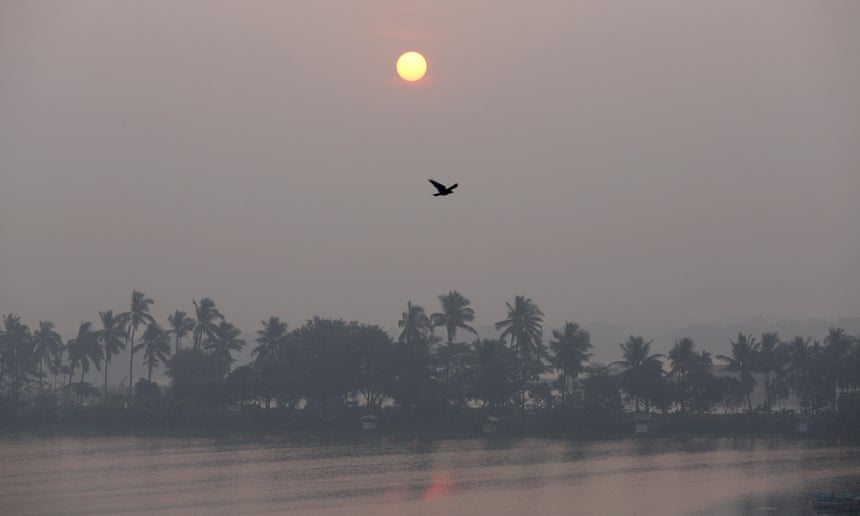
A bird flies over wetlands at sunrise on the outskirts of Kolkata. Photograph: Sean Gallagher/National Geographic Creative/Corbis

The trees on the streets of Kolkata in January are dusty, like neglected pot plants. At traffic lights, salesmen offer feather dusters for drivers to wipe their grimy cars. Shrubs are planted on the central reservation of the city’s new flyovers, surrounded by the implausible boasts on signs proclaiming a “clean and green” city. But the most frequently recurring poster, above almost every street corner, appeals for investors to “Come to Bengal – Ride the Growth”.

Kolkata, a famously cultured city of 14.5 million people – once the second city of the British empire after London – is keen to catch up with Delhi, Mumbai, Chennai and Bangalore, the dynamic and rapidly modernising megacities of the fastest growing major economy in the world.

Kolkata is also a low-lying city, on average it is barely five metres above sea level, served by two major rivers and surrounded by waterways. Its unique wetlands to the east are under pressure from developers like never before, just when they might prove most useful. Hundreds of buildings, from luxury apartments to colleges to more modest homes, are going up in an area which is supposedly protected from development by law.

Faced by the rising sea levels and increased storminess brought on by climate change, cities all over the world – a World Bank study named Guangzhou, Miami, New York, New Orleans and Mumbai at risk of most costly damage – are having to rethink their relationship with flood defences, both natural and artificial. According to the World Bank, an optimistic forecast of just 20cm of sea level rise by 2050 would still make Kolkata the third most exposed city in the world to the risk of flooding.

Such projections no longer belong to a distant future. In November last year, similarly low-lying Chennai experienced cataclysmic floods, which caused the displacement of 1.8 million people. Twenty years ago, Chennai had 650 wetlands in and around the city. Today it has 27. Chennai’s super-powered growth came at the expense of the marshes that could act as an effective natural flood defence; without them, flood water had nowhere to go except cascade into smart new homes.

From the air, Kolkata’s tower blocks are golden in the hazy, smoggy sunshine. To the east, right up against the city sparkles a vast expanse of water: a patchwork of tiny flooded fields bordered by green embankments, ponds, channels and much larger lakes. Take the road to the East Kolkata Wetlands and you’re met by a stream of motorbikes towing two-wheeled trailers, piled high with vegetables and fat silvery carp and tilapia being lugged from the wetlands to city markets.

These waterways are a part-natural, part-human phenomenon and their miraculous character is explained by Dhrubajyoti Ghosh, a slight, bespectacled engineer-turned-ecologist-turned-anthropologist, who speaks English extremely softly and very correctly. Ghosh was asked in 1981 to conduct an investigation into what happened to Kolkata’s wastewater. The city produced a lot of sewage, didn’t have a treatment plant, but didn’t seem to have a pollution problem, either. The waste just sort of disappeared.

“The only English word that suits is serendipity,” says Ghosh, who is now 69, as we stand beside one of its ponds, with the ruins of what resembles a temple behind us. As a young man, he made the short commute from Kolkata to examine these lakes almost every day. He found that the pond water “was beautiful”. To diagnose what was occurring didn’t really require a degree in biology, he says, it was simply common sense. Wastewater is 95% water and 5% problem – bacteria.

Carried by long channels towards the ponds, effluent was broken down by UV rays from the sun. (Ironically, Kolkata’s middle classes pay for UV treatment of their tap water to make it drinkable.) This nutrient-rich water is channelled into ponds where algae and fish thrive. Sewage-grown fish may sound gross but Ghosh and others have found them to be safe; Kolkata’s sewage contains very low levels of heavy metals.

I interrupt to ask about the ruined building behind us. Ghosh smiles slowly. He told local people to leave it standing as an important monument. It is the remains of a conventional sewage treatment plant built by the British, which didn’t work. In tropical countries, expensive water treatment plants struggle to banish bacteria. But Kolkata’s waterways clean its wastewater in less than 20 days. In a conventional water treatment works, thriving algae might become a problem. Here, the algae is removed by fishermen and fed to the fish that grow quickly in these nutrient-rich ponds. “An abundant population of fish growing on nothing,” says Ghosh. “You don’t need fish food.”

The wetlands serve two functions that at first glance seem contradictory: they are the city’s free sewage works and they are also a fertile aquatic market garden. As well as fish, wastewater is used in paddy fields and vegetables are grown on the verdant banks and on a long, low hill created by Kolkata’s organic waste. This recycling makes Kolkata the cheapest major city in India. You can enjoy a traditional breakfast for 30p, a third of the price of Delhi.

The wetlands produce 10,000 tonnes of fish each year and the wetland “garbage farms” provide 40 to 50% of the green vegetables available on the Kolkata’s markets. This food is fresh and cheap because there are almost no transport costs when it is brought by bicycle from these gardens so close to the centre. “I describe this as an ecologically subsidised city,” says Ghosh. “If you lose these wetlands, you lose this subsidy but Calcuttans are not interested to know why they are the cheapest city.”

Kolkata’s wetlands evolved over several human lifetimes and no public official – until Ghosh came along – grasped how it all functioned. But the fishermen knew. The wetlands were originally low-lying salt marshes and silted up rivers. During the days of the British empire, a Bengali engineer educated in Glasgow designed and built gently graded channels that transferred Kolkata’s wastewater from city to wetlands and on to the Bay of Bengal. In the early decades of the 20th century, local fishermen began using this wastewater to farm fish. Ponds were also converted into paddy fields to grow rice. Some 30,000 people make a living from the wetlands. Ghosh’s findings sound uncontroversial but they were not immediately recognised by the authorities. 

“Everybody challenged it for at least 10 years,” he says, “but it’s such a simple principle that it cannot be challenged.”

Real estate in waiting
We walk into the wetlands on a grassy bank that contains a straight channel of water from the city. It is dark matte grey in colour and flows surprisingly quickly. I catch a whiff rather like an urban drain in high summer, a slight tang of sewage. “But it’s not much, is it?” says Ghosh, almost offended at the suggestion that these beautiful wetlands, full of palms, brilliant-white egrets and peacefully industrious human activity, might smell ever so slightly fruity.

After establishing the utility of the wetlands in the 1980s, Ghosh’s next task was to define their area. He drew up a map of these ponds and waterways. Around half the wetlands were taken and their ponds filled in so that a smart new suburb, Salt Lake City, could be built. Ghosh did not quibble. “There is no need to get emotional. The city had to grow. It was organised urbanisation. What’s happening now is not an organised urbanisation.”
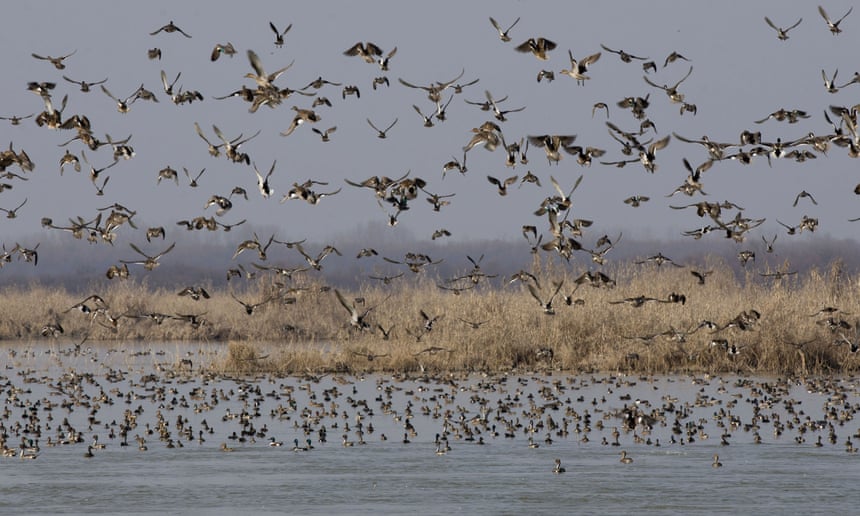
Migratory birds fly above wetlands in Hokersar, another site with Ramsar status. Photograph: Dar Yasin/AP
As Salt Lake City was built, Ghosh persuaded West Bengal’s then chief minister to accompany him on a trip to the remaining wetlands. He sought to demonstrate the effectiveness of Kolkata’s free filtration system to the politician. “I took a glass of water from the pond and I drank it. The chief minister was worried. I told him I do not have a lavatory as a backup,” says Ghosh drily. Of course he didn’t need one. The water was clean. This natural sewer and food bank is “unique in the whole world”, says Ghosh, “and yet we are ready to forget about it.”

In the early 1990s, West Bengal’s government wanted to build a towering world trade centre in the wetlands. Ghosh advised the opposition led by an NGO with the excellent acronym PUBLIC (People United for Better Living in Calcutta). After a judge visited the wetlands, Kolkata’s high court delivered the verdict in 1992 that Ghosh had been hoping for: the wetlands would be preserved for fishing and farming. It was the first major legal battle in India whereby the environment emerged victorious.

Ghosh was not finished, however. He was not confident that West Bengal’s state government would ever conscientiously protect the wetlands. So he sought a higher authority. Like zoologist Jane Goodall and Sir David Attenborough, Ghosh has been given a Global 500 Award, recognition from the UN for environmental achievement. This at least obliges politicians to acknowledge his letters even if, as he quietly points out, they then throw them in the bin.

Ghosh lobbied international conservationists, including officials working for the Ramsar Convention, which designates globally important wetlands. Ramsar understood wetlands to be places where you could watch birds. “Nothing wrong with that but it was incomplete,” says Ghosh. “They had no idea that a huge number of people depended on wetlands for their livelihoods. This was an unknown type of wetland.”
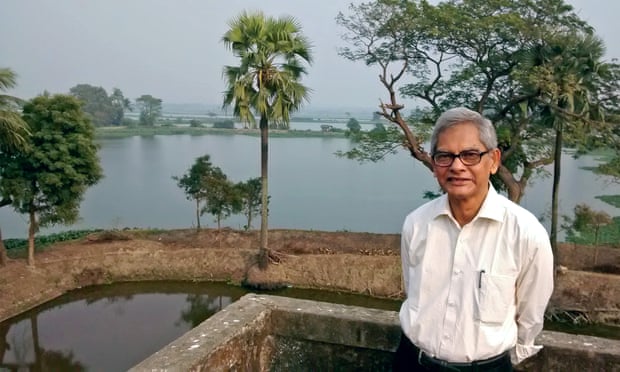
 
Ecologist Dhrubajyoti Ghosh at the wetlands. Photograph: Patrick Barkham

It took a long time to gain international recognition for Kolkata’s wetlands but they were finally given Ramsar status in 2002. It was the highpoint of Ghosh’s career – and he felt it came to mean nothing. Ghosh discovered that the Ramsar status gave no additional legal protection. Ramsar demands that the local government draws up a management plan for every wetlands area within six months of its designation; 14 years on, there is still no management plan for Kolkata’s wetlands.

Worse, says Ghosh, the West Bengal government displays no desire to enforce the 1992 high court ruling. Illegal developments are going up all over the wetlands, and staying up. “People have more confidence in a lack of law than in the law itself,” Ghosh says. And why is the government silent? “They also understand what real estate means to their election campaign. Wetlands are real estate in waiting.”

Today, a banner sign above the road to the wetlands tells travellers that the mangrove forests of Sundarbans, a Unesco World Heritage Site, are just 80km away. There are no signs announcing the East Kolkata Wetlands. They are, literally, off the map.

Your home in the clouds
Stalking the highway along the eastern edge of Kolkata are the new apartment blocks of Rajahat, a gleaming suburb built on soil excavated from the wetlands. “Atmosphere. Your home in the clouds,” boasts one billboard. Electronic advertisements for Vodafone blurt from tower block rooftops. Closer to the smartly dressed office workers sat in motionless rush hour cars are fly-posters for “scholarship tests” and mock exams to help you “learn, compete, succeed”.

Beside these aspirational invitations to personal growth are more appeals from West Bengal’s chief minister, Mamata Banerjee, to “Come to Bengal – Ride the Growth.” Banerjee, who faces an election this spring, came to power in 2011 as a populist, pro-market alternative to Bengal’s long-ruling Communist party. She is desperate to grow Kolkata, and declares she will turn the city into the London of India; by the airport road stands a replica of Big Ben, made from fibre-reinforced polymer, one-third of the size of the original.

Beyond the line of apartments marching out into the wetlands at Rajahat is a shanty town and then Aquatica – “a complete family water theme park and resort”. A dolphin leaping through a rubber ring is painted on its white gates. Beside these is a roadside shack where I drink tiny cups of salty tea with a middle-aged couple, Kartick Chandra Mandal and Shibani Mandal.

Kartick is a fisherman-turned-teacher; Shibani still works in the local fishing industry, packing fish. “The biggest threat to fishing is development,” says Kartick. The water park before us and the low-rise apartment block behind us, fortified with rolls of barbed wire on its walls, were both developments that should not have been permitted. According to Kartick and Shibani, they were paddy fields until a local politician redrew the map – an administrative sleight of hand to move this wetland area into a different parish, which was classified as outside the wetlands and therefore able to be built on.

Such ploys are occurring all over the wetlands, their long-term value trumped by their short-term price as prime real estate. Fishing families allege that ponds are being deliberately sabotaged, with channels blocked up, to force them to abandon their livelihoods. “Land sharks” working for developers use persuasion or intimidation to buy cheap wetland plots and build tower blocks on top. In some cases, the authorities themselves flout their own laws and build small corrugated dwellings on the wetlands for people cleared from the last slums in central Kolkata.

On the rare occasion that the struggle for the wetlands makes the news, its defence is portrayed as elitist. Kolkata’s mayor has declared that the conservation of the wetlands “means little to the common man”. Banerjee, a self-styled champion of the poor, last year stated her intent to find an amnesty for 25,000 illegal buildings within the wetlands area.

Education is usually trumpeted as a saviour of the environment; here, it seems to be the opposite. I wonder if the wetlands could be saved through education, but Ghosh says that no schools bring pupils on trips to the wetlands and no biology lessons are dedicated to understanding this marvellously useful system. Kartick, a teacher, believes that the younger generation are “not as interested or inspired” as his own in preserving the wetlands. “Let there be more ‘dropouts’” he says. “Those who are educated are trying to destroy them.”

Ghosh has dedicated his whole professional life to the wetlands. His wife is dead and his one child lives in Hong Kong, working in high finance. “I worked so hard for recognition from Ramsar and I have got no result. I have lost my life doing this.” It sounds despairing but Ghosh continues to fight for the wetlands. These days, he is less an environmental engineer and more an anthropologist, seeking to describe the unique lives and livelihoods of its residents. If the wetlands can be seen as “heritage”, he thinks, people might cherish them more.

There is one final hope. Aside from providing heritage, a free sewage system and an aquatic market garden, the wetlands’ other urban function – flood defence – is arguably the most indispensable. Chennai’s experience is a powerful lesson. Ghosh realises that it is myopic for his city to mimic Chennai and jeopardise its future by exploiting its wetlands for short-term profit. If Kolkata’s politicians and policymakers can be persuaded too, this famously thoughtful city might avoid the fraught path taken by so many other urban powerhouses who fail to grasp that the sea is always more unstoppable than their own development.

Wednesday, November 11, 2015

2085. India Is Caught in a Climate Change Quandary

By Eduardo Porter, The New York Times, November 10, 2015


Spare a thought for poor India.

India is home to 30 percent of the world’s poorest, those living on less than $1.90 a day. Of the 1.3 billion Indians, 304 million do not have access to electricity; 92 million have no access to safe drinking water.

And India is going to be hammered by climate change.

The livelihoods of 600 million Indians are threatened by the expected disruption of the southwest monsoon from July to September, which accounts for 70 percent of India’s rainfall. India’s rivers depend on the health of thousands of Himalayan glaciers at risk of melting because of a warming climate, while 150 million people are at risk from storm surges associated with rising sea levels.

A lot of damage is already inevitable, a consequence of the emissions of heat-trapping greenhouse gases by richer countries. So, many Indians ask, Why must we pay more? On what grounds can India be asked to temper its use of energy to limit its emissions of greenhouse gases like carbon dioxide?

“Today, I see the carbon space occupied by the developed world,” Prakash Javadekar, the environment minister, said in an interview with The Associated Press in September. “We are asking the developed world to vacate the carbon space to accommodate us. That carbon space demand is climate justice.”

The successful resolution of this confrontation of priorities does not matter just for India’s sake. The tension between economic development and the imperative to curb greenhouse gas emissions remains the central challenge of the diplomatic effort to muster a coalition of rich and poor countries to combat climate change.

The United Nations expects India’s population to reach 1.5 billion by 2030, bigger than China’s. If over the next 15 years it follows anything like the fossil-fuel-heavy path out of poverty that China took over the last 15, it could blow any chance the world has of preventing a disaster.

A critical question for anyone with a stake in preventing a climatic catastrophe is how to conceive and finance a development path for 1.5 billion Indians that prevents this outcome.

Scientists and environmentalists, executives and government diplomats packing their bags to attend the climate summit meeting in Paris, starting Nov. 30, must keep the challenge in mind.

After so many failed rounds of diplomacy, everyone involved is eager to declare the coming meeting a success. So far, 129 countries accounting for nearly 90 percent of greenhouse gas emissions have submitted plans to contribute to the cause.

While the progress is undoubtedly real, the central challenge remains unresolved. Countries are not being asked to make legally binding commitments to reduce their greenhouse gas emissions. They will show up, instead, with Intended Nationally Determined Contributions” to the mitigation effort.

Advanced countries will offer absolute cuts in carbon emissions. But the less developed are expected only to reduce their emissions intensity — a measure of the carbon dioxide released to produce a certain amount of economic activity — in a recognition that their energy consumption still has a long way to grow.

The new approach was necessary to achieve any progress. But it required putting the tough questions aside. Nearly as populous as China, yet way behind in terms of economic development, India presents one of the tougher ones.

By most accounts, the world’s greenhouse gas emissions must be brought close to zero by the end of the century, at the latest. This constrains everyone.

For instance, a recent report by the World Bank argues that economies like China and India must totally decarbonize their electricity supply around midcentury and achieve negative emissions from then on, using carbon capture technologies and vastly increased forests, to suck excessive carbon out of the atmosphere.

To put it mildly, that is going to be a challenge.

Jairam Ramesh, who was minister of the environment under the previous prime minister, Manmohan Singh, argues that India must continue to grow at 7.5 to 8 percent a year for the next 15 years.

To power this growth, India’s electricity consumption — which accounts for over half its greenhouse gas emissions — would rise 6 to 7 percent a year. Even under the most ambitious goals for nuclear power and renewable energy, more than half of this power is expected to come from coal, the dirtiest fuel. “By 2030 India’s coal consumption could triple or quadruple,” Mr. Ramesh told me.

India has come up with a mitigation contribution plan for the Paris meeting. It aims to get 40 percent of its electricity from nonfossil fuels by 2030 and to reduce its emissions intensity by 33 to 35 percent from 2005 to 2030. It also offers to vastly increase its forest cover.

The plan, however, pointedly notes that India’s energy consumption amounts to only 0.6 metric tons of oil equivalent per person, about a third of the world average. It explains that “no country in the world” has ever achieved the development level of today’s advanced nations without consuming at least four tons.

“India has a lot to do to provide a dignified life to its population and meet their rightful aspirations,” it states.

Some analysts say there is a way to thread the needle. Development can be decoupled from carbon emissions, the World Bank insists.

Moreover, economists at the World Bank argued in a separate report released last Sunday that emissions reduction policies could be structured to benefit the poor in the next 15 years — for instance by using revenue from carbon taxes to pay for social insurance.

“The goals are extremely ambitious; only a minority of scenarios get us there,” said Stephane Hallegatte, who led the study. “But they are achievable.”

Under the right set of policies, the World Bank projects, even the most disruptive climate change would add only three million people to India’s extreme poor in 2030. Bad choices, by contrast, would add 42 million to that number.

Some in India seem convinced by the logic. “Our traditional defensive stance has simply not been in the enlightened national interest,” Mr. Ramesh argued in an address last year to the National Institute of Advanced Studies in Bangalore.

“India must view the era of the green economy not as a threat to its developmental plans,” he said. “Instead, it must be viewed as an opportunity to build and demonstrate technological capability to the world.”

And yet, there is still a significant risk that India will say no to the West’s climate change agenda. “It plays hugely well domestically,” Mr. Ramesh told me. “One should never discount that possibility.”