Showing posts with label Global Warming. Show all posts

Sunday, February 10, 2019

3184. A Huge Climate Change Movement Led By Teenage Girls Is Sweeping Europe

By J. Lester Feder, Zahra Jiriji, Pascale Mueller, Buzzfeednews.com, February 7, 2019

Eric Lalmand / AFP / Getty Images

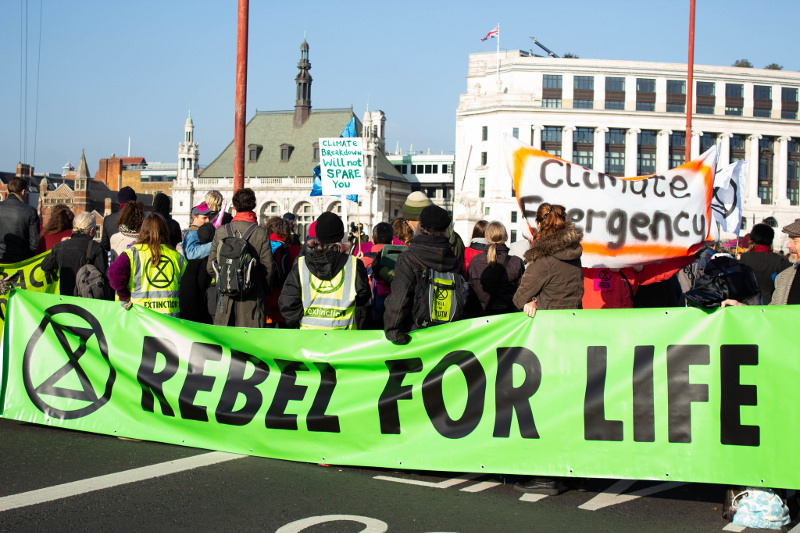
LONDON — A huge student protest movement led almost exclusively by teenage girls and young women is sweeping Europe, and it's on the brink of breaking through in the US.

So far this year, tens of thousands of high school–age students in Belgium, Germany, and Sweden have boycotted class and protested against climate change. The loose movement’s inspiration, a 16-year-old girl who began a solitary picket last year outside the Swedish Parliament in Stockholm, has compared the protests to the March for Our Lives movement organized by the Parkland teens in the wake of a shooting at their school that left 17 dead.

In the latest mass climate strikes, large crowds took to the streets in The Hague on Thursday, in the largest such protest in the Netherlands so far. The teens leading the climate strike across the border in Belgium were in Leuven, the country’s eighth-largest city, where they told BuzzFeed News they had 12,000 people on the streets in one of many actions across the country.

A climate march last weekend in the Belgian capital, Brussels, drew more than 100,000 people, and one of the country’s environment ministers resigned this week after falsely claiming intelligence services had told her the protests were a plot against her.

The protests are injecting a new urgency into the debate around climate change, and calling attention to a lack of action by governments. They are also a sign of the new political power of young women, especially in Europe. Climate strikes have also been organized by students in Australia, and US organizers are planning to participate in an international day of action on March 15.

Jamie Margolin, the 17-year-old founder and executive director of Zero Hour, a group working on the March 15 protest in the US, told BuzzFeed News that climate activism has given young women like her a chance to be heard.

“There aren’t very many spaces that I can be in charge of, and what I’m going to say is going to be heard,” Margolin said. Her group is led largely by young women of color, which she said should come as no surprise, because people who are already vulnerable are going to be disproportionately hit by climate change. A 2014 report by the World Health Organization outlined that women are more likely to be harmed in the kinds of natural disasters made more likely by global warming, bear greater responsibility for getting access to water, energy, and other basics of domestic life, and often are shut out of opportunities when resources decline.

“If you’re a victim of a system of oppression, you’re more affected by the climate crisis — that goes for women,” she said. “Nobody is going to hand us this. We have to step up and raise our voices.”

Some of the most dramatic protests have come in Belgium. For the past four Thursdays, mass walkouts by students have taken place, and at the heart of those actions is a 17-year-old called Anuna De Wever.

De Wever and her best friend, Kyra Gantois, filmed a video and posted it online; they called on students to protest in early January. They expected only a handful of people to turn up, but were stunned to find a crowd of around 3,000. The protests have now grown as large as 30,000 on Thursdays across the country, with even larger protests on the weekend.

“When we started it, Kyra and me, we thought it would be just 20 people,” De Wever said in a phone interview with BuzzFeed News from her home in Antwerp. “I’m so thankful to my generation that they really care about it.”
De Wever was inspired to act after seeing the video of another teenager, Greta Thunberg from Sweden.

Thunberg was 15 when she launched a solitary protest last September by boycotting school every Friday and picketing in front of the Swedish Parliament to demand the country meet obligations under the Paris climate accords.

Thunberg, who has Asperger's syndrome, has become a celebrity since. She addressed global climate talks last December, the World Economic Forum in Davos in January, and has given her own TED Talk. She has an Instagram with more than 250,000 followers where she posts pictures of world leaders, protests, and her dog. From the very beginning, she called for young people to follow her example.

“We are on a school strike for the climate. … We urge everyone to do the same wherever you are,” she said in the video about her climate strike that first popularized the protests in September. “Sit outside your Parliament or local government building until your nation is on a safe pathway to a below two-degree warming target.”

De Wever told BuzzFeed News that as well as Thunberg’s video, two things happened this winter that made her feel like she had to take action: The first was Belgium’s decision not to embrace ambitious steps to cut carbon emissions in December. The second was the realization that she would not be 18 before the spring elections in both Belgium and for the Parliament of the European Union. By the time an election came where she would actually have a say, the chance to rein in climate change could be almost gone forever.

The latest report from the Intergovernmental Panel on Climate Change, released last October, said the world would see catastrophic impacts from climate change, such as rising seas and coral reefs dying, even if countries managed to limit warming to just 1.5 degrees Celsius, which is the most ambitious target under the existing climate accords. The report also said countries needed to act even faster than they’ve previous agreed to.
This seems basically impossible especially as the US, one of the largest emitters of greenhouse gases, is actually increasing its emissions. President Donald Trump has rolled back many climate directives and policies, as well as vowed to withdraw the US from the Paris agreement.

It’s shocking, De Wever said, that adults should have to be reminded by high school students that they’re making decisions that will shape their entire lives.

“Your political games, they’re very funny and all, but you’re the influences of our future,” she told BuzzFeed News. She said the protests, now in their fifth week and drawing tens of thousands in cities across Belgium, have given her a voice that’s “better than voting.”

Her protests have met a considerable backlash; there have been death threats online now being investigated by police, her mother told BuzzFeed News. (In a lengthy Facebook post, Thunberg wrote this month that she had seen “enormous amounts of hate” about her.)

One of Belgium’s environment ministers, Joke Schauvliege, claimed the country's intelligence service had told her the protests were a “setup” and not “spontaneous actions of solidarity with our climate.” Schauvliege later resigned after admitting that the security services told her no such thing.

De Wever told BuzzFeed News that her concern about climate change grew directly out of gender advocacy. De Wever, who was assigned female at birth, identified as a boy throughout primary school, and now identifies as gender-fluid and prefers female pronouns. This experience made her comfortable challenging basic assumptions about the world that older people often treat as unchangeable, which she said is also true of the feeling that the steps to stop climate change are out of reach.

“Being gender-fluid by a young age ... how I see the world is a bit different,” she said. “I don’t look at the mainstream and what they think. I start to have my own values, own principles, and I think about what’s not going right in this world and what can I do and improve it instead of just closing my eyes to it — that really scares me.”

De Wever became passionate about climate change while attending a youth conference associated with the United Nations Commission on the Status of Women in 2016. There she learned that women often suffer disproportionately during natural disasters compared to men, and so were likely to be hurt the worst by climate change.

De Wever’s mother, Katrien Van der Heyden, told her about Thunberg’s video in their kitchen one evening last December. She watched it that night, and then announced the following morning she would make a video of her own with her best friend.

“I have to be very honest about this — at this point in time I didn’t think it would amount to anything,” said Van der Heyden, who now acts as her daughter’s de facto press secretary. “I thought, It’s a nice little project. She’s going to be making that little movie with her friends; it’s educational, much better that just staying at home watching Netflix — I underestimated my daughter.”

Van der Heyden, a 51-year-old sociologist who specializes in gender equity, said she also underestimated the whole young generation.

As far as she could recall, she said, “It’s the very first time in Belgium that a [mass movement was] started by two women and not about feminist rights.” When the protests drew tens of thousands, Van der Heyden said, she was stunned to see as many boys as girls in the crowds, and yet no one ever challenged the leadership of the female organizers.

“We, as women leaders, have been pushed aside by men. We were told we can only be leaders [on women’s issues],” she said. Van der Heyden said that when she sees boys in the crowd shouting her daughter’s name at the rallies, “Every time I’m moved to tears.”

“The whole mansplaining mechanism has really disappeared in that generation,” she said.

But the decision-makers on climate remain overwhelmingly men. When the UN touted a new focus on gender in the Polish climate talks last year, the best it could come up with was that “more than half” of the working groups hammering out the accord had “female representation of 38 per cent or more.”

These protests have been a shot in the arm to well-established environmental protests, said Luisa Neubauer, a 22-year-old from Berlin who led the call for the climate strike in Germany. She’d already been active in Germany’s pitched battle over coal mining, which recently has involved environmental activists occupying sites slated for coal mining in the ancient Hambach Forest.

Neubauer — whose Twitter bio reads, “not a German Greta. We are tens of Thousands” — said that the Thunberg’s example was inspiring to get more women to speak up in the German movement. Though Germany’s chancellor, Angela Merkel, is one of the world’s longest serving and most powerful political leaders, Germany actually lags behind many other European countries in gender equality.

“I’ve been raised in a world where the people leading were men,” Neubauer said. “And if you wanted to make it as a woman, then you had to either look like Angela Merkel or participate in Germany’s Next Top Model.”

Nike Mahlhaus, a 25-year-old activist with the German environmental group Ende Gelände (Land’s End), said her organization had battled for years to get women’s voices into the environmental discussion. It made a deliberate decision to make women spokespeople because media outlets constantly gravitated toward male activists. So often online, she said, she finds herself facing off online with older men whose views get accepted as common sense while she has to defend herself from attacks of being radical or unhinged.

“The men who comment there are the white middle-aged men who keep this system running by thinking that there is no other option,” Mahlhaus said. “It hurts to realize that they have the power to define what is radical and what is reasonable, what is appropriate and what is insane, who we have to respect and who not.”

In many places, these young women’s protests have been treated with outright scorn. Some of the ugliest came from Australian Prime Minister Scott Morrison and his cabinet — which has just five women out of 21 ministers — after a climate strike in November.

“Kids should go to school. … We do not support our schools being turned into parliaments,” Morrison spat during a speech in the House of Commons. Resource Minister Matt Canavan said kids who care about climate should focus on science class during an appearance on 2GB radio, adding, “The best thing you’ll learn about going to a protest is how to join the dole queue.”

Despite the huge scale of recent environmental protests in many countries, they have not produced anywhere near the levels of political attention of smaller protests dominated by older people. The Yellow Vest protests in France, a movement dominated by middle-aged activists who rallied in opposition to a hike in the tax on gasoline, are still driving French politics.

A French minister skipped out on the December climate talks in Poland because of the protests, and French President Emmanuel Macron announced he would reverse the tax, which was introduced to combat global warming. But an environmental protest last week drew more than 80,000 people to the streets of Paris alone, larger than the latest Yellow Vest protest. But it received little attention in French media.

“We really need to do something — the younger generation understand it more,” De Wever told BuzzFeed News. “We are called young and naive, but maybe being naive is what we need right now. We can look at the planet without being locked in the system.”

“This system is just wrong,” she said. “It discriminates against people. We’re not taking care of this planet.”

Thursday, January 31, 2019

3173. Challenges Posed by the ‘Green New Deal’

By Kamran Nayeri, Socialist Action, January 16, 2019
The fanfare about the UN Conference of Parties (COP) 24 in Katowice, located in a coal-mining region in Poland, that the diplomats from some 200 countries have “struck a deal after an all-night bargaining session” that may advance the fight against the unfolding catastrophic climate (The New York Times, Dec. 15, 2018) rings hollow if we recall that just 10 days earlier the same newspaper reported that two years after the Paris Agreement  greenhouse gas emissions accelerated like a “speeding freight train” in 2018.
Two months earlier, on Sept. 9, the United Nations secretary general, António Guterres, held a press conference in New York telling the world that if the world governments “do not change course by 2020, we risk missing the point where we can avoid runaway climate change.” Let’s remember that is only two years from now. Clearly, the world is facing a climate emergency, and so far none of the world’s major polluters are doing anything close to what is needed to avert the impending catastrophe.
The ecological and social crises the world faces today are actually two aspects of the crisis of the anthropocentric industrial capitalist civilization.
To resolve the crisis, humanity must chart a course towards an ecocentric socialist future. Thus, all attempts to reform the present day civilization to address various aspects of the ecosocial crisis are bound to fail if they are not part of an ongoing and deepening struggle waged by working people ourselves—armed with an action program and a strategy to build a self-organized and self-mobilized movement—to achieve an ecocentric socialist society.
The Sunrise Movement in the United States poses an important set of opportunities and challenges for the climate justice movement and its small ecosocialist component. While its stated purpose is to combat the climate crisis, the group has not absorbed a key political lesson apparent in the spontaneous Yellow Vests protests in France—the existing political parties are not to be trusted.
Thus, the Sunrise Movement supports the agenda of Democratic Party Congresswoman Alexandria Ocasio Cortez: a Green New Deal to be foraged by the formation of a Select Committee for a Green New Deal in the legislative session beginning this month. It has used lobbying, albeit through a protest at the halls of the U.S. Congress, to demand legislative action to stop the climate crisis.
Some climate justice groups and a few small labor groups, as well as two-dozen current and just-elected Democratic members of Congress, have signed onto Ocasio Cortez’s proposal.
This development is not surprising. The main groups in the labor and climate justice movements have been working through the Democratic Party all along and essentially have embraced a parliamentarian and reformist approach to climate change policy.
Again unsurprisingly, the Democratic Socialists of America (DSA)—with its ranks swelled with thousands of new recruits, including former supporters of Bernie Sanders’ 2106 Democratic Party campaign—has decided to run candidates in the 2018 elections as Democrats. This follows the reformist tradition of the U.S. social democrats and Stalinists (mostly the Communist Party U.S.A.) since the 1930s. In their view, the task is not to overthrow U.S. capitalism but to reform it by “pushing” the Democratic Party “to the left.”
I need not remind the reader that this “strategy” has a decades-old track record of failure, as can be verified by the dissolution of all progressive movements in the United States that followed a similar course. Just consider the history of the labor, Black, and women’s liberation movements over the past several decades and how such once-powerful movements have been reduced to a shadow of their former selves, a price they paid for being in the Big Tent of the Democratic Party, attempting “to push it to the left” instead of building self-organized and self-mobilized anti-capitalist movements and a fighting labor party to pursue their respective demands.
Impervious to such lessons of the modern political history of the United States, Ted Franklin, a leader of System Change Not Climate Change (SCnCC) who is also a member of the East San Francisco Bay DSA, celebrates Ocasio Cortez’s reformist course. He writes:
“The quasi-magical arrival of Alexandria Ocasio Cortez on the political scene has given climate activists new hope that a program big enough to address the danger will become an actual subject of national debate in the time frame necessary to give us a fighting chance against climate catastrophe.
Her proposal for a Select Committee for a Green New Deal … is gaining momentum as the highly energized progressive base of the Democratic Party confronts the triple obstacles of the Republican neofascist party, the neoliberal wing of the Democratic Party, and the establishment progressives who are now running to the left but still beholden to corporate interests” (Franklin, 2018).
As someone who has been an active member of the national SCnCC network for about three years, and came to know and respect Franklin, his embrace of Ocasio Cortez’s reformist course comes as a surprise to me. To be clear, revolutionary (eco)socialists are not opposed to reforms. Thus, I have spoken in praise of the Oakland No Coal Coalition in which Franklin has played a leading part. But reforms can only be sustained if they are won by the organized and mobilized masses of the working people as a way to enhance our self-confidence and as a stepping stone towards other victories in the direction of an ecocentric socialist future.
The political course proposed by Ocasio Cortez, and following her the Sunrise Movement, and now Franklin, is the exact opposite. It miseducates and confuses any radicalizing youth or working person by suggesting that working through the capitalist Democratic Party, not building our own bottom-up anti-capitalist organization, and eventually a revolutionary labor party based on our own transformed mass organizations, such as unions, is the way to fighting the systemic climate crisis.
Thus, while the defeat of the Democratic Party incumbent, Joe Crowley, by Ocasio Cortez in the Democratic Party primaries registered the movement of the electorate to the left, her decision to run as a Democrat and her subsequent course to campaign for reforming the Democratic Party is entirely damaging to the cause of working people to organize and mobilize independently of the American capitalism and its two-party system.
Reality vs. fantasy: the Select-Committee
Franklin seems to pitch his political support for the Ocasio Cortez’s course on the premise that short of a mass movement of the working people fighting for a program to stop and reverse the climate crisis, the next best option is to work through the Democratic Party to get a national discussion on a Green New Deal to avert the crisis. So, let us consider his argument in some detail.
Like all others in the history of labor and socialist movements who have pursued shortcuts in revolutionary politics, sometimes with disastrous results, Franklin bends reality to fit his fantasy. To begin with, he assumes that because Ocasio Cortez has floated the idea of a Select Committee to forge a Green New Deal, both of these are already facts.
It should be noted in the first place that the likely Democratic Speaker of the House, Nancy Pelosi, has already asked Florida Representative Kathy Castor to lead a “special committee on climate change” in the new Congress that will reinstate the same committee that was dissolved by the former Republican Speaker John Boehner. While both Pelosi and Castor have included references to “thousands of green jobs” they hope to create, they have set aside any mention of a Green New Deal, and it is not even clear if Ocasio Cortez would be assigned to Castor’s climate change committee.
In fact, Castor has already disputed the suggestions that representatives who have received financial contributions from the fossil fuel industry should be barred from serving on her committee, on the grounds that it would be unconstitutional because it would violate their First Amendment right to free speech, a fossil fuel industry legal argument.
Evan Weber, the political director of the Sunrise movement, responded to the announcement by saying: “Nancy Pelosi has the power to determine whether or not the Select Committee for a Green New Deal lives or dies. … Sunrise Movement’s position is and will continue to be that it’s not over until she makes it clear that it’s over” (reported in Other News: Voices Against the Tide, January 2019). This is a sad statement of utter powerlessness of climate justice activists who place their hope in the Democratic Party.
Reality vs. Fantasy: a timely national debate on climate change and a Green New Deal?
With Ocasio Cortez’s proposed Select Committee blocked by the Democratic Party leadership, it would seem the rest of Franklin’s rosy projections are also no more a possibility. But let me consider them as if they were, in fact, to materialize as Franklin hopes.
If we are to believe United Nations Secretary General António Guterres that the world’s governments will run out of time to stop the runaway climate catastrophe if they do not act by 2020, it should be abundantly clear that we are already out of time to act to stop the worst of the climate crisis.
Still, Franklin imagines not only that the Democratic Party will move swiftly to form Ocasio Cortez’s Select Committee but that this committee will hold speedy hearings and formulate a Green New Deal, and that this will ignite a national debate that presumably improves the final legislation, and a similar bill will pass the Republican-controlled Senate and will be signed by President Trump before we run out of time! That is in one year’s time!
Of course, Franklin forgets, and I do not wish to belabor the point, that the climate crisis can only be resolved on the world scale with the top polluters taking the lead. So even if this fantastic scenario plays out as Franklin imagines it, the crisis will become unstoppable if China and the European Union fail to follow. In fact, Franklin himself cites formidable obstacles to any speedy and effective legislation to become law by counting some of the obstacles, including “the neoliberal wing of the Democratic Party,” its “progressive establishment,” and the “neo-fascist” Republican Party. Yet, he still presents Ocasio Cortez’s proposal as a viable option!
The Green New Deal is neither new nor a radical idea. In fact, in all its varieties it is some form of Green Capitalism, which has been criticized by revolutionary ecosocialists, including in the System Change Not Climate Change network.
The neoliberal Democratic New York Times columnist Thomas L. Friedman first proposed it as a way to stop the climate crisis almost 11 years ago (The Times, Jan. 19, 2007, and April 15, 2007). Friedman is a big promoter of the magic of technology and capitalist markets, around which his idea of the Green New Deal was built, and he has influenced the climate justice movement. Earth Justice interviewed him about his Green New Deal, and the Green Party picked up the idea, adding on its own formulations.
And now Congresswoman Ocasio Cortez has made the idea “her own,” and some climate justice groups and small labor groups have supported the idea.  Meanwhile, there has been no questioning of how and why the U.S. Congress, one of the three constitutional seats of power of U.S. capitalism, would somehow legislate a Green New Deal that would actually stop the crisis and the U.S. president would sign it into law without any resistance by the same economic, social, and political forces that have blocked a serious discussion of the crisis for decades without a massive mobilization of the working people!
There is nothing in Franklin’s essay that even hints at who could stop climate change—capitalist politicians or the U.S. and world’s working people.
Climate change mitigation as big business
To understand the capitalist climate mitigation debate, we must understand the ongoing discussion in the capitalist policymaking circles about reforming capitalism to function more efficiently. Health-care policy debates provide an excellent recent example. As a health policy scholar in the early 1990s, I had the opportunity to document and demonstrate in detail how the liberal and conservative health-care reform proposals were framed by concerns about the profitability crisis in the U.S. capitalist economy. Would the discussion on climate change in the U.S. Congress be any different?
Just as the Democratic and Republican policymakers refused to frame the health care reform debate in terms of health care as a human right, there is no reasons to believe that their debate about the Green New Deal would be any differently framed—to put humanity and life on Earth at the center of policymaking deliberations instead of better oiling the capitalist profit-making machine.
Already, a long list of luminaries from both Democratic and Republican parties have spoken out in favor of some form of capitalist climate mitigation policy. Just last September, California’s Governor Brown held the Climate Summit that came on the heels of the May 24, 2017, “Climate Change is Big Business” conference in San Francisco, in which he was its invited keynote speaker.
On Dec. 13, 2018, John Kerry, another strategic thinker of U.S. capitalism, wrote an opinion piece for The New York Times complaining about the heat waves that are “stealing 153 billion hours of labor,” about how tropical infections are moving north, and about falling crop yields in more than two dozen countries: “By 2050 the Midwestern United States could see agricultural productivity drop to its lowest level in decades.” New York State’s right-of-center Democratic Governor Cuomo has called for a Green New Deal for New York.
It is also useful to place the original New Deal in its historical context. Contrary to the reformist fantasy that it was all thanks to the presidency of FDR, “the man of the people,” similar attempts in the 1920s and 1930s were undertaken by other leading capitalist rivals. The fascist Mussolini government embarked on a public works project to recast Rome in its historical glory by building statues and arenas to help whip up Italian nationalist fervor. Hitler built the autobahn system, and when he found it empty of cars, he ordered the design and mass production of Volkswagen Beetle (“people’s car”).
Churchill oversaw the reworking of the earlier welfare programs, such as unemployment insurance, to build the British welfare state. Needless to say, all the key capitalist rivals were also busy rearming themselves to the teeth.
Today’s world is similar in important ways. The American imperialist hegemony that grew out of the ashes of World War II is ending. By some accounts, China is already the largest capitalist economy in the world, with the most modern infrastructure and cutting-edge technology, and even in military terms has become the undisputed power in the Pacific.
The rise of Donald Trump is another sign of the slow decline of American imperialist power and its leadership crisis. Thus, his “make America great again” campaign, which appeals to the nostalgia of sections of U.S. ruling class and working people. His contentious relations with the U.S. key allies and his trade war moves similarly reflect a desire by the same laggard section of the U.S. elite to use raw American imperialist power to maintain its ebbing hegemony in world affairs—but to no avail.
The more forward-looking section of the U.S. capitalist class, mostly in the Democratic Party, aims for rejuvenation of the economy based on new products and new industries, which include “green technologies.” That is what the real Green New Deal is about, the kind that Friedman talks about. Even Paul Krugman, a smart liberal Democrat and Keynesian economist, has come out in favor of redesigning the U.S. economy as a mixed-economy: “You could imagine running a fairly efficient economy that is only 2/3 capitalist, 1/3 publicly owned—i.e., sort-of-kind-of socialist” (The New York Times, Dec. 22, 2018). Is there any doubt that at best they all are talking about Green Capitalism, not the kind of ecosocial transformation that is needed to stop and reverse the climate crisis?
From the perspective of averting the climate catastrophe, as well as the Sixth Extinction and the threat of nuclear war (the U.S. rulers, both Democrats, and Republicans, are already working on a multi-trillion-dollar nuclear rearmament; don’t fool yourself into thinking they would not use it!), and the entire host of ecosocial crisis the world faces, none of these capitalist policy wonks have anything close to a solution.
Neither does Congresswoman-elect Ocasio Cortez. Otherwise, she would have made that program her election campaign platform and would have educated the Sunrise Movement activists in that program and a working-class strategy to fight for such a program.  Instead, she has decided to run as a Democrat and to spend her energy to push the Democratic Party to the left (whatever that means). And when the Democratic Party captured the majority in the midterm elections and Nancy Pelosi, who a year earlier told a student that the Democratic Party is the party of capitalism, became again the most likely candidate for the Speaker of the House, she simply set Ocasio Cortez to the side with a stroke of her pen.
A key difference between a liberal and a working-class revolutionary is this: The former sees power emanating from the “voter” while the latter sees it coming from the self-organized and self-mobilized working people.
Ocasio Cortez is a liberal, not a revolutionary. She has no program, strategy, or set of tactics informed by them to help mobilize independent working-class action to transcend the anthropocentric industrial capitalist civilization in the direction of an ecocentric socialist future. Franklin, on the other hand, considers himself to be a Marxist. Should he not tell the Sunrise Movement activists that to overcome the climate crisis we should not look up to the Democratic Party, the U.S. Congress, or any capitalist institution but to the power of working people ourselves?
Of course, I do not deny that humanity is staring at possible extinction if we cannot undertake a massive reversal within a very short time frame, a very unlikely outcome. But let me ask Franklin why humanity is in such a predicament if not for decades upon decades of reformist betrayal? Is it not time perhaps to confront liberalism and reformism in the labor, climate justice, and (eco)socialist movements?

Monday, January 14, 2019

3156. A Green New Deal vs. Revolutionary Ecosocialism

By Wayne Price, Black Rose Federation, January 4, 2019
Richard Smith
The idea of a “Green New Deal” has been raised in response to the threat of climate and ecological catastrophe. Two such proposals are analyzed here and counter-posed to the program of revolutionary libertarian ecosocialism.
According to the climate scientists, industrial civilization has at most a dozen years until global warming is irreversible. This will cause (and is already causing) extremes of weather, accelerating extermination of species, droughts and floods, loss of useable water, vast storms, rising sea levels which will destroy islands and coastal cities, raging wildfires, loss of crops, and, overall, environmental conditions in which neither humans nor other organisms evolved to exist. The economic, political, and social results will be horrifying.
The scientists write that humans have the technological knowledge to avoid the worst results. But this would take enormous efforts to drastically reduce the output of heat-trapping greenhouse gasses. The recent UN Intergovernmental Panel on Climate Change writes that this “would require rapid and far-reaching transitions in energy, land, urban, and infrastructure (including transport and buildings) and industrial systems…unprecedented in terms of scale.” (quoted in Smith 2018) At the least this means a rapid transition to shutting down fossil-fuel producing industries, leaving most oil, coal, and natural gas in the ground and rationing what is currently available. It means replacing them with conservation and renewable energy sources. It means drastic changes in the carbon-based-fuel using industries, from construction to manufacturing. It means providing alternate jobs and services for all those put out of work by these changes.
To the scientists’ warnings, there have been rumblings of concern from some financial investors, business people (in non-oil-producing industries), and local politicians. But overall, the response of conventional politicians has been business-as-usual. The main proposals for limiting climate change has been to place some sort of taxes on carbon emissions. From liberals to conservatives, this has been lauded as a”pro-market” reform. But, as Richard Smith (2018) has explained, these are inadequate, and even fraudulent, proposals. “If the tax is too light, it fails to suppress fossil fuels enough to help the climate. But…no government will set a price high enough to spur truly deep reductions in carbon emissions because they all understand that this would force companies out of business, throw workers out of work, and possibly precipitate recession or worse.
In the U.S., one of the two major parties outright denies the scientific evidence as a “hoax.” As if declaring, “After us, the deluge,” its policies have been to increase as much as possible the production of greenhouse-gas emissions and other attacks on the environment. The other party accepts in words the reality of global warming but only advocates inadequate and limited steps to deal with it. It too has promoted increased drilling, fracking, and carbon-fuels burning. These Republicans, Democrats, and their corporate sponsors are enemies of humanity and nature, worse than war criminals.
On the Left, there have been serious efforts to take up the scientists’ challenge. Various ecosocialists and other radicals have advocated a massive effort to change the path of industrial society. This is sometimes called a “Green New Deal.” This approach is modeled on the U.S.’s New Deal of F. D. Roosevelt in the Great Depression. Its advocates also usually model their programs on the World War II industrial mobilization which followed the New Deal. (For examples, see Aronoff 2018; Ocasio-Cortez 2018; Rugh 2018; Simpson 2018; Smith 2018; Wikipedia.)
There does need to be a massive social effort to change our current technological course. A drastic transformation of industrial civilization is needed if we are (in Richard Smith’s phrase) to “save the humans,” as well as our fellow animals and plants. Nothing less than a revolution is needed. Yet I think that there are serious weaknesses in this specific approach, not least in modeling itself on the New Deal and the World War II mobilization—which were not revolutions, however romanticized. The proponents of a Green New Deal are almost all reformists—by which I do not mean advocates of reforms, but those who think that a series of reforms will be enough. They are state-socialists who primarily rely on the state to intervene in the economy and even take it over; in practice this program creates not socialism but state capitalism.
From the perspective of revolutionary anarchist-socialism, the Green New Deal strategy is problematic because it means [1] an effort to modify existing capitalism, not to fight it with the aim of overthrowing it. [2] As often stated, it requires working through the Democratic Party. [3] It proposes to use the current national state as the instrument of change. Finally, while advocates speak of popular mobilization and democratization, their overall approach is top-down centralization. [4]

Plans of Ocasio-Cortez and Richard Smith

A member of the Democratic Socialists of America (DSA), Alexandria Ocasio-Cortez was just elected to the House of Representatives as an insurgent Democrat from Queens, NY. With a group of co-thinkers, she has formally proposed that the House set up a special Select Committee for a Green New Deal. (Ocasio-Cortez 2018) This Congressional committee would work out a plan for the transition of the .U.S. to a “green” non-carbonized economy—although it would not have the power to actually implement any plan. Supposedly this will be raised in the 2019 Congress.
The committee would develop a “Plan” to achieve such goals as “100% national power from renewable sources” in ten years, a national “smart” energy grid, upgrading residential and industrial buildings for conservation of energy, investments in drawing-down greenhouse gases, and making “green” technology a big U.S. export. Central to its set of goals is “decarbonizing the manufacturing, agricultural, and other industries.” “Decarbonizing, repairing and improving transportation and other infrastructure.”(Ocasio-Cortez 2018) Supposedly, these goals would be implemented in such a way as to provide good jobs, services, and prosperity for everyone.
Richard Smith is a knowledgeable and insightful ecosocialist writer (from whom I have learned much, despite disagreements). He has a generally positive reaction to this proposal (Smith 2018). Describing himself as “a proud member” of the DSA, he approves Ocasio-Cortez’ idea of a massive governmental program, modeled on the New Deal and World War II mobilization, to counter the climate crisis. However, he raises some significant concerns, specially around the key goal of “decarbonization”.
What’s not said is that decarbonization has to translate into shutdowns and retrenchments of actual companies. How does one decarbonize Exxon-Mobil or Chevron or Peabody Coal? To decarbonize them is to bankrupt them. Further, the same is true for many downstream industrial consumers….” What is required, he concludes, is governmental takeover of these industries with the aim of shutting down or drastically modifying them. “But there is no mention of shutdowns, retrenchments, buyouts, or nationalization.
Even more than the need to decarbonize industry (in the U.S. and internationally), is the need to create a balanced, ecologically-sustainable, system of production. “Perhaps the biggest weakness of the GND Plan is that it’s not based on a fundamental understanding that an infinitely growing economy is no longer possible on a finite planet…, of the imperative need for economic de-growth of many industries or of the need to abolish entire unsustainable industries from toxic pesticides to throw-away disposables to arms manufacturers.” (my emphasis)
Unlike his fellow DSA member (and Democratic politician) Ocasio-Cortez, Smith raises a program which explicitly demands government take-overs of the fossil-fuel producing companies. (He notes, “Others have also argued for nationalization to phase-out fossil fuels.”) He also calls for the nationalization of industries which are dependent on fossil fuels: “autos, aviation, petrochemicals, plastics, construction, manufacturing, shipping, tourism, and so on.” These nationalizations would be part of a plan for phasing-out fossil fuels, phasing-in renewable energy, shutting down fossil-fuel production, shutting down or modifying industries which rely on fossil fuels, and creating large government employment programs. This means changing from an economy built on quantitative growth, accumulation, and profits, to one of “degrowth [and] substantial de-industrialization.”
This program may seem revolutionary. “It’s difficult to imagine how this could be done within the framework of any capitalism…. Our climate crisis cries out for something like an immediate transition to ecosocialism.”
Yet Smith contradicts himself; he does not present his perspective as a revolutionary program. While he proposes socialization (in the form of nationalization) of much of the corporate economy, he does not call for taking away the wealth and power of these main sectors of the capitalist class. “We do not call for expropriation. We propose a government buyout at fair value….The companies might welcome a buyout.” There will be “guaranteed state support for the investors….” Further, “it is perhaps conceivable, taking FDR’s war-emergency industrial reordering as a precedent, that the…plan…for fossil fuels buyout-nationalization…could be enacted within the framework of capitalism, though the result would be a largely state-owned economy. Roosevelt created [a] state-directed capitalism….”
While a revolutionary approach is often derided as absurdly “utopian” and fantastic, this reformist program is itself a fantasy. It imagines that the capitalist class and its bought-and-paid-for politicians—who have resisted for decades any efforts to limit global warming—would not fight tooth-and-claw against this program. They are supposed to accept the loss of their industries, their mansions, their social status, their private jets, their media, their political influence, and the rest of their domination over society—for the sake of the environment! In all probability, to prevent this, they would whip up racism, sexual hysteria, and nationalism, subsidize fascist gangs, urge a military coup, distort or try to shut down elections and outlaw oppositions. All of which has been repeatedly done in the past, and is partially being done right now (if still on a minor scale—so far).
In the (very) unlikely event that the capitalists accepted this program, they would still be left with great wealth from the buyout, which they would use to fight to get back their power. And even in the (extremely unlikely) event that industries could be successfully decarbonized through buyout-nationalization, there would still be the basic problem (as Smith had pointed out) of the essential drive of capitalism to expand and accumulate profits, which must conflict with sustainable life on earth.
There is a whole history of class struggles, of revolutions and counterrevolutions, which have consistently taught the lesson that there is no peaceful-gradual-electoral “parliamentary road to socialism,” including to ecosocialism. Radicals should have learned the most recent lesson of the Syriza party in Greece.


Can the State Save Us?

Central to the conception of a Green New Deal is the belief that the state can save the humans and the biosphere. To Smith, “Saving the world requires the sort of large-scale economic planning that only governments can do.” There is “only one proximate solution: state intervention….” Similarly, Ocasio-Cortez’s proposal states, “We’re not saying that there isn’t a role for private sector investments; we’re just saying that…the government is best placed to be the prime driver.”
What Smith, specifically, is proposing is a form of state capitalism. He advocates “a largely state-owned economy” which may be “within the framework of capitalism,” building on but going beyond Roosevelt’s “state-directed capitalism.” There is a radical tradition which had also advocated nationalization of big business and creation of public works, but had always tied stratification to a demand for workers’ democratic control and management. For example, Trotsky’s Transitional Program states, “Where military industry is ‘nationalized,’…the slogan of workers’ control preserves its full strength. The proletariat has as little confidence in the government of the bourgeoisie as in an individual capitalist.” (Trotsky 1977; 131) Workers’ management is not part of Smith’s proposal, nor that of Ocasio-Cortez (and it has dropped out of the program of most modern-day Trotskyists).
Of course Richard Smith is a sincere socialist democrat and a long-time opponent of Stalinist totalitarianism. But he calls on this U.S. bourgeois state, the state created and dominated by U.S. capitalism and imperialism, to take over the economy and run it. This program is state capitalism. As a result, the economy, even if decarbonized, will have the capitalist drive to accumulate profits. Just as was the state-capitalist Soviet Union, it will still be inherently destructive of the human-nature ecological balance,.
State-socialists focus on blaming the market economy for social ills, such as global warming. They see the state as an outside, neutral, institution, which might intervene in the economy to solve these problems. “If capitalists won’t provide the jobs, then it’s the government’s responsibility to do so. We, the voting public, [will] assert our ownership of the government, not the corporations.” (Smith 2018) In other words, the government could be dominated by the corporations (using their money), or it could be dominated by the people (using their votes). Supposedly either one is possible, in contradiction to the experience of two centuries of class struggle.
The state is a centralized bureaucratic-military socially-alienated institution. It has been created by (and creates) capitalism (and previous systems of exploitation) and serves to uphold it—and is thoroughly involved in all the evils of industrial capitalism. “Climate change is another state effect that governments are incapable of solving….The infrastructure of automotive transportation, industrial agriculture, and electricity generation, which are responsible for the majority of of greenhouse gas emissions, are built and regulated by states (…). The industries responsible for destroying the planet depend on government regulation, police protection, and financing, and form part of an economic complex that is integrally connected to government…Continuing to trust states as the potential solvers of climate change and mass extinction…[is to be] complicit with catastrophe.” (Gelderloss 2016; 241-2)
Anarchists and radical Marxists have agreed that the existing state cannot be used to consistently defend the interests of workers and oppressed people. At times, under pressure from below, this state may give some benefits. Similarly, the management of a corporation may raise workers’ wages when under the threat of a strike. But neither the state nor corporate management is “on our side.” Certainly revolutionaries may pressure the state to make reforms in the same way as the workers may strike to force the bosses to raise their wages. But these efforts, win or lose, do not change the institutional power of capital, in corporations or in the state.
Therefore, anarchists and radical Marxists have advocated overturning and dismantling the state and replacing it with alternate institutions. In an introduction to the Communist Manifesto, Engels modifies their original views by quoting Marx, writing, “One thing especially was proved by the [1871 Paris] Commune, viz., that ‘the working class cannot simply lay hold of the ready-made state machinery, and wield it for its own purposes’.” (Marx & Engels 1955; 6) Which is exactly what Ocasio-Cortez, Smith, and others propose to do.
Anarchists and other libertarian socialists advocate replacing the state with federations of workplace councils, neighborhood assemblies, and voluntary associations, defended by an armed people (militia) so long as is necessary. They advocate socialization of the economy, not by state ownership, but by replacing capitalism with networks of democratically self-managed industries, consumer cooperatives, and collectivized municipalities. They expect productive technology to be modified by the workers, in such a way as to eliminate the division between mental and manual labor and in order to create an ecologically sustainable society.
Ocasio-Cortez and other DSAers rely on the Democratic Party to implement their Green New Deal —a plan which, in Smith’s view should lead to the nationalization of much of the economy. However, the Democrats are committed to managing a traditional, private-capitalist, economy. “Most Democrats…acknowledge global warming is real, yet have failed to take meaningful steps to address the apocalyptic scale of the problem.…The Dems have always played seesaw between the interests of their corporate campaign donors and those of the party’s middle- and working-class base… They have more and more aligned themselves with the jealous interests of their elite backers. Party leaders have embraced a business-friendly, neoliberal approach to climate change, just as they have just about everything else.” (Rugh 2018) For an account of the Democrats’ climate-destroying actions when in office, see Dansereau (2018).
(Members of the Green Party have also advocated a “Green New Deal” for some time. [Wikipedia] I am not reviewing their version of the GND at this time. The Greens reject the Democratic Party, for good reasons, and claim to be for a decentralized society. But they still accept an electoralist-peaceful-reformist strategy. They hope to take over the state by getting their party elected, and then to use the power of the national state to transform capitalism by carrying out a Green New Deal.)

Decentralization and Federalism

Richard Smith is for democracy and democratic planning. He proposes elected “planning boards at local, regional, national, and international levels.” Yet his plan, like that of Ocasio-Cortez, is clearly a top-down, centralized approach. Other experts in ecological regeneration (who are not anarchists) have seen things in a more decentralized perspective.
For example, Bill McKibben has long been a leader of the climate justice movement. His main solution to climate change is decentralization: “more local economies, shorter supply lines, and reduced growth.” (McKibben 2007; 180) “…Development…should look to the local far more than to the global. It should concentrate on creating and sustaining strong communities….” (197) “…The increased sense of community and heightened skill at democratic decision-making that a more local economy implies will not simply increase our levels of satisfaction with our lives, but will also increase our chances of survival….” (231)
Naomi Klein declares, “There is a clear and essential role for national plans and policies….But…the actual implementation of a great many of these plans [should] be as decentralized as possible. Communities should be given new tools and powers….Worker-run co-ops have the capacity to play a huge role in an industrial transformation…. Neighborhoods [should be] planned democratically by their residents….Farming…can also become an expanded sector of decentralized self-sufficiency and poverty reduction.” (Klein, 2014; 133-134)
The (Monthly Review) Marxist Fred Magdoff (a professor of plant and soil science) wrote, “Each community and region should strive, within reason, to be as self-sufficient as possible with respect to basic needs such as water, energy, food, and housing. This is not a call for absolute self-sufficiency but rather for an attempt to…lessen the need for long distance transport….Energy…[should be] used near where it was produced…. in smaller farms…to produce high yields per hectare….People will be encouraged to live near where they work….” (Magdoff, 2014; 30—31) Also, “Workplaces (including farms) will be controlled and managed by the workers and communities in which they are based.” (29)
Compare with the views of anarchist and social ecologist Murray Bookchin: “Civic entities can ‘municipalize’ their industries, utilities, and surrounding land as effectively as any socialist state.…A municipally managed enterprise would be a worker-citizen controlled enterprise, meant to serve human and ecological needs….[There would be] the replacement of the nation state by the municipal confederation.” (Bookchin 1986; 160) The takeover of the oil industry could be a national and international matter, managed through confederation, while use of renewable energy would be primarily implemented by local communes.
In short, the capitalists’ wealth and power should be taken away from them (expropriated) by the self-organization of the working class and its allies. Capitalism should be replaced by a society which is decentralized and cooperative, producing for use rather than profit, democratically self-managed in the workplace and the community, and federated together from the local level to national and international levels. There should be as much decentralization as is reasonably possible and as little centralization as is absolutely necessary. There needs to be overall economic coordination on a national, continental, and world-wide level, by federations of self-governing industries and communities, but not by bureaucratic-military capitalist states. This is ecoocialism in the form of eco-anarchism.

But Let’s be Realistic….

Endorsers of the Green New Deal see it as a realistic proposal for mobilizing masses of people and averting ecological disaster. They regard a program of revolutionary libertarian ecosocialism as unrealistic, a nonstarter for the brief time there is left to save the world. We must act quickly, they say, with proposals most people can accept, calling on the state to take over.
This is itself an example of what C. Wright Mills called “crackpot realism.” The idea that the Democratic Party would endorse a plan for the next session of Congress to develop a program of remaking U.S. capitalism, perhaps nationalizing much of the economy, and then get it passed through Congress—is, shall we say, not likely. With all due respect to its proponents (with whom I share values), they are like the drunk who looks for lost keys under the street lamp, because that is where there is light, even though the keys are certain to be elsewhere.
Smith refers to “de-carbonization” as “a self-radicalizing transitional demand”. He hopes that “a vigorous campaign for this Plan will show why capitalism cannot solve the worst crisis it has ever created and encourage demands for…government planning to suppress emissions….With a…monumental mobilization around this Green New Deal …we can derail the capitalist drive to ecological collapse and build an ecosocialist civilization….”
In other words, he is for building a mass movement for the Green New Deal of Ocasio-Cortez (which he regards as inadequate as proposed), and/or his more radical plan (nationalization based on buying out the capitalists). He hopes that people will become aware of the limits of any pro-capitalism, because the “campaign will show why capitalism cannot solve the crisis.” However, he does not propose to tell the working class and the rest of the population that a pro-capitalist plain “cannot solve the crisis” Instead he advocates a plan which is an expansion of Roosevelt’s “state-directed capitalism.” Apparently he hopes that the people will come to the conclusion that ”capitalism cannot solve the crisis” by themselves—or perhaps with some help from the reformist, state-socialist, Democratic Party-supporting, Democratic Socialists of America. An ecosocialist result is far more likely if there are already radicals telling the truth about capitalism, from the very beginning, even if it is, so far, unpopular to do so.
Revolutionaries have long argued that even reforms are most likely to be won when the rulers fear a militant, aggressive, and revolutionary movement, or at least a revolutionary wing of a broader movement. “Reforms” in this case would be steps to hold back and mitigate the effects of global warming due to capitalist industry, even by using the capitalist state. Such reforms cannot be won by an environmental movement which tries to be “reasonable” and “respectable,” especially if it has a radical left which offers to buy out big businesses and stay within the framework of capitalism.
We cannot say what is reasonable to expect. Today’s popular consciousness is not what it will be tomorrow. The very crises of weather and the environment will change that. The climate crisis will interact with the looming economic crisis, and with continuing turmoil over race, immigration, gender, and sexual orientation. Not to mention endless wars. With such shakeups in the lives of working people and young people, there may be an opening for a revolutionary anarchist ecosocialist program. Whether this will develop in time cannot be known. But we must not give up on history.
In conclusion, revolutionary libertarian ecosocialists should support all sincere struggles for reforms, including those advocating state action, and participate in these movements. But they should always point out the limitations and dangers of these programs, they should always raise the goal of a decentralized-federation of self-managed institutions as the only society capable of ecological harmony and freedom.
The issue is not only whether capitalism is compatible with ecological balance and ending climate change. The question is also about the nature of the state, and whether the state is compatible with avoiding ecological catastrophe. These issues should determine our attitude toward proposals for a Green New Deal.