I read Yuval Noah Harari’s Sapiens soon after it was published. Despite the hype, I found it quite boring. I didn’t learn anything new from the book (and what I did see as new was mostly wrong, as others have commented). Sapiens's intellectual infrastructure was very much 20th-century, failing to profit from the insights brought by the new discipline of Cultural Evolution. So, I didn’t bother analyzing Harari’s argument further.
But yesterday, thanks to a repost by Joe Henrich, I found such an analysis by the Canadian philosopher Joseph Heath on his Substack, Harari vs. Henrich.
Heath’s post deals with four distinctive characteristics of humans. Here’s how he defines them.
Human beings have four distinct qualities (traits, capabilities, behaviours, etc.) that make us quite different from other animals. These are fairly obvious, but there is unfortunately an entire subgenre of academic pedantry that involves challenging items on the list, saying “other animals do that too!” because there are of course similar capabilities to be found elsewhere.* So in the list below I have added the qualifications needed to disarm these objections and pick out what is absolutely distinctive about humans.
1. Intelligence. Humans possess superior intelligence, not just with respect to instrumental tasks, but also in the ability to engage in mathematical, hypothetical/counterfactual, and logical reasoning.
2. Language. Humans employ complex grammatical speech, with propositional differentiation providing context-independent representation of states of affairs.
3. Cooperation. Humans exhibit a distinctive form of ultrasociality, involving complex cooperation among large groups of genetically unrelated individuals.
4. Culture. Humans engage in domain-general transmission of learned behaviours, producing a large body of cultural artifacts and knowledge that exhibits cumulative improvement over time.
Harari’s argument in Sapiens, according to Heath, is that intelligence evolved first (with the Cognitive Revolution c. 70,000 years ago), followed by language, cooperation, and culture. Thus, the sequence is 1—2—3—4. This is the exact opposite of the account of human evolution developed by cultural evolutionists, such as Rob Boyd and Pete Richerson. The best popular book, which explains the sequence, 4—3—2—1, is Henrich’s book The Secret of Our Success: How Culture Is Driving Human Evolution, Domesticating Our Species, and Making Us Smarter (it’s a great read, heartily recommended).
Pointing out that the two explanations, Harari vs. Henrich, are mirror-opposites of each other, is a great insight (and shows why we need philosophers). I strongly recommend that you read Heath’s deconstruction of the Harari argument before you continue with my post. In particular, why our evolutionary sequence couldn't start with our superior intelligence? (Hint: the oversized human brain is so energetically and developmentally expensive — human females face very high risks during childbirth — that it’s not clear selection for what could overcome these costs.)
In my post I will expand a bit on the sequence proposed by cultural evolutionists (including myself, as I am a member of this field). As Heath correctly says, we argue that culture was the primary, original adaptation that provided the basis for the evolution of the other three traits (cooperation, language, and intelligence). Culture is socially transmitted information. Other animals also have culture, but humans are unique in that our stocks of socially transmitted information have been massively cumulative.
The key basis for the possibility of cumulative culture, as Heath writes, “was the emergence of imitativeness. Human infants got really good, not just at copying what other people do, but at mindlessly copying others – repeating the exact behaviours that they observe.”
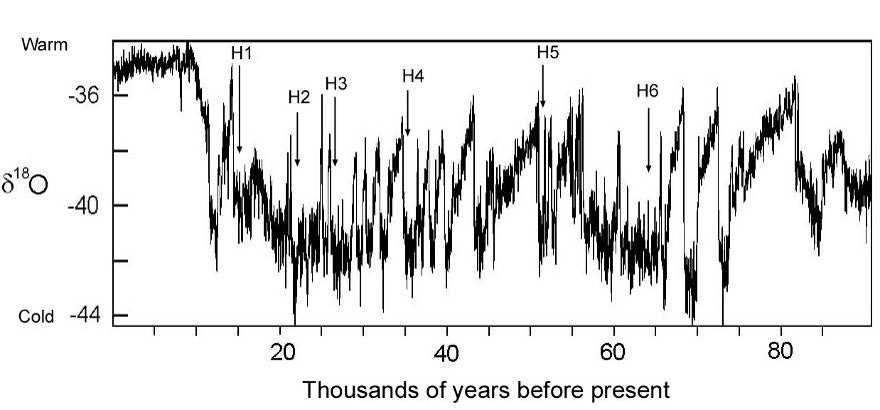
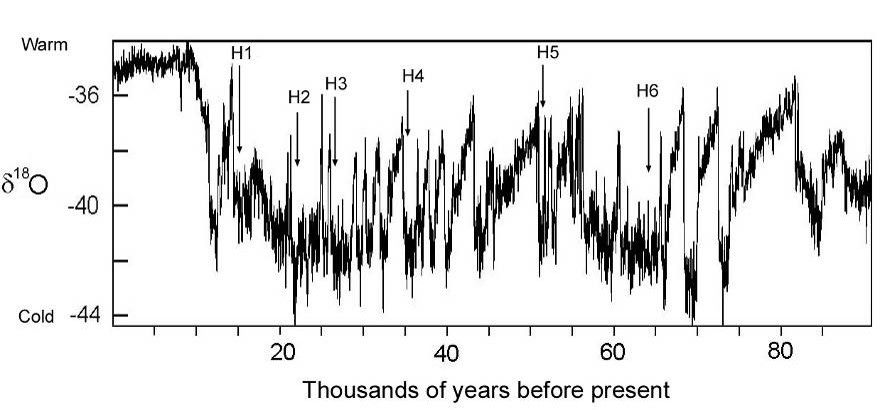
But Heath doesn’t explain what were the selection forces that drove the evolution of human capacity for “mindless” imitation that enabled cumulative culture. This explanation was developed by Pete Richerson and Rob Boyd some years ago, which they continue on refining. Two weeks ago I participated in a workshop, organized by Russ Genet and Pete Richerson, Major Evolutionary Transitions: Biological, Human, and Planetary (UC Davis, September 15-17, 2026). In his talk, titled External Influences on the Evolution of Human Culture, Richerson gave an update on this work. Here’s the key slide, which shows how global climate fluctuated over the past 100,000 years:
Millennial and sub-millennial scale variation from Greenland GRIP core (slide by Peter Richerson, based on data in Ditlevsen et al. 1993).
The most recent period (on the left of the chart), the Holocene (last 11,700 years), has had remarkably stable (and warm) climate. By contrast the preceding geological epoch, Pleistocene, was the time of violent climatic chaos, with recurrent ice ages separated by relatively warm (but brief) interglacial periods. The argument of Richerson and Boyd is that adapting to such violently changing conditions by means of genetic evolution couldn’t work for humans with our relatively long generation times. Genetic evolution, simply, is not fast enough to track rapidly changing environment.
Cultural evolution, on the other hand, while not instantaneous, was fast enough to enable humans to evolve culturally transmitted behaviors that enabled them to survive during the Pleistocene. Although just barely — several times our species was on the brink of extinction. A recent article, A structured coalescent model reveals deep ancestral structure shared by all modern humans, estimates that the numbers of all humans on Earth during the Pleistocene could fall as low as a few thousand, or even less.
Early in his post, Heath throws down the gauntlet, challenging theorists to translate their verbal theories into mathematical models (a methodological challenge with which cliodynamicists heartily agree):
What makes the field of human evolutionary theory so interesting right now is that, deep down, we really don’t know how any of these capabilities evolved. At some level they must have been adaptive, but nobody really understands specifically why or how any of it was adaptive. On the other hand, we know a great deal about how it could not have evolved, because so many bad theories have been proposed over the years, which have not stood up to careful scrutiny. Typically they start out as speculative theories, until someone comes along and says “show me a model of how that could have evolved,” and someone takes the bait, starts building a model... and then realizes that it couldn’t have evolved that way. Indeed, it has turned out to be so difficult to produce an evolutionary model that could plausibly explain any the items on the above list that formal modeling has been where the most interesting action has occurred over the past several decades of research.
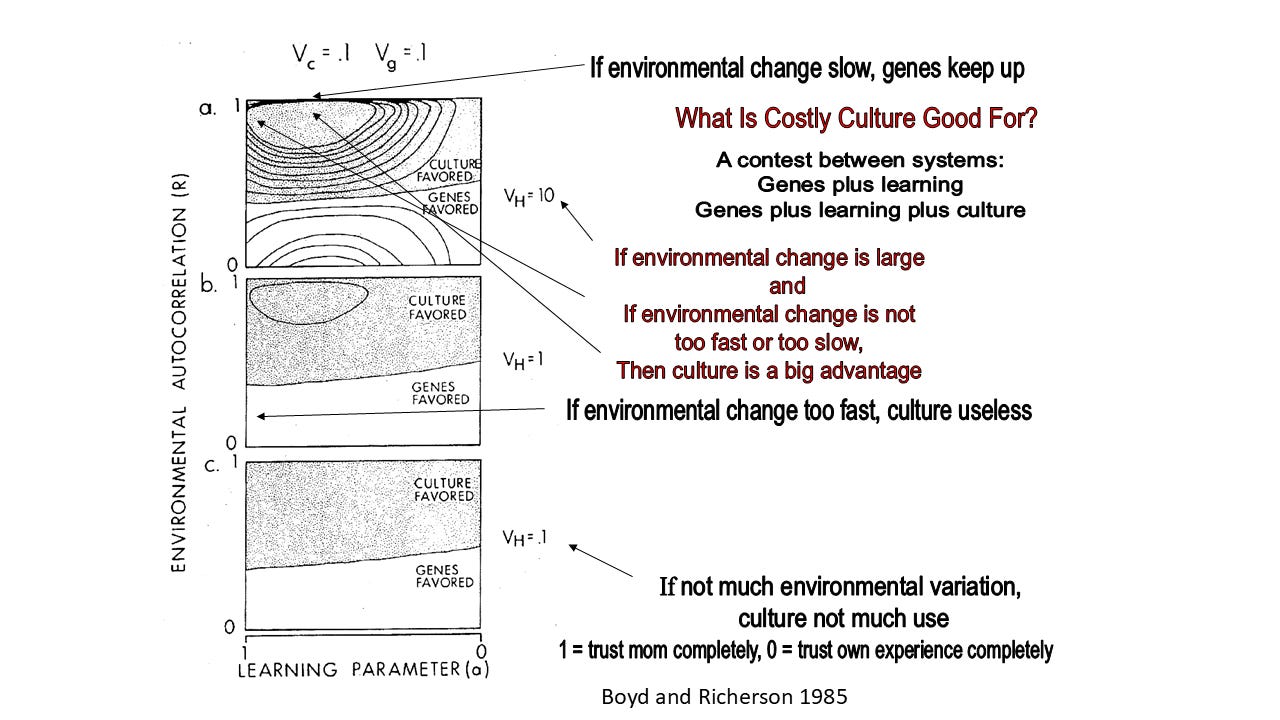
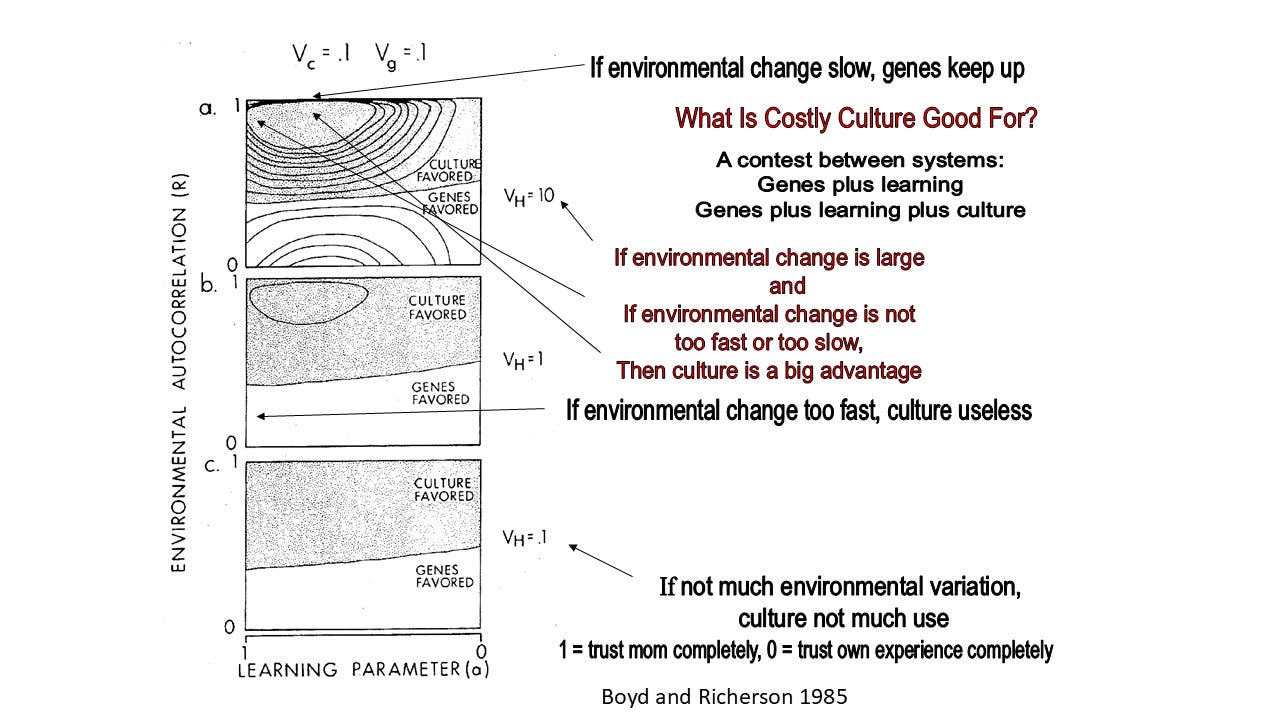
Well, as it happens the explanation linking Pleistocene climatic chaos to the evolution of human culture has been translated into a formal mathematical model by Boyd and Richerson:
Source: Boyd, R, and P J Richerson. 1985. Culture and the Evolutionary Process. Chicago, IL: University of Chicago Press.
In other words, Boyd and Richerson built the model… and realized that “it” could have evolved this way.
Note that cumulative culture doesn’t require language, because social information can be transmitted simply by observing and imitating behaviors of other people. In fact, the next adaptation, which cumulative culture made possible, was not language but cooperation.
The long story is in my book Ultrasociety, so here’s the TL;DR version. Cooperation produces collective benefits, but is privately costly. It’s difficult for it to evolve because “agents” are tempted to free-ride on the efforts of others. The general mechanism by which cooperation evolves is multi-level selection. What many non-specialists don’t realize is the key importance of variation. For cooperation to evolve, variation within groups should be minimized, while variation between groups needs to be maximized. And that’s precisely what “mindless” imitation of other group members does. OK, this is probably still a bit cryptic, so if you are interested in a fully developed explanation I refer you to my book.
The causal chain that cultural evolutionists argue for, thus, starts with the Pleistocene climatic chaos that drove the evolution of culture. Culture enabled the evolution of cooperation by concentrating variation at the between-group level, while minimizing it within groups. Next, as cooperation deepens and becomes more complex, it needs much more sophisticated means of communication, which is a strong selection force for language. Finally, massively cumulative culture, cooperation among increasingly large groups, and capacity for sophisticated communication drove the evolution of intelligence — this trait comes last, not first as Harari (and twentieth century thinkers thought).
To elaborate on the connection between cooperation in large groups and intelligence, consider that cooperation is hard to sustain because of the temptation by people to free-ride. A huge chunk of our cognitive capacities is devoted to keeping track of who is a good cooperator, and who is not, as well as remembering all the gossip (language!) about what Anne did to Sam, and how Karen imposed (or not) sanctions on defectors. (This explanation often goes by the name Machiavellian intelligence hypothesis).
We humans are smart not because we excel in individual cognitive ability, but due to our social intelligence. This is the secret of our success as Henrich’s book explains.
And once human acquired culture, cooperation, language, and intelligence, the Pleistocene ended and we experienced the Great Holocene Transformation. But I don’t need to repeat this story here, as I’ve written about it extensively on this Substack before.
Every so often, some ordinary person, just trying to live his life, winds up getting stuck in the unfortunate position of having to make small talk with me. Even though “What do you do for work?” is usually a reliable conversation-starter, in my case the response (“I’m a philosophy professor”) tends to have a deadening effect. Once in a while, though, someone comes along who’s willing to play ball. Blue-collar guys will sometimes get excited: “Philosophy, cool, I’ve got my own philosophy. We should get some beers someday, and I’ll tell you about it.” On the other hand, tech bros who are willing to play ball often come back with something more bookish, like “What do you think of René Girard?” or “What do you think of Yuval Harari?”
In fact, just the other day I was talking to a guy who went with the Harari gambit. So I told him that I didn’t like Sapiens. He looked a bit crestfallen and asked me why I didn’t like it. I told him I didn’t like it because the theory of human evolution that Harari presented was totally unscientific and wrong. The guy then went to the natural follow-up, which was to ask me what was wrong with it. At that point, I had to exercise considerable self-restraint. Because frankly, I would have loved nothing better than to explain to him everything that was wrong with Harari’s account of human evolution. The problem is that it would have turned into a 20-minute monologue, which is incompatible with the rules of small talk. It would have led me to exhibit the personality flaw that professors develop over time (i.e. lecturing people). So I just mumbled something about it being complicated and moved on.
And yet the answer to his question remained, fully formed in my mind, itching to be released. Since Substack seems as good a place as any to unburden myself, here we go: Not only did Harari’s book annoy me, but all of the critical commentary that I see online is just quibbling (like, “he simplifies this a bit” or “he overstates his claim here”), rather than pointing out the glaring errors in his account.
Furthermore, a lot of people who have read Harari’s book have also read Joseph Henrich’s work and yet don’t seem to realize that the theory Harari is defending is the exact opposite of Henrich’s. Part of the problem is that readers have trouble picking out the structure of these theories, because they don’t understand precisely what the theories are trying to explain. They treat them more like stories than scientific hypotheses. So it’s helpful to start out with some understanding of what the explanatory goals of a theory of human evolution are.
Human beings have four distinct qualities (traits, capabilities, behaviours, etc.) that make us quite different from other animals. These are fairly obvious, but there is unfortunately an entire subgenre of academic pedantry that involves challenging items on the list, saying “other animals do that too!” because there are of course similar capabilities to be found elsewhere.* So in the list below I have added the qualifications needed to disarm these objections and pick out what is absolutely distinctive about humans.
1. Intelligence. Humans possess superior intelligence, not just for instrumental tasks, but also in their ability to engage in mathematical, hypothetical/counterfactual, and logical reasoning.
2. Language. Humans employ complex grammatical speech, with propositional differentiation providing context-independent representation of states of affairs.
3. Cooperation. Humans exhibit a distinctive form of ultrasociality, involving complex cooperation among large groups of genetically unrelated individuals.
4. Culture. Humans engage in domain-general transmission of learned behaviors, producing a large body of cultural artifacts and knowledge that improves cumulatively over time.
What makes the field of human evolutionary theory so interesting right now is that, deep down, we really don’t know how any of these capabilities evolved. At some level they must have been adaptive, but nobody really understands specifically why or how any of it was adaptive. On the other hand, we know a great deal about how it could not have evolved, because so many bad theories have been proposed over the years, which have not stood up to careful scrutiny. Typically they start out as speculative theories, until someone comes along and says “show me a model of how that could have evolved,” and someone takes the bait, starts building a model... and then realizes that it couldn’t have evolved that way. Indeed, it has turned out to be so difficult to produce an evolutionary model that could plausibly explain any of the items on the above list that formal modeling has been where the most interesting action has occurred over the past several decades of research.
Compounding the mystery is that the evolutionary timeline for all of this is extremely short. (Homo erectus only shows up 2 million years ago, etc.) Evolution is very slow. A species like ants, which have been around for 150 million years, have had time to evolve all sorts of fancy adaptations. The entire homo lineage, on the other hand, has simply not been around for very long. This makes it extremely improbable that all four of those items on the list above evolved independently. Furthermore, these complex abilities are highly unlikely to have evolved “from scratch,” as self-standing cognitive modules. Again, due to shortage of time, they are more likely to have emerged through some relatively small “tweak” or modification to a pre-existing system that can already be found in primates.
To pick just one example, humans share with other primates two innate heuristics for making judgements about numbers: a subitization system, which allows us to ‘count’ to three, and a guesstimation system, which allows us distinguish “many” from “few” when eyeballing sets of objects. Testing on human infants shows essentially no difference in the way that these systems work in humans, chimpanzees, orangutans, etc. And yet we are invited to believe that somehow, in the last million years or so, some other evolutionary force came along that, without improving either of these two existing systems, endowed humans with a third “mathematics” module, that gave us the ability, not just to count past three, but to do algebra, geometry, calculus, real analysis, linear algebra, etc. This is not believable. As a result, the most widely held view is that our mathematical abilities must be a byproduct of some other ability, most likely language.
For the past 40 years or so, the big prize in human evolutionary theory has been promised to the theorist able to identify a single, relatively small modification of primate behaviour (ability, capacity, cognition, etc.) that could have produced all four of these distinctive human qualities. Because the most plausible theory would posit only a single adaptation, this means that every contending theory in this space must posit an order of explanation among the four traits listed above. Such a theory would start by picking one of the four items as having arisen first, then show how the other three could have developed as a consequence of this initial modification (probably in sequence).
So every theory is going to have a similar structure: it will posit an initial modification, show how it was adaptive, then explain how it gave rise to a second major trait, then the third, and then finally the fourth. For example, Harari posits the following sequence: 1. intelligence, 2. language, 3. cooperation, 4. culture. (This is in fact why I presented them in that order. What Harari is adopting here is the traditional order of explanation, which was assumed to be correct for the better part of the 20th century.) Henrich, by contrast, posits the following sequence: 4. culture, 3. cooperation, 2. language, 1. intelligence. This is the exciting hypothesis that has been generating interest and attention over the past few decades.
You see now why I said that Henrich’s view is the exact opposite of Harari’s – it literally reverses the order of explanation. So let me say a bit about Harari’s sequence and why scientists have cooled off on that view, before moving on to a quick account of Henrich’s.
The intelligence-first position is obviously a scientific version of the familiar idea, dating back to Plato and Aristotle, that human rationality is the major quality that elevates us above the brutes. It also points to a prominent physiological feature of human beings, clearly present in the fossil record, of encephalization. We have big brains, housed in big skulls. This leads many people to assume that the first stage of human evolution must have been that we became smarter, presumably in direct response to some environmental challenge that made it adaptive (e.g. allowed us to make better tools, to become better hunters, etc.).
The problem with taking intelligence as the starting point, which, strangely enough, Harari acknowledges, is the enormous costs that our big brains impose upon us, both physiologically (they use a lot of energy) and reproductively (they create high levels of mortality in childbirth). It is simply not clear what sort of compensating benefits would have been available in the African savannah to make these tradeoffs worthwhile. If the goal was just to survive and reproduce, by controlling fire and making a few stone tools, the human brain seems strangely overengineered for the task, not to mention massively costly and inefficient. Nevertheless, this is the story that Harari goes with.
Next up is language. Here Harari engages in straight-up handwaving. Language was just a fluke: “The most commonly believed theory argues that accidental genetic mutations changed the inner wiring of the brains of Sapiens, enabling them to think in unprecedented ways and to communicate using an altogether new type of language. We might call it the Tree of Knowledge mutation.”
There are a couple of things wrong with this, beyond the obvious. First, the explanation suffers from a start-up problem. In order for this amazing mutation that made complex language possible to have been adaptive, it would have had to confer some benefit on the first individual to possess that mutation. Being the first person born with the ability to communicate in some “unprecedented way” is not that useful, because who are you going to talk to? The communicative competence would have to have been a byproduct of something else, which spread because it was directly adaptive. Only once it became widespread in the population could language have developed. The alternative would be a gradualist account of how language arose out of a more primitive signaling system that permitted communication with those who did not have the mutation – but then one does not need the mutation to explain it.
This gets us to the second problem with the explanation, which is that lots of animals make noises and engage in signaling, the reason that it doesn’t evolve into anything more complex is that without cooperation language is uninformative. If you take a bunch of antisocial primates, endow them with the ability to speak, the things that they are going to say will be just an expression of their interests. Nothing will be believable, above and beyond what you can infer from watching their behaviour. This is why the signaling systems that we do see in nature are so often costly – this is necessary in order to make the signal credible. Human language, by contrast, is all just cheap talk, and yet somehow manages to be informative. This seems to be possible only because of a prior disposition to engage in cooperative behavior. So the order of explanation seems wrong – you need to have cooperation in place before you are going to see the evolution of language.
Harari, however, claims that things are the other way around – that cooperation is a consequence of language. This idea, which used to be fairly common, has suffered enormously from the development of evolutionary game theory. Back in the 19th and early 20th century, it was often assumed that superior intelligence would give people the rational insight that they should cooperate with one another. Greater attention to the prisoner’s dilemma, however, made it clear that the baseline tendency of superior intelligence would be to entrench uncooperative behaviour, by making people better free-riders.
Harari is aware that the old Kropotkin story about mutual aid cannot be right, and also that group selection is not plausible as a biological account of cooperativeness among humans. So instead he pulls out two theories about how linguistic ability might have made humans more cooperative. The first is derived from an indirect reciprocity model, which suggests that humans cooperate in order to maintain good standing in the community, which is enforced through the circulation of gossip, which tells people who is trustworthy. The second is a variant on the so-called Big God theory, which suggests that people used language to construct mythic systems, which provided them with a credible commitment device that allowed them to cooperate.
The problem with both of these explanations is that they are either regressive or question-begging. Think of the basic problem of human sociality as a collective action problem. The structure of the interaction gives people no incentive to cooperate with one another. The solution cannot be that they cooperate because, if they don’t, people will warn others about them, and they will have fewer opportunities to cooperate in the future. Why would people bother to warn others? As some sort of public service? That’s just another collective action problem. Same thing with big gods. Where does the mythology come from? Why do people believe it, rather than just pretend to believe it? All of these ‘solutions’ to the free rider problem are themselves undermined by free rider problems.
Finally, the most self-evidently false component of Harari’s story is his account of complex culture. This is last in his order of explanation. Technically, he doesn’t believe in culture; his account rather is sociobiological, because he does not treat culture as an inheritance system subject to evolutionary dynamics. Instead, he argues that the development of cooperation allows more people to work together on things like tools, which gives rise to the production of more complex artifacts. This is, quite simply, not an accurate account of technological progress. If one looks at the development of plough agriculture, for example, what one sees is not a group of contemporaries getting together to create more advanced machinery, but rather a process of very gradual, piecemeal improvement over time.
Surveying the landscape, one can see that the traditional order of explanation, despite retaining a certain common-sense appeal, has become hobbled by objections at every step. This is why it was exciting when theorists began to make a serious case for genuinely “outside the box” approaches, such as the one defended by Henrich. Most of this theory, I should note, was pioneered by Peter Richerson and Robert Boyd (here, here, and here). Henrich was Boyd’s student, which is where he got most of it from. Also, I should note that while Henrich has been the most effective at communicating with a broader audience, his own enthusiasm for story-telling sometimes gets in the way of a clear presentation of the view. People always remember the examples that he gives to illustrate the theory, but often fail to grasp the point that the examples were intended to illustrate.
The biggest departure in Henrich’s view is the claim that culture is the primary, original adaptation. The claim is a bit more specific than this. Human culture is made possible by a particular style of social learning, and so the original adaptation – the “tweak” to the basic primate capacities – was the emergence of imitativeness. Human infants got really good, not just at copying what other people do, but at mindlessly copying others – repeating the exact behaviours that they observe. This created the possibility for more complex culture to evolve, somewhat ironically, by freeing it from the bottleneck imposed by individual intelligence. Chimpanzees learn from observing others, but they tend to view the behaviour as a source of inspiration, then use their own intelligence to reproduce the performance. They observe the wheel and then, in a sense, reinvent it for themselves. Human infants, by contrast, are disposed to copy others even when they don’t understand what they are seeing. This means that over time, something like a tool-making procedure can become more and more complex, as people make little improvements to it, yet the next generation of humans is still able to reproduce it, precisely because they do not need to figure out how it works in order to copy it. (Making the evolutionary case for all this, by the way, is a complex modeling challenge. Nothing that I described above is straightforwardly adaptive, which is presumably why one does not see this style of social learning elsewhere in the animal kingdom.)
Readers who have been overexposed to the humanities may be inclined to think that once you bring in culture, suddenly we become free to do whatever we like, and so the rest of the story should be easy. This is clearly wrong. If culture develops through imitation of others, and you start out with an uncooperative species, then the culturally transmitted behaviours are going to be uncooperative as well. If culture somehow gave rise to cooperation, something other than imitation will be needed to explain this. Indeed, the most clever part of the Boyd-Richerson-Henrich story is the way that they account for the transition from culture (4) to cooperation (3).
The first point to grasp is that if human infants learned only from their parents, then no behaviour pattern could emerge culturally that could not also have evolved biologically. This would rule out the cultural evolution of cooperation. Yet as we all know, children learn from sources other than their parents. The two most important additional sources of social learning are role models and peer groups. Each is governed by a powerful heuristic: “imitate the successful” in the case of role models and “imitate the majority” in the case of peers (the latter bias being known to us all as conformism). The big idea – which I’m not going to be able to do justice here – is that conformist social learning increases homogeneity within social groups, thereby potentiating group selection as a force in human cultural evolution. The mechanism of between-group conflict, which is a weak force supporting cooperativeness in biological evolution, becomes a strong force favoring cooperativeness in cultural evolution. Groups with more prosocial behavioural norms are more likely to establish cultural dominance over others. Because of this, human cultures became more cooperative over time.
But that’s not the end of the story. Cultural expectations might have become more cooperative, but human beings were still aggressive, antisocial, individualistic primates. The second component of the theory is the claim that, as cultural expectations diverged from our biological dispositions, cultural conformity began to act as a force for social selection, which set off a process of self-domestication in the human species. (Richard Wrangham has written most entertainingly on this.) The claim, roughly, is that in this new more cooperative cultural context, excessively aggressive and dominant males wound up having their reproductive opportunities curtailed, which led to a series of biological changes that made humans more prosocial by disposition. (This is why Henrich is so interested in gene-culture coevolutionary processes, such as how cultural innovations, like cooking, gave rise to biological changes, like modification of our digestive system.) Cooperativeness, according to this view, started out as just a cultural pattern, but then became partially embedded in our nature through a process of gene-culture coevolution.
Once these two steps in the explanation are in place, the other two are not so difficult. Humans are obviously going to be more interesting to talk to once there is some possibility that they will tell you the truth (or follow rules). There are lots of different versions of how a simple signalling system could have expanded once speakers began to act cooperatively (e.g. here). As far as intelligence is concerned, there is fairly widespread agreement that the direct fitness cost of our brains is so extreme that it must have arisen through some runaway process internal to the species (like the antlers of the Irish elk) and not in response to some fixed environmental challenge. Henrich’s view is that encephalization was driven by the explosive growth of culture. Particularly as cultural adaptations allowed humans to move into environments where we were biologically ill-equipped for survival, the ability to grasp as much of the ambient culture as quickly as possible conferred survival benefits. So the returns to improved cognition and memory became large, as culture provided us with more things worth knowing. My own inclination, as a philosopher, is to put more emphasis on the role that language played in the development of rationality (I am particularly partial to Andy Clark’s account of the “language upgrade” that our biological brains received). This suggests that step 3 must largely have preceded 4, whereas Henrich thinks they could have gone on simultaneously.
So there’s my brief summary of the view. One could go back over this, by the way, and put large question marks beside each of the major claims. None of this is settled science; my subtitle is an exaggeration. I am merely describing where the cutting edge of evolutionary thinking has been over the past several decades. I feel that the theory is worth explaining because, apart from being just monumentally clever, it is also one of the most exciting developments in the human sciences to have occurred during my lifetime. The fact that it is not more widely understood is a pity. One cannot blame the scientists involved for this – most of the major players in the development of the theory have spent a lot of time trying to communicate it to broader audiences in non-technical terms. The problem, I think, lies in how deeply taken-for-granted the traditional order of explanation has become, which results in many readers failing to appreciate how completely this new approach inverts that explanation. But it is also a problem when people like Harari come along and make things more difficult, by taking the old, obsolete view and presenting it as though it were compatible with recent scientific thinking.
____________________
* Many people do this because they think they are scoring points against religion by demonstrating continuity between the behaviour of humans and other animals. This is fine, except that it can cause problems when it comes to explaining the distinctive accomplishments of human beings. This is the major weakness in Frans de Waal’s work. He was so focused on showing that chimpanzees are just like us that he wound up making it harder to explain how human beings manage to accomplish anything different. Most obviously, if chimpanzee politics is just like human politics, then why don’t they have states, or laws, or armies?
Phenomenology is a school of philosophy that origina ted in the late 19th century and early 20th century with the writing of the German philosopher Edmund Husserl. It was a radical new development in philosophy.
What phenomenology offers is an alternative approach to the truth to the one philosophy has been applying for the past two and half thousand years. It is as if Husserl went all the way back to Plato and took a different turnoff along the path to truth. This turnoff has resulted in Phenomenology’s having much more in common with the Eastern schools of philosophy than any other school of the Western tradition.
In this article we are going to look at the history and method of Phenomenology and explore its kinship with Eastern philosophy in more depth.
The historical background
The seeds of phenomenology can be traced back to the 18th century and Immanuel Kant’s distinction between the noumenal world of things-in-themselves and the phenomenal world of reality as experienced through our senses. This thread was picked up in the early 19th century by Georg Wilhelm Hegel with his Phenomenology of Spirit but the birth of Phenomenology as a distinctive philosophical school dates to the works of German philosopher Edmund Husserl in the last decade of the 19th century and the early years of the 20th century.
A circle of followers at several German universities took up his formulation of Phenomenology, but the real heir to Phenomenology’s throne was undoubtedly Husserl’s star student, Martin Heidegger, whose 1928 work Being and Time marked a defining moment in 20th-century philosophy.
After the Second World War, phenomenology’s center of gravity shifted west from Germany to France, where it became a foundational aspect of Jean-Paul Sartre’s Existentialist philosophy and Maurice Merleau-Ponty's philosophy.
Its influence runs through continental philosophy, from Foucault and Derrida to Slavoj Žižek and Judith Butler.
A reversal in the history of philosophy
The word Phenomenology comes from the Greek phainomenon, meaning “that which appears”. The school of Phenomenology focuses on understanding consciousness in its raw form, taking first-hand subjective experience as its starting point rather than the objective world of nature. It is an experientialist rather than a rationalist philosophy.
To illustrate this, let’s use a couple of examples. If we studied time from a rationalist perspective, we would measure it in seconds, minutes, and hours. That is objective noumenal time, which runs at the same speed regardless of human experience. But the phenomenological perspective would look at the subjective first-person experience of time more like the saying attributed to Einstein:
“Put your hand on a hot stove for a minute, and it seems like an hour. Sit with a pretty girl for an hour, and it seems like a minute.”
To the rationalist, time is the same but to the phenomenologist it can appear very different.
Another example is fear. A rationalist might look at fear in terms of physiological changes, such as the activation of the sympathetic nervous system and an increased heart rate, or they might focus on observable behaviors. But the phenomenological perspective talks about what the actual experience of fear is like—the movements and dynamics of consciousness and how it colors the perception of the experience.
What is remarkable about Phenomenology is that it reverses the course of Western philosophy since Plato. Most philosophers offer minor adjustments in the flow of the great conversation. They will criticise their near-contemporaries and adjust the course slightly. But what’s fascinating with Phenomenology is that in many ways it goes back to Plato and takes an alternative course.
Since Plato’s analogy of the cave, philosophy has been riding the rationalist wave with what’s called the representational theory of consciousness. This representational theory holds that we have incomplete access to reality because our senses are creating a representation of what is real and so we are missing out on this reality because our senses are spoon-feeding us a warped, personalised version of what is real.
This is the true beginning of the mind-body separation that crystallised in the work of René Descartes. There is a sense of tragedy in the Western philosophical tradition at humanity’s inability to access this objective Truth. Instead we are stuck in the cave of mere appearances which is devalued as a poor copy of the objective reality.
Phenomenology takes a different tact. Instead of devaluing this phenomenal world of subjective experience, it studies it. What Husserl was trying to do with phenomenology was to make an objective study of the subjective. He was looking to make a science out of consciousness by using systematic reflection to determine the essence of consciousness—its properties and its structures.
Instead of the Platonic representational theory of consciousness, Husserl offers an alternative theory called intentionality.
Intentionality
Intentionality is at the core of Husserl’s philosophy of Phenomenology. As is all too often the case in philosophy, you have to be careful not to think of this word in its everyday use. The term originally comes from the Scholastic medieval philosophical tradition and was resurrected by Husserl’s teacher Franz Brentano (who was also, as it happens, the teacher of Sigmund Freud and Rudolf Steiner). Husserl took the concept and made it the cornerstone of his philosophical school Phenomenology.
Intentionality is often summed up as “aboutness”. This relates to the fact that consciousness is not a thing that can be isolated; consciousness is always about something. It is always in some kind of relationship and interaction with the contents of its experiences.
What is interesting with this intentional conception of consciousness is that it works just as well for the dream world as it does for the waking world. Whether the phenomenon is a fantasy or a reality is irrelevant; the focus is on the interaction between the phenomenon and consciousness. It is not about the external existence of the object but about the study of consciousness and how it interacts with the phenomena presented to it—whether those phenomena come from the external world, a memory or a dream.
This meeting between the phenomenon and consciousness is what Husserl calls Intentionality—it’s the interplay between the content of consciousness and the structures of consciousness.
These structures are called intentionalities and they are the many ways that consciousness interacts with the objects of its experience. They are the different relationships consciousness can have with the object it is “about”. These structures of consciousness are numerous and include perception, memory, protention (anticipation of the future), retention and signification among many others.
A how-to guide to Phenomenology
Now that we know the basics let’s talk about the methodology of Phenomenology. How does one go about doing Phenomenology?
Step one: bracketing
The first step is what Husserl called bracketing (or alternatively phenomenological reduction or epoché). This means that when we approach a phenomenon, let’s say a fire, we set aside all filters and judgments. We home in on the experience of the fire by reducing the phenomenon to its rawest experience.
The fire you’re seeing could be in your imagination; it could be in a dream, or it could be a real fire. To the phenomenologist, it’s all the same, and this all comes back to the idea of Intentionality and the aboutness of consciousness—the relationship it has to the phenomenon of fire.
Step two: eidetic reduction
Once the phenomenon has gone through this process of “bracketing” and we have reduced it to its raw form, the next stage is called eidetic reduction. This comes from the Greek word eidos —the same word Plato uses for his metaphysical Forms or Ideas.
The goal of this eidetic reduction is to find the essence of the phenomenon. This is done using a technique known as imaginary variation whereby the phenomenologist varies all the possible attributes of the phenomenon in order to figure out what its fundamental essence is.
So let’s say you’ve bracketed off the phenomenon of fear and now you’re applying an eidetic reduction to it. With imaginary variation you would mess with the attributes of this fear until you boil it down to what its essence is. So after this sort of investigation you would be left with —as Jose Arcaya noted in his paper on the Phenomenology of fear—attributes like: a feeling of lacking choices and the sense of freezing that accompanies the fear. What you are doing is separating the necessary parts of the phenomenon from the contingent parts.
This essence is the end goal of the phenomenological investigation. For Husserl, at this point we have arrived at a universal scientific truth. We have reached the essence of the phenomenon and this should be as true for you as it is for a Kalahari bushman.
But Husserl’s successor disagreed.
Heidegger’s Phenomenology
Husserlian phenomenology aims at
developing a pure, rigorous science that seeks to capture “knowledge of
essences” by bracketing all conditions that may make one’s consciousness of
something partial.But with Heidegger, the project of phenomenology takes a
different direction. Husserl’s phenomenology was aimed at developing a pure
rigorous science that would capture the knowledge of essences. Phenomenology
was to be a scientific discipline.
With his ontological twist,
however, Heidegger has a different perspective. For him, science is just one
way of knowing. Philosophy goes a layer deeper; it precedes science and
provides its foundation.
Whereas Husserl’s primary concern was formulating the science of consciousness, Heidegger's was ontology and understanding the nature of being. He didn’t believe in Husserl’s quest for knowledge of essences and argued that the experiences in consciousness cannot be separated from the context in which they arise.
You can’t give an objective account of consciousness because it is entangled in the world, it is entangled in being and the conditions of this entanglement vary between individuals, between ages and between different species. Your fear in the 21st century is different from the fear of an ancient Aztec warrior and both are different from the fear of a dog or a gazelle. There is no essence that can be caught and magically bottled. Phenomenology is not a science but something more fundamental—it is an investigation into being itself.
This philosophy of Heidegger is called existential phenomenology over against the transcendental phenomenology of Husserl.
Phenomenology and the East
There is a growing literature on the connections between phenomenology and eastern philosophy. It seems that phenomenology has somehow found a bridging point with the eastern philosophical traditions of India and China that other schools of Western philosophy have not.
Even at a cursory glance, it makes sense. If we look at things like the meridian system of Chinese medicine and the chakra system of the Indian tradition, we see something that looks bizarre from the rationalist point of view. Anatomically speaking there is no heart chakra or third eye chakra to be found. But approached from the phenomenological perspective, we find that we now have a way of approaching these systems. They are maps of the first-person subjective experience of energy in the body. The ancient phenomenologists of China and India mapped out their embodied experience into these models of the human body.
And having sat a number of 10-day Vipassana retreats, the phenomenological overlap becomes apparent. The work of meditation is to observe the body non-judgementally, without generating aversion to negative sensations or craving for positive ones. The goal is simply to observe—to look at the experience objectively and see the impermanence of sensations. The process of Vipassana meditation is bracketing —it’s just to observe the sensations, the biases, the judgments, the resistances and cravings that are constantly bubbling up every moment. Vipassana meditation is a fundamentally phenomenological practice.
A growing literature examines the relationship between phenomenology and these Eastern philosophical traditions, particularly Zen Buddhism and Daoism, and it even seems that Heidegger’s philosophy of Dasein may have been influenced by his reading of the Chinese Daoist philosopher Chuang-Tzu.