Monday, May 30, 2016

2337. Australia, Fearing Fewer Tourists, Has Chapter Taken Out of UN Climate Report

By Michelle Innis, The New York Times, May 27, 2016


SYDNEY, Australia — Leading scientists in Australia and abroad have expressed concern that a new United Nations report about the impact of climate change on dozens of World Heritage sites is absent a chapter describing damage to the Great Barrier Reef, after the Australian government requested that the section be cut.

“I was amazed,” the lead author of the report, Adam Markham, deputy director of climate and energy programs at the Union of Concerned Scientists, said by telephone.

The Australian government requested that the chapter be removed from the report, issued by Unesco and the United Nations Environment Program on Thursday, so that further accounts of damage to the reef, the world’s largest coral ecosystem, would not adversely affect tourism.

In a statement on Friday, the Department of the Environment said “experience had shown that negative comments about the status of World Heritage-listed properties impacted on tourism.” The statement went on to say that the department did not support any of the country’s World Heritage-listed properties being included in “such a publication.’’

Environment Minister Greg Hunt had not been informed of the department’s decision, the statement said, but concerns had been relayed to Australia’s ambassador to the United Nations Educational, Scientific and Cultural Organization, or Unesco.

“But as far as I can see, it is in the newspapers every day,” Mr. Markham said. “Pretty much everyone in the world knows there is a problem on the Great Barrier Reef.”

Mr. Markham said he had thought the report would galvanize support for important sites suffering degradation as sea levels and temperatures rise, and as extreme weather damages the environment.

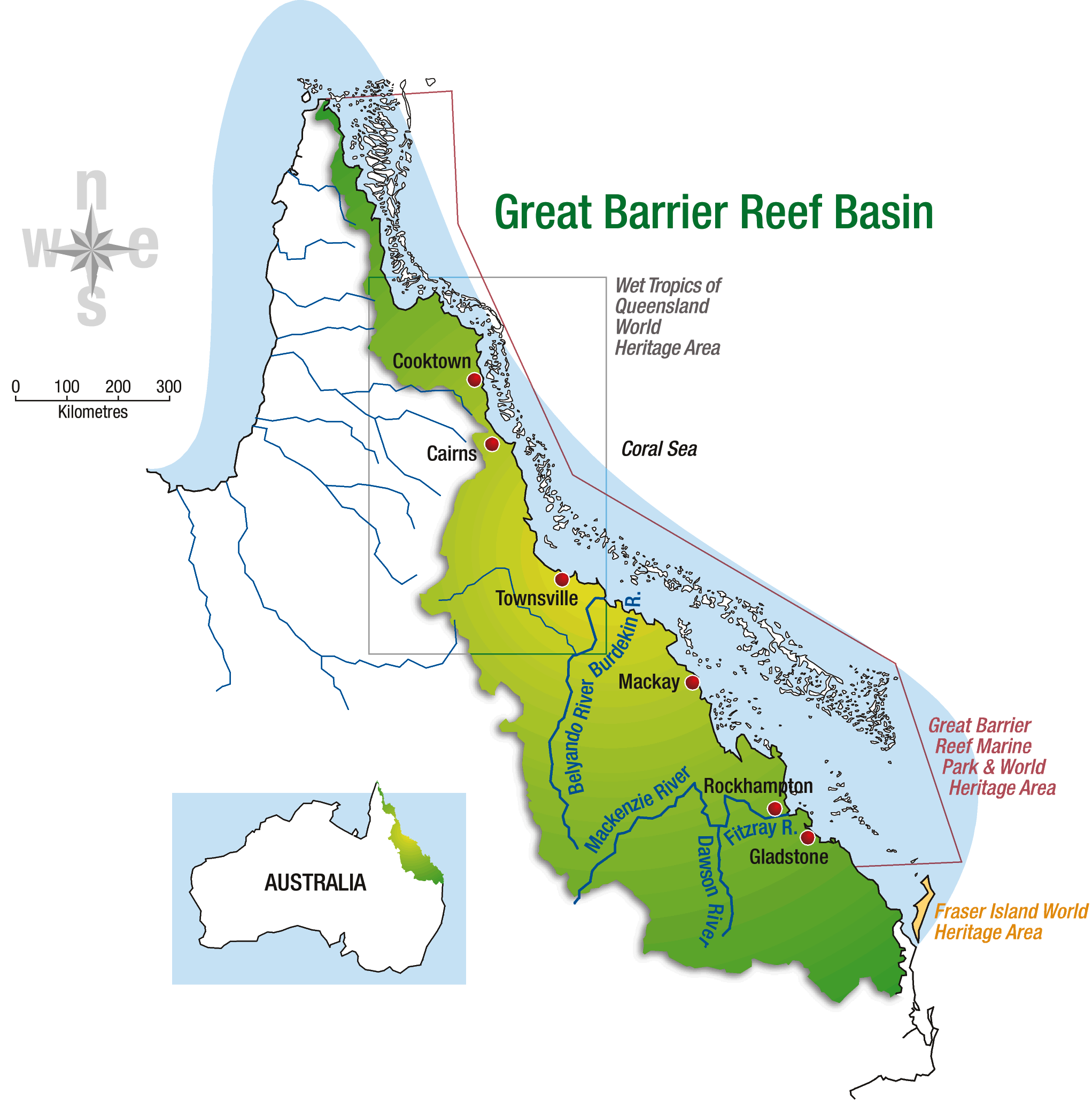
The Great Barrier Reef, which stretches from the tip of northern Queensland more than 1,400 miles southward along Australia’s east coast, has experienced significant coral bleaching over the last year. Bleaching can lead to coral death.

The chapter removed from the report, now published on the website of the Union of Concerned Scientists, warns that Australia is the world’s fourth-largest coal producer and that risks come with plans to expand coal mining and shipping near the reef.

“Its future is at risk, and climate change is the primary long-term threat,” the chapter says.

Australian scientists who reviewed the chapter before the report was published said they were surprised it had been cut.

Ove Hoegh-Guldberg, a director of the Global Change Institute at the University of Queensland, said the report contained nothing new.

“I was naturally a bit disappointed, because the process had not preserved the science,” he said. “And in one sense, if you were trying not to draw attention to the problems on the reef, this would not be the way to do it.”

Prof. Will Steffen of the Climate Change Institute at Australian National University said it was troubling that a government department had succeeded in censoring a global report.

“Australia is the only inhabited continent that is not featured in the report,” he said. “Information is the currency of democracy, and the idea that government officials would exert pressure to censor scientific information on our greatest national treasure is extremely disturbing.”

Australia’s conservative coalition government, in the middle of a re-election campaign, has received little support for its approach to climate change. Prime Minister Malcolm Turnbull did not mention it in a major campaign speech recently and has done little to convince voters that his government believes it is an election issue.

Australia’s national science agency, the Commonwealth Scientific and Industrial Research Organization, or Csiro, is in the middle of a restructuring that includes cutting the number of climate scientists it employs, drawing criticism from scientists at its partner organizations, including NASA.

The inclusion of the Great Barrier Reef in the United Nations report was founded on its significance, Mr. Markham said, adding that references to the island of Tasmania and to Kakadu National Park, in the Northern Territory, had also been removed from the report.

The report does not cover all World Heritage sites; rather, its authors started with about 100 natural and human-made monuments, including Yellowstone National Park and the Statue of Liberty, and winnowed that list to 31 sites in 29 countries.

Terry Hughes, the director of the Center of Excellence for Coral Reef Studies at the Australian Research Council who spent days in April flying over the Great Barrier Reef tracking bleaching and coral mortality rates, said it was astonishing that the reef would be excluded from such a report.

“There is an unprecedented bleaching event underway,” Professor Hughes said. “Climate change and coral bleaching is the single biggest threat to the tourism industry, and the reef itself.”

Sunday, May 29, 2016

2336. The Dawn of the Cthulhucene: A Retrospective

By John Michael Greer, The Archdruid Report, May 4, 2016
Donna Haraway
"This year’s Earth Day in Ashland, Oregon, where I live, featured an interfaith service at the local Unitarian church, and I wasn’t too surprised to get a call inviting me to be one of the presenters.”

That was the opening sentence of the first post ever to appear on The Archdruid Report, Real Druids, which went up ten years ago this Friday. When I typed those words, I had no clear idea of what I was going to do with the blog I’d just started. The end of the publishing industry I wrote for in those days was just then waking up to the marketing potential of author blogs; I was also in the third year of my unpaid day job as head of the Ancient Order of Druids in America (AODA), a small and old-fashioned Druid order distinctly out of step with the pop-culture Neopaganism of the time, and hoped to use a blog to bring the order to the attention of anyone out there who might be interested in something so unfashionable. 

So I sat down at the computer, logged into my Blogger account, clicked on the button marked new post, and stared blankly at it for a while before I started to type. That, as they say, is how it all began.

In terms of the perspectives with which this blog deals—the grand sweep of human history, and the much vaster sweep of geological and evolutionary deep time—ten years is less than an eyeblink. In terms of a single human life, though, it’s a considerable span. Over that period I’ve moved from Ashland to Cumberland, Maryland, the red-brick mill town in the north central Appalachians where I now live. My writing career has burgeoned since then, too, helped along considerably by the two novels and nine nonfiction books that started out as sequences of blog posts. 

My other career, the unpaid one mentioned above, also went through plenty of changes—if any of my readers ever have the opportunity to become the presiding officer of a nearly defunct Druid order and help it get back on its feet, I certainly recommend the experience! Still, twelve years in the hot seat was enough, and at the winter solstice just past I stepped down as Grand Archdruid of AODA with a sigh of relief, and handed the management of the order over to my successor Gordon Cooper. 

There have been plenty of other changes over the last ten years, of course, and quite a few of them also affected The Archdruid Report. One that had a particularly significant impact was the rise, fall, and resurgence of the peak oil scene. Most of a decade before that first post, a handful of people—most of them petroleum geologists and the like—noticed that oil was being pumped much more quickly than new oilfields were being discovered. Now of course this turn of events had been predicted in quite a bit of detail well before then; back in the 1970s, in particular, when the phrase “limits to growth” hadn’t yet become taboo in polite company, plenty of people noticed that trying to extract an infinite supply of oil from a finite planet was guaranteed to end badly.  

That awareness didn’t survive the coming of the Reagan counterrevolution. More precisely, it survived only on the far fringes of the collective conversation of our time, where the few of us who refused to drink Ronnie’s koolaid spent most of two decades trying to figure out how to live in a civilization that, for all intents and purposes, seemed to have succumbed to a collective death wish. Still, our time in exile didn’t last forever.  It was 1998, as I recall, when I found the original Running On Empty email list—one of the first online meeting places for people concerned about peak oil—and I stayed with the movement thereafter as it slowly grew, and the rising tide of data made the case for imminent peak oil harder and harder to dismiss out of hand. 

Two books published in the early 2000s—Richard Heinberg’s The Party’s Over and James Howard Kunstler’s The Long Emergency—helped launch the peak oil movement into public awareness. Not incidentally, those were also the books that convinced me that it might just be possible to talk frankly about the predicament of industrial society: not just peak oil, but the broader collision between the economic ideology of limitless growth and the hard realities of a fragile planet. The Archdruid Report came out of that recognition, though I thought at first that its audience would be limited to the Druid community; I figured that people who had embraced Druid nature spirituality might be more open to the kind of intellectual heresy I had in mind. The blog turned out to have a much broader audience than that, but it took me quite a while to realize that, and longer still to recognize its implications. 

Meanwhile the peak oil movement hit its own peak between 2008 and 2010, and began skidding down the far side of its own Hubbert curve. That’s standard for movements for social change, though it was probably worsened by the premature triumphalism that convinced many peakniks that once they’d proved their case, governments had to do something about the impending crisis, and that also led some large peak oil organizations to spend money they didn’t have trying to run with the big dogs. At this point, as the fracking bubble falters and the economy misbehaves in ways that conventional economic theory can’t account for but peak oil theory can, the bottom has likely been reached, and a much shorter period of exile is duly ending.  Talk about peak oil in the media and the political sphere is picking up again, and will accelerate as the consequences of another decade of malign neglect bear down with increasing force on the industrial world. 

One of the things I find most interesting about this trajectory is that it didn’t impact The Archdruid Report in the way I would have expected. During the years when the peak oil movement was all over large portions of the internet, my monthly page views and other site stats remained fairly modest. It wasn’t until 2010, when the peak oil scene was beginning to falter, that my stats started to climb steadily; my first breakout all-over-the-internet post came in 2011, and thereafter readership has remained high, wobbling up and down around an average of a quarter million page views a month. All ten of my top ten posts, in terms of total unique page views, appeared between 2011 and this year. On the off chance my readers are interested, here they are: 

4. How Not to Play the Game, June 29, 2011
5. An Elegy for the Age of Space, August 24, 2011
6. The Next Ten Billion Years, September 4, 2013
7. Into an Unknown Country, January 2, 2013
9. The Recovery of the Human, February 1, 2012

(I discovered in the process of making this list, by the way, that the Blogger gizmo for tracking all time top posts doesn’t actually do what it’s supposed to do. Like so much of the internet, it provides the illusion of exact data but not the reality, and I had to go back over the raw numbers to get an accurate list. My readers may draw their own conclusions about the future of a society that increasingly relies on internet-filtered information as a source of guidance.) 

None of these posts are only about peak oil, or even about peak energy.  You’ll find references to the hard physical and geological limits of the energy resources available to our species in most of them, to be sure, and quite a few detailed discussions of those limits and their implications among the other 489 posts that have appeared here in the last decade. That said, those limits aren’t quite central to this blog’s project. They derive, like the other common themes here, from something else. 

The philosopher Arthur Schopenhauer noted that his treatise The World as Will and Representation, massive though it is, was simply the working out of a single idea in all its ramifications. The same is true of this blog, though I’m an essayist and novelist rather than an analytical philosopher, and thus my pursuit of the idea I’m trying to pin down has been somewhat more discursive and rambling than his. (I make no apologies for that fact; I write the way I like to write, for those who like to read it.) Not all ideas can be summed up in a few words or a snappy slogan.  In particular, the more thoroughly an idea challenges our basic preconceptions about the nature of things, and the more stark the gap between its implications and those of the conventional wisdom, the more thoroughly and patiently it must be explored if it’s going to be understood at all. 

Even so, there are times when an unexpected turn of phrase can be used, if not to sum up a challenging idea, at least to point in its direction forcefully enough to break through some of the barriers to understanding. Thanks to one of my readers—tip of the archdruidical hat to Mgalimba—I encountered such a turn of phrase last week. That came via a 2014 talk by cutting-edge thinker Donna Haraway, in which she challenged a currently popular label for the geological period we’re entering, the Anthropocene, and proposed her own coinage: the Cthulhucene. 

She had specific reasons for the proposal, and I’d encourage my readers to see what she had to say about those, but I have somewhat different reasons for adopting the term. H.P. Lovecraft, who invented the squid-faced, dragon-winged, monster-clawed devil-god Cthulhu for one of his best stories, used that being and the other tentacled horrors of his imaginary pantheon to represent a concept as alien to the conventional thought of industrial society as the Great Old Ones themselves. The term Lovecraft used for that concept was “indifferentism”—the recognition that the universe is utterly indifferent to human beings, not sympathetic, not hostile, not anything, and that it’s really rather silly of us, all things considered, to expect it to conform to our wishes, expectations, or sense of entitlement. 

Does this seem embarrassingly obvious? The irony, and it’s a rich one, is that most people nowadays who insist that the universe is indifferent to humanity turn around and make claims about the future that presuppose exactly the opposite. I’ve long since lost track of the number of committed atheists I’ve met, for example, who readily agreed that the universe is indifferent to our desires, but then insisted there has to be some other energy resource out there at least as cheap, concentrated, and abundant as the ones we’re currently using up. That claim only makes sense if you assume that the supplies of matter and energy in the cosmos have somehow been arranged for our benefit; otherwise, no, there doesn’t have to be any other resource out there. We could simply use up what we’ve got, and then have to get by without concentrated energy sources for the rest of the time our species happens to exist. 

That’s far from the only example of stealth anthropocentrism I’ve encountered in the same context. I’ve also long since lost track of the number of committed atheists who reject the idea of a caring cosmos out of hand, but then go on to claim that technological progress of the kind we’ve made is irreversible. That claim only makes sense if you assume that history is somehow arranged for our benefit, so that we don’t have to worry about sliding back down the long slope we climbed so laboriously over the last five centuries or so.  If history is indifferent to our preferences, by contrast, the way down is just as easy as the way up, and decline and fall waits for us as it did for all those dead civilizations in the past. 

Then there’s the most embarrassing claim of all, the devout insistence that humanity’s destiny lies out there in space. “Destiny” is a theological concept, and it’s frankly risible to find it being tossed around so freely by people who insist they’ve rejected theology, but let’s go a step further here. If the universe is in fact indifferent to our wishes and desires, the mere fact that a certain number of people have gotten worked up over science-fiction visions of zooming off toward the stars does not oblige the universe to make space travel a viable option for our species. There are in fact very good reasons to think that it’s not a viable option, but you won’t get many people to admit that these days. We (or, rather, some of us) dream of going to the stars, therefore it must be possible for us to go to the stars—and before you claim that human beings can achieve anything they can imagine, dear reader, I encourage you to read up on the long history of attempts to build a working perpetual motion machine. 

I’ve picked on atheists in these three examples, and to some extent that’s unfair. It’s true that most of the really flagrant examples of stealth anthropocentrism I’ve encountered over the last ten years came from people who made quite a point of their atheism, but of course there’s no shortage of overt toxic anthropocentrism over on the religious side of things—I’m thinking here of those Christian fundamentalists who claim that Christ is coming soon and therefore it doesn’t matter how savagely we lay waste a world they themselves claim that God made and called good. I’ve met atheists, to be fair, who recognize that their belief in the absence of purpose in the cosmos implies that no providence will protect us from the consequences of our own stupidity. I’ve also met religious people who recognize that the universe defined by their beliefs is theocentric, not anthropocentric, and that human beings might therefore want to cultivate the virtue of humility and attend to the purposes that God or the gods might have in mind, rather than assuming in blithe arrogance that whatever humanity thinks it wants, it ought to get. 

The dawn of the Cthulhucene represents the arrival of a geological period in which those latter ways of understanding the world will be impossible to ignore any longer. We are beginning to learn no matter how hard we scrunch our eyes shut and plug our ears and shout “La, la, la, I can’t hear you” to the rest of the universe, the universe is not going to give us what we want just because we want it:  that the resources we waste so cluelessly will not be replaced for our benefit, and we will have to face every one of the consequences of the damage we do to the planetary biosphere that keeps us alive. In place of the megalomaniacal fantasy of Man the Conqueror of Nature, striding boldly from star to star in search of new worlds to plunder, we are beginning to see a vast and alien shape rising before us out of the mists of the future, a shape we might as well call Cthulhu: winged, scaled, tentacled, clawed, like a summary of life on earth, regarding us with utterly indifferent eyes. 

In those eyes, we balding social primates are of no more importance in the great scheme of things than the trilobites or the dinosaurs, or for that matter the countless species—intelligent or otherwise—that will come into being long after the last human being has gone to join the trilobites and dinosaurs in Earth’s library of fossil beds.  The sooner we grasp that, the easier it will be for us to drop the misguided anthropocentric delusions that blind us to our situation, wake up to the mess we’ve made of things, and get to work trying to save as many of the best achievements of the last three hundred years or so before the long night of the deindustrial dark ages closes in around us. 

Given that the universe is simply not interested in pandering to the fantasies of omnipotence currently fashionable among influential members of our species—given that no special providence is going to rescue us from the consequences of our assorted stupidities, no resource fairy is going to give us a shiny new energy source to make up for the resources we now squander so recklessly, and the laws of nature are already sending the results of our frankly brainless maltreatment of the biosphere back in our faces with an utter lack of concern for our feelings and interests—how should we then live? That’s the theme that I’ve been trying to explore, in one way or another, since this blog got under way. It’s a vast theme, and one that I haven’t even begun to exhaust yet. I have no idea if I’m still going to be blogging here ten years from now, but if not, it won’t be due to lack of things to talk about.

One more thing deserves to be said here, though. All along the journey that brought me from that first tentative post to this week’s retrospective, one of the things that’s made the way easier and a good deal more enjoyable has been the enthusiasm, understanding, and critical insight that’s been shown by so many of my readers. Time after time, faced with the choice of backing away from a controversial subject or plunging ahead, I’ve taken the plunge, and discovered that my readers were more than ready to jump with me. Time after time, too, when I’ve offered a rough sketch of some part of the landscape I’m trying to explore, my readers have asked questions and posed challenges that helped me immeasurably in clarifying my thinking and discarding approximations that didn’t work. As this blog begins its eleventh year, I’d like to thank everyone who’s made a comment here—and also everyone who’s made a donation to the tip jar and thus helped me afford the hours each week that go into these blog posts. My gratitude goes with each of you; I hopoe you've found the journey so far as rewarding as I have.
Wednesday, May 25, 2016

2335. Organic Farmers Are Not Anti-Science but Genetic Engineers Often Are

By Elizabeth Henderson, Independent Science News, May 24, 2016

Elizabeth-Henderson (photo courtesy Audrey Horn)
Elizabeth Henderson. Photo: courstesy of Audrey Horn.
At one of the public brainstorming sessions for the New York Organic Action Plan, an organic farmer made an impassioned plea for support for “independent science” and told us that with 8.5 billion mouths to feed by 2050, we will need genetic engineering to prevent starvation.

I would like to examine these words carefully to decipher what they mean, how those words are used by this farmer and by others, and suggest how the movement for locally grown organic food in this country should respond.
What is the meaning of ‘independent science’? As co-chair of the Policy Committee for the Northeast Organic Farming Association of New York (NOFA-NY), I have been an active participant in the coalition that is campaigning to pass GMO labeling legislation in NY State. In this capacity, I have spoken at public meetings, to the press and on radio interviews. A question that I have heard from proponents of biotechnology is “why do you organic farmers oppose science, like the climate deniers?”
The first time I heard this, I was startled and felt defensive. Had I ever opposed science?  I searched back through things I had written and reviewed all the policy resolutions the members of NOFA-NY had passed over the years. I found a few places where I criticized reductionist science and defended “indigenous knowledge” (that is things like composting and crop rotations that people who practice a craft know and pass on to their children that has not been proven by research at a university). But nowhere could I find any statement opposing science. Just recently, I reviewed with approval this statement from an organic farming group:
“We support the International Federation of Organic Agricultural Movement’s (IFOAM) definition that organic agriculture is a production system that sustains the health of soils, ecosystems and people. It relies on ecological processes, biodiversity and cycles adapted to local conditions, rather than the use of inputs with adverse effects. Organic agriculture combines tradition, innovation and science to benefit the shared environment and promote fair relationships and a good quality of life for all involved.”
My farm has cooperated in any number of research projects with Cornell University scientists.  We have tested cover crops, held a field day with the Cornell soil health group to allow them to demonstrate the ways a farm can test for biological activity, use a penetrometer, and a rain simulator that shows how much aggregate stability the soils have. We spent 7 years working with Molly Jahns and her team on breeding a variety of sweet pepper. It is earlier ripening, cucumber mosaic virus resistant, and is open-pollinated (and now bears the name of our farm – Peacework!). I served for four years on the Sustainable Agriculture Research and Education Program technical committee and three years on the administrative council. Unlikely activities for someone who is against science.
So what does this question about independent science really mean? I have come to understand that by “science” the biotech folks mean genetic engineering. They are deliberately conflating these two terms. And that seems to be how the farmer at our meeting was using the words too.
So since I do not oppose science, do I oppose genetic engineering? Yes and no. I share with geneticists their fascination with the functioning of the tiniest of particles that make up living matter. One of my favorite books is A Feeling for the Organism (by Evelyn Fox Keller, 1984), a biography of Barbara McClintock (1902-1992), a cytogeneticist who specialized in corn. McClintock was one of the first to map the corn genome. She demonstrated that genes turn physical characteristics on and off and discovered genetic transposition or “jumping genes.” She shook the notion that science held as a truth that the genome is a stationary entity with the genes in an order that is unchanging by showing that it is subject to alteration and rearrangement. For many years, the mainstream of science regarded her with disapproval only eventually to catch up with her and then heap honors on her great discoveries. Science lurches forward – and a great leap is yet to be made for a full comprehension of the relationship between genes and the environment.
The more geneticists look into it, the more complex the relationship of genes to physical traits turns out to be. As Jonathan Latham puts it:
“a defined, discrete or simple pathway from gene to trait probably never exists. Most gene function is mediated murkily through highly complex biochemical and other networks that depend on many conditional factors, such as the presence of other genes and their variants, on the environment, on the age of the organism, on chance, and so forth. Geneticists and molecular biologists, however, since the time of Gregor Mendel, have striven to find or create artificial experimental systems in which environmental or any other sources of variation are minimised so as not to distract from the more “important” business of genetic discovery.
“But by discarding organisms or traits that do not follow their expectations, geneticists and molecular biologists have built themselves a circular argument in favour of a naive deterministic account of gene function. Their paradigm habitually downplays the enormous complexities by which information passes (in both directions) between organisms and their genomes. It has created an immense and mostly unexamined bias in the default public understanding of genes and DNA.” (Latham, op cit)
McClintock’s story reveals how hard it is for the scientific mainstream to accept new concepts. This becomes especially difficult when large commercial entities like chemical/seed corporations build their empires on an interpretation of a scientific phenomenon. And even more difficult when our universities are starved for public research funds and become dependent on corporate support.
I am not against genetic engineering in principle, nor is the organic movement internationally. What we are against is the rush to commercialize crops that have not been adequately tested for safety. There is so much we do not know about them. When you move one gene, many other genes shift and geneticists do not know enough yet to predict the results (Wilson et al., 2006). That is why standards for organic certification in the US and all around the world do not allow the use of genetically engineered seed or other materials like GE rennet in cheese. In regulating any novel technology, we should follow the precautionary principle. Test carefully and at length before commercializing. This has not been done with GE crops. Every cultivar is different and each one should be tested individually (Maffini et al., 2013; GAO, 2010).
Meanwhile, corporations like Monsanto, Dow, Syngenta, etc. have been commercializing a very few money-making GE cultivars that farmers are growing on millions of acres that are doused with toxic chemicals.
The scientific evidence shows that the widespread adoption of genetically engineered crops in the US has led to: 1) an increase in pesticides used in agriculture, according to the U.S. Department of Agriculture’s Pesticide Data Program; 2) development of herbicide resistance in over 20 weed species; 3) insecticide resistance in target pests, including corn rootworms; 4) increased residues of pesticides in foods, including Roundup, a probable human carcinogen; 5) loss of biological diversity, including Monarch butterflies, and 6) massive increases in seed costs for farmers (Huber, 2011).
EPA provides annual average use estimates for the decade 2004-2013. According to Carey Gillam in “What Is Going On With Glyphosate? EPA’s Odd Handling of Controversial Chemical” (May 3, 2016):
“Seventy crops are on the EPA list, ranging alphabetically from alfalfa and almonds to watermelons and wheat. Glyphosate used on soybean fields, on an annual basis, is pegged at 101.2 million pounds; with corn-related use at 63.5 million pounds. Both those crops are genetically engineered so they can be sprayed directly with glyphosate as farmers treat fields for weeds. Cotton and canola, also genetically engineered to be glyphosate tolerant, also have high use numbers. But notable glyphosate use is also seen with oranges (3.2 million lbs.); sorghum (3 million lbs.); almonds (2.1 million lbs.); grapes, (1.5 million lbs.); grapefruit and apples (400,000 lbs. each); and a variety of fruits, vegetables and nuts.”
Since 1974, farmers have poured 1.8 billion kilograms of Roundup on fields (Benbrook, 2016). While independent studies of the safety of GE foods are scarce (because the owners of the Utility Patents of GE plants refuse to allow truly independent research), there are many studies of Round-Up and its main ingredient glyphosate that show it attacks the beneficial organisms in the human digestive system, causing serious health problems – increased birth defects, neurological developmental problems in children, kidney failure, respiratory problems, allergies (Sparling et al., 2006; Benedetti et al., 2013; Lopez et al., 2012; Mesnage, et al., 2015 Marin-Morales et al., 2013; Gress et al., 2015). Studies show that Roundup is a powerful soil biocide, resulting in the increase of microbial plant pathogens and mycotoxins (Johal and Rahe, 1988; Fernandez et al., 2005; Kremer and Means, 2009; Johal and Huber, 2009).
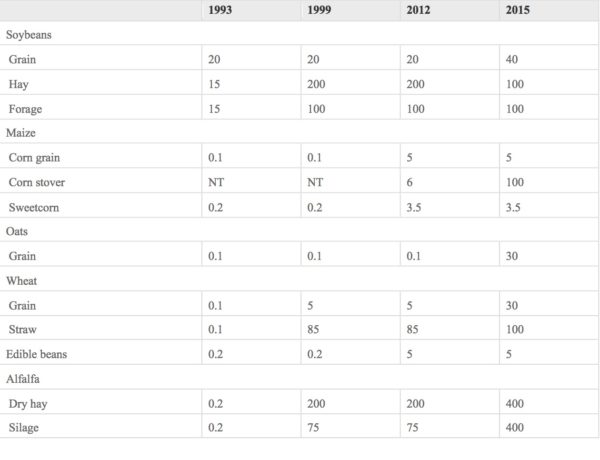
The use of GE crops is part of the whole package of industrialized farming, an integrated system that enables corporate control of our food system (for the results of this see Fig 1 Glyphosate Tolerance Levels since 1993; taken from Benbrook, 2016).
Glyphosate tolerance levels since 1993 (EPA)
GLYPHOSATE TOLERANCE LEVELS SINCE 1993 (EPA)
There has been a speed-up in farming – a grain farmer used to be able to support a family with 160 acres.  Now it takes 1600.  The Roundup-GE package goes with the speed-up. And US government regulation has failed to protect the public from the toxic herbicides that farmers spray on GE crops.
One selling point of Roundup is that it breaks down quickly. That is why you can purchase it off the shelf in garden/hardware stores.  That is accurate – it does break down quickly. But what Monsanto does not mention is that Roundup breaks down into AMPA, which lasts much longer and may be more toxic than glyphosate. (Torstensson 1985; Torstensson et al., 1989; Andréa et al., 2003; Battaglin et al., 2014).
Recently, the World Health Organization declared glyphosate a probable carcinogen, and many studies since 1985 have shown it to be an endocrine disruptor. But that did not stop the Environmental Protection Agency in 2013 from increasing the amount of glyphosate that is considered safe as a residue in soy beans, corn and other crops (see fig.).
It is extremely unscientific and poor public policy for the patent office, a federal agency, to grant billions of dollars of utility patent rights for GE technology based on a demonstration of material difference, and for FDA, another federal agency, to be simultaneously denying consumers basic information about the use of that technology in their food, based on that agency’s finding of a lack of material difference.
Internal FDA documents obtained by the Alliance for Bio-Integrity during a 1998 lawsuit against the agency reveal that the FDA’s Biotechnology Coordinator, James Maryanski, knew full well the potential risks but chose to override them. A November 1, 1991 memo to Maryanski titled “Points to Consider for Safety Evaluation of Genetically Modified Foods. Supplemental Information”, detailed the potential problems with new genetically engineered crops:
“increased levels of known naturally occurring toxicants, appearance of new, not previously identified toxicants, increased capability of concentrating toxic substances from the environment (e.g. pesticides or heavy metals) and undesirable alterations in the levels of nutrients.” (cited in Druker, 2015).
Despite this, the FDA claimed, and continues to assert that genetically engineered foods are perfectly safe and has classified them as “generally regarded as safe” or GRAS under current FDA guidelines.
The utility patents which Monsanto and other corporations hold on seed give them control over every use of that seed – including research to test it for safety.  Farmers are not allowed to save and share the seed. University scientists must have permission from the patent holder and have to pay royalties to do research on patented seed. That is a significant barrier to independent science. By contrast, the Open Source Seed Initiative (OSSI) allows seed purchasers free use of the seed and asks for a pledge
“not to restrict others’ use of these seeds or their derivatives by patents or other means, and to include this Pledge with any transfer of these seeds or their derivatives.” (FEDCO 2016 catalogue, p. 3).
Unfortunately, we do not live in a sweet world where researchers are free to work for the people and the earth and where decisions on what research gets funded are made purely on the basis of which projects benefit the largest number of poor and hungry people in former imperial colonies.
Just as the biotech proponents conflate “science” and GMOs, I and the organic movement conflate our struggle for family-scale, local, organic or agroecological agriculture and against corporate control with the fight against gmos. Buying Roundup Ready seed is not a free choice for farmers. Using that seed ensnares the farmer in Monsanto’s clutches.
There are economic issues here as well. Major Goodman of North Carolina State University, a respected corn geneticist and member of the National Academy of Sciences, stated in testimony before the National Research Council that conventional breeding typically costs about $1 million per trait, while genetic engineering costs $136 million per GE trait, with most of the cost due to research and development, not to regulatory expenses.
If we could assemble a council of farmers and scientists to evaluate the most cost-effective ways to invest public resources to eliminate world hunger, it is doubtful that they would choose genetic engineering. The 2008 United Nations International Assessment of Agricultural Knowledge, Science and Technology for Development (IAASTD), a comprehensive report on the future of farming, authored by 400 scientists and backed by 58 governments, stated that yields of GM crops were “highly variable” and in some cases, “yields declined”. The IAASTD concluded that since 70% of the world’s population is fed by small farms, many run by women, the best course would be to increase investments in agroecology (IAASTD, 2009).
That means doing the kind of work that the organic farmers of the Northeast (under the auspices of NOFA and MOFGA) have been doing for over four decades – helping family-scale farmers, homesteaders and gardeners learn more about how to produce the healthiest, most nutrient dense food using local resources and providing ways for them to share this learning with one another.  Farmer to farmer – campesino to campesino. Scientists who respect the “indigenous” knowledge of farmers can help the way Molly Jahns’ team did in the Peacework pepper breeding project.
If some of the millions spent on genetic engineering were directed to farmer-scientist organizations like Masipag (Farmer-Scientist Partnership for Development) in the Philippines and the National Organic Agriculture Movement of Uganda (NOGAMU), there would be much more progress towards local self-reliance.
I am totally with the organic farmer who declared at our meeting that agriculture needs applied research and technology and that our Land-Grant universities should invest in applied research programs to find the solutions to the complex problems facing farmers today. The division of farmers into two camps – organic and conventional – is destructive and prevents us from learning from one another. It would help all farmers if the USDA research apparatus had funding to support organic research programs at higher levels than the current barely 2 percent of all USDA research dollars.
So at this time, I do not think the organic movement should drop our opposition to allowing certified organic farms to use GE crops.  We should continue to campaign for labeling GMOs. We should call upon Cornell to disband its propaganda arm for GMOs – the Alliance for Science – or repurpose it under the guidance of a board that represents the interests of the people of NY State. We should not oppose continuing research in genetic engineering, but we should demand that equal resources go into agroecology. Independent Science is a great concept.  Let’s work together with conventional farmers for applied research that keeps our farms in business and allows us to grow the healthiest food for all the people while regenerating our soils and arresting climate change.
PS. I urge defenders of GMOs to read Altered Genes, Twisted Truth: How the Venture to Genetically Engineer Our Food Has Subverted Science, Corrupted Government, and Systematically Deceived the Public, by Steven M. Druker (Clear River Press, 2015).

References


Andréa MM, Peres TB, Luchini LC, Bazarin S, Papini S, Matallo MB, Savoy VL (2003). Influence of repeated applications of glyphosate on its persistence and soil bioactivity. Pesquisa Agropecuária Brasileira 38: 1329–1335.
Battaglin WA, Meyer MT, Kuivila KM, Dietze JE (2014) Glyphosate and its degradation product AMPA occur frequently and widely in U.S. soils, surface water, groundwater, and precipitation. J Am Water Resour Assoc 50: 275–290.
Benbrook, C (2016) Trends in glyphosate herbicide use in the United States and globally. Environmental Sciences Europe 28: 3 DOI: 10.1186/s12302-016-0070-0.
Benedetti D, Nunes E, Sarmento M, Porto C, dos Santos CEI, Dias JF, et al. Genetic damage in soybean workers exposed to pesticides: evaluation with the comet and buccal micronucleus cytome assays. Mutat Res. 752: 28–33.
Government Accountability Office (GAO). “FDA Should Strengthen Its Oversight of Food Ingredients Determined to Be Generally Recognized as Safe (GRAS)” GAO-10-246, Feb 3, 2010.
Gress, Steeve; Lemoine, Sandrine; Séralini, Gilles-Eric; Puddu, Paolo Emilio (2014). Glyphosate-Based Herbicides Potently Affect Cardiovascular System in Mammals: Review of the Literature. Cardiovascular Toxicology 15: 117–126. doi:.10.1007/s12012-014-9282-y
Huber D. (2011) Letters from Prof Don Huber to US and EU administrations Sent to President Jose-Manuel Barroso EU President cc to President Herman Van Rompuy, President Jerzy Buzek, Commissioner John Dalli and some MEPs March 25, 2011. These letters include extensive research citations which support this statement.
Johal GS and Rahe JE (1988) Glyphosate, hypersensitivity and phytoalexin accumulation in the incompatible bean anthracnose host-parasite interaction. Molec. Plant Pathol. 32: 267-281.
Fernandez MR, Selles F, Gehl D, DePauw RM and Zentner RP (2005) Crop production factors associated with Fusarium head blight in spring wheat in eastern Saskatchewan. Crop Science 45: 1908-1916 .
Kremer and Means, J. (2009) Glyphosate and glyphosate-resistant crop interactions with rhizosphere microorganisms. Europ. J. Agronomy 31: 153–161.
Johal GS and Huber, D. (2009) “Glyphosate Effects on Diseases of Plants“, European J Agronomy 31: 144–152.
Lopez SL, Aiassa D, Benitez-Leite S, Lajmanovich R, Manas F, Poletta G, et al. (2012) Pesticides used in South American GMO-based agriculture: a review of their effects on humans and animal models. Advances in Molecular Toxicology. Fishbein JC, Heilman JM. New York, Elsevier 2012, 6: 41–75.
Maffini MV, Heather M. Alger, Erik D. Olson, and Thomas G. Neltner. “Looking Back to Look Forward: A Review of FDA’s Food Additives Safety Assessment and Recommendations for Modernizing its Program,” Comprehensive Reviews in Food Science and Food Safety, Vol.12 (439-453)2013. http://onlinelibrary.wiley.com/doi/10.1111/1541-4337.12020/pdf, accessed 8/17/2013.
Marin-Morales MA, de Campos Ventura-Camargo B, Hoshina MM (2013). Chapter 16 – Toxicity of Herbicides: Impact on Aquatic and Soil Biota and Human Health. Herbicides–Current Research and Case Studies in Use (PDF). pp. 399–443.
Mesnage, R, Arno, M, Costanzo, M, Malatesta, M, Séralini, G-E, and Antoniou, M N. (2015) Transcriptome profile analysis reflects rat liver and kidney damage following chronic ultra-low dose Roundup exposure. Environmental Health  14:70 DOI 10.1186/s12940-015-0056-1.
Sparling DW, Matson C, Bickham J, Doelling-Brown P (2006). Toxicity of glyphosate as Glypro® and LI700 to red‐eared slider (Trachemys scripta elegans) embryos and early hatchlings. Environmental Toxicology and Chemistry 25 (10): 2768–2774. doi:10.1897/05-152.1
Torstensson, L. 1985. Behavior of glyphosate in soils and its degradation. The Herbicide Glyphosate. Chap. 9. p. 137-150. Swedish University of Agricultural Sciences. Uppsala, Sweden.
Torstensson NTL, Lundgren L, Stenström J (1989). Influence of climatic and edaphic factors on persistence of glyphosate and 2,4-D in forest soils. Ecotoxicology and Environmental Safety 18 (2): 230–9. doi:10.1016/0147-6513(89)90084-5
Wilson AK, JR Latham and RA Steinbrecher (2006) Transformation-induced mutations in transgenic plants: Analysis and biosafety implications. Biotechnology and Genetic Engineering Reviews 23: 209-234.