Showing posts with label Coral reefs. Show all posts

Saturday, April 21, 2018

2887. Damage to Great Barrier Reef From Global Warming Is Irreversible, Scientists Say

By Jacqueline Williams, The New York Times, April 19, 2018
A diver surveying damaged coral in the Great Barrier Reef after a mass bleaching in 2016. Photo:
XL Catlin Seaview Survey, via Agence France-Presse — Getty Images
SYDNEY, Australia — An underwater heat wave that damaged huge sections of Australia’s Great Barrier Reef two years ago spurred a die-off of coral so severe that scientists say the natural wonder will never look the same again.

Scientists said nearly one-third of the reef’s coral were killed when ocean temperatures spiked in 2016, a result of global warming, according to a study published Wednesday in the journal Nature.

The damage to the reef, one of the world’s largest living structures, has also radically altered the mix of its coral species, scientists said.

“The reef is changing faster than anyone thought it would,” said Terry P. Hughes, the lead author of the study and the director of a government-funded center for coral reef studies at James Cook University in Queensland.

“One thing we can be sure about is the reef isn’t going to look the same again,” Professor Hughes said.

The reef is home to thousands of species, including sharks, turtles and whales. Australia relies on it for about 70,000 jobs and billions of dollars annually in tourism revenue, all now threatened by years of accumulated damage.

The study’s authors estimated how much coral had died in the immediate aftermath of the 2016 heat wave, and then returned nine months later to discern how many corals had regained their color — a sign of restored health — and how many had died. Their report describes a catastrophic die-off on the northern part of the reef, impacting the mix of coral species.

Professor Hughes said scientists had predicted a mass die-off resulting from global warming, but “what the paper shows is that it’s well underway.” He added, “That transition is happening here and now.”

Corals require warm water to thrive, but they are extremely sensitive to heat, and an increase of two or three degrees Fahrenheit above normal can kill them.

Scientists said that if nations honored global commitments in the Paris climate accord aimed at preventing temperatures from rising more than 2 degrees Celsius, Australia would still have the Great Barrier Reef in 50 years. It would still look very different from today.

But if greenhouse gas emissions continue on their current trajectory, the reef will be unrecognizable, they said.

“We’re in unchartered territory,” Professor Hughes said, adding, “Where we end up depends completely on how well or how badly we deal with climate change.”

The Great Barrier Reef has bleached four times since 1998, according to scientists. 

Record high temperatures in 2016 were followed by another bleaching event last year.

“We’re now at a point where we’ve lost close to half of the corals in shallow-water habitats across the northern two-thirds of the Great Barrier Reef due to back-to-back bleaching over two consecutive years,” said Sean Connolly, also with the center for coral reef studies at James Cook University.

Sunday, February 25, 2018

2839. Acid Oceans Will Dissolve Coral Reef Sands Within Decades

By Bradley Eyre, The Conversation, February 22, 2018
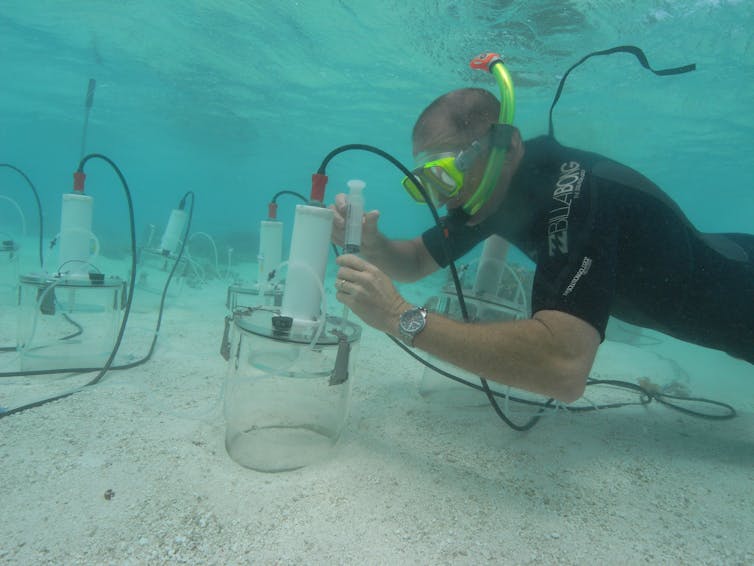
Researchers used benthic chambers (pictured) to test how different levels of seawater acidity affect reef sediments. Steve Dalton/Southern Cross University

Carbonate sands on coral reefs will start dissolving within about 30 years, on average, as oceans become more acidic, new research published today in Science shows.

Carbonate sands, which accumulate over thousands of years from the breakdown of coral and other reef organisms, are the building material for the frameworks of coral reefs and shallow reef environments like lagoons, reef flats and coral sand cays.
But these sands are sensitive to the chemical make-up of seawater. As oceans absorb carbon dioxide, they acidify – and at a certain point, carbonate sands simply start to dissolve.

The world's oceans have absorbed around one-third of human-emitted carbon dioxide.

Carbonate sand is vulnerable
For a coral reef to grow or be maintained, the rate of carbonate production (plus any external sediment supply) must be greater than the loss through physical, chemical and biological erosion, transport and dissolution.

It is well known that ocean acidification reduces the amount of carbonate material produced by corals. Our work shows that reefs face a double-whammy: the amount of carbonate material produced will decrease, and the newly produced and stored carbonate sands will also dissolve.

We measured the impact of acidity on carbonate sands by placing underwater chambers over coral reefs sands at Heron Island, Hawaii, Bermuda and Tetiaroa in the Pacific and Atlantic Oceans. Some of the chambers were then acidified to represent future ocean conditions.

The rate at which the sands dissolve was strongly related to the acidity of the overlying seawater, and was ten times more sensitive than coral growth to ocean acidification. In other words, ocean acidification will impact the dissolution of coral reef sands more than the growth of corals.

This probably reflects the corals' ability to modify their environment and partially adjust to ocean acidification, whereas the dissolution of sands is a geochemical process that cannot adapt.

Sands on all four reefs showed the same response to future ocean acidification, but the impact of ocean acidification on each reef is different due to different starting conditions. Carbonate sands in Hawaii are already dissolving due to ocean acidification, because this coral reef site is already disturbed by pollution from nutrients and organic matter from the land. The input of nutrients stimulates algal growth on the reef.
In contrast, carbonate sands in Tetiaroa are not dissolving under current ocean acidification because this site is almost pristine.

What will this mean for coral reefs?
Our modeling at 22 locations shows that net sand dissolution will vary for each reef. However, by the end of the century, all but two reefs across the three ocean basins would on average experience net dissolution of the sands.

A transition to net sand dissolution will result in loss of material for building shallow reef habitats such as reef flats and lagoons and associated coral cays. What we don't know is whether an entire reef will slowly erode or simply collapse, once the sediments become net dissolving, as the corals will still grow and create reef framework. Although they will most likely just slowly erode.

It may be possible to reduce the impact of ocean acidification on the dissolution of reef sands, by managing the impact of organic matter like algae at local and regional scales. This may provide some hope for some already disturbed reefs, but much more research on this topic is required.

Ultimately, the only way we can stop the oceans acidifying and the dissolving of coral reefs is concerted action to lower CO₂ emissions.

Monday, May 30, 2016

2337. Australia, Fearing Fewer Tourists, Has Chapter Taken Out of UN Climate Report

By Michelle Innis, The New York Times, May 27, 2016


SYDNEY, Australia — Leading scientists in Australia and abroad have expressed concern that a new United Nations report about the impact of climate change on dozens of World Heritage sites is absent a chapter describing damage to the Great Barrier Reef, after the Australian government requested that the section be cut.

“I was amazed,” the lead author of the report, Adam Markham, deputy director of climate and energy programs at the Union of Concerned Scientists, said by telephone.

The Australian government requested that the chapter be removed from the report, issued by Unesco and the United Nations Environment Program on Thursday, so that further accounts of damage to the reef, the world’s largest coral ecosystem, would not adversely affect tourism.

In a statement on Friday, the Department of the Environment said “experience had shown that negative comments about the status of World Heritage-listed properties impacted on tourism.” The statement went on to say that the department did not support any of the country’s World Heritage-listed properties being included in “such a publication.’’

Environment Minister Greg Hunt had not been informed of the department’s decision, the statement said, but concerns had been relayed to Australia’s ambassador to the United Nations Educational, Scientific and Cultural Organization, or Unesco.

“But as far as I can see, it is in the newspapers every day,” Mr. Markham said. “Pretty much everyone in the world knows there is a problem on the Great Barrier Reef.”

Mr. Markham said he had thought the report would galvanize support for important sites suffering degradation as sea levels and temperatures rise, and as extreme weather damages the environment.

The Great Barrier Reef, which stretches from the tip of northern Queensland more than 1,400 miles southward along Australia’s east coast, has experienced significant coral bleaching over the last year. Bleaching can lead to coral death.

The chapter removed from the report, now published on the website of the Union of Concerned Scientists, warns that Australia is the world’s fourth-largest coal producer and that risks come with plans to expand coal mining and shipping near the reef.

“Its future is at risk, and climate change is the primary long-term threat,” the chapter says.

Australian scientists who reviewed the chapter before the report was published said they were surprised it had been cut.

Ove Hoegh-Guldberg, a director of the Global Change Institute at the University of Queensland, said the report contained nothing new.

“I was naturally a bit disappointed, because the process had not preserved the science,” he said. “And in one sense, if you were trying not to draw attention to the problems on the reef, this would not be the way to do it.”

Prof. Will Steffen of the Climate Change Institute at Australian National University said it was troubling that a government department had succeeded in censoring a global report.

“Australia is the only inhabited continent that is not featured in the report,” he said. “Information is the currency of democracy, and the idea that government officials would exert pressure to censor scientific information on our greatest national treasure is extremely disturbing.”

Australia’s conservative coalition government, in the middle of a re-election campaign, has received little support for its approach to climate change. Prime Minister Malcolm Turnbull did not mention it in a major campaign speech recently and has done little to convince voters that his government believes it is an election issue.

Australia’s national science agency, the Commonwealth Scientific and Industrial Research Organization, or Csiro, is in the middle of a restructuring that includes cutting the number of climate scientists it employs, drawing criticism from scientists at its partner organizations, including NASA.

The inclusion of the Great Barrier Reef in the United Nations report was founded on its significance, Mr. Markham said, adding that references to the island of Tasmania and to Kakadu National Park, in the Northern Territory, had also been removed from the report.

The report does not cover all World Heritage sites; rather, its authors started with about 100 natural and human-made monuments, including Yellowstone National Park and the Statue of Liberty, and winnowed that list to 31 sites in 29 countries.

Terry Hughes, the director of the Center of Excellence for Coral Reef Studies at the Australian Research Council who spent days in April flying over the Great Barrier Reef tracking bleaching and coral mortality rates, said it was astonishing that the reef would be excluded from such a report.

“There is an unprecedented bleaching event underway,” Professor Hughes said. “Climate change and coral bleaching is the single biggest threat to the tourism industry, and the reef itself.”

Monday, May 2, 2016

2304. Dredging of Miami Port Badly Damaged Coral Reef, Study Finds

By Lizette Alvarez, The New York Times, May 1, 2016 
Coral killed by sediments from dredging of Miami port.
MIAMI — The large-scale dredging of Miami’s port to accommodate the newest generation of freighters, an undertaking that prompted a long-running battle with environmentalists, caused widespread damage to a portion of the area’s fragile and already distressed coral reef, according to a new report by the National Oceanic and Atmospheric Administration.

The report, based on a December survey undertaken by scientists for the agency’s National Marine Fisheries Service, found that as much as 81 percent of the reef near the dredging site was buried in sediment, and an Army Corps of Engineers contractor report from August shows up to 93 percent partial coral death because of sediment, despite a plan by the Corps to minimize the damage.

The damage is particularly alarming because the world is rapidly losing its reefs, partly because of global warming, experts say.

South Florida has the only coral reef in the continental United States and 80 to 90 percent of it has died or been badly harmed over the years, officials say. The causes include ocean temperatures that have dipped too low or risen too high, acidification, sewage and pollution. Several cycles of white plague disease, including one in 2014 that coincided with the dredge, have also badly hurt South Florida’s reef. White plague, a virus that bleaches and kills coral, has been destroying reefs around the world.

“This Florida reef is as important to our country as the sequoias of California, and we are losing it faster than we can figure out why,” said Rachel Silverstein, the executive director of Miami Waterkeeper, a nonprofit environmental organization that has sued the Army Corps of Engineers over coral damage. “There are a lot of stressors that are impacting and killing coral reefs, but this is a hyper-local example of something we could easily have prevented.”

The agency’s analysis, obtained by The New York Times, contradicts a December report by the corps, which primarily blamed white plague for the coral damage on reef sections near the dredge. In the corps’s report, scientists said that white plague was responsible for 85 percent of the coral deaths in the upper and middle parts of the reef and in the control site, and for 18.3 percent of the deaths of coral closer to shore. The report failed to highlight that 93 percent of the corals closer to the dredge had partially died because of sediment, compared with 7 percent at sites farther away, Ms. Silverstein said.

Scientists for the National Oceanic and Atmospheric Administration disagreed with the corps’s emphasis on white plague disease. Rather, they concluded that the majority of the reef, stretching beyond 3,000 feet, showed conclusive damage to corals by dredging sediment.

The agency’s survey of the extensive damage comes at a time when Fort Lauderdale is seeking final congressional approval for the dredging of its own port, Port Everglades, one of the largest in the country. The dredging project to deepen the port cleared a crucial Senate committee last week as part of a larger water bill and is headed for the Senate floor. Coral reefs are critical to South Florida because they help lessen the damage from hurricanes, are important to marine biodiversity and lure tourists.

Environmentalists have warned Congress and the state that the corps’s plan to lessen the damage to corals in that area is flawed because it does not take into account new information, much of it bolstered by state and county scientists, about the extent of the coral damage from the port of Miami’s dredge. Expansion of Port Everglades is expected to begin next year.

The corps is still working on a final assessment of the Miami dredge’s effects on the coral, said Susan J. Jackson, a spokeswoman for the agency. Scientists will conduct dives this summer and then analyze their findings in the fall, she added.

“The results of the assessment will aid us in determining whether any additional mitigation may be needed,” she said. As for Port Everglades, Ms. Jackson said in an email that “lessons learned from all dredging projects are important, and we’re taking them into consideration during this process.”

Ms. Jackson added that the corps’s plan to protect the coral near Port Everglades was already an improvement over the Miami strategy. The new plan includes planting 103,000 new nursery-raised corals across 18 acres of reef and relocating existing coral to another five acres.

“We are confident in the extensive work we have done,” Ms. Jackson said.
But environmentalists said the plan failed to take into account how much farther than anticipated the sediment spread from the dredge site in Miami, a crucial element. The sediment suffocates coral. They want to see the impact zone extended beyond about 3,000 feet from the site. The Port Everglades plan also relies on a six-year-old survey of staghorn coral, which is listed as threatened under the Endangered Species Act.

The vast majority of staghorn near the Miami dredge site was never relocated by the corps. Either it was missed in 2010 by contractors during the initial survey of the area, or the staghorn reproduced later. The corps ultimately agreed to rescue the remaining staghorn after a legal fight with Miami Waterkeeper and other groups.

It also relocated 924 nonendangered corals. In addition, underwater monitors to measure the sediment failed to work, so the corps relied solely on divers to keep tabs on the coral.

This time around, the Waterkeeper group is trying to set up independent monitoring of the coral before dredging begins to keep close track of possible damage.

“The corps like to say they learned a lot of lessons, and they promise they won’t do this again in Port Everglades,” Ms. Silverstein said. “We would like to see less aspirational talk and more mandatory language protecting these reefs.”

Friday, September 19, 2014

1552. We Can Save the Caribbean’s Coral Reefs

By Jeremy Jackson and Ayana Elizabeth Johnson, The New York Times, September 18, 2014 

PARROTFISH eat algae and seaweed. These brightly colored fish with beaklike mouths inhabit coral reefs, the wellsprings of ocean life. Without them and other herbivores, algae and seaweed would overgrow the reefs, suppress coral growth and threaten the incredible array of life that depends on these reefs for shelter and food.
This was happening in Bermuda, until the government in 1990 banned fish traps that were decimating the parrotfish population. Today, Bermuda’s coral reefs are relatively healthy, a bright spot in the wider Caribbean, where total coral cover has declined by half since 1970.
Last month, in a reminder of just how dire the situation facing the world’s coral reefs is, the National Oceanic and Atmospheric Administration said it was listing 20 species of coral as threatened under the Endangered Species Act, including all of what were once the most abundant Caribbean corals. The action focused primarily on the projected impacts of global warming and ocean acidification. Carbon dioxide emissions are increasing ocean temperatures and making them more acidic — and less hospitable for corals.
But climate change is only half the story. Up to now, the impacts of climate change on reefs have been much less destructive than the localized effects of overfishing, runoff pollution from the land and the destruction of habitats from coastal development. Those problems have exploded in intensity over the past century and will continue to increase sharply with population growth.
Proof of the destructive power of those impacts is evident in the central Pacific where, in spite of rising temperatures, coral cover is many times higher around islands unaffected by fishing and pollution, compared with heavily fished and polluted reefs of nearby islands.
A recent detailed assessment of the changing status of Caribbean reefs over the past 40 years by the Global Coral Reef Monitoring Network and the International Union for Conservation of Nature provides a similarly important finding that offers hope. Across the Caribbean, reefs near islands with effective local protections and governance, like the ones around Bermuda, have double the amount of living coral compared with those
But in Florida, banning fish traps — which should result in more parrotfish, less algae and more coral — has not stemmed coral decline. That’s because of extreme local pressures from millions of residents and tourists and insufficient controls on development. Similar problems plague the Great Barrier Reef in Australia, which is being damaged by agricultural runoff and the development of huge ports for exporting coal. Fishing is carefully regulated there, but those other threats must be equally well managed.
The few remaining places in the wider Caribbean with relatively healthy reefs have one thing in common: a greater abundance of parrotfish and other herbivores. They also benefit by being adjacent to islands with comparatively small populations, more modest development and less pollution. You find this in the Flower Garden Banks National Marine Sanctuary in the northern Gulf of Mexico, on reefs around Curaçao and Bonaire and in protected marine areas in the Bahamas and the Cayman Islands.
Stories about coral reefs commonly focus on doom and gloom. But these new findings indicate that there is actually something we can do right now to help reefs recover: prevent overfishing, overdevelopment and pollution from the land.
None of this lessens our concerns about climate change as humanity burns more coal and oil instead of less. But there is increasing evidence that protection from local stresses promotes the resilience of reef corals to climate change.
Several Caribbean islands are moving to control overfishing and pollution. Barbuda just enacted legislation to protect parrotfish, stop overfishing and establish marine sanctuaries. And the Bahamas, Belize, Bonaire, Cuba and Curaçao are working to enhance protections.
In contrast, the condition of the coral reefs of the Florida Keys, the United States Virgin Islands and Puerto Rico is among the worst in the wider Caribbean, despite vast sums invested in the monitoring of reefs and research on the effects of climate change. This monitoring and research are vitally important, but collecting information without strong corrective action is like a doctor analyzing a patient’s decline without doing everything possible to save her life.
We need to move immediately beyond listings of species as threatened and research about climate change and take rigorous action against the local and global stresses killing corals.
Coral reefs are vital to the economies of the 38 Caribbean countries and territories and their millions of people. These reefs generate roughly $3 billion annually in tourism and fishing and provide protection from storms.

To save coral reefs, we need to follow the lead of Barbuda and our other proactive neighbors. We need to stop all forms of overfishing, establish large and effectively enforced marine protected areas and impose strict regulations on coastal development and pollution while at the same time working to reduce fossil fuel emissions driving climate change. It’s not either/or. It’s all of the above.