Showing posts with label Organic farming. Show all posts

Wednesday, May 25, 2016

2335. Organic Farmers Are Not Anti-Science but Genetic Engineers Often Are

By Elizabeth Henderson, Independent Science News, May 24, 2016
Elizabeth-Henderson (photo courtesy Audrey Horn)
Elizabeth Henderson. Photo: courstesy of Audrey Horn.
At one of the public brainstorming sessions for the New York Organic Action Plan, an organic farmer made an impassioned plea for support for “independent science” and told us that with 8.5 billion mouths to feed by 2050, we will need genetic engineering to prevent starvation.

I would like to examine these words carefully to decipher what they mean, how those words are used by this farmer and by others, and suggest how the movement for locally grown organic food in this country should respond.
What is the meaning of ‘independent science’? As co-chair of the Policy Committee for the Northeast Organic Farming Association of New York (NOFA-NY), I have been an active participant in the coalition that is campaigning to pass GMO labeling legislation in NY State. In this capacity, I have spoken at public meetings, to the press and on radio interviews. A question that I have heard from proponents of biotechnology is “why do you organic farmers oppose science, like the climate deniers?”
The first time I heard this, I was startled and felt defensive. Had I ever opposed science?  I searched back through things I had written and reviewed all the policy resolutions the members of NOFA-NY had passed over the years. I found a few places where I criticized reductionist science and defended “indigenous knowledge” (that is things like composting and crop rotations that people who practice a craft know and pass on to their children that has not been proven by research at a university). But nowhere could I find any statement opposing science. Just recently, I reviewed with approval this statement from an organic farming group:
“We support the International Federation of Organic Agricultural Movement’s (IFOAM) definition that organic agriculture is a production system that sustains the health of soils, ecosystems and people. It relies on ecological processes, biodiversity and cycles adapted to local conditions, rather than the use of inputs with adverse effects. Organic agriculture combines tradition, innovation and science to benefit the shared environment and promote fair relationships and a good quality of life for all involved.”
My farm has cooperated in any number of research projects with Cornell University scientists.  We have tested cover crops, held a field day with the Cornell soil health group to allow them to demonstrate the ways a farm can test for biological activity, use a penetrometer, and a rain simulator that shows how much aggregate stability the soils have. We spent 7 years working with Molly Jahns and her team on breeding a variety of sweet pepper. It is earlier ripening, cucumber mosaic virus resistant, and is open-pollinated (and now bears the name of our farm – Peacework!). I served for four years on the Sustainable Agriculture Research and Education Program technical committee and three years on the administrative council. Unlikely activities for someone who is against science.
So what does this question about independent science really mean? I have come to understand that by “science” the biotech folks mean genetic engineering. They are deliberately conflating these two terms. And that seems to be how the farmer at our meeting was using the words too.
So since I do not oppose science, do I oppose genetic engineering? Yes and no. I share with geneticists their fascination with the functioning of the tiniest of particles that make up living matter. One of my favorite books is A Feeling for the Organism (by Evelyn Fox Keller, 1984), a biography of Barbara McClintock (1902-1992), a cytogeneticist who specialized in corn. McClintock was one of the first to map the corn genome. She demonstrated that genes turn physical characteristics on and off and discovered genetic transposition or “jumping genes.” She shook the notion that science held as a truth that the genome is a stationary entity with the genes in an order that is unchanging by showing that it is subject to alteration and rearrangement. For many years, the mainstream of science regarded her with disapproval only eventually to catch up with her and then heap honors on her great discoveries. Science lurches forward – and a great leap is yet to be made for a full comprehension of the relationship between genes and the environment.
The more geneticists look into it, the more complex the relationship of genes to physical traits turns out to be. As Jonathan Latham puts it:
“a defined, discrete or simple pathway from gene to trait probably never exists. Most gene function is mediated murkily through highly complex biochemical and other networks that depend on many conditional factors, such as the presence of other genes and their variants, on the environment, on the age of the organism, on chance, and so forth. Geneticists and molecular biologists, however, since the time of Gregor Mendel, have striven to find or create artificial experimental systems in which environmental or any other sources of variation are minimised so as not to distract from the more “important” business of genetic discovery.
“But by discarding organisms or traits that do not follow their expectations, geneticists and molecular biologists have built themselves a circular argument in favour of a naive deterministic account of gene function. Their paradigm habitually downplays the enormous complexities by which information passes (in both directions) between organisms and their genomes. It has created an immense and mostly unexamined bias in the default public understanding of genes and DNA.” (Latham, op cit)
McClintock’s story reveals how hard it is for the scientific mainstream to accept new concepts. This becomes especially difficult when large commercial entities like chemical/seed corporations build their empires on an interpretation of a scientific phenomenon. And even more difficult when our universities are starved for public research funds and become dependent on corporate support.
I am not against genetic engineering in principle, nor is the organic movement internationally. What we are against is the rush to commercialize crops that have not been adequately tested for safety. There is so much we do not know about them. When you move one gene, many other genes shift and geneticists do not know enough yet to predict the results (Wilson et al., 2006). That is why standards for organic certification in the US and all around the world do not allow the use of genetically engineered seed or other materials like GE rennet in cheese. In regulating any novel technology, we should follow the precautionary principle. Test carefully and at length before commercializing. This has not been done with GE crops. Every cultivar is different and each one should be tested individually (Maffini et al., 2013GAO, 2010).
Meanwhile, corporations like Monsanto, Dow, Syngenta, etc. have been commercializing a very few money-making GE cultivars that farmers are growing on millions of acres that are doused with toxic chemicals.
The scientific evidence shows that the widespread adoption of genetically engineered crops in the US has led to: 1) an increase in pesticides used in agriculture, according to the U.S. Department of Agriculture’s Pesticide Data Program; 2) development of herbicide resistance in over 20 weed species; 3) insecticide resistance in target pests, including corn rootworms; 4) increased residues of pesticides in foods, including Roundup, a probable human carcinogen; 5) loss of biological diversity, including Monarch butterflies, and 6) massive increases in seed costs for farmers (Huber, 2011).
EPA provides annual average use estimates for the decade 2004-2013. According to Carey Gillam in “What Is Going On With Glyphosate? EPA’s Odd Handling of Controversial Chemical” (May 3, 2016):
“Seventy crops are on the EPA list, ranging alphabetically from alfalfa and almonds to watermelons and wheat. Glyphosate used on soybean fields, on an annual basis, is pegged at 101.2 million pounds; with corn-related use at 63.5 million pounds. Both those crops are genetically engineered so they can be sprayed directly with glyphosate as farmers treat fields for weeds. Cotton and canola, also genetically engineered to be glyphosate tolerant, also have high use numbers. But notable glyphosate use is also seen with oranges (3.2 million lbs.); sorghum (3 million lbs.); almonds (2.1 million lbs.); grapes, (1.5 million lbs.); grapefruit and apples (400,000 lbs. each); and a variety of fruits, vegetables and nuts.”
Since 1974, farmers have poured 1.8 billion kilograms of Roundup on fields (Benbrook, 2016). While independent studies of the safety of GE foods are scarce (because the owners of the Utility Patents of GE plants refuse to allow truly independent research), there are many studies of Round-Up and its main ingredient glyphosate that show it attacks the beneficial organisms in the human digestive system, causing serious health problems – increased birth defects, neurological developmental problems in children, kidney failure, respiratory problems, allergies (Sparling et al., 2006; Benedetti et al., 2013Lopez et al., 2012Mesnage, et al., 2015 Marin-Morales et al., 2013; Gress et al., 2015). Studies show that Roundup is a powerful soil biocide, resulting in the increase of microbial plant pathogens and mycotoxins (Johal and Rahe, 1988Fernandez et al., 2005; Kremer and Means, 2009Johal and Huber, 2009).
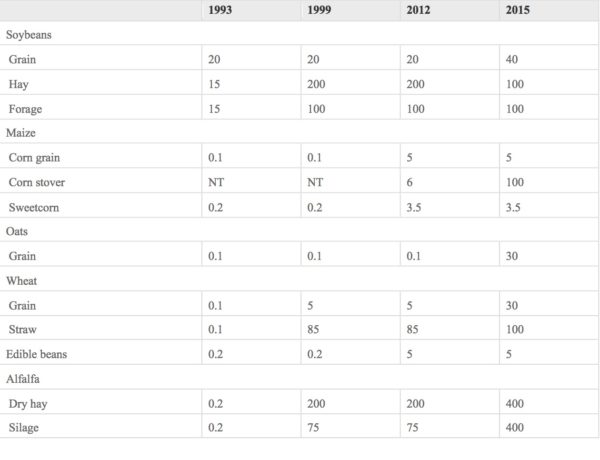
The use of GE crops is part of the whole package of industrialized farming, an integrated system that enables corporate control of our food system (for the results of this see Fig 1 Glyphosate Tolerance Levels since 1993; taken from Benbrook, 2016).
Glyphosate tolerance levels since 1993 (EPA)
GLYPHOSATE TOLERANCE LEVELS SINCE 1993 (EPA)
There has been a speed-up in farming – a grain farmer used to be able to support a family with 160 acres.  Now it takes 1600.  The Roundup-GE package goes with the speed-up. And US government regulation has failed to protect the public from the toxic herbicides that farmers spray on GE crops.
One selling point of Roundup is that it breaks down quickly. That is why you can purchase it off the shelf in garden/hardware stores.  That is accurate – it does break down quickly. But what Monsanto does not mention is that Roundup breaks down into AMPA, which lasts much longer and may be more toxic than glyphosate. (Torstensson 1985; Torstensson et al., 1989Andréa et al., 2003Battaglin et al., 2014).
Recently, the World Health Organization declared glyphosate a probable carcinogen, and many studies since 1985 have shown it to be an endocrine disruptor. But that did not stop the Environmental Protection Agency in 2013 from increasing the amount of glyphosate that is considered safe as a residue in soy beans, corn and other crops (see fig.).
It is extremely unscientific and poor public policy for the patent office, a federal agency, to grant billions of dollars of utility patent rights for GE technology based on a demonstration of material difference, and for FDA, another federal agency, to be simultaneously denying consumers basic information about the use of that technology in their food, based on that agency’s finding of a lack of material difference.
Internal FDA documents obtained by the Alliance for Bio-Integrity during a 1998 lawsuit against the agency reveal that the FDA’s Biotechnology Coordinator, James Maryanski, knew full well the potential risks but chose to override them. A November 1, 1991 memo to Maryanski titled “Points to Consider for Safety Evaluation of Genetically Modified Foods. Supplemental Information”, detailed the potential problems with new genetically engineered crops:
increased levels of known naturally occurring toxicants, appearance of new, not previously identified toxicants, increased capability of concentrating toxic substances from the environment (e.g. pesticides or heavy metals) and undesirable alterations in the levels of nutrients.” (cited in Druker, 2015).
Despite this, the FDA claimed, and continues to assert that genetically engineered foods are perfectly safe and has classified them as “generally regarded as safe” or GRAS under current FDA guidelines.
The utility patents which Monsanto and other corporations hold on seed give them control over every use of that seed – including research to test it for safety.  Farmers are not allowed to save and share the seed. University scientists must have permission from the patent holder and have to pay royalties to do research on patented seed. That is a significant barrier to independent science. By contrast, the Open Source Seed Initiative (OSSI) allows seed purchasers free use of the seed and asks for a pledge
“not to restrict others’ use of these seeds or their derivatives by patents or other means, and to include this Pledge with any transfer of these seeds or their derivatives.” (FEDCO 2016 catalogue, p. 3).
Unfortunately, we do not live in a sweet world where researchers are free to work for the people and the earth and where decisions on what research gets funded are made purely on the basis of which projects benefit the largest number of poor and hungry people in former imperial colonies.
Just as the biotech proponents conflate “science” and GMOs, I and the organic movement conflate our struggle for family-scale, local, organic or agroecological agriculture and against corporate control with the fight against gmos. Buying Roundup Ready seed is not a free choice for farmers. Using that seed ensnares the farmer in Monsanto’s clutches.
There are economic issues here as well. Major Goodman of North Carolina State University, a respected corn geneticist and member of the National Academy of Sciences, stated in testimony before the National Research Council that conventional breeding typically costs about $1 million per trait, while genetic engineering costs $136 million per GE trait, with most of the cost due to research and development, not to regulatory expenses.
If we could assemble a council of farmers and scientists to evaluate the most cost-effective ways to invest public resources to eliminate world hunger, it is doubtful that they would choose genetic engineering. The 2008 United Nations International Assessment of Agricultural Knowledge, Science and Technology for Development (IAASTD), a comprehensive report on the future of farming, authored by 400 scientists and backed by 58 governments, stated that yields of GM crops were “highly variable” and in some cases, “yields declined”. The IAASTD concluded that since 70% of the world’s population is fed by small farms, many run by women, the best course would be to increase investments in agroecology (IAASTD, 2009).
That means doing the kind of work that the organic farmers of the Northeast (under the auspices of NOFA and MOFGA) have been doing for over four decades – helping family-scale farmers, homesteaders and gardeners learn more about how to produce the healthiest, most nutrient dense food using local resources and providing ways for them to share this learning with one another.  Farmer to farmer – campesino to campesino. Scientists who respect the “indigenous” knowledge of farmers can help the way Molly Jahns’ team did in the Peacework pepper breeding project.
If some of the millions spent on genetic engineering were directed to farmer-scientist organizations like Masipag (Farmer-Scientist Partnership for Development) in the Philippines and the National Organic Agriculture Movement of Uganda (NOGAMU), there would be much more progress towards local self-reliance.
I am totally with the organic farmer who declared at our meeting that agriculture needs applied research and technology and that our Land-Grant universities should invest in applied research programs to find the solutions to the complex problems facing farmers today. The division of farmers into two camps – organic and conventional – is destructive and prevents us from learning from one another. It would help all farmers if the USDA research apparatus had funding to support organic research programs at higher levels than the current barely 2 percent of all USDA research dollars.
So at this time, I do not think the organic movement should drop our opposition to allowing certified organic farms to use GE crops.  We should continue to campaign for labeling GMOs. We should call upon Cornell to disband its propaganda arm for GMOs – the Alliance for Science – or repurpose it under the guidance of a board that represents the interests of the people of NY State. We should not oppose continuing research in genetic engineering, but we should demand that equal resources go into agroecology. Independent Science is a great concept.  Let’s work together with conventional farmers for applied research that keeps our farms in business and allows us to grow the healthiest food for all the people while regenerating our soils and arresting climate change.
PS. I urge defenders of GMOs to read Altered Genes, Twisted Truth: How the Venture to Genetically Engineer Our Food Has Subverted Science, Corrupted Government, and Systematically Deceived the Public, by Steven M. Druker (Clear River Press, 2015).

References


Andréa MM, Peres TB, Luchini LC, Bazarin S, Papini S, Matallo MB, Savoy VL (2003). Influence of repeated applications of glyphosate on its persistence and soil bioactivity. Pesquisa Agropecuária Brasileira 38: 1329–1335.
Battaglin WA, Meyer MT, Kuivila KM, Dietze JE (2014) Glyphosate and its degradation product AMPA occur frequently and widely in U.S. soils, surface water, groundwater, and precipitation. J Am Water Resour Assoc 50: 275–290.
Benbrook, C (2016) Trends in glyphosate herbicide use in the United States and globally. Environmental Sciences Europe 28: 3 DOI: 10.1186/s12302-016-0070-0.
Benedetti D, Nunes E, Sarmento M, Porto C, dos Santos CEI, Dias JF, et al. Genetic damage in soybean workers exposed to pesticides: evaluation with the comet and buccal micronucleus cytome assays. Mutat Res. 752: 28–33.
Government Accountability Office (GAO). “FDA Should Strengthen Its Oversight of Food Ingredients Determined to Be Generally Recognized as Safe (GRAS)” GAO-10-246, Feb 3, 2010.
Gress, Steeve; Lemoine, Sandrine; Séralini, Gilles-Eric; Puddu, Paolo Emilio (2014). Glyphosate-Based Herbicides Potently Affect Cardiovascular System in Mammals: Review of the Literature. Cardiovascular Toxicology 15: 117–126. doi:.10.1007/s12012-014-9282-y
Huber D. (2011) Letters from Prof Don Huber to US and EU administrations Sent to President Jose-Manuel Barroso EU President cc to President Herman Van Rompuy, President Jerzy Buzek, Commissioner John Dalli and some MEPs March 25, 2011. These letters include extensive research citations which support this statement.
Johal GS and Rahe JE (1988) Glyphosate, hypersensitivity and phytoalexin accumulation in the incompatible bean anthracnose host-parasite interaction. Molec. Plant Pathol. 32: 267-281.
Fernandez MR, Selles F, Gehl D, DePauw RM and Zentner RP (2005) Crop production factors associated with Fusarium head blight in spring wheat in eastern Saskatchewan. Crop Science 45: 1908-1916 .
Kremer and Means, J. (2009) Glyphosate and glyphosate-resistant crop interactions with rhizosphere microorganisms. Europ. J. Agronomy 31: 153–161.
Johal GS and Huber, D. (2009) “Glyphosate Effects on Diseases of Plants“, European J Agronomy 31: 144–152.
Lopez SL, Aiassa D, Benitez-Leite S, Lajmanovich R, Manas F, Poletta G, et al. (2012) Pesticides used in South American GMO-based agriculture: a review of their effects on humans and animal models. Advances in Molecular Toxicology. Fishbein JC, Heilman JM. New York, Elsevier 2012, 6: 41–75.
Maffini MV, Heather M. Alger, Erik D. Olson, and Thomas G. Neltner. “Looking Back to Look Forward: A Review of FDA’s Food Additives Safety Assessment and Recommendations for Modernizing its Program,” Comprehensive Reviews in Food Science and Food Safety, Vol.12 (439-453)2013. http://onlinelibrary.wiley.com/doi/10.1111/1541-4337.12020/pdf, accessed 8/17/2013.
Marin-Morales MA, de Campos Ventura-Camargo B, Hoshina MM (2013). Chapter 16 – Toxicity of Herbicides: Impact on Aquatic and Soil Biota and Human Health. Herbicides–Current Research and Case Studies in Use (PDF). pp. 399–443.
Mesnage, R, Arno, M, Costanzo, M, Malatesta, M, Séralini, G-E, and Antoniou, M N. (2015) Transcriptome profile analysis reflects rat liver and kidney damage following chronic ultra-low dose Roundup exposure. Environmental Health  14:70 DOI 10.1186/s12940-015-0056-1.
Sparling DW, Matson C, Bickham J, Doelling-Brown P (2006). Toxicity of glyphosate as Glypro® and LI700 to red‐eared slider (Trachemys scripta elegans) embryos and early hatchlings. Environmental Toxicology and Chemistry 25 (10): 2768–2774. doi:10.1897/05-152.1
Torstensson, L. 1985. Behavior of glyphosate in soils and its degradation. The Herbicide Glyphosate. Chap. 9. p. 137-150. Swedish University of Agricultural Sciences. Uppsala, Sweden.
Torstensson NTL, Lundgren L, Stenström J (1989). Influence of climatic and edaphic factors on persistence of glyphosate and 2,4-D in forest soils. Ecotoxicology and Environmental Safety 18 (2): 230–9. doi:10.1016/0147-6513(89)90084-5
Wilson AK, JR Latham and RA Steinbrecher (2006) Transformation-induced mutations in transgenic plants: Analysis and biosafety implications. Biotechnology and Genetic Engineering Reviews 23: 209-234.

Friday, March 25, 2016

2251. Cuba’s Sustainable Agriculture at Risk in U.S. Thaw

By Miguel Altieri, The Conversation, March 25, 2016
Organic farm in Alamar, Havana. Melanie Lukesh Reed/Flickr
President Obama’s trip to Cuba this week accelerated the warming of U.S.-Cuban relations. Many people in both countries believe that normalizing relations will spur investment that can help Cuba develop its economy and improve life for its citizens.
But in agriculture, U.S. investment could cause harm instead.
For the past 35 years I have studied agroecology in most countries in Central and South America. Agroecology is an approach to farming that developed in the late 1970s in Latin America as a reaction against the top-down, technology-intensive and environmentally destructive strategy that characterizes modern industrial agriculture. It encourages local production by small-scale farmers, using sustainable strategies and combining Western knowledge with traditional expertise.
Cuba took this approach out of necessity when its economic partner, the Soviet bloc, dissolved in the early 1990s. As a result, Cuban farming has become a leading example of ecological agriculture.
But if relations with U.S. agribusiness companies are not managed carefully, Cuba could revert to an industrial approach that relies on mechanization, transgenic crops and agrochemicals, rolling back the revolutionary gains that its campesinos have achieved.

The shift to peasant agroecology

For several decades after Cuba’s 1959 revolution, socialist bloc countries accounted for nearly all of its foreign trade.
When Cuban trade with the Soviet bloc ended in the early 1990s, food production collapsed due to the loss of imported fertilizers, pesticides, tractors and petroleum. The situation was so bad that Cuba posted the worst growth in per capita food production in all of Latin America and the Caribbean.
But then farmers started adopting agroecological techniques, with support from Cuban scientists.
Thousands of oxen replaced tractors that could not function due to lack of petroleum and spare parts. Farmers substituted green manures for chemical fertilizers and artisanally produced biopesticides for insecticides. At the same time, Cuban policymakers adopted a range of agrarian reform and decentralization policies that encouraged forms of production where groups of farmers grow and market their produce collectively.


Havana market. Julia Dorofeeva/Shutterstock

As Cuba reoriented its agriculture to depend less on imported chemical inputs and imported equipment, food production rebounded. From 1996 though 2005, per capita food production in Cuba increased by 4.2 percent yearly during a period when production was stagnant across Latin America and the Caribbean.
In the mid-2000s, the Ministry of Agriculture dismantled all “inefficient state companies” and government-owned farms, endorsed the creation of 2,600 new small urban and suburban farms, and allowed farming on some three million hectares of unused state lands.
Urban gardens, which first sprang up during the economic crisis of the early 1990s, have developed into an important food source.
Today Cuba has 383,000 urban farms, covering 50,000 hectares of otherwise unused land and producing more than 1.5 million tons of vegetables. The most productive urban farms yield up to 20 kg of food per square meter, the highest rate in the world, using no synthetic chemicals. Urban farms supply 50 to 70 percent or more of all the fresh vegetables consumed in cities such as Havana and Villa Clara.

The risks of opening up

Now Cuba’s agriculture system is under increasing pressure to deliver harvests for export and for Cuba’s burgeoning tourist markets. Part of the production is shifting away from feeding local and regional markets, and increasingly focusing on feeding tourists and producing organic tropical products for export.
President Obama hopes to open the door for U.S. businesses to sell goods to Cuba. In Havana last Monday during Obama’s visit, U.S. Agriculture Secretary Tom Vilsack signed an agreement with his Cuban counterpart, Agriculture Minister Gustavo Rodriguez Rollero, to promote sharing of ideas and research.
“U.S. producers are eager to help meet Cuba’s need for healthy, safe, nutritious food,” Vilsack said. The U.S. Agriculture Coalition for Cuba, which was launched in 2014 to lobby for an end to the U.S.-Cuba trade embargo, includes more than 100 agricultural companies and trade groups. Analysts estimate that U.S. agricultural exports to Cuba could reach US$1.2 billion if remaining regulations are relaxed and trade barriers are lifted, a market that U.S. agribusiness wants to capture.


Agriculture Secretary Tom Vilsack and Alabama Congresswoman Terri Sewell tour a Havana farmers' market, November 2015. US Department of Agriculture/FlickrCC BY

When agribusinesses invest in developing countries, they seek economies of scale. This encourages concentration of land in the hands of a few corporations and standardization of small-scale production systems. In turn, these changes force small farmers off of their lands and lead to the abandonment of local crops and traditional farming ways. The expansion of transgenic crops and agrofuels in BrazilParaguay and Bolivia since the 1990s are examples of this process.
If U.S. industrial agriculture expands into Cuba, there is a risk that it could destroy the complex social network of agroecological small farms that more than 300,000 campesinos have built up over the past several decades through farmer-to-farmer horizontal exchanges of knowledge.
This would reduce the diversity of crops that Cuba produces and harm local economies and food security. If large businesses displace small-scale farmers, agriculture will move toward export crops, increasing the ranks of unemployed. There is nothing wrong with small farmers capturing a share of export markets, as long as it does not mean neglecting their roles as local food producers. The Cuban government thus will have to protect campesinos by not importing food products that peasants produce.
Cuba still imports some of its food, including U.S. products such as poultry and soybean meal. Since agricultural sales to Cuba were legalized in 2000, U.S. agricultural exports have totaled about $5 billion. However, yearly sales have fallen from a high of $658 million in 2008 to $300 million in 2014.
U.S. companies would like to regain some of the market share that they have lost to the European Union and Brazil.
There is broad debate over how heavily Cuba relies on imports to feed its population: the U.S. Department of Agriculture estimates that imports make up 60 to 80 percent of Cubans' caloric intake, but other assessments are much lower.
In fact, Cuba has the potential to produce enough food with agroecological methods to feed its 11 million inhabitants. Cuba has about six million hectares of fairly level land and another million gently sloping hectares that can be used for cropping. More than half of this land remains uncultivated, and the productivity of both land and labor, as well as the efficiency of resource use, in the rest of this farm area are still low.
We have calculated that if all peasant farms and cooperatives adopted diversified agroecological designs, Cuba would be able to produce enough to feed its population, supply food to the tourist industry and even export some food to help generate foreign currency.
President Raul Castro has stated that while opening relations with the U.S. has some benefits,
We will not renounce our ideals of independence and social justice, or surrender even a single one of our principles, or concede a millimeter in the defense of our national sovereignty. We have won this sovereign right with great sacrifices and at the cost of great risks.
Cuba’s small farmers control only 25 percent of the nation’s agricultural land but produce over 65 percent of the country’s food, contributing significantly to the island’s sovereignity. Their agroecological achievements represent a true legacy of Cuba’s revolution.

Sunday, February 14, 2016

2203. The Struggle for Ecological Agriculture in Cuba

By Richard Levins, Capitalism Nature Socialism, February 2009
Urban organic farming contributed to Cuba's ability to survive the Special Period in the 1990s
A quarter of a century after Rachel Carson’s Silent Spring, pesticides remain a serious hazard to our health, agricultural production and the environment in general. In some parts of the world, pesticide use is increasing and still regarded as an index of progress, while in a few places the expansion of chemical pest control has been stopped or even reversed.
I have followed and participated in the struggle for an ecological agriculture in Cuba since 1964. It is a struggle: science is not the smooth illumination of darkness by light, or a natural process of the unfolding of knowledge. It involves conflicts over priorities, uncertainties about what is necessary or possible, disagreements among different outlooks — in a word, politics.
For a society like Cuba’s, poor but bent on eradicating poverty, there exists an urgency to increase production, sometimes in just a matter of months. Under such circumstances, and especially in the face of uncertainty that accompanies agricultural production, neither farmers nor planners can afford the risks — mass starvation, disease, and dislocation — of switching to new technologies. Nor do they have the resources or the time to conduct the research necessary to develop alternative, ecologically sound production methods.
Additionally, throughout the Third World there is ignorance of the dangers of a chemicalized agriculture and of the existence of alternatives. But ignorance is not the passive absence of knowledge. It is structured into a belief system with areas of information, misinformation, and lack of information that allow people to be dazzled by the promises of progress and blind to its seamy side. In the Third World, this ignorance is organized around the ideology of “developmentalism.” [See “The Debt Crisis: Africa and the New Enclosures,” by Silvia Federici, also in the Winter/Spring 1992 issue of Red Balloon Magazine].
Consequently, in many areas of the world there are no alternative networks able to compete with the chemical industry’s sales efforts. And even planners and administrators with a strong commitment to serving the people can be so preoccupied with production and costs that they leave themselves vulnerable to the sales efforts of the chemical industry that promise quick fixes to long term problems. These forces are pushing their poisons throughout the world; Cuba is one of the few countries in which it may be possible to break that chain in the immediate future, if circumstances (and the U.S.) allow it.

What A Difference A Revolution Makes: Formation Of The Cuban Ecology Movement

The first major factor in the shift toward ecological agriculture in Cuba was the growth, maturity and self confidence of an articulate community of ecologists enjoying public support. Popular interest in ecology was growing. The press carried articles on biological pest management, Jorge Ramon’s wildlife program appeared on television for many years, and amateur groups like the Speleological Society and associations of amateur botanists were part of a national commitment to science and development growing out of the post revolutionary enthusiasm for the nation’s own plants and animals, which seems to accompany the winning of national independence in all countries.
As in most colonial and post colonial societies, Cuban biology was dominated by systematic biology (the description and classification of plants and animals), medicine, (1) and agriculture.(2) In 1959, the revolution brought a strong commitment to science but scarce means for acting on that commitment. Cuba’s small group of systematic zoologists, botanists, and biogeographers (3) felt overwhelmed by the magnitude of the task of describing the biota of Cuba and its geographic distribution before new economic development would alter the habitats beyond recognition. Although there was interest in ecology and evolutionary biology, there was a strong sense that description must precede experimentation. Instructors did not feel capable of teaching in these areas and the library lacked books and journals.(4)
The International Biological Program was a major turning point for Cuban ecology. UNESCO sponsored intensive long term biome studies around the world through the “Man and the Biosphere” projects.(5) Cuba’s contribution was a study of the montane rainforest in the Sierra del Rosario.(6) Collaboration with the Polish and Czech academies of science and individuals from other countries created an international environment within which Cuban botanists and a few zoologists emerged as ecologists. The rainforest project paralleled a reforestation program which included monoculture and clear cutting. As a result, the Institute of Botany came into conflict with the foresters around the ecological irrationality of the scheme, its first foray into ecological policy questions.
At the site of the old Agricultural Experiment Station, the National Institute for Fundamental Research in Tropical Agriculture (INIFAT) was organized. In the new institute, research projects were chosen for both their practical importance and their value in training biologists.(7) Other ecology minded researchers promoted biological control in the Instituto Nacional de Sanidad Vegetal and laboratories of the citrus subministry. In 1980, at the first national ecology meeting, it became clear that ecological interests were emerging in biology, plant protection, fisheries, the tourist industry, and even the food industry.(8)
During the meetings, erosion and deforestation were identified as the major ecological problems, but pollution was expected to increase in importance.(9) In 1987, the Institutes of Botany and Zoology merged to form the Institute of Ecology and Systematics of the Cuban Academy of Sciences, and the first international symposium on these topics was held in Havana in 1988. Ecology was now a respected and legitimate branch of biology with public visibility.
There is now a growing ecological movement in Cuba. But it is not an ecological movement in the sense of those in Europe or North America. It is not a distinct political movement such as the Greens, nor is it an opposition movement confronting a resistant government and corporations; nor is it yet an “official” movement of the sort set up by governments to say yes. Cuban ecology activists are political, committed revolutionaries who see their struggles for ecologically sound policies as part of the duty of communists in building a new society with its own relation to nature.(10)
In their view, ignorance, developmentalism and economic urgency are their main adversaries. But unlike the situation in the United States where vested interests prevent alternative “development” because it threatens profits, the problem in Cuba is not a systematic drive towards chemicalizing agriculture for profit, nor lack of channels for expression, but resistance from developmental ideas which still hold sway. In one stunning recent victory for ecologists, the planning board of Havana has begun to set aside land for restoring mangroves — a hotly contested proposal over the years because of the needs of other sectors. (The government had encouraged “development” along the coast in order to promote tourism and obtain desperately needed foreign exchange, which could have ruined the offshore cays. Recently, however, one section of the stone causeways built to an offshore cay for tourism development was torn up and replaced with a bridge span after ecologists argued that it would harm the mangroves by interfering with the circulation of water.) Similarly, where substandard housing is being demolished in areas of old Havana, they are being replaced by parks, and new housing will be built elsewhere. In the absence of greed as a major interest to be overcome, discussions are not confrontational in the same way as they are in the U.S., and the honest clash of ideas towards common goals replaces the purchased loyalty of privatized industry’s public relations firms and grant agency scientists.

Ants vs. Pesticides: Demonstrating the Effectiveness Of Ecological Pest Management

Higher oil prices and the collapse of its trading partners in eastern Europe have forced the Cuban government to promote energy conservation measures that will cut state energy expenditures by half and private use by 33 percent, as well as alternatives to reliance on foreign non renewable energy sources. The government has already imported hundreds of thousands of bicycles from China to replace reliance on costly automobiles, and farmers have also recently introduced oxen to replace some tractors. In addition to saving on fuel, oxen are better for the soil and their use encourages integrated field crop and pasture. Most daily papers have gone to weekly schedules to conserve paper and energy, and the precarious economic circumstances have even forced some of them to suspend publication. All enterprises have been cutting back on staff, especially on administration. But unlike in the U.S., people left without work are given alternative jobs, retrained at government expense, or receive unemployment insurance at 70 percent of previous wage. And a new industry centered around the manufacture of solar energy devices, which are required on all new construction in Cuba, holds some promise for the future.
The need to economize on foreign exchange, combined with the growing sophistication of the ecological community, has also been a major incentive for the government to seek non chemical pest management strategies. Although natural pest deterrence and control was already being used in a number of areas, ecologists needed dramatic successes to convince the Cuban government to put a major effort into ecological pest management. The first successes came with ants; many of them proved to be voracious predators of agriculture pests. The species Pheidole megacephala is especially versatile in reducing the costs of pest management of a number of crops.
One example: The beetle Cylas formicarius causes significant damage by boring into sweet potatoes while they are forming. Pheidole can form colonies around the sweet potato itself; if the ants get there first they keep the beetles away.
But since Pheidole does not tolerate direct sunlight very well, nests have to be planted in the field after the vines have grown for about 45 days and produced sufficient shade. So the ants are cultivated in pieces of banana stalk and set out into the field at the rate of nine nests per hectare. Even with the labor of propagating and caring for the ants this system of biological pest management cut in half the direct costs of protection. And in bananas, the ants provided long lasting protection compared to chemical methods, which had to be repeated every few weeks.
As the benevolent role of ants became widely known, the recognition of the possibilities of biological methods increased. Cuba now has 14 centers for ant production, probably the only place in the world where ants are propagated for pest management.
The ant project began through a convergence of two independent pathways. I had been agitating for the use of ants because my own studies in the theory of ecosystems convinced me that generalized predators such as ants could play an important role as a first line of defense against pests.(11)
Meanwhile, people at INIFAT were looking for methods of retarding the almost inevitable decline of banana production in old plantations. Across the road from one of INIFAT’s experimental stations was a private farm which had been able to sustain high yields for some 20 years. The farmer did not know why he had this success except that he never had allowed entomologists onto his property with sprayers. A brief investigation revealed the presence of Tetramorium ant nests at the base of each banana plant, protecting them from insect larvae of many kinds, an observation later quantified by Juan Torres working in Puerto Rico.
The success with ants has made it clear that ecological criticism of pesticides was more than a theoretical critique; it could be turned into explicit practice, and in a reasonable amount of time.
Three years ago, the Ministry of Agriculture adopted biological pest control as one of its national priorities for the new five year plan, which included the expansion of the present pesticide free areas by about 30 percent. As a result, the Hermanos Nuñez farm in Pinar del Rio, for instance, is raising earthworms for humus for itself and other farms. The beds lie under a light shade of palms where ants are being raised. The farm also recycles pig residues to feed geese, goose residues to fertilize the pond, and fish residues to enrich the feed for pigs. In addition, they are experimenting with free running native chickens as an alternative to factory style poultry production. Under the national plan, citrus will shift completely to natural control over the five years. As of 1990, 15 percent of the non sugar cane farm land was already under natural control. And in sugar, no insecticides are used, although herbicides are still standard practice.
There are currently four major programs for biological control: the use of ants in bananas and sweet potatoes; the use of trap crops such as corn to divert fruit worms from peppers; the application of Bacillus thuringiensis in vegetable crops; and the cultivation of the parasitic wasp Trichograma on an artesanal scale on farms throughout the country. (12)
In addition, there is active experimentation with fungi, nematodes, wasps, and ants for pest control and at a citrus farm we are designing an ecosystem for multipurpose use. The program includes the selection of plants to improve organic matter in the soil, house beneficial predators and pathogens, attract wasps to nectar sources, fix nitrogen, and increase the rate of decomposition of citrus leaf litter in order to interrupt the life cycle of the greasy spot fungus disease and for other purposes. Local farmers, both individually and cooperatively, have been eager to adopt methods which avoid pesticides; on their own, they have developed innovative techniques for testing additional predator species.

Cuba’s Commitment To Social Benefit

We know from the dismal environmental conditions of eastern Europe and the Soviet Union that socialism [or what has attempted to pass for it — ed.] is certainly no guarantee of ecological approaches and that the advantages of social planning can be overwhelmed by other factors. Indeed, they were overwhelmed in Cuba, also, during the first decades of the revolution.
But today several aspects of the socialist organization of Cuban society favor ecological rationality. First, there is no strong commercial interest in selling pesticides. This is not entirely absent, since Cuba is part of a world capitalist economy and foreign producers would like to sell more pesticides to Cuba. But, unlike other countries, Cuban government officials do not invest in the import business, nor do they have other personal economic interests in purchasing pesticides.
Second, commitment to planned development for the benefit of the whole society means that the health impact of a technology and its effect on the environment cannot be dismissed as irrelevant. Awareness of pesticide toxicity has not only led to health protection measures for farmworkers, but has also empowered the Ministry of Health to have a voice in pesticide policy. And in response to demands from ecologists, the National Commission for Natural Resources and the Environment (COMARNA) has been elevated from an organ of the Academy of Sciences to cabinet level.
With economic concerns pressuring Cuba, the need to protect the 30 percent of Cuban secondary school students who attend schools in the countryside from pesticide exposure becomes increasingly prohibitive. Unlike in the United States, where environmental degradation and health costs are not included in the costs of production that generates them, in Cuba the health related expenses caused by chemical methods in agriculture, and the need to protect people from the dangers, are figured into the composite social cost and weigh heavily in all cost/benefit analyses. There was never any question of ignoring the health impacts of pesticides, so that these issues became part of the balance sheet from the start.
Third, large scale socialist agriculture allows for coherent land use patterns that benefit the whole society, including the adoption of ecological pest management strategies. It may seem that large scale production is inimical to ecological sensitivity to local conditions and to the imperative for diversity. Indeed, in capitalist societies this is all too often the case; but for societies that have rejected economic cutthroat competition between producing units — and with it the systemic drive towards monocultures, maximizing profits, and mechanization (run on non renewable fuels) — large scale planning can implement programs of natural pest control over a large enough area to be effective.(13)
Here’s an example: In capitalist agriculture it would be extremely difficult to get some farmers to forego planting their most lucrative crop (and relinquish their competitive edge) in order to create gaps in its distribution, which would slow down the spread of pests. Nor would they volunteer to grow guavas instead of citrus so that some pests can be sustained on guavas all year round, thus maintaining a permanent reservoir of food for predators which would then move over to the citrus when the pest population increases after the spring rains. With large scale planning in a socialist society, however, such a program of natural pest control can be extremely effective precisely because there is no systemic push toward monoculture. The unit of planning must be large enough to allow precisely for the integration of diverse conditions,(14) while the unit of productionwill be much smaller and reflect the need for mosaic, alley, and polyculture patterns.

Sugar And Foreign Exchange

The sugar industry, however, is a special case. Because of its importance in the Cuban economy, sugar is under a separate ministry from the rest of agriculture. This is certainly an impediment to mixed farming enterprises. The future of sugar in Cuba depends on a number of factors. Sugar is still a major source of foreign exchange for an economy that badly needs it. But prices have been falling and future markets are uncertain. Cuban planners are coming to see sugar, increasingly, as a raw material for industry, including paper, chemical, fuel, and feed for cattle. As the crisis deepens, alternative sources for cloth, such as hemp, are also being developed.
The sugar cane plant is still one of the most effective solar energy collectors we know. It is expected that the industrial products of sugar will gradually replace raw sugar as a prime contributor to Cuban foreign commerce. However, this will create new problems. The very efficient use of the whole cane plant for fuel in the mills as well as for sugar means that there will be less residue left in the field. Therefore, more fertilizer will be required, and under present conditions the best source will be nitrogen fixing plants. This would encourage a step toward diversification through crop rotation.
The same pest control ecologists who work in other branches of agriculture also attend to sugar. Insecticides have never been used extensively in sugar cane, and new problems are being approached ecologically. On one Cuban cooperative farm, a bale of hay recently fell off a truck along a road next to a cane field. Ants living in the hay invaded the cane and within a few months have cleaned the sugar cane borer from several hectares. The ant is now being propagated deliberately by the cooperative. I expect the ecological methods of pest control can be introduced easily into cane, but that the diversification of sugar land use will require more fundamental changes in the planning of agriculture.
Finally, national planning of research makes it possible to establish priorities for ecologically sound pest management and thus to allocate limited resources where they are most needed.
These general favorable factors have been reinforced by recent economic events. Unequal exchange, the disparity between the prices of industrial products that Cuba imports and the agricultural produce that is exported, has been growing in recent years and can be expected to increase even further as Cuba’s major trading partners adopt world (capitalist) price structures as the standard for their own commerce. The problem of the balance of payments has become especially urgent in the last few years and is perhaps the decisive influence making economists receptive to ecologists. Thus, both the long term structure of the economy and the economic constraints of the world recession are acting in phase, for the time being, to encourage biological control of pests and ecological approaches to agriculture.
These factors do not guarantee rational environmental behavior, however. The desperation to produce, whether to maximize profits or to eliminate scarcity, can, and often has, overwhelmed broader and more long term considerations. Administrators whose success will be evaluated by production or profits may be afraid to try something new — especially measures such as refraining from spraying, a crucial factor in allowing wasps, which feed on many pests, to return. But the society’s political and ideological commitment to seeing the whole and working for social benefit makes it possible to win victories by discussion and education, unencumbered by having to bang up against resistance from the system’s fundamental economic interests as well.

The Shift Toward The Left

In recent years, there has been a general leftward shift in Cuban politics that has contributed to the development of ecological rationality in agriculture, whereas most “socialist” countries have adopted rightist “solutions” to the stagnation and alienation created by their command economies and bureaucratic states, including:
  • the promotion of private economic initiatives;
  • management of public enterprises based on the same criteria — profitability — as capitalist firms;
  • adopting capitalist forms of organization and job definition;
  • conventional approaches to science and learning;
  • reliance on the old motivations, such as private marketing of produce and other personal economic incentives;
  • a managerial technocratic approach to development;
  • reliance on experts;
  • putting of economics in command;
  • acceptance of national chauvinism and sexism as well as environmental destruction — all in the name of progress.
Cuba has, in many ways, gone against the recent trends and has challenged capitalist ways of doing things. Instead of giving in to the market pressures, it has innovated new forms of organization to resist them, emphasizing collective and social motivations through which people empower themselves and gain their own expertise, aspire to change human relations, and place politics, not economics, in command.
The resurgence of the leftward trend in Cuba began in the late 1980s. It is referred to as “rectification” and, especially utilizing the ideas of Che Guevara, includes:
1) Exposure of corruption and bureaucratic behavior at all levels of society;
2) Criticism of “economism,” the reliance on capitalist type incentives for production. This includes: restriction on the private marketing of agricultural produce; criticism of the practice of using excessive bonuses to achieve fulfillment of production goals; an appeal to administrators not to look only at meeting production goals but also at how their decisions affect the whole socialist process; revival of the microbrigades (construction brigades recruited from different enterprises to build housing, daycare centers, family doctor clinics and other social construction); the popularization of Ernesto Che Guevara’s economic ideas (including multioficio, the practice of having people do whatever is necessary rather than being confined within a narrow job definition and consagracion, or dedication to one’s job); and reinforcement of egalitarian values with increases in the minimum wage;
3) A general increase in criticism at public meetings and conventions, such as the secondary school students’ federation, the Communist youth, teachers’ meetings, etc.;
4) More vigorous, tenacious and independent investigative journalism;
5) Expanded reliance on mass mobilization (in addition to the central army) for defense;
6) A general increased interest in political questions.
The leftward trend favors an ecological approach to agriculture because it encourages looking at the whole picture rather than narrow economistic goals, criticizes narrow specialization and encourages initiatives. Municipal governments have even been encouraged to develop systems of municipal gardens, where the objective is continuous year round production of a diverse range of vegetable crops. Indeed, in following up on suggestions by ecologists, the food program now requires each province to be as self sufficient as possible in food as a protection against the uncertainties of weather. Each farm is also encouraged, at the very least, to supply its own lunchroom.
This decentralized approach favors widespread innovation and polyculture, and the overall political direction provides a counterweight to the pressures of the world market which makes earning or saving foreign exchange a top priority.

Countertendencies, and the Relationship of Ideology and Material Conditions

But there remains a strong developmentalist current, too. Its major tenet is that progress, including technological progress, proceeds along a single axis from less developed to more developed. Therefore, the task of the less developed is to adopt, adapt, and even surpass the “advanced” countries along this axis using the same technology and basing themselves on the same science.
Such naïve “progressivism” has become part of some marxist traditions, in which science and technology are viewed as “objective” processes, outside of human control and free of class content.
They are seen as essential to generic human progress and needed to solve the major issues of production and society through the expansion of production — especially of cash crops — to meet world market needs and generate foreign exchange which can then be, so they argue, reinvested. This becomes a top priority in a technocratic view of development and social change.
The major elements of developmentalist beliefs in agriculture are: 1) Labor intensive agriculture is backward, capital intensive is modern; 2) Diversity is backward, uniform monoculture is modern; 3) Small scale production is backward, large scale is modern; 4) Subjection to nature is backward, an increasingly complete control over everything that happens in the field or orchard or pasture is modern; 5) Folk knowledge is backward, scientific “expertise” is modern; 6) Generalists are backward, specialists are modern; 7) The smaller the object of study (a reductionist approach), the more modern the investigation.

Determinism and Freedom

Although this outlook is criticized by many marxists as economistic, it nevertheless arises again and again under urgent pressure to meet a country’s consumption needs, and it is often the dominant current where Communist parties are in power.
This sense of urgency is paradoxical. On the one hand, it emphasizes the backwardness and lack of choice of the society struggling to survive in a hostile world. On the other hand, it manifests a tremendous confidence that “we can do anything,” including avoiding the pitfalls of adopting the products of capitalist progress without suffering the same destructive impacts.
Those of us who oppose developmentalism start from an emphasis on the wholeness, historicity and contradictoriness of the world — key components of a truly dialectical materialist analysis. “Science” is not an “objective process outside of human control and free of class content” but is a social process, an instance of the division of labor in which activity aimed at organizing experience for the purpose of finding out is separated from other labor. It is given institutional form (the University, research facilities and corporate think tanks); it develops its own tools (reductionist science); and it adapts its own self conscious ideology from the prevailing ideologies of the broader society (change comes through the management of technocratic and academic elites).
The development of science and technology is the result of a strong interaction between the social structure as a whole, the condition of science, and the natural objects it attempts to study. Therefore, there is not any one inevitable and necessary pathway for the development of science and technology. We are not limited to a choice between stagnation and the high tech pathway that has prevailed over the last half century. We are not predetermined to take the technocratic road. But there are conditions that need to exist, and be strengthened, for that free choice to be possible.

The ‘Greening’ of Socialism in Cuba

Marxists, greens, and other radicals need to approach science differently; for a long time now, as pointed out earlier, science has been seen to be independent of class forces and as an objective force standing outside of human control, and therefore outside of history. We need to begin to see the particular form of conventional agricultural science in its historical context — as the convergence of the commodification of knowledge, the needs of agribusiness, and the dominant reductionist philosophy of science, which sees problems as fundamentally separable and soluble by independent “magic bullets.”
In an agricultural context, developmentalism, in Cuba, is being challenged in many areas:
First, the present high tech, specialized agriculture is a transient developmental stage which fairly rapidly undermines its own productive base through soil depletion, erosion, compaction, salinization, loss of diversity, and the creation of new pest problems. It increases vulnerability to natural and economic disasters and harms the health of the agricultural workers and eventually the whole society and the rest of nature. In capitalist countries, this developmental stage increases class differentiation and undermines the status of women because access to the new technologies is available only to those who can afford it, generally men.
Its successor should be a gentle and thought and knowledge intensive technology that nudges rather than bludgeons nature.(15) This technology makes use of minimum inputs, depending as much as possible on processes already at work in the land:
  • Instead of choosing irrigation as the best way to moisten soil, it first looks to how to increase the moisture holding capacity of the soil.
  • Before building dams it considers forests as the best reservoirs.
  • Before relying on chemical fertilizer it looks to improvement of the soil.
The search for new commodity inputs to sell farmers must be subordinated to the design of agroecosystems that are as self operating as possible.
Second, the spatial patterning of agriculture should be neither the random diversity of the minifundia as determined by land tenure nor the homogeneity of agribusiness, but a mosaic of planned heterogeneity on different scales. This will allow for a more or less uniform need for labor throughout the year, provide products for local consumption as well as for the market, take advantage of the existing variability of the land in soil, exposure and topography, and allow for advantageous agronomic and microclimatic interactions of different kinds of plants and their associated faunas. Among the important interactions are the effects of plants on wind (which thereby modulate the microclimate to a distance of about ten times their height), weed suppression, changes in soil texture depending on the pattern of root formation, retarding erosion, fixation of nitrogen by legumes, accumulation of organic matter, attraction of pests’ natural enemies to sources of nectar and nesting sites, and the confusion, diversion or repulsion of pests.
Alley farming is one way to get the benefits of scale and mechanization but also the interactions between adjacent plots. Strips of crop are long enough to make mechanization feasible and useful but of a width that both allows for machinery and for interactions between crops. Polyculture provides advantages for pest control and soil improvement as well as a hedge against climatic uncertainty. And, on a larger scale, the land use pattern can include non agricultural formations which preserve natural diversity, store water, prevent erosion, modulate climate, and serve as reservoirs for beneficial wildlife. The integration of field crops, pasture and forestry allows for strong recycling pathways.
Third, we distinguish between the unit of production and the unit of planning. The unit of production should be small enough to take advantage of the microclimate heterogeneity of a farm and permit interactions between habitats while being large enough to take advantage of the economies of scale. But the whole patchwork of plots should be coordinated to allow for the management of even highly mobile pests, the recycling of residues among field, orchard and pasture, and the coordination of many different operations. The subunits allow for a detailed intimate knowledge of very local conditions while the whole enterprise allows their fitting together in the service of larger societal goals.
Fourth, we recognize that nature is inherently variable. That variability is harmful if we have very narrowly prescribed targets, but an advantage when we learn to ride with it. For example, small temperature differences can alter drastically the synchrony of populations of pests, their host plants, and their predators. If we depend for plant protection on a single predator or parasite it becomes necessary to monitor the microclimate quite precisely. But if we build an insect community of many species, when one does poorly another does better and we can achieve crop protection without controlling the complex dynamics of all the interacting species. In the face of uncertainty we can select ensembles of crops for their tolerance to change and use diversity as a buffer against the unexpected.
Fifth, the gentler the technology, the more site specific it has to be. The adaptation of a technology suited to every microsite is beyond the capacity of even the most affluent extension service. Rather, the technology has to be developed on the farm through a collaboration of the farmers who have a detailed, intimate, local knowledge of their own circumstances and the off farm scientists who can provide the general, theoretically based and abstract knowledge that requires some distancing from the particular. This interaction is only possible when the parties meet on terms of equality and mutual respect. In class divided societies this is extremely difficult to achieve. In Cuba, the fact that many of the agricultural scientists come from peasant backgrounds makes it easier.(16)
Sixth, many of the most dramatic failures of agricultural or public health or development programs have come about not because of a failure to know the details about the parts of the system but because of a failure to look at the whole. Each specialist invents a contribution which works given the results of the other specialists: engineers design machines for monoculture because agronomists recommend monoculture because the varieties have been selected for their performance in monoculture because that is how farmers plant because the machines are designed. … Each party makes choices that seem rational given the choices the others made so that the whole process gives the appearance of necessity and inevitability. What we are seeing in reality is a contradiction between the growing rationlity in the particular and the irrationality of the enterprise as a whole. Therefore, it is essential to place specialized knowledge into a broader context where we are aware of its source and limitations and always look at the whole.
Finally, the enthusiasm for genetic engineering has reinforced the reductionist bias which sees molecules as more basic than cells which are more basic than organisms which are more basic than populations which are more basic than ecosystems. The term “modern biology” is used to refer to molecular biology, ignoring modern systematics, population genetics, ecology, bioclimatology, etc. Yet the processes on the level of populations and communities determine directly the outcomes of interest to us and are not deducible from the behaviors of their components. Whole system study is the weakest area of agricultural science and must become a top priority.
These arguments are derived from a dialectical materialist marxist approach to science in general and agricultural science in particular. This does not mean that they can only be reached in that way. Some of the same conclusions have been reached by others from different perspectives. But they are easier to reach from a point of view which self consciously calls attention to complexity, process, historicity and contradiction. Nevertheless, the phrase “are derived from” does not mean “arise spontaneously or receive unanimous welcome.” They are a particular reading of marxism which has to confront the developmentalist interpretations.

Conclusion

The struggle for an ecologically sound agriculture is not over in Cuba but progress is being made. This came about through the convergence of several lines of causation: the maturing of the community of ecologists and of worldwide ecological mass movements, the economic pressures to reduce imports, the demonstrated success of several biological pest management programs, the political shift towards the left in the last few years, and active educational campaigns by particular individuals creating both a public awareness of ecological issues and building support within the research institutions and the Ministry of Agriculture.
All of this happened against a background of a socialist economy in which there is no profit oriented chemical industry pushing pesticides, and in which the conscious goal of planning is a better, more abundant and healthier life. Difficulties arise when intermediate goals towards these ends take on a life of their own, become the measure of an enterprise’s contribution to society, and seem to conflict with the long term goals. Although socialism is all too obviously no guarantee that intermediate goals will not obstruct ecological wisdom, it does practically eliminate vested economic interest in perpetuating harmful practices. Therefore, a debate over technological directions is only an argument, a confrontation of opposing beliefs, but not a confrontation of opposing interests.
This gives a different feel to argument even against stubborn ignorance. It makes strong argument effective and makes convincing the other party more important than the simple exercise of power. It also affects the style of the struggle, which starts from the premise of comrades struggling with each other for a shared goal and is more educational than oppositional.
My own participation has been exclusively through a battle of ideas. I hold no power at all in Cuba (or in the United States, for that matter). Yet, when I raised criticisms of particular projects, those who disagreed with me thought it necessary to attempt to convince me of their position, urging that I visit the sites, and discussed the issues at length. The debate also takes place within a marxist theoretical framework, with its emphasis on the historical contingency of science and technology, the importance of looking at the whole, and the recognition of complexity, process and contradiction. This provides the tools for challenging technocratic developmentalist assumptions.
At a time when ecological issues are becoming major political concerns throughout the world, the Cuban struggle should be watched closely and actively supported. The different texture of the struggle in Cuba from that in capitalist countries reveals the intensely political character of human ecology. Its victories under difficult circumstances show just a little of the potential of socialism and of marxism in negotiating a new relation with nature. If it can keep the U.S. and market forces from skewing its socialist development, Cuba may yet be able to overcome some of its contradictions, destructive residues of previous stages of development, and the commandist state form that has plagued all of the so called “socialist” countries; Cuba can become a world ecological power as well as a medical one. Therefore, Cuban ecology needs allies.
Allies of Cuban ecology can support this struggle for ecological rationality in two main ways. Some of us can participate directly by helping the development of Cuban science, providing scientific information that opens up alternative pathways, participating in Cuban scientific meetings, subscribing to scientific journals for the Cuban Academy of Sciences, ordering Cuban journals and, in general, breaking the blockade.
All of us can help by working against the political and economic pressures the United States is applying against Cuba. These pressures reinforce the urgencies that promote short sighted developmentalism and thwart efforts to insist on the big picture and the long horizon. Solidarity with the Cuban revolution does not mean passive endorsement of all present conditions and practices in Cuba but an active, critical and supportive engagement with (and through) the revolutionary process.

———————————————-
NOTES

  1. Systematics and medicine were possible because they were low cost fields in which individuals could work in relative isolation. And indeed there were outstanding researchers such as Carlos Finlay in infectious diseases and Filipe Poey in systematic biology. Foreign biologists also used Cuba as a field site, enriching the museums of Spain and the United States but without creating an indigenous scientific community.
  2. The agricultural experiment station was established by the sugar producers in the early years of this century to serve their industry. Although individual staff members attempted to direct the research agenda more toward Cuban needs, their efforts were limited by the agenda of the administrators, corruption and lack of resources.
  3. The availability of biologists had been reduced by the emigration of opponents of the new government and by the recruitment of some of its enthusiastic supporters into the tasks of organizing science instead of doing research.
  4. Under these conditions, my advocacy of advanced work in ecology and population biology probably made more stark the contrast between what was necessary and what was possible.
  5. A biome is an ecological formation such as rain forest, long grass prairie or desert.
  6. Ricardo Herrera, et al., “Ecologia de los Bosques Siempreverdes del la Sierra del Rosario, Cuba,” Proyecto MAB #1, Academica de Ciencias Cuabana, 1988. Montane refers to mountains. The Sierra del Rosario was an upland rain forest. Sea level rainforests were all pretty much destroyed long ago.
  7. The first results of the use of ants for pest control were obtained at INIFAT, working with Tetramorium bicarinatumas a protector of bananas, as discussed later.
  8. Representatives of polluting industries came to call the attention of ecologists to the pollution they were causing with the piles of husks beside the rice mills and fruit pits where juices were being canned or bottled. They asked for help from ecologists in ameliorating the impact. This was a unique experience for me, since in the United States the representatives of industry play a quite different role in such discussions.
  9. The criticism of pesticide use was raised several times but also resisted by a plant protection station staffperson who argued that pesticides could not be all bad since the Soviet Union produced them.
  10. Some struggles will be more difficult than others. Cuba’s dependence on imported oil makes arguing against nuclear energy more difficult. And the crucial economic role of sugar and its institutionalization in a separate ministry will make the shift to multipurpose farming in the sugar areas more traumatic.
  11. Unlike the more specialized parasitoids, their populations can be maintained even in the absence of the pests we want to control so that they do not lag behind the pest in an outbreak. Ants have another special property: more than one possible community of ants can live in a particular place since the outcome of ant competition depends in part on the age of the colonies, on which got there first. Therefore, if we could introduce ants to a habitat they are capable of occupying, they could maintain themselves in the face of later invasions. Aside from all theoretical arguments, I confess to a special affection for ants which attracted my attention to their practical possibilities and added enthusiasm to my advocacy.
  12. Artesanal as in artisan, small scale craft production rather than industrial.
  13. While relatively immobile pests such as mites and scales can sometimes be controlled on the scale of a single tree, the highly mobile secondary pests (pests that emerged as problems because previous pesticide use destroyed their natural controls, a kind of agricultural iatrogenesis — the provocation of disease by physicians — present a different sort of problem. A moth lays eggs on a plant and the emerging caterpillars eat the leaves, moult, and emerge as moths which fly away. Next year’s pests will not be the offspring of moths from a particular small area but from the whole region. Therefore, the killing of the moths after they have emerged does not protect a small farm. But on a large scale, such measures can reduce the population of pests for the region. This allows additional options for pest control such as the use of birds and bats whose area of activity is relatively large scale.
  14. Eighty percent of Cuban farm land is divided into 400 large state farms. Some three quarters of the remaining land is organized into cooperatives. The small number of enterprises is an advantage for the extension activities of researchers. Fifty one local centers of plant protection service an average of eight state farms each, meet with the cooperatives and individual farmers and cooperate with the small farmers’ association (ANAP) in promoting more suitable methods.
  15. There is nothing romantic or sentimental about the notion of a gentle technology even after George Bush gave gentleness a bad name. Whereas 19th century thermodynamic technologies romanticized the employment of vast quantities of energy to move vast amounts of matter, modern scientific interest emphasizes information, the achievement of big effects with small efforts. The energy of a nerve impulse or the mass of hormone molecules are trivial compared to their impacts. The same applies to ecological management.
  16. In our citrus project on a large state farm, work is being done by scientists from Havana, the science staff of the farm, and secondary school students in an ecology interest circle. We maintain close contact with the state farms and cooperatives, as well as the private sector, networks of innovators meet regularly and cooperatives usually have a member assigned for liaison with scientists.