Showing posts with label Genetically modified organisms. Show all posts

Thursday, July 20, 2017

2666. The Biotech Industry Is Taking Over the Regulation of GMOs from the Inside

by Jonathan Latham, Independent Science News, July 19, 2017

The British non-profit GMWatch recently revealed the agribusiness takeover of Conabia, the National Advisory Committee on Agricultural Biotechnology of Argentina. Conabia is the GMO assessment body of Argentina. According to GMWatch, 26 of 34 its members were either agribusiness company employees or had major conflicts of interest*.
Packing a regulatory agency with conflicted individuals is one way to ensure speedy GMO approvals and Conabia has certainly delivered that. A much more subtle, but ultimately more powerful, way is to bake approval into the structure of the GMO assessment process itself. It is easier than you might think
I recently attended the latest international conference of GMO regulators, called ISBGMO14, held in Guadalajara, Mexico (June 4-8, 2017). ISBGMO is run by the International Society for Biosafety Research (ISBR). When I first went to this biennial series of conferences, in 2007, just one presentation in the whole four days was by a company. ISBR had some aspirations towards scientific independence from agribusiness.
I went for a second time in 2011, to the ISBGMO held in Buenos Aires, Argentina. Company researchers and executives were frequent speakers and the conference had become an opportunity for agribusiness to present talking points and regulatory initiatives as if they had the blessing of science. This year, in Guadalajara, companies were now on the conference organising committee and even conferring conference travel scholarships from the podium. A former conference organiser and ISBR board member told me that the previous ISBGMO (St. Louis, USA, in 2015) had been almost entirely paid for by Monsanto.

Spreading the industry message

In Guadalajara, industry speakers were clearly working from a scripted list. That list translates as the key regulatory objectives of the biotech industry.
Prominent on that list was “data transportability”. Data transportability is the idea that regulators from different jurisdictions, say India, or the EU, should accept identical biosafety applications. Implementation of data transportability would mean that although each country has unique ecosystems and species, applicants ought not to have to provide studies tailored to each. For example, when it comes to assessing effects on non-target organisms, for example of a GMO crop producing an insecticide, regulators in Australia should accept tests on European ladybird species or earthworms as showing that a GMO cotton can safely be grown there.
The appeal of data transportability for an applicant is clear enough—less cost and less risk of their GMO failing a risk assessment. Not once did I hear mention of an obvious downside to data transportability. The fewer tests to which a novel GMO is subjected the less research there is to detect a significant problem if one exists.
A second standard corporate line was “need to know versus nice to know”. In other words do not ask applicants for more data than they wish to supply. The downsides to this are identical to data transportability. Less data is less testing and less science.

Modernising risk assessment?

Another major theme of the meeting was ‘modernization’ of regulation. In this scheme the most ‘advanced’ nation was proposed to be Canada. Canada has adopted what it calls “trait-based GMO regulation”. In trait-based regulation the method of development (i.e. whether the crop was genetically engineered or not) is considered irrelevant. The trait is the sole focus. So if a GMO crop contains an insecticide it is assessed for risk against non-target organisms. If a GMO improves flavour or nutrition then, since there is presumably no risk from flavours or nutrients, then the crop receives what amounts to a free pass.
The Canadian approach sounds harmless, but it has the crucial property that it hands control of risk assessment to the applicant, because under such a system everything depends on what the applicant chooses to call their trait. Imagine you were asked to review the safety of an aircraft, but the manufacturer wouldn’t tell you if it was propeller-driven or a jet; likewise, if a submarine was diesel or nuclear powered.
The Canadian approach therefore, by just asking what the crop is supposed to do, effectively places outside of regulation most of the standard considerations of risk and hazard. Once upon a time, risk assessment was supposed to be about what a product is notsupposed to do. For proposing non-regulation over regulation, Canadian biosafety officials were given more prominent speaking opportunities at ISBGMO14 than any other national regulator.

Tiered risk assessment

An equivalently unscientific innovation, which seems widely accepted, is called tiered risk assessment. Imagine a company presents to regulators an insect-resistant GMO crop. An obvious question arises. How is a regulator to know, since the crops produces an insecticide, if it will kill beneficial organisms such as the bees that feed on its flowers?
In tiered risk assessment this question is answered by feeding the purified GMO insecticide to a bee species. If no harm is observed the crop is assumed safe. No further tests are required. If the bees are harmed then a larger scale test, presumptively more realistic, is conducted. If harm is not observed the crop is assumed safe and no further tests are required. If harm is shown then an outdoor or larger-level test will be conducted.
Monsanto presented a lengthy exposition, in a plenary session, of the ‘soundness’ and ‘logic’ of this tiered approach. Tiered risk assessment has been the subject of little scientific debate (though see Lang et al., 2007), but the implications of the tiered approach are profound. It is an asymmetrical system in which passing any test leads to approval whereas failing that test does not result in disapproval.
Consider the comparison with pharmaceuticals. Currently, all pharmaceutical drugs must pass through three phases of clinical trials; first animal tests, then small scale human trials, then large scale human trials. Failure at any stage is considered terminal. Without wishing to give them any ideas, suppose the FDA were to replace this three-phase system with one under which approval in phase I (animal tests) allowed the developer to go straight to market. There would be, for good reason, an uproar, followed by an avalanche of dangerous medications on the market. But that is precisely the logic of tiered GMO testing.
Tiered testing is therefore a system in which failure is an unacceptable answer. In the scientific review paper that first proposed tiered risk assessment, there is no provision for rejecting the crop in the main figure, which diagrams the proposed decision tree (See Figure 1 of Romeis et al., 2008). Approvals are guaranteed. Agribusiness knows this perfectly well because many of the principal authors of Romeis et al are from the major seed and biotech companies.
The so-called logical innovations presented at ISBGMO14, such as data transportability, trait-based regulation, and tiered risk assessment, are thus intended as regulatory bypasses. They make it all but impossible for a regulator to turn down a GMO application, or even to collect sufficient information. No wonder the biotech industry likes to refer to risk assessment procedures as approval systems.
Given the lack of objection to these approaches at ISBGMO14, the biotech industry ought now to feel confident that the regulation of biotechnology is largely in their hands, but still it wants more.
In the coming years, an upsurge is expected in the GMO pipeline as new applications and new approaches become possible. This pipeline is predicted to include GMO algae, animal biotechnology, gene drives, and so forth. Many of these opportunities the industry knows will be controversial. A pacified regulatory environment is for them a necessity before that can happen.
This is more than a shame. When a comprehensive evaluation of the weaknesses and inherent limitations of scientific risk assessment is urgently needed to cope with these challenges, the chemical and biotech industries are forcing those assessment systems in the opposite direction.

References

Romeis, Jörg; Bartsch, Detlef; Bigler, Franz; Candolfi, Marco P; Gielkens, Marco M C; et al. (2008) Assessment of risk of insect-resistant transgenic crops to nontarget arthropods. Nature Biotechnology; 26: 203-8.
Andreas Lang, Éva Lauber & Béla Darvas (2007) Early-tier tests insufficient for GMO risk assessment. Nature Biotechnology 25: 35 – 36 doi:10.1038/nbt0107-35

Wednesday, July 6, 2016

2362. Genetically Engineered Crops: the Grand and Failed Promise

By Jim Goodman, Counterpunch, July 5, 2016

The endless miles of dead brown fields are finally gone. Spring in the Midwest should be announced by endless miles of green, but at best, a haphazard patchwork of winter wheat, rye, hayfields and the occasional bit of pasture are the only green that show up after snow-melt.
Most of the winter grains planted last fall have been sprayed and killed to make way for endless miles of corn and soybeans.
Corn, soy and alfalfa cover the Midwest, a mono-culture of Genetically Engineered crops (GE) that have mostly displaced the small dairy farms and their pastures, the fields of small grain and diverse mixes of clover and grass hay.
We are at least, partially, through the herbicide season. The first wave was last fall’s “burn-down”, the non-selective spray application (most notably Roundup®) that kills everything and gives the fields that lovely dead brown look in the spring.
The spring “pre-emergence” spray (killing weeds before the corn and soy emerge) is over and the third wave of “post-emergence” spraying is in progress and of course the forth and even fifth spray applications can come anytime during the summer to hopefully kill any weeds that escaped the first three attempts.
Then of course, wheat will need the pre-harvest application of, again, Roundup®, to kill any surviving perennials, but mostly to enhance the dry down of the grain. This is done a few days prior to harvest, and while it is quite effective as a desiccant, it also puts a good amount of herbicide directly on grain that will move into our food chain.
So, if nothing else GE crops have clearly changed the appearance of our landscape, the crops farmers grow and the way they manage weeds and pests. But they have changed the economy as well. The small diversified farms, the cheese factories and the small town businesses are mostly gone.
Some would argue, mostly agricultural economists, corporate agribusiness executives and those farmers who decided to get big rather than get out, that modern agriculture is the economic engine that drives rural America.
And it does, but those of us who still farm on a relatively small scale, those who value the environment, who try and keep our rural schools running, our rural roads passable our hospitals open, to us, it appears modern agriculture has mostly driven the money out of rural America.
Industrialized agriculture still needs people to do the work, but that work must be done at very low wages. When the profit is gone, when small farms are gone, when farm inputs are no longer purchased locally, when the tax base erodes,— rural communities die.
The profit seems to have instead, gone into the pockets of seed, chemical and equipment companies, Wall Street banks and through the hands of corporate lobbyists into the hands of elected officials who will, at all costs, support corporate profit and the wishes of agribusiness. Small towns, people and the environment have become secondary to the growth of modern agriculture.
Just as blue collar workers have seen their jobs and financial stability outsourced, so we have seen the wealth of our rural communities, the local farm income that had once been recirculated in our small towns, sent into the profit margins of corporate agribusiness.
So, do I blame this on GE crops? No, not directly, but the system of farming, the large scale mono-culture grain and livestock production for the world market could not exist without them.
Before the introduction of GE soy in 1996 the trend to larger and fewer farms was clearly happening, but the GE “promise” of effective weed control and higher yields certainly hastened that trend. But that “promise” was just that, a promise— one that was false and quickly broken.
The National Academy of Science in a recent report seemed to find no clear evidence supporting the grand promise of GE crops— they worked in some instances, but failed in others. There was some indication of increased yield but weeds were developing herbicide resistance as well– in short hardly a ringing endorsement. And, GE crops actually increased herbicide usage, not a positive change for our health, or the environment.
Despite the high cost and progressive failure of the GE technology, farmers continue (out of desperation to make a profit?) to embrace it and cover the Midwest with GE corn and soy. More grain used to fatten livestock (despite the demand for grass fed dairy and meat) and further the growth of dairy, hog and poultry production into giant Concentrated Animal Feeding Operations (CAFO’s).
The integral part GE crops have played in the growth of industrial agriculture, the global food economy, obscene corporate profits and the decline of rural communities will be their real legacy and success,— if you can call it that.
And don’t be surprised, as American consumers increasingly reject GE technology, forcing GE crops on the rest of the world is the plan of corporate agribusiness and our government— That, it seems, is one more aspect of American Exceptionalism.

Wednesday, May 25, 2016

2335. Organic Farmers Are Not Anti-Science but Genetic Engineers Often Are

By Elizabeth Henderson, Independent Science News, May 24, 2016

Elizabeth-Henderson (photo courtesy Audrey Horn)
Elizabeth Henderson. Photo: courstesy of Audrey Horn.
At one of the public brainstorming sessions for the New York Organic Action Plan, an organic farmer made an impassioned plea for support for “independent science” and told us that with 8.5 billion mouths to feed by 2050, we will need genetic engineering to prevent starvation.

I would like to examine these words carefully to decipher what they mean, how those words are used by this farmer and by others, and suggest how the movement for locally grown organic food in this country should respond.
What is the meaning of ‘independent science’? As co-chair of the Policy Committee for the Northeast Organic Farming Association of New York (NOFA-NY), I have been an active participant in the coalition that is campaigning to pass GMO labeling legislation in NY State. In this capacity, I have spoken at public meetings, to the press and on radio interviews. A question that I have heard from proponents of biotechnology is “why do you organic farmers oppose science, like the climate deniers?”
The first time I heard this, I was startled and felt defensive. Had I ever opposed science?  I searched back through things I had written and reviewed all the policy resolutions the members of NOFA-NY had passed over the years. I found a few places where I criticized reductionist science and defended “indigenous knowledge” (that is things like composting and crop rotations that people who practice a craft know and pass on to their children that has not been proven by research at a university). But nowhere could I find any statement opposing science. Just recently, I reviewed with approval this statement from an organic farming group:
“We support the International Federation of Organic Agricultural Movement’s (IFOAM) definition that organic agriculture is a production system that sustains the health of soils, ecosystems and people. It relies on ecological processes, biodiversity and cycles adapted to local conditions, rather than the use of inputs with adverse effects. Organic agriculture combines tradition, innovation and science to benefit the shared environment and promote fair relationships and a good quality of life for all involved.”
My farm has cooperated in any number of research projects with Cornell University scientists.  We have tested cover crops, held a field day with the Cornell soil health group to allow them to demonstrate the ways a farm can test for biological activity, use a penetrometer, and a rain simulator that shows how much aggregate stability the soils have. We spent 7 years working with Molly Jahns and her team on breeding a variety of sweet pepper. It is earlier ripening, cucumber mosaic virus resistant, and is open-pollinated (and now bears the name of our farm – Peacework!). I served for four years on the Sustainable Agriculture Research and Education Program technical committee and three years on the administrative council. Unlikely activities for someone who is against science.
So what does this question about independent science really mean? I have come to understand that by “science” the biotech folks mean genetic engineering. They are deliberately conflating these two terms. And that seems to be how the farmer at our meeting was using the words too.
So since I do not oppose science, do I oppose genetic engineering? Yes and no. I share with geneticists their fascination with the functioning of the tiniest of particles that make up living matter. One of my favorite books is A Feeling for the Organism (by Evelyn Fox Keller, 1984), a biography of Barbara McClintock (1902-1992), a cytogeneticist who specialized in corn. McClintock was one of the first to map the corn genome. She demonstrated that genes turn physical characteristics on and off and discovered genetic transposition or “jumping genes.” She shook the notion that science held as a truth that the genome is a stationary entity with the genes in an order that is unchanging by showing that it is subject to alteration and rearrangement. For many years, the mainstream of science regarded her with disapproval only eventually to catch up with her and then heap honors on her great discoveries. Science lurches forward – and a great leap is yet to be made for a full comprehension of the relationship between genes and the environment.
The more geneticists look into it, the more complex the relationship of genes to physical traits turns out to be. As Jonathan Latham puts it:
“a defined, discrete or simple pathway from gene to trait probably never exists. Most gene function is mediated murkily through highly complex biochemical and other networks that depend on many conditional factors, such as the presence of other genes and their variants, on the environment, on the age of the organism, on chance, and so forth. Geneticists and molecular biologists, however, since the time of Gregor Mendel, have striven to find or create artificial experimental systems in which environmental or any other sources of variation are minimised so as not to distract from the more “important” business of genetic discovery.
“But by discarding organisms or traits that do not follow their expectations, geneticists and molecular biologists have built themselves a circular argument in favour of a naive deterministic account of gene function. Their paradigm habitually downplays the enormous complexities by which information passes (in both directions) between organisms and their genomes. It has created an immense and mostly unexamined bias in the default public understanding of genes and DNA.” (Latham, op cit)
McClintock’s story reveals how hard it is for the scientific mainstream to accept new concepts. This becomes especially difficult when large commercial entities like chemical/seed corporations build their empires on an interpretation of a scientific phenomenon. And even more difficult when our universities are starved for public research funds and become dependent on corporate support.
I am not against genetic engineering in principle, nor is the organic movement internationally. What we are against is the rush to commercialize crops that have not been adequately tested for safety. There is so much we do not know about them. When you move one gene, many other genes shift and geneticists do not know enough yet to predict the results (Wilson et al., 2006). That is why standards for organic certification in the US and all around the world do not allow the use of genetically engineered seed or other materials like GE rennet in cheese. In regulating any novel technology, we should follow the precautionary principle. Test carefully and at length before commercializing. This has not been done with GE crops. Every cultivar is different and each one should be tested individually (Maffini et al., 2013; GAO, 2010).
Meanwhile, corporations like Monsanto, Dow, Syngenta, etc. have been commercializing a very few money-making GE cultivars that farmers are growing on millions of acres that are doused with toxic chemicals.
The scientific evidence shows that the widespread adoption of genetically engineered crops in the US has led to: 1) an increase in pesticides used in agriculture, according to the U.S. Department of Agriculture’s Pesticide Data Program; 2) development of herbicide resistance in over 20 weed species; 3) insecticide resistance in target pests, including corn rootworms; 4) increased residues of pesticides in foods, including Roundup, a probable human carcinogen; 5) loss of biological diversity, including Monarch butterflies, and 6) massive increases in seed costs for farmers (Huber, 2011).
EPA provides annual average use estimates for the decade 2004-2013. According to Carey Gillam in “What Is Going On With Glyphosate? EPA’s Odd Handling of Controversial Chemical” (May 3, 2016):
“Seventy crops are on the EPA list, ranging alphabetically from alfalfa and almonds to watermelons and wheat. Glyphosate used on soybean fields, on an annual basis, is pegged at 101.2 million pounds; with corn-related use at 63.5 million pounds. Both those crops are genetically engineered so they can be sprayed directly with glyphosate as farmers treat fields for weeds. Cotton and canola, also genetically engineered to be glyphosate tolerant, also have high use numbers. But notable glyphosate use is also seen with oranges (3.2 million lbs.); sorghum (3 million lbs.); almonds (2.1 million lbs.); grapes, (1.5 million lbs.); grapefruit and apples (400,000 lbs. each); and a variety of fruits, vegetables and nuts.”
Since 1974, farmers have poured 1.8 billion kilograms of Roundup on fields (Benbrook, 2016). While independent studies of the safety of GE foods are scarce (because the owners of the Utility Patents of GE plants refuse to allow truly independent research), there are many studies of Round-Up and its main ingredient glyphosate that show it attacks the beneficial organisms in the human digestive system, causing serious health problems – increased birth defects, neurological developmental problems in children, kidney failure, respiratory problems, allergies (Sparling et al., 2006; Benedetti et al., 2013; Lopez et al., 2012; Mesnage, et al., 2015 Marin-Morales et al., 2013; Gress et al., 2015). Studies show that Roundup is a powerful soil biocide, resulting in the increase of microbial plant pathogens and mycotoxins (Johal and Rahe, 1988; Fernandez et al., 2005; Kremer and Means, 2009; Johal and Huber, 2009).
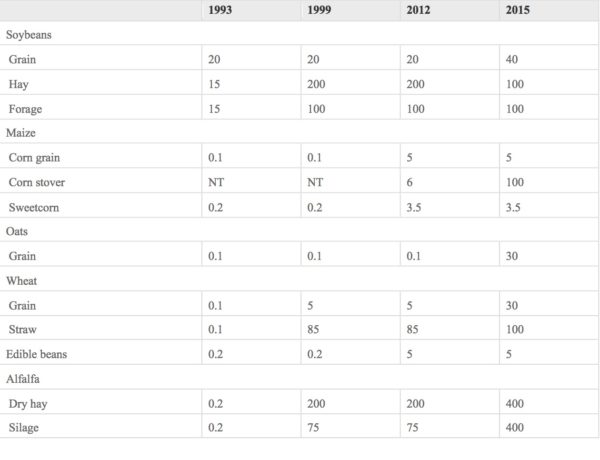
The use of GE crops is part of the whole package of industrialized farming, an integrated system that enables corporate control of our food system (for the results of this see Fig 1 Glyphosate Tolerance Levels since 1993; taken from Benbrook, 2016).
Glyphosate tolerance levels since 1993 (EPA)
GLYPHOSATE TOLERANCE LEVELS SINCE 1993 (EPA)
There has been a speed-up in farming – a grain farmer used to be able to support a family with 160 acres.  Now it takes 1600.  The Roundup-GE package goes with the speed-up. And US government regulation has failed to protect the public from the toxic herbicides that farmers spray on GE crops.
One selling point of Roundup is that it breaks down quickly. That is why you can purchase it off the shelf in garden/hardware stores.  That is accurate – it does break down quickly. But what Monsanto does not mention is that Roundup breaks down into AMPA, which lasts much longer and may be more toxic than glyphosate. (Torstensson 1985; Torstensson et al., 1989; Andréa et al., 2003; Battaglin et al., 2014).
Recently, the World Health Organization declared glyphosate a probable carcinogen, and many studies since 1985 have shown it to be an endocrine disruptor. But that did not stop the Environmental Protection Agency in 2013 from increasing the amount of glyphosate that is considered safe as a residue in soy beans, corn and other crops (see fig.).
It is extremely unscientific and poor public policy for the patent office, a federal agency, to grant billions of dollars of utility patent rights for GE technology based on a demonstration of material difference, and for FDA, another federal agency, to be simultaneously denying consumers basic information about the use of that technology in their food, based on that agency’s finding of a lack of material difference.
Internal FDA documents obtained by the Alliance for Bio-Integrity during a 1998 lawsuit against the agency reveal that the FDA’s Biotechnology Coordinator, James Maryanski, knew full well the potential risks but chose to override them. A November 1, 1991 memo to Maryanski titled “Points to Consider for Safety Evaluation of Genetically Modified Foods. Supplemental Information”, detailed the potential problems with new genetically engineered crops:
“increased levels of known naturally occurring toxicants, appearance of new, not previously identified toxicants, increased capability of concentrating toxic substances from the environment (e.g. pesticides or heavy metals) and undesirable alterations in the levels of nutrients.” (cited in Druker, 2015).
Despite this, the FDA claimed, and continues to assert that genetically engineered foods are perfectly safe and has classified them as “generally regarded as safe” or GRAS under current FDA guidelines.
The utility patents which Monsanto and other corporations hold on seed give them control over every use of that seed – including research to test it for safety.  Farmers are not allowed to save and share the seed. University scientists must have permission from the patent holder and have to pay royalties to do research on patented seed. That is a significant barrier to independent science. By contrast, the Open Source Seed Initiative (OSSI) allows seed purchasers free use of the seed and asks for a pledge
“not to restrict others’ use of these seeds or their derivatives by patents or other means, and to include this Pledge with any transfer of these seeds or their derivatives.” (FEDCO 2016 catalogue, p. 3).
Unfortunately, we do not live in a sweet world where researchers are free to work for the people and the earth and where decisions on what research gets funded are made purely on the basis of which projects benefit the largest number of poor and hungry people in former imperial colonies.
Just as the biotech proponents conflate “science” and GMOs, I and the organic movement conflate our struggle for family-scale, local, organic or agroecological agriculture and against corporate control with the fight against gmos. Buying Roundup Ready seed is not a free choice for farmers. Using that seed ensnares the farmer in Monsanto’s clutches.
There are economic issues here as well. Major Goodman of North Carolina State University, a respected corn geneticist and member of the National Academy of Sciences, stated in testimony before the National Research Council that conventional breeding typically costs about $1 million per trait, while genetic engineering costs $136 million per GE trait, with most of the cost due to research and development, not to regulatory expenses.
If we could assemble a council of farmers and scientists to evaluate the most cost-effective ways to invest public resources to eliminate world hunger, it is doubtful that they would choose genetic engineering. The 2008 United Nations International Assessment of Agricultural Knowledge, Science and Technology for Development (IAASTD), a comprehensive report on the future of farming, authored by 400 scientists and backed by 58 governments, stated that yields of GM crops were “highly variable” and in some cases, “yields declined”. The IAASTD concluded that since 70% of the world’s population is fed by small farms, many run by women, the best course would be to increase investments in agroecology (IAASTD, 2009).
That means doing the kind of work that the organic farmers of the Northeast (under the auspices of NOFA and MOFGA) have been doing for over four decades – helping family-scale farmers, homesteaders and gardeners learn more about how to produce the healthiest, most nutrient dense food using local resources and providing ways for them to share this learning with one another.  Farmer to farmer – campesino to campesino. Scientists who respect the “indigenous” knowledge of farmers can help the way Molly Jahns’ team did in the Peacework pepper breeding project.
If some of the millions spent on genetic engineering were directed to farmer-scientist organizations like Masipag (Farmer-Scientist Partnership for Development) in the Philippines and the National Organic Agriculture Movement of Uganda (NOGAMU), there would be much more progress towards local self-reliance.
I am totally with the organic farmer who declared at our meeting that agriculture needs applied research and technology and that our Land-Grant universities should invest in applied research programs to find the solutions to the complex problems facing farmers today. The division of farmers into two camps – organic and conventional – is destructive and prevents us from learning from one another. It would help all farmers if the USDA research apparatus had funding to support organic research programs at higher levels than the current barely 2 percent of all USDA research dollars.
So at this time, I do not think the organic movement should drop our opposition to allowing certified organic farms to use GE crops.  We should continue to campaign for labeling GMOs. We should call upon Cornell to disband its propaganda arm for GMOs – the Alliance for Science – or repurpose it under the guidance of a board that represents the interests of the people of NY State. We should not oppose continuing research in genetic engineering, but we should demand that equal resources go into agroecology. Independent Science is a great concept.  Let’s work together with conventional farmers for applied research that keeps our farms in business and allows us to grow the healthiest food for all the people while regenerating our soils and arresting climate change.
PS. I urge defenders of GMOs to read Altered Genes, Twisted Truth: How the Venture to Genetically Engineer Our Food Has Subverted Science, Corrupted Government, and Systematically Deceived the Public, by Steven M. Druker (Clear River Press, 2015).

References


Andréa MM, Peres TB, Luchini LC, Bazarin S, Papini S, Matallo MB, Savoy VL (2003). Influence of repeated applications of glyphosate on its persistence and soil bioactivity. Pesquisa Agropecuária Brasileira 38: 1329–1335.
Battaglin WA, Meyer MT, Kuivila KM, Dietze JE (2014) Glyphosate and its degradation product AMPA occur frequently and widely in U.S. soils, surface water, groundwater, and precipitation. J Am Water Resour Assoc 50: 275–290.
Benbrook, C (2016) Trends in glyphosate herbicide use in the United States and globally. Environmental Sciences Europe 28: 3 DOI: 10.1186/s12302-016-0070-0.
Benedetti D, Nunes E, Sarmento M, Porto C, dos Santos CEI, Dias JF, et al. Genetic damage in soybean workers exposed to pesticides: evaluation with the comet and buccal micronucleus cytome assays. Mutat Res. 752: 28–33.
Government Accountability Office (GAO). “FDA Should Strengthen Its Oversight of Food Ingredients Determined to Be Generally Recognized as Safe (GRAS)” GAO-10-246, Feb 3, 2010.
Gress, Steeve; Lemoine, Sandrine; Séralini, Gilles-Eric; Puddu, Paolo Emilio (2014). Glyphosate-Based Herbicides Potently Affect Cardiovascular System in Mammals: Review of the Literature. Cardiovascular Toxicology 15: 117–126. doi:.10.1007/s12012-014-9282-y
Huber D. (2011) Letters from Prof Don Huber to US and EU administrations Sent to President Jose-Manuel Barroso EU President cc to President Herman Van Rompuy, President Jerzy Buzek, Commissioner John Dalli and some MEPs March 25, 2011. These letters include extensive research citations which support this statement.
Johal GS and Rahe JE (1988) Glyphosate, hypersensitivity and phytoalexin accumulation in the incompatible bean anthracnose host-parasite interaction. Molec. Plant Pathol. 32: 267-281.
Fernandez MR, Selles F, Gehl D, DePauw RM and Zentner RP (2005) Crop production factors associated with Fusarium head blight in spring wheat in eastern Saskatchewan. Crop Science 45: 1908-1916 .
Kremer and Means, J. (2009) Glyphosate and glyphosate-resistant crop interactions with rhizosphere microorganisms. Europ. J. Agronomy 31: 153–161.
Johal GS and Huber, D. (2009) “Glyphosate Effects on Diseases of Plants“, European J Agronomy 31: 144–152.
Lopez SL, Aiassa D, Benitez-Leite S, Lajmanovich R, Manas F, Poletta G, et al. (2012) Pesticides used in South American GMO-based agriculture: a review of their effects on humans and animal models. Advances in Molecular Toxicology. Fishbein JC, Heilman JM. New York, Elsevier 2012, 6: 41–75.
Maffini MV, Heather M. Alger, Erik D. Olson, and Thomas G. Neltner. “Looking Back to Look Forward: A Review of FDA’s Food Additives Safety Assessment and Recommendations for Modernizing its Program,” Comprehensive Reviews in Food Science and Food Safety, Vol.12 (439-453)2013. http://onlinelibrary.wiley.com/doi/10.1111/1541-4337.12020/pdf, accessed 8/17/2013.
Marin-Morales MA, de Campos Ventura-Camargo B, Hoshina MM (2013). Chapter 16 – Toxicity of Herbicides: Impact on Aquatic and Soil Biota and Human Health. Herbicides–Current Research and Case Studies in Use (PDF). pp. 399–443.
Mesnage, R, Arno, M, Costanzo, M, Malatesta, M, Séralini, G-E, and Antoniou, M N. (2015) Transcriptome profile analysis reflects rat liver and kidney damage following chronic ultra-low dose Roundup exposure. Environmental Health  14:70 DOI 10.1186/s12940-015-0056-1.
Sparling DW, Matson C, Bickham J, Doelling-Brown P (2006). Toxicity of glyphosate as Glypro® and LI700 to red‐eared slider (Trachemys scripta elegans) embryos and early hatchlings. Environmental Toxicology and Chemistry 25 (10): 2768–2774. doi:10.1897/05-152.1
Torstensson, L. 1985. Behavior of glyphosate in soils and its degradation. The Herbicide Glyphosate. Chap. 9. p. 137-150. Swedish University of Agricultural Sciences. Uppsala, Sweden.
Torstensson NTL, Lundgren L, Stenström J (1989). Influence of climatic and edaphic factors on persistence of glyphosate and 2,4-D in forest soils. Ecotoxicology and Environmental Safety 18 (2): 230–9. doi:10.1016/0147-6513(89)90084-5
Wilson AK, JR Latham and RA Steinbrecher (2006) Transformation-induced mutations in transgenic plants: Analysis and biosafety implications. Biotechnology and Genetic Engineering Reviews 23: 209-234.

Sunday, October 25, 2015

2064. Genetically Modified Soybeans Give Altered Milk and Stunted Offspring, Researchers Find

By Jonathan Latham, Independent Science News, October 25, 2015

Cilentana Goats, Italy
Cilentana goats, Italy. 
Pregnant goats fed with genetically engineered (GE) soybeans have offspring who grow more slowly and are shorter, according to a new Italian study (Tudisco et al., 2015). Publishing in the journal of Small Ruminant Research, the researchers were testing the results of supplementing the feed of female goats with Roundup Ready GE soybeans.  Roundup Ready soybeans are engineered to resist the herbicide Roundup and are sold by agribusiness giant Monsanto. They are some of the most widely grown soybeans in the world.
The reduced growth of the goat kids was attributed by the researchers to their observation that the milk of the GE-fed mothers was significantly less nutritious and contained less of the IgG antibodies important for early growth.
“This was a carefully conducted study” commented Dr. Judy Carman, Director of the Institute of Health and Environmental Research, Australia. She was not involved in the research, but told Independent Science News that:
“The differences in the composition of the colostrum between the mothers fed the GE soy and the non-GE soy were particularly striking.  The colostrum from the GE-fed mothers contained only 2/3 of the fat, 1/3 of the protein and close to half of the IgG of the mothers fed the non-GM soy.”
To carry out these experiments the researchers divided pregnant female Cilentana goats into four groups, sixty days before kidding. Two of the groups were fed goat food containing GE Roundup Ready soybeans (at two different concentrations). The other two groups were fed conventional (non-GE) soybeans, also at two different concentrations.
After the mothers gave birth all offspring were fed only with their mother’s milk for sixty days. The growth of these kids was measured twice. After both thirty days and sixty days the kids of GE-fed mothers were approximately 20% lower in weight and shorter in stature. Both these differences were statistically significant.
Lower offspring weights were not the only unexpected findings. The researchers also found that the milk of GE-fed goats was lower in protein and fat. This difference in milk quality was large (6% protein in both GE-fed groups versus 18% in both non-GE fed groups) for the first few weeks after birth but gradually disappeared—even though the mothers continued to be fed the GE soybeans. Additionally, the researchers also found that the colostrum produced by GE-fed mothers had low amounts of IgG antibodies. These antibodies are important for growth and for healthy immune development.
A third difference noted by the researchers was that transgenic DNA could be detected in the colostrum of most (10/16) of the GE-fed goats. No transgene DNA was detected in the milk of goats fed non-GE soybeans. This is not the first time that transgene DNA (or non-transgenic DNA) has been found in the milk of ruminants, however.
Interestingly, the researchers found that all of the kids were of similar size at birth, regardless of whether their mothers ate Roundup Ready GE soybeans or not. The researchers therefore proposed that the stunting of the offspring of GE-fed mothers reflected a milk deficiency. Presumably either the lower nutritional value of the colostrum and milk of GE-fed mothers or the colostrum antibody differences that were observed. The authors noted that low IgG antibody levels in colostrum are correlated in other ruminants with slower growth and also that IgG antibodies are known to have a role in nutrient absorption because they promote gut development in newborns.
The researchers did not discuss whether the transgene DNA fragments found in the milk played a role in altering kid development.
This result is the strongest demonstration so far of altered growth and development in offspring of GE-fed mothers. The same researchers in 2010 showed altered activity of the lactic dehydrogenase enzyme in kids fed milk from mothers that ate GE Roundup Ready soybeans. In that previous study however, no additional effects on goat offspring were detected (Tudisco et al., 2010).
“It is already known that Roundup Ready soybeans have various defects including a Manganese deficiency. Yet regulators and GMO developers have continuously dismissed credible reports of GMO crops causing apparent harm to animals, from many different research groups.” Said Dr Allison Wilson of The Bioscience Resource Project. “Hopefully they will not ignore yet another study.”
References
Tudisco R., V. Mastellone, M. I. Cutrignelli, P. Lombardi, F. Bovera, N. Mirabella, G. Piccolo, S. Calabrò, L. Avallone and F. Infascelli (2010) Fate of transgenic DNA and evaluation of metabolic effects in goats fed genetically modified soybean and in their offsprings. Animal 4: 1662-1671.
S. Calabrò, M.I. Cutrignelli, G. Moniello, M. Grossi, V. Mastellone, P. Lombardi, M.E. Peroa, F. Infascelli (2015) Genetically modified soybean in a goat diet: Influence on kid performance. Small Ruminant Research 126: 67–74.

Sunday, September 6, 2015

2006. Food Industry Enlisted Academics in G.M.O. Lobbying War, Emails Show

By Eric Lipton, The NewYork Times, September 5, 2015


WASHINGTON — At Monsanto, sales of genetically modified seeds were steadily rising. But executives at the company’s St. Louis headquarters were privately worried about attacks on the safety of their products.

So Monsanto, the world’s largest seed company, and its industry partners retooled their lobbying and public relations strategy to spotlight a rarefied group of advocates: academics, brought in for the gloss of impartiality and weight of authority that come with a professor’s pedigree.

“Professors/researchers/scientists have a big white hat in this debate and support in their states, from politicians to producers,” Bill Mashek, a vice president at Ketchum, a public relations firm hired by the biotechnology industry, said in an email to a University of Florida professor. “Keep it up!”

And the industry has.

Corporations have poured money into universities to fund research for decades, but now, the debate over bioengineered foods has escalated into a billion-dollar food industry war. Companies like Monsanto are squaring off against major organic firms like Stonyfield Farm, the yogurt company, and both sides have aggressively recruited academic researchers, emails obtained through open records laws show.

The emails provide a rare view into the strategy and tactics of a lobbying campaign that has transformed ivory tower elites into powerful players. The use by both sides of third-party scientists, and their supposedly unbiased research, helps explain why the American public is often confused as it processes the conflicting information.

The push has intensified as the Senate prepares to take up industry-backed legislation this fall, already passed by the House, that would ban states from adopting laws that require the disclosure of food produced with genetically modified ingredients.
The efforts have helped produce important payoffs, including the approval by federal regulators of new genetically modified seeds after academic experts intervened with the United States Department of Agriculture on the industry’s behalf, the emails show.

Charla Lord, a Monsanto spokeswoman, said the company’s longstanding partnership with academics helped demystify the science. “It is in the public interest for academics to weigh in credibly, not only to consumers but to stakeholders like lawmakers and regulators as well,” she said.

But even some of the academics who have accepted special “unrestricted grants” or taken industry-funded trips to help push corporate agendas on Capitol Hill say they regret being caught up in this nasty food fight.

“If you spend enough time with skunks, you start to smell like one,” said Charles M. Benbrook, who until recently held a post at Washington State University. The organic foods industry funded his research there and paid for his trips to Washington, where he helped lobby for labels on foods with genetically modified ingredients.

On the other side, the biotech industry has published dozens of articles, under the names of prominent academics, that in some cases were drafted by industry consultants.

Monsanto and its industry partners have also passed out an undisclosed amount in special grants to scientists like Kevin Folta, the chairman of the horticultural sciences department at the University of Florida, to help with “biotechnology outreach” and to travel around the country to defend genetically modified foods.

“This is a great 3rd-party approach to developing the advocacy that we’re looking to develop,” Michael Lohuis, the director of crop biometrics at Monsanto, wrote last year in an email as the company considered giving Dr. Folta an unrestricted grant.

Dr. Folta said that he had joined the campaign to publicly defend genetically modified technologies because he believes they are safe, and that it is his job to share his expertise. “Nobody tells me what to say, and nobody tells me what to think,” he said, adding, “Every point I make is based on evidence.”

But he also conceded in an interview that he could unfairly be seen as a tool of industry, and his university now intends to donate the Monsanto grant money to a food pantry. “I can understand that perception 100 percent,” he said, “and it bothers me a lot.”

Players in a Safety Debate
The moves by Monsanto, in an alliance with the Biotechnology Industry Organization and the Grocery Manufacturers Association, are detailed in thousands of pages of emails that were at first requested by the nonprofit group U.S. Right to Know, which receives funding from the organic foods industry.

The New York Times separately requested some of these documents, then made additional requests in several states for email records of academics with ties to the organics industry.

There is no evidence that academic work was compromised, but the emails show how academics have shifted from researchers to actors in lobbying and corporate public relations campaigns.

The fight between the competing academics is not focused on questions about the safety of genetically engineered seeds themselves. The sides are fighting mainly over the safety of herbicides used in so-called genetically modified organism, or G.M.O., crops. The organic food proponents argue that herbicide use has surged, and that some of these herbicides may be unsafe. The biotech companies say that data relating to herbicide use on genetically engineered crops is being misinterpreted — and that these new crops, more resistant to pests and disease, are helping to feed the world.

So far, the anti-G.M.O. community has been winning the public relations war. Major brands like Chipotle and original Cheerios have moved to reduce or eliminate their use of genetically engineered ingredients, based in part on a marketing judgment that this is what the American public wants. That poses a threat to companies like Monsanto, which had $15.9 billion in global sales last year.

“Misinformation campaign in ag biotech area is more than overwhelming,” Yong Gao, then Monsanto’s global regulatory policy director, explained in an April 2013 email to Dr. Folta as the company started to work closely with him. “It is really hurting the progress in translating science and knowledge into ag productivity.”

Dr. Folta is among the most aggressive and prolific biotech proponents, although until his emails were released last month, he had not publicly acknowledged the extent of his ties to Monsanto.

He has a doctorate in molecular biology and has been doing research on the genomics of small fruit crops for more than a decade. Monsanto executives approached Dr. Folta in the spring of 2013 after they read a blog post he had written defending industry technology.

“We really appreciate independent scientists working to educate the public,” Keith Reding, a microbiologist who helps Monsanto manage its relations with regulatory agencies, wrote in an April 2013 email to Dr. Folta.

A few weeks later, the Council for Biotechnology Information — controlled by BASF, Bayer, Dow Chemical, DuPont and Monsanto — asked Dr. Folta and other prominent academics if they would participate in a new website, GMO Answers, which was established to combat perceived misinformation about their products. The plan was to provide the academics with questions from the public, such as, “Do GMOs cause cancer?”

“This is a new way to build trust, dialogue and support for biotech in agriculture that will help explain in an independent voice what GMOs are,” an executive at Ketchum wrote to Dr. Folta.

But Ketchum did more than provide questions. On several occasions, it also gave Dr. Folta draft answers, which he then used nearly verbatim, a step that he now says was a mistake.

“It was absolutely not the right thing,” he said, adding that he now insists that he write his own responses.

Kate Hall, a spokeswoman for the biotechnology council, said that the scholars were free to revise the scripted responses, and that the group offered these draft answers in only a few dozen cases, compared with the nearly 1,000 responses on GMO Answers to date.

Dr. Folta, the emails show, soon became part of an inner circle of industry consultants, lobbyists and executives who devised strategy on how to block state efforts to mandate G.M.O. labeling and, most recently, on how to get Congress to pass legislation that would pre-empt any state from taking such a step.

While Dr. Folta was not personally compensated, biotech companies paid for his trips to testify in Pennsylvania and Hawaii. “I should state upfront that I have not been compensated for any testimony,” he said at a public hearing in Hawaii, before adding, “The technology is safe and is used because it helps farmers compete.”

Dr. Folta routinely gave updates on his travels — and his face-to-face encounters with opponents of genetically modified crops — to the industry executives who were funding his efforts.

“Your email made my day!” wrote Cathleen Enright, an executive vice president of the Biotechnology Industry Organization, after Dr. Folta gave her a written update on the October 2014 legislative hearing in Pennsylvania. “Please send all receipts to us whenever you get around to it. No rush.”

In August 2014, Monsanto decided to approve Dr. Folta’s grant for $25,000 to allow him to travel more extensively to give talks on the genetically modified food industry’s products.

Dr. Folta is one of many academics the biotech industry has approached to help it defend or promote its products, the emails show.

The company, in late 2011, gave a grant for an undisclosed amount to Bruce M. Chassy, a professor emeritus at the University of Illinois, to support “biotechnology outreach and education activities,” his emails show.

In the same email in which Dr. Chassy negotiated the release of the grant funds, he discussed with a Monsanto executive a monthslong effort to persuade the Environmental Protection Agency to abandon its proposal to tighten the regulation of pesticides used on insect-resistant seeds.

“Is there a coordinated plan to maintain pressure and emphasis on EPA’s evolving regulations?” Eric Sachs, the chief of Monsanto’s global scientific affairs group, wrote in a related email to Dr. Chassy. “Have you considered having a small group of scientists request a meeting with Lisa Jackson,” referring to the E.P.A. administrator at the time.
In an interview, Dr. Chassy said he had initiated the fight against the E.P.A. plan before Monsanto pressed him. But he conceded that the money he had received from the company had helped to elevate his voice through travel, a website he created and other means.

“What industry does is when they find people saying things they like, they make it possible for your voice to be heard in more places and more loudly,” he said.
Dr. Chassy eventually set up a meeting at the E.P.A., with the help of an industry lobbyist, and the agency ultimately dropped the proposal.

In 2013, Monsanto also asked David R. Shaw, the vice president for research and economic development at Mississippi State University, to intervene with the Department of Agriculture to help persuade the agency to approve a new type of genetically modified soybean and cottonseed designed by Monsanto.

Organic farmers argued against this move, convinced that approval of the new seeds would lead to an increase in potentially harmful herbicide use. Monsanto wanted Dr. Shaw, whom the company has supported over the last decade with at least $880,000 in research grants for projects he helped oversee, to refute these arguments, the emails show.

“Our Regulatory Affairs and Government Affairs groups feel it is important that USDA hear from folks like you on the key issues since there is a high probability that many negative voices will be heard during these calls,” said a June 2013 email from John K. Soteres, then Monsanto’s head of weed resistance programs. “Your voice not only counts from the standpoint of presenting scientifically based viewpoints but also to a degree from a numbers standpoint.”

Dow Chemical made a similar pitch this year, with one company executive first reminding Dr. Shaw in an email about the industry’s financial support for the university. Then the executive asked Dr. Shaw to intervene with the Agriculture Department to urge it to approve Dow’s new genetically modified cottonseed, which was designed to be treated with a Dow-produced herbicide.

Dow’s and Monsanto’s requests to the Agriculture Department have since been approved. Dr. Shaw declined to comment. But a university spokesman, Sid Salter, described Dr. Shaw as “a highly ethical researcher.”

Why Not ‘Mommy Farmers’?
At times, the scientists themselves questioned whether they were the best advocates for the companies.

“What the situation requires is a suite of TV spots featuring attractive young women, preferably mommy farmers, explaining why biotech derived foods are the safest & greenest in the history of ag and worthy of support,” wrote L. Val Giddings, a senior fellow at Information Technology & Innovation Foundation, a nonprofit food policy research group in Washington, in an October 2014 email to a Monsanto lobbyist. The company was debating how to defeat labeling campaigns last year in Colorado and Oregon.

Dr. Folta, included in the email chain, agreed.

“We can’t fight emotion with lists of scientists,” Dr. Folta wrote to Lisa Drake, the Monsanto lobbyist. “It needs a connection to farming mothers.”

But Ms. Drake flatly rejected their arguments. Monsanto had already run television ads with mothers who were farmers. They fell flat.

“Doesn’t poll as well as credible third party scientist,” she said. “I know hard to believe, but I have seen the poll results myself, and that is why the campaigns work the way they do.”

Emails and other documents obtained by The Times from Washington State, where Dr. Benbrook served until earlier this year, show how the opponents of genetically modified foods have used their own creative tactics, although their spending on lobbying and public relations amounts to a tiny fraction of that of biosciences companies.

The organic foods industry has a direct financial interest to raise consumer concerns, because federal law requires that any product labeled organic in the United States be free of ingredients produced from genetically modified seeds. So if consumers move away from G.M.O.-based sources, they sometimes switch to organic alternatives.
Like the biotech companies, organic industry executives believed they could have more influence if they pushed their message through academics.

“I am a business guy, not a scientist,” said Gary Hirshberg, the chairman and former president of Stonyfield Farm, which produces organic yogurt, who leads an industry lobbying effort called Just Label It. “So of course it helps to have an academic scientist explain it.”

That is why Dr. Benbrook, who had served as chief scientist at the Organic Center, a group funded by the organic foods industry, resigned his job and sought a university appointment, he said.

“I was working for an organization affiliated and funded by the industry, and people were just not listening,” he said.

At Washington State, Dr. Benbrook was supported by many of the same financial backers, including Organic Valley, Whole Foods, Stonyfield and United Natural Foods Inc. The companies stayed closely involved in his research and advocacy, helping him push reporters to write about his studies, including one concluding that organic milk, produced without any G.M.O.-produced feed for the cows, had greater nutritional value.

At least twice, Mr. Hirshberg’s group also paid for Dr. Benbrook to go to Washington so he could help lobby against a federal ban on G.M.O. labels. And his research suggesting that herbicide use in G.M.O. crops has surged has been a central part of the organic industry’s argument for mandatory labels.

Dr. Benbrook, whose research post at Washington State was not renewed this year, said the organic companies had turned to him for the same reasons Monsanto and others support the University of Florida or Dr. Folta directly.

“They want to influence the public,” he said. “They could conduct those studies on their own and put this information on their website. But nobody would believe them. There is a friggin’ war going on around this stuff. And everyone is looking to gain as much leverage as they can.”