Friday, February 13, 2015

1733. The Risks of Climate Engineering

By Clive Hamilton, The New York Times, February 12, 2015


THE Republican Party has long resisted action on climate change, but now that much of the electorate wants something done, it needs to find a way out of the hole it has dug for itself. A committee appointed by the National Research Council may just have handed the party a ladder.

In a two-volume report, the council is recommending that the federal government fund a research program into geoengineering as a response to a warming globe. The study could be a watershed moment because reports from the council, an arm of the National Academies that provides advice on science and technology, are often an impetus for new scientific research programs.

Sometimes known as “Plan B,” geoengineering covers a variety of technologies aimed at deliberate, large-scale intervention in the climate system to counter global warming.

Despairing at global foot-dragging, some climate scientists now believe that a turn to Plan B is inevitable. They see it as inscribed in the logic of the situation. The council’s study begins with the assertion that the “likelihood of eventually considering last-ditch efforts” to address climate destabilization grows every year.

The report is balanced in its assessment of the science. Yet by bringing geoengineering from the fringes of the climate debate into the mainstream, it legitimizes a dangerous approach.

Beneath the identifiable risks is not only a gut reaction to the hubris of it all — the idea that humans could set out to regulate the Earth system, perhaps in perpetuity — but also to what it says about where we are today. As the committee’s chairwoman, Marcia McNutt, told The Associated Press: The public should read this report “and say, ‘This is downright scary.’ And they should say, ‘If this is our Hail Mary, what a scary, scary place we are in.’ ”

Even scarier is the fact that, while most geoengineering boosters see these technologies as a means of buying time for the world to get its act together, others promote them as a substitute for cutting emissions. In 2008, Newt Gingrich, the former House speaker, later Republican presidential candidate and an early backer of geoengineering, said: “Instead of penalizing ordinary Americans, we would have an option to address global warming by rewarding scientific invention,” adding: “Bring on the American ingenuity.”

The report, considerably more cautious, describes geoengineering as one element of a “portfolio of responses” to climate change and examines the prospects of two approaches — removing carbon dioxide from the atmosphere, and enveloping the planet in a layer of sulfate particles to reduce the amount of solar radiation reaching the Earth’s surface.

At the same time, the council makes clear that there is “no substitute for dramatic reductions in the emissions” of greenhouse gases to slow global warming and acidifying oceans.

The lowest-risk strategies for removing carbon dioxide are “currently limited by cost and at present cannot achieve the desired result of removing climatically important amounts,” the report said. On the second approach, the council said that at present it was “opposed to climate-altering deployment” of technologies to reflect radiation back into space.

Still, the council called for research programs to fill the gaps in our knowledge on both approaches, evoking a belief that we can understand enough about how the Earth system operates in order to take control of it.

Expressing interest in geoengineering has been taboo for politicians worried about climate change for fear they would be accused of shirking their responsibility to cut carbon emissions. Yet in some congressional offices, interest in geoengineering is strong. And Congress isn’t the only place where there is interest. Russia in 2013 unsuccessfully sought to insert a pro-geoengineering statement into the latest report of the Intergovernmental Panel on Climate Change.

Early work on geoengineering has given rise to one of the strangest paradoxes in American politics: enthusiasm for geoengineering from some who have attacked the idea of human-caused global warming. The Heartland Institute, infamous for its billboard comparing those who support climate science to the Unabomber, Theodore J. Kaczynski, featured an article in one of its newsletters from 2007 describing geoengineering as a “practical, cost-effective global warming strategy.”

Some scholars associated with conservative think tanks like the Hoover Institution and the Hudson Institute have written optimistically about geoengineering.
Oil companies, too, have dipped their toes into the geoengineering waters with Shell, for instance, having funded research into a scheme to put lime into seawater so it absorbs more carbon dioxide.

With half of Republican voters favoring government action to tackle global warming, any Republican administration would be tempted by the technofix to beat all technofixes.

For some, instead of global warming’s being proof of human failure, engineering the climate would represent the triumph of human ingenuity. While climate change threatens to destabilize the system, geoengineering promises to protect it. If there is such a thing as a right-wing technology, geoengineering is it.

President Obama has been working assiduously to persuade the world that the United States is at last serious about Plan A — winding back its greenhouse gas emissions. The suspicions of much of the world would be reignited if the United States were the first major power to invest heavily in Plan B.

Clive Hamilton is a professor of public ethics at Charles Sturt University in Australia and the author, most recently, of “Earthmasters: The Dawn of the Age of Climate Engineering.”

1732. As a Scientific Committee Issues a Report Backing Funding for Climate Engineering, Controversy Rages

By Tim McDonnell, Mother Jones, February 10, 2015

You might have heard of "geoengineering." It's the highly controversial theory that humans could slow, stop, or even reverse global warming by "hacking" the planet with epic technological feats that would alter the chemical composition of the atmosphere.

The idea has been around for a few decades, but there have been only a few actual experiments with it, most recently in 2012 when a rogue American millionaire dumped 220,000 pounds of iron sulphate into the Pacific Ocean. His goal was to create a massive, carbon-sucking plankton bloom. The effort succeeded, but was condemned by many scientists, the Canadian government, and the United Nations for violating international laws and for forging ahead with little regard for potential ecological fallout.
Every now and then, geoengineering of one kind or another gets floated by the media as a possible silver bullet if we continue to fail to make meaningful reductions to greenhouse gas emissions. But as the plankton debacle vividly illustrated, there are any number of very good reasons why the proposition never seems to get any traction. Ideas for how to do it are either too expensive, too entangled with thorny legal and geopolitical complications, too ineffective, or all of the above.

"We definitely don't think that we're ready to say this is something worth doing," one of the study's lead authors said.

These issues and more were laid bare today in the most comprehensive assessment of geoengineering to date, a two-volume study involving dozens of scientists that was pulled together by the National Academy of Sciences (a nongovernmental organization that produces peer-reviewed research). The reports offered a fairly damning critique of geoengineering and found that while there could be value in continuing to research the technology, it will never be a panacea for climate change, and we're definitely not ready to start using it yet.

"We definitely don't think that we're ready to say this is something worth doing," said atmospheric chemist Lynn Russell of the University of California, San Diego, a lead author on one of the report's volumes.

There are two basic categories of geoengineering, each with its own unique obstacles. The first involves pulling carbon dioxide out of the atmosphere and burying it underground, effectively reversing the man-made greenhouse gas pollution that causes global warming. (The plankton incident fits this category; the idea was that the plankton bloom would consume a bunch of CO2 and then take it to the ocean depths when the plankton died.) The second kind involves "seeding" the atmosphere with particles that would increase its reflectivity—what climate scientists call "albedo"—and send more sunlight back into space.

Before getting into the whys and wherefores of both categories, it's important to note one key finding of the study: A major risk of all geoengineering is that scientists really don't know that much about what the risks are. This is a relatively young field, Russell explained, but more importantly, it hasn't held much attention for scientists because even the most optimistic scenarios for geoengineering aren't a preferable substitute to the more familiar endeavor of reducing greenhouse gas emissions from cars, power plants, and other sources.

"As a community we've been afraid to do the research," Russell said, "because we thought it would take attention away from mitigating greenhouse gases.”

On that note, this week negotiators from around the world are meeting in Geneva to make strides toward a international climate accord expected by the end of this year. And recently President Barack Obama has announced a few major initiatives—new limits on carbon dioxide and methane emissions—that should slash America's greenhouse footprint. But progress is still too slow for most climate hawks: Even the usually-optimistic United Nations climate chief admitted last week that the upcoming accord is unlikely to keep global warming within the 3.6 degree Fahrenheit limit called for by scientists and agreed to by governments.

With that in mind, Russell said, "there is an obligation to think about whether, even if climate engineering isn't a great idea, it might not be as bad as nothing.”

Which brings us back to our two categories. Here's a useful rundown of the risks and rewards of each, from the report:


NAS
Note the row fourth from the bottom, about how both kinds of geoengineering should be judged; this point is key for understanding why the scientists are against rolling out geoengineering today.

The report finds that existing carbon dioxide removal proposals (like ocean iron fertilization; a process called "weathering" that chemically dissolves CO2 in the ocean; or giant machines that suck carbon directly out of the air) are too expensive to deploy widely. Even if future engineering advances were to bring those costs down, they would have to be weighed against the costs of the more straightforward route: To stop burning fossil fuels for energy. Pulling carbon back out of the atmosphere on a scale necessary to alter the global climate, the report says, is unlikely ever to be more cost-effective than not putting it there in the first place. One notable exception is reforestation, which is cost-effective and readily deployable (a study yesterday from Oxford University argued that planting trees is one of the "most promising" short-term fixes for climate change).
Artificially blocking sunlight would have unknown consequences for photosynthesis by plants and phytoplankton, and high concentrations of sulphate aerosols could produce acid rain, says one expert.

The outlook for albedo modification is somewhat more frightening, in part because the technology is already relatively cheap and available. China already creates an estimated 55 billion tons of artificial rain per year by "cloud seeding"—launching chemical-filled rockets into the upper atmosphere that accelerate the formation of ice crystals that cause rain. Albedo modification would work essentially the same way, using airplanes or rockets to deliver loads of sulphate aerosols into the stratosphere, where they would bounce sunlight back into space. But if the technology is straightforward, the consequences are anything but.

The aerosols fall out of the air after a matter of years, so they would need to be continually replaced. And if we continued to burn fossil fuels, ever more aerosols would be needed to offset the warming from the additional CO2. Russell said that artificially blocking sunlight would have unknown consequences for photosynthesis by plants and phytoplankton, and that high concentrations of sulphate aerosols could produce acid rain. Moreover, if we one day suddenly ceased an albedo modification program, it could cause rapid global warming as the climate adjusts to all the built-up CO2. For these reasons, the report warns that it would be "irrational and irresponsible to implement sustained albedo modification without also pursuing emissions mitigation, carbon dioxide removal, or both.”

To be fair, plenty of diversity of opinion exists among scientists. One long-time proponent of geoengineering, Harvard physicist David Keith (who was not on the committee behind this report) told the Washington Post yesterday that the technology is nothing to be afraid of: "A muffler is a technological fix for the fact that the internal combustion engine is very noisy, and people don’t have a problem with mufflers," he said.

The difference in this context is that mufflers don't come with a host of unknown, potentially catastrophic side effects. Either way, the disagreement this topic inspires just between scientists gives you some indication of how far away we are from making it practically and politically feasible. Still, Russell said, we should continue to research both kinds of geoengineering, if only to be able to express what a large-scale experiment would actually look like.

"The stage we're at now is not even having enough information to make that decision," she said. "But if we did put together a serious research program, we would make a lot of advances relatively quickly."

1731. Jails Have Become Warehouses for the Poor, Ill and Addicted, a Report Says

By Timothy Williams, The New York Times, February 11, 2015


Jails across the country have become vast warehouses made up primarily of people too poor to post bail or too ill with mental health or drug problems to adequately care for themselves, according to a report issued Wednesday.

The study, “Incarceration’s Front Door: The Misuse of Jails in America,” found that the majority of those incarcerated in local and county jails are there for minor violations, including driving with suspended licenses, shoplifting or evading subway fares, and have been jailed for longer periods of time over the past 30 years because they are unable to pay court-imposed costs.

The report, by the Vera Institute of Justice, comes at a time of increased attention to mass incarceration policies that have swelled prison and jail populations around the country. This week in Missouri, where the fatal shooting of an unarmed black man by a white police officer stirred months of racial tension last year in the town of Ferguson, 15 people sued that city and another suburb, Jennings, alleging that the cities created an unconstitutional modern-day debtors’ prison, putting impoverished people behind bars in overcrowded, unlawful and unsanitary conditions.

While most reform efforts, including early releases and the elimination of some minimum mandatory sentences, have been focused on state and federal prisons, the report found that the disparate rules that apply to jails is also in need of reform.

“It’s an important moment to take a look at our use of jails,” said Nancy Fishman, the project director of the Vera Institute’s Center on Sentencing and Corrections and an author of the report. “It’s a huge burden on taxpayers, on our communities, and we need to decide if this is how we want to spend our resources.”

The number of people housed in jails on any given day in the country has increased from 224,000 in 1983 to 731,000 in 2013 — nearly equal to the population of Charlotte, N.C. — even as violent crime nationally has fallen by nearly 50 percent and property crime has dropped by more than 40 percent from its peak.

Inmates have subsequently been spending more time in jail awaiting trial, in part because of the growing reluctance of judges to free suspects on their own recognizance pending trial dates, which had once been common for minor offenses.

As a result, many of those accused of misdemeanors — who are often poor — are unable to pay bail as low as $500.

Timed with the release of the Vera Institute report, the MacArthur Foundation announced Wednesday that it would invest $75 million over five years in 20 jurisdictions that are seeking alternatives to sending large numbers of people to jail. The jurisdictions, which could be cities, counties or other entities that run local jails, will be announced this spring.

Nationwide, the annual number of jail admissions is 19 times higher than the number of those sent to prison, and has nearly doubled since 1983, from about 6 million to 11.7 million. A significant number are repeat offenders, the report said.

In Chicago, for instance, 21 percent of the people sent to local jails from 2007 to 2011 accounted for 50 percent of all jail admissions.

In New York City, the figures were even starker: From 2009 to 2013, about 400 people were sent to jail on at least 18 occasions each, which accounted for more than 10,000 jail admissions and 300,000 days in jail.

The study found that the share of people in jail accused or convicted of crimes related to illegal drugs increased from 9 percent in 1983 to about 25 percent in 2013, and that they were disproportionately African-Americans.

And the study said that while 68 percent of jail inmates had a history of abusing drugs, alcohol or both, jail-based drug treatment programs had been underfunded.

Justin Volpe, 31, a peer recovery specialist in Miami for the Dade County courts, said he spent 45 days in jail in 2007 after being arrested on a petty theft charge. Mr. Volpe, who was homeless, addicted to drugs and suffering from an untreated mental illness at the time of his arrest, said drug treatment and a court-mandated diversion program that included counseling and medication had probably saved his life.

“It was the extra push I needed,” he said.

But Mr. Volpe said there were too few drug and alcohol treatment programs available to those in jail, where there is a close correlation between drug addiction and mental illness.

The Vera Institute report, for instance, found that more than four of five inmates with a mental illness were not treated in jail and that 34 percent of those with mental illness in jail had been using drugs at the time of their arrest, compared with 20 percent of the rest of the jail population.

Still, seeking mental health services sometimes meant longer stints in jail, the report said. In Los Angeles, those seeking help spent more than twice as much time in custody than did others — 43 days, compared with 18 days.

1730. Starved for Energy, Pakistan Braces for a Water Crisis

By Salman Masood, The New York Times, February 12, 2015
In Islamabad residents compete for scare water brought in by a truck
ISLAMABAD, Pakistan — Energy-starved Pakistanis, their economy battered by chronic fuel and electricity shortages, may soon have to contend with a new resource crisis: major water shortages, the Pakistani government warned this week.

A combination of global climate change and local waste and mismanagement have led to an alarmingly rapid depletion of Pakistan’s water supply, said the minister for water and energy, Khawaja Muhammad Asif.

“Under the present situation, in the next six to seven years, Pakistan can be a water-starved country,” Mr. Asif said in an interview, echoing a warning that he first issued at a news conference in Lahore this week.

The prospect of a major water crisis in Pakistan, even if several years distant, offers a stark reminder of a growing challenge in other poor and densely populated countries that are vulnerable to global climate change.

In Pakistan, it poses a further challenge to Prime Minister Nawaz Sharif, whose government has come under sharp criticism for failing to end the country’s electricity crisis. In some rural areas, heavy rationing has meant that as little as four hours of electricity a day is available.In the interview, Mr. Asif said the government had started to bring the electricity crisis under control, and predicted a return to a normal supply by 2017. But energy experts are less confident that such a turnaround is possible, given how long and complex the problem has proved to be.

Now the country’s water supply looms as a resource challenge, intensified by Pakistan’s enduring infrastructure and management problems.

Agriculture is a cornerstone of the Pakistani economy. The 2,000-mile-long Indus River, which rises in the Himalayas and spans the country, feeds a vast network of irrigation canals that line fields producing wheat, vegetables and cotton, all major sources of foreign currency. In the north, hydroelectric power stations are a cornerstone of the creaking power system.

A combination of melting glaciers, decreasing rainfall and chronic mismanagement by successive governments has put that water supply in danger, experts say.

In a report published in 2013, the Asian Development Bank described Pakistan as one of the most “water-stressed” countries in the world, with a water availability of 1,000 cubic meters per person per year — a fivefold drop since independence in 1947, and about the same level as drought-stricken Ethiopia.

“It is a very serious situation,” said Pervaiz Amir, country director for the Pakistan Water Partnership. “I feel it is going to be more serious than the recent oil shortages.”

Shortages of resources have climbed to the top of the political agenda in recent years. Fuel shortages last month, for which government officials blamed mismanagement by the national oil company, caused lengthy lines outside fuel stations that embarrassed the government at a time of low global oil prices.

Mr. Sharif’s government was already grappling with the seemingly intractable electricity crisis, which regularly causes blackouts of 10 hours a day even in major cities. And Mr. Sharif has been visibly distracted by grueling political duels, with the opposition politician Imran Khan, who accuses him of stealing the 2013 election, and with powerful military leaders who have undermined his authority in key areas.

Mr. Asif, the water and energy minister, said the government had started to turn the corner. But he acknowledged that the country’s resource problems were, to a large degree, endemic. “There is a national habit of extravagance,” he said, noting that it extended across resource areas, whether gas, electricity or water.

“I will be very careful not to use the word ‘drought,’ but we are water stressed right now, and slowly, we are moving to be a water-starved country,” he said.

Evidence of chronic water shortages have been painfully evident in some parts of Pakistan in recent years. A drought caused by erratic rainfall in Tharparkar, a desert area in southern Sindh Province, caused a humanitarian emergency in the region last year.

“The frequency of monsoon rains has decreased but their intensity has increased,” said Mr. Amir of the Pakistan Water Partnership. “That means more water stress, particularly in winters.”

Water is also tied to nationalist, even jihadist, politics in Pakistan. For years, religious conservatives and Islamist militants have accused rival India, where the Indus River system rises, of constricting Pakistan’s water supply.

Hafiz Saeed, the leader of the militant group that carried out the 2008 attacks in Mumbai, India, Lashkar-e-Taiba, regularly rails against Indian “water terrorism” during public rallies.

Mr. Asif said that contrary to such claims, India was not building reservoirs on rivers that flow into Pakistan. “We will never let it happen,” he said, citing the Indus Water Treaty, an agreement between the two countries that was brokered by the World Bank and signed in the 1960s.

One major culprit in Pakistan’s looming water crisis, experts say, is the country’s inadequate water storage facilities. In India, about one-third of the water supply is stored in reservoirs, compared with just 9 percent in Pakistan, Mr. Amir said.

“We built our last dam 46 years ago,” he said. “India has built 4,000 dams, with another 150 in the pipeline.”

Experts say the country’s chaotic policies are hurting its image in the eyes of Western donors who could help alleviate the mounting resource crises.

“The biggest looming crisis is of governance, not water — which could make this country unlivable in the next few years,” said Arshad H. Abbasi, a water and energy expert with the Sustainable Development and Policy Institute, a research group based in Islamabad.

Wednesday, February 11, 2015

1729. Global Sea Ice Diminishing, Despite Antarctic Gains

By Science Daily, February 10, 2015

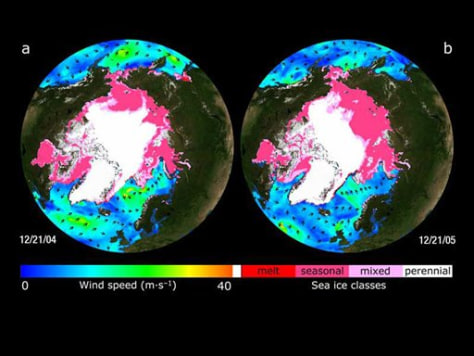
Sea ice increases in Antarctica do not make up for the accelerated Arctic sea ice loss of the last decades, a new NASA study finds. As a whole, the planet has been shedding sea ice at an average annual rate of 13,500 square miles (35,000 square kilometers) since 1979, the equivalent of losing an area of sea ice larger than the state of Maryland every year.

"Even though Antarctic sea ice reached a new record maximum this past September, global sea ice is still decreasing," said Claire Parkinson, author of the study and climate scientist at NASA's Goddard Space Flight Center in Greenbelt, Md. "That's because the decreases in Arctic sea ice far exceed the increases in Antarctic sea ice.”

Parkinson used microwave data collected by NASA and Department of Defense satellites for her study, which was published last December in the Journal of Climate. She added Arctic and Antarctic sea ice extents month by month from November 1978 to December 2013 to determine the global ice extent for each month. Her analysis shows that over the 35-year period, the trend in ice extents was downward in all months of the year, even those corresponding to the Arctic and Antarctic sea ice maximum extents.

Furthermore, the global ice decrease has accelerated: in the first half of the record (1979-96), the sea ice loss was about 8,300 square miles (21,500 square kilometers) per year. This rate more than doubled for the second half of the period (1996 to 2013), when there was an average loss of 19,500 square miles (50,500 square kilometers) per year -- an average yearly loss larger than the states of Vermont and New Hampshire combined.
"This doesn't mean the sea ice loss will continue to accelerate," Parkinson said. "After all, there are limits. For instance, once all the Arctic ice is gone in the summer, the Arctic summertime ice loss can't accelerate any further.”

Sea ice has diminished in almost all regions of the Arctic, whereas the sea ice increases in the Antarctic are less widespread geographically. Although the sea ice cover expanded in most of the Southern Ocean between 1979 and 2013, it decreased substantially in the Bellingshausen and Amundsen seas. These two seas are close to the Antarctic Peninsula, a region that has warmed significantly over the last decades.

In her study, Parkinson also shows that the annual cycle of global ice extents is more similar to the annual cycle of the Antarctic ice than the Arctic ice. The global minimum ice extent occurs in February of each year, as does the Antarctic minimum extent, and the global maximum sea ice extent occurs in either October or November, one or two months after the Antarctic maximum. This contrasts with the Arctic minimum occurring in September and the Arctic maximum occurring in March. Averaged over the 35 years of the satellite record, the planet's monthly ice extents range from a minimum of 7.03 million square miles (18.2 million square kilometers) in February to a maximum of 10.27 million square miles (26.6 million square kilometers) in November.

"One of the reasons people care about sea ice decreases is that sea ice is highly reflective whereas the liquid ocean is very absorptive," Parkinson said. "So when the area of sea ice coverage is reduced, there is a smaller sea ice area reflecting the sun's radiation back to space. This means more retention of the sun's radiation within the Earth system and further heating.”

Parkinson doesn't find it likely that the Antarctic sea ice expansion will accelerate and overturn the global sea ice negative trend in the future.

"I think that the expectation is that, if anything, in the long-term the Antarctic sea ice growth is more likely to slow down or even reverse," she said.

Parkinson calculated and published the global results after witnessing the public's confusion about whether Antarctic sea ice gain might be cancelling out Arctic sea ice loss.

"When I give public lectures or talk with random people interested in the topic, often somebody will say something in the order of 'well, the ice is decreasing in the Arctic but it's increasing in the Antarctic, so don't they cancel out?'" Parkinson said. "The answer is no, they don't cancel out."


Story Source:
The above story is based on materials provided by NASA/Goddard Space Flight Center. Note: Materials may be edited for content and length.

Journal Reference:

1 Claire L. Parkinson. Global Sea Ice Coverage from Satellite Data: Annual Cycle and 35-Yr Trends. Journal of Climate, 2014; 27 (24): 9377 DOI: 10.1175/JCLI-D-14-00605.1

Tuesday, February 10, 2015

1728. Cats and Foxes Imported by European Colonists Are Killing Off Native Mammals in Australia, Study Finds

By The Associated Press, The New York Times, February 9, 2015
There are an estimated 15 million feral cats in Australia

Australia’s mammals are going extinct at an unusually high rate, and a new study says the main culprits are cats and foxes brought to the continent by European settlers. The study, published by the Proceedings of the National Academy of Sciences on Monday, shows that more than 10 percent of the land mammal species endemic to Australia have been wiped out since European settlement began in 1788. That rate has long been a source of puzzlement since sparsely populated Australia would seem to be a paradisiacal haven for animals. But the researchers found that much of the species’ decline coincided with the introduction of two animals: the feral cat, which sailors brought aboard ships to keep rats at bay, and red foxes, brought for hunting. As it turned out, both species hunted a little too well and they spread rapidly. “We knew it was bad, but I think our tallies were much worse than previously thought,” said one of the study’s authors, Prof. John Woinarski of Charles Darwin University.

Monday, February 9, 2015

1727. The Muslims of Early America

By Peter Manseau, The New York Times, February 9, 2015

IT was not the imam’s first time at the rodeo. Scheduled to deliver an invocation at the Fort Worth Stock Show and Rodeo last week, Moujahed Bakhach of the local Islamic Association of Tarrant County canceled his appearance because of the backlash brought on by a prayer he had offered a few days before. The imam had been asked to confer a blessing on horses, riders and members of the military. He was met with gasps from the audience and social media complaints: “Outraged at a Muslim prayer at an all American event!” “Cowboys don’t want it!”

Vocal anti-Islamic sentiment is undergoing a revival. Four days before the imam’s canceled benediction, protesters at the State Capitol in Austin shouted down Muslim speakers, claiming Texas in the name of Jesus alone. In North Carolina two weeks earlier, Duke University’s plan to broadcast a Muslim call to prayer was abandoned amid threats of violence. Meanwhile Gov. Bobby Jindal, Republican of Louisiana claimed that if American Muslims “want to set up their own culture and values, that’s not immigration, that’s really invasion.”

No matter how anxious people may be about Islam, the notion of a Muslim invasion of this majority Christian country has no basis in fact. Moreover, there is an inconvenient footnote to the assertion that Islam is anti-American: Muslims arrived here before the founding of the United States — not just a few, but thousands.

They have been largely overlooked because they were not free to practice their faith. They were not free themselves and so they were for the most part unable to leave records of their beliefs. They left just enough to confirm that Islam in America is not an immigrant religion lately making itself known, but a tradition with deep roots here, despite being among the most suppressed in the nation’s history.

In 1528, a Moroccan slave called Estevanico was shipwrecked along with a band of Spanish explorers near the future city of Galveston, Tex. The city of Azemmour, in which he was raised, had been a Muslim stronghold against European invasion until it fell during his youth. While given a Christian name after his enslavement, he eventually escaped his Christian captors and set off on his own through much of the Southwest.
Two hundred years later, plantation owners in Louisiana made it a point to add enslaved Muslims to their labor force, relying on their experience with the cultivation of indigo and rice. Scholars have noted Muslim names and Islamic religious titles in the colony’s slave inventories and death records.

The best known Muslim to pass through the port at New Orleans was Abdul-Rahman Ibrahim ibn Sori, a prince in his homeland whose plight drew wide attention. As one newspaper account noted, he had read the Bible and admired its precepts, but added, “His principal objections are that Christians do not follow them.”

Among the enslaved Muslims in North Carolina was a religious teacher named Omar ibn Said. Recaptured in 1810 after running away from a cruel master he called a kafir (an infidel), he became known for inscribing the walls of his jail cell with Arabic script. He wrote an account of his life in 1831, describing how in freedom he had loved to read the Quran, but in slavery his owners had converted him to Christianity.

The story of Islam in early America is not merely one of isolated individuals. An estimated 20 percent of enslaved Africans were Muslims, and many sought to recreate the communities they had known. In Georgia, which has joined more than a dozen states in the political theater of debating a restriction on judges’ consulting Shariah, Muslims on a secluded plantation are known to have lived under the guidance of a religious leader who wrote a manuscript on Islamic law so that traditional knowledge might survive.

A clue to what happened to these forgotten American Muslims can be found in the words of a missionary traveling through the South to preach the gospel on slave plantations. Many “Mohammedan Africans,” he noted, had found ways to “accommodate” Islam to the new beliefs imposed upon them. “God, say they, is Allah, and Jesus Christ is Mohammed. The religion is the same, but different countries have different names.”

The missionary considered this to be lamentable evidence of Muslims’ inability to recognize the importance of religious truths. But in fact it proves just the opposite. They understood that their faith was important enough that they should listen for it everywhere, even in a country so distant from the places where they had once heard the call to prayer.

Islam is part of our common history — a resilient faith not just of the enslaved, but of Arab immigrants in the late 19th century, and in the 20th century of many African-Americans reclaiming and remaking it as their own. For generations, its adherents have straddled a nation that jolts from promises of religious freedom to events that give the lie to those promises.

In a sense, Islam is as American as the rodeo. It, too, was imported, but is now undeniably part of the culture. Whether or not protesters in Texas and elsewhere are ready for it, it is inevitable that some Muslims will let their babies grow up to be cowboys. A few cowboys may grow up to be Muslims as well.