Showing posts with label Geoengineering. Show all posts

Wednesday, November 7, 2018

3069. Geoengineering as Dispossession

By Kate Dooley and Doreen Stabinsky, Science for the People, Summer 2018
In signing the Paris Agreement on climate change, countries committed to hold the rise in global temperature to less than a 2°C increase above pre-industrial levels and, further, to aim for keeping the global temperature increase to a 1.5°C limit. Agreeing to stay below this threshold reflects a collective understanding that the impacts of a 2°C temperature rise are, to say the least, undesirable. There is much less of a collective understanding of how to aim for a 1.5°C temperature limit—what options do we have for reducing ongoing emissions and even possibly removing the greenhouse gases (GHG) already present in the atmosphere?
Science gives us a better understanding of the causes and impacts of climate change on our environment, but the scientific gaze is often limiting, providing technical solutions to the “climate problem,” while obscuring underlying politics and political-economic relations. Under the Paris Agreement, nations committed to preventing dangerous global warming through balancing sources (for example, the burning of fossil fuels) and sinks (such as forests, grasslands, and oceans, which take up and store carbon) of human-caused emissions. The idea is that if we take out of the atmosphere as much carbon dioxide (CO2) as we emit, overall CO2 emissions will zero out by the middle of the century. Emissions from the burning of fossil fuels (sources) would be balanced with “sequestration,” through storing carbon dioxide in trees and grasslands, or capturing and liquefying emitted carbon dioxide and burying it underground.
Any land-based technical solutions would require large areas of land. Depending on the choice of technologies, lands currently used to provide food and livelihoods for nomadic livestock herders, small-scale agriculturalists, and forest peoples could be at risk for repurposing toward climate mitigation. 1 Communal and smallholder lands in the global South are often considered “degraded” or “unused” lands by governments or international agencies classifying land-use. Such labels facilitate and legitimize the takeover of “degraded” lands by those with greater power. The lack of secure tenure and land ownership makes these populations vulnerable to dispossession or displacement by the consumptive desires of the wealthy of the world, most of whom live in the global North.2 This is not the first instance where land in the global South has been seen as central to climate solutions–Amazon forests have long been considered important as “the lungs of the planet.”3 Such discursive and material framings pose that for the global good of climate mitigation, land and forest resources will need to be protected and uses reassigned, regardless of who might currently inhabit or use those lands for their livelihoods.
Climate-focused integrated assessment models (IAMs) combine economic and social assumptions (i.e., rates of GDP and population growth) with observations from earth-system models to identify options that reduce GHG emissions over the century. These options are combined with policy to drive emission reductions in energy use, in the production of goods and industry, and from the agriculture and land-use sectors. IAMs are most frequently used to identify options that minimize the economic costs of climate solutions.4 In constructing the assumptions behind these IAMs, obviously political choices are obscured behind the curtain of modeling expertise, which has led to solutions with an outsized reliance on land for climate mitigation in the current generation of models. The risks to the people whose lives and livelihoods depend on these lands are rarely considered, and the proposed solutions risk failing to actually address the climate crisis.

Pulling back the curtain of modeling expertise

The concept of scientific co-production5 illuminates how knowledge is developed and legitimized at the science-policy interface and offers insights into how viewing problems such as climate change through a technocratic lens might obscure important relations of power, rights, and choices about who might shoulder the burdens of climate change mitigation.
As far back as the late 1990s, scholars questioned the policy-usefulness of climate models.6 They argued that the dominance of models in climate policy input obscures political choices that deserve wider debate. There is now an established body of literature critiquing this technocratic and global framing of climate change, devoid of people and impacts.7 Epistemic and cultural biases persist in the process that develops and legitimizes knowledge into policy on climate. The economists, engineers and natural scientists, as well as scientists with developed country affiliations, form an epistemic community influencing the climate solutions considered legitimate in the Intergovernmental Panel on Climate Change (IPCC) assessments of climate science and policy solutions.8
More recent critiques have focused on the IAMs themselves.9 IAMs were originally designed to answer  exploratory questions such as, “what climate outcomes will future emissions produce?” The question has now shifted from showing what levels of emissions (and hence warming) different future development scenarios would result in, to determining what cost-effective technology choices and policies are required to achieve a specific warming “target.”10 It is this process of singling out particularly cost-effective technologies that leads to model conclusions that rely primarily on land as a key mitigation solution.
IAMs represent a negotiated and constructed model of scientific knowledge that scientists and legislators use to provide answers to questions that advance policymaking. This work relies on maintaining sharp boundaries between facts and values11 that create a perception of scientific neutrality and justify the political acceptability of the results.
Yet researchers examining the co-production between science and policy in the context of IAM modeling and identification of mitigation options have shown that the perception of model-based knowledge as “objective science” lends significant authority to outcomes that might otherwise be more critically debated and contested, such as the large-scale use of bioenergy with carbon capture and storage (BECCS).12 Indeed, the emergence of BECCS as the go-to climate solution has been pinned to the IAM epistemic community, without serious engagement with social scientists, ecologists, or bioenergy experts.13 In contrast, including assumptions in models related to broader societal objectives, such as food security, are considered value judgments, which would risk undermining the purported scientific objectivity and hence political credibility of cost-optimization climate models.

Models, Mitigation Options, and Land Use

IAMs offer what some call “magical thinking” to reach the 2°C and 1.5°C temperature targets: assuming that large volumes of CO2 can and will be removed from the atmosphere in the second half of the century.
Bioenergy with carbon capture and storage (BECCS), a form of geoengineering,14 is the favored removal technology included in the model inputs. Bioenergy refers to the use of crops to produce energy when burned, such as wood chips from the forests in Louisiana being shipped to the UK to create electricity in the Drax power station. Carbon capture and storage is the process of stripping CO2 from the waste gases at the time of combustion and then compressing it into a liquid for long-term underground storage. Theoretically, the BECCS process removes some amount of CO2 from the atmosphere that has been converted to plant material through the process of photosynthesis. Putting BECCS technology in place on a planetary scale would require the planting of extensive areas of land for bioenergy crops, over a billion hectares at the upper end of estimates.15
Most IAM scenarios that achieve the 2°C and 1.5°C targets conclude that removals will be achieved predominantly through “land-based sequestration” measures such as BECCS or forest plantations, which would require appropriating extensive areas of land.16 These conclusions, as described above, depend on the model inputs–BECCS and afforestation are the only carbon removal options used in most models. Meaning most IAMs overlook other activities that may remove carbon from the atmosphere, with greater co-benefits and/or fewer negative impacts on societal objectives such as food security.
Other land-based carbon removal options include protecting and restoring forest ecosystems or sequestering carbon in soils by protecting permanent grasslands, adding organic material such as compost, or reducing the frequency of tilling (although with this method there is a significant risk of reversals the next time soils are tilled).17 Any option that requires large amounts of biomass—a term used for any biological material that serves as feedstock for a mass production process such as burning—potentially means a large land requirement. Agricultural wastes and residues, such as residues left after crop harvest, or municipal waste, could be used for BECCS feedstock to avoid the negative impacts that come with increased demand for land, but as residue supply is limited, the scale of carbon removal that can be achieved from residue use alone is also much lower than what is required.
To achieve high levels of bioenergy production for BECCS, models free up large amounts of land from food and feed production for the production of energy crops, using optimistic assumptions for increased agricultural productivity, reduced food waste, and shifts to less meat-intensive diets.18The median value of bioenergy demand in IAM scenarios that would keep temperature rise below 2°C would require a 50% increase in global harvest of biomass, for all purposes, by 2050.19 Many scenarios compatible with 1.5°C require a doubling of global cropland for bioenergy production, with potential losses of around a quarter of current pastureland (Fig. 1).20
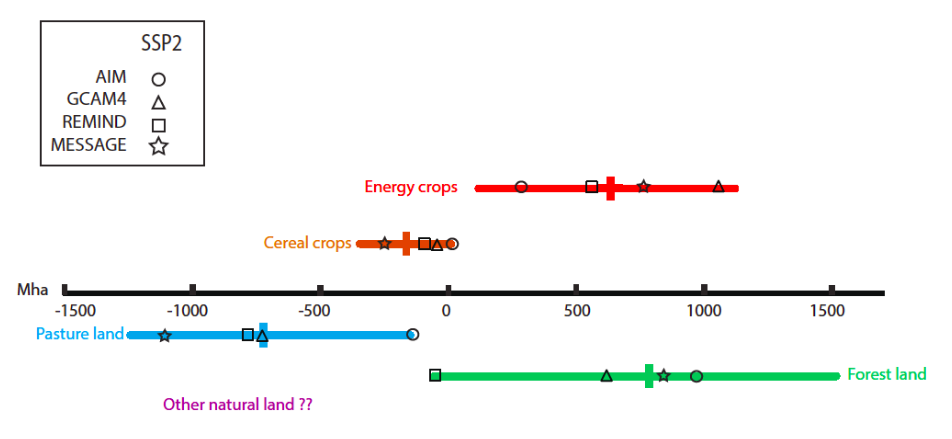
Figure 1: Scale of land use change in modeled 1.5°C pathways (SSPx-1.9 in 2100 relative to 2010). Mha = million hectares (Data from Rogelj et al., 2018).  Note that the scenarios suggest that positive and large amounts land for the production of energy crops and forestland are needed for carbon sequestration (bars to the right of 0), while significant reductions are seen in land devoted to cereal crops and pasture land (bars to the left of 0).
Information on the impact of 1.5°C scenarios on natural lands (land that is not designated as permanent cropland, forest or pastureland, outside of ice and desert lands) is not available, but 2°C scenarios show that loss of natural lands is on the same scale as loss of pastureland–at up to a billion hectares.21 Land-use change on this scale, driven by demand for bioenergy, raises significant concerns for food security and biodiversity.22

The political economy of land use in an era of climate urgency

Land availability for BECCS or other forest plantations becomes a technical problem for modelers to solve through assumptions of future increases in production efficiencies or reductions in livestock consumption while obscuring potential political questions about where “spare” lands for climate mitigation might actually be found. Gibbs and Salmon note that the true extent and availability of so-called “degraded” lands—land available for other uses—is subject to high uncertainties, with wide disagreement in their extent and spatial distribution, pointing out that “even a precise map of the physical area of degraded land would significantly overestimate its potential by neglecting its myriad social, environmental, and political constraints”.23 One of the greatest risks posed by large-scale land-use change for energy crops and forest plantations is the risk of increasing land-tenure insecurity and violent conflict in situations of nonexistent land-rights and poor land-sector governance.24
Remaining below 2°C or 1.5°C will require an extraordinary effort in reducing emissions. Recent studies have generally found that the required emissions reductions necessary to meet the 1.5°C temperature target, without resorting to BECCS or other large-scale carbon removal, necessitates meeting all of the most optimistic assumptions, including behavior change to reduce consumption, a shift to healthier diets, massively scaled-up renewable energy deployment with reduced energy demand, and low population growth.25 In these scenarios, some level of carbon removal is still required, albeit at lesser scales, which can generally be achieved through natural solutions such as protecting and restoring forest ecosystems. This highlights the importance of setting a course for the most ambitious emissions reductions possible in the near term, in order to limit reliance on CO2 removal.

The risks inherent in relying on large-scale future removals for addressing the climate crisis

The result of this fetishism of scientific and technical inputs into the climate debate could have profound consequences and raises particular risks. Reliance on future performance of large-scale removal technologies, however, poses a different class of risks, one that may result in greater warming than relying only on conventional mitigation options aimed at preventing carbon from entering the atmosphere. Relying on the presumption that we will be able to remove emissions in the future makes the task of not putting them in the atmosphere in the first place less urgent. While all mitigation options pose some level of risk that they will not deliver at the pace and scale expected, the risks of conventional mitigation options can be solved by changing technology options or behaviors. The risks of relying on future removals constitute a moral hazard,26potentially locking us into much higher levels of future warming than intended if these removal technologies fail, forcing us to confront considerably higher social and ecological costs compared to reducing emissions now.27 Taking on these risks of delayed action may substantially undermine society’s mitigation efforts in the long-term.28
Based on the scale of land-use involved, proposals for large-scale reliance on land-based removal technologies pose clear and significant risks to sustainable development. At the same time, there is unexplored potential for synergies between climate mitigation in the land sector and the achievement of sustainable development goals (SDGs). Options for removing carbon from the atmosphere that are based on “natural” solutions and ecosystem restoration have been put forward, as well as initial assessments of the synergies between these options and SDGs.29

Socially conscious models

“The Paris agreement shows where we want to go—the brave new world of a balanced carbon budget—but not how to get there. For now, action should focus on urgent emissions reductions and not on an unproven ‘emit now, remove later’ strategy. But the unwelcome truth is that, unless a lot more effort is made to cut emissions, significant CO2 removal will need to begin around 2020, with up to 20 gigatons of CO2 extracted each year by 2100 to keep the global temperature increase ‘well below 2 °C.’
Is that feasible? What environmental risks and constraints are involved? We need to know.” (Williamson 2016)
Integrated assessment models, and the scientific and policy communities that create and use them, also attempt to show us where we want to go and how we might get there. To our collective detriment, through processes that prioritize technical knowledge and scientific authority, they obscure the critical questions Williamson raises above. In the context of integrated assessment models being used to inform future mitigation pathways, closer negotiation between knowledge producers and knowledge users could lead to a more informative set of mitigation scenarios by allowing for a more critical interrogation of the value-based and ethical choices inherent in any scenario-building exercise.30 We call this ‘purposeful modeling’, embodying a reflexive approach to the co-production of scientific knowledge and better accounting for real-world constraints.31
Are the levels of BECCS and afforestation proposed by the models feasible? What environmental—as well as social and political—risks, constraints, and choices are involved? Who might be dispossessed by the conversion of their “degraded” lands for the urgent need to sequester excess atmospheric carbon dioxide? Modelers must develop effective ways to incorporate these questions into their analyses, and more importantly, the broader climate/science policy community has to critically constrain when, how, and why models are used. These are extremely important questions that we must face as we urgently consider how to stop climate change—questions that models cannot answer.

References

  1. In climate change vocabulary, the word mitigation has a very specific usage. It refers toreductions in greenhouse gases in the atmosphere, either through reducing emissions or by removal of gases already emitted.
  2. Tania Murray Li, “To Make Live or Let Die? Rural Dispossession and the Protection of Surplus Populations,” Antipode 41, no. 4 (2010): 66–93, doi:10.1111/j.1467-8330.2009.00717.x.
  3. Karolien van Teijlingen, “Extractive Industries, Power Struggles and the Battle of Ideas,” 2014, http://www.unrisd.org/unrisd/website/newsview.nsf/0/A457B1702081D5C2C1257D15002A5A09.
  4. IPCC, “Climate Change 2014: Synthesis Report. Contribution of Working Groups I, II and III to the Fifth Assessment Report of the Intergovernmental Panel on Climate Change” ed. Core Writing Team, R K Pachauri, and L A Meyer, (Geneva, Switzerland, 2014), doi:10.1017/CBO97811074154.
  5. S Jasanoff, States of Knowledge: the Co-Production of Science and the Social Order, ed. Sheila Jasanoff, (London and New York, 2004).
  6. Simon Shackley et al., “Uncertainty, Complexity and Concepts of Good Science in Climate Change Modelling: Are GCMs the Best Tools?,” Climatic Change 38, no. 2 (1998): 159–205, doi:10.1023/A:1005310109968.
  7. David Demeritt, “The Construction of Global Warming and the Politics of Science,” Annals of the Association of American Geographers 91, no. 2 (2001): 307–37, doi:10.1111/0004-5608.00245; Clark A Miller and Paul N Edwards, Changing the Atmosphere, ed. Clark A Miller and Paul Edwards, (MIT Press, 2001); Shackley et al., “Uncertainty, Complexity and Concepts of Good Science in Climate Change Modelling: Are GCMs the Best Tools?;” Mike Hulme, “Reducing the Future to Climate: a Story of Climate Determinism and Reductionism,” The History of Science Society 26 (June 24, 2011): 245–66; Brian Wynne, “Strange Weather, Again,” Theory, Culture & Society 27, no. 2 (March 2010): 289–305, doi:10.1177/0263276410361499.
  8. Esteve Corbera et al., “Patterns of Authorship in the IPCC Working Group III Report,” Nature Climate Change 6, no. 1 (September 7, 2015): 94–99, doi:10.1038/nclimate2782.
  9. Robert S Pindyck, “Climate Change Policy: What Do the Models Tell Us?,” Journal of Economic Literature 51, no. 3 (September 1, 2013): 860–72, doi:10.1257/jel.51.3.860; Richard Rosen, “Energy Policy – Supplementary Material – March 2016,” Energy Policy, August 7, 2016; Sarah Wolf, Franziska Schütze, and Carlo Jaeger, “Balance or Synergies Between Environment and Economy—a Note on Model Structures,” Sustainability 8, no. 8 (August 2016): 761, doi:10.3390/su8080761; Silke Beck and Martin Mahony, “The IPCC and the Politics of Anticipation,” Nature Climate Change 7, no. 5 (April 28, 2017): 311–13, doi:10.1038/nclimate3264.
  10. Bastien Girod and Thomas Flueler, “Future IPCC Scenarios–Lessons Learned and Challenges to Scenario Building in Climate Change Policy,” Iew, June 1, 2009, 1–17; R E Kopp, S M Hsiang, and M Oppenheimer, “Empirically Calibrating Damage Functions and Considering Stochasticity When Integrated Assessment Models Are Used as Decision Tools,” 2013, doi:10.7282/T35X2BRQ.
  11. Sheila Jasanoff, The Fifth Branch: Science Advisors as Policymakers, (Harvard University Press, 1990).
  12. Kate Dooley, Peter Christoff, and Kimberly A Nicholas, “Co-Producing Climate Policy and Negative Emissions: Trade-Offs for Sustainable Land-Use,” Global Sustainability 1 (June 12, 2018): 1–10, doi:10.1017/sus.2018.6.
  13. Laude, forthcoming.
  14. CBD, Decision X/33. Biodiversity and Climate Change, 2010.
  15. Dooley, Christoff, and Nicholas, “Co-Producing Climate Policy and Negative Emissions: Trade-Offs for Sustainable Land-Use.”
  16. Dooley, Christoff, and Nicholas, “Co-Producing Climate Policy and Negative Emissions: Trade-Offs for Sustainable Land-Use.”
  17. Phil Williamson, “Emissions Reduction: Scrutinize CO2 Removal Methods,” Nature 530, no. 7589 (February 10, 2016): 153–55, doi:10.1038/530153a.
  18. Popp, Calvin, Fujimori, Havlík, Humpenöder, Stehfest, Bodirsky, Dietrich, Doelmann, Gusti, Hasegawa, Kyle, Obersteiner, Tabeau, Takahashi, Valin, Waldhoff, Weindl, Wise, Kriegler, Lotze-Campen, Fricko, Riahi, and Vuuren, “Land-Use Futures in the Shared Socio-Economic Pathways.”
  19. ibid.
  20. Dooley, Christoff, and Nicholas, “Co-Producing Climate Policy and Negative Emissions: Trade-Offs for Sustainable Land-Use.”
  21. ibid.
  22. Joeri Rogelj et al., “Scenarios Towards Limiting Global Mean Temperature Increase Below 1.5 °C,” Nature Climate Change, March 5, 2018, 1–9, doi:10.1038/s41558-018-0091-3 a.
  23. H. K. Gibbs and J. M. Salmon, “Mapping the World’s Degraded Lands,” Applied Geography 57, no. C (February 1, 2015): 12–21, doi:10.1016/j.apgeog.2014.11.024.
  24. Kate Dooley, “Human Rights and Land-Based Carbon Mitigation,” in Routledge Handbook of Human Rights and Climate Governance, (Routledge, 2018), 372–79.
  25. Detlef P van Vuuren et al., “Alternative Pathways to the 1.5 °C Target Reduce the Need for Negative Emission Technologies,” Nature Climate Change, April 5, 2018, 1–10, doi:10.1038/s41558-018-0119-8; Arnulf Grübler et al., “A Low Energy Demand Scenario for Meeting the 1.5 °C Target and Sustainable Development Goals Without Negative Emission Technologies,” Nature Energy, June 1, 2018, 1–13, doi:10.1038/s41560-018-0172-6.
  26. Henry Shue, “Mitigation Gambles: Uncertainty, Urgency and the Last Gamble Possible,” Philosophical Transactions of the Royal Society a: Mathematical, Physical and Engineering Sciences376, no. 2119 (April 2, 2018): 20170105–11, doi:10.1098/rsta.2017.0105.
  27. James Hansen et al., “Young People’s Burden: Requirement of Negative CO2Emissions,” Earth System Dynamics Discussions, October 4, 2016, 1–40, doi:10.5194/esd-2016-42.
  28. Dooley and Kartha, “Land-Based Negative Emissions: Risks for Climate Mitigation and Impacts on Sustainable Development.”
  29. Bronson W Griscom et al., “Natural Climate Solutions,” Proceedings of the National Academy of Sciences 114, no. 44 (October 31, 2017): 11645–50, doi:10.1073/pnas.1710465114; Dooley and Kartha, “Land-Based Negative Emissions: Risks for Climate Mitigation and Impacts on Sustainable Development.”
  30. Dooley, Christoff, and Nicholas, “Co-Producing Climate Policy and Negative Emissions: Trade-Offs for Sustainable Land-Use.”
  31. Dooley, Christoff, and Nicholas, “Co-Producing Climate Policy and Negative Emissions: Trade-Offs for Sustainable Land-Use.”

Friday, July 27, 2018

2979. Geoengineering and Capitalism’s Creative Destruction of the Earth

By John Bellamy Foster, Science for the People Magazine/Monthy Review, Summer 2018 
Photo: Truthout/Flickr
A short fuse is burning. At the present rate of global emissions, the world is projected to reach the trillionth metric ton of cumulative carbon emissions, breaking the global carbon budget, in less than two decades.1 This would usher in a period of dangerous climate change that could well prove irreversible, affecting the climate for centuries if not millennia. Even if the entire world economy were to cease emitting carbon dioxide at the present moment, the extra carbon already accumulated in the atmosphere virtually guarantees that climate change will continue with damaging effects to the human species and life in general. However, reaching the 2° C increase in global average temperature guardrail, associated with a level of carbon concentration in the environment of 450 ppm, would lead to a qualitatively different condition. At that point, climate feedbacks would increasingly come into play threatening to catapult global average temperatures to 3° C or 4° C above preindustrial levels within this century, in the lifetime of many individuals alive today. The situation is only made more serious by the emission of other greenhouse gases, including methane and nitrous oxide.
The enormous dangers that rapid climate change present to humanity as a whole, and the inability of the existing capitalist political-economic structure to address them, symbolized by the presence of Donald Trump in the White House, have engendered a desperate search for technofixes in the form of schemes for geoengineering, defined as massive, deliberate human interventions to manipulate the entire climate or the planet as a whole. Not only is geoengineering now being enthusiastically pushed by today’s billionaire class, as represented by figures like Bill Gates and Richard Branson; by environmental organizations such as the Environmental Defense Fund and the Natural Resources Defense Council; by think tanks like the Breakthrough Institute and Climate Code Red; and by fossil-fuel corporations like Exxon Mobil and Shell—it is also being actively pursued by the governments of the United States, the United Kingdom, China, and Russia. The UN Intergovernmental Panel on Climate Change (IPCC) has incorporated negative emissions strategies based on geoengineering (in the form of Bioenergy with Carbon Capture and Storage [BECCS]) into nearly all of its climate models. Even some figures on the political left—where “accelerationist” ideas have recently taken hold in some quarters—have grabbed uncritically onto geoengineering as a deus ex machina—a way of defending an ecomodernist economic and technological strategy—as witnessed by a number of contributions to Jacobin magazine’s Summer 2017 “Earth, Wind, and Fire” issue.2
If the Earth System is to avoid 450 ppm of carbon concentration in the atmosphere and is to return to the Holocene average of 350 ppm, some negative emissions by technological means, and hence geoengineering on at least a limited scale, will be required, according to leading climatologist James Hansen.3 Hansen’s strategy, however, like most others, remains based on the current system, that is, it excludes the possibility of a full-scale ecological revolution, involving the self-mobilization of the population around production and consumption. What remains certain is that any attempt to implement geoengineering (even in the form of technological schemes for carbon removal) as the dominant strategy for addressing global warming, subordinated to the ends of capital accumulation, would prove fatal to humanity. The costs of such action, the burden it would put on future generations, and the dangers to living species, including our own, are so great that the only rational course is a long ecological revolution aimed at the most rapid possible reduction in carbon dioxide and other greenhouse gas emissions, coupled with an emphasis on agroecology and restoration of global ecosystems, including forests, to absorb carbon dioxide.4 This would need to be accompanied by a far-reaching reconstitution of society at large, aimed at the reinstitution on a higher level of collective and egalitarian practices that were undermined by the rise of capitalism.

Geoengineering the Planet Under the Regime of Fossil Capital

Geoengineering as an idea dates back to the period of the first discoveries of rapid anthropogenic climate change. Beginning in the early 1960s, the Soviet Union’s (and at that time the world’s) leading climatologist, Mikhail Budyko, was the first to issue a number of warnings on the inevitability of accelerated global climate change in the case of industrial systems based on the burning of fossil fuels.5 Although anthropogenic climate change had long been recognized, what was new was the discovery of major climate feedbacks such as the melting of Arctic ice and the disruption of the albedo effect as reflective white ice was replaced with blue seawater, increasing the amount of solar radiation absorbed by the planet and ratcheting up global average temperature. In 1974, Budyko offered, as a possible solution to climate change, the use of high-flying planes to release sulfur particles (forming sulfate aerosols) into the stratosphere. This was meant to mimic the role played by volcanic action in propelling sulfur into the atmosphere, thus creating a partial barrier, limiting incoming solar radiation. The rationale he offered was that capitalist economies, in particular, would not be able to curtail capital-accumulation-based growth, energy use, and emissions, despite the danger to the climate.6 Consequently, technological alternatives to stabilize the climate would have to be explored. But it was not until 1977 when the Italian physicist Cesare Marchetti proposed a scheme for capturing carbon dioxide emissions from electrical power plants and using pipes to sequester them in the ocean depths that the word “geoengineering” itself was to appear.7
Budyko’s pioneering proposal to use sulfur particles to block a part of the sun’s rays, now known as “stratospheric aerosol injection,” and Marchetti’s early notion of capturing and sequestering carbon in the ocean, stand for the two main general approaches to geoengineering—respectively, solar radiation management (SRM) and carbon dioxide removal (CDR). SRM is designed to limit the solar radiation reaching the earth. CDR seeks to capture and remove carbon to decrease the amount entering the atmosphere.
Besides stratospheric aerosol injection, first proposed by Budyko, another approach to SRM that has gained influential adherents in recent years is marine cloud brightening. This would involve cooling the earth by modifying low-lying, stratocumulus clouds covering around a third of the ocean, making them more reflective. In the standard scenario, a special fleet of 1,500 unmanned, satellite-controlled ships would roam the ocean spraying submicron drops of seawater in the air, which would evaporate leaving salty residues. These bright salt particles would reflect incoming solar radiation. They would also act as cloud condensation nuclei, increasing the surface area of the clouds, with the result that more solar radiation would be reflected.
Both stratospheric aerosol injection and marine cloud brightening are widely criticized as posing enormous hazards on top of climate change itself, while simply addressing the symptoms not the cause of climate change. Stratospheric aerosol injection—to be delivered to the stratosphere by means of hoses, cannons, balloons, or planes—would alter the global hydrological cycle with enormous unpredictable effects, likely leading to massive droughts in major regions of the planet. It is feared that it could shut down the Indian monsoon system disrupting agriculture for as many as 2 billion people.8 There are also worries that it might affect photosynthesis and crop production over much of the globe.9 The injection of sulfur particles into the atmosphere could contribute to depletion of the ozone layer.10 Much of the extra sulfur would end up dropping to the earth, leading to acid rain.11 Most worrisome of all, stratospheric aerosol injection would have to be repeated year after year. At termination the rise in temperature associated with additional carbon buildup would come almost at once with world temperature conceivably rising by 2-3° C in a decade—a phenomenon referred to as the “termination problem.”12
As with stratospheric aerosol injection, marine cloud brightening would drastically affect the hydrological cycle in unpredictable ways. For example, it could generate a severe drought in the Amazon, drying up the world’s most vital terrestrial ecosystem with incalculable and catastrophic effects for Earth System stability.13 Many of the dangers of cloud brightening are similar to those of stratospheric aerosol depletion. Like other forms of SRM, it would do nothing to stop ocean acidification caused by rising carbon dioxide levels.
The first form of CDR to attract significant attention from economic interests and investors was the idea of fertilizing the ocean with iron, thereby boosting the growth of phytoplankton so as to promote greater ocean uptake of carbon. There have been a dozen experiments in this area and the difficulties attending this scheme have proven to be legion. The effects on the ecological cycles of phytoplankton, zooplankton, and a host of other marine species all the way up to whales at the top of the food chain are indeterminate. Although some parts of the ocean would become greener due to the additional iron, other parts would become bluer, more devoid of life, because they would be deprived of the nutrients—nitrate, phosphorus, and silica—needed for growth.14 Evidence suggests that the vast portion of the carbon taken in by the ocean would stay on the surface or the intermediate levels of the ocean, with only a tiny part entering the ocean depths, where it would be naturally sequestered.15
Among the various CDR schemas, it is BECCS, because of its promise of negative emissions, which today is attracting the most support. This is because it seems to allow nations to overshoot climate targets on the basis that the carbon can be removed from the atmosphere decades later. Although BECCS exists at present largely as an untested computer model, it is now incorporated into almost all climate models utilized by the IPCC.16 As modeled, BECCS would burn cultivated crops in order to generate electricity, with the capture and underground storage of the resulting carbon dioxide. In theory, since plant crops can be seen as carbon neutral—taking carbon dioxide from the atmosphere and then eventually releasing it again—BECCS, by burning biomass and then capturing and sequestering the resulting carbon emissions, would be a means of generating electricity while at the same time resulting in a net reduction of atmospheric carbon.
BECCS, however, comes into question the moment one moves from the abstract to the concrete. The IPCC’s median-level models are projected to remove 630 gigatons of CO2 from the atmosphere, around two thirds of the total emitted between the Industrial Revolution and 2011.17 This would occur on vast crop plantations to be run by agribusiness. To remove a trillion tons of CO2 from the atmosphere as envisioned in the more ambitious scenarios would take up a land twice the size of India (or equal to Australia), about half as much land as currently farmed globally, requiring a supply of freshwater equal to current total global agricultural usage.18 The costs of implementing BECCS on the imagined scales have been estimated by climatologist James Hansen—who critically notes that negative emissions have “spread like a cancer” in the IPCC climate models—to be on the order of hundreds of trillions of dollars, with “minimal estimated costs” ranging as high as $570 trillion this century.19 The effects of BECCS—used as a primary mechanism and designed to avoid confrontation with the present system of production—would therefore be a massive displacement of small farmers and global food production. Moreover, the notion that the forms of large-scale, commercial agricultural production presumed in BECCS models would be carbon neutral and would thus result in negative emissions with sequestration has been shown to be exaggerated or false when the larger effects on global land use are taken into account. BECCS crop cultivation is expected to take place on vast monoculture plantations, displacing other forms of land use. Yet, biologically diverse ecosystems have substantially higher rates of carbon sequestration in soil and biomass than does monocrop agriculture.20 An alternative to BECCS in promoting carbon sequestration would be to promote massive, planetary ecological restoration, including reforestation, together with the promotion of agroecology modeled on traditional forms of agriculture organized around nutrient recycling and improved soil management methods.21 This would avoid the metabolic rift associated with agribusiness monocultures, which are less efficient both in terms of food production per hectare and carbon sequestration.
Another commonly advocated technofix, carbon capture and sequestration (CCS), is not strictly a form of geoengineering since it is directed at capturing and sequestering carbon emissions of particular electrical plants, such as coal-fired power plants. However, the promotion of a CCS infrastructure on a planetary scale as a means of addressing climate change—thereby skirting the necessity of an ecological revolution in production and consumption—is best seen as a form of planetary geoengineering due to its immense projected economic and ecological scale. Although carbon capture and sequestration would theoretically allow the burning of fossil fuels from electrical power plants with no carbon emissions into the atmosphere, the scale and the costs of CCS operations are prohibitive. As Clive Hamilton writes in Earthmasters: The Dawn of the Age of Climate Engineering, CCS for a single “standard-sized 1,000 megawatt coal-fired plant…would need thirty kilometers of air-sucking machinery and six chemical plants, with a footprint of six square kilometers.”22 Energy expert Vaclav Smil has calculated that, “in order to sequester just a fifth of current [2010] CO2 emissions we would have to create an entirely new worldwide absorption-gathering-compression-transportation-storage industry whose annual throughput would have to be about 70 percent larger than the annual volume now handled by the global crude oil industry, whose immense infrastructure of wells, pipelines, compressor stations and storage took generations to build.”23 Capturing and sequestering current U.S. carbon dioxide emissions would require 130 billion tons of water per year, equal to about half the annual flow of the Columbia River. This new gigantic infrastructure would have to be placed on top of the current fossil-fuel infrastructure—all in order to allow for the continued burning of fossil fuels.24

A Planetary Precautionary Principle for the Anthropocene

If today’s planetary ecological emergency is a product of centuries of war on the planet as a mechanism of capital accumulation, fossil-capital generated geoengineering schemes can be seen as gargantuan projects for keeping the system going by carrying this war its ultimate level. Geoengineering under the present regime of accumulation has the sole objective of keeping the status quo intact—neither disturbing the dominant relations of capitalist production nor even seeking so much as to overturn the fossil-fuel industry with which capital is deeply intertwined. Profits, production, and overcoming energy poverty in the poorer parts of the world thus become justifications for keeping the present fossil-capital system going, maintaining at all cost the existing capitalist environmental regime. The Promethean mentality behind this is well captured by a question that Rex Tillerson, then CEO of Exxon Mobil Corporation, asked—without a trace of irony—at an annual shareholders meeting in 2013: “What good is it to save the planet if humanity suffers?”25
The whole history of ecological crisis leading up the present planetary emergency, punctuated by numerous disasters—from the near total destruction of the ozone layer, to nutrient loading and the spread of dead zones in the ocean, to climate change itself—serves to highlight the march of folly associated with any attempt to engineer the entire planet. The complexity of the earth system guarantees that enormous unforeseen consequences would emerge. As Frederick Engels warned in the nineteenth century, “Let us not…flatter ourselves overmuch on account of our human victories over nature. For each such victory nature takes its revenge on us. Each victory, it is true, in the first place brings about the results we expected, but in the second and third places it has quite different, unforeseen effects which only too often cancel the first.”26 In the face of uncertainty, coupled with an extremely high likelihood of inflicting incalculable harm on the Earth System, it is essential to invoke what is known as the Precautionary Principle whenever the question of planetary geoengineering is raised. As ecological economist Paul Burkett has explained, the strong version of the Precautionary Principle, necessarily encompasses the following:
  1. The Precautionary Principle Proper, which says that if an action may cause serious harm, there is a case for counteracting measures to ensure that the action does not take place.
  2. The Principle of Reverse Onus, under which it is the responsibility of those supporting an action to show that it is not seriously harmful, thereby shifting the burden of proof off those potentially harmed by the action (e.g. the general population and other species occupying the environment). In short, it is safety, rather than potential harm, that needs to be demonstrated.
  3. The Principle of Alternative Assessment, stipulating that no potentially harmful action will be undertaken if there are alternative actions available that safely achieve the same goals as the action proposed.
  4. All societal deliberations bearing on the application of features 1 through 3 must be open, informed, and democratic, and must include all affected parties.27
It is clear that geoengineering promoted in a context of a capitalist regime of maximum accumulation would be ruled out completely by a strong Precautionary Principle based on each of the criteria listed above. There is a near certainty of extreme damage to the human species as a whole arising from all of the major geoengineering proposals. If the onus were placed on status quo proponents of capitalist geoengineering to demonstrate that great harm to the planet as a place of human habitation would not be inflicted, such proposals would fail the test. Since the alternative of not burning fossil fuels and promoting alternative forms of energy is entirely feasible, while planetary geoengineering carries with it immense added dangers for the earth system as a whole, such a technofix as a primary means of checking global warming would be excluded by that criterion, too. Finally, geoengineering under the present economic and social system invariably involves some entity from the power structure—a single multi-billionaire, a corporation, a government, or an international organization—implementing such action ostensibly on behalf of humanity as a whole, while leaving most affected parties worldwide out of the decision-making process, with hundreds of millions of people, perhaps billions of people, paying the environmental costs, often with their lives. In short, geoengineering, particularly if subordinated to the capital accumulation process, violates the most sacred version of the Precautionary Principle, dating back to antiquity: First Do No Harm.

Eco-Revolution as the Only Alternative

As an extension of the current war on the planet, a regime of climate geoengineering designed to keep the present mode of production going is sharply opposed to the view enunciated by Barry Commoner in 1992 in Making Peace with the Planet, where he wrote: “If the environment is polluted and the economy is sick, the virus that causes both will be found in the system of production.”28 There can be no doubt today that it is the present mode of production, particularly the system of fossil capital, that needs to change on a global scale. In order to stop climate change the world economy must quickly shift to zero net carbon dioxide emissions. This is well within reach with a concerted effort by human society as a whole utilizing already existing sustainable technological means—particularly when coupled with necessary changes in social organization to reduce the colossal waste of resources and lives that is built into the current alienated system of production. Such changes could not simply be implemented from the top by elites, but rather would require the self-mobilization of the entire population, inspired by the revolutionary actions of youth aimed at egalitarian, ecological, collective, and socialized solutions—recognizing that it is the world that they will inherit that is most at stake.
Today’s necessary ecological revolution would include for starters: (1) an emergency moratorium on economic growth in the rich countries coupled with downward redistribution of income and wealth; (2) radical reductions in greenhouse gas emissions; (3) rapid phase-out of the entire fossil fuel energy structure; (4) substitution of an alternative energy infrastructure based on sustainable alternatives such as solar and wind power and rooted in local control; (5) massive cuts in military spending with the freed-up economic surplus to be used for ecological conversion; (6) promotion of circular economies and zero-waste systems to decrease the throughput of energy and resources; (7) building effective public transportation, together with measures to decrease dependence on the private automobile; (8) restoration of global ecosystems in line with local, including indigenous, communities; (9) transformation of destructive, energy-and chemical-intensive agribusiness-monocultural production into agroecology, based on sustainable small farms and peasant cultivation with their greater productivity of food per acre; (10) institution of strong controls on the emission of toxic chemicals; (11) prohibition of the privatization of freshwater resources; (12) imposition of strong, human-community-based management of the ocean commons geared to sustainability; (13) institution of dramatic new measures to protect endangered species; (14) strict limits imposed on excessive and destructive consumer marketing by corporations; (15) reorganization of production to break down current commodity chains geared to rapacious accumulation and the philosophy of “Après moi le déluge”; and (16) the development of more rational, equitable, less wasteful, and more collective forms of production.29
Priority in such an eco-revolution would need to be given to the fastest imaginable elimination of fossil-fuel emissions, but this would in turn require fundamental changes in the human relationship to the earth and in the relationship of human beings to each other. A new emphasis would have to be placed on sustainable human development and the creation of an organic system of social metabolic reproduction. Centuries of exploitation and expropriation, including divisions on the basis of class, gender, race, and ethnicity, would have to be transcended. The historical logic posed by current conditions thus points to the necessity of a long ecological revolution, putting into place a new system of sustainable human development aimed at addressing the totality of needs of human beings as both natural and social beings: what is now called ecosocialism.

References

  1. http://trillionthtonne.org, accessed June 3, 2018
  2. Earth, Wind and Fire, special issue, Jacobin 26 (Summer 2017)
  3. James Hansen, Makiko Sato, Pushker Karecha, Karina von Schuckmann, David R. Beerling, Jungi Cao, Shaun Marcott, Valerie Msson-Delmotte, Michael J. Prather, Eelco J. Rohling, Jermy Shakun, Pete Smith, Andrew Lacis, Gary Russell, and Reto Ruedy, “Young People’s Burden: Requirements of Negative CO2 Emissions,” Earth System Dynamics 8 (2017): 577-616; James Hansen, et. al., “Young People’s Burden: Requirements of Negative CO2—Blog Post,” July 18, 2017, http://www.columbia.edu/~jeh1/mailings/2017/20170718_BurdenCommunication.pdf.
  4. See John Bellamy Foster, “The Long Ecological Revolution” Monthly Review 69, no. 6 (November 2017): 1-16.
  5. Spencer Weart, “Interview with M.I. Budyko: Oral History Transcript,” March 25, 1990, http://aip.org, The Discovery of Global Warming (Cambridge, MA: Harvard University Press, 2003): 85-88; Climate and Life (New York: Academic Press, 1974), 485; M.I. Budyko and Yu. A. Izrael, ed., Anthropogenic Climate Change (Tucson: University of Arizona Press, 1991), 1-6; Blue Planet Prize, “The Laureates: Mikhail I. Budyko (1998),” http://www.af-info.or.jp/en/blueplanet/doc/list/1998essay-budyko.pdf; John Bellamy Foster, “Late Soviet Ecology and the Planetary Crisis,” Monthly Review 67, no. 2 (June 2015): 7-10.
  6. M.I. Budyko, Climatic Changes (Washington, D.C.: American Geophysical Union, 1977), 235-36, 239-46; Foster, “Late Soviet Ecology,” 11.
  7. Oliver Morton, The Planet Remade (Princeton: Princeton University Press, 2016), 137-38.
  8. Alan Robock, Luke Oman, and Georgiy L. Stenchikov, “Regional Climate Responses to Geoengineering with Tropical and Arctic SO2 Injections,” Journal of Geophysical Research113 (2008), D16101;  Alan Robock, “20 Reasons Why Geoengineering May Be a Bad Idea,” Bulletin of Atomic Scientists 64, no. 2 (May-June 2008): 15; Clive Hamilton, Earthmasters(New Haven: Yale University Press, 2003), 64.
  9. Robock, “20 Reasons Why Geoengineering May Be a Bad Idea,” 16.
  10. Robock, “20 Reasons Why Geoengineering May Be a Bad Idea,” 16.
  11. Michel E. Mann and Tom Toles, The Madhouse Effect (New York: Columbia University Press, 2016): 123; Robock, “20 Reasons Why Geoengineering May Be a Bad Idea,” 16.
  12. Clive Hamilton, Earthmasters (New Haven: Yale University Press, 2003), 65-67; Robock, “20 Reasons Why Geoengineering May Be a Bad Idea,” 17; Carbon Brief, “Six Ideas to Limit Global Warming with Solar Geoengineering,” May 9, 2018, https://www.carbonbrief.org/explainer-six-ideas-to-limit-global-warming-with-solar-geoengineering.
  13. Hamilton, Earthmasters, 52-55; Carbon Brief, “Six Ideas.”
  14. Hugh Powell, “Fertilizing the Ocean with Iron,” Oceanus Magazine (Woods Hole Oceanographic Institution) 46, no. 1 (January 2008), http://www.whoi.edu/oceanus/feature/fertilizing-the-ocean-with-iron; Hamilton, Earthmasters, 27-35.
  15. Powell, “Fertilizing the Ocean with Iron”; Hamilton, Earthmasters, 35.
  16. Abby Rabinowitz and Amanda Simson, “The Dirty Secret of the World’s Plan to Avert Climate Disaster,” Wired (December 10, 2017), https://www.wired.com/story/the-dirty-secret-of-the-worlds-plan-to-avert-climate-disaster/.
  17. Abby Rabinowitz and Amanda Simson, “The Dirty Secret of the World’s Plan to Avert Climate Disaster,” Wired (December 10, 2017), https://www.wired.com/story/the-dirty-secret-of-the-worlds-plan-to-avert-climate-disaster/.
  18. Julia Rosen, “Vast Bioenergy Plantations Could Stave Off Climate Change—and Radically Reshape the Planet,” Sciencemag.org, February 2018, http://www.sciencemag.org/news/2018/02/vast-bioenergy-plantations-could-stave-climate-change-and-radically-reshape-planet; Rabinowiz and Simson, “The Dirty Secret of the World’s Plan to Avert Climate Disaster”; ETC Group, Biofuel Watch, Heinrich Böll Stiftung, The Big Bad Fix: The Case Against Climate Geoengineering (2017), https://www.boell.de/en/2017/12/01/big-bad-fix-case-against-geoengineering, 22.
  19. James Hansen, “Young People’s Burden,” October 4, 2016, http://www.columbia.edu/~jeh1/mailings/2016/20161004_BurdenCommunication.pdf; Rabinowiz and Simson, “The Dirty Secret of the World’s Plan to Avert Climate Disaster.”
  20. ETC Group, Biofuel Watch, Heinrich Böll Stiftung, The Big Bad Fix, 20-22; “Why Geoengineering Is Not a Remedy for the Climate Crisis,” MR Online, May 22, 2018, https://mronline.org/2018/05/22/why-geoengineering-is-not-a-remedy-for-the-climate-crisis-an-ecological-point-of-view/
  21. Michael Friedman, “Why Geoengineering Is Not a Remedy for the Climate Crisis,” MR Online, May 22, 2018, https://mronline.org/2018/05/22/why-geoengineering-is-not-a-remedy-for-the-climate-crisis-an-ecological-point-of-view/
  22. Hamilton, Earthmasters, 47-50.
  23. Vaclav Smil, “Global Energy: The Last Infatuations,” American Scientist 99 (May-June 2011), https://www.americanscientist.org/article/global-energy-the-latest-infatuations. See also Jeff Goodell, “Coal’s New Technology,” Yale Environment 360, July 14, 2008, https://e360.yale.edu/features/coals_new_technology_panacea_or_risky_gamble
  24. Andy Skuce, ‘We’d Have to Finish One New Facility Every Working Day for the Next 70 Years’—Why Carbon Capture Is No Panacea,” Bulletin of Atomics Scientists (October 4, 2016), https://thebulletin.org/‘we’d-have-finish-one-new-facility-every-working-day-next-70-years’—why-carbon-capture-no-panacea9949.
  25. Tillerson quoted in Michael Babad, “Exxon Mobil CEO: ‘What Good Is It to Save the Planet if Humanity Suffers?’” Globe and Mail, May 30, 2017 (updated June 19, 2017).
  26. Karl Marx and Frederick Engels, Collected Works (New York: International Publishers, 1975), vol. 25, 460-61.
  27. Paul Burkett, “On Eco-Revolutionary Prudence: Capitalism, Communism, and the Precautionary Principle,” Socialism and Democracy 30, no. 2 (2016): 87.
  28. Barry Commoner, Making Peace with the Planet (New York: New Press, 1992), ix
  29. See ETC Group, Biofuel Watch, Heinrich Böll Stiftung, The Big Bad Fix, 10.