Showing posts with label American history. Show all posts

Sunday, April 5, 2020

3342. Thaddeus Stevens, Revolutionary

By Bruce Levin, Jacobin, April 4, 2020
Thaddeus Stevens
If Abraham Lincoln was, in historian James McPherson’s apt words, a “reluctant” revolutionary, Thaddeus Stevens was an eager one. “There was in him,” Frederick Douglass said of the Radical Republican and Pennsylvania congressman, “the power of conviction, the power of will, the power of knowledge, and the power of conscious ability,” qualities that “at last made him more potent in Congress and in the country than even the president and cabinet combined.”
An ardent believer in the “free labor” capitalist society then developing in the US North, Stevens strove throughout his life both to assist that economic system’s growth and to rid it and the nation as a whole of “every vestige of human oppression” and “inequality of rights.” At the national level, he worked above all to outlaw the ownership of human beings that was central to the economy, social relations, and politics of the Southern states. Accomplishing that task, he well knew, would be a huge undertaking. It would require radically transforming Southern society, stripping the wealthy planter class of both its most valuable property and the source of its social authority and political power.
Ruling classes, however, do not surrender their wealth and power willingly, passively, or peacefully. Slave state leaders verified that historical truth by launching an armed rebellion after his antislavery party, the young Republican Party, won the presidential election of 1860. When that rebellion led to war, Thaddeus Stevens, by then a Republican leader in the House of Representatives, was one of the first to grasp the conflict’s implications and the requirements of defeating the pro-slavery forces.
Although others in his party attempted to achieve a military victory by restricting the Union to cautious, conservative methods and goals, Stevens emphatically opposed them. “We must treat this as a radical revolution,” he insisted, because “ordinary means cannot quell this rebellion” or “prevent its recurrence.” Only bold and radical measures striking at the very foundations of the slavery-based South — and the implementation of those measures with the kind of “ardor which inspired the French revolution” — would accomplish that.
In Service of the Revolution
In the wartime US Congress, Stevens fought for strong antislavery and antiracist laws and policies, measures that Abraham Lincoln and others would only come around to later. He was one of the first to call for freeing Confederate slaves and was among the first to insist on the need to recruit black men, free and slave, into the Union’s previously lily-white armies. He pushed for the permanent abolition of slavery — not only in the rebellious states but throughout the United States — a year before Lincoln endorsed that idea.
When the South was finally defeated, Stevens saw in the ensuing tasks of “Reconstruction” an opportunity to bring the country’s laws and government into fuller accord with the Declaration of Independence’s assertion of human equality. He demanded civil and political rights for African Americans, urging the federal government to use all the force at its disposal to defend and enforce those rights against white-supremacist terrorism. (They were eventually codified in the 13th, 14th, and 15th amendments, whose enforcement the modern Civil Rights Movement would demand a century later.) When Lincoln’s successor, Andrew Johnson, allied himself after the war with the South’s white elite in order to restore and reinforce white supremacy, Stevens pushed the House to impeach the president. Only the resistance of more conservative Republicans in the Senate prevented the Radical Republican from getting his wish.
Although trained as a lawyer, Stevens was not especially concerned with staying within the four corners of the law or even the Constitution. His north star was the needs of the revolution. He justified confiscating Confederate property and slaves, for instance, by arguing that the seizures were necessary to suppress the planters’ rebellion. Stevens was not rejecting morality as a guide. But he held that whether an action was moral or immoral depended upon the ends that it served, on the particular context in which the action occurred. Implicit in this line of thinking, of course, was a belief that an appropriate end dictates and justifies the means needed to achieve it.
Then and now, this claim is commonly deplored in the name of absolute standards of right and wrong that transcend time, place, and circumstance. But Thaddeus Stevens considered his own, more practical, understanding of the relationship between ends and means both irresistible and unassailable. His was the same moral compass that revolutionary forces throughout history have commonly utilized.
Stevens found legal support for his approach in “the laws of war,” as explicated by the eighteenth-century Swiss scholar Emer de Vattel. The United States was in a fight for its very life, Stevens argued, invoking Vattel, and it was obliged to do whatever was necessary for victory. But when the war itself was won, Stevens simply modified his argument. Having suppressed the rebellion and begun emancipation, the Union must secure its wartime accomplishments and continue “perfecting” the republic by ensuring equal rights for all, black and white. That goal was the sole standard against which the rightness or wrongness of government action must be judged.
Some worried that such reasoning could also justify tyranny. Stevens responded by directing attention back to the specific ends being sought in each case. That was the way to evaluate the legitimacy of the means being justified. Thus, he noted, both the wartime Union and the leaders of the pro-slavery rebellion claimed extraordinary governmental powers. Must we judge both sets of claims to be of equal merit, Stevens asked. Of course not, he continued. We uphold one claim and reject the other because of the very different ends that each actually serves. In the Union’s case, he said, extraordinary “power is granted for good,” while in the Confederacy’s case, extraordinary power is “seized for mischief.”
Stevens’s ends-based argument reappeared in his impeachment crusade against Andrew Johnson. While the Pennsylvania representative occasionally gave lip service to the narrow framework of other Republicans — who claimed that to be impeached a president must violate a specific law — Stevens’s core motive for trying to remove Johnson from office was not that he was a lawbreaker. Nor was Stevens animated by his personal distaste for the man, although Stevens had indeed come to despise Johnson. (When another congressman tried to excuse the president on the grounds that he was, after all, “a self-made man,” Stevens replied acidly that he was “glad to hear it, for it relieves God Almighty of a heavy responsibility.”)
But at bottom, Stevens was far less concerned with punishing a villain or penalizing past crimes than with clearing a path for future positive action. As with the extraordinary measures that he had championed during the war, that is, Stevens shaped his Reconstruction policies with less concern for the formal legalities involved than for the ends he deemed urgent.
He thus told his party’s caucus in early January 1867 (according to a reporter’s summary) that Republicans needed to impeach Johnson because “it was impossible to reconstruct the South with Andrew Johnson as President.” When a Democratic congressman denounced impeachment’s motives as political, Stevens agreed. The fight to oust Johnson, he readily acknowledged, was “wholly political” in purpose — it was, in other words, indissolubly bound up with a struggle over government policy. Johnson’s removal was necessary for the implementation of policies that would “protect . . . the liberty and happiness of a mighty people” and “take care that they progress in civilization and defend themselves against every kind of tyranny.”
Thaddeus Stevens’s Radical Proposal
More conservative members of Stevens’s party not only blocked Johnson’s impeachment. They also killed one of the congressman’s most radical and potentially transformative initiatives.
After the war, Stevens called upon the federal government to confiscate lands owned by the Southern elite and give them to former slaves as small farms. Doing so, he argued, would provide at least a measure of justice to the “four millions of injured, oppressed, and helpless men, whose ancestors for two centuries have been held in bondage” and forced to perform the labor that paid for the land in question. Creating and safeguarding a democratic society, Stevens argued further, demanded such a measure. “It is impossible that any practical equality of rights can exist,” Stevens explained in the fall of 1865, “where a few thousand men monopolize the whole landed property.” For “how can republican institutions, free schools, free churches, free social intercourse exist in a mingled community of nabobs and serfs?”
As a party floor leader in the House of Representatives whose initially unpopular proposals had often proved essential, Stevens had won great authority among many fellow Republicans. But very few of them were willing to follow his lead on this issue. Just one day after Stevens introduced a land-reform bill, the House overwhelmingly rejected it. More than two-thirds of the Republicans who voted (including even some members of the party’s radical wing) joined Democrats in opposition, and another ten Republicans abstained.
Why? Because most Republican leaders — staunch champions of “free labor” capitalist society — refused to cancel the private-property rights of plantation owners. The challenge of treason and armed rebellion had eventually reconciled them to the abolition of a form of property — human property — that they already considered illegitimate and even sinful. But they balked at infringing, especially in peacetime, upon claims to another form of property — private property in land — that remained as close to their hearts as ever. Many also feared that if black farmers were granted land, they would refuse to use it to grow cotton (a crop so closely associated with slavery), thereby harming New England’s important textile firms.
More broadly still, Republican leaders and their business-backers worried that redistributing property to assist exploited and impoverished people would set a dangerous precedent, one that might encourage similar demands in the North. After all, warned the Republican New York Times, calls to seize property and give it to the poor posed “a question . . . of the fundamental relation of industry to capital.” So “if Congress is to take cognizance of the claims of labor against capital” in this case, then “sooner or later, if begun at the South, it will find its way into the cities of the North.”
A Boston editor expressed similar anxiety. Attacking landed aristocracies, he wrote, “is two-edged,” since “there are socialists who hold that any aristocracy,” including the North’s own economic elite, is anathema. Stoking these fears among capitalists and their newspaper allies was an unprecedented wave of labor organizing and worker strikes in the North that was just then cresting.
The same aversion to labor radicalism would later fuel Northern Republicans’ turn against Reconstruction as a whole, thereby leaving freed people to the tender mercies of a reinvigorated and vengeful Southern white elite. As a result, the fight to further democratize US society was thrown back, and the Second American Revolution was left unfinished.
Democratizing America
In his last year of life, 1868, Thaddeus Stevens already thought he saw that outcome on the horizon. Suffused with gloom, he told a writer that his principal “regret is that I have lived so long and so uselessly.”
Others, however, held his achievements in higher regard. Some who did so could not yet foresee the defeats that lay ahead. Others, because they understood that such defeats would not be total, that key achievements — especially the abolition of outright slavery and all that implied — would endure. And still others, because they believed that the gains that survived and the example that Stevens and other radicals had set would help future generations to reconquer lost ground.
The Civil Rights Movement of the twentieth century did accomplish some of that. But the task of genuinely democratizing US society — especially by doing away with all forms of racial discrimination and oppression and assisting those victimized by it to overcome its powerful and poisonous legacy — remains before us. The kind of dedication and boldness that Thaddeus Stevens displayed in his lifetime will serve us well as we undertake that work.

Monday, August 21, 2017

2691. Confederate Statues and ‘Our’ History

By Eric Foner, The New York Times, August 20, 2017
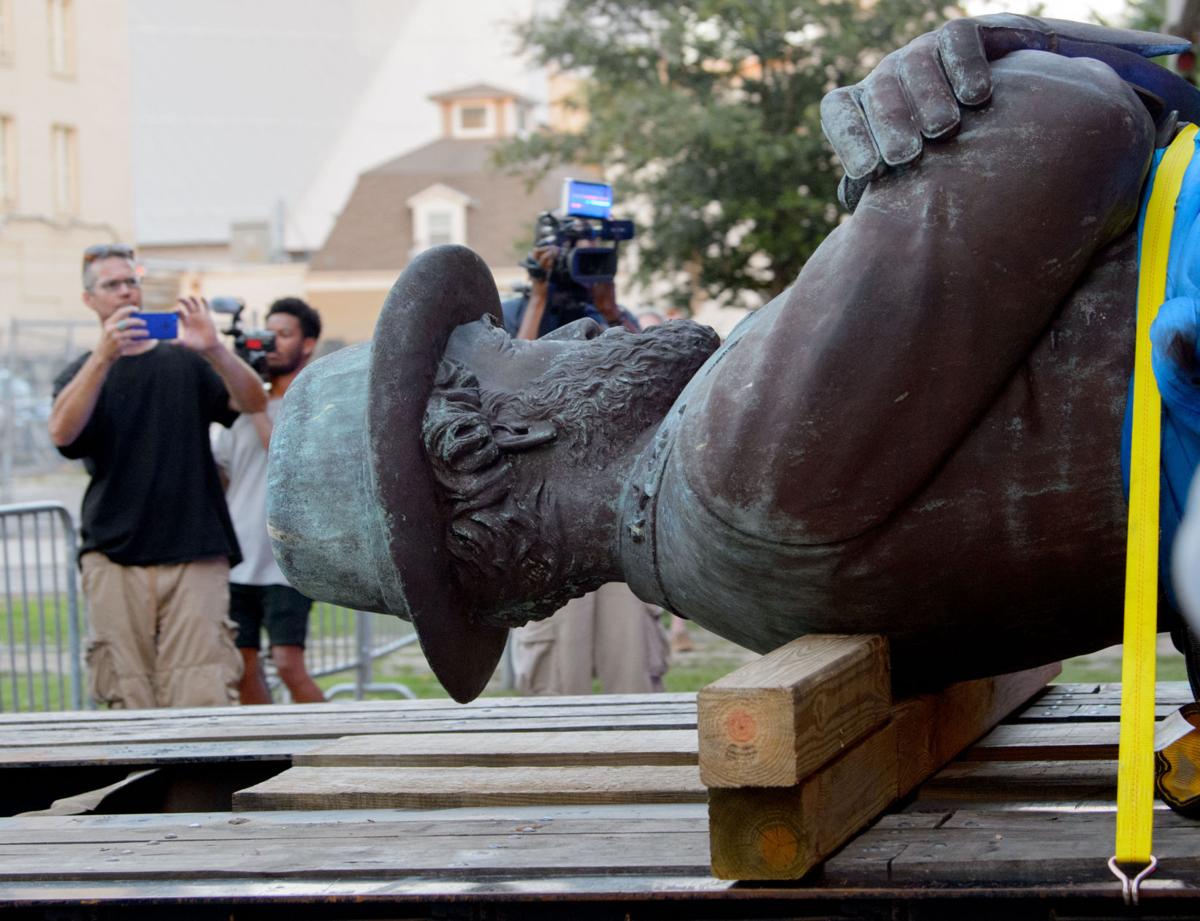
Statue of Rober E. Lee brought down in New Orleans
President Trump’s Thursday morning tweet lamenting that the removal of Confederate statues tears apart “the history and culture of our great country” raises numerous questions, among them: Who is encompassed in that “our”?

Mr. Trump may not know it, but he has entered a debate that goes back to the founding of the republic. Should American nationality be based on shared values, regardless of race, ethnicity and national origin, or should it rest on “blood and soil,” to quote the neo-Nazis in Charlottesville, Va., whom Trump has at least partly embraced?

Neither Mr. Trump nor the Charlottesville marchers invented the idea that the United States is essentially a country for white persons. The very first naturalization law, enacted in 1790 to establish guidelines for how immigrants could become American citizens, limited the process to “white” persons.

What about nonwhites born in this country? Before the Civil War, citizenship was largely defined by individual states. Some recognized blacks born within their boundaries as citizens, but many did not. As far as national law was concerned, the question was resolved by the Supreme Court in the infamous Dred Scott decision of 1857. Blacks, wrote Chief Justice Roger B. Taney (a statue of whom was removed from public display in Baltimore this week), were and would always be aliens in America.

This was the law of the land when the Civil War broke out in 1861. This is the tradition that the Southern Confederacy embodied and sought to preserve and that Mr. Trump, inadvertently or not, identifies with by equating the Confederacy with “our history and culture.”

Many Americans, of course, rejected this racial definition of American nationality. Foremost among them were abolitionists, male and female, black and white, who put forward an alternative definition, known today as birthright citizenship. Anybody born in the United States, they insisted, was a citizen, and all citizens should enjoy equality before the law. Abolitionists advocated not only the end of slavery, but also the incorporation of the freed people as equal members of American society.

In the period of Reconstruction that followed the war, this egalitarian vision was, for the first time, written into our laws and Constitution. But the advent of multiracial democracy in the Southern states inspired a wave of terrorist opposition by the Ku Klux Klan and kindred groups, antecedents of the Klansmen and neo-Nazis who marched in Charlottesville. One by one the Reconstruction governments were overthrown, and in the next generation white supremacy again took hold in the South.

When Mr. Trump identifies statues commemorating Confederate leaders as essential parts of “our” history and culture, he is honoring that dark period. Like all monuments, these statues say a lot more about the time they were erected than the historical era they evoke. The great waves of Confederate monument building took place in the 1890s, as the Confederacy was coming to be idealized as the so-called Lost Cause and the Jim Crow system was being fastened upon the South, and in the 1920s, the height of black disenfranchisement, segregation and lynching. The statues were part of the legitimation of this racist regime and of an exclusionary definition of America.

The historian Carl Becker wrote that history is what the present chooses to remember about the past. Historical monuments are, among other things, an expression of power — an indication of who has the power to choose how history is remembered in public places.

If the issue were simply heritage, why are there no statues of Lt. Gen. James Longstreet, one of Gen. Robert E. Lee’s key lieutenants? Not because of poor generalship; indeed, Longstreet warned Lee against undertaking Pickett’s Charge, which ended the battle of Gettysburg. Longstreet’s crime came after the Civil War: He endorsed black male suffrage and commanded the Metropolitan Police of New Orleans, which in 1874 engaged in armed combat with white supremacists seeking to seize control of the state government. Longstreet is not a symbol of white supremacy; therefore he was largely ineligible for commemoration by those who long controlled public memory in the South.

As all historians know, forgetting is as essential to public understandings of history as remembering. Confederate statues do not simply commemorate “our” history, as the president declared. They honor one part of our past. Where are the statues in the former slave states honoring the very large part of the Southern population (beginning with the four million slaves) that sided with the Union rather than the Confederacy? Where are the monuments to the victims of slavery or to the hundreds of black lawmakers who during Reconstruction served in positions ranging from United States senator to justice of the peace to school board official? Excluding blacks from historical recognition has been the other side of the coin of glorifying the Confederacy.

We have come a long way from the days of the Dred Scott decision. But our public monuments have not kept up. The debate unleashed by Charlottesville is a healthy re-examination of the question “Who is an American?” And “our” history and culture is far more complex, diverse and inclusive than the president appears to realize.

Tuesday, July 4, 2017

2647. July 4: Not Our Independence Day

By William Hogeland and Jonah Walters, Jacobin, July 4, 2016
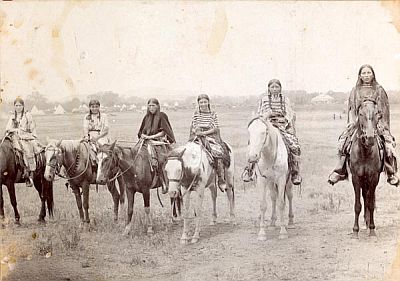
Female Native American warriors. Circa: 1895.  
Introduction. The American Revolution is celebrated by many as liberal democracy’s inaugural triumph, a conflict that, in Lincoln’s words, “brought forth on this continent a new nation conceived in liberty and dedicated to the proposition that all men are created equal.” This romantic narrative of the revolution still enjoys tremendous political currency, as the Right continues to deploy the memory of the Revolutionary War in the service of its agendas, from Tea Party tax paranoia to accusations of bureaucratic tyranny.

More than anything, the American Revolution is celebrated as confirmation of American exceptionalism — a moral, political, and military victory so absolute that it justifies (and indeed mandates) two hundred years of American expansion across the globe.

On the Left, as well, there is the temptation to claim the tradition of the American Revolution; the story of beleaguered colonists standing firm against the British monarchy’s economic tyranny makes for a convenient political allegory.

Even Eugene V. Debs saw in the Revolution something of a historical precedent for the socialist transformation he envisioned when he said in 1912, “I like the Fourth of July. It breathes the spirit of revolution. Today we affirm the ultimate triumph of Socialism.”

But the actual politics of the American Revolution are too often obscured by these kinds of self-serving reinterpretations, argues author William Hogeland. The American Revolution was not a noble war fought in the service of progressive democracy, destined to irrigate the entire planet with its ideology of inalienable freedoms. Nor was it a social revolution from below. Rather, it was the first chapter in an inter-imperial war between Great Britain and its dissident elites in North America. And the American state, even in its earliest incarnations, was more concerned with limiting popular democracy than securing and expanding it.
In his books, Hogeland makes strides towards demystifying this history, recovering the politics that have been evacuated from the American revolutionary mythology.

In recognition of the Fourth of July — a day marking the adoption of the Declaration of Independence by fifty-six prominent property owners — Jacobin‘s Jonah Walters spoke with Hogeland about taxation, the struggles of American Indians against the early US state, and the radical working-class movements that may have promised a better, more equitable America had they not been violently suppressed by the revolutionary elite.

Jonah Walters
To many on the Left, the American Revolution can be interpreted two ways — either as a reactionary power-grab by colonial elites who wanted to secure their control over a slave economy, or a bourgeois revolution in which the projects of economic liberalization and representative democracy were deeply intertwined and new state-formations innovated in the service of egalitarian goals, something of a clumsy rehearsal for the French Revolution.
Do any of these ring true to you?

William Hogeland
Our favored categories can start to look strange when we turn a light on the realities of the American Revolution. The revolution involved coalitions of people who were deeply divided regionally, economically, socially, politically, so anything the big-time founders did agree on will be pretty revealing.

I’d say they were largely agreed on the virtues of representative government — it’s what they’d had for generations, what they saw being threatened — but to question your question somewhat, I’d also note that across the board, from the planters to the financiers to the upper farmers and lawyers, the right of representation in no way equated with democracy, which at the time would have meant “manhood suffrage”: disconnecting the right of political participation from property ownership.

The founders who held power were agreed in their fear and loathing of that idea. Their ideology of rights and liberty was bound up, from ancient times — at least in their minds it was — with protecting property. So both the economic liberalization promoted by the high-finance Hamilton, and the more agrarian program that the slave-economy Madison advanced (once he realized what his old friend in nationalism Hamilton was up to), recoiled from democracy, a term the founders used negatively whenever they referred to placing power in the hands of the unpropertied.

That free yet unpropertied class was big, by the way, in founding-era America. In my view, egalitarian goals, as you’ve put it, were not on the minds of any of the well-known founders, for all of their other differences.  That includes mutually divided nationalists like Washington, Hamilton, Madison, and Adams and state-sovereigntist, anti-nationalists like Patrick Henry.

Jonah Walters
Is there a “revolutionary tradition” in the United States that the Left can somehow salvage? Can we draw any lessons from the American Revolution as we think about the possibility of radical transformation today?

William Hogeland
I find it impossible to draw the sort of lessons from the revolution that many on the Left seem to hope to draw. Most of the lessons I see are negative, which doesn’t make them useless, as far as I’m concerned — quite the contrary — but the American left generally hasn’t seen things that way. A lot of intellectual energy has been expended trying to ground the Left in a positive view of aspects of the American Revolution, and in other successes of American history, defining leftism itself as patriotically and even exceptionally American (“Communism is 20th Century Americanism,” etc).
It’s natural, in the face of a virulent attack from right and center, scourging the Left as un-American, to try to go hyper-American. But that’s only led to a lot of naïve and faux-naïve history, intellectually insupportable as far as I’m concerned. It’s hard for me to see how that kind of history could lead, long-term, to any new clarity in thinking, which I’d see as important to making real change.

When all the real lessons are so painful, what are you supposed to do with them? There’s a compelling quandary regarding the Left and our revolutionary and founding history, and it shouldn’t be wished away.

Here’s a negative lesson of the revolution. The elite founders I was discussing were by no means the only contributors to the revolution. Artisans, laborers both rural and urban, tenants, poor farmers, etc, were all key to the effort; often they led the way. They hoped the revolution would lead to improved political equality, as they defined it, which mostly meant for white men. They often cast their ideas and actions in the elite Whig terms of the day — liberty, rights, “ancient” charter freedoms — but in fact, they took a radical view, in that they wanted to disconnect political privilege from the property.

Radical, because that was a sharp and total break from the long past on which the elite leaders based the right of the revolution itself. Radical because these leaders of a working-class movement wanted new governments to limit the power of wealth, favor labor over capital, favor debtors over lenders. They were levelers, socialists. None of the famous founders agreed with them, and the movement, though crucial to the revolution, was crushed. I’ve analyzed the formation of the nation itself, at the end of the 1780s, as motivated almost exclusively by an elite program of crushing American socialist tendencies.
Well, that’s not a very happy story for the American left to tell about its early history. So we don’t talk much about leaders like James Cannon, Thomas Young, Christopher Marshall, or Herman Husband, or about the Committee of Privates, which organized the entire white working class of Pennsylvania in a successful revolution (briefly) against elite privilege in that state. Instead, we’re always trying to cast one of the Adamses or Hamilton or Madison or Franklin or Jefferson, those famous elite leaders, as half-unaware proto-leftists and arguing about which one to lionize. That story keeps eating its own tail.

Of course, some left historians do talk about the real leftism present at the founding. Without Gary Nash, Woody Holton, Terry Bouton, Wythe Holt, Ray Raphael, Jesse Lemisch and others, I wouldn’t know about this stuff. But few of those historians get across to the public, and those who do seem to me to turn away from the harshest conclusions of their stories, even while showing what really happened; they try to make that early leftism essentially, even exclusively, real-American, and they call for reviving it as such.
A colder-eyed view, inspired by a left economic critique, suggests that the crushing of that movement was in the end far more fully wired, structurally, into the national founding than the left ideas that got crushed.

So I prefer not to see anything as essentially American or un-American. I prefer to imagine we’re free, within reason, to do what we think is right. Having to cast every good idea as an expression of the American Revolution just wears us down.

Jonah Walters
In what ways, if any, was the American Revolution an anti-imperialist war or something of the first chapter in an inter-imperialist one?

William Hogeland
Regardless of some of the founders’ ideological preferences, the War of Independence certainly was the first chapter in the rise of American imperialist warfare. People like to cite Washington, when he was president, on avoiding foreign entanglements. That represents what I see as a widespread fantasy that there could ever have been an independent American nation without expansion driven by a concentration of wealth and military power. That’s what nationhood meant — and that’s why, if we want a radical transformation, we have to stop seeking it somewhere in our national origins.

Washington somehow managed not to see his conquest of the old Northwest in the 1790s as a foreign engagement, because the enemy was indigenous. Neat trick, but in fact many of the men who became revolutionaries, with Washington among the foremost, turned against England in the mid-1770s precisely because the mother country was blocking their expansion into Indian country, “robbing” the colonial speculators of their investments and of the massive potential profits to be made there. In the west, at least, the revolution was a war of American expansion.

Then the Northwest Territory, Indian country ceded by England in 1783, became the emerging nation-state in embryo: run by the federal government before the federal government could run anything within the states themselves. To really establish ownership of that territory took a new war against a mighty confederation that few talk about today. That Indian Confederation handed the new nation the worst defeat it ever suffered at native hands, far worse than what went at the Little Big Horn later on (Colin Calloway has a book out now on that early Indian victory).

In the context of that war, a US military establishment was born. A century or so later, the entire swatch of the continent was at last under US control and ownership, and the Caribbean and the Pacific beckoned. Teddy Roosevelt was not wrong, in my view, to see Anthony Wayne, the conqueror of what is now Ohio and Indiana, the first victorious US general, as a guiding spirit for vigorous global US expansion in the twentieth century.

I’m finishing a book right now on Wayne, the Indian confederation, that little-discussed, all-important founding war, and the politics of forming the US Army.

Jonah Walters
Let’s talk about taxation. “No Taxation Without Representation” has proved a lasting slogan, and the memory of the revolutionary war is routinely deployed by the Tea Party and other elements of the small government, anti-tax right.

But the Revolution also ultimately established a federal government with the power to levy taxes on goods and incomes (including the hated “whiskey tax”), established a national treasury, introduced tariffs and trade restrictions, etc. So what was the relationship between the rebelling colonists and taxes?

William Hogeland
In my view, pace Grover Norquist et al, the founders were not in favor of zero or little taxation, zero or low public debt, and “government small enough to drown in a bathtub.” Some of them were, but as you note, one of the main points of writing and ratifying the Constitution was to enable a powerful federal bureaucracy to collect taxes.

Unlike the late Edmund Morgan, who spent much of a long and important career trying to prove otherwise, I see the ideology of the revolutionary generation regarding British-imposed taxes as erratic. John Dickinson, however, expressed a consistent and meaningful position: even though Americans didn’t send elected representatives to Parliament, it was okay, Dickinson believed, for Parliament to lay taxes and tariffs on Americans for the purpose of balancing trade throughout its empire. But it was not okay to lay such levies for the purpose of raising revenue for the Treasury, unless those taxed consented to the tax, via representation.

That seems like an abstract distinction to us, but it wasn’t to them. While Dickinson opposed American independence, he was among many willing to fight and die for the principle, which goes back to the ineluctable relationship, for the elite revolutionaries, between property and liberty. The government can’t take your property without your consent, which is given through representation. If it does, you have a right of revolution within the English constitutional framework.

When Thomas Paine — one of the few founding-era radicals anyone remembers today — mocked the English constitution in “Common Sense,” he was mocking the very basis that the elites had claimed for fighting England. That’s one reason John Adams so loathed Paine.
Now, the first US tax, which the Constitution was created in large part in order to collect, was earmarked to support a large public debt. Hamilton saw nationhood in terms of public debt, and he’d worked hard throughout the 1780s to grow, not reduce, the domestic war debt: in that debt he rightly saw seeds of nationhood. He funded it, famously, which meant paying nearly 6 percent on the face value of multiple tiers of bonds bought from the federal and state government by a small group of wealthy American investors throughout the war.
Contrary to loose talk then and now, the blue-chip tier of that debt changed hands very little, as E.F. Ferguson showed long ago. Hamilton wanted to yoke those rich investors’ financial gains to the national interest, concentrating American wealth in big national projects. It was a huge bailout, and it worked.

Jonah Walters
But what about popular opposition to that plan? Today, we interpret populist opposition to taxes as an element of reactionary politics — anti-taxers align themselves with capital in opposition to a state they interpret as unfriendly to business. This has been true since at least the Civil War, when Lincoln briefly managed to implement a small income tax, despite massive opposition; a Radical Republican Congressman remarked at the time, “The clamor for the abolition of the income tax is . . . a manufactured cry. It does not come from the masses of the people,” but from “the men of gigantic capital . . . men of colossal fortunes and extraordinary incomes.”

But you claim the Whiskey Rebellion — a populist insurrection that took place during President George Washington’s first term in response to an excise tax on liquor — represents something else. What was the politics of the Whiskey Rebellion? And what does it tell us about the American state in its first years of its existence?

William Hogeland
The so-called “whiskey rebels” — Hamilton called them that, in order to erase their real critique — objected to Hamilton’s plan, which linked private gains to the national interest and thus preserved the status of the wealthy elite in the young republic. Like Dickinson, the rebels too are often wrongly viewed as objecting to taxation itself. They really objected to what they called “unequal taxation”; they wanted progressive tax rates. These were the 1790s version of the radicals of the 1770s whom few remember. Their industries in the west were being sewn up by local rich cronies of nationalists in Philadelphia. In some ways I think their rebellion should be seen as a very ambitious labor action.

It’s also important to know that the whiskey rebels were not diehard anti-federalists, as Pauline Maier presents them in her great book on ratification. In fact, many of the rebels harbored high hopes for a national government; they thought it would be progressive. When they saw that its tax provisions enabled a bailout of the wealthy few at their direct expense — they weren’t “paranoid,” Hamilton really was trying to shut them down economically — they ultimately threatened secession, hoping to start an economically radical state west of the Alleghenies. Washington and Hamilton took 19,000 troops to occupy western Pennsylvania, subjected the citizenry at large to door-kicking mass arrest without warrants, detained people without charge, extracted mass loyalty oaths, etc.

So there’s another weird tale of the fate of founding-era American leftism. When I say our early radicalism was crushed, I mean it literally. With that engagement against the whiskey rebels and the victory of Anthony Wayne over the Indian confederation — US sovereignty established — we might see the American Revolution as fully accomplished. The speculative capital investments of a small group of rentiers (and wannabe rentiers) and industrialists — some of that ambition dated back at least to the 1760’s — were now secured by the might of an emergent, expansionist nation state.

That’s depressing if we’re looking to our revolutionary origins for models of the kind of radical social and economic transformation we’d like to bring about. But I really think it’s our failure to live with the full range of painful founding realities — our constant efforts to explain them away or appropriate them ahistorically to our ends — that obstructs change, and I’d like to revolutionize that situation.

Oh, and Happy Fourth!

Monday, March 6, 2017

2577. The Confederacy Was a Con Job on Whites. And Still Is

By Frank Hyman, The News Observer, March 2, 2017


I’ve lived 55 years in the South, and I grew up liking the Confederate flag. I haven’t flown one for many decades, but for a reason that might surprise you.

I know the South well. We lived wherever the Marine Corps stationed my father: Georgia, Virginia, the Carolinas. As a child, my favorite uncle wasn’t in the military, but he did pack a .45 caliber Thompson submachine gun in his trunk. He was a leader in the Ku Klux Klan. Despite my role models, as a kid I was an inept racist. I got in trouble once in the first grade for calling a classmate the N-word. But he was Hispanic.

As I grew up and acquired the strange sensation called empathy (strange for boys anyway), I learned that for black folks the flutter of that flag felt like a poke in the eye with a sharp stick. And for the most prideful flag waivers, clearly that response was the point. I mean, come on. It’s a battle flag.

What the flag symbolizes for blacks is enough reason to take it down. But there’s another reason that white southerners shouldn’t fly it. Or sport it on our state-issued license plates as some do here in North Carolina. The Confederacy – and the slavery that spawned it – was also one big con job on the Southern, white, working class. A con job funded by some of the ante-bellum one-per-centers, that continues today in a similar form.

You don’t have to be an economist to see that forcing blacks – a third of the South’s laborers – to work without pay drove down wages for everyone else. And not just in agriculture. A quarter of enslaved blacks worked in the construction, manufacturing and lumbering trades; cutting wages even for skilled white workers.

Thanks to the profitability of this no-wage/low-wage combination, a majority of American one-per-centers were southerners. Slavery made southern states the richest in the country. The South was richer than any other country except England. But that vast wealth was invisible outside the plantation ballrooms. With low wages and few schools, southern whites suffered a much lower land ownership rate and a far lower literacy rate than northern whites.

My ancestor Canna Hyman and his two sons did own land and fought under that flag. A note from our family history says: “Someone came for them while they were plowing one day. They put their horses up and all three went away to the War and only one son, William, came back.”

Like Canna, most Southerners didn’t own slaves. But they were persuaded to risk their lives and limbs for the right of a few to get rich as Croesus from slavery. For their sacrifices and their votes, they earned two things before and after the Civil War. First, a very skinny slice of the immense Southern pie. And second, the thing that made those slim rations palatable then and now: the shallow satisfaction of knowing that blacks had no slice at all.

How did the plantation owners mislead so many Southern whites?

They managed this con job partly with a propaganda technique that will be familiar to modern Americans, but hasn’t received the coverage it deserves in our sesquicentennial celebrations. Starting in the 1840s wealthy Southerners supported more than 30 regional pro-slavery magazines, many pamphlets, newspapers and novels that falsely touted slave ownership as having benefits that would – in today’s lingo – trickle down to benefit non-slave owning whites and even blacks. The flip side of the coin of this old-is-new trickle-down propaganda is the mistaken notion that any gain by blacks in wages, schools or health care comes at the expense of the white working class.

Today’s version of this con job no longer supports slavery, but still works in the South and thrives in pro trickle-down think tanks, magazines, newspapers, talk radio and TV news shows such as the Cato Foundation, Reason magazine, Rush Limbaugh and Fox News. These sources are underwritten by pro trickle-down one-per-centers like the Koch brothers and Rupert Murdoch.

For example, a map of states that didn’t expand Medicaid – which would actually be a boon mostly to poor whites – resembles a map of the old Confederacy with a few other poor, rural states thrown in. Another indication that this divisive propaganda works on Southern whites came in 2012. Romney and Obama evenly split the white working class in the West, Midwest and Northeast. But in the South we went 2-1 for Romney.

Lowering the flag because of the harm done to blacks is the right thing to do. We also need to lower it because it symbolizes material harm the ideology of the Confederacy did to Southern whites that lasts even to this day.

One can love the South without flying the battle flag. But it won’t help to get rid of an old symbol if we can’t also rid ourselves of the self-destructive beliefs that go with it. Only by shedding those too, will Southern whites finally catch up to the rest of the country in wages, health and education.

Frank Hyman lives in Durham,where he has held two local elected offices. He’s a carpenter and stonemason and policy analyst for Blue Collar Comeback.

Wednesday, July 6, 2016

2365. Fear of Native Americans and Enslaved Africans and American Indepedence

By Robert G. Parkinson, The New York Times, July 4, 2016


Binghamton, N.Y. — FOR more than two centuries, we have been reading the Declaration of Independence wrong. Or rather, we’ve been celebrating the Declaration as people in the 19th and 20th centuries have told us we should, but not the Declaration as Thomas Jefferson, Benjamin Franklin and John Adams wrote it. To them, separation from Britain was as much, if not more, about racial fear and exclusion as it was about inalienable rights.

The Declaration’s beautiful preamble distracts us from the heart of the document, the 27 accusations against King George III over which its authors wrangled and debated, trying to get the wording just right. The very last one — the ultimate deal-breaker — was the most important for them, and it is for us: “He has excited domestic insurrections amongst us, and has endeavored to bring on the inhabitants of our frontiers, the merciless Indian savages, whose known rule of warfare is an undistinguished destruction of all ages, sexes and conditions.” In the context of the 18th century, “domestic insurrections” refers to rebellious slaves. “Merciless Indian savages” doesn’t need much explanation.

In fact, Jefferson had originally included an extended attack on the king for forcing slavery upon unwitting colonists. Had it stood, it would have been the patriots’ most powerful critique of slavery. The Continental Congress cut out all references to slavery as “piratical warfare” and an “assemblage of horrors,” and left only the sentiment that King George was “now exciting those very people to rise in arms among us.” The Declaration could have been what we yearn for it to be, a statement of universal rights, but it wasn’t. What became the official version was one marked by division.

Upon hearing the news that the Congress had just declared American independence, a group of people gathered in the tiny village of Huntington, N.Y., to observe the occasion by creating an effigy of King George. But before torching the tyrant, the Long Islanders did something odd, at least to us. According to a report in a New York City newspaper, first they blackened his face, and then, alongside his wooden crown, they stuck his head “full of feathers” like “savages,” wrapped his body in the Union Jack, lined it with gunpowder and then set it ablaze.

The 27th and final grievance was at the Declaration’s heart (and on Long Islanders’ minds) because in the 15 months between the Battles of Lexington and Concord and independence, reports about the role African-Americans and Indians would play in the coming conflict was the most widely discussed news. And British officials all over North America did seek the aid of slaves and Indians to quell the rebellion.

A few months before Jefferson wrote the Declaration, the Continental Congress received a letter from an army commander that contained a shocking revelation: Two British officials, Guy Carleton and Guy Johnson, had gathered a number of Indians and begged them to “feast on a Bostonian and drink his blood.” Seizing this as proof that the British were utterly despicable, Congress ordered this letter printed in newspapers from Massachusetts to Virginia.

At the same time, patriot leaders had publicized so many notices attacking the November 1775 emancipation proclamation by the governor of Virginia, Lord Dunmore, that, by year’s end, a Philadelphia newspaper reported a striking encounter on that city’s streets. A white woman was appalled when an African-American man refused to make way for her on the sidewalk, to which he responded, “Stay, you damned white bitch, till Lord Dunmore and his black regiment come, and then we will see who is to take the wall.”

His expectation, that redemption day was imminent, shows how much those sponsored newspaper articles had soaked into everyday conversation. Adams, Franklin and Jefferson were essential in broadcasting these accounts as loudly as they could. They highlighted any efforts of British agents like Dunmore, Carleton and Johnson to involve African-Americans and Indians in defeating the Revolution.

Even though the black Philadelphian saw this as wonderful news, the founders intended those stories to stoke American outrage. It was a very rare week in 1775 and 1776 in which Americans would open their local paper without reading at least one article about British officials “whispering” to Indians or “tampering” with slave plantations.

So when the crowd in Huntington blackened the effigy’s face and stuffed its head with feathers before setting it on fire, they were indeed celebrating an independent America, but one defined by racial fear and exclusion. Their burning of the king and his enslaved and native supporters together signified the opposite of what we think of as America. The effigy represented a collection of enemies who were all excluded from the republic born on July 4, 1776.

This idea — that some people belong as proper Americans and others do not — has marked American history ever since. We like to excuse the founders from this, to give them a pass. After all, there is that bit about everyone being “created equal” in this, the most important text of American history and identity. And George Washington’s army was the most racially integrated army the United States would field until Vietnam, much to Washington’s chagrin.

But you wouldn’t know that from reading the newspapers. All the African-Americans and Indians who supported the revolution — and lots did — were no match against the idea that they were all “merciless savages” and “domestic insurrectionists.” Like the people of Huntington, Americans since 1776 have operated time and time again on the assumption that blacks and Indians don’t belong in this republic. This notion comes from the very founders we revere this weekend. It haunts us still.

Robert G. Parkinson, an assistant professor of history at Binghamton University, is the author of “The Common Cause: Creating Race and Nation in the American Revolution.”