
“Only fools find joy in the prospect of climate engineering”.
The author of that quote, Ken Caldeira of the US Carnegie Institution, is clearly no cheerleader for technological tinkering with the Earth system. Yet Caldeira strongly supports research into geoengineering. This apparent contradiction is central to an emerging debate: should we deliberately intervene in global processes to deliver planet-saving outcomes? Many environmental groups vehemently oppose the idea. The “Hands Off Mother Earth” campaign, the ETC Group (Action Group on Erosion, Technology and Concentration) and Greenpeace believe that precaution trumps all other concerns. To them, geoengineering is a dangerous illusion, a Pandora’s box that ought to remain closed. Nevertheless, some scientists, business leaders and politicians consider that technological solutions to engineer the climate might provide an insurance policy, in which case we urgently need to explore their strengths and weaknesses. Only then would we find out whether geoengineering might provide an effective and acceptable means to avoid − or at least reduce − the predicted dire consequences of global warming.
The concept of engineering the climate (Box 1) is not new. Researchers suggested many of the basic ideas, such as mirrors in space and ocean fertilisation, more than 20 years ago. These approaches are now being revisited, and new ideas have recently been proposed, for two closely linked reasons. First, we recognise more clearly that future, human-driven climate change threatens global economic development, food supply and, for many people, survival. Second, we have collectively failed to address fully the cause underlying this change – the increase of greenhouse gases in the atmosphere.
We may still achieve international commitment to major emissions reductions, if not at Cancún in November (COP 16 of the UN Framework Convention on Climate Change), then over the next few years. But even the most optimistic scenarios for future action risk overshooting “safe” levels of climate forcing, resulting in environmental perturbations that gain a momentum of their own for hundreds if not thousands of years, and having a chaotic impact equivalent to changes between past geological epochs. Indeed, if the boundary between safe and dangerous is defined as either 350 parts per million of atmospheric carbon dioxide or an increase of 1 watt/m2 in radiative forcing, society has already exceeded those thresholds (Rockström et al. 2009).
Prevention is undoubtedly better than cure: it is preferable to tackle problems, of whatever kind, at source rather than trying to deal with their consequences. Yet when prevention fails, a cure is needed. And if such a remedy does not yet exist, we should try to find one. In a recent open discussion on geoengineering, Tim Kruger from the University of Oxford compared climate change and AIDS: many of the criticisms directed against geoengineering, including unintended consequences, misallocation of resources and moral hazard, could also be applied to efforts to treat HIV infection. Current antiretroviral therapies are expensive, have unpleasant side effects and do not provide a fully effective cure; nevertheless, they do dramatically increase survival rates. Kruger concluded that improved AIDS treatments and geoengineering should both be investigated, in addition to and not as a replacement for, the pursuit of preventive approaches.
Dig deeper, though, and that medical analogy becomes less convincing. Individuals decide for themselves whether to be treated for a disease (assuming treatment is available and affordable); approval procedures require that drug efficacy has been convincingly demonstrated; and control-based trials are used to quantify the risks of any side effects. For geoengineering, equivalent informed consent is impossible: everyone everywhere has to take the medication, whether or not they agree to the action taken. Furthermore, success is inherently uncertain because comparative controls are impossible for treatments that involve the Earth system as a whole.
Scrutinising the remedy
Wide uncertainties about the effectiveness of proposed geoengineering schemes are undeniable; yet these can be reduced through science and increased understanding. A strong case can therefore be made that, at the very least, we should bring together existing information for expert evaluation − to assess the feasibility of the proposed technologies not only with regard to their mechanistic performance and impacts, but also their economic and political viability.
Wide uncertainties about the effectiveness of proposed geoengineering schemes are undeniable; yet these can be reduced through science and increased understanding. A strong case can therefore be made that, at the very least, we should bring together existing information for expert evaluation − to assess the feasibility of the proposed technologies not only with regard to their mechanistic performance and impacts, but also their economic and political viability.
We lack detailed option-specific evaluations based on such considerations but there have been efforts in this direction. For example, in 2009 the UK Royal Society provided an overview report, and Tim Lenton and Nem Vaughan published a preliminary assessment of the performance of geoengineering technologies in terms of their radiative forcing potential. There has also been a small UK study on the public acceptability of geoengineering (Box 2). IGBP will make its own contribution to the evaluation of geoengineering through two workshops in 2011-12 associated with its second synthesis. These workshops will focus on the possible consequences, intended and unintended, of different geoengineering options on Earth’s ecosystems and biogeochemical cycles, and their findings will be reported at the global-change open science conference to be held in 2012 in London (Planet under pressure: New knowledge towards solutions).
The Royal Society report considered seven geoengineering techniques based on solar radiation management and nine based on carbon dioxide removal (Figure 1; see also Box 1 for the options). The authors rated various schemes on the basis of effectiveness, affordability, safety and timeliness, with estimates of uncertainty for the first two parameters. There were no clear winners: options that scored highly on effectiveness scored low on safety or cost, whereas those that were affordable and safe were less effective (Figure 1). Safety considerations covered the risk of undesirable regional climate change, ecosystem impacts, termination effects – effects resulting from stopping a particular geoengineering project – and reduction in crop yields. Arguably all solar radiation management techniques should score low on safety because ocean acidification would continue unabated (although not strictly speaking a side effect).
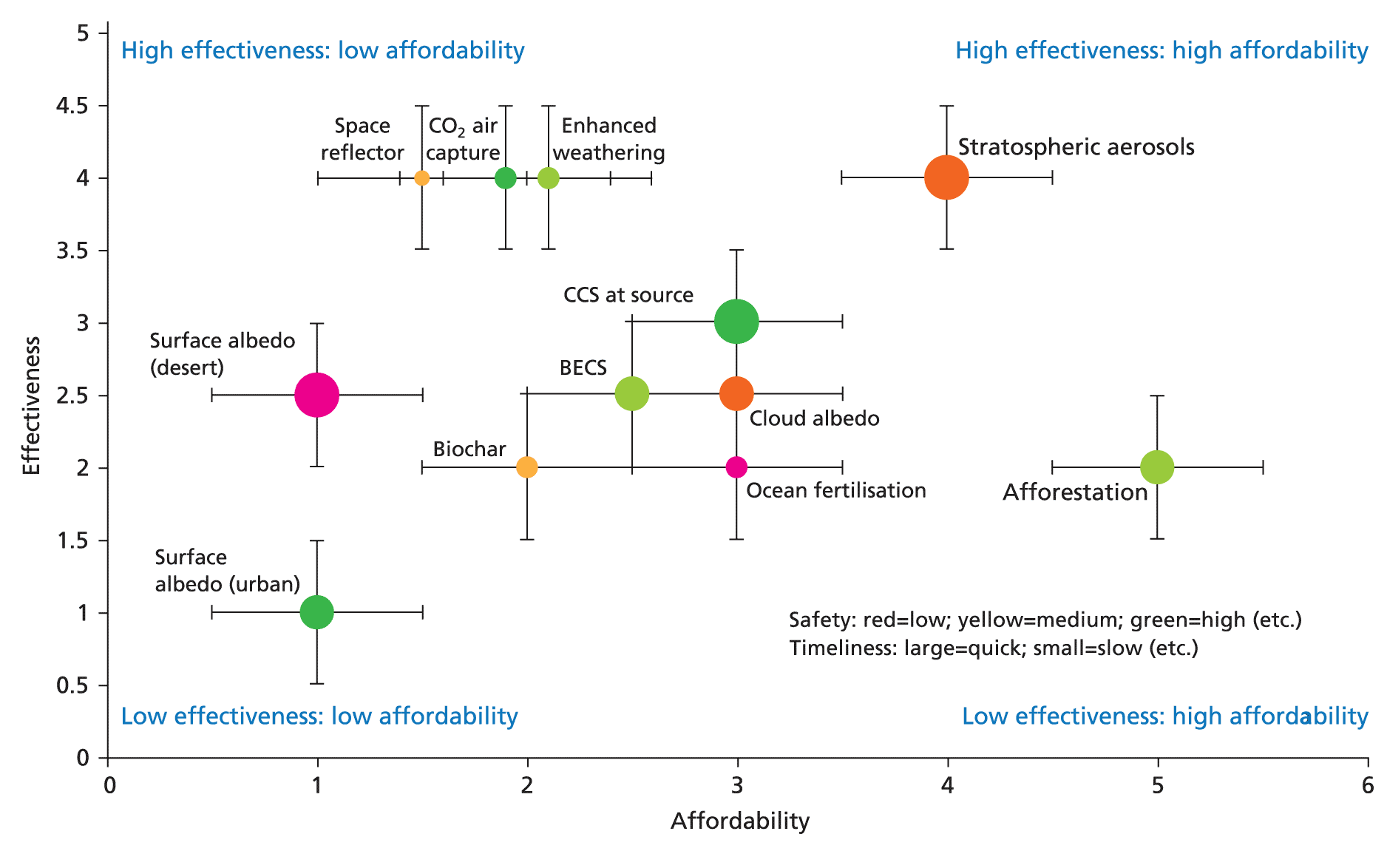

Although the grouping of geoengineering technologies under solar radiation management and carbon dioxide removal has a strong scientific rationale, an arguably more pragmatic grouping would be governance-based, distinguishing: 1) where manipulations and potential adverse impacts are limited to national jurisdictions (for example, afforestation and air-capture of carbon dioxide); 2) manipulations that are nationally-based, but with the possibility of trans-boundary impacts (e.g. large-scale land-albedo changes, geoengineering in coastal seas); and 3) where both manipulations and impacts involve the use of globally-shared resources (for example, open-ocean fertilisation, and atmospheric- or space-based solar radiation management).
Concerns that geoengineering is inherently undesirable and politically unworkable primarily relate to the third category, where one country might derive benefit at the expense of others. For example, a “sunshade” reduction in incoming solar radiation would produce regional disparities in its effects on mean temperature, while also changing the risk of floods, droughts or storms. The broad-scale impacts of such geoengineering, distinguishing winners and losers, can be investigated by modelling (see, for example, the recent work of Peter Irvine and colleagues). Negative effects on, say, crop production could, in theory, be compensated for. But extreme weather events are difficult to predict even in a non-geoengineered climate, and the separation of natural disasters that might have happened anyway from those that were caused by geoengineering would become nearly impossible, risking considerable international tension.
The crunch issues
No country currently includes the riskier forms of geoengineering in its national strategy for tackling climate change, and research to date has been small-scale or indirect. But many less-developed nations are worried about what would happen if richer countries decided that such geoengineering were preferable to reducing their carbon emissions. Partly as a result of this, the regulation of geoengineering is rising up the political agenda, on the basis that international governance frameworks to address such scenarios are needed sooner rather than later.
The research community needs to be aware of, and preferably participate in, these governance discussions to ensure that legitimate scientific studies, without significant impacts, can continue. But this is not always easy. The case of ocean fertilisation – the addition of nutrients to the oceans to encourage biological productivity and thereby sequester carbon – is instructive in this regard, with controversy surrounding the legality of the 2009 Indo-German LOHAFEX iron-addition experiment. Several international bodies and governance instruments are involved in the use and stewardship of the global ocean (including the Convention on Biological Diversity, the London Convention and London Protocol, and the Intergovernmental Oceanographic Commission). It is proving to be a long and complex process for such bodies to agree how ocean fertilisation research ought to be approved. Formal international agreement on “the real thing”, with large-scale impacts potentially lasting years or centuries, could therefore be at least as difficult as negotiating carbon emissions reductions. Or it may even be unobtainable.
Not all geoengineering techniques present such problems. The air-capture of carbon dioxide and its subsequent storage would seem relatively benign, and could be carried out within existing national and international legal frameworks. In fact, storage is already under way in locations such as the Sleipner Field in the North Sea. But deployment of this technology would have to be on a massive scale to be globally effective, and that would be expensive. If costs were covered by a carbon tax, energy costs could double, and participating countries would be at a competitive disadvantage. Similar economic factors are a fundamental reason why the switch to low-carbon energy has not been more rapid, with neither UN conventions nor carbon trading so far succeeding in providing the socio-economic drivers to seriously tackle climate change – preventing carbon emissions in the first place, rather than having to capture the carbon afterwards.
It is highly unlikely that the various groups concerned with geoengineering will reach consensus. Yet, the research community is reaching a common understanding that deliberate climate control through geoengineering is not simply Plan B, providing an alternative to Plan A – reducing emissions. Instead, it may need to become Part 2 of Plan A, to be implemented in addition to very stringent carbon controls. We thus need to scrutinise the environmental risks, public acceptability and geopolitical constraints associated with different geoengineering approaches just as much as their technological feasibilities.
BOX 1. CLIMATE GEOENGINEERING SCHEMES: A WIDE SPECTRUM
Geoengineering can mean different things to different people, covering a very wide spectrum of concepts and ideas. But broadly speaking we can group climate-altering technologies into two categories.
The first of these, solar radiation management (reflecting sunshine) includes technologies seeking to increase the brightness of clouds, land or the ocean surface, or reduce the solar radiation reaching the Earth.
The second category, carbon dioxide removal, involves drawing down carbon dioxide that is already in the atmosphere. The list below is not exhaustive but is aimed at giving an idea of the options being contemplated. For additional details, see the Royal Society´s 2009 report.
Geoengineering can mean different things to different people, covering a very wide spectrum of concepts and ideas. But broadly speaking we can group climate-altering technologies into two categories.
The first of these, solar radiation management (reflecting sunshine) includes technologies seeking to increase the brightness of clouds, land or the ocean surface, or reduce the solar radiation reaching the Earth.
The second category, carbon dioxide removal, involves drawing down carbon dioxide that is already in the atmosphere. The list below is not exhaustive but is aimed at giving an idea of the options being contemplated. For additional details, see the Royal Society´s 2009 report.
Solar radiation management techniques:
- Enhancing surface brightness
- Enhancing cloud brightness
- Increasing stratospheric aerosols
- Placing reflectors in space
Carbon dioxide removal techniques:
- Afforestation, reforestation and avoidance of deforestation
- Biochar
- Enhancing weathering of carbonate or silicate rocks
- Air-capture of carbon dioxide
- Ocean fertilization
BOX 2. THE PUBLIC WEIGHS IN
Opinion polls usually involve a representative sample size of around 1000. But asking that number of people their views on geoengineering isn´t going to work: the overwhelming answer would be “don´t know". So instead a UK polling company invited 85 individuals to three public dialogue events, commissioned by the Natural Environment Research Council and other partners. Public participants were provided with basic information on nine geoengineering technologies; they then debated which approaches should be researched in the future and whether any might be needed at all.
The outcome (Ipsos MORI 2010) was cautious public support, favouring research on those technologies (such as afforestation and biochar) that were perceived as most natural, but not those seen as expensive and risky (for example, mirrors in space). Participants were keen that geoengineering should not conflict with mitigation, but should augment it as much as possible.
The organisers of the public dialogue emphasised that its results were indicative rather than quantitative. Nevertheless, important understanding was gained on how non-scientists make judgements on scientific information. There was recognition that for potentially controversial topics such as geoengineering, decisions to fund research should take into consideration the views and concerns of common people around the world.
Opinion polls usually involve a representative sample size of around 1000. But asking that number of people their views on geoengineering isn´t going to work: the overwhelming answer would be “don´t know". So instead a UK polling company invited 85 individuals to three public dialogue events, commissioned by the Natural Environment Research Council and other partners. Public participants were provided with basic information on nine geoengineering technologies; they then debated which approaches should be researched in the future and whether any might be needed at all.
The outcome (Ipsos MORI 2010) was cautious public support, favouring research on those technologies (such as afforestation and biochar) that were perceived as most natural, but not those seen as expensive and risky (for example, mirrors in space). Participants were keen that geoengineering should not conflict with mitigation, but should augment it as much as possible.
The organisers of the public dialogue emphasised that its results were indicative rather than quantitative. Nevertheless, important understanding was gained on how non-scientists make judgements on scientific information. There was recognition that for potentially controversial topics such as geoengineering, decisions to fund research should take into consideration the views and concerns of common people around the world.
Bronson D, Mooney P, Wetter K J (2009). www.etcgroup.org/en/node/4966
Ipsos MORI (2010) www.nerc.ac.uk/about/consult/geoengineering.asp
Irvine P J, Ridgwell A and Lunt D J (2010) Geophysical Research Letters 37, L18702, doi: 10.1029/2010GL044447.
Lenton T M and Vaughan N E (2009) Atmospheric Chemistry & Physics 9: 5539-5561.
Rockström J et al. (2009) Nature 461: 472-475.
UK Royal Society (2009) Geoengineering the Climate: Science, Governance and Uncertainty.
Phil Williamson is a Science Coordinator for the UK Natural Environment Research Council, based at the University of East Anglia. He is a co-author of Ocean Fertilization: A Scientific Summary for Policy Makers (Wallace D et al. in press; IOC/IGBP). Email: p.williamson@uea.ac.uk


