Showing posts with label renewable energy. Show all posts

Wednesday, February 13, 2019

3188. The Limits of Green Energy Under Capitalism

By David Klein, Truthout, July 16, 2018


Renewable energy is expanding rapidly all around the world. The energy capacity of newly installed solar projects in 2017, for instance, exceeded the combined increases from coal, gas and nuclear plants. During the past eight years alone, global investment in renewables was $2.2 trillion, and optimism has soared along with investments. “Rapidly spreading solar technology could change everything,” announced a piece in the Financial Times, which also explained that, “there is growing evidence that some fundamental changes are coming that will over time put a question mark over investments in old energy systems.”

But can renewable energy grow fast enough in the market economy to pinch off the use of fossil fuels and help fend off climate catastrophe? Unfortunately, it’s not likely. Even as the percentage of global energy generation from renewables increases, so too does global energy consumption, which means that fossil fuel emissions are also increasing.

The world’s energy-related carbon emissions rose by 1.7 percent in 2017 and energy consumption grew by 2.2 percent, the fastest rate since 2013. For the past decade, primary energy consumption increased worldwide at an average rate of 1.7 percent per year. Power generation rose last year by 2.8 percent with renewable energy providing 49 percent of that increase and most of the rest (44 percent) coming from coal. Globally, oil consumption grew by 1.8 percent, natural gas by 3 percent and coal consumption increased by 1 percent. The key point is that greenhouse gas emissions from fossil fuels are increasing even as renewable energy use is growing.

To visualize the relationship between the growing percentage of green energy and increasing total global energy production, imagine a “dynamic energy consumption pie chart.” A growing portion of the pie represents green energy sources, so that piece of the pie is getting wider, but the radius of the pie chart also increases with time to account for the increase of global energy consumption. The pie is getting bigger and bigger while the fossil fuel slice is growing longer (which is bad) but thinner (which is good). Which process wins out? As long as fossil fuel use is not decreasing, it doesn’t matter for the climate.

People often get confused when fossil fuels and renewable energy are discussed together, but the climate only cares about the former. The latter has no effect. Solar panels, wind turbines and the like neither help nor harm the climate. The only thing that matters, in terms of climate disruption, are greenhouse gas emissions.

It is not enough for the percentage of green energy to increase each year — unless it reaches 100 percent of global energy production very quickly. Even if the rate of greenhouse gas emissions decreases, but doesn’t decrease fast enough, we face disaster. What is required is that global greenhouse gas emissions decrease rapidly to zero by mid-century in order for the biosphere to stand a chance of survival. Unfortunately, even a rapidly increasing percentage of green energy production is unlikely to achieve that under capitalist market forces.

What About the Carbon Bubble?
Falling prices for renewable energy have led academics, activists, and investors to warn of a “carbon bubble” of overvalued fossil fuel assets in the global economy, which could lead to a major capitalist crisis. A recent economic study, published in Nature Climate Change predicted that a sudden decrease in the value of fossil fuels — triggered by low renewable energy prices — would cause the carbon bubble to burst, and under the assumption of continuing trends, such an event will likely occur before 2035.

Economic crises notwithstanding, could the bursting of the carbon bubble at least prevent or significantly delay environmental collapse? Unfortunately, no. Lead author Jean-François Mercure warned, as reported by the Guardian, “that the transition was happening too slowly to stave off the worst effects of climate change. Although the trajectory towards a low-carbon economy would continue, to keep within [2 degrees Celsiusabove pre-industrial levels — the limit set under the Paris agreement — would require much stronger government action and new policies.”

Capitalism or Survival
Capitalism requires perpetual economic growth in order to avoid economic crises such as the Great Depression. More specifically, in order to stave off mass unemployment and economic misery, capitalism requires increasing commodity production, escalating resource extraction, increasing trash and toxic dumping, and ever-increasing energy production.

Capitalism, by its very nature, must expand unendingly and it has already surpassed the limits of sustainable growth in the sense that global consumption now exceeds the planet’s bio-capacity to regenerate the resources consumed. According to the World Wildlife Fund, 1.6 Earths would be required to meet the demands humanity makes on nature each year. Capitalism is not only incapable of responding adequately to the environmental crisis, it is the very cause of the crisis and can only make matters worse.

As Richard Smith points out in Green Capitalism: The God that Failed, the scale of change needed to achieve a sustainable civilization is staggering. The rapid reduction of greenhouse gas emissions together with resource conservation requires that we radically reduce or close down large numbers of power plants, mines, factories, mills, processing and other industries around the world. It means drastically cutting back or closing down not only fossil fuel companies, but the industries that depend on them, including automobile, aircraft, airline, shipping, petrochemical, construction, agribusiness, lumber, pulp and paper, and wood product companies, industrial fishing operations, factory farming, junk food production, private water companies, packaging and plastic, disposable products of all sorts, and above all, the war industries. The Pentagon is the single largest institutional user of petroleum products and energy.

The loss of jobs from the de-industrialization required to save ourselves would not be just a few coal mining and oil drilling jobs but millions of jobs in the industrialized world. Mainstream environmentalists argue that the jobs versus the environment dichotomy is a false one, but they are wrong. Within a capitalist framework that is exactly the choice. What we would need to do within this framework to save the biosphere, including ourselves, would result in total economic collapse.

It is not enough just to oppose capitalism. We also need to create something better: An alternative system of human relations along the lines of eco-socialism is not only desirable, it is imperative. Included in such a vision are free health care, free education, free mass transportation, and since most jobs under capitalism are pointless or destructive, we need a drastically reduced workweek.

Polluting industries will not voluntarily shut down. To accomplish what is needed requires socializing virtually all large-scale industries. The only way to rationally reorganize the economy sustainably is to collectively and democratically plan most of the world’s industrial economies.

While all kinds of useless, wasteful and polluting industries must be eliminated, we cannot contract the entire economy. We need to expand some industries, including renewable energy, public health care, public transit, long-lasting energy efficient housing, durable mass transportation vehicles, long-lasting appliances and electronics, repair shops, public schools, public services, environmental remediation, reforestation and organic farming.

It is essential that environmental activists begin to focus on ending the economic system of capitalism itself. The survival of life on this planet depends on it.

Monday, July 10, 2017

2653. What New York Times Got Wrong on Assessment of Transition to 100% Renewables

By Mark Jacobson, EcoWatch, July 9, 2017

This is a response to Eduardo Porter's article in the New York Times on June 20, "Fisticuffs Over the Route to a Clean Energy Future."

Porter's article described a paper published in the Proceedings of the National Academy of Sciences (PNAS) by Chris Clack and coauthors on June 19, criticizing a paper colleagues and I authored in the same journal in 2015. Our original paper showed that the U.S. can transition to 100% clean,  renewable energy in all energy sectors without coal, nuclear power or biofuels. Porter makes several mistakes and omissions in his article that I correct here.

First, Porter relies on his claim that "21 prominent scholars…took a fine comb to the Jacobson paper and dismantled its conclusions bit by bit." This one sentence contains two falsehoods. For starters, our conclusions were not dismantled et al. Our response, which PNAS published as the last word by not permitting a response by Clack, concludes instead, "The premise and all error claims by Clack et al. about Jacobson et al. are demonstrably false. We reaffirm Jacobson et al.'s conclusions."

More important, Porter fails to point out that Clack and coauthors' own disclosure published in their paper indicates that only 3 out of 21 coauthors performed any type of research for the article. The remaining 18 did no research whatsoever, merely contributing to writing the paper with admittedly no research contribution. Of the three authors who did perform research, one has admitted publicly, "I am not an energy expert" (see 15 minutes and 32 seconds into this UCLA debate).


Porter quotes another author, David Victor referring to our 2015 PNAS paper, as stating, "I thought 'this paper is dangerous'," despite the fact that Victor has admitted to doing no research for the article and despite the fact that he is neither a scientist nor an engineer but instead works on international policy and law. Similarly, Porter quotes another author, Varun Sivaram, as stating about the Clack paper, "Our paper is pretty devastating." But, Sivaram has also admitted in writing that he did no research for the article. Moreover, he works in foreign relations, not energy science or engineering.
In the meantime, our 100% clean, renewable energy peer-reviewed papers have collectively had more than 85 researcher-coauthors and more than 35 anonymous peer reviewers.

Porter then mimics Clack's false claim that "most of the scientific community represented on the Intergovernmental Panel on Climate Change" argues that nuclear power is necessary to help solve the climate problem.

However, Porter is wrong. As stated in our PNAS-published response to Clack, the IPCC says the exact opposite: "Without support from governments, investments in new nuclear power plants are currently generally not economically attractive within liberalized markets ..." I don't intend to be harsh. But this statement was in our response, so Porter should never have claimed about the scientific community believing nuclear is necessary in the first place.

Next, Porter claims that I "accused (my) critics of being shills for the fossil fuel and nuclear industries." No, I do not believe any of the authors are shills (someone who is paid specifically to act on someone's behalf), but I do believe most of the authors have either a research, advocacy, or financial conflict of interests in what they have written. For example, one coauthor, Sweeney, "periodically serves as a consultant or advisor to Exxon Corporation, ARCO, the American Petroleum Institute,…", all of whom profit from fossil fuels. He has also stated unequivocally, "If we were to give up on the fossil fuels, we give up on both the economy and security very quickly" (see 1 hour 29 minutes into this video).

Similarly, Jane Long, another co-author, is a Senior Fellow of the Breakthrough Institute, a pro-nuclear advocacy group. It is therefore, no surprise that several authors would criticize our work because of their conflict of interest in keeping fossil fuels and nuclear power on the table.
Porter then criticizes increasing the use of underground storage in rocks, but this storage technology is inexpensive (less than 1/300th the cost per unit energy stored than batteries) and a form of district heat. Sixty percent of Denmark's heat is from district heating using water rather than rocks. Underground rocks are a less-expensive substitute for water tanks. He also somehow thinks it is impossible to build pipes to homes when virtually every new home in the United States has gas and water pipes built to it.

Porter further criticizes the use of more hydrogen, whereas hydrogen production from electricity is an advanced technology developed more than 130 years ago. Porter then unduly criticizes the cost of capital we use and the ability of industry to use demand response to shift times of energy use, when these claims are clearly addressed in our PNAS reply letter at.

Porter then falsely implies that we propose to add new hydroelectric installations equivalent to 600 Hoover dams resulting in 100 times the flow of the Mississippi River. This analogy is nonsensical since our annual energy output is not increased at all, whereas a flow rate of 100 times that of the Mississippi would mean that we would increase the annual energy output of hydropower by a factor of ten, which we don't. The mistake by Porter and co-author of the PNAS article, Ken Caldeira, who provided this claim, is that whereas we increase the ability of the hydro to discharge significantly faster for some hours, we discharge much less during other hours in order to ensure there is zero change in the annual output. Caldeira and Porter tried to make it sound as if we increase the flow rate indefinitely.

Regardless, an alternate solution to increasing the hydropower discharge rate is to increase the discharge rate of concentrated solar power (CSP) and/or to add batteries. Both methods result in low-cost solutions as illustrated for the United States and Canada here.

The fact that the system works with either increased hydropower discharge or increased CSP and batteries contradicts Porter's quote of Clack: "The whole system falls apart because this (hydropower) is the last thing that is used. If you remove any of this, the model fails." To the contrary, the result above demonstrates that the model works without increasing hydropower peak discharge, disproving the main premise of the Clack article that our nation's energy can't run 100% on wind, water, and solar power at low cost.

In sum, I believe that a debate about our energy future can be constructive. But inaccurate statements about scientific work and amplifications of those inaccuracies help no one. Had Porter read our PNAS response carefully, he would not have made the errors he did. Nevertheless, my colleagues and I are always seeking to improve our methods and calculations. Our goals are to better the quality of life of everyone by determining the best ways to provide clean, renewable, and reliable energy while creating jobs and improving people's health and reducing costs. Hopefully, others share these goals, regardless of political party affiliation.

Friday, June 23, 2017

2637. A Case for Community-led Sustainable Energy Programs

By Wolfgang Hoeschele, Shareable, June 23, 2017 

The energy infrastructure that we inherited from the 20th century is one dominated by fossil fuels and uranium, mined in relatively few localities in the world. The distribution and refining of these fuels is tightly held by a few large corporations. Electricity generation typically occurs in plants that hold local or regional monopolies, with vast profit potential. While gasoline is burned in millions of vehicles, the distribution system remains within the control of a few corporations, which often have regional or national oligopoly or monopoly control. The environmental impacts of the energy industry are staggering. It is high time for a change.
On the positive side, the need for change to a 21st-century energy system based on renewable sources of energy is widely recognized, the necessary technologies exist (and are often cheaper than conventional forms of energy provision), and considerable progress has been made. We can build locally-based renewable energy infrastructures. Renewable energy from the sun, wind, water, organic waste, and geothermal heat can be found everywhere on the planet. Hence, every city and town can make use of available renewable energy sources that offer economic opportunity and enhance resilience in the face of global economic crises and environmental change. On a regional level, localities can exchange energy in order to even out seasonal or daily imbalances in supply and demand.
A locally based vision of renewable energy generation could eliminate global- or national-level domination of the energy infrastructure by a few large players, and thus the concentration of profits in the hands of a very few. It could also reduce our greenhouse gas emissions to very low levels, comparable to the emissions before the industrial revolution. But the local orientation alone would not ensure that the benefits would be shared among all sectors of the local population, and therefore it would not guarantee widespread and active support. This is where sharing solutions come in. Shared energy infrastructure means that people together own and operate both the distributed energy generation facilities and the infrastructure to deliver that energy from where it is generated to where it is used.
In a sharing vision of a local renewable energy system, many households will generate their own renewable energy (as in solar photovoltaic or solar thermal systems on their rooftops), but many more, for whom this is not an option, will share in the ownership and operation of off-site renewable energy generation infrastructure such as wind turbines. The distribution systems by which energy is delivered to households will belong to cooperatives, municipalities, or trusts that are accountable to their customers and therefore do not take advantage of the potential of supply monopolies to generate economic rents (unearned income, extraordinary profits). The energy infrastructure is built by companies controlled by their employees, ensuring equitable sharing of the economic benefits. The construction and maintenance of this entire infrastructure is financed in such a way that it benefits the producers and consumers (and often prosumers — people who both produce and consume what they produce), rather than simply providing growth opportunities for the finance "industry." Consumers use their buying power to ensure that they obtain renewable energy that is produced under fair conditions.
All the elements of this locally-based, sharing vision of a renewable energy infrastructure already exist. Some have even been brought to considerable scale, as for example in Denmark, where a large proportion of the wind energy generation is accomplished by local wind cooperatives. The challenge is to bring all these elements together into mutually supportive networks, and to establish such networks essentially everywhere.
In many countries, much of the grid is owned by municipal authorities, which is an excellent solution as long as democratic accountability of these authorities is ensured. Unfortunately, there has been a trend in recent years to privatize electric distribution grids, on the basis of the argument that private control is automatically more "efficient." However, this argument is only valid if there is true market competition, which is not the case in most energy distribution systems.
In this context, the best way to ensure that a business serves its customers is for the customers to take over the business. There are different models to do this: in rural areas — as in much of the U.S. — rural electric cooperatives have long played a large role in running the local grids. In large urban areas, however, this model has not been as successful. At the urban scale, municipal ownership or trusts are more prevalent.
Finally, it is important that the workers installing all this equipment get a good deal — and this works best if they themselves own their own companies and make the important decisions. The challenge now is to bring all these elements together and help them to grow, in order to build an energy infrastructure that allows all of us to live well while ensuring good living conditions for all the other species on this planet.

Monday, May 16, 2016

2323. Renewable Windfall as Germany's Green Energy Meets 90 Percent of Demand

By Lauren McCauley, Common Dreams, May 11, 2016


Germany, the fourth-largest economy in the world and a leader in renewable energy, produced so much energy this weekend from its solar, wind, hydro, and biomass plants that power prices went into negative territory for several hours. Consumers were being paid to use energy.

According to Quartz, around 1 pm on Sunday, May 8—a particularly "sunny and windy day"—the plants supplied a combined 55 gigawatts, or 87 percent, of the 63 gigawatts being consumed.

"The power system adapted to this quite nicely," Christoph Podewil, of the German clean energy think tank Agora Energiewende, told the publication. "This day shows again that a system with large amounts of renewable energy works fine."

According to Agora, the average renewable mix in 2015 was 33 percent.

germany.png
"This is big," wrote Jeremy Deaton, a journalist with Climate Nexus. "Sunday’s spike in renewable output shows that wind and solar can keep pace with the demands of an economic powerhouse. What’s more, the growth of clean energy has tracked the growth of Germany’s economy."

Another key takeaway, according to Deaton, is that the milestone was made possible because of a people-powered "energy revolution."

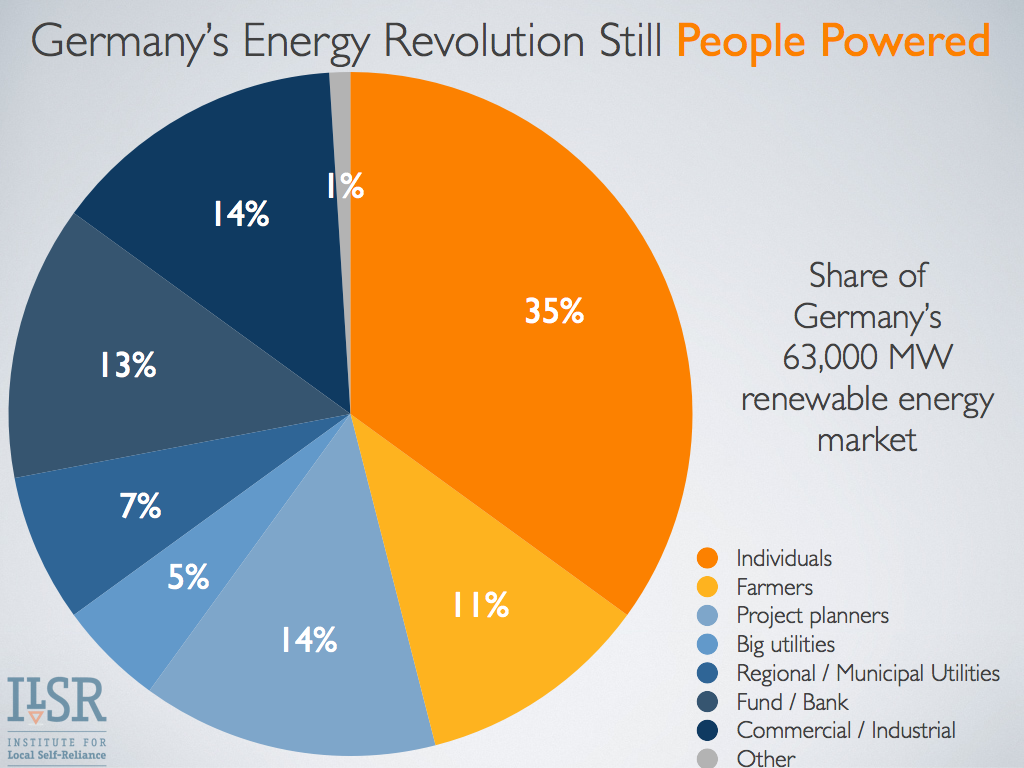
"Sunday’s performance highlights the success of the Energiewende, or 'energy transition,' Germany’s push to expand clean energy, increase energy efficiency, and democratize power generation," he wrote. "Smart policies have opened the renewable energy market to utilities, businesses and homeowners. As of 2012, individuals owned more than a third of Germany’s renewable energy capacity."

However, according to the reporting, the green power haul was slightly complicated by the inability of nuclear and coal plants to be taken offline "so they went on running and had to pay to sell power into the grid for several hours, while industrial consumers...earned money by consuming electricity."

Which, campaigners note, is all the more reason for Germany to expedite its sustainable development goal of reaching 100 percent renewable energy by 2050.

Leaders in Germany are currently debating reforms to the country's clean energy policies, which the renewable energy industry has expressed concern over. Among other policy items, the government has proposed slashing support for onshore wind energy by 7.5 percent starting January 2017, according to a draft document reported on by ReutersWednesday.

Sunday, February 7, 2016

2189. Solar Energy Outlook in Cuba

By Sash Kolopic, Havana Times, February 6, 2016
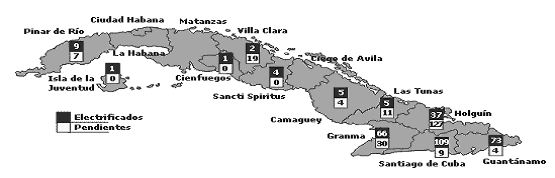
Distribution of photovoltic installations in Cuba

On the outskirts of Havana, in the neighborhood of San Miguel de Padron, the electricity was cut off for an entire day last week. Local residents already fear that the blackout may signal the preparations for an upcoming energy shortage due to the recent political changes in Venezuela and the likely end to the oil subsidy program with Cuba.

Cuba’s electricity supply is still highly dependent on oil imports from neighboring Venezuela. But, like most Caribbean nations, Cuba has immense potential for energy generation from renewable alternatives, including solar energy, which can be utilized to meet domestic and small business needs.

Cuba’s renewable energy output is small, estimated to be at about 4% of its overall production in 2012. The government claims that it wants to increase its renewable energy generating capacity to 24% by 2030 through an investment of $3.5 billion. In order to reduce its dependence on fossil fuel imports, Cuba has instituted a wide-reaching energy efficiency program in 2006, which has overseen various energy saving initiatives for households, including the replacement of old and inefficient domestic appliances.

Another aspect of the improvement program was a switch to a more distributed country-wide network of energy generation with smaller power plants in order to reduce the potential for damages and blackouts that were previously the result of hurricanes affecting a more centralized network. Looking ahead, with the recently introduced economic reforms and a looming end to the US embargo, Cuba needs to act on the next phase of improvements to accommodate the economic growth and the rising energy demand for domestic and industrial use.

For solar energy to have a long-term impact on Cuba’s energy demand and production, projects must expand beyond off-grid usage. The focus should shift toward urban applications of solar systems and the further development of solar-powered domestic appliances.

Solar energy potential in Cuba is high when considering that the country’s geographic position can enable a generation of 5kWh per square meter – about the average daily usage of one household. Although solar energy projects have thus far been limited to remote areas, capacity has increased considerably in recent years.

In 2013 Cuba’s first solar farm opened in Cantarrana, near Cienfuegos, with a capacity of 2.6 MWp. The Santa Teresa solar plant (4.5 MWp capacity) near the U.S. naval base at Guantanamo has started operating recently as well. The government has built a manufacturing plant that has produced 14,000 photovoltaic solar panels, also near Cienfuegos. Currently, the Granma Province has the largest percentage of renewable energy generation within Cuba at about 37% in 2013. By the end of 2014, over 1,500 off-grid solar systems were powering clinics, schools, community centers, and homes located in remote areas of Granma Province. The Cuban government has stated that it wants to have 700 MW of solar energy capacity installed by 2030.

Cuba can rely on local expertise to help support the growth of solar energy around the country. It has a well-educated labor force and local organizations, such as the Centro de Investigaciones de Energía Solar (CIES), that are working on the research, development, and implementation of various solar energy projects and solutions. Additionally, CIES is developing the academic and technical capacity in all of Cuba’s provinces through training workshops paired with solar installations that are easily maintained by the community. They have designed a multitude of prototypes including PV controllers, solar energy water heaters, solar kitchens, solar dryers and other appliances.

Unfortunately, CIES is limited by insufficient funding which is vital for further product testing and improvement, as well as for planning a potential international market presence to meet the growing global demand for solar-powered solutions and appliances.

Working closely with CIES is the local NGO Cubasolar, which is run by local engineers, scientists and planners who have been very active in pushing for the advancement of renewable energy in Cuba. One of their major successes has been the creation of a countrywide network of experts in various sectors and they foster the cooperation and knowledge transfer with international actors in the field of solar energy. Cubasolar publishes a quarterly magazine, “Energía y Tu”, featuring articles about research, projects, and initiatives in the field of renewable energy.

For solar energy to have a long-term impact on Cuba’s energy demand and production, projects must expand beyond off-grid usage. The focus should shift toward urban applications of solar systems and the further development of solar-powered domestic appliances. Particularly the latter category offers Cuba a lot of potential to develop into a global actor, as the international demand for high-quality, affordable solar appliances is strong.

The element preventing Cuba from achieving that position is a financial one. Despite recent economic reforms, Cuba is still not a very attractive option for foreign direct investment, with or without the obstacles presented by the US embargo. Even if the embargo were to end soon, it doesn’t guarantee that international finance mechanisms will immediately be able to (or allowed to) proverbially take off.

To support the development of the renewable energy sector in Cuba, a cautious small-scale entry into the complex world of international finance could likely start by initially incorporating small energy projects by international NGOs or via corporate social responsibility (CSR) programs from major global corporations – an unlikely scenario given the recent rebuke by the Cuban government towards Google’s proposal to provide internet access throughout the country and instead turning to partners from China.

Another financing option includes tapping into international development funds which focus on advancing renewable energy such as the UN’s Solar Energy For All program. An example of that approach is the recent $15 million loan that the Cuban government has received from the Abu Dhabi Fund for Development (ADfD) that was created together with the International Renewable Energy Agency (IRENA).

The loan should partly help finance four 10 MW solar power plants. Beyond that, the Cuban government has a long way to go if it is to build the planned 700 MW of solar capacity and secure the $3.5 billion that are necessary to fund its vision of a countrywide energy transformation. How the government aims to achieve that, with whom, and under what conditions is still a mystery.

Thursday, January 28, 2016

2179. US Electricity Could Be Powered Mostly by Affordable Solar and Wind Technology by 2030

By Science Daily, January 25, 2016
Since the sun is shining or winds are blowing somewhere across the United States all of the time, researchers theorized that the key to resolving the dilemma of intermittent renewable generation might be to scale up the renewable energy generation system to match the scale of weather systems. Image is courtesy of University of Colorado at Boulder.

The United States could slash greenhouse gas emissions from power production by up to 78 percent below 1990 levels within 15 years while meeting increased demand, according to a new study by NOAA and University of Colorado Boulder researchers.

The study used a sophisticated mathematical model to evaluate future cost, demand, generation and transmission scenarios. It found that with improvements in transmission infrastructure, weather-driven renewable resources could supply most of the nation's electricity at costs similar to today’s.

"Our research shows a transition to a reliable, low-carbon, electrical generation and transmission system can be accomplished with commercially available technology and within 15 years," said Alexander MacDonald, co-lead author and recently retired director of NOAA's Earth System Research Laboratory (ESRL) in Boulder.

The paper is published online today in the journal Nature Climate Change.

Although improvements in wind and solar generation have continued to ratchet down the cost of producing renewable energy, these energy resources are inherently intermittent. As a result, utilities have invested in surplus generation capacity to back up renewable energy generation with natural gas-fired generators and other reserves.

"In the future, they may not need to," said co-lead author Christopher Clack, a physicist and mathematician with the Cooperative Institute for Research in Environmental Sciences at the University of Colorado Boulder.

Since the sun is shining or winds are blowing somewhere across the United States all of the time, MacDonald theorized that the key to resolving the dilemma of intermittent renewable generation might be to scale up the renewable energy generation system to match the scale of weather systems.

So MacDonald, who has studied weather and worked to improve forecasts for more than 40 years, assembled a team of four other NOAA scientists to explore the idea. Using NOAA's high-resolution meteorological data, they built a model to evaluate the cost of integrating different sources of electricity into a national energy system. The model estimates renewable resource potential, energy demand, emissions of carbon dioxide (CO2) and the costs of expanding and operating electricity generation and transmission systems to meet future needs.

The model allowed researchers to evaluate the affordability, reliability, and greenhouse gas emissions of various energy mixes, including coal. It showed that low-cost and low-emissions are not mutually exclusive.

"The model relentlessly seeks the lowest-cost energy, whatever constraints are applied," Clack said. "And it always installs more renewable energy on the grid than exists today."

Even in a scenario where renewable energy costs more than experts predict, the model produced a system that cuts CO2 emissions 33 percent below 1990 levels by 2030, and delivered electricity at about 8.6 cents per kilowatt hour. By comparison, electricity cost 9.4 cents per kWh in 2012.

If renewable energy costs were lower and natural gas costs higher, as is expected in the future, the modeled system sliced CO2 emissions by 78 percent from 1990 levels and delivered electricity at 10 cents per kWh. The year 1990 is a standard scientific benchmark for greenhouse gas analysis.

A scenario that included coal yielded lower cost (8.5 cents per kWh), but the highest emissions.

At the recent Paris climate summit, the United States pledged to cut greenhouse emissions from all sectors up to 28 percent below 2005 levels by 2025. The new paper suggests the United States could cut total CO2 emissions 31 percent below 2005 levels by 2030 by making changes only within the electric sector, even though the electrical sector represents just 38 percent of the national CO2 budget. These changes would include rapidly expanding renewable energy generation and improving transmission infrastructure.

In identifying low-cost solutions, researchers enabled the model to build and pay for transmission infrastructure improvements--specifically a new, high-voltage direct-current transmission grid (HVDC) to supplement the current electrical grid. HVDC lines, which are in use around the world, reduce energy losses during long-distance transmission. The model did choose to use those lines extensively, and the study found that investing in efficient, long-distance transmission was key to keeping costs low.

MacDonald compared the idea of a HVDC grid with the interstate highway system which transformed the U.S. economy in the 1950s. "With an 'interstate for electrons', renewable energy could be delivered anywhere in the country while emissions plummet," he said. "An HVDC grid would create a national electricity market in which all types of generation, including low-carbon sources, compete on a cost basis. The surprise was how dominant wind and solar could be.”

The new model is drawing interest from other experts in the field.

"This study pushes the envelope," said Stanford University's Mark Jacobson, who commented on the findings in an editorial he wrote for the journal Nature Climate Change. "It shows that intermittent renewables plus transmission can eliminate most fossil-fuel electricity while matching power demand at lower cost than a fossil fuel-based grid -- even before storage is considered."

Journal Reference:
1 Alexander E. MacDonald, Christopher T. M. Clack, Anneliese Alexander, Adam Dunbar, James Wilczak, Yuanfu Xie. Future cost-competitive electricity systems and their impact on US CO2 emissionsNature Climate Change, 2016; DOI: 10.1038/NCLIMATE2921

Thursday, July 30, 2015

1956. Germany Just Got 78 Percent Of Its Electricity From Renewable Sources

By Ari Phillips, Climate Progress, July 29, 2015


On Saturday, July 25, Germany set a new national record for renewable energy by meeting 78 percent of the day’s electricity demand with renewables sources, exceeding the previous record of 74 percent set in May of 2014.

According to an analysis by German energy expert Craig Morris at the Energiewende blog, a stormy day across northern Europe combined with sunny conditions in southern Germany led to the new record, the exact figures of which are still preliminary. Morris writes that most of Germany’s wind turbines are installed in the north and most of its solar panels are in the south.

If the figures hold, it will turn out that wind and solar generated 40.65 gigawatts (GW) of power on July 25. When this is combined with other forms of renewables, including 4.85 GW from biomass and 2.4 GW from hydropower, the total reaches 47.9 GW of renewable power — occurring at a time when peak power demand was 61.1 GW on Saturday afternoon. To bolster his analysis, Morris points to early figures from Agora Energiewende, a Germany energy policy firm, that have renewables making up 79 percent of domestic power consumption that day.

Renewable sources accounted for 27.8 percent of Germany’s power consumption in 2014, up from 6.2 percent in 2000. The expansion of renewables and another weather phenomenon — a relatively mild winter — led to Germany’s greenhouse gas emissions falling for the first time in three years in 2014, a 4.3 percent year-over-year drop. Greenhouse gas emissions are now down to their lowest level since 1990, according to analysts at Agora Energiewende.

This made 2014 a big year for Germany’s renewable energy transition, known as Energiewende, which requires the phasing out of nuclear energy by 2022 and reducing greenhouse gases at least 80 percent by 2050. The government also wants the at least double the percentage of renewables in the energy mix by 2035.

In response to the Fukushima nuclear meltdown in Japan in 2011, Germany decided to shutter its nuclear power operations, causing the country to rely more on coal as it transitions to renewables. Currently coal still accounts for some 44 percent of the country’s power generation.

In 2014, Germany had nine nuclear power plants with a total output of 12,702 megawatts, making up nearly 18 percent of the country’s electricity demand. In order to eliminate nuclear power by 2022, many worry that Germany will have to turn to fossil fuels like coal and oil to help bridge the transition to renewables, causing a spike in greenhouse gas emissions.

Osha Gray Davidson, author of Clean Break, a book about Germany’s transition to clean energy, told TakePart that for such a large industrialized country to get 28 percent of its power from renewable sources is “pretty amazing,” and that Germany is a good model for the United States.

“Manufacturing accounts for much more of the German economy than the American economy, and they have 80 million people — much larger than a country like Denmark, which gets more of its power from renewables but has a much smaller industrial base, and has a population of five and a half million people,” he said.
Currently, the United States gets about 13 percent of its energy demand from renewable sources, according to the U.S. Energy Information Administration.

As more and more wind turbines and solar panels come online there is a major technology push to create better forecasting software and to increase the efficiency and enhance the location of these forms of power. IBM and the National Renewable Energy Laboratory (NREL) recently announced that they are working on a producing solar and wind forecasting that’s at least 30 percent more accurate than conventional methods.

“There is good reason to believe that with better forecasts, it might be possible to push solar’s energy contribution up to 50 percent [by 2050],” IBM Research Manager Hendrick Hamann recently said about the United States. “As we continue to refine our system in collaboration with the DOE, we hope to double the accuracy of the system in the next year. That could have a huge impact on the energy industry — and on local businesses, the economy and the natural environment.”

Monday, November 17, 2014

1646. Renewable Energy Is Not Enough: Low-Enery Use Societies Are Needed

By Almuth Ernsting, Truthout, November 16, 2014


Renewable energy is growing faster than ever before. Sure, some countries are lagging behind, but others are setting widely praised records.

Germany has installed over 24,000 wind turbines and 1.4 million solar panels, and renewables generate 31 percent of the country's electricity on average - and as much as 74 percent on particularly windy or sunny days. According to the German government, 371,400 jobs have been created by renewable energy. Norway generates 99 percent of its electricity from renewable energy. Denmark already generates 43 percent of electricity from renewables and aims to phase out fossil fuel burning by 2050.

Many view such news as rays of hope in a rapidly destabilizing climate. We all need some good news - but is renewables expansion really the good news people like to think? Can we really put our hopes for stabilizing the climate into trying to simply replace the energy sources in a growth-focused economic and social model that was built on fossil fuels? Or do we need a far more fundamental transition towards a low-energy economy and society?
Here's the first problem with celebratory headlines over renewables: Record renewable energy hasn't stopped record fossil fuel burning, including record levels of coal burning. Coal use is growing so fast that the International Energy Authority expects it to surpass oil as the world's top energy source by 2017.

Perhaps the 1,500 gigawatts of electricity produced from renewables worldwide have prevented a further 1,500 gigawatts of fossil fuel power stations? Nobody can tell. It's just as possible that renewables have simply added 1,500 gigawatts of electricity to the global economy, fueled economic growth and ever-greater industrial resource use. In which case, far from limiting carbon dioxide emissions worldwide, renewables may simply have increased them because, as discussed below, no form of large-scale energy is carbon neutral.

As long as energy sources that are as carbon-intensive and destructive as fossil fuels are classed as "renewable," boosting renewable energy around the world risks doing more harm than good.

Germany's Energy Transition illustrates the problem: Wind turbines and solar panels have certainly become a widespread feature of Germany's landscape. Yet if we look at Germany's total energy use (including heating and transport), rather than just at electricity, energy classed as renewable accounts for just 11.5 percent. The majority, 87.8 percent, of Germany's energy continues to come from fossil fuels and nuclear power (with waste incineration accounting for the difference of 0.7 percent). Coal consumption, which had been falling until 2008, has been rising again since then. Germany remains the European Union's (EU) top coal consumer. Net electricity exports are being blamed for the rise in coal burning and carbon dioxide emissions, yet they account for just 5 percent of Germany's electricity - and electricity accounts for less than half of the country's energy use.

The picture looks even worse when one examines the mix of energy classed as renewable in Germany: Solar photovoltaic (PV) makes up 11.5 percent of renewables, wind, 16.8 percent. The bulk of it - 62 percent - comes from bioenergy, much of which is far from low carbon or sustainable. It includes biofuels, many of them made from imported soya and palm oil that are being expanded at the expense of tropical forests and peatlands and that destroy the livelihoods of small farmers, indigenous and other forest dependent peoples worldwide. It includes biogas made from 820,000 hectares of corn monocultures in Germany - a key driver for biodiversity loss in the country. And it includes wood pellets linked to forest degradation across Central Europe. On closer examination, therefore, 24,000 wind turbines and 1.4 million solar panels have scarcely made a dent in Germany's fossil fuel burning and carbon emissions.

Norway's situation is unique in that virtually all of the country's electricity is generated from hydro dams, which were gradually expanded over the course of more than a century. Fossil fuels (mostly oil) still surpass renewable energy in Norway's overall energy mix (with electricity accounting for less than half of the total), though only marginally so, and Norway's economy remains heavily dependent on oil and gas exports.

Norway's own hydro dams - many of them small-scale - have raised little controversy but the same cannot be said for Norway's efforts to export this model to other countries. The Norwegian government and the state-owned energy company Statkraft have been at the forefront of financing controversial dams and associated infrastructure in Laos, India, Malaysian Borneo and elsewhere. One example is Statkraft's joint venture investment in a new dam in Laos that has displaced 4,800 people and is causing flooding, erosion, and loss of fisheries and land on which people relied for growing rice.

Another example is Norwegian aid for transmission lines for mega-dams in Sarawak, a Malaysian province in Borneo which has seen vast areas of tropical rainforest - and the livelihoods of millions of indigenous peoples - sacrificed for palm oil, logging and also hydro power. One dam alone displaced 10,000 people and at least 10 more dams are planned, despite ongoing resistance from indigenous peoples. Far from being climate-friendly, hydro dams worldwide are associated with large methane emissions - with one study suggesting they are responsible for 25 percent of all human-caused methane emissions and over 4 percent of global warming. The disastrous consequences of Norway's global hydro power investment illustrates the dangers of the simplistic view that anything classed as renewable energy must be climate-friendly and merits support.

What about the much-heralded renewable transition of Denmark? There coal use is falling and around 21 percent of total energy is sourced from renewables. Denmark holds the world record for wind energy capacity compared to population size. Unlike many other countries where wind energy is firmly controlled by large energy companies, Denmark has seen strong support for locally owned wind energy cooperatives, widely considered an inspiring example of clean, community-controlled energy. Nonetheless, wind energy in Denmark accounted for just 3.8 percent of Denmark's total energy use in 2010.

Bioenergy accounts for a far greater percentage of Denmark's "renewable energy" than does wind - and indeed for a greater share in the country's overall energy mix than is the case in any other European country. As in Germany, Denmark's bioenergy includes biofuels for transport, which studies show tend to be worse for the climate than equivalent quantities of oil once all the direct and indirect emissions from deforestation, peatland destruction and other land use change associated with them are accounted for. And it includes wood pellets, with Denmark being the EU's, and likely the world's, second biggest pellet importer after the United Kingdom. Most of those pellets come from the Baltic states and Russia, from countries where clear-cutting of highly biodiverse forests is rampant. Studies show that burning wood from whole trees can be worse for the climate than burning coal over a period of decades or even centuries.

Thus, on closer inspection, many of the "great renewable energy successes" don't look so great after all.

Clearly, the current catch-all definition of "renewables" is a key problem: Defining methane-spewing mega-dams, biofuels, which are accelerating deforestation and other ecosystem destruction, or logging forests for bioenergy as "renewable" helps policy makers boost renewables statistics, while helping to further destabilize planetary support systems. As long as energy sources that are as carbon-intensive and destructive as fossil fuels are classed as "renewable," boosting renewable energy around the world risks doing more harm than good.

A saner definition of "renewable energy" clearly is vital but would it open the door toward 100 percent clean and plentiful energy? Comparing the rate of wind energy expansion in Denmark and wind and solar power expansion in Germany with the tiny contribution they make to both countries' total energy supply indicates otherwise.

Wind and solar power require far less land per unit of energy than biomass or biofuels, but the area of land needed to replace fossil fuel power stations with, say, wind turbines is vast nonetheless. According to a former scientific advisor to the UK government, for example, 15 offshore wind turbines installed on every kilometer of the UK coastline would supply just 13 percent of the country's average daily energy use. And offshore turbines are more efficient than onshore ones.

Researchers agree that the life-cycle impacts of wind and solar power on the climate and environment are definitely smaller than those of fossil fuels, as long as turbines and panels are sensibly sited (not, for example, on deep peat). But this doesn't mean that the impacts are benign. Generating that 13 percent of UK energy from offshore wind would require wind turbines made of 20 million tons of steel and concrete - more than all the steel that went into US shipbuilding during World War II. Steel manufacturing is heavily dependent on coal, not just as a fuel for the furnaces but because it is needed to enrich the raw material, iron ore, with carbon to make it stable. And concrete is hardly "carbon neutral" either - cement (a key component) accounts for 5 percent of global carbon dioxide emissions.
Solar PV panels are up to four times as energy and carbon-intensive to produce as wind turbines: Aluminum - used to mount and construct solar panels - is about as carbon and energy-intensive as steel. Silicon needs to be smelted at 2,000 degrees Celsius and materials used to replace silicon have an even higher environmental footprint. Then there's an array of highly toxic and corrosive chemicals used during manufacturing. Yet with regards to pollution, building wind and marine turbines is likely worse than making solar panels, because efficient and lasting turbine magnets rely on rare earth mining and refining. One 5-megawatt turbine requires a ton of rare earths, the mining and refining of which will leave behind 75 cubic meters of toxic acidic waste water and one ton of radioactive sludge. Two-thirds of the world's rare earths are refined in one town in China, where people have become environmental refugees and virtually all who remain suffer from ill health associated with toxic chemicals and radiation. In the quest for "clean energy" rare earths mines are being sought and opened around the globe. The only US rare earths mine, Molycorp's in California, has been reopened, after having been shut down due to a long history of repeated spills of toxic and radioactive waste. Since reopening, the operators have already been fined for spilling yet more hazardous waste.

Zero-carbon, clean energy? Well, no. And yet, there are no large-scale energy sources with lower carbon emissions and less harmful environmental impacts than wind and solar power. As one scientist argues from the perspective of thermodynamics: "To talk about 'renewable energy' or 'sustainable energy' is an oxymoron, as is 'sustainable mining' or 'sustainable development.' The more energy we use, the less sustainable is humanity."

We certainly need to swiftly end fossil fuel burning and the destruction of ecosystems and that will require us to rely on the least harmful energy sources such as wind and solar power. But the myth of plentiful "clean" energy stops us from focusing on the far deeper changes needed - a transformation toward a low-energy society. A depressing conclusion? Not necessarily. As UK climate change campaigner and author George Marshall has pointed out, we could cut flights (and probably all transport emissions) and slash energy used for home heating by 80 percent overnight by going back to the way people used to live as short a time ago as 1972, provided we used home insulation and efficient boiler technology developed since then. Instead, 40 years of efficiency gains have been wiped out by ever-greater consumption. Yet UK "personal satisfaction" surveys show that people's sense of satisfaction or happiness peaked in 1970. Once people's basic needs for energy are met, rising energy use remains vital for corporate profits and economic growth, but not for people's quality of life.

Most readers will have never lived in a low-energy society. Imagining what such a society might look like and how to move toward the transformation required to get there, and to overcome the corporate interests that depend on profits from ever rising energy use, must be priorities for anyone aware of the seriousness of climate change. Daunting no doubt, but once we've abandoned faith in plentiful "clean" energy, we can finally make a start.