Showing posts with label Clean renewable energy. Show all posts

Wednesday, February 7, 2018

2819. Why a Big Utility Is Embracing Wind and Solar

By Justin Gillis and Hal Harvey, The New York Times, February 6, 2018
Turbines at the Spring Canyon Wind Farm outside Peetz, Colo. The farm is owned by Invenergy, and produces energy under contract to Xcel Energy. Photo: Ryan David Brown for The New York Times. 


DENVER — Imagine planning your next trip and finding that Delta was selling first-class seats for less than the cramped middle seats in the back of the plane.

So you fly first class to New York and walk into the best French restaurant, only to discover that every dish is cheaper than the burger and fries down the street. Waiter, bring the duck à l’orange!

Fanciful as that might sound, something a bit like it is happening right now in the world of electricity.

Xcel Energy is a utility company with millions of electric customers in the middle of the country, from Texas to Michigan. In booming Colorado, the company asked for proposals to construct big power plants using wind turbines and solar panels.

The bids have come in so low that the company will be able to build and operate the new plants for less money than it would have to pay just to keep running its old, coal-burning power plants.

You read that right: In parts of the country, wind and solar plants built from scratch now offer the cheapest power available, even counting old coal, which was long seen as unbeatable.

Xcel, Colorado’s biggest power company, has pitched a plan to regulators that will involve replacing two large coal-burning units with renewable energy and possibly some natural gas. The company expects to save tens of millions of dollars as a result. Power bills in Colorado have been falling recently, and they are likely to fall further with this plan.

So the plan will be cheaper, but why will it be better?

Because it will cut Xcel’s emissions. That includes the carbon dioxide that is warming the planet, of course, but it also includes other pollutants, like the fine particles that can send children to the hospital with asthma attacks.

Under the leadership of Benjamin Fowke, a gray-haired chief executive trained in finance, Xcel intends to get far ahead of the clean-power requirements that have been imposed by its regulators.

Across its eight-state system, Xcel predicts that well over half its electricity will come from renewable sources by the mid-2020s. It will be one of the cleanest large utility companies in the country.

Now, to be clear, the low bids that Xcel is getting include some federal subsidies for clean power. Those subsidies are entirely defensible, but both parties in Congress have agreed to phase them out in a couple of years. Mr. Fowke is jumping now in part to lock in the subsidized prices.

Yet costs for renewable technologies are coming down so much that by the time the federal subsidies expire, wind turbines and large-scale solar arrays will still be competitive in large parts of the country.

The same trend is occurring all over the world, even in countries that do not offer subsidies, with renewable projects routinely beating fossil-fuel projects in countries like Mexico and India. We are confident more price declines are coming.

The costs of huge batteries are also falling, and it looks as if they will turn out to be a big help in managing the variability of wind and solar power. Xcel is already testing a battery project near Denver, and it may buy more batteries as part of the new plan.

How, exactly, did the cleanest energy technologies get on a path to become the cheapest?
In a way, the story is as old as Henry Ford and his Model T, or in more recent times, the amazing progress of computer chips.

As they scale up, new technologies often follow a “learning curve” that cuts the cost. But it’s not automatic. You have to build more and more units to drive the prices down.

That happened naturally with consumer products like Model Ts and cellphones, since everybody who saw the things wanted one. But the electricity system was a hidebound, monopolistic industry that used to spend virtually nothing on innovation.

For decades, utility executives who were wedded to coal regarded solar panels and wind turbines as expensive trinkets. But some farsighted political leaders saw the potential as early as the 1970s.

President Jimmy Carter was one. Jerry Brown, then serving as California’s youngest-ever governor, was another. Republican leaders in windy states, like Terry Branstad and Charles Grassley of Iowa, also got on board.

A combination of state clean-power mandates and federal subsidies helped to increase the market, as did similar policies in Europe. It has taken a couple of decades, but we are reaching a point where the new energy technologies are going to be cheap enough to drive a lot of the old coal-burning power plants off the market.

Nowadays, of course, the Trump administration is trying to take the country backward. It recently offered a scheme to subsidize coal and nuclear plants, but the plan was so ludicrous, a federal panel dominated by Trump appointees voted it down 5-0.

More ominously, the administration recently imposed costly tariffs on solar panels made in China. That is unquestionably bad for the solar industry, but we think it will turn out to be a temporary setback.

The real question now is how fast can the fossil-fuel plants be shut down. Even with favorable economics, human and institutional inertia is such that the remaining coal plants could take a long time to die.

States need to find ways to help utilities make the right decisions, perhaps by sharing some of the short-term costs of the shutdowns. They also need to protect workers who lose their jobs, and compensate communities that stand to lose part of their tax base.

Despite such concerns, the cost trends are clear, and inexorable. Mr. Fowke has positioned Xcel to take advantage of them, and a handful of other power companies across the country are taking similar steps.

But most utilities are still doing only what governments have required of them. With the best power plants becoming the cheapest, isn’t it time for their leaders to seize the future, too?

Tuesday, July 11, 2017

2657. Heinberg on Jacobson vs. Clack Debate on Energy Transition

By Richard Heinberg, Resilience, July 11, 2017
Richard Heinberg
A heated debate in the pages of one of the country’s most renowned scientific journals has gained national attention. The debate is over whether a combination of wind, solar, and hydroelectricity could fully power the U.S. But both sides of the debate are completely missing half of the equation.
In a series of papers published over the last few years, Mark Jacobson of Stanford University (along with co-authors) has offered a series of transition plans for achieving a 100 percent wind-solar-hydro energy economy. These include comprehensive blueprints for the United States, for each individual state, and for the world as a whole. His message is clear: such a transition is not only possible, it’s affordable—cheaper, in fact than maintaining the current fossil fueled system. There is no technical or economic barrier to an all-renewable future—only a political one, resulting from the enormous influence of fossil fuel companies on Congress and the White House. Jacobson’s plans have been touted by celebrities (Leonardo DiCaprio and Mark Ruffalo) and at least one prominent politician (Bernie Sanders).
However, during the past two years, a group of scientists unconvinced by Jacobson’s arguments has labored to craft a critical review of his plans, and to get it published in the same journal that printed Jacobson’s own most-cited paper. They voice a concern that the growing popularity of Jacobson’s plans could lead to critical mistakes in policy making and investment choices. The lead author, Christopher Clack, and his 20 co-authors attack Jacobson’s assumptions and highlight what they call serious modeling errors. Much of their criticism has to do with Jacobson’s ways of getting around solar and wind power’s most notorious drawback—its intermittency. Jacobson says we can deal with cloudy and windless days by storing energy in the forms of underground heat and hydrogen. Clack et al. point out that doing so on the scale Jacobson is proposing is unprecedented (therefore, we really don’t know if it can be done), and also argue that Jacobson made crucial errors in estimating how much storage would be needed and how much it would cost.
The stakes in this controversy are high enough that the New York Times and other mainstream media have reported on it. One pro-renewables scientist friend of mine despairs not just because of bad press about solar and wind power, but also because the reputation of science itself is taking a beating. If these renowned energy experts can’t agree on whether solar and wind power are capable of powering the future, then what are the implications for the credibility of climate science?
Jacobson and colleagues have published what can only be called a take-no-prisoners rebuttal to Clack et al. In it, they declare that, “The premise and all error claims by Clack et al. . . . about Jacobson et al. . . . are demonstrably false.” In a separate article, Jacobson has dismissed Clack and his co-authors as “nuclear and fossil fuel supporters,” though it’s clear that neither side in this debate is anti-renewables.
However, Clack et al. have issued their own line-by-line response to Jacobson’s line-by-line rebuttal, and it’s fairly devastating.
This is probably a good place to point out that David Fridley, staff scientist in the energy analysis program at Lawrence Berkeley National Laboratories, and I recently published a book, Our Renewable Futureexploring a hypothetical transition to a 100 percent wind-and-solar energy economy. While we don’t say so in the book, we were compelled to write it partly because of our misgivings about Mark Jacobson’s widely publicized plans. We did not attack those plans directly, as Clack et al. have done, but sought instead to provide a more nuanced and realistic view of what a transition to all-renewable energy would involve.
Our exploration of the subject revealed that source intermittency is indeed a serious problem, and solving it becomes more expensive and technically challenging as solar-wind generation approaches 100 percent of all electricity produced. A further challenge is that solar and wind yield electricity, but 80 percent of final energy is currently used in other forms—mostly as liquid and gaseous fuels. Therefore the energy transition will entail enormous changes in the ways we use energy, and some of those changes will be technically difficult and expensive.
Our core realization was that scale is the biggest transition hurdle. This has implications that both Jacobson et al., and Clack et al. largely ignore. Jacobson’s plan, for example, envisions building 100,000 times more hydrogen production capacity than exists today. And the plan’s assumed hydro expansion would require 100 times the flow of the Mississippi River. If, instead, the United States were to aim for an energy system, say, a tenth the size of its current one, then the transition would be far easier to fund and design.
When we start our transition planning by assuming that future Americans will use as much energy as we do now (or even more of it in the case of economic growth), then we have set up conditions that are nearly impossible to design for. And crucially, that conclusion still holds if we add nuclear power (which is expensive and risky) or fossil fuels (which are rapidly depleting) to the mix. The only realistic energy future that David Fridley and I were able to envision is one in which people in currently industrialized countries use far less energy per capita, use it much more efficiently, and use it when it’s available rather than demanding 24/7/365 energy services. That would mean not doing a lot of things we are currently doing (e.g., traveling in commercial aircraft), doing them on a much smaller scale (e.g., getting used to living in smaller spaces and buying fewer consumer products—and ones built to be endlessly repaired), or doing them very differently (e.g., constructing buildings and roads with local natural materials).
If powerdown—that is, focusing at least as much on the demand side of the energy equation as on the supply side—were combined with a deliberate and humanely guided policy of population decline, there would be abundant beneficial side effects. The climate change crisis would be far easier to tackle, as would ongoing loss of biodiversity and the depletion of resources such as fresh water, topsoil, and minerals.
Jacobson has not embraced a powerdown pathway, possibly because he assumes it would not appeal to film stars and politicians. Clack et al. do not discuss it either, mostly because their task at hand is simply to demolish Jacobson. But powerdown, the pathway about which it is seemingly not permissible for serious people to speak, is what we should all be talking about. That’s because it is the most realistic way to get to a sustainable, happy future.

Tuesday, June 21, 2016

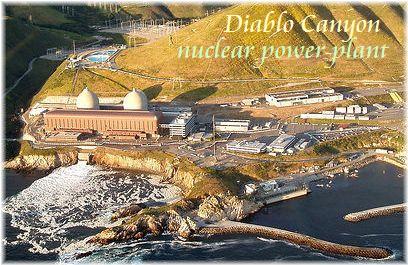
2355. Diablo Canyon Nuclear Plant to be Shut Down, Power Replaced by Renewables, Efficiency, Storage

By Friends of the Earth, June 21, 2016


BERKELEY, CALIF. - An historic agreement has been reached between Pacific Gas and Electric, Friends of the Earth, and other environmental and labor organizations to replace the Diablo Canyon nuclear reactors with greenhouse-gas-free renewable energy, efficiency and energy storage resources. Friends of the Earth says the agreement provides a clear blueprint for fighting climate change by replacing nuclear and fossil fuel energy with safe, clean, cost-competitive renewable energy. 

The agreement, announced today in California, says that PG&E will renounce plans to seek renewed operating licenses for Diablo Canyon’s two reactors -- the operating licenses for which expire in 2024 and 2025 respectively. In the intervening years, the parties will seek Public Utility Commission approval of the plan which will replace power from the plant with renewable energy, efficiency and energy storage resources. Base load power resources like Diablo Canyon are becoming increasingly burdensome as renewable energy resources ramp up. Flexible generation options and demand-response are the energy systems of the future.

By setting a certain end date for the reactors, the nuclear phase out plan provides for an orderly transition. In the agreement, PG&E commits to renewable energy providing 55 percent of its total retail power sales by 2031, voluntarily exceeding the California standard of 50 percent renewables by 2030.

"This is an historic agreement," said Erich Pica, president of Friends of the Earth. "It sets a date for the certain end of nuclear power in California and assures replacement with clean, safe, cost-competitive, renewable energy, energy efficiency and energy storage. It lays out an effective roadmap for a nuclear phase-out in the world's sixth largest economy, while assuring a green energy replacement plan to make California a global leader in fighting climate change.”

A robust technical and economic report commissioned by Friends of the Earth served as a critical underpinning for the negotiations. The report, known as “Plan B,” provided a detailed analysis of how power from the Diablo Canyon reactors could be replaced with renewable, efficiency and energy storage resources which would be both less expensive and greenhouse gas free. With the report in hand, Friends of the Earth’s Damon Moglen and Dave Freeman engaged in discussions with the utility about the phase-out plan for Diablo Canyon. NRDC was quickly invited to join. Subsequently, International Brotherhood of Electrical Workers Local 1245, Coalition of California Utility Employees, Environment California and Alliance for Nuclear Responsibility partnered in reaching the final agreement. The detailed phase out proposal will now go to the California Public Utility Commission for consideration. Friends of the Earth (and other NGO parties to the agreement) reserve the right to continue to monitor Diablo Canyon and, should there be safety concerns, challenge continued operation.

The agreement also contains provisions for the Diablo Canyon workforce and the community of San Luis Obispo. “We are pleased that the parties considered the impact of this agreement on the plant employees and the nearby community,” said Pica. “The agreement provides funding necessary to ease the transition to a clean energy economy.” 

Diablo Canyon is the nuclear plant that catalyzed the formation of Friends of the Earth in 1969. When David Brower founded Friends of the Earth the Diablo Canyon was the first issue on the organization’s agenda and Friends of the Earth has been fighting the plant ever since. This agreement is not only a milestone for renewable energy, but for Friends of the Earth as an organization.

Monday, May 16, 2016

2323. Renewable Windfall as Germany's Green Energy Meets 90 Percent of Demand

By Lauren McCauley, Common Dreams, May 11, 2016


Germany, the fourth-largest economy in the world and a leader in renewable energy, produced so much energy this weekend from its solar, wind, hydro, and biomass plants that power prices went into negative territory for several hours. Consumers were being paid to use energy.

According to Quartz, around 1 pm on Sunday, May 8—a particularly "sunny and windy day"—the plants supplied a combined 55 gigawatts, or 87 percent, of the 63 gigawatts being consumed.

"The power system adapted to this quite nicely," Christoph Podewil, of the German clean energy think tank Agora Energiewende, told the publication. "This day shows again that a system with large amounts of renewable energy works fine."

According to Agora, the average renewable mix in 2015 was 33 percent.

germany.png
"This is big," wrote Jeremy Deaton, a journalist with Climate Nexus. "Sunday’s spike in renewable output shows that wind and solar can keep pace with the demands of an economic powerhouse. What’s more, the growth of clean energy has tracked the growth of Germany’s economy."

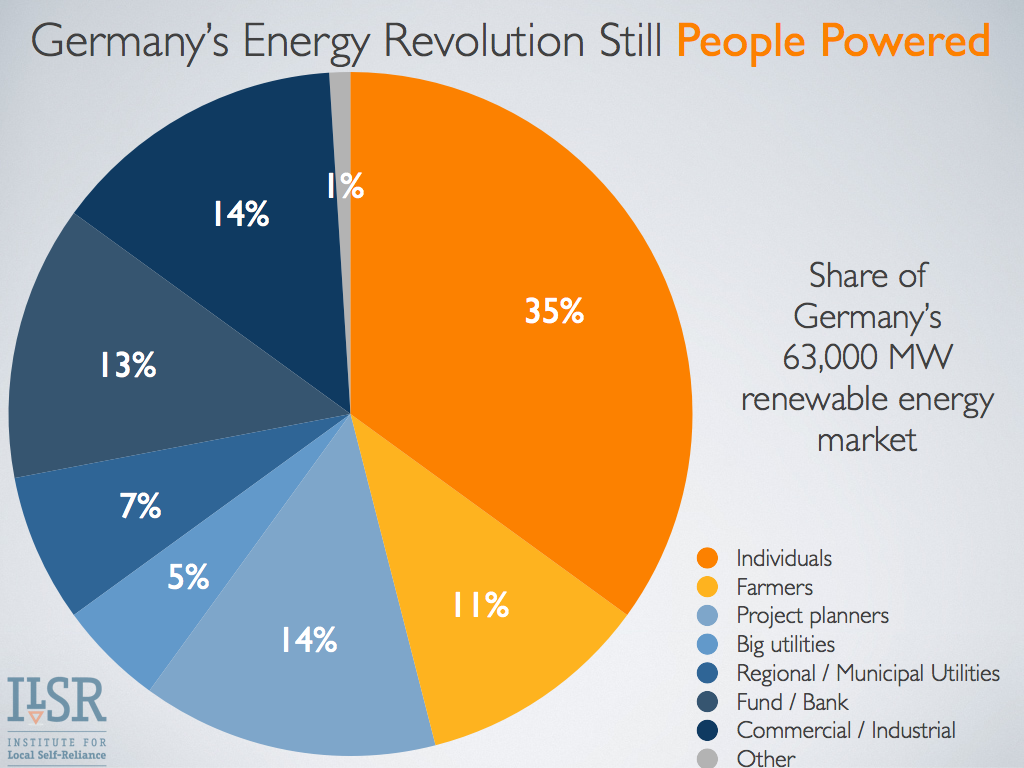
Another key takeaway, according to Deaton, is that the milestone was made possible because of a people-powered "energy revolution."

"Sunday’s performance highlights the success of the Energiewende, or 'energy transition,' Germany’s push to expand clean energy, increase energy efficiency, and democratize power generation," he wrote. "Smart policies have opened the renewable energy market to utilities, businesses and homeowners. As of 2012, individuals owned more than a third of Germany’s renewable energy capacity."

However, according to the reporting, the green power haul was slightly complicated by the inability of nuclear and coal plants to be taken offline "so they went on running and had to pay to sell power into the grid for several hours, while industrial consumers...earned money by consuming electricity."

Which, campaigners note, is all the more reason for Germany to expedite its sustainable development goal of reaching 100 percent renewable energy by 2050.

Leaders in Germany are currently debating reforms to the country's clean energy policies, which the renewable energy industry has expressed concern over. Among other policy items, the government has proposed slashing support for onshore wind energy by 7.5 percent starting January 2017, according to a draft document reported on by ReutersWednesday.

Friday, April 15, 2016

2278. Baseload Power Is a Myth: Even Intermittent Renewables Will Work

By Mark Diesendrof, The Conversation, Arpil 10, 2016

The future of civilisation and much biodiversity hangs to a large degree on whether we can replace fossil fuels – coal, oil and gas – with clean, safe and affordable energy within several decades. The good news is that renewable energy technologies and energy efficiency measures have advanced with extraordinary speed over the past decade.
Energy efficient buildings and appliances, solar hot water, on-shore wind, solar photovoltaic (PV) modules, concentrated solar thermal (CST) power with thermal storage and gas turbines burning a wide range of renewable liquid and gaseous fuels are commercially available on a large scale. The costs of these technologies have declined substantially, especially those of solar PV. In 2012, despite the global financial crisis, global investment in these clean, safe and healthy technologies amounted to US $269 billion. Denmark, Scotland and Germany and several states/provinces around the world have official targets of around 100% renewable electricity and are implementing policies to achieve them.
The principal barrier is resistance from vested interests and their supporters in the big greenhouse gas polluting industries and from an unsafe, expensive, polluting, would-be competitor to a renewable energy future, nuclear power. These powerful interests are running a campaign of renewable energy denial that is almost as fierce as the long-running campaign of climate change denial. Both campaigns are particularly noisy in the Murdoch press. So far the anti-renewables campaign, with its misinformation and gross exaggerations, has received little critical examination in the mainstream media.
The renewable energy deniers rehash, among others, the old myth that renewable energy is unreliable in supplying base-load demand.

Renewable electricity is reliable

In a previous article for The Conversation I reported on the initial results of computer simulations by a research team at the University of New South Wales that busted the myth that renewable energy cannot supply base-load demand. However at the time of the article I was still under the misconception that some base-load renewable energy supply may be needed to be part of the renewable energy mix.
Since then Ben Elliston, Iain MacGill and I have performed thousands of computer simulations of 100% renewable electricity in the National Electricity Market (NEM), using actual hourly data on electricity demand, wind and solar power for 2010. Our latest research, available here and reported here, finds that generating systems comprising a mix of different commercially available renewable energy technologies, located on geographically dispersed sites, do not need base-load power stations to achieve the same reliability as fossil-fuelled systems.
The old myth was based on the incorrect assumption that base-load demand can only be supplied by base-load power stations; for example, coal in Australia and nuclear in France. However, the mix of renewable energy technologies in our computer model, which has no base-load power stations, easily supplies base-load demand. Our optimal mix comprises wind 50-60%; solar PV 15-20%; concentrated solar thermal with 15 hours of thermal storage 15-20%; and the small remainder supplied by existing hydro and gas turbines burning renewable gases or liquids. (Contrary to some claims, concentrated solar with thermal storage does not behave as base-load in winter; however, that doesn’t matter.)
The real challenge is to supply peaks in demand on calm winter evenings following overcast days. That’s when the peak-load power stations, that is, hydro and gas turbines, make vital contributions by filling gaps in wind and solar generation.

Renewable electricity is affordable

Our latest peer-reviewed paper, currently in press in Energy Policy journal, compares the economics of two new alternative hypothetical generation systems for 2030: 100% renewable electricity versus an “efficient” fossil-fuelled system. Both systems have commercially available technologies and both satisfy the NEM reliability criterion. However, the renewable energy system has zero greenhouse gas emissions while the efficient fossil scenario has high emissions and water use and so would be unacceptable in environmental terms.
We used the technology costs projected to 2030 in the conservative 2012 study by the Bureau of Resources and Energy Economics (BREE). (In my personal view, future solar PV and wind costs are likely to be lower than the BREE projections, and future fossil fuel and nuclear costs are likely to be higher.) Then, we did thousands of hourly simulations of supply and demand over 2010, until we found the mix of renewable energy sources that gave the minimum annual cost.
Under transparent assumptions, we found that the total annualised cost (including capital, operation, maintenance and fuel where relevant) of the least-cost renewable energy system is $7-10 billion per year higher than that of the “efficient” fossil scenario. For comparison, the subsidies to the production and use of all fossil fuels in Australia are at least $10 billion per year. So, if governments shifted the fossil subsidies to renewable electricity, we could easily pay for the latter’s additional costs.
Thus 100% renewable electricity would be affordable under sensible government policy, busting another myth. All we need are effective policies to drive the transition.

Tuesday, September 22, 2015

2032. Greenpeace Report Details Path to 100% Clean Renewable Energy by 2050

By Jon Qeally, CommonDreams, September 21, 2015 


With scientists and experts from around the world telling world leaders with increasing urgency ahead of upcoming climate talks in Paris that "It must be done," a new report says "It can be done." 

As the planetary impacts of global warming become more apparent with every passing day, the goal of building and maintaining an energy system run on 100 % renewable power has become one of the driving demands of the world's environmental and climate justice movements, new research presented by Greenpeace on Monday shows that if the political will can be mustered, there are neither technological nor economic barriers preventing humanity from building a fossil fuel- and nuclear-free world by 2050.

"The phase out of fossil fuels and transition to renewable energy is not only needed, but can be achieved globally by mid-century," said Kelly Mitchell, the climate and energy campaign director for Greenpeace USA. "In the US, we must prioritize keeping coal, oil and gas in the ground while accelerating the transition to clean energy like wind and solar. Doing so would both create new jobs and ensure a healthier planet for future generations.”

According to the report:
100% renewable energy for all is achievable by 2050, and is the only way to ensure the world does not descend into catastrophic climate change. Dynamic change is taking place in the energy sector. Renewable energies have become mainstream in most countries, and prices have fallen  dramatically.  The report shows we could transform our energy supply, switching to renewables, which would mean a stabilization of global CO2 emissions by 2020, and bringing down emissions  towards near zero emissions in 2050.
Produced in collaboration with researchers at the German Aerospace Centre (DLR), the new Greenpeace report—titled World Energy [R]evolution: A Sustainable World Energy Outlook 2015is the latest global energy analysis which shows that not only is the transition to cleaner energy sources possibly in the coming decades, the actual financial costs of taking on a such a massive transition would actually be cheaper over the coming decades than retaining the "dirty energy" status quo in the face of climate change.

Greenpeace admits the cost of its plan is "huge" but that "the savings are even bigger." According to their estimates, the global average of additional investment needed in renewables is roughly $1 trillion a year until 2050. However, because renewables don’t require continuous fuel inputs, the savings over the same period would be $1.07 trillion a year, more than covering the costs of the required up-front investment.

Calling for a strategic phase-out of both fossil fuel and nuclear energy by mid-century, the Greenpeace plan targets the most carbon-intensive fossil fuels first—including lignite and coal—before moving on to less-polluting sources like oil and gas.

"We must not let the fossil fuel industry’s lobbying stand in the way of a switch to renewable energy, the most effective and fairest way to deliver a clean and safe energy future," said Greenpeace International Executive Director Kumi Naidoo. "I urge all those who say ‘it can’t be done’ to read this report and recognize that it can be done and must be done for the benefit of people around the world.”

What's more, the group says, this energy transformation would be a source of millions upon millions of jobs, more than enough to replace those lost by the shuttering of the coal, oil, and gas industries.

The report says that nearly 20 million jobs in the renewable energy sector could be created between now and 2030, because of strong growth and investment in renewables. The solar photovoltaic (PV) industry alone, the research estimates, will provide 9.7 million jobs, equal to the number of people now working in the coal industry today. In the wind sector—which has shown unprecedented growth in recent years--job growth will continue grow to over 7.8 million jobs, twice as many as are employed in oil and gas today.

"The solar and wind industries have come of age, and are now cost competitive with coal," said Greenpeace’s Sven Teske, the lead author of the report. "It is very likely they will overtake the coal industry in terms of jobs and energy supplied within the next decade. It’s the responsibility of the fossil fuel industry to prepare for these changes in the labor market and make provisions. Every dollar invested in new fossil fuel projects is high risk capital which could end up as stranded investment.”

With the UN climate talks in Paris fast-approaching, Greenpeace says the urgency of the crisis must compel political leaders to finally act—and act boldly—on the message that the scientific community and civil society leaders have been issuing with growing levels of intensity in recent years.

With their new report as a blueprint for what's possible, said Naidoo, "the Paris climate agreement must deliver a long term vision for phasing out coal, oil, gas and nuclear energy by mid-century, reaching the goal of 100% renewables with energy access for all.”


Wednesday, July 15, 2015

1932. Nuclear Plant Closing Reflects Overhaul of German Energy Production

By Melissa Eddy, The New York Times, July 12, 2015
Nuclear plant at Granfenheinfeld, Germany
GRAFENRHEINFELD, Germany — In one of this country’s most popular novels for young readers, the nuclear reactor on the edge of this Bavarian town melts down, spewing a radioactive cloud that threatens all of Germany and robs a 14-year-old girl of her family and her hope for the future.

Last month, that nuclear power plant in Grafenrheinfeld, responsible for meeting the energy needs of industry-heavy Bavaria since 1981, came to a less dramatic but equally symbolic end. The plant became the first active reactor to be decommissioned since 2011, following Chancellor Angela Merkel’s about-face on nuclear power after the Fukushima Daiichi nuclear plant catastrophe in Japan.

Taking Grafenrheinfeld offline is a milestone in Germany’s push to establish a nuclear-free energy system by 2022, but also one made possible by its determination to cut greenhouse gas emissions by 40 percent of 1990 levels by 2020. The plant can be closed because it has already been replaced by alternative energy sources like solar and wind.

But while Germany has made substantial progress in its energy transformation policy, its aspiration is being put to the test by new political, technological and economic challenges as it moves into the next phase of the effort.

How it deals with the obstacles could go a long way in determining whether the country becomes a model for moving toward a reduced- or even post-carbon economy.

“The exit is taking place at a pace that is breathtaking, even for those of us who were always for it, and the transition to a decarbonized economy is not without great challenges that only come at a price,” Sigmar Gabriel, Germany’s minister for energy and the economy, told industry leaders last month.

Current projections indicate that Germany needs to speed up the pace of reducing its greenhouse gas emissions if it wants to meet its 2020 goals.

Shifts in the energy market, including the persistently high price of natural gas in Europe and economic and political disincentives to move away from coal, have resulted in higher emissions than originally predicted. Europe’s failure to set up an effective carbon market that would encourage emission reductions has also contributed.

At the same time, under political pressure, the government was forced to back down from a proposal to impose fees on the oldest, and dirtiest, power plants, to encourage their phaseout.

Yet Grafenrheinfeld is a good example of how Germany’s efforts have already transformed its energy picture.

The plant, nestled in the Main River valley, generated roughly 14 percent of the electricity for the state of Bavaria, home to companies including Siemens and the carmakers BMW and Audi, as well as nearly six million households.

But now renewable energy sources, predominantly solar and hydro power, contribute electricity roughly equivalent to that produced by the nuclear plant, and officials said they were confident that was sufficient to maintain stability on the electricity grid.

“We have made substantial progress with expansion of renewable energy in Bavaria, to the extent we will be able to cover most of the capacity lost through renewables,” Ilse Aigner, Bavaria’s minister for energy and the economy, said before the plant was taken offline.

Even greater progress has been made across Germany. Renewable energy sources accounted for 26 percent of its gross electricity production last year, double the 13 percent of the United States but lagging neighboring Denmark, which is generating more than 30 percent of its electricity through wind power alone.

Even in the town of Grafenrheinfeld, solar panels glint from the roofs of homes and that of the local horseback riding club’s indoor arena, as distinct a part of the skyline as the bulbous church spires and the reactor’s twin cooling towers.

The expansion of alternative energy has led to a decline in the price of raw power, rendering nuclear power plants like the one in Grafenrheinfeld, once the cash cows of the energy industry, unprofitable. The Grafenrheinfeld plant was not scheduled to be shut until December, but E.On, the utility that owns it, decommissioned the reactor ahead of schedule to save on costs.

Still, the most recent projections show Germany will need to cut an additional 22 million metric tons of carbon emissions within the next five years if it is to meet its targets. Germany’s energy ministry in December proposed closing the gap by imposing penalties on the oldest lignite coal-fired power plants that are the prime emitters.

In response, 15,000 miners traveled in buses to the German capital in late April, blowing whistles and waving banners to denounce the proposal, which union leaders said would mean a loss of thousands of jobs.

Officials in Berlin recently adopted an alternative, drawn up in consensus with unions and industry leaders. Instead of being required to cover the full gap of 22 metric tons, the industry will be expected to reduce carbon emissions by about half that.

The difference is to be made up largely through subsidies to improve efficiency in heating generation and consumption, which could prove more costly to consumers.

The alternative plan comes as Germany looks to the next chapter of its emissions reduction program: cutting greenhouse gas emissions to 55 percent of 1990 levels by 2030, while at the same time increasing renewable sources to about 50 percent of energy production.

“We are now headed into a more challenging phase of the energy transition,” said Patrick Graichen, who heads Agora Energiewende, a research center in Berlin devoted to explaining the energy transition program. “Reaching the first 25 percent went swiftly, as they were largely absorbed by the existing system. But now reaching the 50 percent mark will mean transforming the system.”

Shutting the nuclear plants, which do not emit carbon but have other risks, would seem to be contradictory at such a time. Ms. Merkel surprised many in 2012 when she reversed an earlier policy, announcing the immediate closing of eight nuclear power plants and plans to shutter the remaining nine by 2022.

But Ms. Merkel faced political pressure on that front as well — powerfully illustrated in Gudrun Pausewang’s 1987 best seller “The Cloud,” read by generations of German high school students. Its depiction of a catastrophic meltdown helped raise public support for alternative energy sources.

Gaby Gehrold, who lives five miles away in Schweinfurt, was one of thousands of demonstrators who had sought an end to nuclear power.

“I think that we have set an example that we are serious about the energy transformation and our desire to see it continue, to ensure that all nuclear reactors need to be shut off,” she said.

Not everyone feels that way. Gerhard Riegler, a self-described “dyed-in-the-wool” Grafenrheinfelder who has worked at the reactor since its beginning, said the closing means a loss of jobs and tax revenue, but most of all a loss of pride.

“It is like having a car that for years you have cleaned and maintained and kept in running condition, but suddenly someone comes along and says you have to get rid of it. Just like that,” said Mr. Riegler, who is also the town’s deputy mayor. “It hurts.”

Every part of the country’s energy transition has had winners and losers. Yet while Germans have seen electricity prices rise to finance renewable sources — a three-person household now pays 29.13 euro cents per kilowatt-hour, including a renewable-energy surcharge of 6.17 euro cents — they have expressed deep and lasting support for the change.

In an October 2014 nationwide survey by TNS Emnid for the Agency for Renewable Energies, 92 percent of Germans said they supported the expansion of renewable energy sources.

“In Germany we are now seeing the brakes put on, out of a need to protect coal, as they used to protect nuclear,” said Hans-Josef Fell, a former lawmaker for the Green Party who fought Grafenrheinfeld from its start, but has now shifted his attention to fighting efforts to restrict the expansion of wind farms in Bavaria. “That will continue for a bit, but not for much longer. It is not sustainable for much longer.”