A modern grocery store whose shelves are packed with everything from pasta to wine fills a spot in central Havana once occupied by a drab state-owned flower shop, its ceilings and walls repaired and repainted.
A former state glass company in a Havana suburb now houses a showroom for a private business selling Cuban-made furniture.
And at the Cuban capital’s port, forklifts carefully unload American eggs from a refrigerated container. The eggs are bound for an online private supermarket that, much like Amazon Fresh, provides home delivery.
These ventures are part of an explosion of thousands of private businesses that have opened in recent years across Cuba, a remarkable shift in a country where such enterprises have not been permitted and where Fidel Castro rose to power leading a communist revolution determined to eliminate capitalist notions like private ownership.
But today Cuba is confronting its worst financial crisis in decades, driven by government inefficiency and mismanagement and a decades-long U.S. economic embargo that has led to a collapse in domestic production, rising inflation, constant power outages and shortages of fuel, meat and other necessities.
So the island’s communist leaders are turning back the clock and embracing private entrepreneurs, a class of people they once vilified as “filthy” capitalists.
Taking advantage of loosened government restrictions granting Cubans the legal right to set up their own enterprises, roughly 10,200 new private businesses have opened since 2021, creating a dynamic, if fledgling, alternative economy alongside the country’s hobbled socialist model.
Underscoring the growth of private businesses — and the government’s economic travails — private sector and government imports last year each totaled about $1 billion, according to government data.Much of the private sector imports came from the United States and were financed by cash remittances sent by Cubans there to relatives back home. About 1.5 million people work for private businesses, a 30 percent jump since 2021, and they now represent almost half of the total work force on the Caribbean island.
“Never has the private sector been given so much space to operate in Cuba,” said Pavel Vidal, who studies Cuba’s economy and is auniversity professorin Cali, Colombia. “The government is bankrupt, so it has no other choice but to invite other actors in.”
Despite the private sector’s growth, its overall contribution to Cuba’s economy, while increasing, remains modest, accounting for about 15 percent of gross domestic production.
Still, the economic transformation is significant enough that it is leading to deep divisions in the island’s communist system as a new business elite acquires wealth, something anathema to Cuba’s revolutionary ideology.
Cubans working for the state, including white-collar professionals, doctors and teachers, make the equivalent of roughly $15 a month in Cuban pesos, while employees in the private sector can make five to 10 times that amount. A government salary does not go very far in the private stores that have popped up, where a bag of Italian potato chips costs $3, a bottle of good Italian wine $20 and even an everyday need, like toilet paper, costs $6 for a pack of 10 rolls. Most customers who can afford those kinds of prices receive money from abroad, work for other private businesses or are diplomats. “You have to be a millionaire to live in Cuba today,” said Yoandris Hierrezuelo, 38, who sells fruit and vegetables from a cart in Havana’s Vedado neighborhood, earning about $5 a day. “The state can no longer meet the basic needs of the population.”
Cuban government officials said the legalization of private businesses was not a grudging acceptance of capitalism for the sake of economic survival, making it clear that state-run industries still dwarf the private sector’s role in the economy.
“It’s not an improvised strategy,” Susset Rosales, the planning and development director at the Ministry of Economy, said in an interview. “We have a very clear idea of the pathway for gradual recuperation of the economy with the incorporation of new economic actors that are complementary to the socialist state economy.
But U.S. officials say that the growth of private businesses could be a game changer, paving the way for greater democratic and economic freedom.
“The question is — are they enough?” said Benjamin Ziff, the chargé d’affaires who heads the United States Embassy in Cuba. “Cuba is falling apart faster than it is being rebuilt. There is no turning back.’’
A key question, he added, is whether the government will allow the private sector “to expand fast enough and freely enough to meet the challenges.”
Cuba’s rapidly expanding private sector has attracted deep skepticism within Miami’s staunchly anti-Communist Cuban exile community, where many dismiss it as a ruse by Cuba’s communist leaders to ride out the economic crisis and cling to power.
Representative Maria Elvira Salazar, a Republican and one of South Florida’s three Cuban Americans in Congress, led a congressional hearing in January about private business titled “The Myth of the New Cuban Entrepreneurs” and suggested that licenses for such ventures were reserved for relatives of Cuban government officials.
“The Cuban regime is still in the business of power, and there’s nothing that proves to me that they’re willing to give a portion of that market share to anybody else but themselves,” she said in an interview.
Since banning private businesses in the 1960s, Cuba has, in fact, experimented with free market practices during other times of hardship, only to roll them back later when economic pressures eased.
When the Soviet Union collapsed in the early 1990s and left Cuba without its main economic benefactor, the government issued a limited number of “self-employment” licenses for some low-income tradespeople, including barbers and tire repairers
After President Barack Obama restored diplomatic relations with Cuba in 2015 and relaxed the U.S. embargo, American tourists flooded the island, and U.S. companies began exploring investments.
Still, the Communist Party never fully embraced the private sector, regarding it as a potential Trojan horse for “Yanqui imperialists.”
Then came a double blow. Donald J. Trump’s election in 2016 led to the restoring of sanctions on Cuba, including a ban on U.S. cruise lines sailing there. Three years later, the Covid-19 pandemic shut down Cuba’s tourism sector entirely, its largest source of foreign currency.
Since then, Cuba has been in financial free fall. Production of pork, rice and beans — food staples — plunged by more than half between 2019 and 2023, according to the government.
This year Cuba requested — for the first time — help from the United Nations World Food Program, to provide enough powdered milk for children, the state-run media reported. A lack of oil and an aging electrical grid have led to rolling blackouts across the country.
The worsening living conditions triggered a rare public display of unhappiness in March as hundreds of people took to the streets of Santiago de Cuba, the country’s second-largest city, chanting, “Power and food,” according to social media and official government reports.
The economic hardships have set off an enormous surge in emigration. Since 2022, roughly 500,000 Cubans have left the island, an extraordinary exodus for a country of 11 million, and most Cubans who have left have gone to the United States.
Amid so much deprivation, privately run small businesses offer a small dose of hope for those with the money to open them, and for their employees.
Many are taking advantage of regulations introduced in 2021 granting Cubans the legal right to set up their own enterprises, which are limited to 100 employees
Across Havana, new delis and cafes are appearing, while entire office floors are leasing space to young entrepreneurs bursting with business plans and products, from construction and software to clothes and furniture
Diana Sainz, who had lived abroad for much of her life and worked for the European Union, took advantage of the economic changes in her homeland and opened two Home Deli markets in Havana, offering a mix of locally made items like pastas and ice cream, as well as imported goods, such as beer and cereals.
Ms. Sainz says Cuba had not had a private supermarket in decades. “Now it’s beautiful to see a store on every street corner,” she said. “When you compare things to five years ago it’s totally different.”
Still, many business owners said the Cuban government could do more to build the private sector.
Cuba’s state-owned banks do not allow account holders to access deposits in dollars to pay importers because of the government’s lack of foreign currency to pay its own bills. U.S. sanctions also prohibit direct banking between the United States and Cuba.
And the Cuban government has kept major industries off limits to private ownership, including mining and tourism.
But that has still left plenty of opportunities.
Obel Martinez, 52, a Cuban American interior decorator from Miami, recently partnered with a local restaurant owner to reopen a landmark Havana restaurant, La Carreta, that was abandoned by the state a decade ago. “The ceiling was falling, and we had to totally demolish the interior and rebuild it,” he saidMr. Martinez grew up in Cuba and after working in Spain and Mexico, he resettled in Miami but never gave up his Cuban residency. “We are showing the state that it’s possible to do things another way,” said Mr. Martinez, as he surveyed a busy lunchtime crowd in the 136-seat restaurant, which serves traditional Cuban fare. “And we’re totally private.”
The Cuban State has shown strong political will to guarantee the proper development and well-being of childhood. Different data and researches show the high levels of protection and development among children and adolescents, especially regarding educational coverage and mother-child health care.
The Convention on the Rights of the Child came into force in Cuba on September 20th, 1991, when the Convention’s text, signed by the President of the Council of State of the Republic of Cuba, was published entirely in the Official Gazette. This way, the rights of children and adolescents were endorsed by a legal body.
Currently, Cuba has a population of 11.2 million, including 2.3 million people under 18 years of age, who account for 21 per cent of the total population.
Cuba is currently undergoing an updating process of its economic model, based on the Economic and Social Policy Guidelines approved in 2011. Despite the complex transformations being carried out in the country, there has always been an explicit commitment by the government and its institutions to preserve the achievements made in the protection of childhood and adolescence.
The most disadvantaged population sectors are those who receive less income, live in run-down houses or hard-to-reach areas, suffer from nutritional deficiencies, have disabilities, or make up families with risk behaviours and habits. However, the Government provides attention to the most disadvantaged child and adolescent populations.
The net enrolment rate in primary education is 99.1 per cent and the gross secondary school enrolment ratio is 96.4 per cent, with high gender parity indexes at all levels. In addition, all deliveries are registered and 99.9 per cent of them take place in hospitals with the assistance of qualified health professionals.
In 2015, Cuba became the first country in the world to eliminate mother-to-child transmission of HIV and congenital syphilis. This was achieved as a result of the State’s efforts, with the support of international cooperation, to guarantee prenatal care, with an average of 10 check-ups per pregnant woman; institutional delivery with qualified personnel; serological and HIV testing during pregnancy with active surveillance of pregnant women who test positive for HIV or syphilis; and access to antiretroviral treatment according to the guidelines of international organizations.
The State gives priority to early childhood comprehensive development through education and health programs like the Mother and Child Care Program, the “Educate your Child” Program and the attention to day-care centres. The early childhood care programs have a 96 per cent coverage, through either institutional or non-institutional modalities.
The attention to people with disabilities is a priority of the social policy aimed at increasing their quality of life and equal opportunities. The Ministry of Education and other institutions, together with families and communities, have started to apply other options for socio-educational inclusion, by integrating children and adolescents with disabilities into mainstream education at the pre-school, primary and secondary levels, as well as to the “Educate your Child” Program. This entails challenges that involve teachers and families.
Accidents remain the main cause of death among children aged 5-9, and adolescents aged 10-19.
Some nutritional deficiencies still exist:
- Iron deficiency anaemia (mild) is still a public health issue. In 2011, 21.6 per cent of women suffered from it during the first quarter of pregnancy, and 31.3 per cent of children between 6 to 35 months old. In eastern Cuba, mild anaemia affects 39.5 per cent of children under 2. - Overweight and obesity show an upward trend, prevalent in 17.6 percent of children under five. - The average duration of exclusive breastfeeding in children aged 0-35 months is 2.9 months. - The vitamin A status of pre-schoolers shows a mild sub-clinical deficiency in eastern provinces and moderate in the western region. The highest prevalence of iodine deficiency disorders is found among school children in the mountainous region and reaches a 32.6 per cent.
The age of criminal responsibility is 16 years. There are three Protection Centres for Children and Adolescents and other services with similar roles in different provinces for specialized care, avoiding re-victimization, for children who are victims of crimes and other damages to their integrity and development.
In Cuba, about 400 children without family protection are currently living in institutions (homes for children without family protection). These institutions are governed by the Ministry of Education, particularly through the Departments of Pre-School and Special Education. The State contributes with human, material, and financial resources so that life in these institutions runs as similarly as the conditions in family homes, with a reduced number of children (no more than 20).
The program “For a world of rights”, led by the Ministry of Justice and made up of several institutions and organizations, has fostered the promotion of a culture of rights. The studies carried out show a gradual increase of knowledge about the national legislation and the CRC, as well as opportunities to strengthen meaningful participation of children and adolescents in matters that affect them.
The constant promotion of meaningful participation of adolescents through culture and sports is crucial so that new generations assume an active role in the updating of the Cuban model and a more effective exercise of citizenship.
The growing but still limited access to information and communication technologies opens a range of perceptions, interests and aspirations in the Cuban child and adolescent universe. The steps taken by Cuba in this regard should be maintained and accompanied by additional efforts to improve their quality.
More than 3.9 million voters, or 66.9 percent, voted to ratify the new 'family law' code, the National Electoral Council said [Alexandre Meneghini/Reuters]
Cubans have overwhelmingly approved a sweeping “family law” that would allowsame-sex couplesto marry and adopt, the electoral commission said, in a move that will also redefine rights for children and grandparents.
More than 3.9 million voters – 66.9 percent – voted to ratify the new code while 1.95 million or 33 percent were opposed, National Electoral Council President Alina Balseiro Gutierrez said on state-run television on Monday.
The 100-page “family code” legalises same-sex marriage and civil unions, allows same-sex couples to adopt children, and promotes equal sharing of domestic rights and responsibilities between men and women.
Preliminary results from the electoral commission showed 74 percent of 8.4 million Cubans eligible to vote participated in the Sunday referendum.
“Love is now the law,” President Miguel Diaz-Canel wrote on Twitter on Monday morning.
“It is paying off a debt with several generations of Cuban men and women, whose family projects have been waiting for this law for years,” he said. “As of today, we will be a better nation.”
The reforms had met unusually strong open resistance from a growing evangelical movement in Cuba — and many other Cubans — despite an extensive government campaign in favour of the measure.
That push included thousands of informative meetings across the country and extensive media coverage backing it.
Cuban elections, in which no party other than the Communist is allowed, routinely produce victory margins of more than 90 percent — as did a referendum on a major constitutional reform in 2019.
The “family law” measure had been approved by Cuba’s parliament, the National Assembly, after years of debate about such reforms.
It would allow surrogate pregnancies, broader rights for grandparents in regard to grandchildren, protection of the elderly and measures against gender violence.
Diaz-Canel, who has promoted the law, acknowledged questions about the measure as he voted on Sunday. “Most of our people will vote in favour of the code, but it still has issues that our society as a whole does not understand,” he said.
A major supporter of the measure was Mariela Castro, director of the National Center for Sex Education and a promoter of rights for same-sex couples. She is the daughter of former President Raul Castro and the niece of his brother, Cuban leader Fidel Castro.
But there is a strong strain of social conservatism in Cuba and several religious leaders have expressed concern or opposition to the law, worrying it could weaken nuclear families.
While Cuba was officially atheist for decades after the 1959 revolution led by Fidel Castro, it has become more tolerant of religions over the past quarter century.
That has meant a greater opening not only to the once-dominant Roman Catholic Church, but also to Afro-Cuban religions, protestants and Muslims.
Some of those churches took advantage of the opening in 2018 and 2019 to campaign against another plebiscite that would have rewritten the constitution in a way to allow gay marriage.
Cuba collaborates with the Pasteur Institute of Iran in the last trail of its Covid-19 vaccine.
Cuba’s socialist approach to developing vaccines against COVID-19 differs strikingly from that of capitalist nations of the world. Cuba’s production of four vaccines is grounded in science and dedicated to saving the lives of all Cubans, and to international solidarity.
The New York Times’s running report on the world’s vaccine programs shows 67 vaccines having advanced to human trials; 20 of them are in the final phase of trials or have completed them. The United States, China, Canada, the United Kingdom, Germany, South Korea, and India have each produced many vaccines; most vaccine-manufacturing countries are offering one or two vaccines.
Cuba is the only vaccine manufacturer in Latin America; there are none in Africa. The only state-owned entities producing the leading vaccines are those of Cuba and Russia.
Cuba’s Finlay Vaccine Institute has produced two COVID-19 vaccines. Trials for one of them, called Sovereign I, focus on protecting people previously infected with COVID-19. The antibody levels of some of them turned out to be low, and the vaccine might provide a boost.
The other vaccine, Sovereign II, is about to enter final human trials. For verifying protection, these trials require tens of thousands of subjects, one half receiving the vaccine and the other half, a placebo vaccine. Cuba’s population is relatively small, 11 million people, too small to yield enough infected people in the short time required to test the vaccine’s protective effect. That’s why Sovereign II will be tested in Iran.
100 million doses of Sovereign II are being prepared, enough to immunize all 11 million Cubans, beginning in March or April. The 70 million remaining doses will go to Vietnam, Iran, Pakistan, India, Venezuela, Bolivia, and Nicaragua. Sovereign II “will be the vaccine of ALBA,” explained Venezuelan Vice President Delcy Rodríguez, referring to the solidarity alliance established in 2004 by Venezuelan President Hugo Chavez and Cuba’s Fidel Castro.
“Cuba’s strategy in commercializing the vaccine represents a combination of what’s good for humankind and the impact on world health. We are not a multinational where a financial objective comes first,” says Vicente Vérez Bencomo, director of Cuba’s Finlay Vaccine Institute. Income generated by vaccine sales abroad will pay for health care, education, and pensions in Cuba just as happens with exports of medical services and medicines.
Cuba’s Center for Genetic and Biotechnological Engineering is developing two other COVID-19 vaccines; One, named “Mambisa” (signifying a female combatant in wars of liberation from Spain), is administered via the nasal route, just as is Cuba’s hepatitis B vaccine. The other vaccine, named “Abdala” (a character in a Jose Martí poem) is administered intramuscularly. The two vaccines are involved in early trials.
Cuba was ready
Cuban education emphasizes science and technology. In the 1990s, Cuba accounted for 11% of doctorate-level Latin American scientists. Cuban scientists work in the 50 or so biomedical research and production facilities which together make up Cuba’s state-owned BioCubaFarma Corporation, and which produces vaccines, drugs, medical tests, and medical equipment. It makes 60% ofmedicines used in Cuba, and 8 of 12 vaccines.
Cuba previously produced a pioneering vaccine that prevents life-threatening infection caused by type B meningococcus. Cuba developed a genetically-engineered hepatitis B vaccine and a vaccine offering palliative treatment for lung cancer. A Cuba-developed vaccine offers protection against infection, particularly childhood meningitis, caused by the Hemophilus Influenza type B bacterium.
In fashioning vaccines, Cuban scientists relied on familiar technology.
To provide an immunological extra, the antigen of Cuba’s Sovereign II vaccine is mixed with tetanus toxoid, as was done with Cuba’s Hemophilus influenza vaccine. As with other vaccines, scientists used a segment of the virus’s protein – here the COVID-19 virus – to form an antigen to stimulate protective antibodies. By contrast, the U. S. Pfizer and Moderna vaccines contain the whole viral protein, not a segment. That protein contains “genetic instructions” which enter human cells, causing them “to make spike proteins, which then get released into the body” where they trigger antibodies.
Observers suggest that this innovative U.S. technology may be less safe than the one used in Cuban vaccines. Not requiring extremely cold storage, as do the U.S. vaccines, the Cuban vaccines are suited for areas without adequate refrigeration capabilities.
Cuba’s bio-medical production sector has also created drugs for treating Covid-19 infection. Interferon, an antiviral agent developed in Cuba, produced in China, and used throughout the world, prevents many Covid – infected patients from becoming critically ill. The Cuban anti-inflammatory drug Jusvinza, used for treating auto-immune diseases, and Cuba’s monoclonal antibody Itolizumab, which moderates exaggerated immune responses, are both effective in reducing Covid-19 deaths.
The other way
The U. S. approach to producing and distributing COVID-19 vaccines is based on private enterprise, although the U. S. government did deliver billions of dollars to pharmaceutical companies to produce vaccines free of charge to recipients. The companies have contracted with purchasers abroad.
According to forbes.com in November, 2020, ‘If Moderna’s [vaccine] can get FDA approval and can make enough doses, its top line could be nearly $35 billion higher … than … in the last 12 months.” Another report suggests that, “The companies (Pfizer and Moderna) stand to earn billions of dollars in profits from their COVID vaccines this year [and] there will be more profits in later years.” The companies “claim the rights to vast amounts of intellectual property.”
With corporations in charge, distribution of COVID-19 vaccines is skewed. As of Jan. 27, “some 66.83 million doses have been sent out, of which 93 percent were supplied to only 15 countries.” In Latin America, only Brazil, Argentina, Mexico, and Chile have secured purchase contracts adequate for immunizing entire populations. The companies’ contracts with African nations allow for immunization of only 30 percent of Africans in 2021. Meaningful immunization has yet to begin there.
The wealth divide determines distribution Epidemiologists at Duke University report that, “Whilehigh-income countries represent only 16% of the world’s population, they currently hold 60% of the vaccines for COVID-19 that have been purchased so far.” Cuban journalist Randy Alonso reports that only “27 percent of the total population of low and middle income countries can be vaccinated this year.”
“The world is on the brink of a catastrophic moral failure – and the price of this failure will be paid with lives and livelihoods in the world’s poorest countries,” declared Dr. Tedros Adhanom Ghebreyesus, director of the World Health Organization, onJanuary 18. He warned that, “some countries and companies continue to prioritize bilateral deals, going around COVAX, driving up prices and attempting to jump to the front of the queue.”
The WHO initiated the global vaccine collaboration COVAX to assure access by poor nations to COVID-19 vaccines. The 190 nations that are enrolled agreed to obtain vaccines through COVAX. Rich nations would supply COVAX with funds to enable 90 poor nations to receive no-charge vaccines. COVAX anticipates distributing two billion doses, enough to immunize only 25 % of the populations of poor nations during 2021.
Problems include: wealthy nations order vaccines independent of COVAX; they buy more vaccine than they need; manufacturers set prices; and prices are secret, variable, and very high.
Most other countries producing COVID-19 vaccines are at variance with Cuba through their profiteering and because they are complicit with the U.S. economic blockade of Cuba. Pursuing routine overseas commercial affairs, they all too easily adjust to U.S. regulations by means of which that cruel policy is enforced. More to the point, the U.S. blockade hinders Cuba’s vaccine efforts, and they are silent.
“We don’t have in Cuba all the raw materials and supplies we’ll need for the unprecedented scale of production that vaccinating our whole population requires,” Dagmar García-Rivera, Director of Research at Cuba’s Finlay Vaccine Institute, explained. “They have to be purchased and for this, we need financing. This is made infinitely more difficult by the U.S. embargo … Procuring the necessary reagents for research and the raw materials for production is a challenge we face daily.”
In confronting the pandemic, Cuba exhibits attention to detail suggestive of a level of caring and concern not readily matched elsewhere. For example, Cuba’s government-friendlycubadebate.cu website provides a daily, detailed update of the infection’s impact. Its report on Jan. 27 presents data relating to cities, provinces, the nation, and the world – and the nation’s intensive care units. Readers learn that of 43 patients in intensive care that day, 16 were in critical condition, stable or unstable, and 27 were in “grave” condition.
All 43 cases are reviewed, beginning with: “Cuban citizen, 75 years old, from Alquízar, in Artemisa, already suffering from arterial hypertension and ischemic cardiopathy who is afebrile, on mechanical ventilation, is hemodynamically stable… with acceptable blood gases (oxygen and CO2), is improving radiologically with inflammatory lesions in the right [lung] base – reported as critical but stable.” The cases of four Cubans who died that day are also presented.
Fighting a pandemic in Cuba, it’s understood, is no casual matter. Nor is the health of Cuba’s people.
(Physician and life-long Cuba solidarity activist, W.T. Whitney Jr. resides in rural Maine. This article originally appeared in Marxism Leninism Today, February 28, 2021.)
HAVANA (Reuters) – Cuba began mass testing for the new coronavirus this week even as it appeared to have contained infections, and residents struggled to move around amid a partial shutdown in search of scarce basic goods.
New cases have fallen to less than 20 per day from a peak of around 50 in April.
Since the first COVID-19 illness was reported two months ago there have been 1,804 confirmed cases, of which 70.7% have recovered and 78 people have died.
Cuba has closed its borders and the tourism industry, schools and public transportation. Masks are mandatory and eating at restaurants, bars and social gatherings prohibited. Cubans have been urged to stay at home and practice social distancing.
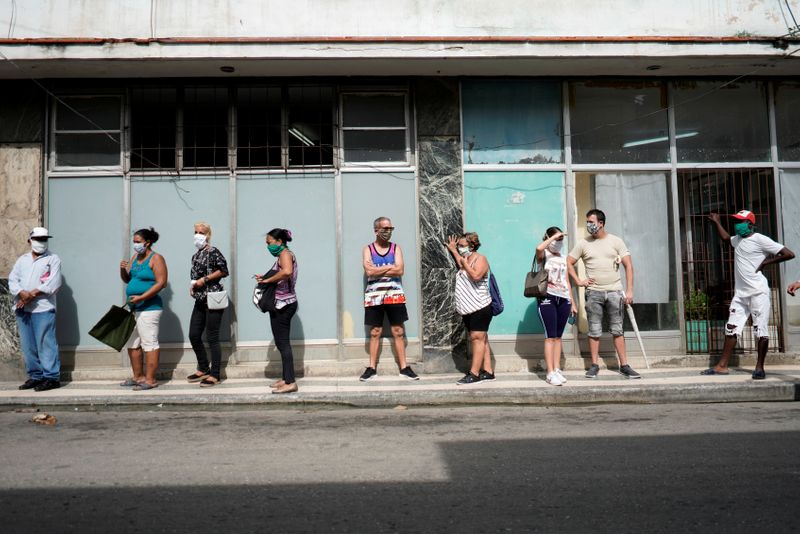
But the public has not been confined to quarters and has taken to trudging about in search of basic supplies, waiting in long lines and even dusting off bicycles from the dark days following the fall of the Soviet Union.
“I had to fix this bicycle up because I hadn’t used it in 25 years,” 49-year-old Alfredo Fonseca said, as he prepared to peddle to work in Havana. “I had to start using it again because of the pandemic and closing of public transportation.”
Tania Castro had fewer options. “I am walking and walking a lot because I don’t have a bicycle, a motorcycle, or a car and the buses are not working,” she said.
While Communist-run Cuba’s universal and free healthcare system has proved key in containing COVID-19, the pandemic has exacerbated shortages of basic goods and a chaotic retail system caused largely by U.S. sanctions and the centralized, state-dominated economy.
Cuba’s top epidemiologist, Francisco Durán said on Monday that mass testing would help better define the prevalence of the coronavirus as many people found to be infected showed no symptoms.
“The objective is to find new cases and then intervene, isolate, seek contacts, and take all possible measures to ensure that Cuba continues as it is now,” he said during his daily virus update broadcast to the nation.
Many experts believe Cuba has managed to control the outbreak better than many countries in the region due to its well-staffed preventive healthcare system, mobilization of activists through mass organizations to track cases, a centralized system that allows a better focus, and willingness to quarantine large numbers of people.
Cuban scientists announced last week they had adapted SUMA, a computerized system developed locally, to quickly detect antibodies of the new virus, allowing for mass testing in hospitals and clinics at little cost.
“That is a big advance,” Havana doctor Marta Martinez said.
To date, the Caribbean island nation has used expensive and often donated tests that take days to process, old-fashioned door knocking by health personnel and medical students to trace contacts, and isolation.
Thousands of patients, suspected cases, close contacts and persons considered at risk have been hospitalized or quarantined in makeshift institutions while in other countries they may have been told to simply stay home.
“The neighborhood family doctor office is notified about anyone at home with symptoms and must take immediate action,” said Yosian Diago, a nurse in central Havana supervising medical students going door to door.
“The same students help the population understand what they can do to help, and well, this is how many cases have been detected.”
(Reporting by Marc Frank; Additional reporting by Mario Fuentes and Nelson Acosta; Editing by Richard Chang)
Cuba is the most sustainably developed country in the world, according to a new report launched today.
The socialist island outperforms advanced capitalist countries including Britain and the United States, which has subjected Cuba to a punitive six-decades-long economic blockade.
The Sustainable Development Index (SDI), designed by anthropologist and author Dr Jason Hickel, calculates its results by dividing a nation’s “human development” score, obtained by looking at statistics on life expectancy, health and education, by its “ecological overshoot,” the extent to which the per capita carbon footprint exceeds Earth’s natural limits.
Countries with strong human development and a lower environmental impact score highly, but countries with poorer life expectancies and literacy rates as well as those which exceed ecological limits are marked down.
Based on the most recent figures, from 2015, Cuba is top with a score of 0.859, while Venezuela is 12th and Argentina 18th.
The SDI was created to update the Human Development Index (HDI), developed by Pakistani economist Mahbub ul Haq and used by the United Nations Development Programme to produce its annual reports since 1990.
The HDI considers life expectancy, education and gross national income per capita, but ignores environmental degradation caused by the economic growth of top performers such as Britain and the US.
“These countries are major contributors to climate change and other forms of ecological breakdown, which disproportionately affects the poorer countries of the global South, where climate change is already causing hunger rates to rise,” Mr Hickel said.
“In this sense, the HDI promotes a model of development that is empirically incompatible with ecology and which embodies a fundamental contradiction: achieving high development according to HDI means driving de-development elsewhere in the world. For a development indicator that purports to be universal, such a contradiction is indefensible.”
Britain, ranked 14th in 2018’s HDI, falls to 131st in the SDI, while the US, 13th in the ul Haq index, is 159th out of 163 countries featured in the new system.
Mr Hickel added: “The SDI ranking reveals that all countries are still “developing” – countries with the highest levels of human development still need to significantly reduce their ecological impact, while countries with the lowest levels of ecological impact still need to significantly improve their performance on social indicators.”
By Tony Perrorttet, Photography by Néstor Martí, smithsonian.com, May 2018
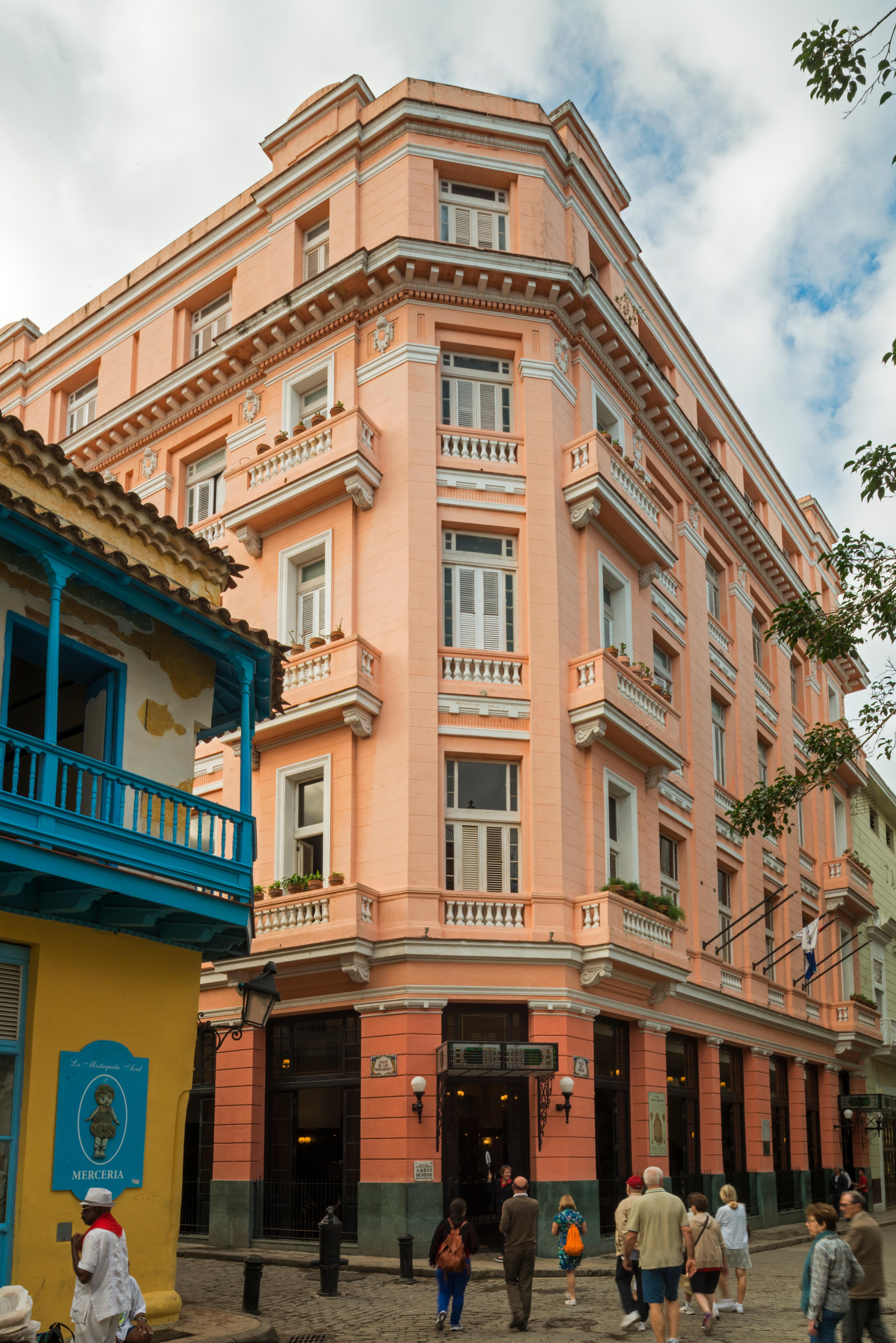
Formerly an arcade and office building, dating to 1917, the structure underwent a city-led restoration and reopened last year as the Hotel Manzana Kempinski.
In a sweltering morning in Old Havana, a courtly figure in a crisp gray guayabera shirt weaves through the Plaza de Armas, the city’s Spanish colonial heart, trying not to attract attention. Although none of the foreigners lolling beneath the banyan trees and royal palms recognize him, a ripple of excitement passes through the Cubans, who nudge each other, smile and stare. Perhaps only on this island obsessed with its operatic past could a historian become a celebrity on a par with a Clooney or DiCaprio. Eusebio Leal is the official historian of the city of Havana, a regal-sounding position that brings with it enormous influence and exposure—he starred for many years in his own TV show where he explored Old Havana’s streets—and he is as far from the cliché of the dusty, isolated academic as it is possible to get. In fact, Leal is credited with almost single-handedly bringing Old Havana from the brink of ruin to its current status as the most ravishing and vibrant architectural enclave in the Western Hemisphere.
Deftly dodging well-wishers, Leal ducks into the Historical Library, where some 50 female workers line up to kiss him on the cheek and offer flustered greetings. In his hectic round of duties, he has come to honor one of Cuba’s countless obscure intellectual champions—a certain Alfredo Zayas Méndez, who founded this archive 80 years ago, an exalted act in a nation with the highest level of education in Latin America. Standing before a plaque, Leal orates off the cuff for 45 minutes about the biblio-hero Zayas, a rhetorical tour de force that includes fond personal anecdotes, philosophical musings on “the importance of memory” and flirtatious exchanges that make the audience collapse into helpless laughter. He then takes questions, poses for snapshots, examines a restoration plan for the Havana Capitol—offering his expert opinion about work on the dome—before dashing off with his minder to a high-level government meeting.
The whirlwind visit leaves everyone a little dazed. At age 75, Leal shows no signs of slowing his notoriously hectic pace. For the last 50 years, almost as long as the Cuban revolution has lasted, his outsized personality has been inseparable from Old Havana itself. Working within the Communist system, he pioneered a capitalist network that would save the district’s architectural heritage at the same time as maintaining its community life so that it would not become a “living museum” like Venice or Old San Juan. A consummate politician, he combined a deft personal touch with the poorest residents while navigating the high corridors of government and hobnobbing with Fidel Castro. Although he has stepped back from direct power in the last couple of years following a serious illness, he is still regularly loaded with international honors, as both Cubans and foreigners—even Miami exiles—fall over themselves to pile him with praise.
“Eusebio Leal is a legendary figure in the preservation world,” says Joshua David, president of the World Monuments Fund in New York, who visited Havana for a workshop on architectural restoration in February 2017. “He pioneered innovative ways to fund restoration in Old Havana, which at the same time supported social programs like health clinics and old age homes.” “He’s an incredibly complex, brilliant man,” declares Gregory Biniowsky, a left-wing Canadian lawyer who has worked in Havana since 1995 and has dealt with Leal and his Office of the Historian (OHC) regularly. “He’s the best of the revolution.” Leal’s own workers are intensely loyal. “He inspires everyone,” says Mariela Mulet, the chief of the Prado Investment Group working on the Capitol. “He saved Old Havana though his own willpower. There won’t be another one like him in a long time.” On the street, the support is even more effusive: “Leal is the only person who Cubans would erect a monument to while he is still alive,” declares Alian Alera, a young librero, or bookseller. “When I was a boy, I was there when he personally came and presented my father with his book-selling license.” “Without Leal, Havana would be nothing like what it is today,” sums up the American historian Nancy Stout, who worked with his office on several books. “A lot of Cubans would do anything for him.”
Today, Old Havana still protrudes into Havana Harbor like a clenched fist, surrounded on three sides by glistening blue waters, and a stroll through its streets provides a unique glimpse of the first European steps in the New World. The city was founded in 1519, when the Spanish still had one foot in the Middle Ages and captains would casually write in their ships’ logs about sea serpents, dragons and men with two heads. Like Christopher Columbus, who had made landfall in Cuba on his first voyage 27 years earlier, settlers grappled to understand what they saw. They imagined the tracks of crocodiles were those of enchanted lions and groups of distant cranes were monks in robes; the Taíno Indians carried mysterious “firebrands” of flaming leaves they inhaled and called tobacco. With its deep harbor and strategic location, Havana soon became the staging post for brutal missions of discovery. Conquistadors sallied forth in search of El Dorado and the Fountain of Youth—and the wonders they did find, like Cuzco in Peru and Tenochtitlán in Mexico, proved more extraordinary than the fantasies. Soon galleons loaded with Aztec and Inca treasure gathered in Havana beneath a string of honey-stoned fortresses, built to protect against pirates like Sir Francis Drake. Twice a year, armadas of up to 30 boats loaded with gold and silver and their heavy naval escorts would catch the Gulf Stream back to Seville on the Carrera de Indias, the Indies Route. (The same current brought the marlin that would lure fishermen like Ernest Hemingway centuries later, the fish traveling “like cars along a highway,” as he put it in Esquire magazine.)
The story of Leal’s meteoric career rise begins in the same spot Havana was founded nearly five centuries ago, the Plaza de Armas. Dazzled by its intricate facades—a gorgeous brocade of carved curlicues, heavy oak portals and wrought-iron balconies—few visitors notice that the northern flank of the plaza, known as Calle Tacón, is paved with smooth wooden bricks. It was here that a confrontation unfolded with the municipal government that would in a sense define Leal’s future.
In 1967, as a self-taught, 25-year-old historian in revolutionary Havana, Leal learned that a heavy truck had cracked open the asphalt in front of the governor’s palace on the plaza. Investigating the site, he found fragments of a colonial-era wooden street, which the German naturalist Alexander von Humboldt had reported seeing in 1800. (It was laid, legend holds, so a governor’s wife could enjoy her siesta untroubled by carriage wheels rattling on cobblestones.) Apart from a few fragments in Paris, Rome and St. Petersburg, the wooden bricks were a unique find, and Leal soon gained permission to repave the entire stretch in wood. But as he was about to start, news arrived that a cultural delegation from Europe was on its way and government workers were rushing in with asphalt instead. “I realized I would lose the opportunity to create something unique and beautiful,” he recalls. So he lay down in front of the steamrollers—a rare act of civil disobedience in Cuba. The standoff lasted until the mayor of Havana himself came to beg Leal to get out of the way, promising that he would be permitted to re-excavate the street later. “He kept his word and so did I,” recalls Leal with satisfaction. “And the whole world celebrated the discovery of something fantastical and different: the wooden street.”
He then reworks an old Cuban rhyme: “Hay que poner un poco de locura a veces en la cordura.” (“You sometimes need to inject a little madness into the sanity.”) “In other words,” he explains, “if you are too sane, things don’t proceed, nothing happens.”
I had managed to find Leal in a rare moment of calm by meeting him at, of all places, the University of Notre Dame in Indiana, where he had traveled to give a lecture. Trailed by his entourage of embassy officials and aides, we wandered the Catholic college’s verdant grounds to visit Gothic chapels and candle-filled shrines while he painted a picture of Old Havana as vividly as if we were in the Plaza de San Francisco. Today, Leal is frail and thin, but he is still a master orator, speaking in perfectly formed sentences like a Spanish intellectual from another age. Perhaps because of his illness, he was unusually willing to speak about his early life, which had offered few clues to his success. Despite his rebellious streak, Eusebio Leal Spengler was in many ways a quintessential product of the revolution. He was born to a poor family in the shabby, low-rise Cayo Hueso district of Central Havana, a typically Cuban immigrant mix of Spaniards (on his father’s side) and Alsatians (on his mother’s) who traveled to Havana via Charleston, South Carolina. Although he grew up only a few hundred yards from Old Havana, he never visited it until age 7 or 8, he says, when an elderly friend of the family took him to her home. “I was amazed,” he recalls. “I had never seen stairways go up to that height! The magnificence of the cathedrals, the colors, the crowds of vendors selling everything in the street—the way they sang and danced—it was a really fascinating world!” He kept going back as a teenager to explore. “When I could see it closer, with more maturity, I was astonished by the carved stones, the spectacular iron latticework, the enormous doors,” he recalls. “It all impressed me greatly.”
At the time, Old Havana was regarded by government planners as an embarrassing eyesore. As crowded as Manhattan’s Lower East Side in its heyday, it was avoided by wealthier Cubans as a vice-ridden slum. In 1955, the dictator Fulgencio Batista even approved a plan by a New York-based design firm to level the colonial enclave’s core. Catering to Cubans’ passion for American cars, it was slated to become a combination parking lot and highway interchange lined with cheesy boutiques for cruise liners. Luckily, the plan never got past the blueprints; the Cuban revolution intervened.
Leal was 16 when Batista, having made millions from bribes from mafia-run casinos, fled into exile on New Year’s Day, 1959. A devout Catholic, Leal rushed to ring the church bells to usher in the new era, as throngs of Habaneros took to the streets in jubilation. “We were celebrating the end of the massacre,” Leal recalls, “the time when corpses would be found every day in the street, when people disappeared.” A week later, Castro and his barbudos, the “bearded ones,” rode in on their “victory caravan.” “The revolution paralyzed the systematic destruction of buildings,” Leal explains. But Fidel proved to be more interested in Cuba’s impoverished countryside than the capital, which he regarded as a parasite filled with American gangsters and prostitutes that had sucked the country dry. Old Havana was saved from the wrecking ball but left to poetically decay. (In 1959, Fidel guaranteed the district’s social coherence by banning evictions and reducing rents by 30 to 50 percent. Contrary to Marxist dogma, citizens who stayed in Cuba were allowed to keep one home and one holiday residence, according to Biniowsky.)
Still, the revolution transformed Leal’s life. He had been forced to leave school in the sixth grade to help support his single mother, who worked as a washerwoman and cleaner. Now that education was free, he put himself back in school, and began to lap up the deluge of art, music and film. (“Italian Realism, Ingmar Bergman, Orson Welles!”) Above all, the voracious autodidact haunted the libraries. “It was in the silence of the library that I learned the love of books as objects, and their fascinating contents,” he says, poring over works of the ancient Roman engineer Vitruvius and the Renaissance architect Palladio. “I am what I read in those books!” He also sought out the famous Office of the Historian. “By ancient tradition, every old city in Latin America maintains the institution of ‘chronicler,’ who is named for life to save the memory of the city,” he explains. In the early 1960s, the position was taken by a writer with the sonorous name of Emilio Roig de Leuchsenring, and Leal went to study at the small museum he maintained. In 1962, after charming Roig’s wife and secretary, he was introduced to the man himself. They spoke for hours. “He was very eloquent, very accessible,” Leal recalls. “When I was leaving, he took both my hands like a salutation and said, ‘This is not an end, it’s just the beginning.’”
018_e12_havana.jpg
Shops and cafés along Callejón de los Peluqueros (Hairdressers’ Alley) with Arte Corte, a combination hair studio, interactive museum and gallery devoted to the art of barbering, in the foreground. (Néstor Martí)
The prolific Roig was at the center of a circle of left-leaning bohemians. “There were historians, teachers, geographers,” Leal recalls of this golden age. “I was 20 years old, they were mostly 60, 65...some were 80 or more. I used to track them down in the homes,” he laughs, rapping the table with his knuckles as if knocking on a door.
By the time Roig died in 1964, Leal was a regular at the Historian’s Office. (“I wasn’t an employee but a confidant.”) Three years later, when a plan was unveiled to turn the governor’s palace on the Plaza de Armas into the first museum to Havana’s history, Leal was hired as architect, archaeologist and, at times, laborer. (“It was very manual. I was sometimes a construction worker, sometimes a bricklayer.”) At the same time he worked alongside renowned scholars such as Irving Rouse of Yale University. When the museum finally opened in 1976, Leal was the natural choice to be its first director.
By then, his work had drawn the attention of Celia Sánchez, Fidel’s partner in the guerrilla war of the late 1950s who took a passionate interest in Cuban history. Celia had become the unofficial gatekeeper for access to Fidel, and her patronage allowed him to present his ideas to the Maximum Leader. “Leal went to Celia to lay out his personal vision,” says historian Nancy Stout, author of a biography of Sánchez. “She would talk to Fidel and create a momentum that people couldn’t oppose.” It was a valuable friendship: Leal’s Catholicism and energy had ruffled the feathers of many Communist bureaucrats. “When you are riding a horse, you kick up lots of dust and those who follow behind get dust in their eyes, and it bothers them,” he says. “Celia helped and protected me.”
International recognition came when Old Havana and its crown of Spanish forts were declared a Unesco World Heritage site in 1982, among the first sites to receive the accolade. The listing covered 529 acres, including 242 blocks with some 4,000 buildings. Not all of them are colonial. In fact, Old Havana’s streets are a sprawling encyclopedia of Western architecture, with buildings from the 16th to the 20th centuries tossed together—a mix of Rococo, Baroque and neo-Classical styles with crumbling gems such as Art Nouveau pharmacies thrown in. But the Unesco honor came with few funds from Geneva, and foreign tourism was not considered a way to attract income. “Tourism was still regarded as part of a very exploitative past,” says Joseph Scarpaci, director of the Center for the Study of Cuban Culture + Economy and co-author of Havana: Two Faces of the Antillean Metropolis, referring to the mafia-run casinos and brothels that had defined Havana in the 1950s as the “sin city” of the Caribbean: “Fidel had always made it clear that he didn’t want Cuba to be an island of chambermaids and bartenders.” By the end of the 1980s, Old Havana was in a dire state. Its 75,000 residents were often without working plumbing or regular electricity. Landmark buildings were on the verge of collapse and riddled with amateur renovations. Pools of putrid water and garbage gathered in corners, the sidewalks were cracked like eggshells, and there was almost no street lighting. Old Havana, it was sometimes said, was “a 40-watt town”—on a good night.
Renaissance | Castillo de la Real | Fuerza, 1577
(Elizabeth M. LaDuke)
Built in a typical four-point Renaissance ground plan modeled after structures in Seville, the “Castle of the Royal Force” is the oldest stone fortress in the Americas. Atop its west tower is a bronze weathervane called “La Giraldilla.” The female figure, holding a cross in one hand and a palm tree trunk in the other, has become a symbol of Havana.
Salvation came, paradoxically, from economic disaster. The collapse of the Soviet Union and the end of sugar subsidies in 1991 threw Cuba into bankruptcy, beginning a decade of privation euphemistically called “the Special Period in Time of Peace.” Things were desperate by 1993, when Leal accompanied Fidel on a trip to Cartagena, another Spanish port in the Caribbean that the Colombian government was turning into a hugely lucrative tourist attraction. On the flight out, Fidel came to Leal’s seat, he recalls. “He asked me: ‘What can I do—or what can we do—for Habana Vieja?’” Without hesitation, Leal explained that an entirely new economic model was needed where hotels, restaurants and museums would earn hard currency—the U.S. dollar had just been legalized—and profits could be pumped directly back into restoration. The approach departed from decades of state-controlled policy, but Leal told Fidel that “without a sound financial basis, the idea of saving Old Havana is a utopia. It’s a fantasy. It’s like St. Augustine’s City of God.” Saving Old Havana did not mean giving up progressive Socialist principles, Leal assured Fidel. In fact, central to his plan was to keep residents in their homes and use tourism to improve living standards. “We’re not talking about Pompeii or Herculaneum. We’re talking about Havana! We have to invest in schools, playgrounds, services for the elderly.” (Leal drew on liberation theology, he says, which inspires progressive priests to work in poor communities from rural Brazil to Nicaragua: “It’s not possible in Latin America to talk about social justice without taking into account Christian thought.”)
(Map by LaTigre)
Fidel was sold. A trained lawyer, he personally drew up legislation to create a unique company called Habaguanex, which could deal directly with foreign investors and was exempt from returning its profits to the state. (Although the name sounds like a Soviet-era pharmaceutical venture, Habaguanex was actually a heroic Taíno Indian leader of the early 1500s, who quite probably gave his name to Havana as well.) Leal was at last appointed historian of the city, given $1 million in seed money and carte blanche on how to use it. “Fidel gave him everything,” says Stout. “He even had a special security force at the historical sites. Cubans used to joke that he had his own personal army.”
Fidel’s sense of urgency may have been heightened by an incident in Old Havana only a few weeks before. A visiting British journalist for the Independent newspaper was photographing the splendid facade of the College of the Holy Angel in the Plaza Vieja when it started to wobble in front of his eyes. “He said to me, ‘Oh look, it’s falling down,’ in typically dry British style,” recalls Victor Marín, an architect and vice president of ICOMOS, the International Council of Monuments and Sites in Cuba, who was with him at the time. “And as we watched, the whole thing crumbled before our eyes!” Although nobody was hurt, photos of the collapse were plastered around the world, embarrassing the Cuban government, which seemed incapable of looking after its heritage.
Leal’s first ventures in the 1990s were modest: With his team of academics and craftsmen, he opened for paying guests three small restaurants and the Hotel Ambos Mundos, where Ernest Hemingway had lived in the 1930s while writing For Whom the Bell Tolls. (It was conveniently located between El Floridita, a bar known for its excellent daiquiris, and La Bodeguita del Medio, famed for its mojitos.) Thanks to the U.S. trade embargo, workers had to be creative in finding building materials. “I was able to talk to Fidel almost daily about the problems and he would come up with a solution,” Leal recalls. He became Fidel’s “man for capitalism,” managing the only for-profit entity in all of Cuba. Funds from his first humble enterprises were soon put back into restoring more restaurants, bars and hotels, as well as the colonial squares. In Plaza Vieja, an ugly parking lot from the 1950s (which was in theory underground but actually rose a yard above the ground) was imploded and its centerpiece became a fountain of Carrara marble with spouting dolphins, recreated from old drawings of the original design by Giorgio Massari, one of the myriad Italian artisans who flooded Cuba in the 18th century.
Residences were also renovated: Behind the Fototeca de Cuba gallery on the Plaza Vieja, for example, is a Spanish courtyard with eight apartments that are still inhabited by the original residents. Other housing was built from scratch in vacant lots. At the same time, a percentage of the profits went to programs such as breakfasts for schoolchildren, maternal-care facilities, centers for retirees and spaces for young artists. All this made Leal immensely popular, a beacon of hope in the grim economic horizon of the Special Period. “Leal got things done!” says historian Stout. “But he was also there for Habaneros in a very intimate, hands-on way. He would go to the construction sites every day to make sure his workers had lunch!”
As success followed success, the Office of the Historian expanded. In 2003, it took over much of the seaside promenade, or Malecón, and in 2005, Chinatown, while Old Havana became the engine for Cuba’s booming tourist industry. The financial benefit from Fidel’s original $1 million investment is hard to estimate, since Cuban companies do not open their books. But in 2011, the Washington Post reported, the annual revenue of Habaguanex was $119 million with $23 million in profits. The Office of the Historian employed some 3,000 workers, most of whom were locals, and by 2016, it managed some 20 boutique hotels, 25 restaurants, 30 stores, various museums, a radio station and a glossy magazine, Opus Habana—a total of over 300 different entities. (As Cubans joke: “When we want to be, Cubans can be more capitalist than the capitalists.”)
Construction of the five-mile-long sea wall and promenade, the Malecón, began in 1901. Hurricane Irma last year dealt a blow to ongoing repairs. (Néstor Martí)
Leal, meanwhile, became a uniquely Cuban celebrity—a deputy in the National Assembly, known for a series of marriages to much younger women (which Fidel and Raúl Castro attended), and a popular media star. For his hit TV and radio series “Andar La Habana” (“Walk Havana”), he wandered the streets recounting forgotten stories—how, for example, the British captured the city in 1762, then exchanged it for the Spanish colony of Florida. He also became a darling of the foreign media—even in the United States, where National Geographic described him as “a man of action as well as words,” the academic answer to Che Guevara. “He was handsome, he was well-spoken,” recalls Lucy Scott, then a field producer for “CBS News” who interviewed Leal several times. “He knew his stuff but he was also very of-the-moment. Only later did we realize the real depth of his knowledge.” Leal was chosen to give personal tours to visiting dignitaries: Most recently, he showed Pope Francis around in 2015 and President Barack Obama in 2016.
Eventually, Habaguanex became a victim of its own success. Although Leal was above suspicion, corruption scandals began to emerge in the company after 2012. The details are still shadowy (“Cuba is like a Fellini film, you never know what part of the journey you are in,” says Scarpaci), but there were a string of arrests for embezzlement, drug sales and bribery. Leal became seriously ill, and while he was recovering in August 2016, control of Habaguanex was transferred to a sprawling military-run enterprise called GAESA. Leal declared that the move would allow the Historian’s Office to concentrate on its true mission, cultural preservation. And so far, GAESA’s presence has had little practical effect. “They said they would keep up support for our projects, and they have kept their word,” said Ayleen Robainas, an architect and urban planner with the Master Plan office, which oversees the preservation efforts.
Old Havana’s status is now assured as the centerpiece of the Cuban tourism industry. “It’s one of the most extraordinary urban historical centers in the world,” says Joshua David of WMF. “And it’s even more remarkable for its proximity to the United States. You fly a few minutes from Miami and you’re in a completely different world.”
Today, the hand of the Historian’s Office is everywhere in the Old City, its logo on interpretive signs, before-and-after photos (entitled “Para No Olvidar,” “Lest We Forget”) and building sites. The Master Plan office is now a shiny, high-tech warren filled with engineers, architects and sociologists, offering Wi-Fi to local residents and a hall for monthly meetings. (One of its popular events is a weekly seminar on how to start a small business; the office receives 50 applications a week from budding entrepreneurs, mostly for paladares, private restaurants, and casas particulares, bed-and-breakfasts, it says.)
Visitors from around the world now throng the cobbled pedestrian lanes between the four plazas, dubbed “the Golden Kilometer” by the office. Leal’s former headquarters in the Plaza de Armas, the Palacio de los Capitanes Generales, is now surely one of the world’s most charming museums, with emerald peacocks parading around its courtyard filled with palm trees. Next door, the Palacio del Segundo Cabo, built in 1772 as the royal post office for all of Spain’s Latin American possessions, was reborn in May 2017 as a state-of-the-art museum devoted to cultural connections between Cuba and Europe. From there, “a parade of columns,” as Marín dubs the shady colonial patios, leads to the Cathedral (which the Cuban author Alejo Carpentier called “music turned to stone”).
Still, San Cristóbal de la Habana, as the city was formally known, was a rough-hewn place for its first two centuries. The street names evoke its raw early days: On Calle Oficios (trades), artisans hammered leather boots and horseshoes. On Mercaderes (merchants), vendors offered sandalwood from Brazil and cured meats from the old country. Picota (yoke) was where criminals were tied to a post and flogged. The port only grew to its current grandeur in the 18th century, when vast city walls were completed and aristocratic mansions were carved from limestone blocks. Hundreds of merchant ships docked within sight of the plazas, the air rang with the sound of church bells and cockfights, and the streets teemed with smugglers. By then, Cuba’s indigenous people had been almost entirely wiped out, but the rise of sugar plantations turned the trickle of African slaves into a flood that would give Havana its rich racial mix.
As sugar exports made Cuba rich, the city walls were torn down in 1863 and replaced by a grand avenue called the Paseo del Prado built along Old Havana’s margins, lined with spectacular buildings that are being restored today. Leal’s most ambitious project to date is the renovation of the spectacular Capitol Building, which opened in 1929 and resembles the U.S. Capitol in Washington, D.C. Since 2013, artisans have been buffing its splendid bronze doors, polishing its 60 types of marble and removing decades of dust from giant statues. “The U.S. Capitol doesn’t have interior courtyards as the Cuban one does,” said the project’s director, Mariela Mulet, as we strolled through the cavernous interior swarming with artisans. “And our cupola is 12 feet taller!” To prove the point, she finds a key and leads me on a backstage climb up to the dome’s windswept summit. We clamor up wrought-iron interior stairs, go hand-over-hand along rickety scaffolding, then emerge onto the exposed belfry 302 feet above the city just as a thunderstorm hits, lashing our faces with rain globules that sting like needles. The whole of Havana spreads below us in a glorious buffet. “What a view!” Mulet shouts over the gale. “But up here you think: Oy, how much more there is to do!” From this aerie, it is obvious that Old Havana is only a fraction of the sprawling metropolis. Many of Leal’s own people now take an interest after-hours in restoring more modern parts of the city with a design group called Habana Re-Generacion: Along the harbor, for example, are abandoned factories, warehouses and an electricity plant from the early 1900s, when Cuba had some of the most advanced technology in Latin America. There are dreams to bring these structures back to life—the electricity plant could be the next Tate Modern, the warehouses turn eastern Havana into a new Brooklyn—if only for the lack of funds.
**********
Nobody denies that much more work needs to be done in Old Havana as well. “It’s an extraordinary success story,” says David, “but there are also an extraordinary number of buildings in urgent need of repair.” This is obvious only a few steps from the Golden Kilometer, where streets are still in a state of dreamlike decrepitude. Walls are crumbling, trees grow like weeds from abandoned balconies and the streets are still an obstacle course of open sewers and potholes that could swallow a vintage Cadillac. Emergency repairs prop up houses battered by tropical deluges and eroded by salt air.
Like anyone who has undertaken such an ambitious project, Leal is not immune to criticism. “The Cubans have their own narrative of what is unfolding in Old Havana, and they bristle at counternarratives,” says Scarpaci. “I admire Leal, his intelligence and his generosity,” he stresses, but argues that there has been a “Disneyfication” of Old Havana. Courtyards are adorned with dubious contemporary artworks, Scarpaci says, and commercialization has spread, with Benetton and other foreign hard currency stores displacing residents. “What are you going to do in Cuba, write a letter to the editor?”
The residential renovations for the 55,000 current inhabitants have also been drawn-out and complicated. Due to Old Havana’s overcrowding, not all tenants were able to stay in their homes: In one typical building, 61 families shared a handful of bathrooms with little access to water; after the structure was gutted and converted into modern apartments, only 16 families were able to return. Sociologists worked with residents to decide who would stay. The others were relocated to Soviet-style housing projects across the harbor, which are often more comfortable but charmless and remote.
Like all Cubans, residents are also scrambling to cope with Raúl Castro’s reforms of 2011, which permitted 200 professions to earn hard currency and allowed people to sell and rent their homes. This has brought a new phenomenon: gentrification. “Life is changing!” says Victor Marín. “Owners of old American cars who used to be too poor to pay for gas are now driving around tourists and getting rich.” The influx of new money means that the Historian’s Office, he says, “needs to balance the new realities.”
Sometimes these “new realities” blend past and present seamlessly. In 2016, a Cuban DJ who goes by the name Alain Dark turned his family’s rooftop apartment in the heart of the Old City into the open-air Bar Roma. Located in a crumbling apartment building, it can be reached by a rattling iron-cage elevator from the 1920s operated by an elderly resident. “Where was I born?” Dark shouts over the throbbing Cuban pop, then marks out a circle on the tiled floor with his toe. “My mother gave birth to me right here! I grew up in this building.” Covered in tattoos and wearing a baseball cap backwards, he recalls following tourists about the streets as a kid. “I also grew up asking foreigners for Chiclets!” he says with a laugh. “‘Hello, mister, one Chiclet, please? One money?’” The bar now serves lechón, pork sandwiches, and cuba libres to a bohemian crowd that is half foreign, half Cuban—and Dark makes sure that the small cadre of local fashionistas and artists get free drinks, subsidized by sales to outsiders. Elderly neighbors wander in and out of the bar, and those on the same floor open their own apartments and sell snacks to patrons. One elderly lady named Xiomena sitting regally on her frayed lounge chair even makes a little spare cash by providing access to her baño.
Other times, the new realities are more complex. Many Cubans were disconcerted when the first genuine five-star hotel, the Gran Hotel Manzana Kempinski, opened in an iconic 1917 shopping arcade on the edge of Old Havana in spring 2017, largely because in the ground-floor luxury stores items such as $10,000 Rolex watches were being sold by locals who earned about $30 a month. But Habaneros have quickly gotten used to the idea, and are often seen wandering the mall out of curiosity. “It will attract a different kind of tourist,” says Ariel Piedra, one of the local architects on the Manzana. “It won’t be the Canadian fireman who wants to drink a ton of beer and then leave.”
Still, communal life continues with an energy unheard of in other Latin American colonial sites, most of which are virtual ghost towns after dark. Just a few doors away from trendy new cocktail bars like O’Reilly 304 are crowded bodegas, hole-in-the-wall butchers with bloody meat hanging from hooks, and elementary schools where the kids still wear crimson-and-white uniforms introduced in the Soviet age. Every block includes glimpses through windows at rooms where old couples, the husband in a wife-beater, might be watching vintage TVs under peeling posters of Che or Fidel in their prime.
In remote corners of Old Havana, Leal’s work inspired grass-roots ventures nobody could have imagined in 1993. At its northern edge, the once-derelict Callejón de los Peluqueros, Hairdressers’ Alley, is thriving again after a barber known as Papito set up Artecorte, a combined salon and art gallery. Its success has attracted a string of private cafés with outdoor tables in streets blocked to traffic. (“It’s almost like Rome,” marvels Marín.) In the far south, a former red-light district, the self-styled “social entrepreneur” Pavel García, who has the shoulder-length hair and bushy beard of an Old Testament prophet, runs a project called BarrioHabana, which organizes neighborhood kids into soccer teams as a way to get them involved in the arts. The teams now paint murals, join chess clubs and visit Havana’s museums and theaters. “The kids used to think these places were just for tourists and the rich,” says García, “but we show they are for them too!”
**********
Despite his recent illness, Leal is filled with plans for Old Havana’s future. The entire waterfront will be revived to greet an expected influx of cruise ships. The train station will be opened this year as a museum to the Cuban railway system, which was the first in Latin America. And new community projects include “148,” a derelict Art Deco block in the very heart of Old Havana being turned into a combination of low-cost housing, student residences and a cultural center for teenagers, complete with radio, sound and TV recording studios.
And Leal is as open as ever to creative ideas. In January 2017, he visited the Google offices in Manhattan to celebrate a 3-D movie collaboration about Cuba’s national hero, José Martí, who lived in New York in exile for 15 years, in part to promote U.S.-Cuban relations by emphasizing the countries’ shared history. (A statue of Martí stands in the southern edge of New York’s Central Park.) Timing the visit just after President Donald Trump’s inauguration was not accidental, Leal explained, when I met him not long afterward at Notre Dame. Trump’s vow to roll back the Obama-era thaw has thrown the future of Cuba—and Old Havana—into uncertainty once again. In November 2017, new travel rules were brought in that require American tourists to work with an authorized tour group to ensure compliance (although they do not need to go with a group). Americans were also banned from patronizing many GAESA-run hotels and restaurants, but how this might be enforced is unclear.
“I don’t have a crystal ball,” says Leal. “But I know that each era brings its own challenges. All we can do is prepare ourselves intellectually, emotionally, ethically for what is to come.” And with that he leapt up and declared the interview over. (“Now you know more about me than I know about myself!”) He dashed off with his entourage into a waiting limousine for the airport. Matters in Old Havana needed his attention.



/https://public-media.smithsonianmag.com/filer/57/de/57deb85f-ad3c-47c4-a1bd-bc4678564f57/may2018_e13_havana.jpg)


/https://public-media.smithsonianmag.com/filer/0a/cd/0acdee39-0ea0-4fdb-8734-ee455c74a0be/may2018_e02_havana.jpg)