Showing posts with label Ocean acidification. Show all posts

Thursday, November 1, 2018

3061. Oceans Are Warming Faster Than Predicated

by Kendra Pierre-Louis, The New York Times, October 31, 2018
How do you take the ocean’s temperature?

The question might sound like the prelude to a children’s joke. But for climate scientists, the answer has serious consequences.

Climate change is rapidly warming the world’s oceans, killing off aquatic organisms — like coral reefs and kelp forests — that anchor entire ecosystems. The warmer waters also cause sea levels to rise and make extreme weather events like hurricanes more destructive.

If scientists can more accurately measure the speed at which oceans are warming, they can better predict the future effects of climate change. And a study published Wednesday in the journal Nature suggests that oceans are warming far faster than the estimates laid out by the Intergovernmental Panel on Climate Change, the global organization for climate data.

The study, led by Laure Resplandy, a biogeochemical oceanographer at Princeton University, found that between 1991 and 2016 the oceans warmed an average of 60 percent more per year than the panel’s official estimates.

In October, the panel released a major report predicting that some of the worst effects of climate change, including coastal flooding, food shortages and a mass die-off of coral reefs, could come to pass as soon as 2040 if human greenhouse gas emissions continue at current levels. The I.P.C.C. report showed that scientists may have been underestimating the severity of the world’s present climate trajectory.

The new ocean temperature estimates, if proven accurate, could be another indication that the global warming of the past few decades has exceeded conservative estimates and has been more closely in line with scientists’ worst-case scenarios.

The researchers used a new approach that derived ocean temperatures by measuring the levels of carbon dioxide and oxygen in the atmosphere.

Those gases dissolve in ocean waters, but the amount the ocean can hold depends on its temperature. “As the ocean has been warming, it’s basically pushing out oxygen and carbon dioxide,” said David Nicholson, an associate scientist at the Woods Hole Oceanographic Institution who was not involved in the study.

As Dr. Resplandy put it: “If you leave a Coke outside in the sun, it’s going to warm and it’s going to lose the gas. It’s a little bit the same idea.”

Scientists normally measure ocean temperatures using thermometers, but stitching together a global temperature record requires thermometers around the globe. Global temperature records were spotty before 2007, when an international consortium began a program, known as Argo, creating an international network of ocean-temperature-measuring instruments.

But a group from Scripps Institution of Oceanography had been taking careful measurements of atmospheric carbon dioxide since 1991, for unrelated reasons. Dr. Resplandy and her team used that data set for this study.

Dr. Nicholson said the study was an example of how collecting data now can have unexpected benefits later. “It kind of supports the importance of collecting these long-term time series even if it isn’t apparent at the start what the outcome will be,” he said.

Scientists already know that the world’s oceans absorb 90 percent of the excess heat trapped on Earth by human greenhouse gas emissions. In its recent report, the I.P.C.C. used one of the lower available estimates of how much the oceans have warmed. Dr. Resplandy and her team found that the upper estimate is more likely what is happening.

“Their estimates overlap with previous estimates, but it’s aligned with some of the higher estimates,” Dr. Nicholson said. “It’s not like completely changing our understanding of what the ocean might be taking up — it’s a new type of measurement that’s weighing in toward the higher end of that.”

There are some caveats. This is a novel approach, and it is unclear if it will hold up to further scrutiny. Kevin E. Trenberth, a senior scientist in the Climate Analysis Section at the National Center for Atmospheric Research, noted that the methodology works best over long periods of time but does not detail what happens year to year.

Still, Dr. Trenberth’s own research found that the I.P.C.C.’s measurements for observed ocean heat were too low. “This is a new complementary method, and the results are quite compatible with our estimates for the most part,” he wrote in an email.

Dr. Resplandy said her work did not upend the I.P.C.C. report’s warnings that humanity has only a couple of decades to ward off some of climate change’s most catastrophic effects.

“It doesn’t change the results,” she said. “What it does is that it makes it harder to get there.”

Sunday, February 25, 2018

2839. Acid Oceans Will Dissolve Coral Reef Sands Within Decades

By Bradley Eyre, The Conversation, February 22, 2018
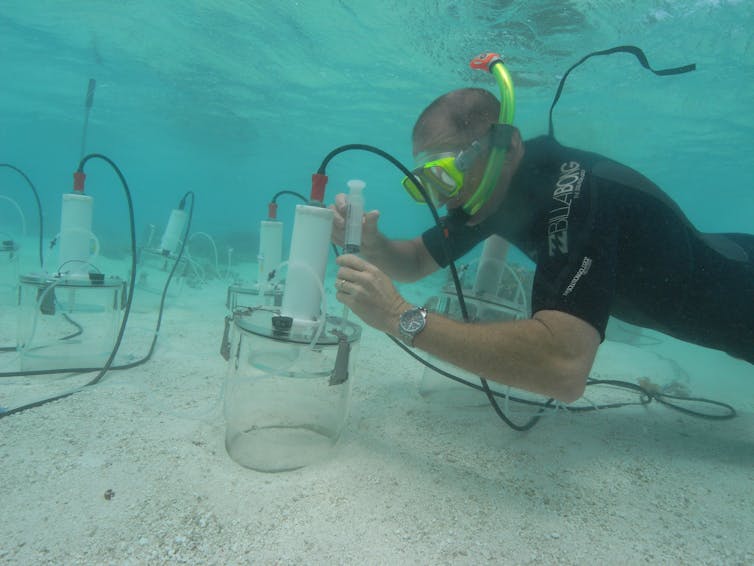
Researchers used benthic chambers (pictured) to test how different levels of seawater acidity affect reef sediments. Steve Dalton/Southern Cross University

Carbonate sands on coral reefs will start dissolving within about 30 years, on average, as oceans become more acidic, new research published today in Science shows.

Carbonate sands, which accumulate over thousands of years from the breakdown of coral and other reef organisms, are the building material for the frameworks of coral reefs and shallow reef environments like lagoons, reef flats and coral sand cays.
But these sands are sensitive to the chemical make-up of seawater. As oceans absorb carbon dioxide, they acidify – and at a certain point, carbonate sands simply start to dissolve.

The world's oceans have absorbed around one-third of human-emitted carbon dioxide.

Carbonate sand is vulnerable
For a coral reef to grow or be maintained, the rate of carbonate production (plus any external sediment supply) must be greater than the loss through physical, chemical and biological erosion, transport and dissolution.

It is well known that ocean acidification reduces the amount of carbonate material produced by corals. Our work shows that reefs face a double-whammy: the amount of carbonate material produced will decrease, and the newly produced and stored carbonate sands will also dissolve.

We measured the impact of acidity on carbonate sands by placing underwater chambers over coral reefs sands at Heron Island, Hawaii, Bermuda and Tetiaroa in the Pacific and Atlantic Oceans. Some of the chambers were then acidified to represent future ocean conditions.

The rate at which the sands dissolve was strongly related to the acidity of the overlying seawater, and was ten times more sensitive than coral growth to ocean acidification. In other words, ocean acidification will impact the dissolution of coral reef sands more than the growth of corals.

This probably reflects the corals' ability to modify their environment and partially adjust to ocean acidification, whereas the dissolution of sands is a geochemical process that cannot adapt.

Sands on all four reefs showed the same response to future ocean acidification, but the impact of ocean acidification on each reef is different due to different starting conditions. Carbonate sands in Hawaii are already dissolving due to ocean acidification, because this coral reef site is already disturbed by pollution from nutrients and organic matter from the land. The input of nutrients stimulates algal growth on the reef.
In contrast, carbonate sands in Tetiaroa are not dissolving under current ocean acidification because this site is almost pristine.

What will this mean for coral reefs?
Our modeling at 22 locations shows that net sand dissolution will vary for each reef. However, by the end of the century, all but two reefs across the three ocean basins would on average experience net dissolution of the sands.

A transition to net sand dissolution will result in loss of material for building shallow reef habitats such as reef flats and lagoons and associated coral cays. What we don't know is whether an entire reef will slowly erode or simply collapse, once the sediments become net dissolving, as the corals will still grow and create reef framework. Although they will most likely just slowly erode.

It may be possible to reduce the impact of ocean acidification on the dissolution of reef sands, by managing the impact of organic matter like algae at local and regional scales. This may provide some hope for some already disturbed reefs, but much more research on this topic is required.

Ultimately, the only way we can stop the oceans acidifying and the dissolving of coral reefs is concerted action to lower CO₂ emissions.

Saturday, December 19, 2015

2123. Fish Stocks Are Declining Worldwide, and Climate Change Is on the Hook

By Clare Lechin-Hoar, NPR, December 14, 2015
A fisherman shovels grey sole, a type of flounder, out of the hold of a ship at the Portland Fish Pier in Maine, September 2015. New research finds the ability of fish populations to reproduce and replenish themselves is declining across the globe. The worst news comes from the North Atlantic, where most species are declining. Photo: Gregory Rec/Portland Herald via Getty Images.

For anyone paying attention, it's no secret there's a lot of weird stuff going on in the oceans right now. We've got a monster El Nino looming in the Pacific. Ocean acidification is prompting hand wringing among oyster lovers. Migrating fish populations have caused tensions between countries over fishing rights. And fishermen say they're seeing unusual patterns in fish stocks they haven't seen before.

Researchers now have more grim news to add to the mix. An analysis published Monday in the Proceedings of the National Academy of Sciences finds that the ability of fish populations to reproduce and replenish themselves is declining across the globe.
"This, as far as we know, is the first global-scale study that documents the actual productivity of fish stocks is in decline," says lead author Gregory L. Britten, a doctoral student at the University of California, Irvine.

Britten and some fellow researchers looked at data from a global database of 262 commercial fish stocks in dozens of large marine ecosystems across the globe. They say they've identified a pattern of decline in juvenile fish (young fish that have not yet reached reproductive age) that is closely tied to a decline in the amount of phytoplankton, or microalgae, in the water.

"We think it is a lack of food availability for these small fish," says Britten. "When fish are young, their primary food is phytoplankton and microscopic animals. If they don't find food in a matter of days, they can die.”

The worst news comes from the North Atlantic, where the vast majority of species, including Atlantic cod, European and American plaice, and sole are declining. In this case, Britten says historically heavy fishing may also play a role. Large fish, able to produce the biggest, most robust eggs, are harvested from the water. At the same time, documented declines of phytoplankton made it much more difficult for those fish stocks to bounce back when they did reproduce, despite aggressive fishery management efforts, says Britten.

When the researchers looked at plankton and fish reproduction declines in individual ecosystems, the results varied. In the North Pacific — for example, the Gulf of Alaska — there were no significant declines. But in other regions of the world, like Australia and South America, it was clear that the lack of phytoplankton was the strongest driver in diminishing fish populations.

"When you averaged globally, there was a decline," says Britten. "Decline in phytoplankton was a factor in all species. It was a consistent variable."

And it's directly linked to climate change: Change in ocean temperature affects the phytoplankton population, which is impacting fish stocks, he says.

Food sources for fish in their larval stage were also a focus of research published earlier this summer by Rebecca Asch, now a post-doctoral research associate at Princeton University. Asch studied data from 1951 to 2008 on 43 species of fish collected off the Southern California coast and found that many fish have changed the season when they spawn. When fish spawned too early or too late in the season, there can be less plankton available to them, shrinking their chance of survival. She calls it a "mismatch" between when the fish spawn and when seasonal plankton blooms.

Knowing just how vulnerable our fisheries are to potential climate change is on the radar of NOAA Fisheries. The agency has put together a Fish Stock Climate Vulnerability Assessment report expected to be released in early 2016. And like many things associated with climate change, there will be winners and losers.

Jon Hare is the oceanography branch chief for NOAA Fisheries' Northeast Fisheries Science Center and a lead researcher on the agency's assessment. He says they looked at 82 fish and invertebrate species in the Northeast. About half of the species, including Atlantic cod, were determined to be negatively impacted by climate change in the Northeast U.S. Approximately 20 percent of the species are likely to be positively impacted—like the Atlantic croaker. The remainder species were considered neutral.

Similar assessments are underway in the California Current and the Bering Sea, and eventually in all of the nation's large marine ecosystems.

"This is where the idea of ecosystem-based management comes in. It's not only fishing that is impacting these resources," says Hare. "We need to take a more holistic view of these resources and include that in our management.”

Britten says the fact that productivity of a fishery can change should be an eye-opener for fisheries management.

"It's no longer just pull back on fishing and watch the stock rebound. It's also a question of monitoring and understanding the ability of stocks to rebound, and that's what we demonstrated in this study. The rebound potential is affected as well," says Britten.

Friday, July 3, 2015

1910. Climate Change: The Window of Opportunity in Saving Oceans Is Closing Fast

By Ove Hoegh-Guldberg, The ConversationJuly 2, 2015

Until recently, you might be forgiven for thinking that the oceans were a trivial component of Earth’s climate system, and that the consequences of change were minimal. After all, only 5% of papers published on climate change involve ocean systems. The Intergovernmental Panel on Climate Change (IPCC), which evaluates the peer-reviewed scientific literature, did not devote a regional chapter to the ocean until its most recent major report.
Yet the ocean system could not be more important: it regulates the global temperature and atmosphere, feeds 3 billion people, and largely determines our weather. The ocean also has lots of “inertia” – which means that getting the ocean to change takes a lot of energy, but once it begins to change, slowing it down becomes more or less impossible.
paper published today in Science (on which I am one of the authors) has issued a warning that our window of opportunity to save the oceans from major changes is in danger of slamming shut, bringing with it the risk that we will encounter planetary-scale tipping points in the behaviour of the climate. Building on the IPCC’s extensive assessment last year of the effects of climate change on the oceans, my co-authors and I have compiled the latest evidence and projections about the ocean under rapid human-driven climate change.
The news is not good. Failure to act on climate change will see warmer and more stagnant oceans, with declining oxygen levels and productivity in some regions, and the removal or modification of ecosystems in other areas. Fisheries and national economies are in the cross hairs in many regions. Rising seas and intensifying storms, plus a loss of critical coastal features, will make life on the shores of a rapidly changing ocean dangerously different to today.
The risks currently being experienced across the planet. Most, if not all, are set to increase. Gattuso et al.
Click to enlarge
A lot hinges on whether we can meet the globally agreed 2C “warming guardrail”, but there are fears that this is impossible within current economic strategies, and that even this target is unsafe.
It would be fine to state this if we had a safe alternative, but we don’t. Consequently, the bar for the end-of-year Paris climate summit is set much higher than many understand. As I’ll explain below, we need a global deal that reduces global emissions to zero over the next 20 years, or else we will see momentous changes.

Calls to action

Thankfully, world leaders are beginning to wake up to the challenge facing our oceans. US Secretary of State John Kerry and Prince Albert II of Monaco, are among those who have spoken out against what many see as impending chaos.
The latest is Pope Francis, who became the first pontiff to warn of ocean warming, acidification and sea-level rise, pointing out in his recent encyclical that “a quarter of the world’s population lives on the coast or nearby, and … the majority of our megacities are situated in coastal areas”.
For the first time, the Vatican is fighting for the ocean. Ove Hoegh-Guldberg, Global Change Institute, University of Queensland
Our research adds to the already mounting evidence that these leaders are right when they say we need to act decisively on fossil fuel emissions and other drivers of climate change.
One of the most stunning conclusions from the IPCC’s report is the statement that “the current rate and magnitude of ocean acidification are at least 10 times faster than any event within the last 65 million years”. Given that periods of rapid acidification over tens of thousands of years – slow by our current human-driven standard - resulted in mass extinctionand ecological collapse, this alone should be reason to act.
In a few regions, such as the North Sea, temporary increases in fisheries production are being reported, as the ice retreats, seas warm, and productivity increases. But these benefits are few and far between, and are likely to disappear over time as the ocean warms and acidifies further.
Coral reefs perhaps provide the perfect parable for the Pope’s encyclical. Everyone appreciates their beauty and value, but few may be aware of the crucial role that they play in terms of protecting coastlines, and supporting fisheries and other industries. They generate hundreds of billions of dollars each year and support some 500 million mostly poor people worldwide. Our report highlights the extreme sensitivity of these ecosystems to ocean warming and acidification.
Climate-driven changes in the oceans pose risks to organisms, ecosystems, people and industry. Gattuso et al.
Click to enlarge

Work to do at the Paris summit

As we progress down the road to Paris, paved with skeletons of these important organisms, there is little doubt about the amount of work that needs to be done in Paris. Analysis of the world’s “carbon budget” (see here and here suggest that we can emit about another 500-800 billion tonnes (gigatonnes) of carbon dioxide before we push global temperatures beyond 2C above the pre-industrial average. This gives us about 20 years before net global emissions have to fall to zero – a tall order indeed.
There is hope. The recent US-China climate deal is one reason to be optimistic that negotiations in Paris will be smoother than at the Copenhagen climate talks in 2009. But I wonder whether leaders are aware of the true scale of the work that needs to be done to avoid catastrophe. Perhaps the fact that China this week made clear the strength of its new climate commitments is evidence of this.
Yet here is a sobering calculation: imagine that the rest of the world falls into line with the US and Chinese climate targets. How much of the world’s budget would we burn?
The answer would be that the world had emitted 1,400 gigatonnes of CO2, or 175-280% of our remaining budget, dragging average global warming to 3C and beyond (see the orange line on the graph below). This would be disastrous for us and our children, and many of the benefits of our oceans (coral reefs, fisheries, coastal living) would be transformed beyond recognition.
The relationship between cumulative carbon dioxide emissions and future average global temperatures. IPCC
Click to enlarge

An ethical response

Mention of “us and our children” brings us back to Pope Francis and the importance of not reducing everything to a dollar value. Yet even in pure economic terms, given that the IPCC calculates that keeping atmospheric CO2 below about 450 parts per million (which would give us a good chance of staying within the 2C guardrail) would cost just 0.06% of global consumption growth per year, one is left wondering why we are not jumping right in and solving this problem.
Pope Francis made an important observation:
In a word, businesses profit by calculating and paying only a fraction of the costs involved. Yet only when “the economic and social costs of using up shared environmental resources are recognized with transparency and fully borne by those who incur them, not by other peoples or future generations”, can those actions be considered ethical.
Once can only hope the leaders heading to Paris will heed his words and drive their efforts in a new direction.