As the latest controversy over GMO’s unfolds – this time it’s about a House Bill that would ban labeling laws – it’s time for a moment of honesty about science and safety. Of course safety is hardly the only bone of contention in GMO debates, but safety is the issue that’s most hotly contested and that’s most central to the labeling bill.
Rep. Mike Pompeo, the sponsor of the bill, writes that activists are misleading consumers with false claims about unsafe food. Actually, “more than 100 research projects over 25 years” have “affirmed and reaffirmed the safety” of GM foods.
I must point out to my GMO-doubting friends that Pompeo’s statement about the research is accurate. A lot of studies have failed to find any health risk for any GM food. And for those of us who study GM crops professionally, there eventually comes a point to set aside allegiances and emotions and take a frank and careful look at the science.
I have reached that point, but I know of someone else who reached a similar point, someone who was ideally positioned to speak on issues of technology and food and safety. The late Dr. Norman Borlaug, “Father of the Green Revolution” and Nobel laureate, was a passionate proponent of GM crops. This humanitarian scientist captured something important about modern agriculture and how to deal with its critics. Borlaug realized that when lives were at stake, it is appropriate to be impatient, even downright irate, with anti-science critics of valuable technologies.
How to Deal with Anti-Science Fear Monger
Borlaug made the case against anti-science fear mongers most memorably in a blunt speech to the Food and Agriculture Organization that was later reprinted in the New York Times.[1, 2] From the start it was cle
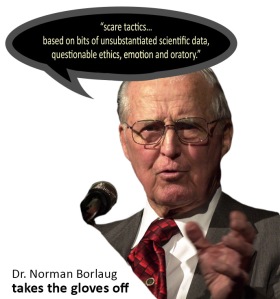 ar that the time for kid gloves was over. The “vicious, hysterical propaganda campaign,” he began, “by fear provoking, irresponsible environmentalists,” was a detriment of world society. “Vitriolic” attacks against the technology were “distorted” and “one-sided”, making no mention of the technology’s importance in “protecting our food and fiber production.”
These critics are actually few in number, but “extremely effective force in lobbying for legislation” and “brainwashing the general public” with “scare tactics…based on bits of unsubstantiated scientific data, questionable ethics, emotion and oratory.”
Then he came to safety. Despite claims that the technology is dangerous, the Surgeon General is clear that no available information shows this. The safety record of the technology is “truly remarkable,” given the “prolonged exposure by hundreds of millions of people.”
“Despite the wild rhetoric of the environmentalists about…damage to both human and wild life,” he continued, “as more and more scientific evidence accumulates, the charges … become less and less convincing.” The technology is not “causing any discernable injury to man.”
OK let me come clean. While it is true that late in life Borlaug was a combative defender of GM crops, this speech was actually delivered in 1971. The agricultural technology he was defending was not genetic modification of crops, which would not appear for over a decade. It was DDT. And as rash as Borlaug’s claims may sound today, they were accurate: hundreds of millions of people had been exposed to DDT, and no injury to human health had been discerned — and wouldn’t be for 36 more years. The real lesson here is not how to be irate with science’s critics, but how to be humble about science’s weaknesses.
A Long Record of Safety
DDT came into civilian use in 1945. In the 1950s it was used heavily for mosquito control and heavier still in agriculture – particularly in the US, where increasingly fertilized and irrigated grain fields led to a boom in agricultural insect pests.

Snorting a few lines of nice safe DDT.
Many scientists were sure it was safe from the beginning. Entomologist Kenneth Mellanby reported that when lecturing about DDT in the years after World War II, he “frequently consumed a substantial pinch of DDT, to the consternation of the audience, but with no apparent harm to myself, either then or during the next 40 years.” Early evidence indicated it was harmful to birds but not humans. By 1962, even Rachel Carson’s Silent Spring could cite no solid evidence of impacts on human health.
Still, the US banned DDT in 1972, to Borlaug’s dismay. It remained in the environment, but as more scientific evidence accumulated in the following years, claims of human health impacts continued to be “less and less convincing.” In 1979, the World Health Organization reported that “the safety record of DDT is phenomenally good.” In 1991, agricultural ecologist Gordon Conway and sustainable agriculture expert Jules Pretty published Unwelcome Harvest, an exhaustively-research book on agriculture and pollution.[3] Their conclusion: DDT can severely affect birds, “Yet in humans there is little evidence of a hazard to health, except at very high dosages.” However DDT proponents even dismissed claims that birds were being affected.
Many became convinced that environmental DDT was contributing to the rising rates of breast cancer, but over 30 separate studies failed to find a link between breast cancer and bodily levels of DDT (or its metabolite DDE).[4] Breast cancer activists and environmentalists lobbied congress to fund research on cancer hotspot areas in the 1990s. This led to the large-scale Long Island Study, focused on breast cancer where pesticides had been used heavily in the past. But in 2002 when results began to appear, the findings again seemed to exonerate DDT.
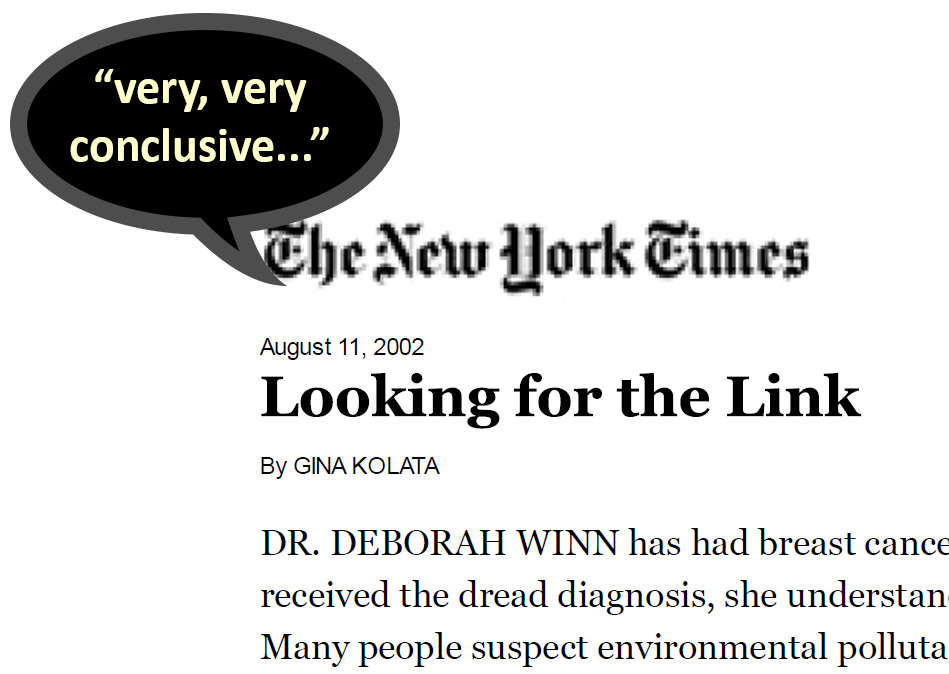
Many saw this as the end of the road for DDT critics. New York Times reporter Gina Kolata pointed out the lack of conclusive evidence of environmental causes of cancer.[5] She quoted the Long Island Study leader who said the data were “very, very conclusive: that the chemicals they studied “are not associated with breast cancer.” A large-scale meta-analysis of DDT (and PCB) studies around the same time also failed to find a link with breast cancer. “I think we have the answers” said the head of the mets-study. Anyway, if “the risks are very small and exposures took place in the distant past,” then “it may be beyond the capacity of science to find it.” Although breast cancer activists rejected the Long Island findings, Kolata wrote that “others said it may be time to close the books.”
Looking in All the Wrong Places
The problem with all this is that if you’re looking in the wrong place, it doesn’t really matter how many times or how carefully you look. Environmental factors in breast cancer risk turn out to be strongly age-related. Studies of radiation exposure show that the breast is most likely to develop cancer if exposed in utero, before menarche, and before first pregnancy – but not later. None of the studies of DDT and breast cancer – including the Long Island study that supposedly “closed the book” – measured exposure during these critical windows of breast development.
Come to think of it, how could you even do such research? DDT has been banned for decades. How could you compare incidence of breast cancer – which usually strikes women in adulthood – with DDT exposure early in life? Sounds like something “beyond the capacity of science.”
It isn’t. In a path-breaking study published in 2007,[6] epidemiologist Barbara Cohn of UC-Berkeley’s Public Health Institute used a remarkable dataset on over 20,000 pregnant women and children in Oakland collected in 1959-1967. These were peak years for DDT use in the US. For each individual they knew the age when the spraying started, and they also measured the levels of DDT and DDE in the blood. Then they tracked down the women’s medical records nearly 40 years later. If you are a woman, or if you know any women, you need to know the results.
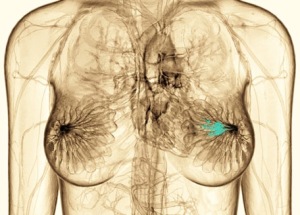
In the US, 1 in 8 women will develop breast cancer. More stats here. (Men get breast cancer too, but on a much smaller scale.) There is no single cause; DDT is only one contributing factor.
It turned out that women born before 1931, who were almost all past puberty when the spraying started, were no more likely to develop breast cancer than the control cases. That was generally consistent with the dozens of earlier studies. But women who had the highest exposure to DDT before the age of 14 were five times as likely to develop breast cancer later in life. All the other studies had missed this critical period.[7]
This was only the beginning. Cohn’s team has now completed a 54-year follow-up on daughters born to women in the Oakland study: daughters whose mothers had high levels of DDT while pregnant were more likely to develop breast cancer.[8] Another study found that boys whose pregnant mothers had high levels of DDT were also more likely to develop testicular cancer.[9] Ongoing research is investigating a range of other health impacts.
What we still don’t know the mechanisms behind the carcinogenic effects. DDT is known to disrupt endocrine systems; the cancer-causing mechanism may specifically have to do with estrogen. Hopefully this research will stimulate experiments to isolate the mechanisms involved.
But what we do know is that it took us 62 years to even begin to “discern the injury” to humans caused by DDT. With one in eight American women today developing breast cancer, Dr. Borlaug’s scathing denunciation of anti-science fear mongers now seems particularly reckless and scientifically naïve.
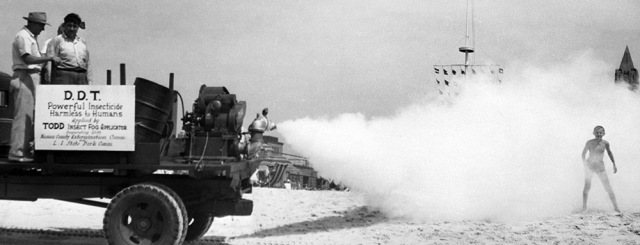
There are lots of wonderful images and videos of gleeful kids being directly sprayed with DDT. But the vast majority of DDT was used for overproducing grains, not controlling mosquitoes. Much of it ended up in the water or in the food chain.
But Aren’t GM Crops Different?
Are there lessons here for debates on genetic modification? GM crops are not DDT. But frankly, most of the differences between GM crops and DDT should only heighten our concern. Consider these three differences:
1. DDT is one chemical; GM crops are all different. Crop plants are different and the gene constructs biotechnologists paste together are different; moreover each “transformation event” (meaning when the gene construct is inserted into one of the target plant’s chromosomes) is unique. Each transformation event raises a host of questions, only some of which have to be answered before a plant is released (more on this...). This is why the World Health Organization says
Different GM organisms include different genes inserted in different ways. This means that individual GM foods and their safety should be assessed on a case-by-case basis and that it is not possible to make general statements on the safety of all GM foods.
It’s also why one of the corporate scientists in charge of the safety assessment of the world’s first GM food (Calgene’s Flavr-Savr tomato) writes about the “absurdity of claiming that all GMO’s are safe.”
2. Health impacts for GM crops will be even harder – actually much harder – to detect than for DDT. DDT is measurable in the blood; some effects of highly processed ingredients made from GM plants may be “beyond the capacity of science to find.”
3. Many more “non-industry” scientists have a professional and personal (and sometimes financial) stake in GMO’s than they did in DDT. Borlaug was not financially dependent on the pesticide industry (although he did appear at press conferences organized by DDT manufacturers[10]); however academic research on GM plants is routinely funded by the biotech industry, and researchers are beholden to biotech corporations for access to patented genes. Academic biotechnologists (along with a small pack of journalistic attack dogs, mostly funded by the industry) swarm on anyone – including scientists – who point to uncertainties about GM crops. They often evince the same scorn that Borlaug showed towards the “hysterical propaganda” on DDT. In fact the words are almost identical.
A frank look at the science points us in the opposite direction. The billions of meals with traces of one or another GM ingredient means even less than the exposure of hundreds of millions to DDT. The claim that any GM crop is known to be safe … let alone all GM crops… let alone all future GM crops — is reckless, foolish, and scientifically silly. And if Congress actually uses this as a justification for a bill prohibiting state labeling laws, then it has reached a new low.
References
1. Delivered as the McDougall Memorial Lecture at the FAO Conference, 8 Nov 1971. Later excerpted in Borlaug, N.E., Mankind and Civilization at Another Crossroad: In Balance with Nature – A Biological Myth. BioScience, 1972. 22(1): p. 41-44.
2. Borlaug, N.E., DDT, the First Domino, in New York Times. 1971. p. 13.
3. Conway, G. and J. Pretty, Unwelcome harvest: agriculture and pollution. 1991, London: Earthscan.
4. Cohn, B.A., Developmental and Environmental Origins of Breast Cancer DDT as a Case Study. Reproductive Toxicology (Elmsford, N.y.), 2011. 31(3): p. 302-311.
5. Kolata, G., What Causes Cancer: Can Science Find the Missing Link?, in New York Times. 2002: New York, N.Y. p. 2-c1.
6. Cohn, B.A., et al., DDT and Breast Cancer in Young Women: New Data on the Significance of Age at Exposure. Environ Health Perspectives, 2007. 15(10): p. 1406–1414.
7. Eskenazi, B., et al., The Pine River Statement: Human Health Consequences of DDT Use. Environmental Health Perspectives, 2009. 117(9): p. 1359-1367.
8. Cohn, B.A., et al., DDT Exposure in Utero and Breast Cancer. The Journal of Clinical Endocrinology & Metabolism, 2015. Online (in press) jc.2015-1841.
9. Cohn, B.A., P.M. Cirillo, and R.E. Christianson, Prenatal DDT Exposure and Testicular Cancer: A Nested Case-Control Study. Archives of Environmental & Occupational Health, 2010. 65(3): p. 127-134.
10. Cullather, N., The hungry world: America’s cold war battle against poverty in Asia. 2010, Cambridge MA: Harvard Univ. Press, p. 247.