Showing posts with label Capitalism and nature. Show all posts

Sunday, March 17, 2019

3210. Trump Administration Loosens Sage Grouse Protections, Benefiting Oil Companies

By Coral Davenport, The New York Times, May 15, 2019
The sage grouse, known for its distinctive mating dance.CreditCredit Bob Wick/Bureau of Land Management.
The Trump administration on Friday finalized its plan to loosen Obama-era protections on the habitat of the sage grouse, an imperiled ground-nesting bird that roams across 10 oil-rich Western states.
The plan, which would strip away protections for the bird on nearly nine million acres of land in the West — making it easier for oil and gas companies to drill on that land — was first detailed in a draft proposal published in December.

The sage grouse plan is the latest step in a series of moves by the Trump administration to promote oil and gas drilling on public land, in support of what President Trump has called a policy of American “energy dominance.” The architect of the plan, David Bernhardt, is a former oil lobbyist who now serves as acting head of the Interior Department.

Mr. Trump has nominated Mr. Bernhardt to formally assume the position of interior secretary.
“The plans adopted today show that listening to and working with our neighbors at the state and local levels of government is the key to long-term conservation and to ensuring the viability of local communities across the West,” Mr. Bernhardt said in a statement on Friday.

Environmentalists criticized the plan as a giveaway to the oil and gas industry that would devastate the nesting habitat of the bird.

“By punching oil-rig-sized loopholes through these plans, the administration will drive the sage grouse closer to an endangered species listing,” said Jesse Prentice-Dunn, policy director for the Center for Western Priorities, an advocacy group. “Unfortunately for the grouse, Bernhardt is also leading a charge to gut the Endangered Species Act.”

Mr. Bernhardt has led an effort to overhaul the 1973 law, which was designed to protect the nation’s wildlife. He has pushed for changes such as requiring the federal government to take into account the economic impact of placing a species on the endangered species list. Currently, the law only requires that regulators take into account the scientific evidence showing whether a species is threatened.

Under a sage grouse plan put forth in 2015, during the administration of former President Barack Obama, oil and gas drilling was banned or limited in 10.7 million acres where the bird lives, under a stringent designation known as “sagebrush focal areas.” The new plan would limit that designation to all but 1.8 million acres, mostly in Oregon and Montana.

Gov. Kate Brown of Oregon, a Democrat, offered praise for the protections in her state afforded by the Trump administration’s plan.

“Balancing sage grouse habitat protection and economic development requires mitigation of negative impacts,” she said. “This agreement is a critical step that marks a shift away from planning toward active conservation and landscape management to protect this iconic species. Oregon’s bounty is beautiful and worth continuing to protect and fight for.”

Friday, May 25, 2018

2928. Wilbur Ross: "That Moon Colony Will Be a Reality Sooner Than You Think"

By Wilbur Ross, The New York Times, May 24, 2018


The first man on the moon held an American flag. In the not-too-distant future, astronauts on the moon may be holding fuel pumps.

The future for American commercial space activity is bright. Space entrepreneurs are already planning travel to Mars, and they are looking to the moon as the perfect location for a way station to refuel and restock Mars-bound rockets. As much as this sounds like the plot of “2001: A Space Odyssey,” it is coming closer to reality sooner than you may have ever thought possible.

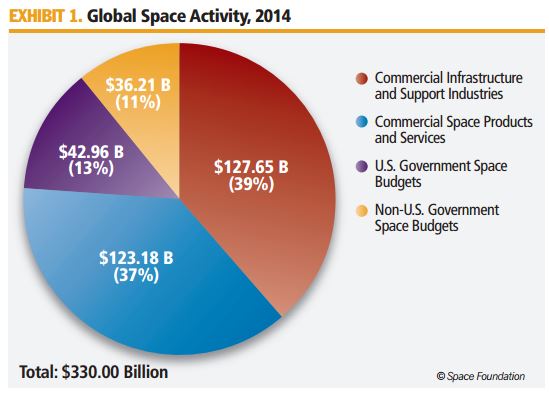
A privately funded American space industry is the reason. This industry is making progress in leaps and bounds. The global space economy is approaching $350 billion and is expected to become a multitrillion-dollar industry. There are more than 800 operational American satellites in orbit, and by 2024 that number could exceed 15,000. Thanks to public-private partnerships, for the first time in seven years American rockets will soon carry NASA astronauts into space. Long dormant, Cape Canaveral is now bustling with activity. America is leading in space once again.

Space tourism may only be a year away. Tickets for human flights into lower earth orbit have already sold for $250,000 each. Earth-based mining companies may soon face stiff competition from the mining of gold, silver, platinum and rare earths on asteroids and even other planets. A race is already developing to create the technology that will bring those crucial resources back to earth.

Competition is already fierce, with Russia and China challenging the United States for leadership, and about 70 other countries working their way into space. But today’s space race is different. It is driven by innovative companies that are finding new solutions to get to space faster, cheaper and more effectively.

As these companies advance new ideas for space commerce and nontraditional approaches to space travel, they seek the legitimacy and stability that comes with government support and approval. They yearn for a government that acts as a facilitator, not just a regulator. Government must create frameworks that enable, rather than stifle, industry.
Unfortunately, our system for regulating private space exploration and commerce has not kept up with this rapidly changing industry. For example, when it comes to licensing cameras in space, we review small, high school science-project satellites the same as billion-dollar national defense assets, leaving too little time and too few resources for crucial national security needs.

On Thursday, President Trump signed Space Policy Directive 2, which will make important strides toward modernizing our outdated space policies. These changes include creating a new office, the Space Policy Advancing Commercial Enterprise Administration, within my office to oversee coordination of the department’s commercial space activities, establishing a “one-stop shop” to work on behalf of the budding private space sector.

This will be a major change. At my department alone, there are six bureaus involved in the space industry. A unified departmental office for business needs will enable better coordination of space-related activities. To this end, I have directed all Commerce Department bureaus with space responsibilities to assign a liaison to the new Space Administration team, including the International Trade Administration, Bureau of Industry and Security, National Telecommunications and Information Administration and National Oceanic and Atmospheric Administration.

When companies seek guidance on launching satellites, the Space Administration will be able to address an array of space activities, including remote sensing, economic development, data-purchase policies, GPS, spectrum policy, trade promotion, standards and technology and space-traffic management. The new office will also enable the department to manage its growing responsibilities in space.

The department will take on a greater role when it comes to regulation and promotion of space activity. But as the agency charged with promoting job creation and economic growth, we will not engage only in oversight, but will support American companies so they can compete and lead on a level playing field.

Collectively, these efforts will unshackle American industry and ensure American leadership in space. This is essential to technological innovation, economic growth, jobs and national security. But, perhaps more important, it is rejuvenating the American passion for space exploration.

I can still remember when President John F. Kennedy declared that America would put a man on the moon and when Neil Armstrong took that first step on the lunar landscape. Glued to televisions, Americans were filled with excitement and national pride during the Apollo missions.
Last month I felt that same passion as I visited the Space Symposium in Colorado Springs with Vice President Mike Pence. “As we push human exploration deeper into space, we will unleash the boundless potential of America’s pioneering commercial space companies,” the vice president told the crowd.

This is a very special time in space history — there is a convergence of technology, capital, and political will. The United States must seize this moment.

Wilbur Ross is U.S. secretary of commerce.

Monday, May 15, 2017

2612. Nature, Labor, and the Rise of Capitalism

By Martin Empson, Monthly Review, May 2017

Capitalism has, to put it mildly, a peculiar relationship with the natural world.1 Karl Marx perhaps summarized it best in the Grundrisse, where he wrote that with the rise of the capitalist mode of production, “for the first time, nature becomes purely an object for humankind, purely a matter of utility; ceases to be recognized as a power for itself; and the theoretical discovery of its autonomous laws appears merely as a ruse so as to subjugate it under human needs, whether as an object of consumption or as a means of production.”2 In the same section, Marx notes that “capital creates the bourgeois society, and the universal appropriation of nature as well as of the social bond itself by the members of society.”
This instrumentalized relation to the natural world contrasts sharply with the ways that nature was seen and used by earlier human societies. This novel interaction with nature arose from the violent social transformations that accompanied the development of capitalism in Western Europe, and expanded with the spread of that system to the rest of the world. Marx catalogued the many forms of plunder and destruction perpetuated by early capitalism as it remade the world in its image: “The discovery of gold and silver in America, the extirpation, enslavement and entombment in mines of the aboriginal population, the beginning of the conquest and looting of the East Indies, the turning of Africa into a warren for the commercial hunting of black-skins, signalized the rosy dawn of the era of capitalist production. These idyllic proceedings are the chief momenta of primitive accumulation.”3 Capital, he famously concluded, enters the world “dripping from head to foot, from every pore, with blood and dirt,” as nature itself is subordinated to the needs of the system.4
In all historical societies, humans have had some form of metabolic interaction with nature. Through our labor, we have always transformed nature to satisfy our needs—indeed, as Marx puts it, the essence of labor is the “appropriation of nature for the satisfaction of human needs”:
Labor is, first of all, a process between man and nature, a process by which man, thorough his own actions, mediates, regulates and controls the metabolism between himself and nature. He confronts the materials of nature as a force of nature. He sets in motion the natural forces which belong to his own body, his arms, legs, head and hands, in order to appropriate the materials of nature in a form adapted to his own needs. Through this movement he acts upon external nature and changes it, and in this way he simultaneously changes his own nature.5
Capitalism was a radical break with the past: for the first time, production of basic goods was driven by the accumulation of wealth for its own sake, and not primarily to satisfy human needs. This system of generalized commodity production has also changed us. We are alienated from the natural world, as the products of our own labor are no longer under our own control. Our very perception of nature is shaped by an economic system that treats “the environment” as a collection of commodities to be exploited for profit.
This historical emphasis on our changing relationship with the natural world is not unique to Marxism, or even to the left. The great Whig historian G. M. Trevelyan believed that among other things, social history must be concerned with “the attitude of man to nature.”6 Colonial encounters between Europeans and indigenous populations of the Americas offer a vivid—and bloody—illustration of these changing attitudes. These interactions were, on the whole, enormously destructive for the people and ecology of the Americas. Millions died from disease or military conquest, communities and civilizations were destroyed, and many thousands were enslaved. Despite some European migrants’ vision of a land free from hierarchy and exploitation, the so-called New World rapidly came under the rule of capitalist social relations.7A corresponding change occurred in the ways people understood the land and used its resources.
In her classic book Myths of Male Dominance, the anthropologist Eleanor Burke Leacock studied the changing social structures of the Montagnais-Naskapi people of Canada after the arrival of the French fur trade in the seventeenth century. The Montagnais were an egalitarian, matrilocal society of hunter-gatherers, and their social relations were governed by “generosity, cooperation, and patience…those who did not contribute their share were not respected, and it was a real insult to call a person stingy.” Despite the upheavals the Montagnais had endured, Leacock still found vestiges of a quite different social organization during her twentieth-century fieldwork:
As far as I could see, decision-making on such important issues was a most subtle process—indeed an enigma to the fieldworker schooled in competitive hierarchies—whereby one found out how everybody concerned felt without committing oneself until one was fairly sure in advance that there would be common agreement. I was constantly struck by the…continual effort…to operate together unanimously…in the direction of the greatest individual satisfaction without direct conflict of interest.8
The Jesuit missionaries who accompanied the fur traders to Canada were horrified by Montagnais life, and set about trying to “civilize” the tribe. Within a decade, the old order began breaking down, as the economic base of Montagnais society was transformed. The European market for fur was enormous, and to meet this insatiable demand, traders offered the Montagnais and other indigenous peoples European goods in exchange for tens of thousands of pelts. The communities around the trading stations consequently grew dependent on French tools, weapons, clothing, and food. Filling French orders for fur meant that the Montagnais ceased to be hunters who spent large parts of the year travelling long distances; they instead became sedentary trappers. The collective, collaborative experience of hunting gave way to a more individualistic one, with single people managing traps and reaping the rewards. Before the Europeans’ arrival, the Montagnais had no notion of private property; now the land was divided into individually owned lots. Social relations changed too: under pressure from the Jesuits, the patriarchal European model of family life came to dominate, as women were forced out of their role as producers and men took on the primary task of trapping.
Similar changes occurred everywhere European traders went, as John F. Richards notes in his study of the commodification of animals. For instance, “although the Creeks adapted quickly and successfully to the new incentives of the deerskin trade, they…faced a basic contradiction. Economic and political forces made it imperative that they deliver a maximal number of deer skins every year. They became market hunters linked into the world market who used muskets to avidly pursue as many deer and bear as possible.”9
It is important not to romanticize the life of indigenous peoples before European arrival, lest we slip into old tropes of “noble savages” living in perfect harmony with nature. As Richards notes, evidence exists that in pre-contact times, Native Americans faced with an abundance of prey would kill more animals than they needed, to ensure they got the choicest food.
But this hardly compares with the scale of the slaughter of animals driven by European demand for fur and skins. As Richards puts it: “Once Indians were touched by the stimulus of market demand, any restraints they had previously maintained eroded rapidly. Pursuit of the material rewards offered by the fur traders forced Indians to hunt preferred species steadily, despite declining numbers…. What they became were commercial hunters caught up in the all-consuming market.”10
Even Europeans’ wide-eyed descriptions of the New World often read like catalogues of natural commodities. Thus the explorer Martin Pring, in his 1603 report on the island later named Martha’s Vineyard, seemed to be compiling a kind of shopping list of trees. Centuries of deforestation had made wood expensive in Europe, and Pring recognized the island’s potential riches:
As for Trees the Country yeeldeth Sassafras a plant of sovereigne vertue for the French Pox, and as some of late have learnedly written good against the Plague and many other Maladies; Vines, Cedars, Okes, Ashes, Beeches, birch trees, Cherie trees bearing fruit whereof we did eat; Hasels, Witchhasels, the best wood of all other to make Sope-ashes withall; walnut trees, Maples, holy to make Bird lime with and a kinde of tree bearing a fruit like a small red Peare-plum.11
Letters home from other visitors to the Americas include similar inventories of natural resources. Explorer James Rosier described coastal vegetation in Maine as “the profits and fruits which are naturally on these Ilands.”12
The transformation in attitudes toward nature that followed European arrival in the Americas mirrors that which accompanied the rise of capitalism in Europe. Keith Thomas has pointed out that in Tudor and Stuart times, “the long established view was that the world had been created for man’s sake and that other species were meant to be subordinate to his wishes and needs.”13 By way of illustration, Thomas cites a fanciful early seventeenth-century poem depicting animals as willingly heading off to their slaughter for human consumption:
The pheasant, partridge and the lark
Flew to thy house, as to the Ark.
The willing ox of himself came
Home to the slaughter, with the lamb;
And every beast did thither bring
Himself to be an offering
The separation of the people from the soil, one of the “original sources of wealth,” was a protracted and brutal one. Rural producers were turned into wage laborers. Many were pushed off the land into the growing towns and cities; others were forced to emigrate, often to the frontiers of capitalism in the New World. The remainder lost their traditional rural role, becoming wage laborers, as Marx recognized:
The immediate producer, the worker, could dispose of his own person only after he had ceased to be bound to the soil and ceased to be the slave or serf of another person…the historical movement which changes the producers into wage-laborers appears on the one hand as their emancipation from serfdom…. But on the other, these newly freed men became sellers of themselves only after they have been robbed of all their own means of production, and all the guarantees of existence afforded by the old feudal arrangements.14
This new primacy of private property had to be enforced, and in England, Parliament enacted hundreds of new laws to encourage further enclosure and limit shared use of land. Such legislation was needed, as E. P. Thompson noted, because “property was not, in 1700, trenched around on every side by capital statutes.”15 Thompson referred specifically to the notorious 1723 Black Act, which criminalized unauthorized “hunting, wounding or stealing of red or fallow deer [in a forest, common lands, or Royal Park], and the poaching of hares, conies or fish.” The law imposed capital punishment on those found guilty of poaching.16
As the great agricultural trade unionist Joseph Arch noted, the act and other anti-poaching laws went beyond protecting private property to alter the ways that people used the country’s natural resources:
We laborers do not believe hares and rabbits belong to any individual, not anymore than thrushes or blackbirds do…. To see hares and rabbits running across his path is a very great temptation to many a man who has a family to feed…so he may kill a hare or a rabbit when it passes his way, because his wages are inadequate to meet the demands on them, or from dire necessity, or just because he likes jugged hare as well as anybody else.17
The Black Act was part of “making the world safe for English merchants and landlords to increase in wealth and so to contribute to the new power of the English state.”18
As in the Americas—though with far less bloodshed—such changes transformed social attitudes toward nature. Henry Best was an English yeoman farmer who saw his land triple in value through a process of enclosure in the mid-1600s. The author of several works on improved agricultural methods, Best had developed his own system for selling animals at optimal prices. All of this made him “intolerant” of the remaining communal traditions among his fellow villagers, and he refused to contribute to the shared hay stock for winter because “our hay would have been spent in feeding other men’s animals.” Best worked vigorously to ensure that other farmers’ animals did not stray onto his land, even keeping watch in the middle of the night. Deliberately isolating himself from his neighbors, Best represented an early case of the classic capitalist small landholder, driven by the desire to maximize his own profits at the expense of the wider community.19
The parceling up of the land in effect created private property where there was none before, and new restrictions on the use of nature by rural populations formed a foundational part of the new capitalist order, managed and protected by the state. As historian George Yerby writes, “the land was being pinned down, set at a conceptual distance, captured on the page and assessed in theory, rather than simply worked as a continuous, unbroken physical exercise.”20
Light Shining in Buckinghamshire, an anonymous pamphlet circulated by the Diggers in 1648, complained bitterly of the rapid spread of enclosure:
All the Land, Trees, Beasts; Fish, Fowle, &c. are inclosed into a few mercinary hands; and all the rest deprived and made their slaves, so that if they cut a Tree for fire they are to be punished, or hunt a fowle it is imprisonment, because it is gentlemens game, as they say; neither must they keep Cattle, or set up a House, all ground being inclosed, without hyring leave for the one, or buying room for the other, of the chiefe incloser, called the Lord of the Mannor, or some other wretch as cruell as he.
These changes provoked spirited resistance. Anti-enclosure movements threw down fences and hedges, and riots broke out in protest of new land laws. Massed bands of poachers confronted armed gamekeepers in set-piece battles, and communities fought in the courts, in the streets, and in the fields to protect their shared interests. Later the rise of agricultural unions moved the battle away from violent clashes toward the struggle over wages and working hours, but riots and protests were for decades the principal form of mass outrage at what was being done to common people and their land.
The “classical case against the open-field and common,” Thompson writes, “was its inefficiency and wastefulness of time.” He cites a 1795 report complaining that the rural laborer, “in sauntering after his cattle…acquires a habit of indolence. Quarter, half and occasionally whole days are imperceptibly lost. Day labor becomes disgusting.”21 In Thompson’s view, enclosure and agricultural improvement were “concerned with the efficient husbandry of the time of the labor force.” In towns and cities, urban industry had “time discipline” at its heart, and education served as “training in the ‘habit of industry.’”22 Workers in the new factories and workshops had to be broken from their old habits into new ways of working.
This primary accumulation of wealth, as Marx called it, laid the basis for the development of the capitalist system, and severed traditional ties between the people and the soil, concentrating workers in towns and cities. This process of urbanization and proletarianization also brought with it a new form of time discipline, and the use of “reserve armies of the unemployed” to inhibit workers’ struggles against their employers.
All of this led ultimately to the rise of fossil fuels, which came to dominate British industry in the nineteenth century. This process was neither automatic nor speedy. As late as 1800, only eighty-four steam engines powered cotton mills in England, compared to around a thousand mills run by water.23 John Robison, a professor of philosophy and lifelong friend of James Watt, inventor of the steam engine, complained: “Water is the most common power and indeed the best, as being the most constant and equable; while wind comes sometimes with greater violence and at others is totally gone. Mills may also be moved by the force of steam…but the expense of fuel most undoubtedly prevent this mode of constructing mills from ever becoming general.”24
Nonetheless, steam engines were adopted eventually, despite the high capital costs of plant and fuel and the novel engineering needed. One reason was that they freed mill owners from the natural limits of hydropower; only so many water wheels can be installed over a particular river, and only in so many suitable locations are available. Fossil fuels, cheap and abundant, had no such constraints.
But the main reason that fossil fuels came to dominate capitalist production, as Andreas Malm argues in his recent book Fossil Capital, is that steam power offered “a ticket to the town.” Steam meant that industry could now be located in urban areas where workers disciplined in factory work could be easily hired (and fired). No longer would factory owners be compelled to build homes, churches, and schools in remote valleys. Instead, the slums of Manchester, Birmingham, and Glasgow became the major sites for mills. In 1833, J. R. McCulloch explained these developments in the Edinburgh Review: “The work that is done by the aid of a stream of water is generally as cheap as that which is done by steam, and sometimes much cheaper. But the invention of the steam-engine has relieved us from the necessity of building factories in inconvenient situation merely for the sake of a waterfall. It has allowed them to be placed in the center of a population trained to industrious habits.”25 Marx wrote that the process of primitive accumulation “conquered the field for capitalist agriculture, incorporated the soil into capital and created for the urban industries the necessary supplies of free and right-less proletarians.”26
That the capitalist mode of production transformed human social relations is universally known, but it served equally to alter the relationship between humanity and nature. The separation between town and country grew, and the concentration of people in new and growing urban areas drove the adoption of new technologies and labor methods. Fossil fuels became the dominant form of energy, further enabling capital to exploit the workforce. Twenty-first century ecological crisis was never inevitable, but it became steadily more likely with capitalism’s global expansion. Understanding the historical processes that gave rise to the Anthropocene will be a vital weapon in the struggle for a sustainable and just world.

Notes

  1. This article is based on two talks, the first given in May 2014 at Birkbeck College, University of London, and the second in November 2016 at the Marx Memorial Library in London, as part of the Raphael Samuel History Center’s History and Environment seminar series.
  2. Karl Marx,Grundrisse (London: Penguin, 1977), 410.
  3. Karl Marx,Capital, vol. 1 (London: Penguin, 1990), 915.
  4. Marx,Capital, vol. 1, 926.
  5. Quoted in John Bellamy Foster, Marx’s Ecology (New York: Monthly Review Press, 2000), 157; Marx,Capital, vol. 1, 283.
  6. G. M. Trevelyan,English Social History (London: Pelican, 1982), 10.
  7. For an excellent description of this process in one relatively small area of North America, see John Tully, Crooked Deals and Broken Treaties (New York: Monthly Review Press, 2016).
  8. Eleanor Burke Leacock, Myths of Male Dominance (Chicago: Haymarket, 2008), 71–72.
  9. Richards,The World Hunt (Berkeley, CA: University of California Press), 35–36.
  10. Richards,The World Hunt, 45–46.
  11. William Cronon,Changes in the Land (New York: Hill and Wang, 1983), 21.
  12. Cronon,Changes in the Land, 20-21.
  13. Keith Thomas,Man and the Natural World (New York: Pantheon, 1983), 17.
  14. Marx, Capital, vol. 1, 875.
  15. E. P. Thompson,Whigs and Hunters (London: Penguin, 1977), 21.
  16. Thompson,Whigs and Hunters, 22.
  17. Quoted in Horn,The Rural World 1780–1850 (London: Hutchinson, 1980), 181.
  18. Christopher Hill,Liberty against the Law (London: Penguin, 1997), 9.
  19. George Yerby,The English Revolution and the Roots of Environmental Change (New York: Routledge, 2016), 250.
  20. Yerby,The English Revolution, 89.
  21. E. P. Thompson, “Time, Work-Discipline, and Industrial Capitalism,”Past and Present 38 (1967): 77.
  22. Thompson, “Time, Work-Discipline, and Industrial Capitalism,” 78, 84.
  23. Andreas Malm,Fossil Capital (London: Verso, 2016), 56.
  24. Malm,Fossil Capital, 56.
  25. Quoted in Malm,Fossil Capital, 123-124.
  26. Marx,Capital, vol. 1, 895.

Thursday, October 13, 2016

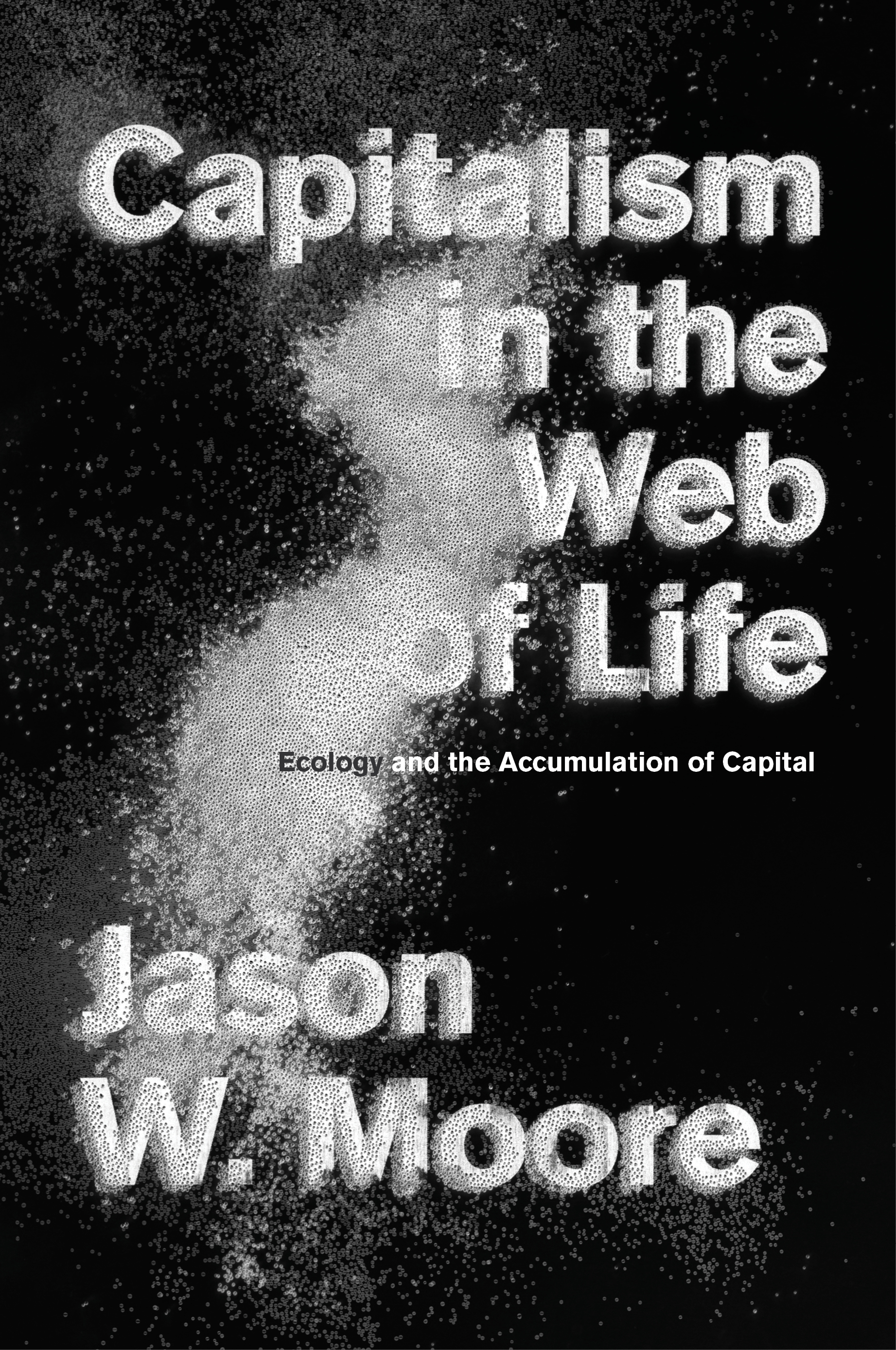
2472. Jason Moore’s “Capitalism in the Web of Life: Ecology and the Accumulation of Capital”

By Louis Proyect, The Unrepentant Marxist, October 10, 2016


Earlier this year I was startled to discover that a debate had broken out between supporters of John Bellamy Foster on one side and Jason Moore on the other over how to properly theorize ecology from a Marxist standpoint. Since Moore’s scholarship was influenced by Immanuel Wallerstein, I wondered what the problem could be. Weren’t they all on the same wave-length with Monthly Review having provided a platform for the dependency theory/World Systems schools that included Wallerstein, Andre Gunder Frank, Samir Amin and others?

As it happens, ecology is a topic that lends itself to debate since except for Marx’s relatively brief discussion of soil fertility and Engels’s observations on the despoliation of the Alps, there was very little analysis until the Green movement took off in the early 1960s. Rachel Carson’s article on DDT helped to create an awareness that pollution was not just an annoyance but a threat to human existence. This led to Marxist scholars trying to anchor the new movement theoretically even if they spoke in a hundred different voices. Unlike analyzing imperialism, there was no theoretical continuity to build upon. Basically ecosocialism had to be created from scratch.

For me it meant dumping some of the baggage I picked up in the Trotskyist movement. After all, Trotsky embraced nuclear power in “If America Should Go Communist” and Joe Hansen, who was Trotsky’s bodyguard in Coyoacan, lauded the Green Revolution (the term for chemical-based farming rather than ecology) in a 1960 pamphlet titled “Too Many Babies?: The Myth of the Population Explosion”.

When I began reading and writing about Marxism and ecology nearly 25 years ago, I soon became aware that it was a highly contested field with almost as much acrimony as you could find in the Leninist left over how to build a revolutionary party. Although almost everybody except Frank Furedi could agree that fracking and industrial farming were threats to the environment, there were disagreements over how to theorize the nature/society nexus.

Initially there was a strong tendency to view Marx and Engels as inadequate guides to understanding the environmental crisis. In a November-December 1989 New Left Review article, Ted Benson was generally sympathetic to M&E but considered them to be susceptible to the “productivism” that reigned supreme in the 19th century when capitalism was transforming the world. Benson viewed this as overly optimistic, finding fault with Marx’s statement in V. 3 of Capital that the “Development of the productive forces of social labour is the historical task and justification of capital” since it didn’t consider the problematic of natural limits.

In the early 90s I had occasional email contacts with James O’Connor who had launched a journal titled “Capitalism, Nature and Socialism” (CNS) in 1988 that provided a platform for people like Benson. O’Connor was one of the first scholars working in the field who attempted to ground his ecosocialism on Marxist theory or at least his own interpretation of the theory. He posited something he called “the second contradiction of capitalism” that described a capitalism that undermined the conditions needed to reproduce itself:

An ecological Marxist account of capitalism as a crisis-ridden system focuses on the way that the combined power of capitalist production relations and productive forces self-destruct by impairing or destroying rather than reproducing their own conditions (“conditions” defined in terms of both their social and material dimensions).

Although I eventually moved away from O’Connor’s theory and toward those developed by John Bellamy Foster and Paul Burkett that I considered better grounded in Marxism, I remain indebted to his insights that I credited in articles on Hurricane Sandy and Flint, Michigan.

In 1998 I wrote a brief critique of David Harvey’s “Justice, Nature & The Geography of Difference” on the Progressive Economists Network (PEN-L) that took note of what I considered his wrongheaded take on American Indians that echoed Shepherd Krech’s mistitled “The Ecological Indian”, a book that had the usual junk about bison being driven off of cliffs, etc. I suspected that O’Connor, who was a PEN-L subscriber at the time, had ideological differences with Harvey since he asked me expand on my brief post and submit it to CNS. After working a couple of months on it, I was shocked to discover that O’Connor felt his readers would not find it useful.

At the time, I was fairly close to John Bellamy Foster and asked him why my article could have been rejected. After reading it, he told me that it was far too “materialist” for the prevailing editorial outlook at CNS.

Before long I would discover that O’Connor also resented Foster likely because of a somewhat critical review of his “Natural Causes: Essays in Ecological Marxism” in the February 1999 Monthly Review by Paul Burkett that described his “second contradiction” theory as “hampered by the artificial lines he draws between capital’s exploitation of labor and capital’s destructive use of natural and social conditions.”

O’Connor got the chance to retaliate against Foster, who he likely blamed for publishing Burkett’s article, in the June 2001 issue of CNS that contained critiques of Foster’s “Marx’s Ecology”. I loyally defended Foster against the attacks as did Jason Moore in the very next issue of CNS where he wrote: “The idea that nature has its own laws of motion that can be bent but not controlled by human society runs like a red thread through Marx’s Ecology. In so doing, Foster makes a signal contribution to the renewal of an activist materialist outlook that is at once historical and geographical, social and ecological.”

It turned out that David Harvey had his own problems with Foster who he had labeled as a “neo-Malthusian” in the book I had reviewed for CNS. I guess in the world of celebrity Marxism, being a “neo” is a favored insult considering Robert Brenner’s labeling of Paul Sweezy as a “neo-Smithian” in NLR. So you can get the idea by now. In this small world having theoretical differences over how to theorize ecosocialism can lead to some really bad blood.

Despite being upset with how MRZine became an outpost of pro-Assad propaganda, I have had no issues with Foster’s writings on ecology as well as those of Paul Burkett who was on the same wave-length. The two had made important contributions to highlighting the “green” component of Marx’s writings especially the passages that dealt with the “metabolic rift”, a term that referred to the growing gulf between city and countryside with human waste polluting the Thames rather than fertilizing wheat fields. For Marx, the soil fertility crisis of the 19th century was as big a threat to society as global warming is today.

So when I first learned that there were rival camps supporting either Foster or Jason Moore, I wasn’t sure what to make of it. Now that I have just finished Moore’s “Capitalism in the Web of Life: Ecology and the Accumulation of Capital”, I am in a much better position to comment on the differences between two of the most respected ecosocialist scholars.

To start with, despite having met Jason Moore in person for only the first time this year, I have exchanged email with him over the years mostly to show my appreciation for his contribution to the Brenner thesis debate in articles such as “Sugar and the Expansion of the Early Modern World-Economy” that showed the influence of Sidney Mintz who had argued that sugar plantations in Jamaica were far more advanced than any factory in Europe in the 17th century despite being based on slave labor.

When I discovered that Moore’s 2007 dissertation was titled “Ecology and the Rise of Capitalism”, I was eager to read it especially since it included an epigraph by one of my favorite musicians: “A hard rain’s a-gonna fall.”

I had long believed that the origins of capitalism had more to do with the European colonization of the Americas than tenant farming in Britain, especially since Marx was quite explicit about that in chapter 26 of V. 1 of Capital: “The discovery of gold and silver in America, the extirpation, enslavement and entombment in mines of the aboriginal population, the beginning of the conquest and looting of the East Indies, the turning of Africa into a warren for the commercial hunting of black-skins, signalised the rosy dawn of the era of capitalist production.”

My attention was primarily focused on the genocidal wars against native peoples but secondarily on how it was connected to environmental despoliation as I pointed out in an article on the Blackfoot Indian that Foster published in “Organization and Environment”, a journal that he lost in a hostile takeover. When the high plains were purged of the bison in order to serve the profit motives of cattle ranchers, the end result was the same kind of metabolic rift that Marx diagnosed:

Modern capitalist society has no use for the advice of Engels or for the Blackfoot philosophy. It regards nature as simply something to be dominated. It builds cities in the desert and drills for oil in the rainforest. The dire consequences of these actions are now staring us in the face. Cities like Phoenix, Arizona and Los Angeles are ecological nightmares as water from the surrounding states is diverted from its proper use in agriculture. The cities might have pleasant looking shrubbery in air-conditioned shopping malls, but meanwhile the surrounding countryside is rapidly being turned into a desert.

What Moore did in his dissertation was connect the dots between the rise of capitalism in Europe and the transformation of nature in the New World into a source of natural resources critical for the growth of industry in the Old World. Without sugar and cotton plantations, silver mines and the like, Europe would have remained a backwater. It was not just Columbus’s arrival that made this possible; Western Europe also marched eastward and carried out similar predations in China, India and Eastern Europe. In essence, it was all part of an evolving World System that viewed nature useful only as a substratum for commodity production.

Moore described the process thusly:

We can now state the matter simply. The principal spatial expression of endless capital accumulation is the endless conquest of the earth. Limitless economic expansion premised on the rising productivity of labor is limitless geographical expansion premised on the low-cost exploitation of human and extra-human nature. Because the system has been ruthlessly competitive, there is an inescapable temporal counterpart to this geographical tendency – not only the endless conquest of the earth but the conquest and incorporation of the earth in the most rapid way possible.

Essentially, “Capitalism in the Web of Life: Ecology and the Accumulation of Capital” is an attempt to extract a theoretical framework for ecosocialism based on the research contained in his dissertation. It is part a restatement of some of the essential historical findings in the dissertation with an attempt to ground them philosophically by breaking with a Cartesian dualism that has ostensibly hampered Marxist theorization of the nature/society nexus. Indeed, the aim of the book is to remove the slash between nature and society and view them as dialectically related.

Cartesian dualism is a peculiar creature. These abstractions of Nature/Society separate symbolically what is unified practically in the history of capitalism: the life activity of the human species in the web of life. On the one hand, the binary is clearly falsifying and confused. It presumes an ontological separation that animates historical narratives in which relations between human (“social” relations) are theoretically independent of relations between humans and the rest of nature. The binary, moreover, confuses particular natures that are objects of capitalist development with nature as the matrix within which capitalism develops. Nature/Society forms a binary of violent abstractions in Sayer’s sense of the term—removing constitutive relations from the historical phenomena under investigation. One can no more extract “nature” from the constitution of capitalism than one could remove law, class struggle, the modern state, science, or culture.

I will return to how this rejection of Cartesian dualism led to the current ideological conflicts between Foster’s supporters and Moore after giving you a sense of the erudition that distinguishes Moore’s book from any I have read in the literature of ecology. The grasp of historical, geographical, scientific and cultural strands and how they interact with each other can be breathtaking.

For example, in chapter eight, titled “Abstract Nature and the Limits to Capital”, Moore explains how critical the metric system was to the rise of capitalism. Adopted by the French republic in 1799, it served as the modern mechanism of exchange. It arose to facilitate trade across borders, a key ingredient for undermining feudal economies that relied on distinct measuring systems.

Maps were also a sine qua non for world capitalism in its early stages. The skilled mapmakers of the Dutch East India company were necessary for helping its colonizers identify which piece of territory were ripe for conquest.

Accurate measurement was not only necessary for the conquest of land. It was also how human beings could be commodified as well, particularly in the slave trade. Traders had defined the “standard” slave: male, thirty to thirty-five years old and between five and six feet tall. Referred to as a pieza de India (piece of the Indies), the slave so designated could be used in economic planning for the colonist.

Is it possible that such a necessary integration of world systems and ecology could be accomplished without being committed to the “web of life” perspective defended by Moore? I for one cannot be positive that this is the case but can only say that if it enabled him to write such a powerful account of how we have ended up in such an intractable and ongoing environmental crisis today, this practically justifies it.

Turning now to Moore’s criticisms of Foster, they are contained in chapter three titled “Towards a Singular Metabolism: From Dualism to Dialectics in the Capitalist World Ecology” and are relatively brief—no more than a couple of pages—and begins with a tribute to Foster’s writings on the metabolic rift that integrated capital, class and metabolism as an organic whole.

The criticism, as far as I can tell, rests in these few words:

Foster’s insight was to posit capitalism as an open-flow metabolism, one that requires more and more Cheap Nature just to stay in place: not just nature as input (e.g., cheap fertilizer) but also nature as waste frontier (e.g., greenhouse gas emissions). Many of the most powerful implications of metabolic rift thinking, however, remain fettered by the very dualisms that Foster initially challenged. Not least is an unduly narrow view of accumulation as an “economic” process (it is surely much more than this) and an undue emphasis on the rarely specified “destruction” of nature.” Historical natures are subject to broadly entropic processes—the degradation of nature—but these are also reversible within certain limits. Much of this reversibility turns on capitalism’s frontiers of appropriation.

However, a more extensive critique of the theory of the metabolic rift can actually be found in an article titled “Transcending the metabolic rift: a theory of crises in the capitalist world ecology” that appeared in the January 2011 Journal of Peasant Studies. There Moore writes:

Surely part of the answer is directly given in Foster’s reading of Marx himself. In this interpretation, Marx’s critique of capitalism emphasized how ‘bourgeois society’s . . . domination of humanity’ rested on its ‘domination of the earth’, especially in the form of large-scale landed property. The endless accumulation of capital is, in other words, the endless commodification of nature. But rather than corral accumulation crisis in one pen, and biospheric crisis in another, might we instead begin from the relations that connect the two? I am therefore concerned that the particular distillation of the metabolic rift into ‘general properties’ loses sight of the whole as a ‘rich totality of many determinations and relations’.

In other words, back in 2011 and now in his latest book, Moore’s criticism is not that Foster’s reading of Marx on the metabolic rift is wrong but that it does not go far enough. The first inkling I got that Foster was stung by Moore’s criticism was in an article titled “Marx’s Ecology and the Left” that was mostly a polemic against the kind of Frankfurt-inspired analysis that could be found in James O’Connor’s CNS. But I had trouble figuring out why Moore would be included as he was toward the end of the article when Foster and co-author Brett Clark referred to “some thinkers” who invert the Frankfurt School’s domination of nature thesis and turn it into an “uncritical production of nature notion” that effectively “de-naturalizes social theory to an extreme, imposing ecological blinders.” When I went to the end notes, I discovered that Moore was one of those thinkers:

Moore presents a social “monist and relational” view, rooted in a metaphorical concept of “singular metabolism,” and defined in terms of “bundled” society-nature relations, in which he equates capitalism and “world ecology,” rejecting Marx’s own theory of metabolic rift.

With all due respect to John Bellamy Foster and Brett Clark, there is no evidence that Moore rejected Marx’s theory of metabolic rift or Foster’s scholarship that rested on it. He accepts it totally but only faults Foster for not going far enough in its application.

Subsequently Foster and Clark wrote an article titled “Marxism and the Dialectics of Ecology” that sounded as if Moore might have been included in the woeful Sasha Lilley collection titled “Catastrophism: The Apocalyptic Politics of Collapse and Rebirth”, a book that warned against warnings that capitalism was destroying the planet:

In a turn away from ecological science, Moore warns against the “fetishization of natural limits.” Directly contradicting some of the world’s leading climate scientists, members of the Anthropocene Working Group, he asserts: “The reality is not one of humanity [i.e., society] ‘overwhelming the great forces of nature.’” Rather he suggests that capitalism has an apparently infinite capacity for “overcoming seemingly insuperable ‘natural limits’”—hence there is no real rift in planetary boundaries associated with the Anthropocene, and, implicitly, no cause for concern. At worst, the system’s appropriation of nature ends up increasing natural resource costs, creating a bottom-line problem for capital, as “cheap nature” grows more elusive. Capitalism itself is seen as a world-ecology that is “unfold[ing] in the web of life,” innovating to overcome economic scarcity whenever and wherever it arises. (emphasis added)

This attempt to paint Moore as a neoliberal Green could only have been written by ignoring his chapter ten titled “The Long Green Revolution: The Life and Times of Cheap Food in the Long Twentieth Century” that has the same basic message as Foster’s “The Vulnerable Planet”, namely that we are facing catastrophe unless capitalism is abolished.

This chapter hearkens back to the soil fertility crisis of the nineteenth century that was never really resolved by the Green Revolution hailed by Joe Hansen. It describes a stark failure to sustain a working class that benefited from Cheap Food historically all to the advantage of a ruling class in need of Cheap Labor. The chapter also alludes to the mounting crisis of climate change that while threatening the utter destruction of cities on the seacoasts also impacts food production since drought undermines the possibility of feeding the working population. The final page of the chapter can hardly be mistaken as endorsing the idea that capitalism has an “infinite capacity” for overcoming natural limits:

Capitalist agriculture today is headed towards an epochal transition: from contributing to capital accumulation by reducing the costs of labor-power undermining even the middle-run conditions necessary for renewed accumulation. This is signaled by the rise of negative-value. At the point of production the superweed effect shows our future in the present: more energy- and chemical-intensive strategies to discipline agro-ecologies as these evolve into forms of work/energy hostile to the law of Cheap Nature. At the scale of the biosphere the energy-intensive character of capitalist agriculture now feeds a spiral global warming that increasingly limits capitalism as a whole.

Global warming poses a fundamental threat not only to humanity, but, more immediately and directly, to capitalism itself. This inverts the usual line of radical critique, which overstates the resilience of capitalism in the face of these changes—an overstatement that derives from a view of capitalism as a social system that acts upon nature, rather than a world-ecology that develops through the web of life. The condition for maintaining negative-value in its latent state was the possibility for moving entropy out of commodity production. Today, such latent negative-value can no longer be moved out, as biospheric changes penetrate global re/production relations with unusual power and salience. Global warming will, in the coming two decades, so thoroughly mobilize until-now latent negative-value—fed by capitalist agriculture and in turn undermining the Cheap Food model—that it is difficult to see how capitalist agriculture can survive(emphasis added)

As I understand it, Moore has been trying unsuccessfully to have a public debate with Foster. I would hope that one can be organized before long since it would be of keen interest to activists and scholars alike. While some of the issues might appear abstruse, they ultimately affect us on the most basic level, namely the possibility of human life to continue. Facing what many scientists call a Sixth Extinction, the stakes of such an exchange are very high.

I would like to conclude this post with some of my own reflections on the issues raised by Moore’s book.

To start with, I am not convinced that Cartesian dualism is exactly the obstacle to understanding and resolving the environmental crisis. To begin with, the Cartesian dualism is much more about the individual and nature rather than society and nature, and in particular the individual mind as the famous dictum “Cogito ergo sum” (I think therefore I am) would indicate.

In fact, the philosophers of modernity who are in many ways nothing more than discussants on Descartes’s “Meditations on First Philosophy” had little interest in society as such. They were preoccupied with epistemological questions revolving around whether the mind can truly perceive the real world. As reported by Boswell, Samuel Johnson had this to say about George Berkeley, a radical idealist:

After we came out of the church, we stood talking for some time together of Bishop Berkeley’s ingenious sophistry to prove the nonexistence of matter, and that everything in the universe is merely ideal. I observed, that though we are satisfied his doctrine is not true, it is impossible to refute it. I never shall forget the alacrity with which Johnson answered, striking his foot with mighty force against a large stone, till he rebounded from it — “I refute it thus.”

The Cartesian tradition is basically a restatement of the allegory of the cave in Plato’s Republic, one that prioritizes the mind philosophically. As such, idealism influenced the way in which social scientists, including historians, explained the world past, present and future. It is the philosophy that serves as a handmaiden to capitalism since it predicates progressive social change as the outcome of good ideas rather than revolutionary action by the masses. You can see this most clearly in electoral politics where candidates promising reform have managed to hoodwink working people for the past three centuries at least.

Marx and Engels broke with idealism as part of the generation of post-Hegelians who had finally come to terms with the priority of the real world over ideas. As a materialism, Marxism constitutes the end point of Cartesian idealism as Engels explained in “Socialism, Utopian and Scientific”:

The new facts made imperative a new examination of all past history. Then it was seen that all past history, with the exception of its primitive stages, was the history of class struggles; that these warring classes of society are always the products of the modes of production and of exchange — in a word, of the economic conditions of their time; that the economic structure of society always furnishes the real basis, starting from which we can alone work out the ultimate explanation of the whole superstructure of juridical and political institutions as well as of the religious, philosophical, and other ideas of a given historical period. Hegel has freed history from metaphysics — he made it dialectic; but his conception of history was essentially idealistic. But now idealism was driven from its last refuge, the philosophy of history; now a materialistic treatment of history was propounded, and a method found of explaining man’s “knowing” by his “being”, instead of, as heretofore, his “being” by his “knowing”.

If Marx and Engels were correct in defending a dialectical and materialist approach to understanding and then changing the world, might it be said that they continued to operate on the basis of a kind of dualism? In the passage above, Engels refers to the superstructure that develops out of the “real basis” in society, the class relations between worker and boss being of supreme importance. Isn’t base/superstructure a fundamentally dualist conception? Needless to say, there have been many Marxists who were troubled by this formula that slid easily into economic determinism and that was capable of being turned into a state religion by Stalin. That being said, Marx’s writings are replete with references to a kind of duality between society (referred to usually as man) and nature. For example, in chapter 48 of V. 3 of Capital, which deals extensively with the problems of soil fertility, Marx writes:

Just as the savage must wrestle with Nature to satisfy his wants, to maintain and reproduce life, so must civilised man, and he must do so in all social formations and under all possible modes of production. With his development this realm of physical necessity expands as a result of his wants; but, at the same time, the forces of production which satisfy these wants also increase. Freedom in this field can only consist in socialised man, the associated producers, rationally regulating their interchange with Nature, bringing it under their common control, instead of being ruled by it as by the blind forces of Nature; and achieving this with the least expenditure of energy and under conditions most favourable to, and worthy of, their human nature.

Now I would be the first person to defend the right of anybody to question something that Marx or Engels wrote. They were products of their age and could hardly be untouched by the dynamism of capitalism that was at its height when they were trying to build a revolutionary movement. Keep in mind that Marx was an unabashed admirer of Abraham Lincoln, who was the quintessential bourgeois revolutionary even to a dyed-in-the-wool Political Marxist like Vivek Chibber. If Marx ever took note of Marx’s waffling on abolition, it never came to my attention.

Despite my reservations about Cartesian dualism being a key obstacle to developing an ecosocialism adequate to the task of saving the planet, I am sympathetic to the idea of a Marxist research project that is monist in spirit. Specifically, I would identify a program for resolving the environmental crisis that synthesizes scientific research and political strategy as urgently needed. Currently, there are disparate efforts usually based on one’s professional training either as biologists, climate scientists, historians, sociologists, etc. that amount to the story of the blind men and the elephant. Is it a tusk (climate change) or is it a trunk (soil fertility) or is it a tail (assaults on the poor such as in Flint) or is it an ear (biodiversity)?

The lack of a synthesis on the science side seems particularly glaring. You have an entire panoply of environmental threats growing out of the commercial exploitation of the Amazon rainforest that requires an analysis that spans water and soil chemistry, public health, and climate science. And all of this is connected to the plight of native peoples who are like the canaries in the coal mines, the first to face extinction by the capitalist system’s inexorable drive for profits.

To identify, confront and finally abolish the system that threatens humanity and nature, it will require a movement of scientists, scholars and workers that functions as a subset of a larger world movement that in the final analysis is the only one capable of moving toward a future based on the common good rather than private profit. As daunting as that sounds, it will eventually become possible because it is the capitalist system itself that will drive people into common struggle.