Showing posts with label Conservation. Show all posts

Friday, October 10, 2025

3672. Jane Goodall: The Woman Who Broke the Boundaries of Anthropocentrism and Patriarchy

 By Kamran Nayeri, October 10, 2025


Jane Goodall, one of the world's leading primate ethologists and one of the most popular conservationists, died at the age of 91 on October 2, 2025, during a speaking tour in Los Angeles (see note 1).

Goodall abandoned the prevalent anthropocentric attitude of biologists by the way she studies the chimpanzees in Gombe, East Africa.[i] This enabled her to uncover their complex behavior through living alongside them. In 1965, the University of Cambridge awarded Goodall a PhD in ethology. Jill Tiefenthaler, executive director of the National Geographic Society, wrote: “To know Jane was to know an extraordinary scientist, conservationist, humanitarian, educator, mentor and, perhaps most profoundly, an enduring champion for hope.”

Goodall was born on April 3, 1934, in London. When she was five years old, his father left home, and her mother raised her. Goodall attributes her self-reliance to her mother's upbringing. From an early age, she was fond of nature and was influenced by books and stories about animals, such as The Story of Dr. Doolittle and Tarzan. Dr. Doolittle's story is about a doctor who understands animal language, treats animals, and becomes a naturalist. Tarzan is the story of a European boy who chimpanzees in the jungles of Africa raised, understood the language of animals, and lived among them. As a teenager, Goodall worked in a restaurant to save money to go to Africa.

Goodall worked in a restaurant to save money so she could travel to Africa.

In 1957, Goodall traveled to Kenya, where he met paleontologist Lewis Leakey and became his secretary. Leakey believed that studying the life of chimpanzees in their own environment could help better understand human life in the Stone Age. Chimpanzees and humans share 98 to 99 percent of their DNA. Leakey was looking for someone who could live in Africa alongside chimpanzees with enough patience to get to the chimpanzees and document their behavior.  Goodall seemed to Leakey to be an ideal person, especially since she was not university-trained so she could view the chimpanzees with a fresh eye.

Jane Goodall's career is an example of the difficulties women faced at that time (and still they do in most places) to advance in a male-dominated society.

When she applied for financial support from the National Geographic Society, a committee of eighteen men who decided on applications expressed reservations that a young woman of delicate stature would be able to live amid wild animals and poisonous snakes and environment infested with malaria mosquitos even though Goodall had already documented that chimpanzees make tools to hunt termites.

This was a great discovery. When she telegraphed her findings to Leakey, he was excited and replied that either chimpanzees are human, or we must accept that toolmaking is not what defines us as humans.

Despite Goodall's discovery, the grant-making committee of National Geographic refused to pay her $1,120 for daily expenses, doubting her ability to withstand harsh weather, wild animals, venomous snakes, and malaria-carrying mosquitoes, as she lacked a college education. Eventually, Leakey was able to convince the committee otherwise. Three years later, the University of Cambridge awarded Goddall an honorary doctorate!

15 years at Gombe

In July 1960, the twenty-six-year-old Goodall began studying a group of chimpanzees in Kasakela, in the rainforest of the Gombe Stream National Park in Tanzania (hereinafter Gombe). Goodall’s approach to learning about the lives of chimpanzees was fundamentally different from the usual way biologists study wildlife from afar or in zoos and laboratories. Goodall had decided to get to know them as their neighbor (see note 2). At first, she relied on her binoculars to monitor the chimpanzees' behavior, as trying to get closer to them would cause them to flee.

Gradually, chimpanzees got used to the presence of their neighbor. Goodall also recorded her observations in a notebook and with a pen. In October 1960, she observed a chimpanzee that she named David Greybeard trimming a small branch, making it wet, and then pushing it into a termite hole. He would then eat the termite that stuck to the damp branch as he pulled it out.

Goodall also documented the complex communication and behavior between chimpanzees, showing that chimpanzees sometimes fight with each other and sometimes even eat meat.  Later, she observed chimpanzee groups fighting over territory. Goodall showed that there could be social and emotional connections between humans and chimpanzees.

After Goodall's early successes, Hugo van Lawick, a Dutch nobleman and photographer, was sent to document Goodall's activities and the chimpanzees' lives. They fell in love and married in 1964. Three years later, they had a son, Eric Louis van Lawick, nicknamed Grubb.

During this time, Goodall's study of the chimpanzees deepened. The chimpanzees now considered Goodall as their own, and she became close friends with a female chimpanzee named Flo, who had a daughter. Goodall wrote that she learned a lot about motherhood from Flo, and her own experience made her more aware of chimpanzee mothers’ behavior. Soon after, Flo also had a son whom Goodall named Flint.  Flo looked after her son and wouldn't even let her daughter get close to her baby for a while. She was very gentle and loving with her baby, teaching her son about his surroundings and how to live. As Flint grew bigger, Flo allowed her daughter to help her care for him.

After Flint grew up, one day, when Flo was passing through the stream her heart suddenly stopped, and she died. For some time, Flint tried to get the usual affection from the corpse of his mother. Eventually, he realized that Flo was dead, and he suffered a severe depression. A few weeks later, Flint also died.

At the same time, funding for Hugo's work as a photographer and videographer in Goodall’s project was cut off. To earn an income, Hugo began filming animals in the Serengeti National Park. On the other hand, Goodall received funding to establish the Gombe Research Station, where biology students could live and conduct chimpanzees research. Gradually, Goodall's work was to administer students' research.

When Goodall’s son was 6 years old, he was sent to London to study and to live with Goodall’s mother. At the same time, Goodall's professional career and her husband’s separated them. Finally, they divorced in 1974.

Goodall witnessed two tragedies at Gombe. The first was in 1966 when chimpanzees contracted polio virus. The virus paralyzed them in the hands, legs, neck, and chest. Goodall and her colleagues hid the polio vaccine in bananas and gave it to chimpanzees to save those who were not infected. This was contrary to the accepted standards at the time. An important lesson from this experience was the need to prohibit direct contact between researchers and wild animals. Goodall forbade any direct contact with the chimpanzees after that bitter experience.

The second tragedy was the four-year war (1974-1978) between two groups of chimpanzees, which had split into the Kasakela group. Within eight months, a group of chimpanzees separated themselves. They formed a new group in the southern part of the region, consisting of six male chimpanzees, three female chimpanzees, and their offspring. Eight males, twelve females, and their offspring remained. The war ended when all males were killed. The cause of this bloody conflict was territorial control for access to food.

Goodall concluded from this experience that war between humans must be motivated by similar motives. Of course, Goodall also witnessed solidarity within species in times of danger. She was with Hugo when he was filming, a group of wildebeest in the Serengeti attacked a group of lions that had overtaken a single wildebeest. The herd, after initial hesitation, attacked the lions en masse and saved the individual from certain death. 

The debate over the influence of culture versus nature in the formation of human nature and behavior has been ongoing.

Goodall, Darwin, and Marx

In 2002, on a TED program about her research, Goodall said, "We have found that there is no sharp line separating humans from the rest of the animal world." In his epoch-making book, On the Origin of Species (1859), Darwin proposed the theory of natural selection, which hd developed by studying artificial selection (breeding). He argued that higher animals possess thought, morality, and emotions such as love, affection, and sympathy, like humans. He also suggested that the underlying moral principles of human behavior are instincts, similar to those found in other animals.

Thus, for nearly a hundred and seventy years, we have known that there is an excellent likelihood that human nature may not be merely the sum of his social relations, as Marx asserted in his Theses on Feuerbach (1845). Of course, Marx and Engels in The German Ideology (1845) corrected this assertion by saying that the history of humans should begin with an examination of their natural conditions of life. However, they acknowledge that this lies outside the scope of their book, which outlines their theory of society and history, known as historical materialism. They consciously focused on examining social relations in class society by abstracting from nature, making their theory anthropocentric by design. The reason for this is apparent: the theory of history, which embeds human society in its natural settings, requires knowledge gradually gained from the middle of the twentieth century in disciplines such as anthropology, archaeology, and biology.

Although Darwin's theory of evolution scientifically rejected the anthropocentric view of the world and proposed an ecological view instead, the attitude of many scientists and activists of social change, including Marxists, remained anthropocentric.

From this perspective, the efforts of E. O. Wilson, a renowned entomologist, biologist at Harvard University, and conservationist who died in 2021, are noteworthy. His theory of sociobiology is an ambitious project that seeks to establish a common foundation based on Darwin's theory of evolution, integrating the natural sciences, social sciences, and humanities as a single theory (Wilson, 1998).

Marxists have criticized this project.  Criticism from Marxists, including Richard Levins and Richard Lewontin, Wilson's colleagues at Harvard University, emphasized Marx's theory of how social relations influence the determination of human nature. Although they were respectively prominent ecologist (Levins) and biologist (Levinas), who wrote Dialectical Biology (1985), they could not deny the evolutionary origin of human nature. However, they focused on capitalist society as a more prominent factor in the determination of human nature. On the contrary, Wilson insisted on the essential role of the evolutionary factors that cause social relationships that contribute to human behavior.

A discussion of this critical debate lies outside the scope of this essay. My critique of Wilson's theory (Nayeri, 2015) is an attempt to elevate this debate in light of today's knowledge. Today, human nature can only be understood through animistic materialism, which gives historical agency to all beings, not just human beings. Furthermore, on this basis, history began at least 2.8 million years ago with the emergence of the genus Homo. Marx and Engels’ theory of history is limited to the rise of civilization (class societies) five thousand years ago (Nayeri, 2021; 2025 Chapter 19)..

Thus, human history is deeply embedded in natural history, which began at least with the emergence of life on Earth 3.8 to 4.5 billion years ago.

Today, with the discovery of the microbiome, we know that nature lives inside our bodies as well as outside of us. The microbiome, a collection of bacteria, viruses, fungi, and algae in our gut, is not only fundamental to our health but also influences our brain activity and plays a role in determining our personality. 

Thus, the theory of human nature as well as the theory of society and history must be based on animistic materialism and the latest knowledge of the twenty-first century if we want to tackle effectively the existential ecological crises of our time.

Goodall as a pioneer

Goodall was a pioneer who questioned the commonly held anthropocentric views despite the central message of Darwin's theory of evolution and showed us that we are animals and kin to the rest of the animal kingdom.

Goodall argued that nonhuman animals, like humans, are individuals and hoped to speak for those who could not speak for themselves. The philosopher James Rachels (1990), an environmental ethicist who based his views on Darwin’s theory, agreed.

In 1977, she created the Jane Goodall Institute for the conservation of chimpanzees and wildlife.  In 1991, she introduced the Roots and Buds program to the Institute’s mission to educate children about the importance of preserving ecosystems. Today, it operates in 100 countries. 

Toward the end of her life, Jane Goodall campaigned to mobilize people to confront the existential ecological crises. Since Goodall never developed an understanding of the systemic causes of these crises, she focused her energy on instilling hope in the public by arguing that everyone can contribute to the solution by making simple lifestyle changes.

Still, her vision mattered. Goodall endorsed Henry David Thoreau's valuable edict that "in wildness is the preservation of the world. "

 Notes:

 1.The reader is interested in the life of Jane Goodall, I recommend watching her documentary on YouTube, which is also free.  https://youtu.be/d3b6zSpy7P4?si=uaVgNLb4EN8-

2. [See, for example, her own comment.

References:

Levins, Richard and Richard Lewontin. The Dialectical Biologist. 1985.

Nayeri, Kamran. “An Ecological Socialist's Reflection on Edward O. Wilson's Sociobiology.” Our Place in the World: An Ecosocialist Journal. 2015.

____________. “The Case for Ecocentric Socialism.” Our Place in the World: A Journal of Ecocentric Socialism. 2021.

___________.  Whose Planet? Essays on Ecocentric Socialism. 2025.

Morning, Brett. Jane. 2017.

National Geographic: Jane Goodal: A Look Inside. 2018.

Peterson, Dale. Jane Goodall: The Woman Who Redefined Man. 2023.

Rachels, James. Created from Animals: The Moral Implications of Darwinism. 1990.

Thoreau, Henry D. “Walking.” Atlantic Monthly. 1862.

Wilson, E.O. Consilience: The Unity of Knowledge. 1998.


[i] See, for example, her own comment.


Tuesday, July 27, 2021

3535. This ‘Shazam’ for Birds Could Help Save Them

By Margaret Renkl, The New York Times, July 26, 2021 

Northern Cardinal


I spent my entire childhood playing in the woods and meadows of rural Alabama. The world back then was lush and green: cooled by creeks, carpeted by pine needles, attended by birdsong. In those days there were nearly three billion more birds in North America than there are today, and my young days played out beneath the sound of their music.

The staggering loss of birds — nearly a third of them since 1970 — is due to human behavior: to climate change, to deforestation and ecosystem fragmentation, to insecticides and free-roaming pets, to light pollution in our skies and microplastics in our waterways, to glass-encased skyscrapers protruding into migratory flyways, among other choices that favor our own convenience over the lives of our wild neighbors.

I can’t help but wonder how much of the blame lies, too, in indifference, our failure even to notice what we’ve lost. Birds can be secretive creatures, staying high in the treetops or deep in the underbrush. Even those in plain sight often move startlingly quickly, appearing as hardly more than a flash of color, a blur of wings. Except for the background sound of birdsong, many people are never aware of how many birds — or how few — they share the world with.

Apps like iNaturalist from National Geographic and the California Academy of Sciences help to close that gap, functioning as both electronic field guides and vast data-collection devices. They learn as we learn, improving with every photo and map pin we upload, helping experts understand a planet undergoing profound change. But what of the vast number of birds we never see, those we only hear? To offer that feature — one that accurately and consistently recognizes birds by sound alone — would be the birding equivalent of finding the Holy Grail.

Identifying birds by their songs has always been difficult, for computers and humans alike. Every species of bird has a range of vocalizations, sometimes an immense range, and those vocalizations can have regional inflections, just as people speak with local accents. In some species, individual birds put a unique spin on their songs, too. A mockingbird is the avian equivalent of a jazz musician.

Last month, the Cornell Lab of Ornithology released an updated version of its Merlin Bird ID app, which allows users to identify birds by song. There are other voice-recognition apps for birds, but they are accurate barely 50 percent of the time. Though Merlin doesn’t claim to be 100 percent accurate, it comes very close. Drawing on a database of notes and recordings contributed by tens of thousands of citizen scientists through the Lab’s eBird initiative, Merlin listens as you listen, in real time, and tells you what you’re hearing. The app can identify some 400 North American species so far and will keep expanding. It’s an immense achievement, a quantum leap forward, nothing less than “a Shazam for bird songs,” as an article in Fast Company put it. 

Naturally, I had to try out the new technology. I am far from an expert birder, but I do know my avian neighbors, and I figured a good way to test Merlin’s accuracy was to try it with birds I can already recognize by ear.

The first test didn’t bode well. I was reading on the sofa when I heard a Carolina wren singing just above my head. It was hopping around in a hanging basket barely a foot beyond the glass and singing its head off. That wren was as close as any bird was ever going to get, but the app was stumped. “Merlin has no matches,” it reported. Merlin fared no better in the two other recordings I made indoors.

But outside, something magical happened. I set my phone down on the table on my back deck, opened the Merlin app, chose “Sound ID” and hit the microphone button. Immediately a spectrogram of sound waves began to scroll across the screen. Every time a bird sings, the sound registers as a kind of picture of the song. By comparing that picture with others in its database, the app arrives at an ID.

I watched as Merlin rolled out the names of bird after bird — tufted titmouseEuropean starlingCarolina chickadeenorthern cardinalAmerican crowwhite-breasted nuthatcheastern towheehouse wrenAmerican goldfinchblue jayeastern bluebirdAmerican robinCarolina wrenhouse finch. It didn’t miss a single one.

What amazed me was not merely the accuracy of the ID but also the way the app untangled the layers of song, correctly identifying the birds that were singing in my yard, as well the birds that were singing next door and the birds that were singing across the street. If the same bird sang a second time, the app highlighted the name it had already listed. Watching those highlights play across the growing list of birds was almost like watching fingers fly across a piano keyboard.

Then I started seeing the names of birds I’d never seen in this yard before, birds that for me have existed only as undifferentiated sounds in the trees: Kentucky warbler, blue-gray gnatcatcher, yellow-breasted chat. The new bird I’d been hearing but not seeing all summer long, the one whose song sounded to me like, “Here, here, do you know my name?” turned out to be a magnificent summer tanager. Merlin also picked up the song of a yellow-throated warbler, a bird the app identified as uncommon for this area. I knew two were here because one of their babies fell out of a nest onto my son’s car — it was safely reared by the wildlife experts at Walden’s Puddle and released back into the wild — but I had never heard them sing. At least, I didn’t know what I was hearing when I heard them sing.

This enchanting app is aptly named. Watching those birds appear on my phone screen in response to the sound of their voices in the air was a kind of wizardry — like watching the notes of a song become visible, like having fairies or angels suddenly embodied before me. Merlin made me see what before I could only imagine.

The timing for this app is perfect. During the pandemic quarantines, many people took up bird-watching as a pastime, and people who notice birds almost invariably become people who love birds. Love can’t save the environment, of course, but when enough voters fall in love, they can surely shift the political winds toward preservation.

That’s because we are a species motivated by love. Our most powerful work is done in the fervor of love; our most urgent effort is born from the fear of losing what we love best. To save birds, we need to make the whole human race fall in love with birds. What if all the people with phones in their pockets could suddenly hear beyond the sounds of their own machines? What if we could all discover how surrounded we are by bright-winged fairies and golden-voiced angels come down to live among us?

Thanks to the Cornell Lab of Ornithology, now we can.

Sunday, March 17, 2019

3210. Trump Administration Loosens Sage Grouse Protections, Benefiting Oil Companies

By Coral Davenport, The New York Times, May 15, 2019
The sage grouse, known for its distinctive mating dance.CreditCredit Bob Wick/Bureau of Land Management.
The Trump administration on Friday finalized its plan to loosen Obama-era protections on the habitat of the sage grouse, an imperiled ground-nesting bird that roams across 10 oil-rich Western states.
The plan, which would strip away protections for the bird on nearly nine million acres of land in the West — making it easier for oil and gas companies to drill on that land — was first detailed in a draft proposal published in December.

The sage grouse plan is the latest step in a series of moves by the Trump administration to promote oil and gas drilling on public land, in support of what President Trump has called a policy of American “energy dominance.” The architect of the plan, David Bernhardt, is a former oil lobbyist who now serves as acting head of the Interior Department.

Mr. Trump has nominated Mr. Bernhardt to formally assume the position of interior secretary.
“The plans adopted today show that listening to and working with our neighbors at the state and local levels of government is the key to long-term conservation and to ensuring the viability of local communities across the West,” Mr. Bernhardt said in a statement on Friday.

Environmentalists criticized the plan as a giveaway to the oil and gas industry that would devastate the nesting habitat of the bird.

“By punching oil-rig-sized loopholes through these plans, the administration will drive the sage grouse closer to an endangered species listing,” said Jesse Prentice-Dunn, policy director for the Center for Western Priorities, an advocacy group. “Unfortunately for the grouse, Bernhardt is also leading a charge to gut the Endangered Species Act.”

Mr. Bernhardt has led an effort to overhaul the 1973 law, which was designed to protect the nation’s wildlife. He has pushed for changes such as requiring the federal government to take into account the economic impact of placing a species on the endangered species list. Currently, the law only requires that regulators take into account the scientific evidence showing whether a species is threatened.

Under a sage grouse plan put forth in 2015, during the administration of former President Barack Obama, oil and gas drilling was banned or limited in 10.7 million acres where the bird lives, under a stringent designation known as “sagebrush focal areas.” The new plan would limit that designation to all but 1.8 million acres, mostly in Oregon and Montana.

Gov. Kate Brown of Oregon, a Democrat, offered praise for the protections in her state afforded by the Trump administration’s plan.

“Balancing sage grouse habitat protection and economic development requires mitigation of negative impacts,” she said. “This agreement is a critical step that marks a shift away from planning toward active conservation and landscape management to protect this iconic species. Oregon’s bounty is beautiful and worth continuing to protect and fight for.”

Saturday, January 19, 2019

3161. Conservation Biology: Just Preservation

By A. Trevesa, F.J. Santiago-Ávila, and W.S. Lynn, Biological Conservation, 2019 

Related image
Graphic credit: https://thenatureofbusinessdotorg.files.wordpress.com/2012/12/ego-versus-eco.jpg

Editor's note: Below is the Abstract to "Just Preservation" (click on the hyperlink for the entire article in PDF format) which presents a much needed alternative view of conservation to the existing anthropocentric views.  Julie Callahan. 

Abstract: We are failing to protect the biosphere. Novel views of conservation, preservation, and sustainability are surfacing in the wake of consensus about our failures to prevent extinction or slow climate change. We argue that the interests and well-being of non-humans, youth, and future generations of both human and non-human beings (futurity) have too long been ignored in consensus-based, anthropocentric conservation. Consensus-based stakeholder-driven processes disadvantage those absent or without a voice and allow current adult humans and narrow, exploitative interests to dominate decisions about the use of nature over its preservation for futurity of all life. We propose that authentically non-anthropocentric worldviews that incorporate multispecies justice are needed for a legitimate, deliberative, and truly democratic process of adjudication between competing interests in balancing the preservation and use of nature. Legitimate arenas for such adjudication would be courts that can defend intergenerational equity, which is envisioned by many nations' constitutions and can consider current and future generations of non-human life. We urge practitioners and scholars to disavow implicit anthropocentric value judgments in their work – or make these transparent and explicit – and embrace a more comprehensive worldview that grants future life on earth fair representation in humanity's decisions and actions today.

Tuesday, November 27, 2018

3101. Conservation Efforts Can Make a Difference

By Jeremy Rehm, Nature, November 22, 2018

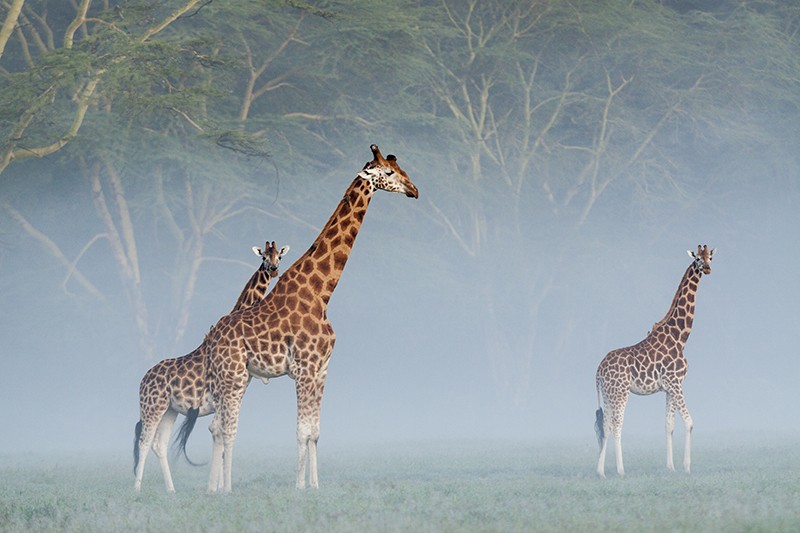
Rothschild's giraffes in the mist at dawn in Kenya
Rothschild’s giraffe populations are slowly recovering. Credit: Denis-Huot/NPL/SPL

Nearly one-third of the world’s species are threatened with extinction. But for some iconic animals, years of conservation efforts are finally paying off.

Mountain gorillas, a subspecies of giraffe and two types of whale are all in a lower conservation category — meaning they are considered less vulnerable to extinction — than the last time they were assessed.
This is according to a 14 November update to the International Union for Conservation of Nature (IUCN) Red List, which catalogues the conservation status of the world’s animals, fungi and plants.
The IUCN puts these successes down to years of collaborative effort among governments, businesses and society to help species to recover.
“We can see the positive impact that having this long-term investment in conservation can have,” says Tara Stoinski, president of the Dian Fossey Gorilla Fund International in Atlanta, Georgia.

Species revival

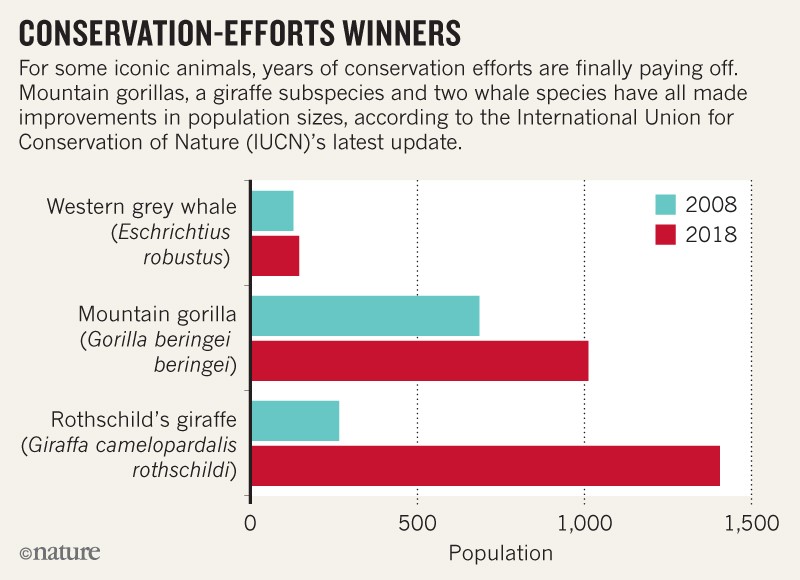
Mountain gorillas (Gorilla beringei beringei) live in the mountain rainforests that straddle Uganda, Rwanda and the Democratic Republic of the Congo, where habitat destruction from agricultural expansion, disease and civil unrest have severely threatened their populations. In 2008, mountain gorillas numbered only 680 individuals, meriting their classification at the time as ‘critically endangered’, which is exceedingly close to extinction.
But because of extreme conservation measures, including daily monitoring and protection by armed guards, says Stoinski, the gorilla populations have risen at last count to 1,004. The IUCN has accordingly lowered their conservation status to ‘endangered’, which indicates that their populations are small and still highly vulnerable to extinction, but less so than before (See ‘Conservation-efforts winners’) .
Illegal hunting, habitat destruction and the spread of human agriculture have similarly caused populations of Rothschild’s giraffe (Giraffa camelopardalis rothschildii), found mostly in Uganda and Kenya, to drop from as many as 2,500 individuals in the 1960s to around 500 between 2006 and 2009.
After being categorized as endangered on the 2010 IUCN Red List, legal protections, the reintroduction of a handful of giraffes to parts of Kenya and the development of species recovery plans have boosted the giraffe populations to around 1,470 mature individuals. The population is now designated as ‘near threatened’, which means it has improved but is still small enough that it could easily become endangered again.

Wars on whaling

Fin whales (Balaenoptera physalus) and western grey whales (Eschrichtius robustus) in the western Pacific were hunted nearly to extinction in the early-to-mid-twentieth century. But after commercial whaling activities on both species ceased in the 1980s the populations steadily climbed.
Combined estimates from different parts of the world between 2006 and 2008 put the then-endangered fin-whale populations at around 62,000 animals. Current estimates reach nearly 100,000 mature individuals — enough to move their status to ‘vulnerable’.
Western grey whales made a similar climb, albeit much more incrementally, from being critically endangered, with roughly 120 individuals in 2007, to endangered in 2018, amounting to 170–180 individuals.
“It really does just come down to the fact that if we don’t kill them, they increase towards recovery,” says Randall Reeves, chair of the IUCN Species Survival Commission Cetacean Specialist Group, in Hudson, Canada .
Despite the improvements, the IUCN says, there are still pressures that threaten each of these species. Whales are at risk of getting entangled in fishing gear. Illegal hunting and habitat destruction still threaten giraffes. And mountain gorillas are still susceptible to environmental disasters and disease epidemics, including recurring Ebola outbreaks. “We can’t just tick this off and move on to something else,” Stoinski says.

Saturday, July 7, 2018

2961. Lions Eat Men Suspected of Poaching Rhinos

By Kimon de Greef, The New York Times, July 6, 2018
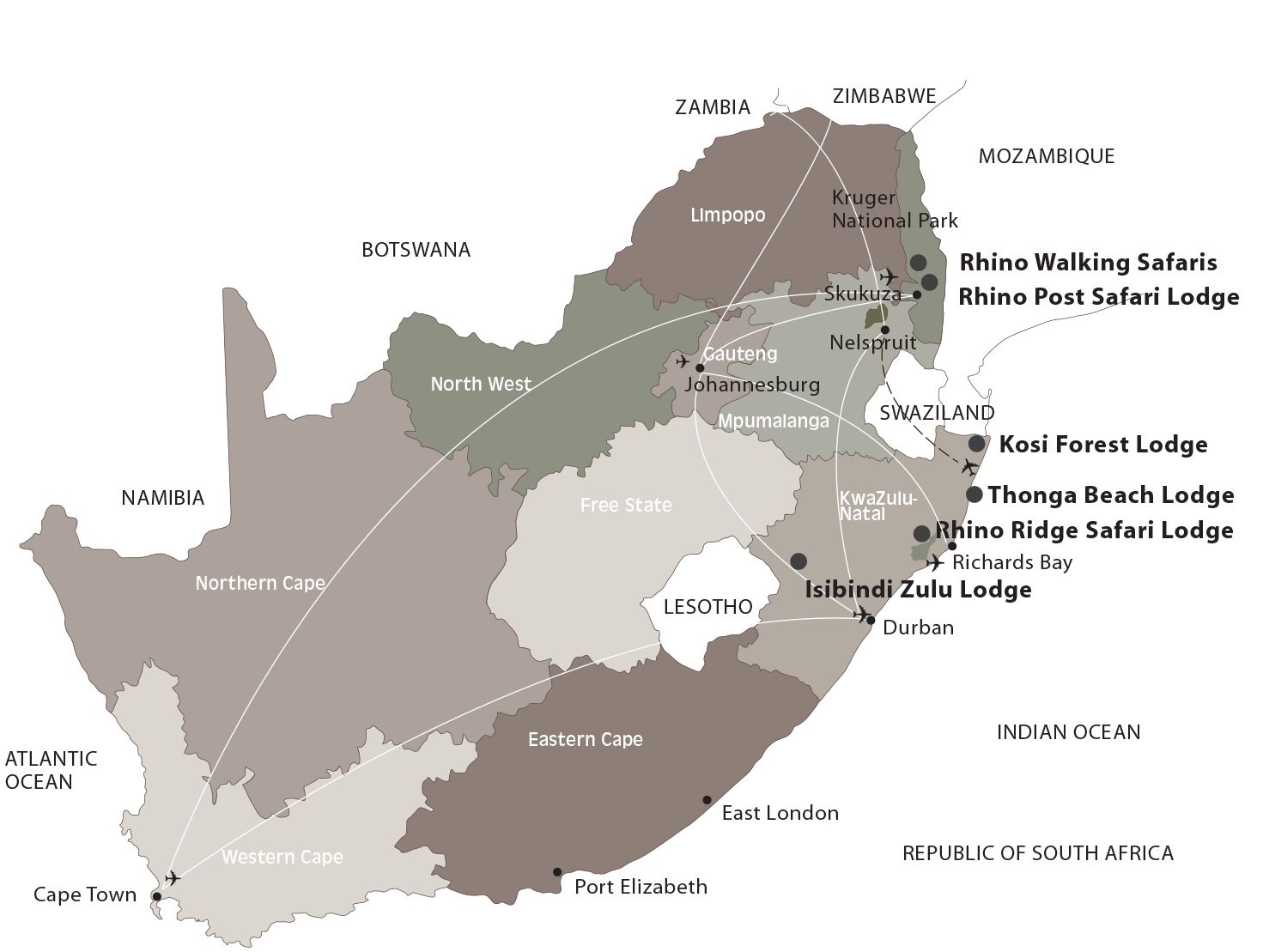
Rhinoceros reserves in South Africa

CAPE TOWN — In the cold hours before dawn this week on a South African game reserve, a dog began barking. It was a special breed of Belgian sheepdog, and its job was to listen for poachers.

The dog’s handler, trained to guard rhinoceroses, could hear a pride of lions in the distance. He decided it was a false alarm. But that Monday evening, rangers came across the remains of men suspected of being poachers.

“One of our guys found what he thought was a soccer ball,” Nick Fox, the owner of the private game reserve in Eastern Cape Province, said on Friday. “It turned out to be a skull.”
The next morning, rangers and police officers said that as many as three men suspected of being rhino poachers had been killed by lions in an area densely packed with thorn bushes.

“There was nothing we could do before that,” Mr. Fox said. “It was getting dark — too unsafe to be on foot.” He added, “Once lions have taken down a human, you cannot be on the ground with them.”

To get to the remains, the rangers had to shoot the lions with darts to knock them out.

The men killed had been carrying a high-caliber rifle and an ax for chopping off the horns of the animals they planned to hunt, Mr. Fox said. They also had food to last several days — “mostly bread,” Mr. Fox said — and wire cutters for getting through fences. His estimate of three victims was based on counting their clothes and shoes.

Rhino horn is worth about $9,000 per pound in Asia, driving a lucrative and illicit trade. It is a prized ingredient in Chinese traditional medicine and is considered a status symbol.

South Africa is home to about 20,000 wild rhinos, more than 80 percent of the world’s population. About one-third of the animals are owned by private breeders. Since 2008, more than 7,000 rhinos have been hunted illegally, with 1,028 killed in 2017, according to the South African Department of Environmental Affairs.

Capt. Mali Govender of the Eastern Cape police service confirmed the deaths and said that the remains had been sent for forensic testing. But she said it “was not possible to speculate” how many victims had died.

Of the rifle recovered from the scene, which had been fitted with a silencer, Captain Govender said, “You don’t take a pellet gun to a game farm.”

People suspected of being poachers have been killed by lions in South Africa before. In February, a man’s mauled body was found in a reserve near Kruger National Park.

Mr. Fox, who established his game reserve, called Sibuya, in 2003, said there was “virtually no poaching at all” in the Eastern Cape until 2010, when suddenly it became a “serious problem.”

A single rhinoceros was poached in the Eastern Cape in 2007, according to the province’s environment department. In 2016, poachers killed 19.

“There are more poachers now, and they are very well equipped,” Mr. Fox said. To protect the rhinos on his property, he said, he had set up an antipoaching unit with guards, dogs and patrol vehicles.

“You literally need to have your own private army now,” he said, estimating the cost to him at more than $73,000 a year.

He would not confirm how many rhinoceroses were on his farm, heeding a nationwide moratorium on publicizing the numbers. In March 2016, he lost three rhinos to poaching, he said.

“It’s devastating when that happens,” he said. “This time, there’s a huge sense of relief.”

According to Annette Hübschle, a researcher at the University of Cape Town’s Center of Criminology, rhino poaching has been expanding from Kruger National Park, in northeastern South Africa, because of militarized antipoaching crackdowns.

“You now have traveling poaching gangs,” Dr. Hübschle said, adding, “Rhino horn has huge value, so even low-level poachers can make a lot of money.”

“Selling a single horn can exceed the yearly income of most rural people,” Dr. Hübschle said.

The Eastern Cape is South Africa’s poorest province, with a gross domestic product of less than $3,700 per capita. The unemployment rate here, including people who have given up looking for work, exceeds 45 percent, significantly higher than the national average.

“Behind poaching there’s a bigger story of structural inequality,” Dr. Hübschle said. “People were chased off their land during colonialism and apartheid, losing their customary hunting rights and tenure. Today, many local communities experience some trickle-down from poaching, while attitudes are generally negative towards private game owners and protected areas.”

Responding to the death of the men, some residents saw a moral lesson. Annamiticus, a wildlife crime advocacy group, wrote on its website that “a gang of rhino killers apparently received a dose of their own medicine.” On social media, many users saw it as “karma.”

“Whenever the death of a poacher is reported, there’s this horrendous outpouring,” Dr. Hübschle said. “People seem absolutely delighted at the death of local people.”

Julian Rademeyer, a project leader of Traffic, a nonprofit group that monitors illegal wildlife trades, and the author of “Killing for Profit,” about rhino poaching in South Africa, said: “It is doubtful that these deaths will deter other poachers. The middlemen will simply up the price they are prepared to pay, and more young men will line up to kill or die.”

Sunday, July 16, 2017

2663. The Government Is Now the Yellowstone Grizzly’s Biggest Threat

By Thomas McNamee, The New York Times, July 14, 2017

In March 2016, the United States Fish and Wildlife Service proposed removing the Yellowstone grizzly bear population from the list of threatened species. The uproar was ferocious. Conservationists, scientists, 125 Indian tribes and some 650,000 citizens expressed concern about the move.

Now the government has gone and done it anyway.

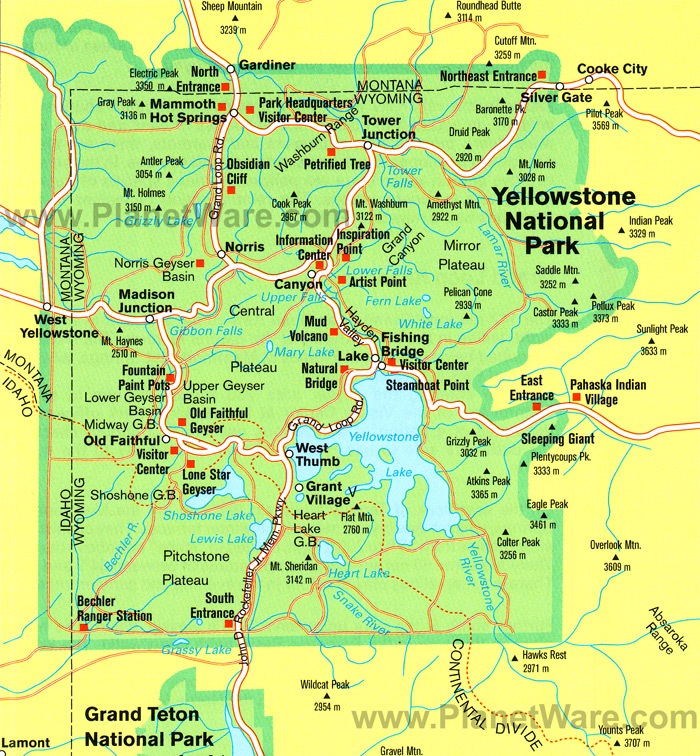
Why? Because, foremost, the service’s biologists and administrators believe that the population has recovered to self-sustainability. And it has in fact grown a lot since 1984, the year I published “The Grizzly Bear,” when mother bears numbered in the low 30s — the brink of extirpation. The Department of the Interior now claims that “an estimated 700” grizzlies inhabit the Greater Yellowstone Ecosystem — a vast wildlands centered on the world’s first national park but also including Grand Teton National Park, portions of six national forests, three national wildlife refuges and other federal, state, private and Indian lands.

A true recovery could be the greatest triumph yet for the Endangered Species Act of 1973, which is itself politically endangered. The states surrounding Yellowstone National Park — Idaho, Montana and Wyoming — have been pressing for the delisting for years, so that they can assume management of the bears outside the boundaries of the Yellowstone and Grand Teton parks. All three states plan to issue hunting licenses, which would be few in number but a major victory in the culture wars of the mountain West.

This is not the first time the feds have tried to delist the Yellowstone grizzly. They did it in 2007 and were met with a barrage of legal fire from conservation groups, which won in court and again on appeal. The court restored the bear to full protection in 2009, with a stinging rebuke of the government’s scientific claims.

So is it a true recovery this time? Nearly all conservation biologists outside government say that an absolute recovery will never be possible for the Yellowstone grizzly population.
The Yellowstone grizzly’s food system is collapsing. One of the bears’ most important sources of nutrition has been the seeds of the whitebark pine, but the tree is under a double attack.

The native mountain pine beetle has historically been kept in check by periodic deep freezes, but there haven’t been any of those for years now, and this beetle has been killing pine species throughout the Rocky Mountains. The other attacker is the nonnative white pine blister rust, a deadly fungus that attacks the stems of the trees. More than 80 percent of the whitebarks are now dead or dying in the Greater Yellowstone region.

Until recent years, early each summer there were vast runs of spawning cutthroat trout up the tributaries of Yellowstone Lake — a high-fat feast for grizzlies. Since the illegal introduction in the 1980s of nonnative lake trout, however, which feed on juvenile cutthroats, the spawning runs are down by 90 percent.

A little-known but significant food source is an annual aggregation of army cutworm moths at high altitude in the Absaroka Mountains. One bear can eat up to 40,000 moths — 20,000 calories’ worth — in one day. The moths depend on moist microhabitats that are drying as summers continue to warm.

A less well understood but equally grave danger is that Yellowstone grizzlies live on what is effectively an island, its surrounding “sea” being devoid of grizzlies in all directions. Island populations are subject to inbreeding and hence lowered reproduction rates, and grizzlies are among the least fecund of mammals to start with. When island populations fall into reproductive decline, there are no adjacent populations to resupply them.

Many of the thousands of public comments on delisting have focused on the renewal of hunting. Very few people can stomach the image of a grizzly bear shot down — somehow it’s not like an elk or a deer. Management by the states is supposed to be rigorously overseen by the federal authorities, and over-hunting would seem to be unlikely under the proposed guidelines. Yet pursued by even a small number of hunters, Greater Yellowstone’s grizzlies would become much less visible for the millions of visitors who want only to see one.

Because they’re so hard to find in any case, grizzly bears are formidably hard to count, and a number of eminent scientists reject the government’s population claims. David Mattson, a recently retired visiting senior research scientist at the Yale School of Forestry and Environmental Studies, maintains that the population has “grown very little if at all during the last decade. Most of the claimed increase is an artifact of changes in method” of counting, “a fact often obfuscated by the agencies promoting delisting. And the population has been declining for at least three years.”

The only way Yellowstone’s grizzly bears can be expected to thrive in the long run is for their ecosystem to be connected by a corridor of occupied habitat to other grizzly populations — the one centered in Glacier National Park to the north and others up the Rocky Mountain chain to Alaska. That’s still possible, if grizzly hunting remains forbidden and the connecting lands are safeguarded in perpetuity against incursion and development, which they are not today.

Classification of the Yellowstone grizzly as a threatened species is set to expire at the end of July unless the courts step in again. Taking away federal protection now — with the bears’ food sources plunging and their ecosystem isolated — is an act of either deceit or folly.