Showing posts with label Materialism. Show all posts

Sunday, August 23, 2020

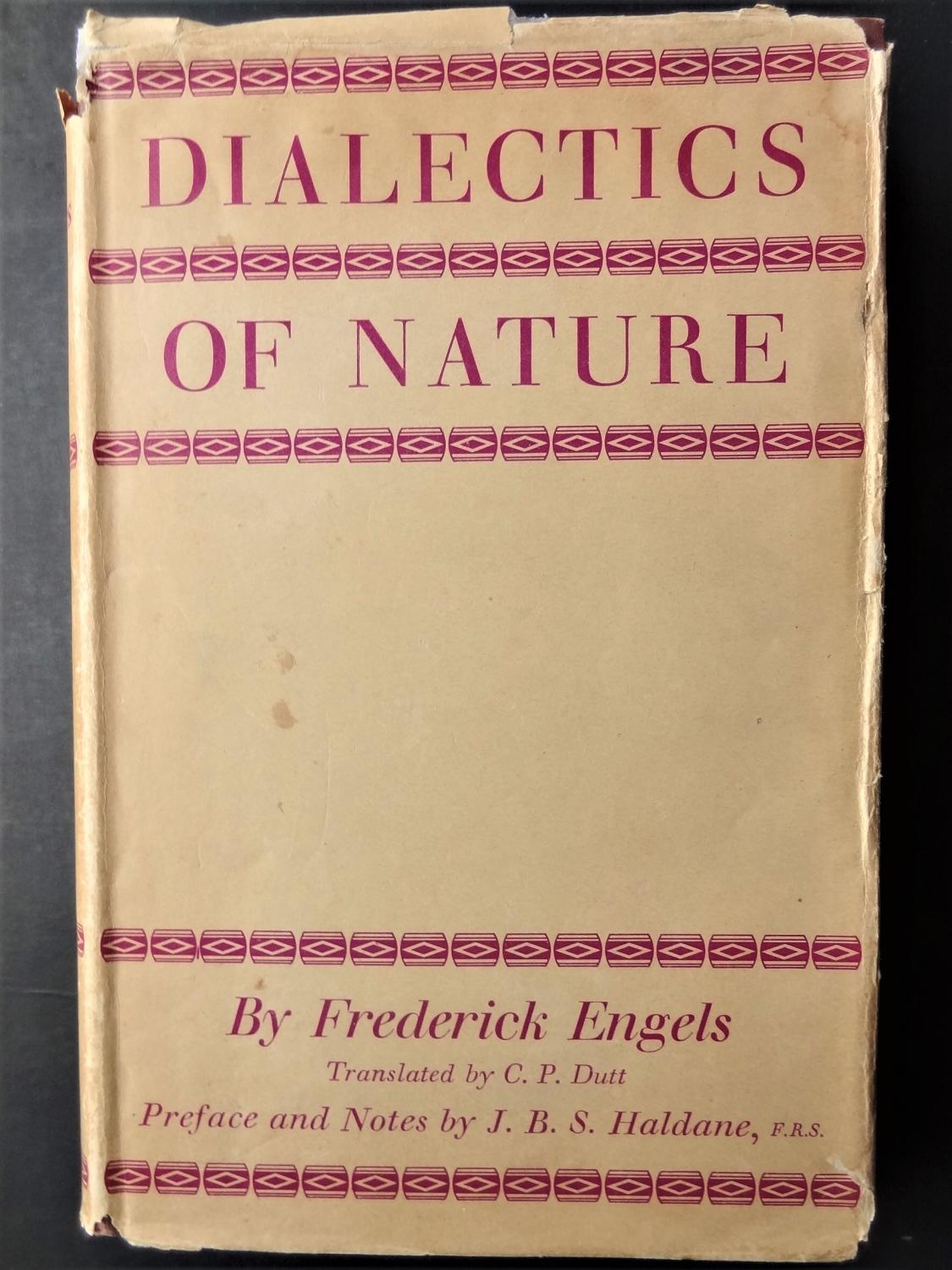
3414. Book Review: Dialectics of Nature

By George Novack (William F. Warde), Fourth International, December 1940


The ideological development of every social movement has followed the course determined by the material conditions of its existence. The evolution of scientific thought under proletarian auspices has been the opposite of that under bourgeois auspices. This difference in development grew out of the different social necessities which confronted the two revolutionary classes in the first stages of their careers.

The main line of bourgeois thought advanced from the natural to the social sciences. The earliest bourgeois philosophers were primarily concerned with promoting man’s knowledge of nature after the long sleep of the middle ages. They had no interest in reforming society along bourgeois lines. They devised new intellectual methods for increasing man’s power over nature rather than for decreasing the power of man over man.

Lord Bacon, the progenitor of English empiricism, deliberately turned his back upon the religious controversies, in which great political struggles then first manifested themselves, to investigate the workings of nature. Descartes, the founder of modern rationalism, opposed to the sterile “speculative” philosophy of the schoolmen his own “practical philosophy,” which would make mankind “masters and possessors of nature” and enable them to “enjoy without any trouble the fruits of the earth and all its comforts.” Newton gave a classical form to physics a century and a half before Ricardo performed the same task for bourgeois economics.
 
Material Causes of Intellectual Evolution
This order of development was not accidental. The principal task of the bourgeoisie at that period was to augment the productive forces, thereby increasing their own wealth and power. The scientific thought of the proletarian movement, on the other hand, has progressed from the social to the natural sciences. This, too, was not without sufficient reason. The urgent job of the proletariat under capitalist domination was less to increase the productive forces of society, as the bourgeoisie was compelled to do under feudal rule, than to free the already highly developed productive forces from the dead hand of capitalist ownership and control.

This explains why Marxism, the scientific method of the revolutionary proletarian movement, concentrated attention in the first phase of its activity upon the solution of historical, social and economic problems. Practical necessity dictated that the most pressing theoretical problems in the sphere of social phenomena be solved first. Although the theory of dialectical materialism was essentially a universal system of thought, embracing both nature and society, its detailed application to the theoretical problems of the natural sciences had to be postponed for later consideration.
 
Marx, Engels, and Natural Science
The creators of dialectical materialism were keenly conscious of the gaps in their theoretical work. Marx looked forward to writing a handbook of dialectics after he had completed Capital. In the latter years of his life Engels made a comprehensive study of mathematics and the natural sciences with the aid of reconstructing their theoretical foundations with the aid of the materialist dialectics just as he and Marx had previously revolutionized social science.

“Marx and I,” he wrote in the second preface to Anti-Duehring, “were pretty well the only people to rescue conscious dialectics from German idealist philosophy and apply it in the materialist conception of nature and history. But a knowledge of mathematics and natural science is essential to a conception of nature which is dialectical and at the same time materialist. Marx was well versed in mathematics, but we could only partially, intermittently and sporadically keep up with the natural sciences. For this reason, when I retired from business and transferred my home to London, thus enabling myself to give the necessary time to it, I went through as complete as possible a ‘moulting,’ as Liebig calls it, in mathematics and the natural sciences, and spent the best part of eight years on it.”

Anti-Duehring was the first fruit of this work; Dialectics of Nature the last. While Anti-Duehring remains the best exposition of the philosophy of dialectical materialism, the Dialectics of Nature, despite its fragmentary character, must now be read as its indispensable supplement. Engels could not finish this work owing to the tremendous labor involved in editing and publishing Capital (here is direct evidence of the interference of social science with the advancement of natural science!) and to other tasks connected with the revolutionary movement. The present volume consists of six more or less completed chapters together with a sheaf of disconnected notes and separate articles.

Although it has taken over sixty years for Engels’ manuscript to appear in English, it arrives at an opportune moment. Here is one more means for educating those students who have felt the need of delving deeper into the theoretical bases of Marxism and of answering those critics who have demanded to know how the doctrines and methods of dialectical materialism can be applied to the problems of natural science. Doubtless, the new school of petty-bourgeois revisionists, whose disdain for Marxist theory is surpassed only by their ignorance of it, will attach little more positive value to these writings than did their predecessor, Edward Bernstein, who held the manuscript for many decades after Engels’ death without seeing any necessity for publishing it. But every serious student of Marxist thought will rejoice that these keys to an understanding of the materialist dialectic have finally become accessible.
 
What Engels Seeks to Demonstrate
In the Dialectics of Nature Engels aimed to demonstrate that the processes of nature obey the same general laws of motion as social and intellectual processes. As he wrote in Anti-Duehring, Engels surveyed mathematics and the natural sciences to convince himself “that amid the welter of innumerable changes taking place in nature, the same dialectical laws are in operation as those which in history govern the apparent fortuitousness of events; the same laws as those which similarly form the thread running through the history of the development of human thought and gradually rise to consciousness in the mind of man ...” and which were first formulated by Hegel in mystical form before Marx and Engels refashioned them into the materialist dialectic.

In the Introduction, Engels presents a critical review of the development of natural science on its theoretical side. He explains how and why this first period in the rebirth of natural knowledge was dominated by the viewpoint of the absolute immutability of nature. The fixed stars and our own solar system, the earth and its fauna and flora were considered to be eternally the same. There was no place in such a scheme of things for the idea of universal evolution.

This outlook, which prevailed in all branches of natural science until well into the 19th century, began to be undermined in one science after another by the internal development of the sciences themselves. In astronomy, by the Kant-Laplace hypothesis of the evolution of the solar system from a nebula; in geology, by Lyell’s conception of the successive transformations of the earth s surface; in physics, by the formulation of the mechanical theory of heat and by the law of the conservation of energy; in chemistry, by Mendeleyeff’s discovery of the periodic arrangement of the elements; and in biology by Darwin’s theory of the origin of species. This series of discoveries gave rise to a new scientific conception of nature, the theory of universal evolution, “the view that the whole of nature, from the smallest element to the greatest, from grains of sand to suns, from protista to men, has its existence in eternal coming into being and passing away, in ceaseless flux, in unresting motion and change.”

The full consequences of these revolutionary developments in the separate sciences, which shattered the old picture of an immutable nature, were slow to realize themselves in the conscious thought of individual natural scientists and in genial scientific theory. Practising scientists, who accepted the results and pursued the methods of the evolutionary standpoint in their special department of activity, clung to the old metaphysical ways of thinking in other fields of thought and in their general conceptions.
 
The Dialectical Theory of Evolution
Meanwhile the new and higher stage of natural knowledge demanded a theoretical system and a method of thought appropriate to itself. The old mechanical system of nature with its unchangeable laws and elements and its metaphysical mode of thought operating with inflexible and exclusive categories no longer sufficed.

It was a philosopher rather than a scientist who provided natural science with the intellectual means for its emancipation from the old outlook and for the construction of a new one. Just as Descartes had outlined the mechanical system of nature, so Hegel formulated the first systematic conception of the whole natural, social and spiritual world as a continuous process of development.

In his dialectical logic Hegel attempted to give a rational form and evolve a rational method out of the many-sided, contradictory processes of evolution. The laws of his dialectic are nothing but the most general laws of motion and change in nature, society and human thought. These laws were originally conceived by Hegel in idealist fashion as mere laws of thought. But, as Marx and Engels subsequently demonstrated in their materialist version of dialectical logic, the dialectical laws are conceptual formulations of objective material realities.
 
Three Laws of Dialectics
Engels discusses three principal laws of dialectics: the law of the transformation of quantity into quality, and vice versa; the law of the interpenetration of opposites; and the law of the negation of the negation. He takes the experimental results of the individual sciences, sifts and synthesizes them, to show that these dialectical laws are really laws of development in nature and therefore valid for theoretical natural science.

The first law signifies that “in nature, in a manner exactly fixed for each individual case, qualitative changes can only occur by the quantitative addition or subtraction of matter or motion (so-called energy).” In the second chapter Engels indicates precisely how this law operates by numerous examples taken from the exact sciences of mechanics, physics, and chemistry where accurately measurable and traceable quantitative variations are directly linked with the production of qualitative differences. In physics, it has since been ascertained, there exists a continuous series of rays from radio to cosmic rays in which quantitative variations in wavelength manifest themselves in determinable qualitative differences. This same law is equally clearly observable in chemistry where the properties of bodies are altered in concordance with their changed quantitative composition. Engels cites the allotropic forms of elements, the nitrogen oxide compounds, the homologous series of carbon compounds, and the periodic arrangement of the elements according to their atomic weights; modern chemists could add many more examples.

The second law of the dialectic asserts that everything has a self-contradictory character, containing within itself its own opposite. The bi-polar essence of all things manifests itself in change, which is a process of alteration, or transformation of something from its original state through a series of intermediate variations into its opposite. Engels brings forward this law of the interpenetration of opposites in the third chapter where he investigates the most important of scientific problems, the basic forms of motion.
 
The Nature of Motion
All natural knowledge is based upon the study of material movement of one kind or another. A correct conception of motion is therefore absolutely indispensable to natural science. What is motion? Motion, says Engels, is a contradictory combination of attraction and repulsion. All the various forms of motion arise out of the interplay between these two opposing phases of its being. Wherever and whenever motion occurs throughout nature, these polar opposites will be found inseparably united. This dialectical definition of motion already implicitly contains the empirically discovered physical law of the conservation of energy. For, if each individual attraction is compensated for by a corresponding repulsion somewhere else, then the sum of all attractions in the universe must be equal to the sum of all repulsions.

Motion consists of the concrete unity of attraction and repulsion. Through their interaction with one another, and their transmutation into one another, the diverse modes of motion in nature are produced. The universal interplay of attraction and repulsion can be seen in the simplest kind of motion, mechanical motion, which consists of a change of place on the part of any body. Since motion is always relative, change of place requires the interaction of at least two bodies to manifest itself. When two bodies act upon each other so that a change of place of one or both of them results, this change of place can consist only of an approach or separation. But the movement of one body toward another involves the overcoming of the repulsion that separates them, and vice-versa. Moreover, the attraction of one body to another involves its repulsion from a third body. Thus all change of place necessarily entails the reciprocal action of attraction and repulsion and their replacement by one another.

The mechanical movements of masses on the earth’s surface can be resolved into the centripetal force of gravitation and counteracting centrifugal forces. The same interpenetration of attraction and repulsion is displayed in the mutual movements of the heavenly bodies, as in the dynamic equilibrium maintained between the earth and sun. If the earth were not bound to the sun by attraction, it would leave the solar system and fly off into space. If the sun, on the other hand, did not exert constant repulsion in the form of radiant energy upon the earth and keep it at a distance, this planet would long ago have fallen into its flaming mass and become absorbed.

Every mode of motion in nature from the lowest to the highest, from simple mechanical motion to complicated organic behavior, embraces and arises out of the simultaneous action and reaction of attraction and repulsion. Motion is in fact nothing but the most general expression for the manifold series of forms in which these polar opposites manifest themselves.
 
The Dialectical Definition of Motion
Engels employs this dialectical, two-sided, comprehensive definition of motion to criticize and to correct the one-sided conceptions of the nature of motion prevailing in Newtonian physics. The Newtonians erred in making attraction, or gravitation, the fundamental form of motion in nature. They thereby disregarded the equally important role of its opposite, repulsion, overlooking in particular the transformations of the one phase of motion into the other. Engels undertakes an analysis of the concepts of force, energy, and work in the writings of Helmholtz, the great nineteenth-century German physicist, to demonstrate how this neglect of the essentially bipolar character of motion introduced confusion and perpetuated error in physical theory.

Since Engels wrote, the fact that motion embraces both attraction and repulsion has been strikingly verified by the electronic theory of matter, the physical theory of relativity, and, as Haldane points out, by recent developments in the astronomical theory of the spiral nebulae. In the principles of the new “wave mechanics” the dialectical law of the interpenetration of opposites has just scored a great victory over the old mechanical conceptions.

This triumph is all the more definitive because it has been so long and consciously resisted by the physicists themselves. When first they found that electronic phenomena exhibited the properties of both waves and particles, they were profoundly perplexed by this contradiction, which could not be reconciled nor explained by the sundered categories of mechanical theory. Subatomic theory became deadlocked. After much pondering, the most daring physicists have now at last concluded that in the subatomic world waves and particles can no longer be considered absolute opposites; that they can be united in a single entity; that they can possess the same properties; and that, under certain conditions, they can be transformed into one another.
 
The Negation of the Negation
The law of the negation of the negation, which Hegel used as the fundamental law for the construction of his whole system of thought, has a far wider sphere of application in the system of nature. This law really expresses the fundamental form of development in nature.

The opposing forces at work in every single thing bring, about constant changes in its constitution. These changes accumulate in quantity until, at a certain determinate stage in the process of development, a distinct qualitative transformation or leap occurs. The thing loses its original identity and passes over into its opposite.

But the evolutionary process does not halt at the point of simple negation. The new form of material existence is no less self-contradictory than the old and subject to the same internal restlessness. The first negation in turn undergoes self-differentiation and division until it, too, passes into its own opposite and thereby becomes negated. The final result of this process is called the negation of the negation, a synthetic unity which has discarded the transitional forms but preserved within itself the essential content of both sides of the contradictory whole.
All the transformations of material motion studied by natural science exemplify the working of this law of the negation of the negation in physical reality. Engels employs the law to clarify the interconnections between mechanical and molecular motion, or heat.
 
Mechanical into Molecular Motion
All the various forms of motion are generated, as we have said, through the interplay of attraction and repulsion and their conversion into one another. But in each specific mode of motion one or the other extreme is predominant. Pure mechanical motion is essentially a form of attraction. Although repulsion is necessarily present in all cases of mechanical motion, it exists in a negative or passive state. The active role is played by attraction.

As a form of attraction, mechanical motion is the negation of repulsion. But it contains within itself the possibility of transformation into its opposite. This dialectical development actually occurs in nature through the contact or collision of one body with another. In the resultant friction or impact, part of the pure mechanical motion of the masses is destroyed and reappears in the form of internal molecular motion, or heat. The heat produced by the application of brakes is an everyday instance of this phenomenon.

Heat, however, which agitates and separates the molecules of solid bodies, is a form of repulsion. In the case of heat, repulsion comes forward as the active, and attraction recedes into the passive, side of the material process. The conversion of mechanical motion into heat is therefore a negation of the negation, a reversion of the material motion to the original state of repulsion, but on a higher level of development.
 
Dialectics of Scientific Discovery
The law of the negation of the negation is manifested, not only in the physical process of the conversion of mechanical motion into heat, but also in the history of its discovery. Mankind long ago actually converted mechanical motion into heat, first by the instinctive act of rubbing the body with the hands to keep it warm, and then by making fire from friction. But this negation of the original positive form of mechanical motion was only the first step in the dialectics of the process. In order to complete the development, mankind had to reverse the process and convert heat into mechanical motion.

This second stage, the negation of the negation, was realized only after many thousands of years through the invention of the steam-engine, which is an apparatus for converting heat into useable mechanical motion. In this instance historical human practice in the realm of technology provides proof of the logical law of the negation of the negation.

Here also is proof that “the dialectics of the brain is only the reflection of the form of motion of the real world, both in nature and history.” The law of the negation of the negation would not have forced its way into conscious thought unless it had already been operative in physical processes and in social life.
 
Mechanics Versus Dialectics
Yet, as Engels points out, even after the problem of converting mechanical motion into heat and heat back again into mechanical motion had been solved in human practice, natural scientists failed to formulate this fact in a completely correct or comprehensive theoretical fashion. At first they regarded heat, like electricity, as a special kind of imponderable substance rather than as a mode of material motion. Then, when they recognized heat as a mode of motion, both in the restricted law of the mechanical equivalent of heat and in the general law of the conservation of energy, they expressed the inter-relations between these two modes of motion exclusively from the one-sided standpoint of quantity.

But mechanical and molecular motion are not only quantitatively but qualitatively related. They are different forms of the same material motion. Dialectical materialism shows its superiority to the mechanical viewpoint because, in addition to comprehending the quantitative identity between the two forms of motion, formulated by the law of the quantitative equivalence of motion through all its changes of form, it also explains their qualitative diversity and the manner of their mutual metamorphoses.

Dialectical materialism has a different conception of the main task of natural science than the exponents of the mechanical school whose ideas have prevailed in natural scientific thought since Descartes and Newton. The mechanicians, who were preoccupied with studying the laws of the passage of bodies through space, believed that the goal of science was to reduce all other forms of material motion into the elementary form of mechanical motion, to resolve the higher modes of motion into the lower, the more complex into the simple. Thus, in the introduction to his Principia, Newton wrote:

“It would be desirable to deduce from the elements of mechanics the remaining phenomena of nature.”

This conception of the ultimate aim of natural science coincided with that relatively primitive level of technology and industry which was principally concerned with utilizing and exploiting machines in which one aspect of mechanical movement (potential energy) was transformed into another (kinetic energy). Scientific thought revolved within the same narrow circle as scientific practice, generalizing the changes within one single simple form of motion, mechanical transposition.

Hand in hand with the tremendous advances in technology and large-scale industry during the past two centuries, scientists have discovered, investigated, and put to work many other kinds of material motion, thermal, electro-magnetical, chemical, and so on. They have especially applied themselves to studying the interconnections and transformations of these modes of motion into one another. Scientists now know that, while these other forms of motion are always bound up with real mechanical motion, they cannot be reduced to it without obliterating their specific characteristics. The laws of physiology, or society, or thought, although based upon the fundamental laws of nature, cannot simply be “deduced from the elements of mechanics,” as Newton anticipated.

On all sides the laws governing mechanical motion are seen to have their limits; they have lost their sovereign status. [1] The expansion of technical, industrial, and purely scientific practice has widened the theoretical horizon of science far beyond the old mechanical ideal, presenting an immensely broader view of its task which dialectical materialism has not only recognized but best formulated.
 
The Dialectical Conception of Science
This new conception is epoch-making. In contrast to the mechanical standpoint, dialectical materialism regards the task of science to be, not the reduction of all modes of motion into one, but the study of the main forms of material motion in their natural sequence, dialectical interconnections, and transformations into one another.

The forms of motion range all the way from the crude mechanical motion of masses to the complex activity of thought in the human brain. In the course of material evolution all these different modes of motion, mechanical, molecular, atomic, electronic, chemical, thermal, organic, social, and intellectual, have developed one out of the other through the interplay of attraction and repulsion, the original contradictory essence of motion. They constitute an inter-related, hierarchical series, each one of which is naturally linked with the others, and capable, under proper material conditions, of being converted into one another.

This conception provides for the first time a sound material basis for the systematic classification of the sciences. Each individual science either analyses a separate form of motion (chemistry) or the interconnections between several forms of motion (electro-chemistry). The essential order of the sciences corresponds to the order of the generation of the various forms of motion in nature and their dialectical transition into one another. Thus dialectical materialism introduces a new principle of order to replace the confusion and anarchy which has reigned in scientific thought since the bankruptcy of the old mechanical system. All the diverse departments of human knowledge from astronomy to logic are correlated into one vast synthesis.

Part of the material in the Dialectics of Nature, as of any treatise on natural knowledge written over sixty years ago, has been rendered obsolete by the subsequent progress of the physical sciences. This is particularly true of the chapter on electricity in which the greatest advances have been made in the past half-century. Yet there is remarkably little chaff in these pages. Engels’ observations were pointed in the right direction and have in many instances been confirmed by the further researches of the physical sciences. Each discussion of a specific question is of enduring value as an example of the way to use the concepts of materialist dialectics as instruments of critical thought in the natural as well as in the social sciences.
 
The Task That Awaits Us
The task of delineating the dialectical character of natural events, which Engels set for himself and failed to finish, still waits to be accomplished. Despite the wealth of materials provided by recent revolutionary developments within the natural sciences, that task stands at approximately the point where Engels left it. The theoreticians of the post-Marxian period – Bernstein, Kautsky, Adler, etc. – possessing the same hostility or indifference toward the philosophy of dialectical materialism as our contemporary anti-dialecticians, had neither the equipment nor incentive to do anything along this line. Lenin’s Materialism and Empiric-Criticism and his notebooks on Hegel’s logic made possible a renaissance of the philosophy of Marxism and cleared a path for the extension of its ideas and methods to the problems confronting physical science.

It was to be hoped that, when the Bolsheviks commanded state power in Russia, their scientific leaders and academies would undertake this task on a collective, as well as an individual, basis. Under Lenin’s sponsorship promising beginnings were made. But these were cut short by the reaction. Unalloyed Marxist thought, banished from politics, could hardly be expected to extend its roots into the subsoil of nature or to flourish freely for any length of time under the baneful shadow of Stalin’s regime. Consequently, Marxism shrivelled from a vigorously growing ideological movement into a sterile scholasticism.

The Stalinists might preserve some relics of past Marxist thought as the medieval schoolmen preserved the writings of Aristotle or as they themselves mummified Lenin’s body: to exhibit the decaying glories of the past while violating their spirit in the present. For this reason we owe the publication of Dialectics of Nature to them. In science as in society remnants of the heritage of the October Revolution are here and there embedded within Stalinism; some good can still emanate from this abomination: a contradiction which will doubtless horrify the anti-dialecticians. But under Stalinist auspices there cannot be any consistent or fruitful development of the science of dialectical materialism.

In this domain of thought, as in all others, the forces of the Fourth International are obliged to carry forward the tasks left unfinished by their Marxist forerunners. In the philosophical works of Marx and Engels, and now in the Dialectics of Nature, they will find the main trails already blazed for them.

Dialectics of Nature by Frederick Engels, Translated by C.P. Dutt
Preface and Notes by J.B.S. Haldane, FRS 383 pages. International Publishers, New York, 1940. $2.50.

Footnote 
1. See, for example, The Evolution of Physics by Einstein and Infeld, especially the section on The Decline of the Mechanical View.

Monday, November 5, 2018

3068. Trotsky's Views on Philosophical Issues

By Leon Trotsky, Socialist Revolution, November 2013
Leon Trotsky
Editor's note: The following introduction is by the editors of Socialist Revolution. KN

Introuction: Buried in the Trotsky archives at Harvard are many as-yet undiscovered and untranslated treasures of Marxism. One of the most important discoveries in the last few decades was a series of notebooks by Trotsky on philosophy in general and dialectics in particular. First translated and published by Columbia University Press in 1986, with an extensive introduction by historian Philip Pomper. We reproduce here the most important excerpts from these writings. In them there is a wealth of insight into dialectical materialism, positivism, the dialectics of Lenin and Martov, Freud and psychoanalysis, Darwin and evolution, and more.  
Excerpt 1
Hegel
See the topic L. [Lenin]
Those who repudiate “dialectics” consider it to be simply superfluous, a useless playing with thought. Positive science is enough! Does positive science therefore exclude pure mathematics and logic?
In fact, dialectics is related to logic (formal) as higher mathematics is to lower.
Hegel himself viewed dialectics precisely as logic, as the science of the forms of human cognition, but in Hegel these forms are the ones in which the world develops, in that in logical forms it is only [realizing] its material content. Dialectics is summarized by Hegel in a work called “Wissenchaft der Logik.”
For Hegel dialectics is a logic of broader dimensions—in space and in time—universal logic, the objective logic of the universe.
The negation of the concept in itself.
If we visualize the fabric of life as a complex piece of knitting, then the concept can be equated with the separate stitches. Every concept seems to be independent and complete (formal logic operates with them this way), in reality every stitch has two ends, which connect it with adjacent stitches. If pulled at the end it unravels—the dialectical negation of a concept, in its limitedness, in its sham independence.
Some objects (phenomena) are confined easily within boundaries according to logical classification, others present [us with] difficulties: they can be put here or there, but within a stricter relationship—nowhere. While provoking the indignation of systematizers, such transitional forms are exceptionally interesting to dialecticians, for they smash the limited boundaries of classification, revealing the real connections and consecutiveness of a living process.
According to Hegel being and thinking are identical (absolute idealism). Materialism does not adopt this identity—it premises being to thought.
“abstract, tot unbewegend”
Sehr gut!
The identity of being and thinking according to H[egel] signifies the identity of objective and subjective logic, their ultimate congruence. Materialism accepts the correspondence of the subjective and objective, their unity, but not their identity, in other words, it does not liberate matter from its materiality, in order to keep only the logical framework of regularity, of which scientific thought (consciousness) is the expression.
“in ihrer Wahrheit das ist in ihrer Einheit”
Sehr gut!
The doctrine of the teacher is taken up only in ready-made results, which are transformed into a pillow for lazy thought. Hegel on Kant and his epigones.
From Kant to Hegel (from dualism to monism)
Kant: Reason is self-legislating, it constructs its tools of cognition (the categories) by itself; only the thing in itself is located outside of consciousness.
Hegel: But the thing in itself is only a logical abstraction, created by reason; consequently nothing exists aside from Reason.

Is it possible to say that Hegel’s absolute idealism is a self-legislating solipsism?
The concept—is not a closed circle, but a loop, but you can also knot it. (this has been said once already!!)
Mikhailovskii and others deduce the triad from the past, present and future. There is a shadow of truth here, but only a shadow. Our conceptualizing reflects processes, transforming them into “objects.” Not every present is suitable for the formation of a concept; a certain stabilization of the process is necessary in order for an enduring representation of it to form. This act of consciousness is thereby a rupture with the past, which prepared the stabilization. Our concept of the earth, the “most durable” of our conceptions, the “most durable” of the objects of our everyday conceptions, the “most durable” of the objects of our everyday milieu, is based upon a total rupture with the revolutionary formation of the solar system. The concept is conservative. Its conservatism issues: a) from its utilitarian purpose, b) from the fact that the memory of a person, like that of humankind, is short.
Thus the triad does not at all correspond to an undifferentiated past, present, and future, but to the formative stages of the process.

Excerpt 2
The Second Notebook
a = a is only a particular case of the law
a ≠ a.
Dialectics is the logic of motion, development, and evolution.
Formal logic involves stationary and unchanging quantities: a = a. Dialectics retorts: a ≠ a. Both are correct. A = a at every given moment. A ≠ a at two different moments.
Everything glows, everything is changing. What does logic express? The law of the external world or the law of consciousness? The question is posed dualistically, [and] therefore not correctly [for] the laws of logic express the laws (rules, methods) of consciousness in its active relationship to the external world. The relationship of consciousness to the external world is a relationship of the part (the particular, specialized) to the whole.
Logic involves unchanging qualities (a = a) and the fixed quantities of these qualities. Dialectics is constructed on the transition of quantity into quality and the reverse.
The law of the transition of quantity into quality is (very likely) the fundamental law of dialectics.
In this sense dialectics is the logic of Darwinism (in opposition…to Linnaeus . . .), the logic of Marxism (in opposition to rationalistic, idealistic theories of the historical process), the logic of philosophical materialism (in opposition to Kantianism, etc.) The dialectical relationship to quality signified an entirely new relationship to so-called moral values. Official, that is, bourgeois thought today still views justice, rights, honors, as absolute values, as higher criteria. Dialectical materialism razed to the ground the kingdom of idealistic mythology. It showed how imperceptible quantitative molecular changes in economics prepare the way for a radical change in moral criteria: the old values are transformed into their opposite, against them new values enter the scene, the carrier of which is a new class or stratum, not seldom a new generation of the [old] class itself. It is quite usual in philistine circles to accuse Lenin of cynicism, and this expresses precisely hostility to the dialectical worldview, a struggle for absolute values, [both] essential for covering up their] pitiful, barren, self-interested practice.
Alexander III [in] the 1880s was much more confident and decisive in the defense of autocracy than his father. “The great reforms”—especially the zemstvo, the judiciary, the press—made it possible for the bureaucracy to distinguish the true strength of its enemies and allies. The balance proved to be a favorable one.
Dialectics
It must be recognized that the fundamental law of dialectics is the conversion of quantity into quality, for it gives [us] the general formula of all evolutionary processes—of nature as well as of society.
Cognition begins with the differentiation of things, with their opposition to each other, with a classification of their qualitative differences. The quantitative definitions operate with independent particulars, consequently they depend upon qualitative definitions (five fingers, ten years, 100 amperes).
Practical thought lives within these limits. For a cattle trader a cow is a cow; he is interested only in the individual qualities of its udder. From his practical point of view he is indifferent to the genetic links between the cow and an amoeba.
If we grasp the universe from the point of view of atomic theory, then it appears to us like a gigantic laboratory for the transformation of quantity into quality and the reverse.
It is possible to acknowledge this, but to fail to make it the fundamental principle of one’s own thought. There are those who unite the Kant-Laplace worldview with biblical faiths or quasi-faiths and, while advertising themselves as Darwinists, believe in the higher principles, the moral innate in humanity.
The principle of the transition of quantity into quality has universal significance, insofar as we view the entire universe—without any exception—as the product of formation and transformation and not as the fruit of conscious creation.
Hegel himself undoubtedly did not give the law of the transition of quantity into quality the paramount importance which it fully deserves. Hegel relied upon the Kant-Laplace theory, but he did not yet know either Darwinism or Marxism. It is indeed sufficient to recall that the dialectician Hegel could consider the Prussian state the incarnation of the absolute idea.
Engels, following Hegel, called those who think in absolute and unchanging categories, that is, who visualize the world as an aggregate of unchanging qualities, metaphysicians.
In a more or less pure form “metaphysical” thinking exists perhaps only in savages.
Among civilized people eclecticism holds sway. The laws of “evolution,” of “progress,” on the whole are recognized, but independent of them several absolute categories are accepted—in the area of economics (private property), in the politics (democracy, patriotism), in morals (the categorical imperative).
Anglo-Saxon thinking is at the present moment the preserve of empiricism.
In the English scholar’s head, just as on the shelves of his library, Darwin, the Bible, stand side by side, without disturbing each other. Anglo-Saxon thinking is constructed according to the stem of the impermeable bulkhead. From this issues the most stubborn opposition in the conservative Anglo-Saxon world to dialectical thinking, which destroys all impermeable bulkheads.
“The transition into its opposite”
Vernunft wird Unsinn
Wohltat–Plage
To view phenomena according to their resemblance or opposition means to see them according to their quality.
The transition of quality into quantity and the reverse presupposes the transition of one quality into another.
See Freud.
In primitive languages, big and small, high and low, etc., are expressed by one word, and the opposition between big and small is expressed by gestures, intonations, etc. In other words language, at a time when it was being developed, had only a general character, converting opposing qualities into quantitative differences.
The very same thing applies to the concepts of sweet and bitter, and at a later time—to good and evil, wealth and poverty, etc.
In these abstract formulas we have the most general laws (forms) of motion, change, the
transformation of the stars of the heaven, of the earth, nature, and human society.
We have here the logical (dialectical) forms of the transformation of one regime into another. But in such general form it is a matter only of possibility.
The conversion of an abstract possibility into a concrete necessity—also an important law of dialectics—is defined each time by a combination of definite material conditions? Thus, from the possibility of a bourgeois victory over the feudal classes until the victory itself there were various time lapses, and the victory frequently looked like a semivictory.
In order for a possibility to become a necessity there had to be a corresponding strengthening of some factors and the weakening of others, a definite interrelationship among these strengthenings and weakenings. In other words: it was necessary for several interconnected series of quantitative changes to prepare the way for a new constellation of forces.
The law of the conversion of possibility into necessity this leads—in the last analysis—to the law of the conversion of quantity into quality.

Catastrophes
Everything flows, but not outside [its] banks. The world is not “fluid,” there are changes in it, the crystallization of durable (congealed) elements, although indeed not “eternal” ones. Then life creates its own banks for itself in order later to wish them away. The quantitative changes of matter at a given stage push against those congealed forms, which sufficed for its previous state. Conflict. Catastrophe. Either the old form conquers (only partially conquers), necessitating the self-adaptation of the conquered (partially) process, or the process of movement explodes the old form and creates a new one, by way of its new crystallizations from its wombs and the assimilation of elements of the old form.
See in addition
[John Stuart] Mill #
The liberal (gradualist) conception of development, progress
The theory of revolutions
The logical antimony of content and form in this way loses its absolute character. Content and form change place. Content creates new forms from itself. In other words the correlation of content and form leads, in the last analysis, to the conversion of quantity into quality.
Continue in relation to the other antinomies.

What is the aim of this? says the contemporary “positivist”: I can give an excellent analysis of the world of phenomena without these contrivances and pedantic subtleties. With equal justification a butcher will say that he can sell veal without restoring to the Aristotelian syllogism. To the butcher we would try to make clear that in reality he is always relying on the syllogism without knowing it; [that] if his trade is poor, then his personal ignorance cannot but affect it; but that, if he wants to set things up solidly, then he cannot avoid teaching his son the sciences, the composition of which includes the science of the syllogism (logic).
To the representative of positivism, with his limited point of view, we say that all the contemporary sciences [(at their head, those that involve matter, substance)] use the laws of dialectical thinking at every step, just as the shopkeeper uses the syllogism or as Monsieur Jourdain uses prose: without ever knowing it. Precisely because of this the average scholar preserves many habitual [traits resembling those] of impermeable bulkheads, not posing those questions which issue from the general movement of scientific thought, and cravenly ceases to draw general conclusions, when they call for a dialectical leap.
The dialectic does not liberate the investigator from painstaking study of the facts, quite the contrary: it requires it. But in return it gives investigative thought elasticity, helps it cope with ossified prejudices, arms it with invaluable analogies, and educates it in a spirit of daring, grounded in circumspection.
[Text of a newspaper clipping reporting Enrico Fermi’s discovery of a new element.]
The example of Mendeleev, whose lack of dialectical method prevented him from recognizing the mutual transformability of the elements, despite the fact that his discovery of the periodic table of elements connected the quantitative differences among them to the quantitative differences of atomic weights.

Excerpt 3
Lenin and Martov
If all contemporary thought is penetrated by elements of the dialectic, then this is even truer of the political thinking of the Mensheviks, who had passed through the school of Marxism and revolutionary events. But dialectics differ. Martov very subtly, in many cases, with great virtuosity commanded the dialectic. But this was a dialectic close to his thinking about phenomena in the intelligentsia milieu connected with the intelligentsia of the top stratum of the workers.
Martov sometimes very intelligently analyzed regroupings in the sphere of parliamentary politics, changes in the tendencies of the press, the maneuvers of ruling circles—insofar as all this was limited to ongoing politics, the preparatory stage for distant events or the peaceful conditions when only the leaders, deputies, journalists, and ministers of prewar Europe acted in the political arena, when the basic antagonists remained virtually unchanging.
Within these boundaries Martov swam about like a fish in water. His dialectic was a dialectic of derivative processes and limited scale, episodic changes. Beyond these boundaries he did not venture.
On the contrary, Lenin’s dialectic had a massive character. His thought—his opponents often accused him of this—“simplified” reality, indeed swept aside the secondary and episodic in order to deal with the basic. Thus, Engels “simplified” reality when he defined the state as armed detachments of people with material appendages in the form of jails. But this was a saving simplification: true, insufficient in itself for an evaluation of the conjunctures of the day, it was decisive in the last historical analysis.
Lenin’s thought operated with living classes as the basic factors of society and thus revealed all its power in those periods when the great masses entered the scene, that is, in periods of profound upheavals, wars, and revolutions. The Leninist dialectic was a dialectic for the large scale.
Although the fundamental laws of mechanics hold for all man’s productive activity, in reality there is the mechanics of the watchmaker and the mechanics of Dnepostroi. Martov’s thought was the thought of a watchmaker in politics. Lenin’s thought worked on the scale of Dnepostroi. Is this a difference of a quantitative order? Quantity here passes over into quality.
The comparison with the watchmaker, however, has very conditional meaning. A watch’s mechanism will live its self-contained life (so long as it is not ruined), and the watch’s hands can correctly show the hour, even though the watchmaker is ignorant of the law of the earth’s motion around its axis. But the politics of a minor scale (internal groupings within parties, parliamentary games, etc.) maintains its relative independence while the (relatively) large factors, that is, classes, are unchanging. Martov’s dialectic therefore yielded the more tragic misfirings in matters of a minor scale as well, the closer the approach of stormy class conflicts, of perturbations in the life of society. And since our entire epoch since the first years of the century became one of ever more grandiose historical perturbations, Martov’s thought increasingly showed its weakness, turned dialectics simply into a screen for inner uncertainty, and fell under the influence of vulgar empiricists, like Dan.
To the contrary, Lenin’s thought analyzed all the secondary phenomena, all the elements of the superstructure more penetratingly, the more immediately they depended upon the class movements that were occurring. From stage to stage Lenin’s thought became stronger, more courageous, and at the same time subtler and more flexible.
Martov’s mistakes were always and invariably mistakes to the right of historical development, they grew in frequency and in scope and soon outgrew the area of tactics and moved into that of strategy, and by virtue of that rendered nil the tactical resourcefulness and wealth of his initiatives.
Lenin’s political mistakes were always to the left of the line of development, thus the farther [along the line of development], the rarer they became, the smaller the angle of deviation, the sooner they were recognized and corrected; by virtue of which the relationship between strategy and tactics achieved a higher and more perfect correspondence.
Materialist dialectics
(beginning)
Dialectics is the logic of development. It examines the world—completely without exception—not as a result of creation, of a sudden beginning, the realization of a plan, but as a result of motion, of transformation. Everything that is became the way it is as a result of lawlike development.
In this, its fundamental and most general sense, the dialectical view of nature and humanity coincides with the so-called “evolutionary” view of nature, the view of the contemporary natural and social sciences, insofar as they genuinely deserve this designation. One needs only to note that the philosophical conception of the development of all existence, representing a courageous generalization issuing from the preceding development of science, emerged before Darwinism and Marxism and either indirectly or directly enriched them.
We further will see that “evolution” as a general formula for the origins of the world and society is more amorphous, less concrete, with less content, than the dialectical conception. Now it is quite enough for us that the dialectical (or evolutionary) point of view, consequently the suitable one, inevitably leads to materialism: the organic world emerged from the inorganic, consciousness is a capacity of living organisms depending upon organs that originated through evolution. In other words “the soul” of evolution (of dialectics) leads in the last analysis to matter. The evolutionary point of view carried to a logical conclusion leaves no room for either idealism or dualism, or for the other species of eclecticism.
Thus, “the materialist dialectic” (or “dialectical materialism”) is not an arbitrary combination of two independent terms, but is a differentiated unity—a short formula for a whole and indivisible worldview, which rests exclusively on the entire development of scientific thought in all its branches, and which alone serves as a scientific support for human praxis.
“The liberal conception of “progress”
Vestnik Evropy [Herald of Europe], sixth year, second book, February 1871
Russia’s commercial problems
The development of international trade links—to speak with the words of J. S. Mill— “being the chief guarantee of peace on the globe, serves as the great, solid security for the constant progress in ideas, institutions, and qualities of the human species.”
Transpose here what was said about Clemenceau, his attitude toward evolutionism, etc.
Note, how an egg “progresses” into a chicken.
The old sophism about the bald man is the dialectical revelation of the unsoundness ( = inadequacy) of formal categories.

Contrary to a photograph, which is the element of formal logic, the [motion-picture] film is “dialectical” (badly expressed)

Cognizing thought begins with differentiation, with the instantaneous photograph, with the establishment of terms—conceptions, in which the separate moments of a process are placed but from which the process as a whole escapes. These terms-conceptions, created by cognizing thought, are then transformed into its fetters. Dialectics removes these fetters, revealing the relativity of motionless concepts, their transition into each other.
“We can investigate reality without the dialectic.”
In the same way that we can walk without [knowing] anatomy and digest food without [knowing] physiology.

Hegel’s absolute idealism is directed against dualism—against the thing-in-itself of dualism. Isn’t the recognition of the reality of the external world, outside a cognizing consciousness and independent of it, a return to dualism? Not at all, for cognition is in no respect an independent principle for us, but a specialized part of the objective world (make precise).

The evolutionary point of view is not at all hostile to our reason (Engels). Therefore we must study evolutionary logic (dialectics). Eastman scoffs at this.
Reason, which would be present at the most distant evolution of the earth, at the origin of the solar system and at the development in it of organic life, etc., and would be able to embrace these processes, would be so to speak, dialectical reason immanent at birth. But our human reason is nature’s youngest child. To human memory nature offered not so much a picture of change, as repeating cycles, “the wind returns to its circuits.” Humanity itself is a consecutive succession of generations. Each generation starts the difficult work of cognition in a certain sense from the beginning. Within the boundaries of everyday praxis people are accustomed to dealing with unchanging objects. As a result of this innate, inherited, automatized [practice] there appears rational logic, which dismembers nature into autonomous and unchanging elements. The development of thought makes its way from vulgar logic to dialectics only on the basis of accumulated scientific experience, under the spur of historical (class) development.
Rationalism is an attempt to create a complete system on the basis of vulgar logic.
The chronology of evolutionism
The Kant-Laplace theory of the origins of the solar system
The dialectic of Hegel (after the French Revolution)
The theory of [Charles] Lyell (the evolution of the earth)
The theory of Darwin (the origin of species)
The theory of Marx
In this fashion the transition from thinking in static categories to thinking in [terms of] development traces its lineage to the epoch after the Great French Revolution, which was the last great, brilliant burst of courageous rationalism.
Kant earlier believed that logic had been perfected because, since the time of Aristotle, that is, over a period of two thousand years, it hadn’t changed.
Hegel to the contrary saw in this the enormous backwardness of logic.
The essence of the matter is that the rules and methods of a narrowly practical, common or vulgar [mode] of thinking crystallized—entirely on the basis of praxis—and the theoretical work connected to it—very early, already in ancient times, and within the boundaries of this common thinking change was neither demanded nor tolerated. But precisely the growth and development of cognition on the foundation of Aristotelian logic prepared the way for its explosion.
The triad is the “mechanism” of the transformation of quantity into quality.
Historically humanity forms its “conceptions”—the basic elements of its thinking—on the foundation of experience, which is always incomplete, partial, one sided. It includes in “the concept” those features of a living, forever changing process, which are important and significant for it at a given moment. Its future experience at first is enriched (quantitatively) and then outgrows the closed concept, that is, in practice negates it, by virtue of this necessitating a theoretical negation. But the negation does not signify a turning back to tabula rasa. Reason already possesses: a) the concept and b) the recognition of its unsoundness. This recognition is tantamount to the necessity to construct a new concept, and then it is inevitably revealed that the negation was not absolute, that it affected only certain features of the first concept. The new concept therefore has by necessity a synthetic character: into it enter those elements of the initial concept, which were able to withstand the trial by experience + those new elements of experience, which led to the negation of the initial concept.
Thus, in the domain of thinking (cognition) as well, the quantitative changes lead to qualitative ones, and then these transformations haven’t a [steady] evolutionary character but are accompanied by breaks in gradualness, that is, by small or large intellectual catastrophes. In sum, this also means that the development of cognition has a dialectical character.
The new “synthetic” concept in turn becomes the point of departure for a new trial, enrichment, verification, and for a new negation. This is the place of the triad in the development of human thought. But what is its place in the development of nature?
Here we approach the most important problem of dialectical philosophy.
The interrelationship between consciousness (cognition) and nature is an independent realm with its own regularities.
Consciousness splits nature into fixed categories and in this way enters into contradiction with reality. Dialectics overcomes this contradiction—gradually and piecemeal— bringing consciousness nearer to the world’s reality. The dialectic of consciousness (cognition) is not thereby a reflection of the dialectic of nature, but is a result of the lively interaction between consciousness and nature and—in addition—a method of cognition, issuing from this interaction.
Since cognition is not identical with the world (in spite of Hegel’s idealistic postulation), dialectical cognition is not identical with the dialectic of nature. Consciousness is a quite original part of nature, possessing peculiarities and regularities that are completely absent in the remaining part of nature. Subjective dialectics must by virtue of this be a distinctive part of objective dialectics—with its own special forms and regularities. (the danger lies in the transference—under the guise of “objectivism”—of the birth pangs, the spasm of consciousness, to objective nature.)
The dialectic of cognition brings consciousness closer to the “secrets” of nature, that is, it helps it master the dialectic of nature too. But what does the dialectic of nature consist of? Where is the boundary separating it from the dialectic of cognition (a vacillating dialectical “boundary”)?
Consciousness acts like a camera: it tears from nature “moments” and the ties and transitions among them are lost; but the object of photography, the living person is not broken up into moments. Rather, motion-picture film gives us a crude “uninterruptedness” satisfactory for the retina of our eye and approaching the uninterruptedness of nature. True, cinematic uninterruptedness consists in fact of separate “moments” and short breaks between them. But both the former and latter are related to the technology of the cinema, which exploits the eye’s imperfection.
Verify how this problem is treated by Lenin and Plekhanov.
Hegel himself spoke more than once about necessary concreteness, issuing from the immanent motion of “moments”—of motion which represents the direct opposite of an analytic procedure (Verfahrens), that is, of an action external in relation to the object itself (Sache) and innate in the subject.

22/VI/1934
The identity of Being (Sein) and Nothingness (Nichts), like the contradictoriness of the concept of the beginning, in which Nichts and Sein are united, seems at first glance a subtle but fruitless play of ideas. In fact, this “game” brilliantly exposes the failure of static thinking, which at first splits the world into motionless elements, and then seeks truth by way of a limitless expansion [of the process].

The role of the émigrés
All of the information about the West, including [what came] through the legal press (right up to the liberal [press]), came through them.
Legal and illegal Marxism
1905
Legal writers of Tsarist Russia not only did not say everything, they didn’t think things through. In essence, they didn’t express fully and often did not think through the main point. Remaining within the boundaries of legality, they emasculated their thought. The illegal press seemed to them “simplistic,” “fanatic,” “rectilinear.” But when the days of freedom began, it turned out that the undergrounders, the émigrés, swept the journalistic field. Only they knew how to write the language of the revolution. But this is the least of it: precisely from among the émigrés came the most talented journalists. This was no accident: politics calls for spirit, consequently, courage, and these qualities express themselves in style.
The identity of opposites
Little Paul says “donne!” both when he wants to take, and when he wants to give.
Excerpt 4
Why on a given stage of scientific thought in various areas is it necessary to put a theory “on its legs” (the presumption being that it has been standing on its head until that moment?)
Because humankind in its practical activity is inclined to view the entire world as a means, and itself as the end. Practical egocentrism (homocentrism)—is carried over into theory—turns the entire world structure on its head. From this issues the need for corrections (Kant-Laplace, Lyell, Darwin, Marx).
The brain is the material substrate of consciousness. Does this mean that consciousness is simply a form of “manifestation” of the physiological processes in the brain? If this were the state of affairs, then one would have to ask: What is the need for consciousness? If consciousness has no independent function, which rises above physiological processes in the brain and nerves, then it is unnecessary, useless; it is harmful because it is a superfluous complication—and what a complication!
The presence of consciousness and its crowning by logical thought can be biologically and socially “justified” only in the event that it yields positive vital results beyond those which are achieved by the system of unconscious reflexes. This presupposes not only the autonomy of consciousness (within certain limits) from automatic processes in the brain and nerves, but the ability of consciousness to influence the action and functions of the body as well. What kind of switches serving consciousness are there for achieving these goals? These switches clearly cannot possess a material character, or else they would be included in the chain of anatomic-physiological processes of the organism and could not play an independent role consisting of their prescribed functions. Thought operates by its own laws, which we can call the laws of logic; with their help achieving certain practical outcomes, it switches on the last (with more or less success) in the chain of our life activities.
It is well known that there is an entire school of psychiatry (“psychoanalysis.” Freud) which in practice completely removes itself from physiology, basing itself upon the inner determinism of psychic phenomena, such as they are. Some critics therefore accuse the school of Freud of idealism. That psychoanalysts are frequently inclined toward dualism, idealism, and mystification. Thus, Fr. Wittels (Freud, l’homme, la doctrine, I’ecole— French translation) admonishes his teacher for not daring “depouiller contempletement l’ame de tout ce qui est organique” (207). Insofar as I know, this is a fact. But by itself the method of psychoanalysis, taking as its point of departure “the autonomy” of psychological phenomena, in no way contradicts materialism. Quite the contrary, it is precisely dialectical materialism that prompts us to the idea that the psyche could not even be formed unless it played an autonomous, that is, within certain limits, an independent role in the life of the individual and the species.
All the same, we approach here some sort of critical point, a break in all the gradualness, a transition from quantity to quality: the psyche, arising from matter, is “freed” from the determinism of matter, so that it can independently—by its own laws—influence matter.
True, a dialectic of cause and effect, base and superstructure, is not news to us: politics grows out of economics in order for it in turn to influence the base by switches of a superstructural character. But here the interrelationships are real, for in both instances the actions of living people are involved; in one instance they are grouped together for production, in the other—under the pressure of the demands of the very same production—they are grouped politically and act with the switches of politics upon their own production grouping.
When we make the transition from the anatomy and physiology of the brain to intellectual activity, the interrelationship of “base” and “superstructure” is incomparably more puzzling.
The dualists divide the world into independent substances: matter and consciousness. If this is so, then what do we do with the unconscious?
Additional Notes
Dialectics
The syllogism is absolutely correct only when it is a tautology, that is, when it is fruitless.
The syllogism is “useful” when…it is incorrect, that is, when it admits into concepts “clearance.”
The entire matter depends upon the permissible dimensions of “clearance.” Here is where dialectics begins.
The fundamental “cell” of dialectical thinking is the syllogism. But it [too] undergoes transmutation, changes, like the basic cells in various tissues of an organism change.
“Philosophy” = a toolmaking guild in relation to all the remaining guilds of science.
A toolmaking guild is not a substitute for production as a whole. In order to use a tool one has to know a special area of production (metal work, lathe work). When an ignoramus, armed with the “materialistic dialectic” tries to solve complicated problems in special areas intuitively, he inevitably makes a fool of himself.
On the other hand, the “specialized” scholar can do without a toolmaking guild, that is, can use a tool of his own making, but his work will clearly suffer from it (Darwin, Mendeleev, and [others]).
“Our Revolution” 1906
from Kliachko
Herzen called Hegel’s philosophy the algebra of revolution.
Dialectics is the logic of development. Logic (formal) is the dialectic of motionlessness. Logic is a particular case of the dialectic, when motion and change enter into the formula as “0.”
Cicero believed that between unquestionable truth and unquestionable falsehood there is a broad middle region of truth which depends upon the subject, on the person who is doing the reasoning:
Ista sunt ut disputantur
(a verbatim translation is
impossible) depends upon the
point of view
The “engineer” plays the very same universal role in the social constructions of M. Eastman and other Americans that Robinson Crusoe played in the constructions of bourgeois political economists.
People orient themselves toward ideas in two ways: treating them either as arbitrary, unreal shadows, standing outside the world of facts in their material conditionality, or as almighty “factors” which command reality. Both views are false.
The idea is a fact in a chain of other facts.
“With Hegel the dialectic stands on its head. It has to be put on its feet in order to uncover the rational kernel under the mystical hull.” These words of Marx from the introduction to the second edition of Das Kapital (1873) more than once inspired critical wits to refine them.
But in essence the very same operation—to turn something over from its head and stand it on its feet—has been repeated in every area of human thought.
God created man.
Man created God.

The earth orbits around the sun.
The sun orbits around the earth.
“To stand on its head…” Eastman scoffs at this. Nevertheless, science like art is full of such reversals.
  1. Cosmology until Galileo established the interdependence between movements of the sun and earth. Galileo did not repudiate this dependence, but turned it on its head.
  2. Pre-Darwinian biology established the expediency of the structure of species, the correspondence (suitability) of organs to the conditions of life. From this it wound up with a preconceived system. Darwin did not reject the “expediency,” the correspondence of organs, functions, environment, but turned the interdependence on its head. In this brilliant reversal lies the essence of Darwinism.
    a. To support this, citations about Darwinism.
  3. Mendeleev and his periodic system of elements. For him the indecomposable individualities entered certain mathematical relationships to each other.
Subsequent developments in chemistry turned these mutual relationships on their head.
All evolution is a transition from quantity into quality. The very concept of gradual, slow development signifies the achievement of qualitative values with the help of quantitative change. This works decisively in all areas.
Darwin’s natural selection, which leads to the creation of various plant and animal species, is nothing other than the accumulation of quantitative changes, yielding as a result a new qualities, a new species.
Whoever denies the dialectical law of the transition from quantity into quality must deny the genetic unity of plants and animal species, the chemical elements, etc. He must, in the last analysis, turn back to the biblical act of creation.
Teleological thinking
Tolstoy did not want to accept that he lived on this earth without a preset aim, like a bird that has fallen from its nest.
“It is important to recognize that god is the master and to know what he wants of me; but what he wants of me; but what he himself is, and how he lives, I will never know, because I am not his equal. I am the worker, he is the master.” (Tolstoy)
Teleology and Determinism
All schools of subjectivism in one or another fashion are based on the contradiction between objective cause and subjective purpose. Determinism is the philosophy of objective causality. Teleology is the philosophy of subjective purposes. The attempt to set up a hostile opposition between them or to combine them eclectically is itself a product of philosophical ignorance. The purpose is a partial aspect of the cause. Teleology is only a special department of determinism.
Darwinism
Everyone recognized the process of formation of variations by way of natural or artificial selection, but many categorically refused to recognize the very same process for the formation of species. As long as the transitional forms are there, the unity of a species seems stable. But should the transitional forms disappear, the varieties would become species.
–[Every process has its material or nonmaterial paleontology.] Darwin’s doctrine started as a theory of the origin of species and became a theory of the evolution of the organic world.
The zoological geography of Darwin and Wallace—thanks to evolutionary theory separated by a gulf from the zoography of Linnaeus, etc. (The role of paleontology) The intermediate links have died out.
The history of language—is the paleontology of thought.
Along what lines did the objections against Darwinism proceed? The Dutch botanist De Vries,58 the author of the so-called theory of mutations, tried to establish a basic distinction between the special features of variations and those of species, by virtue of which they could not cross from one to the other (But De Vries was an evolutionist all the same.)
Until Darwin the question about the origins of species was considered to be “the secret of secrets.”
Wallace on Darwin:
“I don’t have…that inexhaustible patience for gathering a multitude of the most diverse facts, that surprising capacity to draw conclusions from those precise and rich physiological observations, that cleverness is designing a plan of experimentation and that gracefulness in execution, finally—that inimitable style—clear and at the same time cogent and precise—in a word, all those qualities that make Darwin a fully accomplished person…”
(apply to a characterization of Lenin—show the consistency of [his] qualities in various areas)
Dialectics
Wallace—not only a Darwinist but a scientist who independently arrived at the theory of the evolutionary origin of species (among them, humanity), spent more than a little effort to adduce evidence that there was an impassable barrier between human beings and animals in the area of intellect and morality, in other words, evidence for the divine origin of the “soul.”
Wallace makes the same leaps in relation to the transitions from inorganic to organic matter and the appearance of consciousness.
Evolution does not permit bargains: you either have to admit it or reject it.
Every reaction is bound to repudiate transformism.
National-Socialism cannot be reconciled with Darwinism.