Friday, March 6, 2015

1757. The Planetary Crisis and Policymakers' Denial

By Dahr Jamail, truth out.org, March 2, 2015


Scientists are now mapping a world that is changing rapidly in often-terrifying ways. Climate disruption and world leaders' unwillingness to act have put us at risk of experiencing mega-droughts, the disappearance of coral reefs and other ecological impacts of an anthropogenically warming planet.

The UN World Meteorological Organization recently announced that 14 of the 15 hottest years ever recorded have occurred since 2000. Ponder that for a moment before reading further.

In what is perhaps eerily prophetic timing, this February marked the 50th anniversary of US President Lyndon B. Johnson's warning about carbon dioxide. In a 1965 special message to Congress, he warned about the buildup of carbon dioxide and said, in what would become the harbinger warning of anthropogenic climate disruption (ACD):

Air pollution is no longer confined to isolated places. This generation has altered the composition of the atmosphere on a global scale through radioactive materials and a steady increase in carbon dioxide from the burning of fossil fuels.

The potential consequences of this warming are also multiplying, as witnessed by a recent NASA study that shows that the United States is "at risk of [a] mega-drought future." The research shows that the Southwest and Central Plains are both on course for super-droughts, which have not been witnessed in over 1,000 years.

Earth
After the single worst mountaineering accident in history took place last summer on Mount Everest, the standard climbing route for that mountain has become off limits. Many mountaineers, including this writer, credit ACD with making the section of the route where the deadly accident occurred more dangerous than ever before.

An increasing number of reports now demonstrate that ACD is leading to new disease outbreaks around the world. In fact, many scientists fear that ACD is already creating the ecological basis for infectious deadly diseases to spread to both new places and new hosts as the planet's atmosphere changes.

Other scientists are warning of a coming "climate plague," and say that exotic diseases like Ebola, SARS and West Nile virus will become "increasingly common" as ACD progresses. Less dramatically but equally pertinent, recent studies are already linking ACD to longer and more intense hay fever seasons in the United States.

Wildlife is reflecting the changes to the climate as well. Grizzlies in Yellowstone National Park emerged several weeks early from their winter hibernation due to the arrival of spring-like weather, with warmer temperatures and rain falling instead of the usual snow, according to a park spokesperson.

Madagascar's lemur species, most of them already imperiled, are now being severely impacted by the effects of ACD, which will cause an average of half of their current habitats to be removed over the next 70 years.

Although it's not as though we needed any further evidence that ACD is real and progressing rapidly, a study recently published in Nature, drawn from evidence taken from ancient plankton fossils drilled from the ocean floor, supports current predictions about ACD, as it verifies what we are seeing today, and where it will lead, since it has happened in the past.
On the human front, a recent report shows how disasters resulting from ACD are pushing India's poorest children further into poverty and sometimes human trafficking, as parents are displaced.

Lastly, researchers at an annual American Association for the Advancement of Science conference in the United States reported that the dramatic acceleration of ACD and its impacts on agriculture mean that "profound" societal changes are needed in order to feed the world's ever-growing population. One example of these changes is the fact that, according to one of the scientists at the conference, in order to feed the planet between 2000 and 2050, agricultural output would have to produce the same amount of food as was produced in the last 500 years.

Water
As usual, the impact of ACD is extremely clear when it comes to water and water-related issues around the globe.

In Alaska, the annual Iditarod sled dog race is in increasing jeopardy, as warmer temperatures and dwindling snow cover are making it more challenging to run the race. Mushers are having to skirt open-water sections of previously frozen rivers, run their teams and sleds over long sections of bare ground, and run their dogs at night because daytime temperatures are sometimes too warm.

In the Pacific Northwest, a possibly record-setting bad snow year is in full swing, as mountain snowfalls remain at record low levels, and forecasts for the rest of the season are calling for more of the same. By way of example, the snowpack in the Olympic Mountains is at only 8 percent of its usual level.

A recent report revealed that anthropogenic air pollution in the northern hemisphere is reducing rainfall over Central America. Scientists explained that sun-masking pollution cools the northern hemisphere where most global industry is based. This then pushes the intertropical convergence zone (a rain band that encircles the globe) south because it moves toward the warmer hemisphere.

Researchers from the University of Arizona have shown that melting ice is causing the land to rise up in Iceland, and possibly elsewhere. The result of this could be a dramatic increase in the number of volcanic eruptions around the globe - yet another unintended consequence of ACD.

While it's no secret that glaciers are melting in Antarctica and Greenland, a recently published study provided new evidence that the carbon from melting glaciers is impacting the downstream food chains and having a significant impact on those ecosystems. This means substantial changes to the base of the food web, changes that will have clear ramifications for global fisheries and ultimately, humans' ability to feed themselves.

A recent study published in the journal PLOS ONE, titled "Smothered Oceans: Extreme Oxygen Loss in Oceans Accompanied Past Global Climate Change," revealed that abrupt, extensive loss of oxygen occurred in the oceans when the global ice sheets melted approximately 10,000 to 17,000 years ago. These findings explain similar changes that are already occurring in the oceans right now.

New analysis of thousands of temperature measurements taken during deep ocean probes confirmed that the planet is experiencing "unabated planetary warming" when one includes the vast amounts of greenhouse-trapped heat in the oceans.

Life in the oceans is being impacted in what are increasingly obvious ways. Rutgers University professor Malin Pinsky, who studies the effects of ACD on fisheries, recently announced a study showing species redistribution (having to move to new areas due to temperature changes) of fluke, which are being pushed north toward cooler waters. Pinsky has already studied a similar phenomenon happening with flounder.

In California, nearly 1,000 sea lions have been washed ashore this year in what rehabilitation centers state is a growing crisis for the animals. National Oceanic and Atmospheric Administration officials are blaming warming ocean temperatures for the problem.

It's important to place this distressing news for the planet's oceans in a larger - and even more distressing - context. Now is a good time to recall an alarming 2011 report, in which the International Program on the State of the Ocean warned of mass extinction, based on the then-current rate of marine distress. The expert panel of scientists warned that a mass extinction event "unlike anything human history has ever seen" was coming, if the multifaceted degradation of the world's oceans continues.

Since 2011, destruction of the oceans has not only continued, but it has increased dramatically. A World Resources report states that all coral reefs will be gone by 2050 "if no actions are taken," a study published in BioScience states that oysters are already "functionally extinct" since their populations are decimated by overharvesting and disease, and the "dead zone" in the Gulf of Mexico, and others around the globe, continue to break size records.

Other water-related effects of climate disruption abound.

The massive snowfall in Boston this winter set all-time records for snow within 14, 20, and 30-day periods, and has been tied to ACD.

ACD-fueled drought continues to plague the planet, as the major vacillations between extreme dryness and floods grow increasingly common.

Sao Paulo, Brazil's largest and wealthiest city that typically has access to one-eighth of the fresh water on the planet, is now seeing its taps run dry as the region struggles to cope with "an unprecedented water crisis." And in the United States, California's drought continues to make front-page news, as usual. The state suffered one of its driest Januarys on record, indicating that, without a doubt, the state is headed into a fourth straight year of drought.
Also in California, scientists are seeing that state's shrinking snowpack as a harbinger of things to come. They are expecting the snowpack to shrink by at least one-third as the climate continues to warm in the coming decades, and expect that by the end of this century, more than half of what now functions as a massive natural freshwater reservoir could be gone.

Indeed, a recent NASA study warns us of an "unprecedented" North American drought, and shows that California is currently in the midst of its worst drought in more than 1,200 years. The study also shows how things are only going to get worse.
Meanwhile, the distress signals from the Arctic continue to make themselves known, in the form of melting ice.

A study recently published in the Journal of Climate shows that the amount of ice already lost in the Arctic dwarfs any of the ice gains that have occurred around Antarctica. ACD deniers had pointed toward increasing ice buildup in parts of the Antarctic as a sign that ACD was not happening, but this study blows that "argument" out of the water. "I hope that these results will make it clear that, globally, the Earth has lost sea ice over the past several decades, despite the Antarctic gains," wrote study author Claire Parkinson, a sea ice researcher at NASA's Goddard Space Flight Center in Maryland.

Seattle-based urban planner Jeffrey Linn produced a series of maps that show what is going to occur as sea levels continue to rise and major cities are submerged in hundreds of feet of water. They are worth looking at closely.

A study just published in the journal Nature Communications shows that sea levels north of New York City "jumped by 128mm (5 inches)" in just two years. This is an unprecedented rate in the history of tide gauge records. The US scientists who authored the study warned that coastal areas now need to prepare for "short term and extreme sea level events."
Lastly, on the subject of rising sea levels, researchers recently reported that rising sea levels are already impacting Kennedy Space Center in Florida, where the historic and iconic launch pads 39A and 39B are under threat as nearby beachfront is washing away at an alarming rate.

Fire
A recent state-commissioned study in the US projects between a 2.5 to 5.5-degree Fahrenheit temperature increase by 2050, which would bring more disease, crop damage and wildfires to the state of Colorado, along with other states in the center of the country.
To make matters worse, another recent report makes it clear that wildfire season in the United States, which used to be confined to the months of July and August, has grown two and a half months longer in the last 40 years - and continues to expand.

Beyond the US, a recent study in the New Scientist revealed that ACD-augmented wildfires could begin releasing radioactive material locked in contaminated forest soils around Chernobyl, allowing them to spread all over Europe.

Air
A recent study published in Scientific Reports reveals that the forests' ability to suck carbon from the atmosphere is likely slowing down. The ramifications for this are obvious: With forests' ability to remove carbon dioxide from the atmosphere compromised, the impacts of ACD speed up dramatically.

Climate Central recently published an interactive tool called Winter Loses Its Cool, which allows you to see how daily low temperature projections for US cities are being impacted by ACD.

A modeling study published in LiveScience in February shows how ACD is spawning even more tornadoes in the US Southeast.

Another report - which shouldn't surprise anyone living in the frigid northeastern US - shows how ACD is clearly shifting the jet stream that drives the weather for that region. This has been evident throughout most of February, where record-breaking bitterly cold air from Siberia wracked the region, along with the eastern half of Canada, with incredibly low temperatures and record snowfalls. It is obvious that something is amiss with the planet's atmosphere when the US Northeast is getting weather, regularly now, that used to be found only within the Arctic Circle. As global temperatures slowly equalize as a result of ACD, the jet stream is no longer contained to its previous patterns.

January 2015 showed that worldwide temperatures are showing little sign of relenting from 2014's record high levels, as January matched the warmest records for the month in 125 years of data records, according to Japan's Meteorological Agency.

Lastly, the giant craters in Siberia that are believed to have been caused by methane gas eruptions in melting permafrost are now sparking fears of the unfolding of an Arctic natural disaster. That disaster would look like increasingly escalating temperatures that cause self-reinforcing feedback loops to kick in, and cause the permafrost in the Arctic to continue melting, hence releasing the rest of the trapped methane.

Denial and Reality
There is some big news on the ACD-denial front this month, as it was recently revealed how the deniers' favorite scientist, Harvard-Smithsonian Center for Astrophysics' Wei-Hock Soon, has been taking cash from corporate interests - and the documents are there to prove it. He has accepted more than a cool $1.2 million in money from the fossil fuel industry, and opted not to disclose that minor conflict of interest in the vast majority of his so-called scientific papers.

Nevertheless, others who are taking massive amounts of cash from the fossil fuel industry, like the infamous Sen. Jim Inhofe (R-Oklahoma), continue to spout on about how only God can cause climate change.

A recently published op-ed in LiveScience asks the question, "Is it safe to be a climate scientist?" given how aggressive and even dangerous the pushback has been against scientists for simply doing their jobs.

It's a legitimate question because given the fact that 2014 was the hottest year on record and all the other overwhelming evidence that ACD is in full swing and accelerating by the day, the denial movement has began to reach new heights of lying and propagandizing. By way of example, Australian Prime Minister Tony Abbott's top business advisor Maurice Newman says that he believes ACD is a "myth."

Meanwhile, talk of "geoengineering" as a "solution" for ACD continues to grow in frequency and volume, to the extent that the National Academy of Sciences (NAS) recently issued two firmly pessimistic reports on the subject. The NAS refused to call it "geoengineering," however, instead calling it "climate intervention." The NAS panel rejects the use of the term "geoengineering" because, "We felt 'engineering' implied a level of control that is illusory," according to Dr. Marcia McNutt, who led the report committee.

Another, little-noticed factor that may be driving denial: noise pollution. A senior US scientist recently expressed concerns about how human-created noise is making us oblivious to the sound of nature. Rising background noise in some areas threatens to make people deaf to the sounds of birds, flowing water and wind blowing through trees, and the problem is exacerbated by people opting to use iPods during their hikes. "We are conditioning ourselves to ignore the information coming into our ears," the scientist said. Along with the fact that the majority of the global population now lacks regular access to wilderness, it is becoming ever easier for people to avoid thinking about ACD, since they are out of touch with the planet.

There have been important recent developments on the reality front for this section.
As a mitigation option, a recent Reuters story reminds us, "Giving more women who want it access to birth control to limit their family size, in both rich and poor countries, could be a hugely effective way to curb climate change, according to experts."

Truthout also recently published an analytical piece on this topic, noting that there are 225,000 people at the dinner table tonight who weren't there last night - and that the vast majority of carbon emissions are coming from so-called developed countries, rather than poorer "developing" countries.

In an action geared toward raising global awareness, Catholics in 45 countries aim to send an ACD message through their Lenten chain of fasting this year. In addition, Pope Francis' scheduled address to a joint session of Congress this fall is aiming to put Republican lawmakers who are ACD deniers square on the hot seat.

Given recent reports and events, let us remember the shockwaves caused in the global scientific community when, in 2010, Australian emeritus professor of microbiology Frank Fenner, who helped eradicate smallpox from the planet, predicted the human race would be extinct within the next 100 years. Believing humans will be unable to survive the ongoing twin-headed dragon of unbridled population explosion and overconsumption, Fenner stated unequivocally, "It's an irreversible situation. I think it's too late. I try not to express that because people are trying to do something, but they keep putting it off."

On that note, researchers at Oxford University recently compiled a "scientific assessment about the possibility of oblivion" that predicts various scenarios of how human civilization will most likely end.

With ACD listed as the No. 1 most likely way we perish, the list goes on to include other possibilities like global thermonuclear war, a global pandemic, ecological catastrophe and global system catastrophe. Only two of the 12 scenarios - major asteroid impact and a super volcano - were not anthropogenic.

Regarding ACD, the researchers believe the possibility of global coordination to mitigate the impacts to be the largest controllable factor in whether or not catastrophe can be prevented. However, they also warned that the impact of ACD would be strongest in poorer countries, and that large human die-offs stemming from migrations and famines would cause major global instability.

Thursday, March 5, 2015

1756. Climate Change and the War in Syria

By Mark Fischetti, Scientific American, March 2, 2015


Climate change can make storms stronger, cold spells longer and water supplies drier. But can it cause war? A new study published today in Proceedings of the National Academy of Sciences says drought in Syria, exacerbated to record levels by global warming, pushed social unrest in that nation across a line into an open uprising in 2011. The conflict has since become a major civil war with international involvement.

Drying and drought in Syria from 2006 to 2011—the worst on record there—destroyed agriculture, causing many farm families to migrate to cities. The influx added to social stresses already created by refugees pouring in from the war in Iraq, explains Richard Seager, a climate scientist at Columbia University’s Lamont-Doherty Earth Observatory who co-authored the study. The drought also pushed up food prices, aggravating poverty. “We’re not saying the drought caused the war,” Seager said. “We’re saying that added to all the other stressors, it helped kick things over the threshold into open conflict. And a drought of that severity was made much more likely by the ongoing human-driven drying of that region.”

Seager added that the entire Middle East “faces a drier, hotter climate due to climate change. This will stress water resources and agriculture, and will likely further increase risk of conflict.” Global warming is desiccating the region in two ways: higher temperatures that increase evaporation in already parched soils, and weaker winds that bring less rain from the Mediterranean Sea during the wet season (November to April).

A number of research efforts in recent years have suggested that warmer temperatures and drought increase the risk of violent conflict around the world. A 2009 study found that over the past 30 years in sub-Saharan Africa, temperature rise correlated with an increase in the likelihood of civil war. A 2011 study implicated climate change in pushing up food prices in Egypt, fueling revolution there.

Trouble related to drought in the Middle East may get worse. The United Nations Intergovernmental Panel on Climate Change has predicted that human effects on climate change will make the area drier than it would have become without the manmade influences.

The U.S. Defense Department is taking the warning seriously. It issued a report last November declaring climate change a "threat multiplier” that will impact national security. When Scientific American asked Seager if his group’s research supports that point of view he said, “Yes. It does. Climate change is very much a cause of concern for national, regional and international security and this study makes clear how that can work. The Syrian war has now taken on a life of its own…however, a drought made worse by climate change was one important factor that initiated the social unraveling.”

Colin Kelley, a climatologist at the University of California, Santa Barbara, who led the work while finishing his doctorate at Lamont-Doherty, concurred, but was also careful to state that severe droughts can have a catalytic effect and contribute to, but not cause, civil unrest.


Although snowstorms and rising sea levels garner more of the headlines about extreme weather driven by climate change, drought is quickly rising as the most troublesome, near-term impact. Another paper in PNAS suggests links between global warming and the terrible, ongoing drought in California. Although civil unrest is far less likely there, tension is indeed growing between political leaders in northern and southern California over who gets the increasingly scarce water from rivers, underground aquifers and snow melt, all of which are declining.

Sunday, March 1, 2015

1755. How Education Shaped Communist Cuba

By Andy S. Gomez and Paul Webster Hare, The Atlantic, February 25, 2015


F is for Fidel, Y is for Yanqui. This mantra used for teaching the alphabet in revolutionary Cuba shows just how far its educational divide with the U.S. has stretched. No sector illustrates better how Cuba and the U.S. have grown apart in over 50 years than education. Cuba claims today that its academic standards are among the highest in the world, and the country has educated tens of thousands of foreign students, mostly in medicine. U.S. policymakers know little about the methods used in Cuban education, nor what practical opportunities for collaboration in research and business might exist. With the agreement the two countries made last December to restore diplomatic relations, that may be about to change.

The U.S. and Cuba built strong links in education over the span of more than 50 years after the island’s independence from Spain in 1902. The first American football game played by the University of Miami in 1926 was against the University of Havana. Ruston Academy, founded in Havana by Americans in 1920, became a model international school among the U.S. expat community and prominent Cuban families. Fidel and Raul Castro for their parts both attended elite Catholic schools, first in Santiago then at Havana’s Colegio de Belén. Raul Castro’s wife, Vilma Espin—whose father was a senior official with Bacardi—attended MIT in the 1950s. In 1959 the number of Americans expats in Cuba was not enormous, probably under 50,000; only 6,500 Americans were formally registered as residents of Cuba but many more came back and forth. Still, Cuban and U.S. culture—jazz, baseball, Coca-Cola, Chevrolets—were in regular interaction.

Fidel's vision for education was that the revolution would be built doing practical work—not in university classrooms.

Cuban education had been a major subject of political debate in Cuba before the revolution. The 1940 constitution enacted under Fulgencio Batista included a requirement that the Ministry of Education should take the largest share of the government’s budget, except in cases of emergency. And the same constitution provided for compulsory primary education between the ages of 6 through 14. Yet in 1953, the year of the last full census that was taken before the Revolution, only 44 percent of children in these age groups were in school. The absentee figures were much higher in the rural areas. Cuba was not, of course, exceptional for these times. In the 1950s, though Cuba had an overall illiteracy rate of 23 percent (with 53 percent in rural areas), this was good for Latin America. Cuba’s secondary-school attendance was relatively high as well. In 1953, 12 percent of those between the ages of 15 and 19 were in school, a very high figure for the region. And 20,000 Cubans were enrolled in universities. But standards varied, and affluent parents often chose to pay to send their kids to private schools; these school inequalities mirrored those across Cuba during that time.

So the scene was set for Fidel Castro to select education as a major issue for his revolution. He had mentioned plans to raise teachers’ salaries and improve rural schools briefly in the manifesto of his revolution, but once in power it was clear that he saw education as having a pivotal role in consolidating his revolution. Under Fidel Castro, education became universal—but he also stipulated that anyone who received this education would have to actively promote government policies both during and after their schooling. They would also be required to take government-approved courses that didn’t tolerate any criticism of socialism as a way of life. In other words, education was seen as key to the revolution taking hold and creating a literate population loyal to the government.

*     *    *

The Cuban government’s illiteracy campaign was an early example of mobilization—the revolution hitting the ground running. Many of the enlisted teachers were themselves high-school students. By 1961, when the literacy campaign was at its height, Fidel Castro began closing all private schools, many of which were run by the Catholic Church. This followed the breaking of diplomatic relations with the U.S. and the seizure of American commercial and residential property. The battleground with the U.S. therefore had an early educational focus. And it provoked the first wave of Cuban exiles, those who did not like the direction the revolution was taking. The so-called "Pedro Pan" flights brought to America school-age children whose parents preferred exile in the U.S. to indoctrination. Many educators from the old regime followed, prompting a teacher shortage on the island. The Colegio de Belén, which the Castros had attended, was reestablished in Miami.

Increasingly, Cuban education was geared around the needs of the state. As Cuba became officially socialist, children followed the Marxist maxim of combining work and study. The government assigned them tasks like working in agriculture or tending the gardens of the school. And adolescents were sent to boarding school for a period to make sure their loyalty to the revolution was secure. Engineering and technical education took priority over the arts. Rebellious youth who mimicked the long hair and western ethos of the Woodstock-Beatles era were punished; the revolution would determine what was appropriate appearance and behavior. Elite schools like the Centro Vocacional de Lenin, on the outskirts of Havana, catered to the children of the top party cadres and military.

Citizens of post-communist nations have understood that a new curriculum for their schools is as important as a revised constitution for their governments.

The resources Fidel received from the Soviet Union funded a massive increase in new institutions. At the end of the 1960s there were over 30,000 students at technical schools and 40,000 at universities, compared to 6,000 and 2,0000, respectively, in 1958. The government opened many new schools in the remote rural regions of Cuba. Fidel, however, was never a believer in education for its own sake. His vision for education was that the revolution would be built doing practical work—not in university classrooms. In 1966 he chided university students for having less "revolutionary consciousness" than agronomists. Then, in 1968, he forecast that all Cuban universities could be abolished since only a few activities would require higher studies. In the future "practically every factory, every agricultural zone, every hospital, every school will be a university," he said. The individual competition for grades or achievement was played down in favor of nurturing the ethos of the colectivo.

The collapse of the Soviet Union meant that Cuba’s resources were no longer unlimited. While the student population continued to grow until 2008, the number of jobs available that matched their qualifications declined. All university entrants had to be approved by the government, and political and military connections facilitated admission for courses that promised better-paying jobs, such as those in IT, tourism, and medicine. 

Universities continued to be free, but the percentage of total budget devoted to education—which at 34 percent was one of the world’s highest—was not sustainable.

In 1989, university professors, along with doctors, were at the top of the salary scale. But after that their relative pay declined in comparison to others, such as small private farmers and the "self-employed" in black markets. Many qualified professionals, including teachers, moved to these sectors—sometimes into private tutoring. The university dropout rate rose to more than 30 percent and students increasingly looked elsewhere to earn money, and absenteeism among both students and teachers became common.

Despite its economic difficulties, Cuba’s international education outreach has continued. But the Cuban government increasingly charges foreign governments for their students attending institutions such as the Latin American Medical School. Since 1999 the country has educated more than 20,000 medical students—making this education sector a particularly important revenue source.

Last December's agreement didn’t change Cuba’s education system: The government is unlikely to forgo its monopoly on education materials, curriculum—and informal opinion polls suggest that Cubans support the free public-education system developed under the revolution. The country’s priority for the sector is securing hard currency to keep schools open and maintaining a teacher quorum; 60 percent of its teachers are women, and they are undergoing the brunt of the downsizing initiated under Raul Castro. Large numbers of community colleges and rural prep schools have been closed. University enrollment dropped by 36 percent between 2008 and 2011, perhaps in part because of higher admission standards. And private education is now again making small, unofficial inroads in Cuba; many parents, for example, employ private tutors to give their children an edge.

*     *     *

Cuba’s primary motive in agreeing to its rapprochement with the U.S. was economic—not political. Yet Raul Castro knows that Cuba’s economy won’t experience a decisive and sustained boost if it sits back and thinks it’s business as usual in education; he knows that education reform is needed to compliment that transformation. Education reform in post-Communist countries such as Poland, Hungary, and the Czech Republic worked not because there was a change in the government—but because of a complete transformation of the prevailing political system.

After all, the Cuban government has long considered ideas weapons in the class struggle against capitalism and Western-style democracy.

Although he’s rejected political reform, Raul Castro has called for new ideas—he advocates for a new sense of self-reliance among individual Cubans and an end to the inverted pyramid of salary payment, among other goals. All of these objectives, of course, have implications for education. Again, of the institutions central to the revolutionary government, education has been the most crucial because it represented the process of ideological transfer; the strategy is key for the Cuban state’s claim to its citizenry. After all, the Cuban government has long considered ideas weapons in the class struggle against capitalism and Western-style democracy. Its leaders also stress the function of education as a way to foster social equality. But this reliance on education as a tool for indoctrination can no longer be taken for granted: Many Cubans, especially those born after the fall of the Soviet Union (who now account for nearly 20 percent of the island’s 11 million population) no longer believe in the Marxist ideology.

As the transitions of Europe’s post-communist states have shown, it is not easy to demolish years of totalitarian control without addressing the issue of reconstruction—particularly psychological reconstruction. Citizens of post-communist nations have understood that a new curriculum for their schools is as important as a revised constitution for their governments. They recognize that schools must teach young citizens the meaning of democracy if they are to develop and sustain a free society and government. Cuba for its part demonstrates how a political system can exercise effective government social control over ideology and political culture; it shows how a government can reduce sophistication by emphasizing the importance of the collective wellbeing of the state—not the individual. The system has broken down the ability of individuals to claim ownership of central historical experiences, beliefs, values, and myths that a new education system will have to restore. However, any educational transition will take time to move from what is accepted as certain to something that is, initially, uncertain.

Any "new" education system will need to break down these beliefs and create new ones while minimizing the psychological trauma involved. The implementation of a new worldview should be slow and flexible. Otherwise, Cuba will replicate what has occurred in some post-Communist states, where new systems are confusing for citizens who are nostalgic for the "old ways"—not because they were better but because they knew how to behave within the structure of social control.

U.S. educators know that democratic principles cannot be imported or exported from one country to another. However, the "new" Cuba policies enacted by the Obama administration lift key restrictions that will enable more people-to-people contact, and this interaction can be very constructive in developing in Cuban minds the reality of "change." But even though the U.S. also has "free" public schools and subsidized state universities, American educators and companies will need to recognize that their education system is currently a world apart from that in Cuba.

Ultimately, if Cuba’s economic reforms are to function, its population will need retraining at all levels, in part to nurture a new civil society. Concepts like civic knowledge, civic skills, and civic virtues demonstrate there are much more than 90 miles of separation between the American and Cuban concepts of such education. The separation comes down to conformity versus individuality; stability versus instability; and censorship versus freedom of expression. Moreover, little common ground exists on issues like the rule of law, how a government represents individuals, and what political participation really means. To quote one of Fidel Castro’s favorite phrases, there will need to be a "battle of ideas.”

The individual competition for grades or achievement was played down in favor of nurturing the ethos of the colectivo.

A central feature of civic education for a constitutional democracy is the development of intellectual and participatory skills—an important common good. Intellectual skills empower citizens to identify, describe, and explain information and ideas pertinent to public issues and defend their points of view. The development of civic skills requires active learning by students both inside and outside the classroom. The individual is being educated for his or her own benefit to function better in society—not just to become another asset for that society. Virtues such as self-discipline, compassion, tolerance, and mutual respect for all regardless of political opinions are indispensable to the proper functioning of any civil society. It’s up to social agencies, including schools, to encourage a government that’s responsive and accountable to its citizens.

* * *

Many Cubans are already receiving informal education through their interactions—visits, funding, conversations—with Cuban Americans, in large part thanks to Obama’s 2009 policy changes. And these families are poised to invest in businesses and institutions that serve the education sector. The recent agreement facilitated visits from U.S. passport holders who fall under one of the 12 categories needed to travel to Cuba with what’s known as a "general license," several of which cover educational purposes. These travelers will even be permitted to use U.S. credit and debit cards; moreover, U.S.-based nonprofits and universities will be able to open bank accounts on the island.

The opportunities for accessing new resources in the U.S. are undeniably attractive. Cuba badly needs hard currency, and its economic reforms have been slow and largely timid. The island’s poor Internet infrastructure and low access is also a major hindrance. Its political allies—including Venezuela, Iran, and Russia—face economic downturns; even China is unlikely to bankroll big infrastructure projects. Education will increasingly compete with other sectors for resources. Beyond this, the country’s businesses and foreign investors will increasingly compete for the best Cuban students, many of whom will be highly motivated after decades of earning very meager wages. They are also disciplined, and many speak excellent English. Meanwhile, government-employed teachers will now be able to provide consulting advice to businesses—including foreign investors.

A fully open relationship between U.S. and Cuba—which, of course, is far from what the December agreement brought— would have many implications for education. But the first consequences will be a new transparency. As educational institutions from both countries interact, there will be a huge increase in mutual knowledge—unimpeded by government filters.

Though the December development is symbolically important, it’s also led to real academic changes in both directions. And there are many ways to build on these changes, from the expansion of academic exchange options to training opportunities at American universities for K-12 Cuban teachers. The U.S. could even offer funding and upgraded technology to facilitate distance learning at Cuban institutions. (IT equipment can be supplied to Cuba under the new agreement.)

The next round of U.S.-Cuba talks begin this Friday. The U.S. needs to be proactive in pushing agenda items for cooperation with Cuba, which can reconstruct a mutually beneficial relationship. Education is one area where cooperation could, with determination on both sides, take root at an early stage.

Fifty years of estrangement means an acuerdo on education will not be easy; obstacles range from the physical reconstruction of schools to ideological and psychological reorientation. But establishing some common ground is possible. No longer will it make sense for a Cuban leader to repeat Fidel Castro’s words: "The universities are only available to those who share my revolutionary beliefs." And the diversity within America’s educational institutions will show the Cubans that no single approach produces all the answers. In the new era of U.S.-Cuba relations—if it genuinely proves to be such—there are few more promising areas for U.S.-Cuba cooperation than education.

1754. Natural Protected Areas Get 8 Billion Visits Per Year

By Chris Mooney, The Washington Post, February 24, 2015
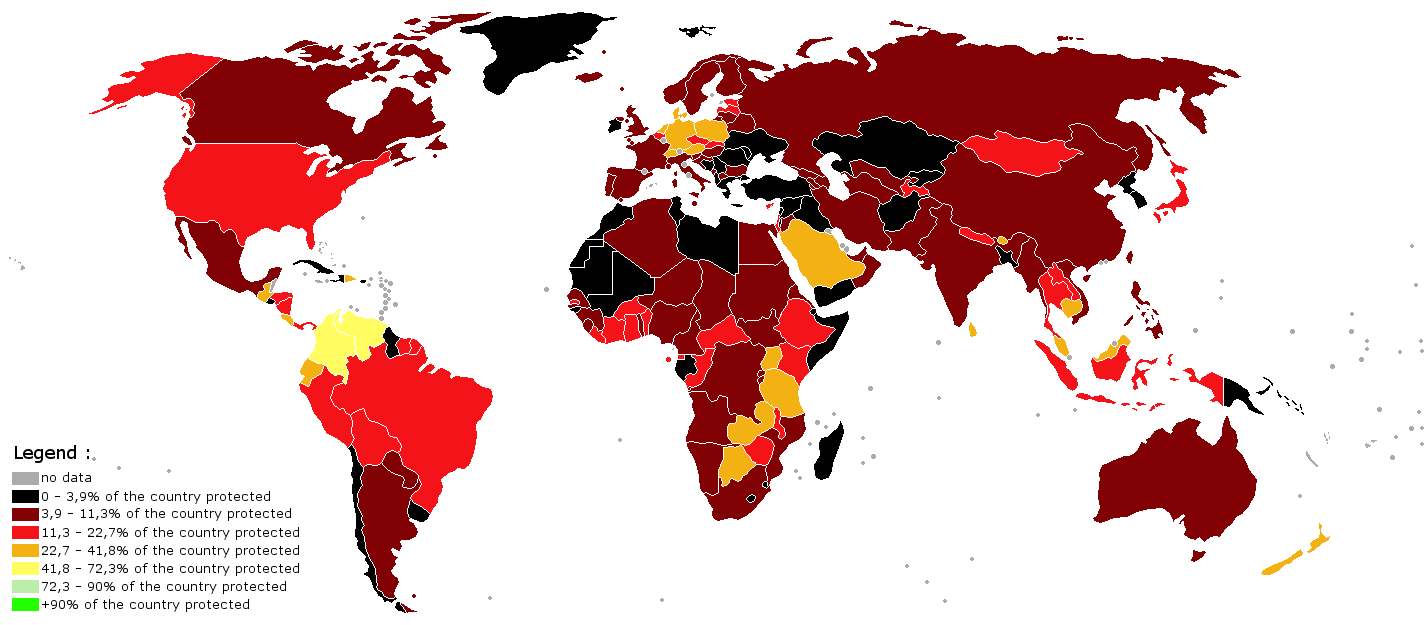
Lighter areas have more protected areas

We haven’t paved the planet — yet.

From the Grand Canyon to Grand Teton, the world is full of so-called “protected areas”: National parks, lands, wildlife preserves, and other wild places that people can visit and enjoy, but that are managed so that they remain untrammeled and intact. They comprise, overall, 12.7 percent of the Earth’s land surface.

We all know these places exist, and we sometimes visit them. But according to a new paper in PLOS Biology, “sometimes” might not really be the right word. If the study — by University of Cambridge biologist Andrew Balmford and a group of colleagues from academia and conservation organizations — is correct, then humans across planet Earth literally throng to these places.

The paper finds that people are paying global protected areas an estimated 8 billion visits a year, a “strikingly large” number (in the study’s words) that exceeds the total global population.

Some of the biggest draws, according to the researchers, include South Korea’s Seoraksan National Park (more than three million visits a year), the UK’s Lake District (over 10 million) and the Golden Gate National Recreation Area (over 13 million annually).

Even so, the new study finds, not everybody visits these places — it tends to be relatively wealthy North Americans and Europeans who do so. These continents account for four fifths of protected area visits — an estimated 3.8 billion occurring in Europe, and 3.3 billion in North America.

Moreover, our spending to preserve these wild and pristine places doesn’t remotely rival their value, in light of the 8 billion figure above. The study estimates that the 8 billion visits are worth $ 600 billion dollars in direct tourist expenditures, and an additional $ 250 billion in “consumer surplus” (money that people would be willing to spend if they had to on these visits).

“These figures dwarf current, typically inadequate spending on conserving [protected areas],” note the authors, who say that the world currently spends less than $ 10 billion in keeping protected areas…protected.

The study only examined visits to terrestrial protected areas — vast swaths of the ocean and of Antarctica are also protected, if far more rarely visited. The 8 billion estimate comes from analyzing attendance at 556 protected areas in 51 countries, and then using models to extrapolate those numbers to a much larger group of 94,238 sites on Earth that count as protected areas (still excluding Antarctica, the oceans, and some very small sites or sites that don’t welcome tourists).

The authors acknowledge that there is much uncertainty in the figure, but add that “we consider it implausible that there are fewer than 5 billion [protected area] visits worldwide each year.”

The upshot? Spend more on nature, and you can expect to get a great payback. “Substantially increased investments in protected area maintenance and expansion would yield substantial return,” the study concludes.

1753. The Externality Trap, or, How Progress Commits Suicide

By John Michael Greer, The Archdruid Report, February 25, 2015
I've commented more than once in these essays about the cooperative dimension of writing:  the way that even the most solitary of writers inevitably takes part in what Mortimer Adler used to call the Great Conversation, the flow of ideas and insights across the centuries that’s responsible for most of what we call culture. Sometimes that conversation takes place second- or third-hand—for example, when ideas from two old books collide in an author’s mind and give rise to a third book, which will eventually carry the fusion to someone else further down the stream of time—but sometimes it’s far more direct. 

Last week’s post here brought an example of the latter kind. My attempt to cut through the ambiguities surrounding that slippery word “progress” sparked a lively discussion on the comments page of my blog about just exactly what counted as progress, what factors made one change “progressive” while another was denied that label. In the midst of it all, one of my readers—tip of the archdruidical hat to Jonathan—proposed an unexpected definition:  what makes a change qualify as progress, he suggested, is that it increases the externalization of costs.  

I’ve been thinking about that definition since Jonathan proposed it, and it seems to me that it points up a crucial and mostly unrecognized dimension of the crisis of our time. To make sense of it, though, it’s going to be necessary to delve briefly into economic jargon. 

Economists use the term “externalities” to refer to the costs of an economic activity that aren’t paid by either party in an exchange, but are pushed off onto somebody else. You won’t hear a lot of talk about externalities these days; it many circles, it’s considered impolite to mention them, but they’re a pervasive presence in contemporary life, and play a very large role in some of the most intractable problems of our age. Some of those problems were discussed by Garret Hardin in his famous essay on the tragedy of the commons, and more recently by Elinor Ostrom in her studies of how that tragedy can be avoided; still, I’m not sure how often it’s recognized that the phenomena they discussed applies not just to commons systems, but to societies as a whole—especially to societies like ours. 

An example may be useful here. Let’s imagine a blivet factory, which turns out three-prong, two-slot blivets in pallet loads for customers. The blivet-making process, like manufacturing of every other kind, produces waste as well as blivets, and we’ll assume for the sake of the example that blivet waste is moderately toxic and causes health problems in people who ingest it. The blivet factory produces one barrel of blivet waste for every pallet load of blivets it ships. The cheapest option for dealing with the waste, and thus the option that economists favor, is to dump it into the river that flows past the factory. 

Notice what happens as a result of this choice. The blivet manufacturer has maximized his own benefit from the manufacturing process, by avoiding the expense of finding some other way to deal with all those barrels of blivet waste. His customers also benefit, because blivets cost less than they would if the cost of waste disposal was factored into the price. On the other hand, the costs of dealing with the blivet waste don’t vanish like so much twinkle dust; they are imposed on the people downstream who get their drinking water from the river, or from aquifers that receive water from the river, and who suffer from health problems because there’s blivet waste in their water. The blivet manufacturer is externalizing the cost of waste disposal; his increased profits are being paid for at a remove by the increased health care costs of everyone downstream. 

That’s how externalities work. Back in the days when people actually talked about the downsides of economic growth, there was a lot of discussion of how to handle externalities, and not just on the leftward end of the spectrum.  I recall a thoughtful book titled TANSTAAFL—that’s an acronym, for those who don’t know their Heinlein, for “There Ain’t No Such Thing As A Free Lunch”—which argued, on solid libertarian-conservative grounds, that the environment could best be preserved by making sure that everyone paid full sticker price for the externalities they generated. Today’s crop of pseudoconservatives, of course, turned their back on all this a long time ago, and insist at the top of their lungs on their allegedly God-given right to externalize as many costs as they possibly can.  This is all the more ironic in that most pseudoconservatives claim to worship a God who said some very specific things about “what ye do to the least of these,” but that’s a subject for a different post.

Economic life in the industrial world these days can be described, without too much inaccuracy, as an arrangement set up to allow a privileged minority to externalize nearly all their costs onto the rest of society while pocketing as much as possible the benefits themselves. That’s come in for a certain amount of discussion in recent years, but I’m not sure how many of the people who’ve participated in those discussions have given any thought to the role that technological progress plays in facilitating the internalization of benefits and the externalization of costs that drive today’s increasingly inegalitarian societies. Here again, an example will be helpful. 

Before the invention of blivet-making machinery, let’s say, blivets were made by old-fashioned blivet makers, who hammered them out on iron blivet anvils in shops that were to be found in every town and village. Like other handicrafts, blivet-making was a living rather than a ticket to wealth; blivet makers invested their own time and muscular effort in their craft, and turned out enough in the way of blivets to meet the demand. Notice also the effect on the production of blivet waste. Since blivets were being made one at a time rather than in pallet loads, the total amount of waste was smaller; the conditions of handicraft production also meant that blivet makers and their families were more likely to be exposed to the blivet waste than anyone else, and so had an incentive to invest the extra effort and expense to dispose of it properly. Since blivet makers were ordinary craftspeople rather than millionaires, furthermore, they weren’t as likely to be able to buy exemption from local health laws. 

The invention of the mechanical blivet press changed that picture completely.  Since one blivet press could do as much work as fifty blivet makers, the income that would have gone to those fifty blivet makers and their families went instead to one factory owner and his stockholders, with as small a share as possible set aside for the wage laborers who operate the blivet press. The factory owner and stockholders had no incentive to pay for the proper disposal of the blivet waste, either—quite the contrary, since having to meet the disposal costs cut into their profit, buying off local governments was much cheaper, and if the harmful effects of blivet waste were known, you can bet that the owner and shareholders all lived well upstream from the factory.  

Notice also that a blivet manufacturer who paid a living wage to his workers and covered the costs of proper waste disposal would have to charge a higher price for blivets than one who did neither, and thus would be driven out of business by his more ruthless competitor. Externalities aren’t simply made possible by technological progress, in other words; they’re the inevitable result of technological progress in a market economy, because externalizing the costs of production is in most cases the most effective way to outcompete rival firms, and the firm that succeeds in externalizing the largest share of its costs is the most likely to prosper and survive. 

Each further step in the progress of blivet manufacturing, in turn, tightened the same screw another turn. Today, to finish up the metaphor, the entire global supply of blivets is made in a dozen factories in  distant Slobbovia, where sweatshop labor under ghastly working conditions and the utter absence of environmental regulations make the business of blivet fabrication more profitable than anywhere else. The blivets are as shoddily made as possible; the entire blivet supply chain from the open-pit mines worked by slave labor that provide the raw materials to the big box stores with part-time, poorly paid staff selling blivetronic technology to the masses is a human and environmental disaster.  Every possible cost has been externalized, so that the two multinational corporations that dominate the global blivet industry can maintain their profit margins and pay absurdly high salaries to their CEOs. 

That in itself is bad enough, but let’s broaden the focus to include the whole systems in which blivet fabrication takes place: the economy as a whole, society as a whole, and the biosphere as a whole. The impact of technology on blivet fabrication in a market economy has predictable and well understood consequences for each of these whole systems, which can be summed up precisely in the language we’ve already used. In order to maximize its own profitability and return on shareholder investment, the blivet industry externalizes costs in every available direction. Since nobody else wants to bear those costs, either, most of them end up being passed onto the whole systems just named, because the economy, society, and the biosphere have no voice in today’s economic decisions. 

Like the costs of dealing with blivet waste, though, the other externalized costs of blivet manufacture don’t go away just because they’re externalized. As externalities increase, they tend to degrade the whole systems onto which they’re dumped—the economy, society, and the biosphere. This is where the trap closes tight, because blivet manufacturing exists within those whole systems, and can’t be carried out unless all three systems are sufficiently intact to function in their usual way. As those systems degrade, their ability to function degrades also, and eventually one or more of them breaks down—the economy plunges into a depression, the society disintegrates into anarchy or totalitarianism, the biosphere shifts abruptly into a new mode that lacks adequate rainfall for crops—and the manufacture of blivets stops because the whole system that once supported it has stopped doing so. 

Notice how this works out from the perspective of someone who’s benefiting from the externalization of costs by the blivet industry—the executives and stockholders in a blivet corporation, let’s say. As far as they’re concerned, until very late in the process, everything is fine and dandy: each new round of technological improvements in blivet fabrication increases their profits, and if each such step in the onward march of progress also means that working class jobs are eliminated or offshored, democratic institutions implode, toxic waste builds up in the food chain, or what have you, hey, that’s not their problem—and after all, that’s just the normal creative destruction of capitalism, right? 

That sort of insouciance is easy for at least three reasons. First, the impacts of externalities on whole systems can pop up a very long way from the blivet factories.  Second, in a market economy, everyone else is externalizing their costs as enthusiastically as the blivet industry, and so it’s easy for blivet manufacturers (and everyone else) to insist that whatever’s going wrong is not their fault.  Third, and most crucially, whole systems as stable and enduring as economies, societies, and biospheres can absorb a lot of damage before they tip over into instability. The process of externalization of costs can thus run for a very long time, and become entrenched as a basic economic habit, long before it becomes clear to anyone that continuing along the same route is a recipe for disaster. 

Even when externalized costs have begun to take a visible toll on the economy, society, and the biosphere, furthermore, any attempt to reverse course faces nearly insurmountable obstacles. Those who profit from the existing order of things can be counted on to fight tooth and nail for the right to keep externalizing their costs: after all, they have to pay the full price for any reduction in their ability to externalize costs, while the benefits created by not imposing those costs on whole systems are shared among all participants in the economy, society, and the biosphere respectively. Nor is it necessarily easy to trace back the causes of any given whole-system disruption to specific externalities benefiting specific people or industries. It’s rather like loading hanging weights onto a chain; sooner or later, as the amount of weight hung on the chain goes up, the chain is going to break, but the link that breaks may be far from the last weight that pushed things over the edge, and every other weight on  the chain made its own contribution to the end result

A society that’s approaching collapse because too many externalized costs have been loaded onto on the whole systems that support it thus shows certain highly distinctive symptoms. Things are going wrong with the economy, society, and the biosphere, but nobody seems to be able to figure out why; the measurements economists use to determine prosperity show contradictory results, with those that measure the profitability of individual corporations and industries giving much better readings those that measure the performance of whole systems; the rich are convinced that everything is fine, while outside the narrowing circles of wealth and privilege, people talk in low voices about the rising spiral of problems that beset them from every side. If this doesn’t sound familiar to you, dear reader, you probably need to get out more. 

At this point it may be helpful to sum up the argument I’ve developed here:

a) Every increase in technological complexity tends also to increase the opportunities for externalizing the costs of economic activity;

b) Market forces make the externalization of costs mandatory rather than optional, since economic actors that fail to externalize costs will tend to be outcompeted by those that do;

c) In a market economy, as all economic actors attempt to externalize as many costs as possible, externalized costs will tend to be passed on preferentially and progressively to whole systems such as the economy, society, and the biosphere, which provide necessary support for economic activity but have no voice in economic decisions;

d) Given unlimited increases in technological complexity, there is no necessary limit to the loading of externalized costs onto whole systems short of systemic collapse;

e) Unlimited increases in technological complexity in a market economy thus necessarily lead to the progressive degradation of the whole systems that support economic activity;

f) Technological progress in a market economy  is therefore self-terminating, and ends in collapse. 

Now of course there are plenty of arguments that could be deployed against this modest proposal. For example, it could be argued that progress doesn’t have to generate a rising tide of externalities. The difficulty with this argument is that externalization of costs isn’t an accidental side effect of technology but an essential aspect—it’s not a bug, it’s a feature. Every technology is a means of externalizing some cost that would otherwise be borne by a human body. Even something as simple as a hammer takes the wear and tear that would otherwise affect the heel of your hand, let’s say, and transfers it to something else: directly, to the hammer; indirectly, to the biosphere, by way of the trees that had to be cut down to make the charcoal to smelt the iron, the plants that were shoveled aside to get the ore, and so on. 

For reasons that are ultimately thermodynamic in nature, the more complex a technology becomes, the more costs it generates. In order to outcompete a simpler technology, each more complex technology has to externalize a significant proportion of its additional costs, in order to compete against the simpler technology. In the case of such contemporary hypercomplex technosystems as the internet, the process of externalizing costs has gone so far, through so many tangled interrelationships, that it’s remarkably difficult to figure out exactly who’s paying for how much of the gargantuan inputs needed to keep the thing running. This lack of transparency feeds the illusion that large systems are cheaper than small ones, by making externalities of scale look like economies of scale. 

It might be argued instead that a sufficiently stringent regulatory environment, forcing economic actors to absorb all the costs of their activities instead of externalizing them onto others, would be able to stop the degradation of whole systems while still allowing technological progress to continue. The difficulty here is that increased externalization of costs is what makes progress profitable. As just noted, all other things being equal, a complex technology will on average be more expensive in real terms than a simpler technology, for the simple fact that each additional increment of complexity has to be paid for by an investment of energy and other forms of real capital. 

Strip complex technologies of the subsidies that transfer some of their costs to the government, the perverse regulations that transfer some of their costs to the rest of the economy, the bad habits of environmental abuse and neglect that transfer some of their costs to the biosphere, and so on, and pretty soon you’re looking at hard economic limits to technological complexity, as people forced to pay the full sticker price for complex technologies maximize their benefits by choosing simpler, more affordable options instead. A regulatory environment sufficiently strict to keep technology from accelerating to collapse would thus bring technological progress to a halt by making it unprofitable. 

Notice, however, the flipside of the same argument: a society that chose to stop progressing technologically could maintain itself indefinitely, so long as its technologies weren’t dependent on nonrenewable resources or the like. The costs imposed by a stable technology on the economy, society, and the biosphere would be more or less stable, rather than increasing over time, and it would therefore be much easier to figure out how to balance out the negative effects of those externalities and maintain the whole system in a steady state.  Societies that treated technological progress as an option rather than a requirement, and recognized the downsides to increasing complexity, could also choose to reduce complexity in one area in order to increase it in another, and so on—or they could just raise a monument to the age of progress, and go do something else instead.

The logic suggested here requires a comprehensive rethinking of most of the contemporary world’s notions about technology, progress, and the good society. We’ll begin that discussion in future posts—after, that is, we discuss a second dimension of progress that came out of last week’s discussion. 

1752. Vandana Shiva: ‘All Life Depends on Soil’

By Vandana Shiva, EcoWatch, February 16, 2015


Indian civilization has sustained itself over thousands of years because it revered the soil as sacred and inviolable. It treated it as Mother Earth.

The Atharva Veda invokes the prayer to prithvi, the Earth:

“Let what I dig from thee, O Earth, rapidly spring and grow again.
O Purifier, let me not pierce through thy vitals or thy heart”

Today’s dominant policies and laws seem to be saying the opposite to the Earth—“We will dig so deep and so violently, we will bulldoze so brutally, on such a large scale and at such a high speed, that we will tear through your vitals and your heart, ensuring that nothing can grow from you again.”

Both ecological science and our ancient wisdom teaches us that all life depends on soil. But we are now unthinkingly adopting the illusion that human progress is based on how fast we can destroy, bury and consume the soil.

Uncontrolled urbanization, mega mines, superhighways and gigantic infrastructure projects are the burial grounds of fertile soil. We are forgetting that life grows from soil, not concrete and tarmac.

It is only our farmers who are practicing ecological agriculture, returning organic matter to the soil and growing soil fertility, and, through it, the foundation of our food and our future. In practicing organic farming, they also conserve water and absorb carbon dioxide from the atmosphere, thus addressing climate change. Money might grow from speculative real estate development, but not life. Multiple “clashes of civilization” are taking place in India today around soil and land.

There is a clash between what Aristotle called “chrematistics,” the art of money-making, and “oikonomia,” the art of living. The clash is between the soil and Earth centred agrarian economies of peasant societies and the money-centered speculative economies which are obsessed with the art of money making, with no respect for the democratic rights of people whose land is being grabbed, or for the soil that has sustained our civilization over millennia.

This intense clash is because the government wants to forcefully and undemocratically appropriate land from the farmers and hand it over to builders and speculators.
A war against land and people has been declared through the land acquisition ordinance which, by reversing the Right to Fair Compensation and Transparency in Land Acquisition, Rehabilitation and Resettlement Act, 2013, takes us back to the colonial law of 1894.

There is a clash between two views of history on the land question. There is a false, linear view of history that projects human progress as moving from agriculture to industry to service economies. A more realistic view recognises that history moves in cycles.

At the national level, history of land is not a linear history of dispossession, but a cyclical history of land grab and land reform.

The British created the zamindari system, which led to violence, injustice and famines. Peasants started movements like Tebhaga after the great Bengal famine, and movements for land reform and land rights based on “land to the tiller” philosophy. West Bengal had its Operation Barga, India introduced “land ceiling,” a limit on the ownership of land, and land reform along with land distribution made Independent India a land of hard working, sovereign and proud small farmers.

The land grab ordinance is, in fact, a new zamindari, aimed at reversing all that Independent India put in place to protect—land, food security, the sovereignty of small farmers and the country. But it is more than a reversal because the context is different. In today’s context, unjust laws passed undemocratically for land acquisition have far more impact because the activities are more destructive ecologically and socially. 

Removal of the clauses for consent in the land ordinance is an assault on democracy. Removal of the food security clauses is a reckless and irresponsible action forfeiting the future. Has the government been so blinded by corporate “chrematistics” that it cannot see the damage this will do to life of the soil, the “oikonomia,” the vital food economy of the peasants? Has it been so deafened by the voice of those whose only objective is profits and money-making, that it cannot hear the screams of a dying soil and the people of the soil—the tribals and peasants?

A new Singapore-style capital is proposed for Andhra Pradesh at the cost of Rs 100,000 crore. About 100,000 acre of prime farmland on the banks of the Krishna river is being grabbed from small farmers who, with one acre land, earn more than Rs 30,000 per month. Former Indian Administrative Service officer Devasahayam reports how the government is describing the concrete jungle it is planning as being “full of life and economic activity,” implying that farming that feeds people is a “lifeless activity!”

Globally, young people are moving back to the land, driven both by crisis of unemployment and by frustration with the urban corporate life which might bring money, but no satisfaction. Young people from banks and software companies are coming to Navdanya to learn how to be organic farmers and make a living from the land. After the banks and information technology (IT), it is soil and land that holds the future.

We already have a scarcity of land and fertile soil. To bury this scarce and precious resource on the basis of an outmoded view of history, progress and development is not enlightened policy-making. There is not enough land in the country for the limitless appetite for mining, urbanisation and industrialisation. While profiteering from land in a globalised economic system based on the false idea of limitless growth might inspire current policies, land and fertile soils set their own ecological limits. There are also social and political limits to how much dispossession, injustice, violence and destruction of democracy a society can bear. Protests against land grab and the land law are growing across the country. If they are violently crushed, as in the tribal areas, violent conflicts will intensify. In the worst case scenario, if the fabric of the soil and society are ruptured beyond repair, we will disintegrate as a civilization, as is happening to so many societies around us.

We can avert the collapse of our civilization if, in this year of soil, we collectively and democratically commit ourselves to protecting and rejuvenating the soil and, thus, our future.