Showing posts with label U.S.-Cuba relations. Show all posts

Thursday, February 18, 2016

2212. Obama to Visit Cuba in March, as Talks of Expanding Trade Begin

By Julie Herschfeld Davis, The New York Times, February 17, 2016
Rodrigo Malmierca, the Cuban minister of trade and foreign investment, during a U.S. Chamber of Commerce luncheon on Tuesday in Washington. Photo: Chip Somodevilla/Getty Images.

WASHINGTON — President Obama will travel to Cuba within weeks, a senior administration official said on Wednesday, making a historic visit as part of an effort to end more than a half-century of estrangement and forge normalized relations with a Cold War adversary.

The administration will announce the trip — the first by a sitting president in 88 years, when Calvin Coolidge visited — on Thursday as top Commerce, Treasury and State Department officials are meeting privately with their Cuban counterparts in Washington for talks aimed at expanding business ties between the two nations.

Opening the discussions on Wednesday, Penny Pritzker, the commerce secretary, called on the government of Cuba to open its economy to American business and investment, saying the Cubans must do more to help facilitate commerce after the thaw between the two nations.

Ms. Pritzker said her department had acted aggressively since Mr. Obama’s December 2014 announcement to pave the way for American companies to do business in Cuba, granting 490 authorizations amounting to $4.3 billion last year alone — a roughly 30 percent increase over the previous year.

“But we need help from the Cuban side,” Ms. Pritzker said. “The U.S. companies that are attempting to do business in your country continue to face challenges.”

She added: “Without specific changes on your side that allow the private sector to engage, our changes will not unlock the opportunities for the Cuban people that both of us want to see.”

Tha talks, which began in a wood-paneled library at the Commerce Department within view of the White House, represent the latest effort by the Obama administration to push forward with the policy shift the president set in motion just over a year ago. But the process is vastly complicated by the American statutory trade and commercial embargo that has been in place for decades and that only Congress can lift.

While the Commerce and Treasury Departments have moved several times to loosen restrictions on travel and trade, Rodrigo Malmierca, the foreign trade and investment minister of Cuba, said the onus was on the United States to remove the embargo, and on Mr. Obama to essentially defang the laws that compose it in the meantime.

“These measures have been positive and are in the right direction, but still they are not sufficient in terms of the lifting of the main obstacle that we still confront that is the blockade,” Mr. Malmierca, who was seated opposite Ms. Pritzker as the talks began, said in Spanish through a translator. “We are aware of the fact that the blockade can only be fully lifted with the actions in Congress,” he added, but, “we know that the executive has prerogatives which can be used in terms of the dismantling, trying to void the blockade.”
The regulatory discussions began on Wednesday, a day after the signing in Havana of an arrangement allowing scheduled direct flights between the United States and Cuba for the first time in decades.

American carriers can begin applying to the Department of Transportation to offer the service — up to 20 scheduled flights a day to Havana and 10 to each of nine other international airports in Cuba. The pact aims to substantially increase travel between the two countries, which are currently served by only about a dozen charter flights a day.

But even as Mr. Obama makes progress in his drive to forge closer commercial ties with Cuba, the process is hamstrung by sanctions that have left American businesses wondering what they are permitted to do. Mr. Malmierca said on Tuesday that he had heard from many American companies that want to establish businesses in Cuba but are ensnared in regulatory limbo, awaiting special licenses from the United States government.

“The problem that we face today is that many companies want to do business, but we need to create the conditions for them to access the Cuban market,” Mr. Malmierca said at an event hosted by the U.S. Chamber of Commerce.

He repeatedly said that Cuba welcomed American investment and would not “discriminate” against United States companies. “Lifting the blockade is essential to advancing this,” he said.

On Wednesday, Mr. Malmierca called on Mr. Obama to do more unilaterally, including allowing the dollar to be used in transactions with Cuba. On Tuesday, he said the president should lift the ban against imports of top Cuban products like rum and cigars and end the prohibition against direct investment in Cuba.

Critics argue that with each move to foster better relations and American investment, the president is rewarding a dictatorial government that infringes on human rights and squelches democratic discourse.

But Mr. Obama has argued that the best way to put pressure on the Cuban government is to expose its citizens to American values and ideals and through diplomatic channels re-established last year when embassies reopened in Havana and Washington.

This week’s technical talks are the second time since Mr. Obama announced the opening with Cuba in December 2014 that Ms. Pritzker and Mr. Malmierca have come together with officials from their governments to try to harmonize some aspects of their business regulations. Ms. Pritzker traveled to Havana in October to begin the discussions, which have been made even more labyrinthine on the American side by the statutory embargo.

The Obama administration announced last month that it was relaxing more restrictions on business with Cuba, including allowing United States banks to provide direct financing for the export of any product other than agricultural commodities, which are still walled off under the embargo.

Wednesday, February 17, 2016

2210. The First American Build Factory in Cuba Since 1959 Revolution

By Susan Adams, Forbes, February 16, 2016

tractor

Horace Clemmons and Saul Berenthal, both 72-year-old retired software engineers, are slated to become the first Americans since 1959 to set up a manufacturing plant in Cuba. Their plan: produce small, easily maintained tractors for use by family farmers. Under new regulations issued by the Obama administration, the U.S. Treasury Department’s Office of Foreign Assets Control gave the Paint Rock, AL-based partners the go-ahead last week. Once they get final approval from the Cubans, they anticipate that in early 2017, they’ll start building a factory in a special economic zone set up by the Cuban government in the port city of Mariel. In this condensed and edited interview, Berenthal describes his transition from software entrepreneur to Cuban manufacturing pioneer.
Susan Adams: Tell me about your personal connection to Cuba.
Berenthal: I was born and raised in Cuba. I came to the U.S. in 1960 right after the revolution. First I came and then my parents. My family in Cuba is in the cemetery. But I have lots of friends there and I’ve been traveling back and forth since 2007.
Adams: How did you get the idea to build tractors?
Berenthal: I understood the needs of the Cuban economy. Cuba has to import more than 70% of what people eat. They’re still using oxen to farm the land. Our motivation really is to help the Cuban farmer be more productive.
Adams: But you and Mr. Clemmons are software engineers. How did you know the first thing about farm equipment?
Berenthal: Horace was born and raised on a farm in Alabama. He’s the farming expert and I’m the Cuba expert.
Adams: Just because he was raised on a farm wouldn’t mean he would know how to make tractors.
Berenthal: We hired an engineering company in Alabama that helped us pick up an existing design that was appropriate for what we wanted to do. We brought in state-of-the-art technology and produced the tractors. We have a tractor in Cuba already that’s going to be shown at an agricultural fair in March.
Adams: It sounds like you were motivated less by profit than by a desire to help the Cuban economy and Cuban-American relations.
Berenthal: Yes, our motivation is really to help Cuban farmers be more productive. Through commerce and trade, we can bring Cuban and American people closer together.
Adams: What about making money?
Berenthal: Our business model says we are investing in Cuba and reinvesting any profits we make. We’ll do what we did with our other businesses. We’ll create value and then sell the company.
Adams: What profit margins do you project for your tractors?
Berenthal: We’re aiming for 20%.
Adams: How many tractors do you need to sell before you’re profitable?
Berenthal: We believe we’ll sell 300 tractors in the first year and then we’ll ramp up to 5,000. That includes other light equipment we’ll sell for construction as well. The facility will have the capacity to produce up to 1,000 tractors a year. I think the profitability will come after the first or second year when we start to do production and not just assembly in Cuba.
Adams: But Cuba is plagued by shortages of the most basic products. How will you get tractor parts?
Berenthal: They’re all going to be sourced and shipped from the U.S. The current state of the embargo makes it so we can’t buy parts there. But we think that within the next three years the embargo will be lifted and we’ll be able to source from Cuba, if not sooner.
Adams: Your factory will be in a special economic zone?
Berenthal: It’s called ZED, for Zona Especial de Mariel. It’s built around one of Cuba’s biggest ports and it has a whole bunch of sections dedicated to foreign investment. They provide for a bunch of tax and investment incentives. We’re also taking advantage of Cuba’s commercial treaties with the rest of Latin America, where we’ll be able to ship and provide better pricing than for tractors built in the U.S.
Adams: What kind of tax incentive is Cuba offering?
Berenthal: For the first 10 years we don’t pay any taxes.
Adams: How many local people will you employ?
Berenthal: We’ll start with five and ramp up to 30 within the first year and then probably go up to 300.
Adams: You want to sell the tractors for $8,000-$10,000. How can a Cuban farmer with an ox possibly afford that?
Berenthal: There are a couple of ways. There is financing by the Cuban government and by third countries like Spain, France and the Netherlands. We also count on Cuban-Americans who live in the U.S. who have relatives and friends that run farms. We think they would be happy to contribute to Cubans owning a tractor. We’re also counting on NGOs that help Cuban farmers, like religious groups.
Adams: How much is your initial investment?
Berenthal: We project a $5 million investment and then it will go up to $10 million.
Adams: Where are you getting the money?
Berenthal: It’s private money. We have a couple of investors but we have also sold a couple of companies.
Adams: What was your first company?
Berenthal: We left IBM in 1982 and started our own company to compete with it. It was called PSI, for Post Software International, in Raleigh, NC, which developed software for cash registers. We had revenues of $30 million, offices in South America, Europe, Australia. The company was bought by Fujitsu in 1995. The purchase price wasn’t public. We had 300 employees in the states and 400 throughout the rest of the world. It was a significant enterprise.
Adams: Then you started a second company?
Berenthal: Csoft. It was a company that supported the credit card readers at gas pumps. We integrated those with the inside point-of-sale devices. In 2005 we sold that to the gas pump manufacturer we’d developed the software for. That company had $12 million in revenue and 60-some-odd employees.
Adams: What did you do after that sale?
Berenthal: We enjoyed life and then I started traveling to Cuba to find out what was going on there. We had other businesses that had to do with real estate and office buildings.
Adams: What did you find when you went to Cuba?
Berenthal: I started meeting with people and I had a lot of contacts in the economics department at the University of Havana. I learned what the Cuban government was proposing to do about readjusting the economy. In 2014, when the opportunity for trade arose, we decided to pursue farming and tractors.
Adams: How difficult was it to get U.S. government approval?
Berenthal: In all honesty it was tedious rather than difficult. We had to wait for the regulations to change so that the proposal we made was covered by the regulations implemented over the last nine months.
Adams: Were you competing with other U.S. companies?
Berenthal: We certainly believe we’re going to compete with the Chinese and Byelorussians, who are the current suppliers of tractors to the Cuban government.
Adams: Where did you get the names for your company, Cleber, and product, Oggun.
Berenthal: Cleber is from our names, Clemmons and Berenthal. It’s clever! Oggun is the name of the deity for iron in the Santeria religion. Santeria is the most popular religion in Cuba. It’s a mixture of Catholic and African religions.
Adams: Do you practice Santeria?
Berenthal: No ma’am. I’m Jewish. We’re called Jewbans.

Sunday, January 10, 2016

2157. Cubans, Fearing Loss of Favored Status in U.S., Rush to Make the Arduous Journey

By Francis Robeles, The New York Times, Januray 9, 2016
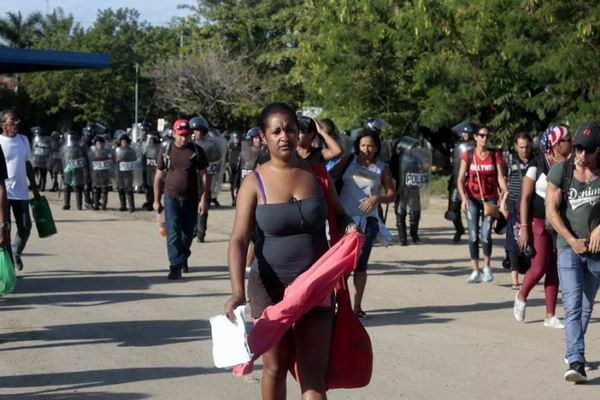
A group of Cubans seeking to tarvel to the U.S. in Costa Rica
LA CRUZ, Costa Rica — In Gretchen López’s slumber, during whatever winks of sleep she could get in a crowded open air shelter, she dreamed she was sending money to her mother in Cuba to renovate her crumbling house and buy delicious food.

“But I woke up and I was here,” she said, looking around a fire station here in rural Costa Rica, where she sleeps beside hundreds of other Cubans who got stuck while trying to make a perilous journey through eight countries to reach the United States.

Now, after two months languishing in a shelter, Ms. López and nearly 11,000 other Cubans who were stranded because of a political impasse in Central America will soon be back on the trail, heading to the United States in an exodus that some officials have likened to a stampede.

While American politicians debate whether to accept Syrian refugees and lament the crush of Central Americans who make their way illegally into the United States, the border is about to be crashed in the coming weeks by another wave of newcomers.

But in this case, the Cubans have a trump card: American law has long given them special status to live in the United States and apply for a green card — provided they make it there.

This latest wave of Cuban migration stems from a number of changes enacted by Cuba’s communist government in recent years, in part to jump-start the island’s feeble economy. People are allowed to sell their cars and real estate, a move that suddenly enabled many more to pay smugglers to get them to the United States. Cuba also began allowing its citizens to obtain passports and leave the country more freely, unleashing a rush for the exits.

If that was the kindling, the Obama administration’s decision in 2014 to restore diplomatic relations with Cuba served as the match. Rumors quickly circulated that with embassies reopening, the United States would soon eliminate the 1966 Cuban Adjustment Act, which gives Cubans who make it to the United States a fast track to permanent legal residency.

“There’s a rush of Cubans now, because a lot of people are afraid of that law being repealed,” said Lázaro Clarke, 34, who worked as a barber and fruit vendor in Havana, as he waited in Costa Rica. “With the law or without the law, I’m going.”
Tens of thousands of Cubans have plunked down the profits of their home and car sales to pay for a treacherous 5,000-mile journey by plane, bus, boat and foot. Most have begun by flying to Ecuador, which did not used to require a travel visa. Then they have moved on to Colombia, Panama, Costa Rica, Nicaragua, Honduras, Guatemala and Mexico in hopes of reaching the American border.

The circuitous route allows Cubans to bypass the dangerous trip through the Florida Straits, a crossing that cost many Cubans their lives and where, because of an American policy known as “wet foot, dry foot,” they would be turned back if caught by the Coast Guard.

About 30,000 Cubans made it to the southwest border of the United States in the 2015 fiscal year, a 77 percent increase from the year before, according to the Customs and Border Protection agency.

Kathya Rodríguez, the director of Costa Rica’s immigration service, said, “In 2015, the numbers just shot up.”
Costa Rica said it warned its neighbors last year that a tidal wave was building.

“Many countries turned to look the other way, as though they were ghosts — they knew they were there, but paid no attention,” said Costa Rica’s foreign minister, Manuel González.

Then in November, Costa Rica broke up a smuggling network that had been ferrying migrants through the country. Without the guides to lead the way, migrants who had been quietly slipping past border crossings suddenly became conspicuous. Thousands of them.

Costa Rica gave them transit visas and sent them on their way, but Nicaragua — a longstanding ally of Cuba — balked, refusing to let them pass. Cubans started to pile up at the Nicaraguan border. In November, throngs of them pushed their way past the border agents.

They were repelled by Nicaraguan soldiers with tear gas and swift beatings. “As much as we lived under a regime, nothing like that had ever happened to us before,” Ms. López, 22, said. “Tear gas? Bullets? Some of us had been beaten by the police before, but not like that.”

Thousands of Cubans who said they were fleeing political and economic repression at home learned about the unexpected perils of free societies, including the proliferation of guns. Armed bandits preyed upon Cubans on the road, especially those who had not thought to first wire their life savings to relatives in the United States.

“I would tell anyone not to take this trip,” said Pedro Enrique Duarte, a 48-year-old accountant who was attacked in Colombia and rescued by a local family. “You spend the whole time straddling between life and death.”
Many people were financially wiped out.

“I sold my house for $3,000, and I will arrive in debt,” said Dayana Fernández, a 22-year-old hairdresser who hopes to join her in-laws in South Florida.

With Nicaragua still refusing to offer passage, Costa Rica has spent $1 million to house and feed the Cubans in schools and other shelters around the country.

“Never before have we, even in a natural disaster, had the necessity to attend to this many people for this long,” Mr. González said.

Late last month, Costa Rica and the other Central American countries agreed on a plan to hasten the Cubans’ departure. On Tuesday, a group of 180 Cubans are scheduled to fly over Nicaragua to El Salvador, which had not been part of the migrant trail. From there, they will take a bus to Guatemala, then another to southern Mexico.

If the effort goes smoothly, two flights will leave each day, with the expectation that it will take three weeks to evacuate the approximately 8,000 Cubans stuck in Costa Rica. The hope is to hatch a similar plan for the 3,000 Cubans in Panama, too.
The Cubans will pay $555 for the charter flight, the bus and food arranged by a travel agency. Once in Mexico, the Cubans will be on their own to reach the United States border. Unlike Hondurans and other Central Americans trying to reach the border, Cubans can receive a 20-day transit visa from Mexico.

Nations in the region stressed that the deal was a one-time offer. To stem the flow of migrants, Ecuador started requiring visas in December. Costa Rica says it will deport any additional Cubans caught in its territory.

The Cuban government has long condemned the American policy of accepting Cuban migrants, saying it encourages human trafficking and “the politicization of immigration policies.”

“We see it as a double standard,” said Hugo Martínez, El Salvador’s foreign minister. “It’s a policy that allows one set of migrants to be treated in a privileged manner and another set of migrants in a discriminatory fashion.”
There has been ample talk of modifying or revoking the 1966 Cuban Adjustment Act, but the likelihood of action by Congress appears slim.

“Nobody should be given preferential treatment,” said Representative Henry Cuellar, a Texas Democrat who visited the Cubans at the shelters in Costa Rica. “I don’t think it’s fair at all.”

Even some staunch opponents of the Cuban government say the law needs to be rethought.
“This notion that you’re going to have people coming up Central America and into the United States through the southern border is unacceptable,” said Senator Marco Rubio of Florida, a Cuban-American running for the Republican presidential nomination.

The State Department said in a statement that the United States is “committed to supporting safe, orderly and legal migration from Cuba,” but added that “the administration has no plans to alter current migration policy regarding Cuba.”
The only bill to repeal the act came from Representative Paul Gosar, Republican of Arizona, who said Cubans should be treated like other “illegal immigrants.” He drew little support from Cuban-Americans, and his bill has gained little traction.

“Maybe people think it’s not fair for us to get that privilege,” said Igor Thondike, who has been sleeping on a basketball court in Costa Rica since November. “It’s also unfair that we Cubans have gone more than 50 years without an election.”

He is eager to continue his journey and hopes to find a job installing windows in the United States.

Friday, August 14, 2015

1979. Fidel Castro: Reality and Dreams

By Fidel Castro Ruz, Granma, August 13, 2015
Fidel Castro in his latest appearance in July 2015. Photo: Estudios Revolución.
Writing is a way to be useful if you believe that our long-suffering humanity must be better, and more fully educated, given the incredible ignorance in which we are all enveloped, with the exception of researchers who in the sciences seek satisfactory answers. This is a word which implies in a few letters its immense content.
All of us in our youth heard talk at some point about Einstein, in particular after the explosion of the atomic bombs which pulverized Hiroshima and Nagasaki, putting an end to the cruel war between the United States and Japan.
When those bombs were dropped, after the war unleashed by the attack on the U.S. base at Pearl Harbor, the Japanese Empire had already been defeated. The United States, whose territory and industries remained removed from the war, became the country with the greatest wealth and the best weaponry on Earth, in a world torn apart, full of death, the wounded and hungry.
The Soviet Union and China together lost more than 50 million lives, along with enormous material damage. Almost all of the gold in the world landed in the vaults of the United States. Today it is estimated that the entirety of this country’s gold reserves reached 8,133.5 tons of this metal. Despite that, tearing up the Bretton Woods accords they signed, the United States unilaterally declared that it would not fulfill its duty to back the Troy ounce with the value in gold of its paper money.
The measure ordered by Nixon violated the commitments made by President Franklin Delano Roosevelt. According to a large number of experts on the subject, the foundation of a crisis was created, which among other disasters threatens to powerfully batter the economy of this model of a country. Meanwhile, Cuba is owed compensation equivalent to damages, which have reached many millions of dollars, as our country has denounced throughout our interventions in the United Nations, with irrefutable arguments and facts.
As has been expressed with clarity by Cuba’s Party and government, to advance good will and peace among all the countries of this hemisphere and the many peoples who are part of the human family, and thus contribute to the survival of our species in the modest place the universe has conceded us, we will never stop struggling for peace and the well-being of all human beings, for every inhabitant on the planet regardless of skin color or national origin, and for the full right of all to hold a religious belief or not.
The equal right of all citizens to health, education, work, food, security, culture, science, and wellbeing, that is, the same rights we proclaimed when we began our struggle, in addition to those which emerge from our dreams of justice and equality for all inhabitants of our world, is what I wish for all. To those who share all or part of these same ideas, or superior ones along the same lines, I thank you, dear compatriots.
Fidel Castro Ruz
August 13, 2015
1:23 a.m.

Thursday, November 20, 2014

1649. Esteban Morales on Cuba-US Relations

By Fernando Ravsberg, Havana Times, November 20, 2014
Esteban Morales

Cuban professor Esteban Morales is one of the most reputable experts on the issue of Cuba-US relations. He has just published a book titled De la confrontacion a los intentos de normalizacion (“From Confrontation to Normalization Efforts”), a volume crucial to understanding the bilateral conflict between the two countries. He agreed to devote part of his limited time to speak with us about the past, present and future of these relations.

Are changes in US policy towards Cuba coming?
Esteban Morales: We would need to do a detailed analysis of the past elections and the current makeup of the US Congress. Obama can’t lift the embargo, because that is a prerogative of Congress, but there are many things he can do. He can broaden academic exchange between the two countries, make it possible for US citizens to visit Cuba, take our country off the list of nations that sponsor terrorism, hold talks about the Guantanamo Naval Base, and increase the United States’ cooperation efforts in the fight against Ebola. Obama can also negotiate the exchange of Alan Gross for our three comrades serving prison sentences in the United States.

There are those who compare the United States coordination efforts in the Ebola campaign with its Ping-Pong diplomacy with China.
EM: Well, it does resemble it in the sense that it is kind of rapprochement that could open other doors. Many things can be done to lessen the pressure on Cuba and those applied on the United States, the pressure Latin America put on the US by inviting Cuba to the 2015 Summit of the Americas, for instance. Washington is paying an increasingly higher price for maintaining that policy of hostility.

Could bilateral talks be undertaken in the short term?
EM: I believe it is possible today. In 1977, with the Carter administration, the most important talks to date were held. The problem then was that the bilateral debate included multilateral issues, like Cuba’s presence in Angola and Central America and its relations with the Soviet Union.

What would be the obstacles today?
EM: The obstacles that existed in Carter’s time do not exist today. Our relations with Russia are different, we do not have troops in Africa and the situation in Central America has changed. Cuba’s international activism is of a different nature today – it has more to do with aid in areas of health, education and others.

What we have today are contradictory perceptions. Obama said the main obstacle is the case of Alan Gross, but that can be overcome easily. What happened with Gross is his fault and the fault of US intelligence services, who sent him to Cuba. His own family has said that Obama is responsible for the situation. Our government is offering to exchange him for the 3 Cubans still imprisoned in the US. Everyone would benefit from that.

Would Cuba be willing to release Gross in exchange of starting talks, or is the release of the three Cuban agents one of the conditions?
EM: I believe it’s a condition, because it’s a very painful situation for us – those men have been in prison there for 16 years. They went on a mission to protect Cuba and what they did to them there was unjust. I believe it is right that Cuba should make their release a condition for allowing Gross to return to the United States. The Obama administration has the power to do this and it would not involve high costs for it. The other day, they traded 11 Taliban prisoners for a US soldier.

Does Cuba want to begin negotiations there?
EM: Negotiations needn’t start there. In fact, we’re already working together in the fight against Ebola. We can debate other issues, but, sooner or later, we’re going to have to talk about these people in prison.


What would be on the agenda for Cuba?
EM: One of the issues we have to talk about is the blockade, particularly its financial aspect, which leads to things as absurd as the US $ 8 billion fine applied on a French bank. Cuba could also ask for US citizens to be allowed to travel to Cuba freely, because that would have a significant impact on the growth of tourism. We could address the lifting of restrictions on a number of medications we need and the US currently does not allow us to buy. We can negotiate the rules of trade with the United States, which today force Cuba to pay in advance and in cash. There are a number of things we can do.

To what extent would the Cuban government be willing to negotiate?
EM: The Cuban government is willing to negotiate everything the US government wants to, including the issue of human rights. What Cuba isn’t going to accept is for Washington to impose parameters on Cuba’s political system, demanding that it become a multi-party system or that it adopt a market economy. Those issues have to do with Cuba’s sovereignty as a country and we would never accept being told what to do in this sense.

Why did previous negotiations fail?
EM: The main cause was that the United States was never willing to negotiate on an equal footing – it always tried to impose its agenda on us. Washington tried to tell us what our international relations should be like, demanding that we break ties with the Soviet Union. They demanded that we leave Angola. That was the end of it, it made it impossible to make any headway, because Cuba could not accept having the US dictate its policy.

What could Cuba do to facilitate a rapprochement?

EM: Two years ago, Cuba advanced an immense number of issues where cooperation with the US was possible, including medical and educational issues. But we won’t arrive at an understanding while Washington continues to think that Cuba is far too small to address it as an equal. Our rhetoric today is very diplomatic vis-à-vis the United States and Raul Castro has said he is willing to talk about anything, anytime, but only on the basis of equality.