By Ike Nahem, The Unrepentant Marxist, November 15, 2018
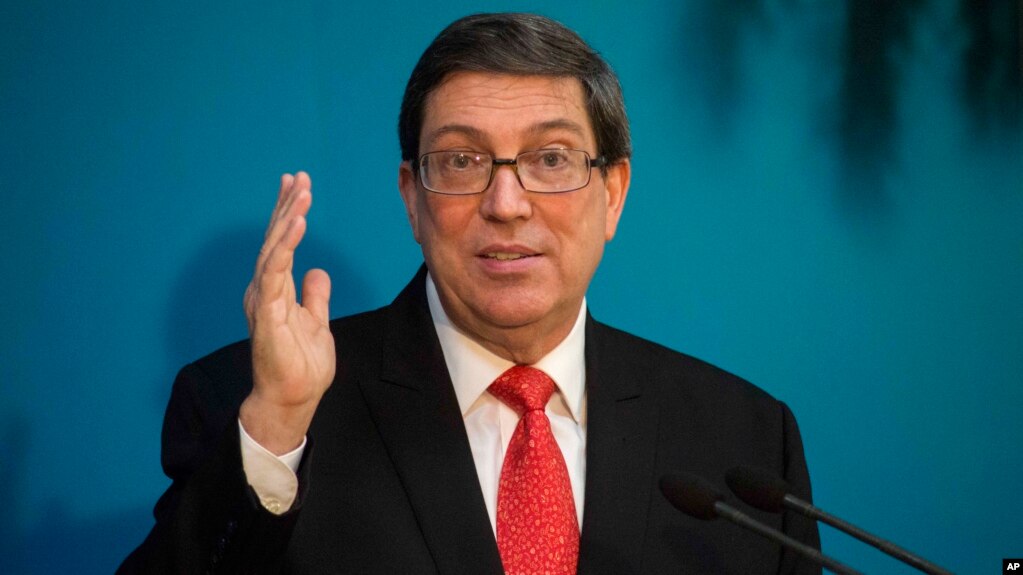 |
| Cuba's Minister of Foreign Affairs spoke at the UN on November 1, 2018. |
On November 1, 2018, for the twenty-seventh straight year, the full United Nations General Assembly (UNGA) voted by a near-unanimous 189-2 for “the necessity of ending the economic, commercial and financial embargo imposed by the United States of America against Cuba.” The Israeli government, as usual, voted automatically with the US without saying a word on the floor. There were no abstentions, but Moldova and Ukraine chose not to vote at all.
[Footnote 1: The Benjamin Netanyahu Israeli government generally jerks its knee behind the US position on the Cuba anti-US blockade votes, abstaining in the last vote in 2016 when Barack Obama was in the White House. Netanyahu’s UN representatives reverted to a No vote this time under Trump. While diplomatic relations between Israel and Cuba have not been restored since being broken in the aftermath of the 1973 Middle Eastern War, which saw major combat between Israeli forces and the armies of Egypt and Syria, Israel and Cuba carry out significant two-way economic trade and commercial relations. There is important Israeli-based capital investment in several Cuban projects and industries including irrigation technology, office towers, and agricultural production. There is also fully legal travel from each country to the other. The many thousands of Israeli travelers to Cuba, and the travel agencies that work with them, have found no anti-Semitism in Cuba and no personal hostility towards Israelis even though the Cuban government is a strong supporter of Palestinian self-determination and has normal or friendly diplomatic relations with all the Arab countries as well as Iran. Cuba promotes a two-state solution for Israel-Palestine based on UN Resolution 242, with East Jerusalem as the Palestinian capital.]
“Clever” Tactic Fizzles Fast
The final vote had been delayed a day as the Donald Trump White House wheeled out what they apparently thought was a very clever tactic aimed at diverting attention away from Washington’s annual political isolation and defeat. The tactic was to propose a series of no less than eight “amendments” to the anti-blockade Resolution with bogus attacks against Cuba over “human rights” and political freedoms inside Cuba.
US Ambassador to the UN Nikki Haley, in her last hurrah before resigning the post by year’s end, presented the “amendments” as being formulated by directly using the past words from Washington’s NATO allies in the European Union and Canada. This year, as usual, the EU and Canadian representatives made perfunctory statements after the vote with implicit criticisms of Cuba along the lines of restrictions on democratic rights, freedom of speech and assembly, and so on, which are sometimes put in the context of the US blockade. (See my Submission to the United Nations Human Rights Commission, Geneva, Switzerland, “The Case of Cuba: “Human Rights” as a Club” https://dissidentvoice.org/2017/10/the-case-of-cuba-human-rights-as-a-club/)
Both EU and Canadian diplomatic spokespeople quickly disabused Haley of any hope that Washington’s maneuvers would gain traction this year and bottle up the works. An Austrian diplomat speaking for the EU and the Canadian representative both made forceful statements rejecting all the “amendments.” They reiterated that the “amendments” had “no place in the current Resolution” and that the question of the “extraterritorial” US economic, commercial, and financial embargo against Cuba should not be “mixed up” with the issues raised through the “amendments.”
The General Assembly was required to vote on each Amendment separately. Haley and her boss Trump were isolated and cornered with no political way out. Each “amendment” went down in flames with 3 votes in favor (the US, Israel, and the Ukraine, which managed this time to press a button, 114 against, with 66 abstentions.
The common denominator in the near-unanimous votes, year after year in the UNGA, is the question of “extraterritoriality,” whereby the United States government gives itself the right to impose its economic, political, and travel blockading of Cuba on other countries and commercial entities who have normal or friendly relations with the Cuban workers’ state. It is this US posture, long before Trump’s regime came into power, that determined the votes of the European Union – a major capitalist trading and economic bloc with its own great political pretensions – with Cuba against US policy. Trump and Haley’s amendments ploy fizzled fast and was labeled correctly by EU and Canadian representatives as a “diversion” from the real issue, for them, of “extraterritoriality.”
The General Secretary’s Report
Most speakers from the floor referred positively to the report issued by UN General Secretary Antonio Guterres, the former Portuguese President and former President of the Socialist International, on the UNGA Resolution against the US blockade. It is a 168-page long comprehensive document. (http://undocs.org?A/73/85). Virtually every member-state plainly gives their opposition to the US blockade in their own words, as well as statements from 36 “organs and agencies of the United Nations system” from the Comprehensive Nuclear-Test-Ban Treaty Organization to the United Nations Children’s Fund to the World Trade Organization, all attacking from their own angle and perspective the US blockade and solidarizing to some degree, mostly strongly, with Cuba.
From Obama to Trump
The Trump Administration has re-tightened aspects of the US economic and travel sanctions that had been marginally loosened during the last two years of the second Barack Obama White House. Full diplomatic relations were restored between Washington and Havana in July 2015 and Trump has stopped short of moving to abrogate them. He has, however, virtually frozen US embassy functions in Havana, making it very difficult for Cuban citizens to travel to the United States. This includes family members, trade unionists, doctors and scientists, and artists and musicians. “People-to-people” licensed travel to Cuba by US citizens is still possible and Cuban-American citizens remain able to travel back and forth to the island with no special requirements.
Trump has consciously ratcheted up bellicose and provocative anti-Cuba rhetoric. This plays badly with the “public opinion” of the peoples and governments of the world, including inside the United States and among Cuban-Americans. The fusillades of hostile demagogy against the Cuban government by Trump, Nikki Haley, and National Security Advisor John Bolton only produces disdain and contempt across the political and ideological fissures in world politics. This is because the Cuban state and government practice of international solidarity – including Cuba’s vanguard role in medical internationalism and worldwide emergency disaster relief efforts – and its political principles is universally admired. It is universally recognized that Cuba’s quick action and dispatch of medical personnel was the decisive factor in containing and conquering the 2014 outbreak of Ebola in West Africa on the ground. Also very clear factually are the example of Cuba’s great human indices for the health and education of the Cuban population as a whole despite the terrible impact of decades of US economic and political aggression, and recurrent military and terrorist threats. These are all settled questions around the world. And all the huffing and puffing of Trump and his lackeys cannot change that.
For many years before Trump, the UNGA annual vote around Cuba have registered an accumulating political problem for Washington in the world, particularly across the Americas. This was the case under both Republican and Democratic White Houses and Congresses. Considerable political damage was absorbed by the US government. Well into his second term, President Barack Obama, backed by his former-Secretary of State Hillary Clinton, the bulk of the Democratic Party, and some Republicans, decided that a political retreat was necessary. (https://dissidentvoice.org/2010/03/obama-and-cuba-end-of-an-illusion/)
Months and years of serious diplomatic talks preceded the December 2014 “breakthrough” announcements by Presidents Obama and Raul Castro. The political retreat and shift by Obama required him to order the release of the Cuban Five and for the US State Department to formally remove Cuba – an historic recipient of US-sponsored terrorism in the actual world – from its “State Sponsors of Terrorism” list. But the US economic, financial, and commercial embargo – which openly aims to use US power to universally blockade Cuba – remained in place and was barely tinkered with by Obama even in areas he could have.
[Footnote 2: In the 1990s, Cuba’s economy contracted sharply, and virtually overnight, following the evaporation of the island’s exchange and commercial ties with the former Soviet Union and allied Eastern European governments during the “Cold War.” Long-defeated counter-revolutionary Cuban-American organizations, with histories of violence and terrorism against Cuba, felt the wind in their political sails. They illegally organized from US territory, stepping up subversive provocations against Cuba. These groups particularly targeted the rapidly expanding Cuban tourism industry which was generating much-needed foreign exchange. A terrorist bomb killed an Italian tourist. After repeated attempts to get the US government to act against all of this, a team of trained Cuban revolutionaries was dispatched to South Florida to infiltrate and monitor these groups clandestinely. Until they were arrested and convicted in a rigged Miami Courthouse in 1998, the Cuban Five – Fernando Gonzalez, Rene Gonzalez, Antonio Guerrero, Gerardo Hernandez, and Ramon Labanino – preempted a number of planned attacks. A major international campaign organized over many years demanded freedom for the Cuban Five. The last three incarcerated Cuban heroes were released in December 2014, as part of the agreement between Cuban President Raul Castro and US President Barack Obama to restore US-Cuban diplomatic relations.]
John Bolton Whips it Up
John Bolton, who replaced the harried Lieutenant General H.R. McMaster as Donald Trump’s National Security Advisor in April 2018, has a history of ranting and railing hard against Cuba. In 2002 he ran up the propaganda flagpole the idea that Cuba was involved in the production of chemical and biological weapons. Inside the George W. Bush Administration, Bolton pushed for international inspectors to monitor Cuba’s biological facilities. This clear attempt to frame Cuba was not, and could not, gain any political traction, insofar as it was: 1) made up out of whole cloth; and 2) then-President Fidel Castro responded quickly, forcefully, and with full political impact. Bolton crawled back in his hole.
[Footnote 3: At the time Bolton thundered, “The United States believes that Cuba has at least a limited offensive biological warfare research and development effort. Cuba has provided dual-use biotechnology to other rogue states. We are concerned that such technology could support [biological weapons] programs in those states. We call on Cuba to cease all [biological weapons]-applicable cooperation with rogue states and to fully comply with all of its obligations under the Biological Weapons Convention.”]
On November 1, 2018, in Miami, at a campaign rally in support of Florida Republican candidates in Miami, Bolton conjured up a “troika of tyranny” with Venezuela and Nicaragua as US-anointed members and Cuba the communist mastermind. The crowd of hundreds was populated with veteran Cuban counterrevolutionaries and mercenaries from Washington’s wars and terrorism against the Cuban Revolution since the 1960s.
The Last Ordeal of Nikki Haley at the UN
If I was a talented cartoonist, I would portray Nikki Haley up there at the UNGA podium, and John Bolton among the defeated, aging counterrevolutionaries, as caricatures with steam coming out of their ears. The cornered Haley could only strike the pose of relishing in her government’s isolation and pathetically trying to make a virtue out of political humiliation. Haley pouted: We. Are. Alone. We are proud of it! We are defiant!! (And we are screwed.)
The most revealing statement of all from Haley was her labeling of the proceedings as a “a total waste of time.” To begin with, the annual vote and previous votes represents a particularly powerful marker that acts as a restraint on US aggression. It is part of the world political atmosphere that creates space for the international political defiance of US policy and solidarity with Cuba. It is this solidarity that has eroded the blockade politically and economically, objectively helping revolutionary, socialist Cuba survive the economic cataclysm of the 1990s following the near-overnight collapse of its then-extensive economy ties with the former Soviet Union and the so-called “socialist camp in Eastern Europe.”
The reality is that the accumulation of political defeat for Washington year-after-year, in forum after forum, has become a material factor in world politics. Haley’s arrogance barely veils the accumulated political damage that Washington continues to endure on the “Cuba Question” in Latin American and world politics.
Haley engaged, on the stage of world politics, in what in psychology is called “minimization,” that is “a type of deception coupled with rationalization in situations where complete denial is implausible,” as defined in Wikipedia. Practitioners such as Haley are engaged in “downplaying their misdemeanors when confronted with irrefutable facts.” Haley’s bleating went so far as to portray the world body gathering as ganging up and bullying poor old Uncle Sam. Here we have Goliath turned into David. Here the schoolyard bully finds the entire school united against him and the bully cries foul. But with no allies and collaborators, the bully’s aura and the fear he counts on evaporates.
Haley and Bolton’s Bombast is Not Politically Sustainable.
All the bluster in the world cannot hide the political weakness in the Trump Administration’s policy. After the latest thumping for US policy at the UN can Trump move to implement new anti-Cuba actions beyond what he has already done? Will legal travel between the US and Cuba, including for Cuban-Americans, be closed even more, or all together? Will diplomatic relations be unilaterally abrogated by Trump? Are subversive US “regime change” programs being reactivated and stepped up?
US embarrassment and political isolation at the UN would likely become a political disaster and crisis for Washington at home as well as worldwide if US anti-Cuba moves sharply escalate with interventionist threats and deeds. Such moves would be far more likely to increase demands to defy Washington and back up the UNGA Resolutions with concrete deeds, despite the US veto in the UN Security Council (UNSC). Bullying in full view is rarely a winning tactic in the long run, especially when the bully is up against a politically savvy opponent full of principle and dignity such as the Cuban revolutionaries.
In any case, Trump and his team are nowhere near creating the political conditions for a US-backed military coup in Venezuela, let alone direct US military aggression.
The interventions from the General Assembly floor began with the “geopolitical” and other groupings that claim to speak as one, from time to time, on issue by issue. On the Cuba-sponsored Resolution, top diplomats from one country lined up to denounce US policy for the bloc or group: Ethiopia for the African Group, Egypt for the Group of 77 Plus China; Venezuela for the Non-Aligned Movement; El Salvador for the Community of Latin American and Caribbean States (CELAC); Singapore for the Association of South East Asian Nations (ASEAN); the Bahamas for the Caribbean Community (CARICOM); and Bangladesh for the Organization of Islamic Cooperation.
Solidarity with Cuba was most pronounced by the representatives of countries that have benefited directly from Cuba’s socialist internationalism. The representative from the Bahamas, who spoke for the Caribbean Community gave a heartfelt tribute to Cuban medical assistance, including the free medical training of Bahamian and Caribbean doctors. These were echoed by strong language from the representatives of St. Vincent and the Grenadines and Jamaica. Jamaica’s representative called the US blockade “an affront to the world.” He was echoed by many speakers when he expressed “profound disappointment that we are still meeting on this question, that this is still happening” following the steps were taken under Obama’s last years which raised hopes (and illusions) worldwide and in the United States.
Part of the campus of the Latin America School of Medicine (ELAM). Since 2005 ELAM. has graduated tens of thousands of physicians from oppressed and exploited populations in Africa, Asia and the Americas, including working-class and impoverished communities in the US, with full scholarships offered by Cuba. These new young doctors make a commitment to work in underserved areas upon graduation.
South African and Namibian representatives spoke with sharp emotion of Cuba’s decisive part in the defeat of the apartheid South African state and the “democratic dispensation” in South Africa, and the winning of the independence of Namibia.
The Bolivian representative gave a militant defense of the Cuban Revolution – “the enormous island of dignity.” He called US aggression against Cuba “one of the most important issues facing the UN system…One of the most powerful countries – the host country – refuses to comply with General Assembly resolutions year after year…Cuba is an example for all humankind [with its] selfless assistance to the rest of the world. Cuba was there in Africa! Cuba was there!” He ended his rousing remarks by quoting the legendary Ernesto Che Guevara, who said “the people of Cuba are stirred when any injustice occurs in the world.”
Cuba Speaks for Itself
Before the final vote on November 1, 2019, after Haley’s amendments were defeated, Cuba’s Foreign Minister Bruno Rodriguez took the floor in a powerful presentation. (http://misiones.minrex.gob.cu/en/un)
Rodriguez spoke in the tradition of Cuban revolutionary diplomacy around the world and at the UN going back to the work of the legendary Cuban UN Ambassador Raul Roa and the speeches of Fidel Castro and Ernesto Che Guevara before the General Assembly. In those early decades of the Revolution, when the US blockade was at its tightest, and when the military threats and interventions of Washington and the militarized counterrevolutionary exiles was at its height, Cuba boldly made its case and defended itself politically from the platform of the UN.
[Footnote 4: It was a time when a Cuban diplomat was assassinated in the streets of Queens, New York. It was a time when terrorist bombs were set off at the offices of the 1199 Health Care Workers Union, which courageously opposed the US blockade of Cuba, in the heart of Manhattan, the offices of Casa de las Americas, Cuban-Americans who defended the Revolution, and elsewhere. The Cuban Mission to the United Nations made networks of friends and supporters of revolutionary and socialist Cuba in the 25-mile-radius New York City-area where Washington, as the host country of the UN, could not prevent a Cuban presence or Cuban revolutionary freedom of speech at the UN. These friendships and solidarity have become deeply rooted over many decades. This was recently exemplified when newly elected President of the Cuban Council of State, Miguel Diaz-Canel, came to the United Nations for the Fall 2018 opening of the General Assembly and spoke to some 2300 people from New York, New Jersey and many other cities, who packed into the historic Riverside Church in Manhattan, for a rousing evening of solidarity.]
Raul Roa and Fidel Castro at the United Nations General Assembly in 1960
Rodriguez spoke not only as Cuba’s top diplomat in making a comprehensive presentation of the human impact of the US blockade, including in Cuba’s exclusion from US-based life-saving or life-enhancing medical products, medications, technologies, and devices. Much of Rodriguez’s presentation took this up in moving detail. But he also spoke as a representative of the Cuban socialist revolution, which holds up the banner of international solidarity with the oppressed and exploited the overwhelming majority of humanity in opposition to the world of capitalist exploitation and imperialist war.
Rodriguez began his speech with an expression of solidarity with the Jewish community of Pittsburgh, Pennsylvania where a Jew-hater inspired by Nazi ideology and anti-immigrant hatred gunned down eleven Jewish people in their Tree of Life Synagogue on October 27. The Temple congregation was prominent in aiding war and other refugees migrating to the US. This evidently sparked the carnage. Rodriguez also expressed solidarity with the victims of floods and landslides in Indonesia which killed dozens.
Most powerfully the Cuban Foreign Minister was not about to listen to any lectures from Donald Trump, Nikki Haley or the United States government on Human Rights:
“The US government does not have the least moral authority for criticizing Cuba or anyone else with regards to human rights. We reject the repeated manipulation of human rights with political purposes as well as the double standards that characterize it… The US government is the author of human rights violations against its own citizens, particularly Afro-Americans and Hispanics, minorities, refugees and migrants. In the midst of the opulence of that country, 40 million of its citizens live in conditions of poverty and 52 million live in impoverished communities. More than half a million sleep in the streets. Twelve per cent lack medical insurance and millions of low-income persons will be left without it. Quality education is not accessible to the majority. Equal opportunities are a pipedream. It is a government of millionaires imposing savage policies…There is a different racial pattern with regards to the inmate population, the length of imprisonment terms, the application of the death penalty -which is also applicable to minors and the mentally disabled; and the number of persons being shot dead by the police. The US government builds walls and separate children -even young children- from their migrant parents and put them in cages. The United States is party to only 30 per cent of human rights instruments and does not recognize the right to life, peace, development, security, food or the human rights of boys and girls.”
Rodriguez’s speech included a strong socialist critique of the “democratic” pretensions and highfalutin words of Washington’s mouthpieces vs. the realities of capitalist politics in the United States:
”The ‘special interests,’ that is, the corporate interests, have kidnapped the US political system, which is corrupt by definition…Words and political statements do matter. While demonizing and turning political opponents, institutions, social groups and nations into enemies through the use of propaganda, division, violence, hatred, [then] crimes and wars thrive and take root…Dirty politics, indecency, amorality, lies, the redesigning of electoral districts out of political convenience and the manipulation of voters are all exacerbated. Six million low-income US voters are prevented from voting. In Florida, 21 per cent of Afro-American voters are not entitled to cast their vote. [There is] [f]ake information [and] the monopoly over communication…The US government unscrupulously interferes in the electoral processes and internal affairs of most States in this planet.” (See Isaac Saney’s Submission to the UN Human Rights Council, “Cuba, Human Rights and Self-Determination for a clear look at Cuba’s highly participatory electoral procedures. https://www.counterpunch.org/2017/10/06/cuba-human-rights-and-self-determination/)
A Post-World War II, Post-Cold War World is Emerging
This year the UN vote highlighting the US economic war against Cuba converges with Washington’s – which is now Trump’s Washington – tendentiousness and political isolation on other burning issues and existing and looming crises worldwide: Trump’s unilateral pulling out of the Joint Comprehensive Plan of Action (JCPOA) that was reached between Iran and the United States, the UK, Russia, France, China, Germany and the EU in July 2015 and confrontations he is pushing with the EU and other powers over US “extraterritorial” pressures to tow the US line; unfolding political developments on the Korean Peninsula; Saudi Arabia’s US and UK-backed murderous war on Yemen and the mounting political crisis in the Saudi bastion of reaction in the entire Middle East region; the political aftershocks of the brutal Syrian war; prospects for a two-state settlement in Israel-Palestine; and Trump’s pulling out of the (already weak) UN “Framework Convention on Climate Change” after 2020, an issue where Washington is even more isolated than on Cuba.
Trump, in his crude branded way, blurts out US imperial arrogance in a world today that is marked by an emerging post-World War II, post-Cold War era where the full-spectrum economic, financial, and political dominance of the American Colossus is receding more and more from sight in history’s rear-view mirror. Recently, South Korea’s President Moon Jae-in floated the idea of lifting some of his country’s sanctions against the North, Trump said, “They won’t do it without our approval. They do nothing without our approval.” (Both “South” and “North” Korea voted with Cuba at the UN.)
The relative decline of US capitalist power in the world of today means that the still-overwhelming military dominance Washington holds – in terms of nuclear arsenal and another unmatched firepower capability; the worldwide reach and projection of US naval and air power, with hundreds of military bases in operation worldwide – still finds great pressures and limits on the political ability to use it, particularly since the unintended consequences of the 2003 US invasion of Iraq. I think this is particularly true across the Americas, even with the recent electoral advances of conservative and reactionary forces on the South American continent.
Brazil’s Election and Potential New Alignments
With the election on October 28, 2018 of Jair Bolsonaro, a rightist demagogue, Trump and Bolton quickly saw a potential weighty ally in Latin America for the perspective of putting together a political bloc against Cuba and to breach the wall of continental solidarity with it against the US blockade. Bolton welcomed Bolsonaro’s election saying, “The recent elections of like-minded leaders in key countries, including Ivan Duque in Colombia, and last weekend Jair Bolsonaro in Brazil, are positive signs for the future of the region, and demonstrate a growing regional commitment to free-market principles, and open, transparent, and accountable governance… today, in this hemisphere, we are also confronted once again with the destructive forces of oppression, socialism, and totalitarianism…Under this administration, we will no longer appease dictators and despots near our shores in this hemisphere. We will not reward firing squads, torturers, and murderers … The troika of tyranny in this hemisphere – Cuba, Venezuela, and Nicaragua – has finally met its match.”
Bolton shameless demagogy, as with Haley, correlates to another classic scientific category called “psychological projection.” This is, in Wikipedia’s definition, “a theory in psychology in which the human ego defends itself against unconscious impulses or qualities (both positive and negative) by denying their existence in themselves while attributing them to others. For example, a person who is habitually rude may constantly accuse other people of being rude. It incorporates blame shifting.” Insofar as the United States government has a crystal-clear history and legacy of supporting, sustaining, or directly installing virtually every blood-soaked military or rightist family or oligarchical dictatorship in Central America, Latin America, and the Caribbean in modern times, this is “projection” of the highest order. (Check out this US interventionist history in https://www.zompist.com/latam.html)
And let us underline that Bolton is praising a political and military figure, Bolsonaro, who came out of and defends wholeheartedly the right-wing military regime in Brazil from 1964-1986, with its documented history of death-squads, murder, and torture on a mass-scale. Bolsonaro has publicly said that the military dictatorship did not murder and torture those who resisted and fought it enough.
[Footnote 5: It should be noted that the democratically elected government of João Goulart, which attempted to carry out progressive measures in education, voting rights, taxes, and land reform that infuriated the Brazilian capitalists and large landowners. It also enraged bipartisan Washington, in this case under the liberal Democratic White Houses of John Kennedy and Lyndon Johnson. This was mainly because Goulart opposed the US blockade of Cuba and refused to break diplomatic relations as demanded by Kennedy and Johnson. Between 1961 and 1964, the CIA performed so-called psyops, or “psychological operations” against Goulart, poured money into opposition groups, and was essentially the architect of the coup.]
Bolsonaro was elected with a ten-point margin, culminating, for now, a deepening political crisis in Brazil that was set in motion by the sharpest economic retraction and recession in modern Brazilian history that kicked in starting in 2014. This drawn-out political earthquake saw the 2016 impeachment and removal from office of Workers Party (PT) President Dilma Rousseff on dubious charges of manipulating budget statistics followed by the 2018 imprisonment and barring from running for President of PT leader and former president Luis Ignacio Lula da Silva on the relatively petty charges of receiving access to an apartment on the beach. Denied strongly by da Silva, the charges rose to the level of the absurd given the massive corruption that marks capitalist politicking in Brazil with its rampant wheeler-dealerism, kickbacks, and bribe-taking. This was the case before, during, and after Lula da Silva and the PT won the Presidency in January 2003, starting with the political forces that moved against Rousseff and Lula da Silva.
Among the aftershocks over time from the 2007-08 world economic crisis and depression was the collapse in raw materials, energy, and other commodity prices in world capitalist markets. This expedited the economic crisis in Brazil, the eighth largest capitalist economy in the world. Brazil has built up giant export platforms for oil and other raw materials to markets in advanced capitalist countries such as the US and the EU, as well as to China, over many decades. Huge capitalist farms in Brazil export products such as soy beans, sugar, and meat that brought in large sums in foreign exchange. It is an example of how even the most developed (semi-industrialized) capitalist economies in “Third World” nation-states like Brazil are dependent on the advanced capitalist economies of the United States, western Europe, and Japan and the international institutions they control like the World Bank and International Monetary Fund (IMF) for markets and credits (that is, debt).
In that cyclical period of expansion driven by high commodity-raw material prices, the successive PT governments funded social-welfare programs that created real – but tenuous and ephemeral as it turned out – alleviation of extreme poverty, of which there is a tremendous amount in Brazil. These policies marginally advanced working-class access to education and health care and fueled Lula’s high levels of political support and popularity. This popularity was apparently the decisive factor in banning him from being on the ballot in the Presidential election, where most surveys had placed him in the lead.
Politically, the PT policies delivered relative class and political stability, without any disruption of the financial, economic, and social dominance of the Brazilian bourgeoisie and landowning ruling classes. The Workers Party in the October 2018 elections paid the political price for the sharp economic recession that unfolded from 2014-16, with a stagnant “recovery” today. Bolsonaro was able to exploit other issues such as the miserable living conditions in the favelas, controlled by criminal gangs running organized drug rackets that are tangled up with corrupt and murderous police forces. The Brazilian ruling classes and media oligopolies swung behind Bolsonaro decisively in the elections, burying previous derisions of him when he was “on the fringe” of bourgeois politics in Brazil.
It remains to be seen if Bolsonaro is prepared to – or is politically able to – unite with Trump in an anti-Cuba, anti-Venezuela crusade. In a November 7, 2018 Financial Times article titled “Brazil version of Trump to play hardball with Bolivian autocrat,” writer Gideon Long relishes a coming confrontation between Bolsanaro and Bolivian President Evo Morales (“one of the last survivors of the leftist ‘pink tide’”) over a natural gas deal that is up for renewal. Long further asserts the ascendancy of “a new regional order” in a Latin America that he says has “shifted rightward.”
Bolsonaro Forces Out Cuban Doctors
On November 14, 2018, the press office of the Cuban UN Mission in New York issued a Declaration from the Ministry of Public Health announcing the withdrawal of Cuban doctors from Brazil following Bolsonaro’s attacks and threats on them and the Program More Doctors organization the Cuban volunteers work through. The Declaration states:
“Jair Bolsonaro, president-elect of Brazil, who has made direct, contemptuous, and threatening comments against the presence of our doctors, has declared and reiterated that he will modify the terms and conditions of the Program More Doctors…he has questioned the qualification of our doctors and has conditioned their permanence in the program to a process of validation of their titles and established that contracts will only be signed on an individual basis…These unacceptable conditions make it impossible to maintain the presence of Cuban professionals in the Program…The decision to bring into question the dignity, professionalism and altruism of Cuban cooperation workers who, with the support of their families, are currently offering their services in 67 countries is unacceptable. During the last 55 years, a total of 600,000 internationalist missions have been accomplished in 164 nations, with the participation of 400,000 health workers who, in quite a few cases, have fulfilled this honorable task more than once. Their feats in the struggle against the Ebola virus in Africa, blindness in Latin America and the Caribbean and cholera in Haiti as well as the participation of 26 brigades of the International Contingent of Doctors Specialized in Disaster Situations and Great Epidemics “Henry Reeve” in Pakistan, Indonesia, Mexico, Ecuador, Peru, Chile and Venezuela, among other countries, are worthy of praise…Likewise, 35,613 health professionals from 138 countries have been trained in Cuba at absolutely no cost as an expression of our solidarity and internationalist vocation. The peoples from Our America and from all over the world know that they will always be able to count on the solidarity and humanistic vocation of our professionals.”
“Pinochetism” Without Pinochet?
Bolsonaro is gearing up to carry out a “neoliberal” austerity program of attacks on industrial workers, agricultural workers, landless peasants, and small and medium farmers. He looks to the “model” of the policies carried out with extreme violence by the US-backed military dictatorship of General Augusto Pinochet, which overthrew the elected, constitutional President Salvador Allende in a 1973 US-backed military coup.
At each step of the consolidation of his brutal dictatorship Pinochet consulted with and was advised by various US government and academic figures. These included, famously, a group of University of Chicago (UC) conservative and reactionary economists, spawns of Milton Friedman and Frederick von Hayek. These “Chicago Boys” found themselves dominating the Economics Department at UC and were available for the cause of crushing the workers and peasants of Chile into the dirt.
Survivors and would-be revivers of that “Chicago School” are very enthusiastic backers of Bolsonaro, starting with incoming Finance Minister Paulo Guedes. In an interview with the November 2, 2018 Financial Times Guedes said Bolsonaro’s election presents a “Pinochet” moment for Brazil. “The Chicago boys saved Chile, fixed Chile. Fixed the mess.”
Of course, when class and political polarization reaches the intensity of the last years of the Allende government, the room for “parliamentary democratic” resolution diminishes. Washington and the Chilean bourgeoisie and oligarchy, including in the officer corps of the Chilean armed forces, were baying for blood and carried out economic sabotage, covert subversion, and terrorism against Allende’s Popular Unity (UP) coalition, whose mass and electoral support was increasing at the time of the coup. Nevertheless, the UP government and Chilean revolutionists were unable to counterattack effectively and derail the more-and-more open coup plotting, US covert action, and right-wing mobilizations.
[Footnote 6: See Fidel Castro on Chile, Pathfinder Press, New York, 1982 with an introduction by Elizabeth Stone, a comprehensive compilation of speeches, interviews, press conferences, and interactions with Chilean workers and trade unionists, peasants, and students from November 10 to December 4, 1971 when the Cuban revolutionary and President visited the country. In speech after speech, Castro foresees – in a cumulative master class in the Marxist method – the gathering, impossible-to-be-avoided political, social, and class showdown. Castro did everything in his power to prevent a historic defeat and slaughter of working people in Chile similar to what Ernesto Che Guevara had witnessed in 1954 Guatemala. The classic documentary The Battle of Chile, shot during the Allende years and during the coup, smuggled out of Chile, and finished in Cuba, shows how workers and peasants, ready to defend their gains, arms in hand, waited, Godot-style, to be mobilized, armed, trained, and organized as the defense of democratic space and constitutional legality was being abandoned by the Chilean ruling classes and was, in fact, collapsing.]
It would have been impossible to carry out “the fix” Guedes crows about for Chile without the destruction of democratic rights and political space and murdering thousands of trade unionists and revolutionary-minded working-class and student youth, and anyone who stood in their way. Gruesome torture was institutionalized by the “fixers” on a mass, industrial scale after the initial bloodbath. This was a pre-condition for smashing trade union legality and driving the workers movement underground. Suppressing wages and worker’s rights laid the basis for renewed “confidence” and profitability for Chilean and foreign capital. Cyclical economic expansion primarily benefited a super-affluent minority.
The workers and mass struggles that pried open political space and trade-union legality in the 1980s, leading to Pinochet’s demise, used that space to fight to raise their living standards.
Can there be an updated Pinochetism against Brazil’s highly organized working-class movement, including mass trade unions and landless peasant organizations that Bolsonaro has made a career of making harsh attacks on? Bolsonaro spoke openly during and after the election of going after “delinquent Reds,” and organizations of landless peasants and homeless people, in addition to going after pension systems for organized workers, a centerpiece of Pinochet’s “reforms” in Chile.
While many on the Brazilian “left,” including PT activists, are no doubt shaken by the election of Bolsonaro, who obviously won the votes of many disillusioned and desperate working people, it should be said that the Brazilian workers and peasant class organizations and the mass, social movements, including for Afro-Brazilian rights, women’s rights, and LGBT rights, have not been defeated in struggle and combat, as was the case in Chile. Bolsonaro’s “electoral mandate” will be tested in the actual class and political struggles ahead.
Operation Condor II?
With Pinochet’s triumph in 1973 there was increased collaboration and coordination of the Latin American military regimes (joined by Argentina in 1976) under Chilean leadership (and that of the US CIA in the shadows) in the so-called “Operation Condor,” which operated death squads and organized terrorist acts on a continental scale.
Trump’s team, to the degree that they have a coherent political focus on Latin America, certainly see opportunities to advance US policies through alignments with the series of more conservative and reactionary governments that won elections in Argentina, Chile, Columbia, and Peru in recent years. Economic conditions in all these states compel them, and they all are preparing, to take on the working-class and popular movements and to use the economic crisis to reverse the advances made in the period of the “pink tide” ascent. The Mauricio Macri government in Argentina, in particular, is in a real-time crisis after a disastrous decline in the value of the Argentine peso and consequent huge rise in the country’s dollar-denominated debt, topped off with a humiliating $57 billion “bailout” loan from the hated International Monetary Fund.
It should be noted that the election of Andres Manuel Lopez Obrador in Mexico will replace a conservative “neoliberal” regime with an Administration and legislature that campaigned as progressive, anti-establishment, anti-corruption, and opposed to US interventionist policies in the Hemisphere.
Venezuela
Trump and the Latin American forces he looks to bloc with certainly would like to pounce on Venezuela, which they portray as descending into ungovernability and endless economic cataclysm, and therefore is viewed as politically vulnerable. They dream and devise plans to sweep in a pro-imperialist government in an orchestrated “regime change.” There has leaked for public consumption US discussions and collaboration with pro-coup forces inside Venezuela’s military and other state institutions. These discussions were over the viability of a US-backed coup or a direct US military intervention to overthrow the Nicolas Maduro government. Nikki Haley has spoken openly to street actions calling for Maduro’s overthrow.
The Trump White House has spent over $20 million in “humanitarian refugee assistance” under the pretext of dealing with some 2-3 million Venezuelan refugees who have been generated from the still-deepening economic crisis, crash in production, and runaway inflation in the country. These refugees have poured mainly into Colombia, with many transiting from there to Ecuador and other Latin American countries.
It is certain that the class struggle across the Americas will intensify and deepen in the period at hand and coming. And that the political alignments of today may not be the realignments of tomorrow. The “Cuba Question” is bound to be at the center of all of this. The 2018 UN vote against the US blockade strengthens Cuba’s position in this volatile and explosive period in world and Western Hemispheric politics, and in the international class and national liberation struggles, that are now unfolding.


