Showing posts with label Technology. Show all posts

Friday, May 21, 2021

3506. Cosmotechnics and Ontological Turn in the Age of the Anthropocene

By Pieter Lemmens,  Angelaki: Journal of the Theoretical Humanities, August 2020


Heidegger’s 1949 Bremen lecture on “The Question Concerning Technology” has been enormously influential in its conceptualization of the ontological essence of modern technology as being less that of the originary classical Greek notion of technē, understood as a bringing-forth of beings, than of what Heidegger called “enframing” [Gestell], understood as a mode of revealing of beings that provokes or challenges them forth exclusively as standing reserves [Bestand]. Under enframing, “nature” is being reduced to a gigantic reservoir of energy and material resources for economic and technological exploitation. While this image and critique of modern technology has been widely if critically accepted in the West, what has often been missed in those criticisms of its detail or trajectory is its applicability when extended to non-Western technological developments, both historically and projectively, for if these are not reducible to either technē or enframing in the Western sense, how can we articulate their unfolding and what could this question of technology prior to the Heideggerian formulation contribute to the current debate on the Anthropocene and the profound ecological and geological mutations it entails?

One current way forward in this context of the Anthropocene is a reappraisal of the idea of nature. For example, some representatives of the so-called “ontological turn” in contemporary anthropology such as Philippe Descola (Beyond Nature) and Eduardo Viveiros de Castro (Cannibal Metaphysics and Relative Native) have proposed an unravelling of the concept of nature to show that nature as it is experienced in non-European cultures cannot be equated to naturalism, which is a product of modernity, characterized by an opposition between nature and culture, in which nature is conceived as a universal ground that is common to all particular cultures arising from it while each having a different view or conception of that nature, which is adequately conceived though only by Western science. This naturalist framework of one universal nature – mono-naturalism – and many particular cultures – multiculturalism – is being confronted by these anthropologists with an alternative framework, principally derived from Amerindian animism, of a commonly shared culture – mono-culturalism – giving rise to many different natures – multi-naturalism – as well as with other ontologies, to wit totemism and analogism, that each understand the relation between nature and culture in yet other ways.

This mobilization of the non-modern can be seen as an attempt to reconceptualize the relation between the human and the non-human, and hence to go beyond the nature–culture dichotomy that restricts all visions to a parochial Western worldview. It is in the same spirit, but as a more pragmatically realist and political gesture, that this special issue of Angelaki addresses a parallel question for technology, which is whether it is also possible to conceive of multiple technologies, understood specifically in the sense of multiple cosmotechnics and if so what form this may take? It is our belief that it is not only the notion of “nature” that has to be challenged as the anthropologists did, but also the efficacy of any “return to nature” should be questioned, and that it is rather more urgent today to rethink the question of technology and of its possibilities for humanity’s future existence and coexistence with non-human inhabitants on the planet.

Although the critique of modernism and Western naturalism from the viewpoint of non-modern and non-Western ontologies – such as practiced today by Descola and Viveiros de Castro but also others such as Tim Ingold, Eduardo Kohn and Robin Wall Kimmerer – is certainly worthwhile and fruitful for fostering the ontological imagination in our search for other, less destructive and less alienating modes of (co-)existence (cf. Weber), we share Clive Hamilton’s reservations about the ultimate value of what he aptly calls “‘going native’ ontologically” for confronting the problems of the Anthropocene (106). The fact of the matter is that non-Western cultures are just as overwhelmed and disoriented by the Anthropocene as Western culture itself, although it may very well be the case that the Earth’s indigenous populations are in some sense much better prepared for the impending breakdown of the capitalist world system than the well-pampered yet for the most part overly distressed, precarized and proletarianized inhabitants of the so-called “affluent societies” (Danowski and Viveiros de Castro 95–96), if only because they have already experienced the collapse of their cosmos (104). And the recent COVID-19 pandemic has demonstrated how fragile and arguably broken the global capitalist arrangement already is, with very dire prospects on the horizon.

More importantly still, the great majority of non-Western cultures have since long been enframed themselves by Western technology through colonization and imposed modernization such that the global technological condition has also become their destiny. Any “return” to native ontologies or conceptions of nature seems rather futile in this regard. All over the planet, a “second nature” that has been thoroughly affected by technology has come to replace the allegedly pristine “first nature” of yore. This is precisely the condition of the Anthropocene, where the technosphere – as the material condition of what Pierre Teilhard de Chardin and Vladimir Vernadsky have dubbed the noosphere in the 1920s – has come to overrule the biosphere. It is this development that is hardly if at all taken into account by the representatives of current anthropology’s ontological turn, who generally fail to appreciate the decisive role of technology in anthropogenesis as well as in cosmogenesis, such as it has been emphasized in the work of the French paleoanthropologist André Leroi-Gourhan and more recently by the French philosopher and social critic Bernard Stiegler (Technics and Time 1). The ideas of these two authors have been particularly important for Hui in the development of his project of cosmotechnics.

Just as the ontological turn wants to do away with the opposition between nature and culture, the concept of cosmotechnics is designed to overcome modernity’s opposition between nature and technology. Far from recommending a rehabilitation of pre-modern or non-modern ontologies or cosmologies though, the cosmotechnics project explicitly looks at the future and aims to be an imaginative and inventive discipline in search for new cosmotechnics, and that is to say a plurality of cosmotechnics for the age of the Anthropocene, in which the different cultural spheres that exist across the globe are not called to retreat into their ancient cosmological structures – or what Peter Sloterdijk calls their traditional symbolic “immuno-spheres” (Sloterdijk and Heinrichs) – but to imagine and invent new practices of technological world-formation, taking inspiration from the ideas behind these structures, not in the least the moral or ethical ideas. It may indeed be “too late to exhume the corpse of Confucius” as Hamilton argues (107), but that does not mean it makes no sense at all to consult the Confucianist tradition – and by extension other traditions of thought beyond those of the West – for cues of how to think differently about “the unification between the moral order and the cosmic order through technical activities,” as Hui’s preliminary definition of cosmotechnics has it. A further objective of the cosmotechnics project, which it shares with Gilbert Simondon’s genetic philosophy of technology, is to work towards a reconciliation of nature and technology.

When an anthropologist such as Descola develops an “anthropology of nature” (Die Ökologie der Anderen), it should also be possible to conceive of something like an “anthropology of technics,” and if there are indeed multiple natures then it should also be possible to think of multiple technics that are different from each other, and not just functionally and aesthetically different – say at the level of technical artefacts – but different at the ontological and onto-historical level in the Heideggerian sense, or as Hui prefers: at the level of cosmology or histories thereof.

The concept of cosmotechnics was initially introduced in Hui’s treatise The Question Concerning Technology in China. An Essay in Cosmotechnics, which understood itself first of all as a response to Heidegger’s original question concerning technology but aiming to expand this question beyond Heidegger’s still Eurocentric horizon and opening it up towards other, non-European cultures, such as Chinese culture which Hui, being Chinese himself, has taken as an example in his book. The concern that Hui shares with Heidegger is the fact that the Western technological trajectory has come to dominate nearly all other cultural spheres around the globe and has indeed become a planetary force – the gigantic, monolithic force foremost responsible for the arrival of the Anthropocene as the age of generalized psychic, social, cultural, economic and ecological deterioration or “entropization,” as Bernard Stiegler has put it, characterizing the Anthropocene as the Entropocene (Automatic Society).

According to cosmotechnics all technics are fundamentally cosmological and all cosmologies are fundamentally technical, and what it underlines is that technology is not a universal, transcultural category but essentially dependent in its unfolding on a non-technical cosmological factor that is culture-specific. As such it aims to rethink and re-orient the question concerning technology in terms of the question concerning technodiversity. Its emphasis on multiple cosmotechnics has to be distinguished from so-called multiculturalism, which is fundamentally a reactionary politics of cultural identity. The multiplicity of cosmotechnics implies multiple epistemologies and epistemes which can contribute to reflection on the development of technologies, opening up a discourse on technodiversity for overcoming the current homogenization and planetarization of enframing actualized in the Anthropocene. Hui, again, uses China as an example to demonstrate that it is not only possible but also necessary to elaborate on culture-specific histories of cosmotechnics, and to see how these different understandings can be reconsidered and reevaluated so as to re-orient and re-imagine current technological globalization with its nearly complete obliteration of technodiversity from a cosmotechnical perspective.

The ultimate concern of the cosmotechnics project, which is further developed by Hui in Recursivity and Contingency and in Art and Cosmotechnics (forthcoming in 2020), is to show the necessity of overcoming the current global dominance of Western or promethean technology, re-interpreted as one particular form of cosmotechnics (i.e., that of capitalism). Its ultimate objective is to encourage another, non-Eurocentric way of thinking about technology in order to bring about what Hui calls a bifurcation or rather fragmentation of World History such that it may open the future toward a plurality of heterogeneous technological trajectories, each driven by a different cosmotechnical imaginary. As such it projects a profound “reframing” of the current planetary enframing so as to “recosmicize the Earth” (Augustin Berque) and doing so in a variety of locally specific ways.

In this special issue, ten authors explore various dimensions of the cosmotechnics proposal, some in closer dialogue with Hui’s work, others by relating to it more tangentially and taking it into other, sometimes very different, directions. I have to confine myself here to an extremely concise exposition of the authors’ contributions.

Pieter Lemmens interprets Hui’s cosmotechnics in terms of a “critical synthesis” of Heidegger’s and Stiegler’s views of technology which updates them for the emerging post-Eurocentric epoch. Marco Pavanini situates cosmotechnics within an anthropotechnological and culture-historical perspective and shows that it, as an inevitably comparative discipline, requires reflexive awareness of the various “cultural techniques” that condition any culture’s self-understanding so as to guard itself against ethnocentrism, suggesting the cultural techniques approach developed among others by Thomas Macho to be the proper “organon” of cosmotechnics. Andrés Vaccari emphasizes the affinity of Hui’s cosmotechnics with that of Gilbert Simondon and then mobilizes both to offer a scathing critique of the hegemonic cosmotechnics of today’s hypercapitalist conjuncture, that of transhumanism/singularitarianism, interpreted as a corporate, neosubstantivist ideology serving the agenda of a rabid neoliberalism intent on totally controlling and colonizing the planet. Yuk Hui for his part argues that cosmotechnics can help to overcome the totalizing tendency of the currently dominant cybernetic paradigm structuring the relation between nature and technology, or between ecology and machines, by offering a more pluralistic, historical and regional understanding of this relation, enabling what he calls a genuine “political ecology of machines.” Bernard Stiegler, in an article that relates Hui’s concept of technodiversity to his own notion of noodiversity, argues for the necessity to develop an entirely new theoretical computer science with a view to countering the entropic tendencies inherent in the global digital milieus of contemporary “platform capitalism” so as to rethink the relation between the nervous and the logical and resurrect a new space for the exercise of reason, which is now in the process of being dissolved in a digitally automated understanding, itself completely reduced to calculation. Jason Tuckwell takes Hui’s idea of cosmotechnics as starting point for a critique of technicity conceived as a uniquely human characteristic, a viewpoint derived from Aristotle, arguing instead that technically mediated agency is constitutive for all species and showing that this articulates nicely with the non-universalist conception of technics embraced by Hui and allows for the possibility of non-humans also having a cosmotechnics. Sjoerd van Tuinen, in a historically informed reflection on the possible future(s) of artificial intelligence, more or less presents Leibniz as a cosmotechnic thinker of technological and noetic diversity avant la lettre, contrasting his proto-cybernetic idea of reason as distributive composition and unnatural common sense with Hegel’s collectivization of an artificial yet self-naturalizing good sense. Clive Hamilton argues that exploring ancient cosmological frameworks for conceiving new future cosmotechnics in the plural may be wrongheaded since they all originate from the definitively past epoch of the Holocene, whilst the development of what he calls a “fifth ontology” beyond those four currently held by humans on the planet (as distinguished by Philippe Descola) will necessarily originate from our progressive interactions with the entirely unprecedented Anthropocene Earth. Frédéric Neyrat responds to the cosmotechnics proposal affirmatively yet critically, from his own quite unique “Alienocene” perspective, by presenting “Afrofuturism” as an alternative, non-imperialist, non-colonialist and non-exploitative cosmotechnics countering the violent, acosmic cosmotechnics of capitalism. In this Afrofuturist cosmotechnics, the cosmos is not limited to our terrestrial abode though but designates the entire universe as a trajectory extending all the way to its an-archic origin in the so-called Big Bang, reminding us of the ultimate futility of any technological will-to-power. Peter Skafish finally relates to the cosmotechnics proposal by reflecting, from a more anthropologically or rather anthropotechnologically informed approach and in dialogue with anthropology’s contemporary ontological turn, on the body and on “techniques of the body” (a term coined by Marcel Mauss) from a pluri-ontological and “polyrealist” perspective, showing how the body and its technicity manifest in very different ways according to its ontological as well as cosmological embedding, illustrating this in particular with reference to Amerindian shamanism and – most extensively – traditional Chinese medicine.

It will be obvious from this all too brief preview that cosmotechnics is a concept that opens up many possible avenues for philosophical reflection, offering a fresh perspective for rethinking the human–nature–technology nexus in multiple ways. We hope that this special issue marks the beginning of the development of cosmotechnical thinking as a new direction for the philosophy of technology, that also allows for an enriched dialogue with other disciplines such as ethnology, anthropology, cultural history, social and political science, and not in the least also the arts. We thus hope that it may inspire future critical thinking about the human condition in the context of the Anthropocene and may support imagining a new technological modus vivendi on this planet or rather a multiplicity thereof, and we also hope, finally, that the cosmotechnics project will be taken up by different cultures and different localities on the planet.

bibliography

  • Danowski, Déborah, and Eduardo Viveiros de CastroThe Ends of the World. Trans. Rodrigo Guimaraes NunesCambridgePolity2017. Print. [Google Scholar]
  • Descola, Philippe. Beyond Nature and Culture. Trans. Janet LloydChicagoU of Chicago P2013. Print. [Crossref][Google Scholar]
  • Descola, Philippe. Die Ökologie der Anderen. Trans. Eva MoldenhauerBerlinMatthes2014. Print. [Google Scholar]
  • Hamilton, Clive. Defiant Earth. The Fate of Humans in the AnthropoceneCambridgePolity2017. Print. [Google Scholar]
  • Heidegger, Martin. The Question Concerning Technology and Other Essays. Trans. William LovittNew YorkHarper1977. Print. [Google Scholar]
  • Hui, Yuk. Art and CosmotechnicsMinneapolisU of Minnesota PForthcoming. [Google Scholar]
  • Hui, Yuk. The Question Concerning Technology in China. An Essay in CosmotechnicsFalmouthUrbanomic2016. Print. [Google Scholar]
  • Hui, Yuk. Recursivity and ContingencyLondonRowman2019. Print. [Google Scholar]
  • Ingold, Tim. The Perception of the Environment. Essays on Livelihood, Dwelling and SkillLondonRoutledge2011. Print. [Google Scholar]
  • Kohn, Eduardo. How Forests Think. Toward an Anthropology Beyond the HumanBerkeleyU of California P2013. Print. [Crossref][Google Scholar]
  • Leroi-Gourhan, AndréGesture and Speech. Trans. Anna Bostock-BergerCambridge, MAMIT P1993. Print. [Google Scholar]
  • Sloterdijk, Peter, and Hans-Jürgen HeinrichsNeither Sun Nor Death. Trans. Steve CorcoranCambridgeMASemiotext(e)2011. Print. [Google Scholar]
  • Stiegler, Bernard. Automatic Society Vol. 1. The Future of Work. Trans. Daniel RossCambridgePolity2016. Print. [Google Scholar]
  • Stiegler, Bernard. Technics and Time 1. The Fault of Epimetheus. Trans. Richard Beardsworth and George CollinsStanfordStanford UP1998. Print. [Google Scholar]
  • Viveiros de Castro, Eduardo. Cannibal Metaphysics. Trans. Peter SkafishMinneapolisUnivocal2014. Print. [Google Scholar]
  • Viveiros de Castro, Eduardo. The Relative Native. Essays on Indigenous Conceptual WorldsChicagoHau2015. Print. [Google Scholar]
  • Wall Kimmerer, Robin. Braiding Sweetgrass. Indigenous Wisdom, Scientific Knowledge and the Teachings of PlantsMinneapolisMilkweed2015. Print. [Google Scholar]
  • Weber, Andreas. IndigenialitätBerlinNicolai2018. Print. [Google Scholar]

Saturday, June 16, 2018

2944. Book Review: The Power of the Machine: Global Inequalities of Economy, Technology, and Environment

By Eric C. Jones, Journal of Ecological Anthropology, 2005


Hornborg’s book—a seamlessly organized collection of his previously published articles—asks this question: What is the source of the world’s current ecological crises? His answer is the familiar bogeyman of capitalism and its henchman money. But his explanation of that answer is quite innovative and has the potential to help build a framework that would be a theoretical breakthrough for understanding human-environment relations. In addition to standard positivist arguments, he also incorporates many concepts and analytical techniques from poststructural theory. He applies these perspectives to the broad scope of global economics and the ubiquity of environmental degradation—and specifically individuals involved in everyday relationships of production, distribution and consumption. Because of its subject matter and innovative approaches, this book should be read by all economic and ecological anthropologists and would provide good material for teachers of upper division classes in those fields, although the book addresses questions that are pressing in virtually all of the social sciences. 

In response to a growing literature that wants to push the origins of the process of wealth accumulation back at least 5000 years (see Gills and Frank 1990), the book argues for discontinuities in the modes of wealth accumulation, which are plunder, merchant capitalism, financial capitalism, undercompensation of labor, and underpayment for natural resources (unsustainable extraction). Industrial capitalism is a particular arrangement of these modes that threatens sustainability in a way that others have not. By Hornborg’s definition, all modes of accumulation structure the appropriative processes (via tools), transformative processes (of raw materials) and convertible processes (creation of valuables and consumables). The implication of this theory is that all modes of accumulation have, at base, one thing in common: some minimum net transfer of wealth from one sector of society to another is assured by people’s evaluations that support a certain rate of exchange. The latter part sounds almost circular and seems to resemble the rationale of neoclassical economics, i.e., people believe that the trading they are doing is fair (otherwise they wouldn’t do it). Combined along with the net transfer of wealth, the ramification is that accumulation, i.e., the existence of haves and have-lesses, is fundamental to complex society, that both the haves and the havelesses develop beliefs that help maintain the system, and that these beliefs often include hopefulness about the Power of the Machine to solve problems. Drawing from the Second Law of Thermodynamics, Hornborg also tries to join political economy and bioecology first by labeling Marx’s and H.T. Odum’s analyses of alternative currencies (labor and emergy, respectively) as normative theories, second by finding that the energy that remains in a finished product is inversely proportional to the increase in its value. Thus, urban centers of accumulation contain less potential energy, but higher value, and are the result of accumulative processes that exploit human labor and unsustainably mine the biophysical environment. This argument parallels Harvey’s (1985) idea of the ‘spatial fix’, in which capital will always seek places where the global terms of trade can find a cheaper cost of production. Hornborg would emphasize that it does not take less energy to mine the ground in one place than another, and it does not take less muscle or finesse to build a tool in one place than another. If labor and capital costs were equalized across the planet, economic growth would be limited even more than it is now. Thus, it might follow that industrial capitalism always depends upon, and co-exists with, the other modes of accumulation to maintain unequal global terms of trade. Industry is only the latest material arrangement of the modes of accumulation, while wage labor is the most recent cultural arrangement of the modes of accumulation. 

The book asserts that the core of the problem of environmental and economic unsustainability under industrial capitalism is that the dominant use of general purpose money (Marx’s D form of exchange value) excludes the use of other ways of compensation that would not accelerate production at such a high rate. Industrial capitalism both promotes and requires growth, and at some point, growth is unsustainable economically due to the inherent limits of human consumption, as well as the limited ability of the environment to support continuous economic growth. The techno fix is not a solution; it is an illusion. Significantly, the book’s discussion of these familiar tenets blames not only capitalists, but all human participants in complex society. And the blame does not lie just with human behavior, but also with human cognition. Here, the book is not worried about a false consciousness, but about two special qualities of human cognition. The first of these is the innate human sense of reciprocity that creates expectations and obligations that are at the foundation of human society (Mauss 1990 [1925]). Hornborg here also draws from much of Godelier’s work on exchange, although The Power of the Machine does not engage the groundbreaking The Enigma of the Gift (Godelier 1999). Industrial capitalism tends toward a global economic system that lacks insulated protection for communities, thus destroying the bases for reciprocity and forcing greater reliance on general purpose money. Secondly, Hornborg is interested in the human obsession with tools and new technology—‘the fetishization of the machine.’ Although not addressed in the book, this tendency of humans as toolmakers might be better subsumed under externalized cognition—a broader human pattern that includes tools, language and most forms of labor (see Gumperz and Levinson 1991; Hutchins 1995). This would show how our fascination with machines is inherent to human culture, and how it allows certain economic systems to increase the net transfer of wealth from one part of society to another. 

While these processes have obvious implications for the sustainability of human societies, Hornborg does not think that the problem of sustainability will be solved by reducing reliance on technology; technological change is fundamental to human society. Rather, he argues, the key to sustainability lies with reducing the dominance of general purpose money. Otherwise, our worship of machines, when combined with certain arrangements of the modes of accumulation such as industrialism and wage labor, necessarily result in unsustainability. The way to reduce the predominance of general purpose money is by supporting other forms of exchange, which do not allow for such rapid accumulation of wealth—perhaps by the very forms of exchange that people in anti-systemic movements advocate. 

Hornborg supports this theory with data from his own ethnographic study of native resistance to mining in Nova Scotia, as well as with archeological data on the use of shell money by complex societies in pre-Columbian Peru. Hornborg’s use of these disparate data sets supports his contention that anthropologists should quit “dissecting local worlds,” and instead turn their objectifying gaze on processes of modernity to show how local lives have changed as a result of modernity. Specifically, anthropologists should ask how to “conceptualize the relations between money, language, identity, and power in a way that suggests strategies for reempowering local sustainable communities.” The book argues that the answer is framed by development—a process by which forces larger than the community come to have a much greater say about the flow of resources in that community than does the community itself. 

Hornborg steers clear of romanticizing local and indigenous people, and says that context is what creates behaviors that are sustainable. Feminism, socialism, environmentalism, and indigenous movements all use rhetoric of good and evil, wherein these movements are on the good side, and their enemies are on the bad side. Many would see this as a Levi-Straussian dictum that humans seek to understand through polar opposites. However, the book argues that it is modernity that is responsible for this kind of thinking, rather than deep structure. Perhaps the special impact of modernity (or is it industrial capitalism?) is caused by another process noted in the book, that modernity pits groups against one another for the limited resource of charity/donation/human development money (and publicity). In order to shore up the relatively sparse argument that modernity is the cause of extremism in identity building, a discussion of revitalization movements would be an interesting addition to the book. Nonetheless, the Nova Scotia case study chapter does provide an interesting perspective on how globalization and world systems help create local meanings and local behaviors, even if those meanings and behaviors themselves can be considered anti-systemic or anti-globalization. 

The book does rely on frustrating jargon at times, such as ‘objectifying modernity’ or ‘encompassing encompassment.’ And citations are not provided for heady, or perhaps even circular, statements like “Modernist realities tend to objectify, encompass, and transcend the concrete realties of place” (226). Also, the book’s editors could have helped the readability of the book by insisting that quotes be removed from frequent use for several words (e.g., ‘order’, ‘value’, ‘usable form’). These minor qualms aside, the ideas in the book are quite accessible and will prove a fruitful resource with which people interested in theory or application concerning a host of contemporary problems can dialogue for many years to come. 

Eric C. Jones, University of North Carolina at Greensboro, Department of Anthropology 

References 
Cook, S. 1970 Price and output variability in a peasant-artisan stoneworking industry in Oaxaca, Mexico: An analytical essay in economic anthropology. American Anthropologist 72(4):776-801. Gills, B.K., and A.G. Frank. 1990 The cumulation of accumulation: Theses and research agenda for 5000 years of world system history. Dialectical Anthropology 15(1):19-42.Godelier, M. 1999 The enigma of the gift. Translated by Nora Scott. Chicago: University of Chicago Press. Gumperz, J.J., and S.K. Levinson. 1991 Rethinking linguistic relativity. Current Anthropology 32(5):613-622. 
Harvey, D. 1985 “The geopolitics of capitalism,” in Social relations and spatial structures. Edited by D. Gregory and J. Urry, pp. 128-163. New York: St. Martin’s Press. 
Hutchins, E. 1995 Cognition in the wild. Cambridge, MA: MIT Press. Mauss, M. 1990 The gift: The form and reason of exchange in archaic societies. Translated by W.D. Halls. New York: W.W. Norton.
Sahlins, M. 1976 Culture and practical reason Chicago: University of Chicago Press.

Monday, November 23, 2015

2093. The Next Resource Shortage?

By David S. Abraham, The New York Times, November 20, 2015
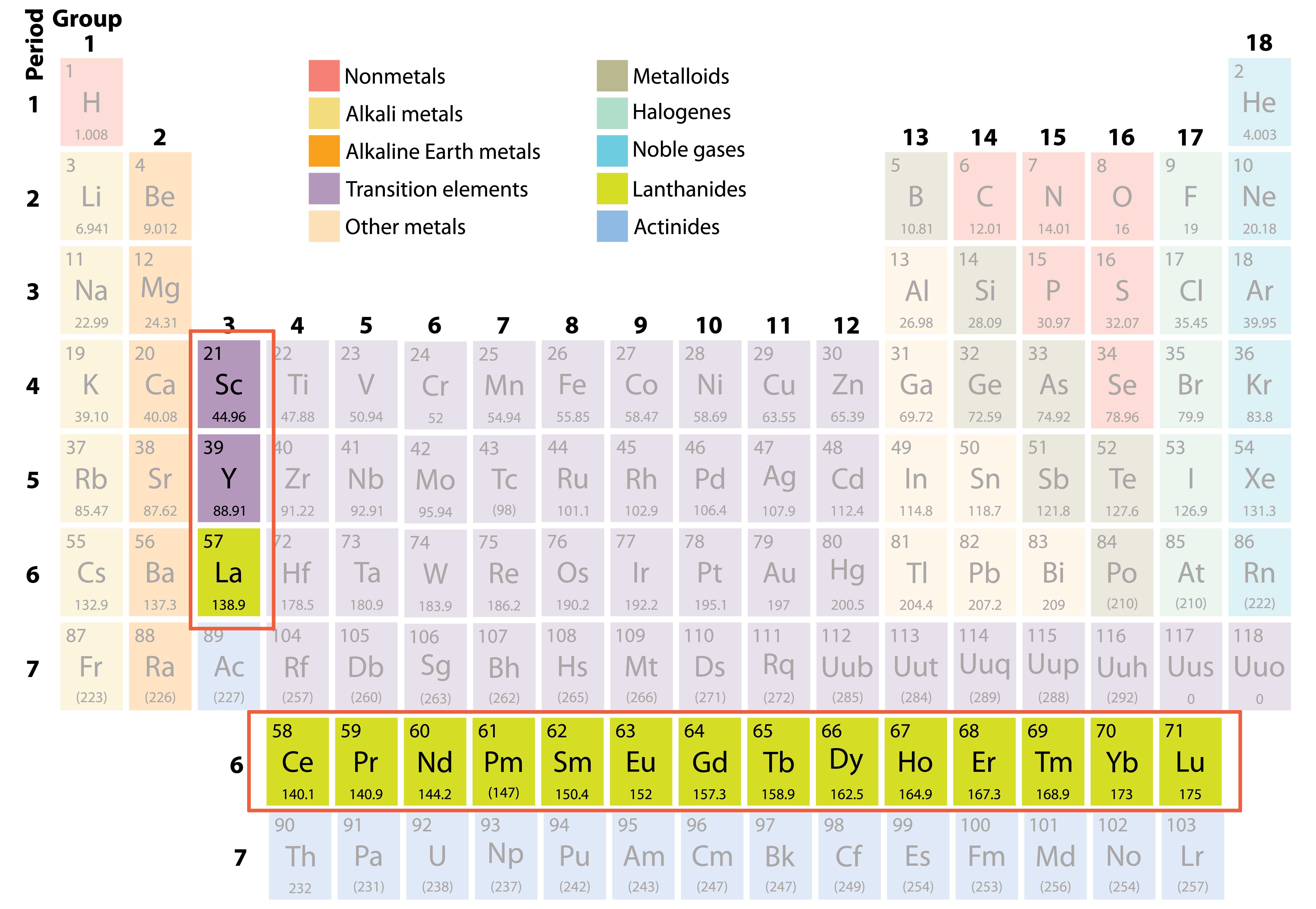
Rare Earth elements
WHEN world leaders gather in Paris later this month to forge an agreement on climate change, they will discuss ways to use less fossil fuel, expand energy-efficient technologies and reduce carbon dioxide emissions. Yet even as our leaders are pushing us to use fewer resources, their vision will force us to use more.

Though energy from the sun and wind appears boundless, the resources needed to turn it into power are not. And as we move away from oil, gas and coal, there is increasing demand for the rare metals that are at the heart of green technology. In the process, we are trading one resource dependency for another, and unleashing a new set of economic and environmental ramifications.

These rare metals — a group of roughly 50 that includes indium, rare earths and gallium — are produced in small quantities, often several thousands of tons annually or less; blended with other metals; and traded in back-room deals. But don’t let their obscurity fool you. They are critical to green technology. Their unique properties make the products we buy smaller, faster and more powerful.

They are embedded in the tallest wind turbines, the smallest computer chip and in every battery. If we succeed in meeting the International Energy Agency’s minimum recommendation of nearly quadrupling wind power capacity by 2030, growing electric vehicle use more than 100-fold by 2025, and increasing battery efficiency, specialty metals like dysprosium and cobalt will take center stage.

The Department of Energy and the European Union now fret over potential shortages of these metals because the speed of technological innovation may soon outpace our ability to develop sustainable supplies to support them. The American Chemical Society reports that nearly half of naturally occurring elements face supply risks. But a sole focus on geologic supply is misguided.

The greater concern is that miners cannot quickly ramp up production. Supply lines can take 10 to 15 years to develop, resulting in part from challenging mining regulations, the high costs of opening a mine and environmental concerns. And finding the right mix of heat and acids to produce some of these metals can take years, if it can be done at all. Having the minerals in the ground doesn’t mean these metals can be produced.

Specialty metals are rarely mined for themselves. They are byproducts of more lucratively mined metals like copper. This means that even if prices of a rare metal were to skyrocket, companies often have little economic incentive to produce them if it means sacrificing some base metal production or investing in new processing equipment. If supplies cannot be produced in a timely way, these specialty metals will become more expensive, limiting their use.

This is not an abstract issue. Fears of resource shortages, caused by uncertain supply, have led companies to abandon promising technologies. Wind power manufacturers, like General Electric, shifted away from using technologies requiring rare earths, a set of rare metals produced almost entirely in China. Fear persists in the market that Beijing would again restrict access, as it did in 2010 when it cut off supplies to Japan. When one mine or country dominates production — as China does for nearly half of all critical metals — supply risks abound.

Substitution can have a hidden but profound environmental impact. For example, air-conditioners built without a rare earth magnet motor are significantly less efficient. In the United States, which expends 5 percent of all the electricity it produces on air-conditioning, less efficient machines can mean significantly more energy consumption and carbon dioxide emissions.

Until 30 years ago, many rare metals were mere chemistry curiosities. With the advent of green technology and the proliferation of electronic gadgets, we have produced more of most rare metals over the past three decades than we did from the beginning of time to the 1980s.

Manufacturers will most likely discover ways to become more efficient with rare metals, using less in each product. But even if electric cars, for example, use 50 percent less rare metal per car, the increase in vehicles needed to meet green energy goals will lead to vast demand.

Rather than predicting which metal we need, we must turn rare metals into commodities, by making them cheaper, more abundant and produced with minimal environmental impact. A good first step is government investments in science to develop a cadre of mineralogy and material researchers who can help unlock the powers of rare metals and produce them with greater ease. Governments can also foster investment in rare metals by establishing faster permitting systems for their extraction with clear, stringent environmental standards.

Companies, too, have a role to play. Manufacturers must make products easier to reuse and recycle. Internationally, the establishment of a materials agency to publish research and data can help bring transparency to the opaque market. And funding for international development initiatives should support environmentally sustainable rare metal operations.

Over a century ago, we jumped into fossil fuels without understanding the ramifications of their use. We would do well to realize the resource implications of our green ambitions and develop a resource plan with them in mind.

David S. Abraham is the author of “The Elements of Power.”

Sunday, June 14, 2015

1881. Towards a Real Fusion of Socialism and Ecology

By Ned Ludd, People and Nature, June 14, 2015
"Socialism can only be reached by bicycle” – José Antonio Viera-Gallo, Assistant Secretary of Justice in the government of Salvador Allende (Chile, 1970-73)
“Today, the main content of politics is economics, and the main content of economics is technology” – E.F. Schumacher, “Technology with a Human Face” (in Small is Beautiful, 1973)
Have you noticed how practically every critical issue about the future of our society hinges on technology? Whether it’s the global ecological crisis, the elimination of jobs through automation, surveillance and social effects of the internet, or the threat of a new eugenics, technology is critical. Yet public debate about these issues is stuck in the myths of progress through technology and the “neutrality” of technology. The left, because of its fundamental allegiance to those myths, has not got much to say and seems to have a major blind spot in its general methodology of critique of capitalist ideology.

On the whole, the left has learned rather little from the green critique of industrialism, and as a result most left theorising on this issue mounts to little more than bolting on a rather shallow environmentalism. Confident that it owns the master narrative on these issues (i.e. the dynamics of class conflict and capitalism), the left generally does not do much better than asserting that, once we control the means of production, everything will be fine. (Of course, there have been many more sophisticated approaches, particularly from Marxist critical theory; I am speaking here of mainstream left politics.) As a result, at least in industrialised countries, the left has failed to mobilise the working class to defend nature.

From its side, since its fundamental critique is technical (we have a better science, ecology), not political, the green movement has failed to engage the working class at all. Both sides sit entrenched in their own theories and snipe at each other. (There has been a fair bit of that on People and Nature, and very unhelpful it has been.) Neither side can gather the courage to take a fundamental look at its own basic theory, even in the face of the existential crises mentioned above. A genuine fusion of socialism and ecology still goes begging.

The key to an ecosocialist theory lies in the recognition of the importance of technology as a form of power and in understanding technocracy. For the last 200 years, corporate power has fundamentally been based on control and ownership of technology. The basic corporate business plan has been to erode people’s means of subsistence, by using industrial technology to produce cheap goods. Thus we become dependent upon corporations and the market for the means of subsistence and lose the skills needed to feed, clothes, house, etc ourselves. Naturally, corporations design technology to suit their interests, for example through planned obsolescence and the ongoing process of automation in order to reduce labour costs.

These ways in which corporations design technology to suit their interests, and the overall function of technology within capitalism, are fairly obvious. But if, as I have, you spend 25 years fighting corporate technology such as bio-technology, you come to realise that there is something more. Technology has its own power system and ideology, which I call technocracy, which is not the same as capitalism, although it tends to work hand-in-glove with it. The essence of technocracy is described succinctly by the maxim of its founding father, the 17th century philosopher and statesman, Francis Bacon: Knowledge is Power. It is a system of power over nature and people through technology and technical discourse. Of course, this translates into more power and influence for scientists and engineers. In his utopia, New Atlantis, Bacon proposed a formal political technocracy, in which society is ruled by a scientific institute.

With the Scientific Revolution of the 17th century, there developed a new set of ideas about nature and human beings’ place in it and relation to it.  Whereas previously nature had been seen as alive, with the Scientific Revolution and the work of the French philosopher, Rene Descartes, nature was reconceptualised as a giant clockwork machine. Clocks were the most sophisticated machines of the time, and were viewed as instruments of social order.

The organic metaphor of nature was condemned as a pagan mystification. Instead, nature was seen as merely a set of resources, to be exploited through technology, without any limits or restraints imposed by seeing the universe as as alive, or the earth as mother. The idea of domination of nature, seen as an unruly female, is very explicit in the writings of Bacon and the founders of the Royal Society [set up by the British elite in the 17th century to support science].[1]

The crucial shift that occurred in 17th century England and France was the emergence of a new culture and philosophy in which the control of nature without any restraint became identified as progress, and gradually became the material and economic basis of society. Of course, all human societies have necessarily manipulated nature; but until the 17th century this was always moderated by cultural and/or religious restraints. The new worldview legitimated the authority of Man, seen as separate from nature, to control and manipulate it. The control of nature serves profit and military advantage, but is also a key means of controlling people and creating social order. A key example of the latter is eugenics.

The key concepts of technocracy are technical: materialism/mechanistic understanding of nature, efficiency, uniformity, rationalisation, automatic control, etc. Within this framework, the efficient and smoothly-running machine was elevated to a cultural ideal, and the result is a machine-centred not a human-centred society. In technocratic society, everything is conceptualised as a machine and then supposed to work like a machine, from the largest-scale elements of state and market economy, down to the human body. The working out of this plan for order, the gradual elimination of disorder, difference, diversity, anomaly in all aspects of human life and society, was described by 20th century sociologists as “rationalisation”. Over the last 400 years, technocratic thinking became, together with capitalism, the central element of the culture of Western modernity.

The bourgeois achieves his/her position in technocratic capitalist society by mastery of technology or, more generally, of technique (systems of rules and technical knowledge, such as medicine and law, or of governance, such as accounting, bureaucracy and corporate management), and, as the ideology of the bourgeoisie, technocracy is the pervasive and dominant culture of modernity. Thus, class is fundamentally about mastery of technique/technology, and the main way to rise in class society is the acquisition of scientific/technical knowledge.

Technocracy gives meaning and purpose to modern life through its identification of the ongoing process of perfection of control of nature as both progress and freedom – freedom from the constraints imposed by nature, such as death. The cliché that the idea of progress through technology is the modern religion is all too literally true. In his book The Religion of Technology, David Noble has traced the development, beginning in the 10th century, of a monastic theological movement aiming, through the improvement of technological control over nature to achieve nothing less than the restoration of Man to his state of grace and dominion over nature, prior to The Fall.  Noble shows how this Christian transcendentalism has continued to echo through the writings of scientists and engineers up to the present, for example in the space programme and the idea of colonisation of space, and in biotechnology.

Thus, from the 17th century onwards the development of our society can be characterised as an attempt to mould the world, including nature and all of human life, down to its most intimate aspects, as well as larger social structures, into one all-encompassing machine. The central aspect of this, in which technocracy melded with capitalism, arose around 1780 in England, in the form of industrial capitalism. What made Adam Smith’s notion of the market so convincing is that it is supposed to be an impersonal machine, automatically regulating prices, supply and demand, in the interests of all, rather than being controlled by arbitrary (i.e. human) “special interests” such as those of the king and aristocracy.  It is also a spiritual concept – “the invisible hand”. The history of industrial capitalism is the history of the evolution towards perfection of the socio-technical system, within which the individual human being really is little more than a cog or data point.

The overall result of technocracy is that we live in a society in which power is wielded through decisions about introduction of new technologies and the directions of basic scientific research – decisions which have massive effects upon the overall economic and social development of society but remain in the hands of scientific experts and bureaucrats.

In the heyday of the technocracy movement, a sign over the entrance to the 1933 Chicago World Fair perfectly expressed the technocratic attitude: “Science Discovers, Technology Executes, Man Conforms”.

Thus we are subjected to a series of technological and economic revolutions about which there has been very little or no public debate. Not surprisingly, popular movements of resistance to the imposition of new technologies, such as the anti-GM food movement, arise in response. Such movements are forced to question the technocratic ideology of neutrality and depoliticisation, that serves as a cloak for the way corporations, the military and the state project their power through technology.

Marx and the Luddites
The best example of a movement of resistance to both technocracy and capitalism is the Luddites; what distinguishes them from later working class movements was their direct attack, not only on the masters’ wage-cutting, use of unapprenticed labour, etc, but also on the machines (known as “frames”) which were destroying their livelihoods. But they were no anti-technology primitivists, as the history written by the victorious industrialists would have us believe.

Their slogan was that they would “put down machinery hurtful to Commonality”; that word implies not only the common people and the common good, but also the system of commoning that was currently being destroyed through the enclosures.  They broke the frames as part of a general attack on The Machine of industrial capitalism, as Kirkpatrick Sale puts it. Their revolt, as well as later movements, such as the Captain Swing riots of the early 1830s, sparked a wide public debate in England on the “machinery question”. But as Maxine Berg and David Noble describe in their books on the period, not only were their opponents, the political economists, successful in convincing mainstream opinion that machinery meant progress; the same view was gradually adopted by middle class radicals seeking to lead the workers’ movement.

Marx was, of course, strongly influenced by the political economists. He had many things to say on technology, much of it correct, and much self-contradictory, but for our purposes the key passage is from Capital, volume 3. He criticises the Luddites for giving reactionary governments a pretext for repression, and concludes: “It took both time and experience before the workpeople learnt to distinguish between machinery and its employment by capital, and to direct their attacks, not against the material instruments of production, but against the mode in which they are used.” I have an essay on the Luddites produced by the Communist Party around 1970, which takes a similar patronising tone, praising the Luddites for their revolt but saying that, unfortunately, they were living before “the rise of the sun of scientific socialism”.

Marxists still like to insist that capital is not a thing, but a “social process” or “social relation”. But, as Noble rightly points out in his book Progress Without People, this is a piece of middle-class abstractification. (Middle class power is always based on mastery of abstract/theoretical knowledge). The Luddite workers who were on the sharp end of the new machinery saw things in more concrete, materialist terms. They could tell that the machinery was not merely an embodiment of class relations, but that the machine principle was a way of controlling people through control of nature, and eventually dispensing with them.

Breaking the Frame
In the early 21st century, after 200 years of industrial capitalism, it is becoming increasingly apparent that the environmental crisis it has created is as much a result of the technocratic mentality of domination of nature without restraint as it is of the capitalist drive for endless growth and its priority of profit above all else. Industrialism is just as much the cause of the problem as capitalism, and the left, if it is to embrace any genuine ecosocialism, needs to abandon its mythology of the 

“liberation of the productive forces”. Instead of that narrative of progress, we need to realise that industrialism is a 200-year-old bubble that is beginning to burst. (That does not mean that we should or can dispense with industrial production of some goods. The problem is industrialism, the philosophy of organising all production and the entire society according to technocratic principles.)

It’s time for the left to realise that Ivan Illich was right when he said: “The transition to socialism cannot be effected without an inversion of our present institutions and the substitution of convivial for industrial tools. At the same time, the retooling of society will remain a pious dream unless the ideals of socialist justice prevail.”[2]  His message in Tools for Conviviality, similar to that of José Antonio Viera-Gallo, quoted at the top of this post, is that we need to dismantle not only the social forms, but also the technological structures of industrial capitalism.

More techno-fixes (like climate engineering and “clean technology”) will not get us out of this mess: we can’t let the people who burned down the forest tell us how to replant it.

Increasingly, radicals are moving towards the idea of commoning – the crucial point of which is that is a system of both communitarian/socialist social organisation and conservation of nature. The two things are mutually interdependent, because as this blog rightly argues, the fundamental relationship upon which any society is materially based is that between humans and nature. That relationship is articulated through technology.

The Breaking the Frame Gathering (July 9-12, near Sheffield) is an attempt to explore and take seriously the politics of technology, to look at the ways that not only capitalist social relations, but also the technocratic philosophy is expressed through technology, and what we can do about it.  You are hereby invited to attend. 

More on technology:
■ Tools for Conviviality by Ivan Illich is now downloadable here
[1] Carolyn Merchant’s ground-breaking account of the Scientific Revolution, The Death of Nature (1980) provides many examples of the way that 17th century scientists saw nature as the unruly female in need of discipline.
[2] Ivan Illich, Tools for Conviviality (Open Forum, 1973)