Showing posts with label Food security. Show all posts

Monday, January 20, 2020

3308. Food at Risk as Third of Plants Face Extinction

By Tim Radford, Climate News Network, December 17, 2019
More than a third of the world’s plants are so rare they face extinction. In a warmer world, that would leave supplies of food at risk.
Botanists have made a new census of terrestrial plants – only to find that with nearly 40% of them rare, or extremely rare, this may put food at risk.
And a second team of researchers, in a separate study, has established that some of these rare or vanishing species could include the wild relatives of some of the planet’s most popular vegetables.
The two studies matter. The first underlines yet another reason for new and determined conservation strategies to preserve the extraordinary natural variety and richness of life – the shorthand word that scientists use is biodiversity – already under pressure from the explosion in human numbers, the destruction of natural habitats and the looming catastrophe of climate change driven by rapidly rising global temperatures.
And the second study is simply a matter of the next lunch or dinner: many rare plants are survivors with the resources to adapt to change. In a fast-changing world, crop breeders may need to go back to the wild relatives to look for the genes that will keep the commercial carrots, courgettes, pumpkins and chilli peppers on the grocery shelves.
US scientists and international colleagues report in the journal Science Advances that they worked for 10 years and compiled 20 million observational records to establish a simple plant census: the forests, grasslands, scrublands, tundra and swamps of the wild world are home to about 435,000 unique plant species.
“According to ecological and evolutionary theory, we’d expect many species to be rare, but the actual observed number we found was pretty startling,” said Brian Enquist of the University of Arizona, who led the consortium. “There are many more rare species than we expected.”
The rare species were most likely to be clustered in what ecologists call hotspots: the northern Andes in South America, Costa Rica, South Africa, Madagascar and south-east Asia.
What these places have in common is that, over millions of years, they have maintained stable climates, and as the glaciers retreated at the end of the last Ice Age, these tropical mountains and valleys provided refuge for life’s variety.
But these survivors may not enjoy a stable future, as ever higher levels of greenhouse gases are spilled into the atmosphere from human use of fossil fuels, and global temperatures continue to rise, and as human communities expand into what was once wilderness.
Significant loss ahead
“In many of these regions, there’s increasing human activity such as agriculture, cities and towns, land use and clearing,” said Professor Enquist.
“So that’s not exactly the best of news. If nothing is done, this all indicates that there will be a significant reduction in biodiversity – mainly in rare species – because their low numbers makes them more prone to extinction.”
Humans depend on the natural world for survival: biodiversity – plants, fungi, mammals, birds, fish, amphibians, reptiles and so on – provides all human nourishment, most of the medicines, fuels, fabrics and textiles that warm and shelter 7.7bn people, and at the same time maintains supplies of water, air, crop pollinators and so on.
But new research in the journal Plants, People, Planet confirms once again that many of the wild ancestors and cousins of the crops that nourish billions could be at risk.
And these wild relatives – which have survived climate shifts over millions of years – represent a vital resource for plant breeders anxious to cope with rapid global heating.
Unpreserved
The latest study confirms that 65% of wild pumpkins and more than 95% of wild chilli peppers are not formally preserved in any gene banks protected by conservation scientists.
“The wild relatives of crops are one of the key tools used to breed crops adapted to hotter, colder, drier, wetter, saltier and other difficult conditions,” said Colin Khoury of the International Centre for Tropical Agriculture.
“But they are impacted by habitat destruction, over-harvesting, climate change, pollution, invasive species and more. Some of them are sure to disappear from their natural habitats without urgent action.”
Dr Khoury and his colleagues have prepared a series of detailed maps of the range and distribution of the wild relatives of a range of important food species: the aim is to focus on the most effective kinds of protection for what, literally, could become tomorrow’s lunch in a world of rapid change.
“If they disappear, they are gone,” said Dr Khoury. “Extinction is forever, which is a loss not only in terms of their evolution and persistence on the planet, but also a loss to the future of our food.” – Climate News Network

Friday, March 25, 2016

2251. Cuba’s Sustainable Agriculture at Risk in U.S. Thaw

By Miguel Altieri, The Conversation, March 25, 2016
Organic farm in Alamar, Havana. Melanie Lukesh Reed/Flickr
President Obama’s trip to Cuba this week accelerated the warming of U.S.-Cuban relations. Many people in both countries believe that normalizing relations will spur investment that can help Cuba develop its economy and improve life for its citizens.
But in agriculture, U.S. investment could cause harm instead.
For the past 35 years I have studied agroecology in most countries in Central and South America. Agroecology is an approach to farming that developed in the late 1970s in Latin America as a reaction against the top-down, technology-intensive and environmentally destructive strategy that characterizes modern industrial agriculture. It encourages local production by small-scale farmers, using sustainable strategies and combining Western knowledge with traditional expertise.
Cuba took this approach out of necessity when its economic partner, the Soviet bloc, dissolved in the early 1990s. As a result, Cuban farming has become a leading example of ecological agriculture.
But if relations with U.S. agribusiness companies are not managed carefully, Cuba could revert to an industrial approach that relies on mechanization, transgenic crops and agrochemicals, rolling back the revolutionary gains that its campesinos have achieved.

The shift to peasant agroecology

For several decades after Cuba’s 1959 revolution, socialist bloc countries accounted for nearly all of its foreign trade.
When Cuban trade with the Soviet bloc ended in the early 1990s, food production collapsed due to the loss of imported fertilizers, pesticides, tractors and petroleum. The situation was so bad that Cuba posted the worst growth in per capita food production in all of Latin America and the Caribbean.
But then farmers started adopting agroecological techniques, with support from Cuban scientists.
Thousands of oxen replaced tractors that could not function due to lack of petroleum and spare parts. Farmers substituted green manures for chemical fertilizers and artisanally produced biopesticides for insecticides. At the same time, Cuban policymakers adopted a range of agrarian reform and decentralization policies that encouraged forms of production where groups of farmers grow and market their produce collectively.


Havana market. Julia Dorofeeva/Shutterstock

As Cuba reoriented its agriculture to depend less on imported chemical inputs and imported equipment, food production rebounded. From 1996 though 2005, per capita food production in Cuba increased by 4.2 percent yearly during a period when production was stagnant across Latin America and the Caribbean.
In the mid-2000s, the Ministry of Agriculture dismantled all “inefficient state companies” and government-owned farms, endorsed the creation of 2,600 new small urban and suburban farms, and allowed farming on some three million hectares of unused state lands.
Urban gardens, which first sprang up during the economic crisis of the early 1990s, have developed into an important food source.
Today Cuba has 383,000 urban farms, covering 50,000 hectares of otherwise unused land and producing more than 1.5 million tons of vegetables. The most productive urban farms yield up to 20 kg of food per square meter, the highest rate in the world, using no synthetic chemicals. Urban farms supply 50 to 70 percent or more of all the fresh vegetables consumed in cities such as Havana and Villa Clara.

The risks of opening up

Now Cuba’s agriculture system is under increasing pressure to deliver harvests for export and for Cuba’s burgeoning tourist markets. Part of the production is shifting away from feeding local and regional markets, and increasingly focusing on feeding tourists and producing organic tropical products for export.
President Obama hopes to open the door for U.S. businesses to sell goods to Cuba. In Havana last Monday during Obama’s visit, U.S. Agriculture Secretary Tom Vilsack signed an agreement with his Cuban counterpart, Agriculture Minister Gustavo Rodriguez Rollero, to promote sharing of ideas and research.
“U.S. producers are eager to help meet Cuba’s need for healthy, safe, nutritious food,” Vilsack said. The U.S. Agriculture Coalition for Cuba, which was launched in 2014 to lobby for an end to the U.S.-Cuba trade embargo, includes more than 100 agricultural companies and trade groups. Analysts estimate that U.S. agricultural exports to Cuba could reach US$1.2 billion if remaining regulations are relaxed and trade barriers are lifted, a market that U.S. agribusiness wants to capture.


Agriculture Secretary Tom Vilsack and Alabama Congresswoman Terri Sewell tour a Havana farmers' market, November 2015. US Department of Agriculture/FlickrCC BY

When agribusinesses invest in developing countries, they seek economies of scale. This encourages concentration of land in the hands of a few corporations and standardization of small-scale production systems. In turn, these changes force small farmers off of their lands and lead to the abandonment of local crops and traditional farming ways. The expansion of transgenic crops and agrofuels in BrazilParaguay and Bolivia since the 1990s are examples of this process.
If U.S. industrial agriculture expands into Cuba, there is a risk that it could destroy the complex social network of agroecological small farms that more than 300,000 campesinos have built up over the past several decades through farmer-to-farmer horizontal exchanges of knowledge.
This would reduce the diversity of crops that Cuba produces and harm local economies and food security. If large businesses displace small-scale farmers, agriculture will move toward export crops, increasing the ranks of unemployed. There is nothing wrong with small farmers capturing a share of export markets, as long as it does not mean neglecting their roles as local food producers. The Cuban government thus will have to protect campesinos by not importing food products that peasants produce.
Cuba still imports some of its food, including U.S. products such as poultry and soybean meal. Since agricultural sales to Cuba were legalized in 2000, U.S. agricultural exports have totaled about $5 billion. However, yearly sales have fallen from a high of $658 million in 2008 to $300 million in 2014.
U.S. companies would like to regain some of the market share that they have lost to the European Union and Brazil.
There is broad debate over how heavily Cuba relies on imports to feed its population: the U.S. Department of Agriculture estimates that imports make up 60 to 80 percent of Cubans' caloric intake, but other assessments are much lower.
In fact, Cuba has the potential to produce enough food with agroecological methods to feed its 11 million inhabitants. Cuba has about six million hectares of fairly level land and another million gently sloping hectares that can be used for cropping. More than half of this land remains uncultivated, and the productivity of both land and labor, as well as the efficiency of resource use, in the rest of this farm area are still low.
We have calculated that if all peasant farms and cooperatives adopted diversified agroecological designs, Cuba would be able to produce enough to feed its population, supply food to the tourist industry and even export some food to help generate foreign currency.
President Raul Castro has stated that while opening relations with the U.S. has some benefits,
We will not renounce our ideals of independence and social justice, or surrender even a single one of our principles, or concede a millimeter in the defense of our national sovereignty. We have won this sovereign right with great sacrifices and at the cost of great risks.
Cuba’s small farmers control only 25 percent of the nation’s agricultural land but produce over 65 percent of the country’s food, contributing significantly to the island’s sovereignity. Their agroecological achievements represent a true legacy of Cuba’s revolution.

Saturday, December 19, 2015

2125. Climate Crisis and Population Explosion

By Stephen Emmett, The Guardian, December 4, 2015 


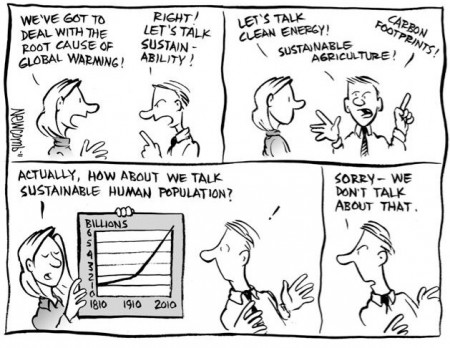
The perennial cry: we need to talk about climate change. And this week, with world leaders in Paris, we have been. But only up to a point. For the likely impact of the rising global population is almost entirely absent, not only from the debate about climate change, but also from that about loss of biological diversity, food and water security, disease, pollution and energy.

Let’s just remind ourselves of the population statistics of the past half century. In just over half my lifetime, the world’s population has more than doubled, from 3 billion people to now more than 7 billion. The ability to feed some of this growing population has in no small part been a consequence of the advent of the green revolution: that is, the industrialisation and intensification of agriculture and the entire food production system.

Producing all this food requires a lot of water. In fact, approximately 70% of all usable water on Earth is now used for food production. And almost 40% of the entire (ice free) land surface of the planet is now dedicated to agriculture.

The green revolution made more food, and that made food much cheaper. As a result of this – and increasing industrialisation and globalisation over the same period – those of us in Europe, North America and Japan have had much more money to spend on consumption. In fact, we embarked upon the creation of an unprecedented consumer culture – of clothes, televisions, electronics, mobile phones, cars and holidays.

All the food and other things we have been producing and consuming require a lot of energy – to generate the basic materials, manufacturing, transport, use, and disposal. As a result our use of oil, coal and gas has increased dramatically to meet rocketing demand for energy consumption.

We are now starting to see the first signs of the impact this is having on our life support system: Earth. Agricultural intensification is causing serious soil degradation and depletion of groundwater in some of the most agriculturally intensive and important areas of the planet. Land use for agriculture, urbanisation and infrastructure (eg roads) continues to cause loss of habitat for much of the world’s biodiversity. It is not just terrestrial ecosystems that are being degraded. Many of the world’s marine ecosystems are being rapidly degraded by overfishing, pollution and ocean acidification.

Demand for energy by our increasing population over the past half-century has led to an accumulation of atmospheric carbon dioxide, the concentration of which – now 400 parts per million – has not been present on this planet for several million years.

And yes, the result of this – of all our activities and consumption – is the emerging change in our climate apparent in the rise in global average temperature and, more importantly, the frequency of extreme weather events: heat waves, floods, droughts. The climate change now emerging is predominantly a consequence of the past activities of fewer than 3 billion people; not the current activities of 7 billion of us.

Critics of the book in which I lay out this problem, Ten Billion, have sought to remind me that, in fact, the fertility rate has been declining since the 1960s. And that we will in any event technologise our way out of the problems we now face. And that I am therefore being alarmist in my claims that climate change, ecosystem degradation, land degradation, and risks to food and water security are going to get worse. I know the global fertility rate has been dropping. Yet the global population has more than doubled over the 50 years in which the fertility rate has been declining, and the UN projects that there are set to be at least 10 billion of us in just a few decades.

Moreover, population growth in many counties is rising rapidly. According to the United Nations, the population of Afghanistan is projected to grow by 242% in the next 80 years; the population of Iraq by 344%; Nigeria by over 400% – to possibly more than 900 million people – and that of Malawi and Niger by more than 700%. This is not just a “developing countries” issue. The United States is projected to grow by more than 40% from 315 million to 450 million people in the next 80 years.

According to the Office for National Statistics, the UK population is projected to grow from 64 million in 2014 to 85 million in the next 80 years. That is like adding the inhabitants of 20 new cities the size of Birmingham to the UK.

Most of the evidence points to our current “business as usual” trajectory of growth and consumption, leading to all of our problems getting worse; potentially much worse.

According to the US government’s Energy Information Authority, global energy demand is likely to triple this century, as both population and energy demand per capita increase sharply, with much of that energy demand continuing to be met chiefly by oil, coal and gas, even under optimistic scenarios of growth in “renewable” energy technologies.

Demand for food is set to double by 2050 as a result of increasing population and consumption per capita – especially as more people move to an increasingly meat-based diet. So-called “rational optimists” are quick to claim that this demand will be easily met without significant further appropriation of land for agricultural use thanks to the ongoing “miracle” of the green revolution.

This ignores the fact that soil degradation and erosion are increasing rapidly in many parts of the world; that many of the world’s crops are increasingly at risk from novel (primarily) fungal pathogens; and that climate and crop models showing the number of extreme weather events associated with predicted future climate change are projected to have potentially devastating effects on crops in significant parts of the world.

Indeed, there are ample reasons to be concerned that we may be heading towards unprecedented food crises over the coming decades, with consequent extremely deleterious risks to the health of hundreds of millions, perhaps billions, of people.

 Furthermore, in many parts of the world where population is increasing rapidly, there is a rise in the number of people living in close quarters with pigs and poultry (not to mention the increasing consumption of “bush meat”). And as a consequence we are greatly increasing the risk of a novel pathogen crossing the species barrier and creating a truly terrifying global pandemic.

Remarkably, collectively, we seem to want to deny all of this: that we are the drivers of the main problems facing us this century; and that, as we continue to grow, these problems are set to get worse. Climate change, extreme weather events, pollution, ecosystem degradation – the fundamental alteration of every component of the complex system we rely upon for our survival – are due to the activities of the rising human population.

There are no simple solutions: but leaders at the Paris summit cannot even begin to tackle climate change unless they recognise that its parent – our increasing population – is creating a greater looming crisis.

Monday, October 26, 2015

2066. Forests Can Help Alleviate World Hunger

By Emily J. Gertz, Takepart, May 6, 2015


Growing more food for the globe’s rising population is the major driver of deforestation. But a new report, endorsed by dozens of forest scientists, has found that leaving those trees standing would do much more to curb hunger than would converting them to cropland or pastures.

More than 1 billion people worldwide already depend on forests for food and crucial nutrients, according to the report, which was published Wednesday by the International Union of Forest Research Organizations.

For communities in Machakos County in eastern Kenya, the report stated, forest tree fruits such as pawpaws, mangoes, and loquats are major sources of vitamin A, and guava is a source of vitamin C.

The wild animals, fish, and insects in forests are also important sources of protein, iron, and fats. In the Rio Negro area of Brazil’s Amazon, the report noted, communities obtained 70 percent of their protein from fish caught in flooded forests and rivers.
Healthy forests also help communities withstand changing climate conditions, civil unrest, and shifting food prices, according to the researchers.

Although tree crops such as rubber, palm oil, and coffee are worth tens of billions of dollars a year in international trade, the report warned that razing natural forests and replacing them with tree crop plantations does not help reduce hunger. Instead, tree crop plantations increase food insecurity by wiping out local sources of food and eradicating agricultural as well as natural biodiversity.

There is little evidence for the “land sparing” argument that such plantations save forests by producing their crops more efficiently, the report noted. But there is a great deal of evidence that “land sharing,” or managing the land for multiple uses and biodiversity, can increase the supply of forest foods and support animal species that are important to agriculture, such as the birds, bats, and bees that pollinate crops
But unless governments integrate forests into their national food policies and international agreements, these benefits are all but invisible.

The report made several recommendations for ways that political leaders could “reimagine forests and food security.” Governments need to restore degraded forests to healthy biodiversity to increase their forest food supplies. They can also “target” particular forest foods for “improved harvest and/or cultivation”—in essence, putting more effort into managing which foods grow in forests. Better education on nutrition, particularly for women and children, can also help communities improve how they gather and manage forest-based foods.

Economic policies and programs must also help communities develop income from forest-related foods and other products, the researchers said.

“We know that forests already play a key role in mitigating the effects of climate change,” Christoph Wildburger, the coordinator of IUFRO’s Global Forest Expert Panels initiative, said in a statement. “This report makes it very clear that they also play a key role in alleviating hunger and improving nutrition.”

Monday, September 14, 2015

2016. Extreme Weather and Food Shocks

By Tim Benton and Rob Bailey, The New York Times, September 8, 2015


Recent events highlight concerns about the risks to global food security posed by changing patterns of extreme weather affecting the world’s “breadbasket” regions such as the American Midwest, South America’s southern cone, the Black Sea and the Yangtze River valley. In 2012, the worst drought to hit the U.S. Midwest in half a century sent international maize and soybean prices to record levels. In 2011, wheat prices nearly doubled after an unprecedented heat wave devastated the Russian harvest. The global food price crisis of 2007-8 had its roots in a run of poor harvests in previous years.

Global food security largely depends on the production of a few “mega-crops” in the breadbasket regions: maize, wheat, rice and soybeans. On the whole, the system works well. International trade provides a global market for these specialized production centers, reducing the cost of food for billions of people by allowing agriculture to flourish where it can be most efficient. Trade also allows countries to meet unforeseen production shortfalls through imports, as Britain did in the summer of 2013 after floods spoiled the winter wheat harvest. But when extreme weather ruins the harvest in a breadbasket region, that’s not just a problem in the country affected, it’s a problem for all importing countries.

Of course the risk to the world’s food security doesn’t arise simply from bouts of bad weather. Weather’s impact can be compounded by the actions of governments and markets. Governments can make things much worse when, for example, they try to shore up domestic food supplies by banning or limiting agricultural exports, further pushing up international prices. The 2007-8 crisis saw over 30 governments impose export restrictions in a spiral of rising prices and collapsing market confidence; the 2011 wheat spike was amplified when Russia turned off exports.

Likewise it is becoming clear that severe weather shocks rippling through the food system can ignite wider instability. During the 2007-8 crisis, protests erupted in 61 countries and turned violent in 23. In the wake of the Russian heat wave, the price of bread was one of several grievances behind the Arab Spring. Once shocks to the food system spill over into other areas, they can cascade through economic and political systems with sometimes devastating consequences.

Amid these pressures, the global food system is coming under increasing strain, as highlighted in a recent report that we wrote in conjunction with other British and American experts for the U.K.-led Global Food Security program. Rising incomes and changing dietary preferences mean demand for food is growing faster than cereal yields. Water scarcity and soil depletion present challenges for agriculture, which faces sharper competition for resources from urbanization and energy production. A precarious supply-and-demand balance means the system is easily unbalanced.

The stability of the global food system faces risks from the increasingly frequent extreme weather that is being driven by climate change. For example, in the United States there were more than four times more weather events causing damage in excess of $1 billion (in 2011 prices) in 2007-11 than in 1980-85. Drought is a particularly powerful driver of global food shocks. Two episodes stand out: in 1988-9, when maize and soybean were seriously affected in the U.S. Midwest, and in 2002-3, when rice and wheat were hit in Eastern Europe and Western Asia.

Were these two events to happen in the same year — a multiple breadbasket failure — it would result in the loss of between 5 and 10 percent of the production of these major crops, more than enough to supply the basic calorie needs of the United States for a year. Until recently, such a calamity would have been expected every 100 to 200 years, but this number is shrinking rapidly due to climate change. An initial analysis of recent data suggests that the risk of a 1-in-100-year event during the second half of the last century is likely to increase to 1-in-30 years by 2040 — and perhaps even 1-in-15 years in the decades after 2050.

A multiple failure in the world’s breadbaskets in the same year is, in our view, a plausible worst-case scenario for today. In fact, by the end of the century such an event may occur every few years unless we reduce emissions overall, and we change what we grow, and how we grow it, to adapt to the changing climate. Such a crisis would almost certainly be compounded by export restrictions, panic buying and hoarding, driving food prices to new heights.

This would be particularly serious for the food-importing countries of the developing world, especially in Sub-Saharan Africa. The shock would come at the economic level, in the form of inflation, balance-of-payment difficulties and budgetary pressures, and it would strike at the human level in increasing poverty; in the developed economies, consumers would feel the pinch as grocery prices climbed. Of even more concern, however, would be the spread of the crisis from food markets to political systems in the world’s geopolitical hotspots; fragile countries could be destabilized, especially the major grain importers of the Middle East and North Africa.

Given these predictions and warnings, what needs to be done?

Agriculture must of course be adapted to a dramatically changing climate: We need to reverse declines in yield growth. This requires significantly more research and development investment to increase maximum attainable yields and to expand agricultural extension services. Additional investment is needed to reduce the environmental impact of farming and to bolster its ability to withstand climate change.

In addition, vulnerable countries can shore up their food security through policy measures to insulate their populations from market shocks. Such efforts include holding strategic stocks, raising national production to reduce import dependency and improve self-sufficiency, and “buying forward” to lock in future import prices.

The greatest challenge will be to make the global food system far more resilient. Rules limiting the use of export barriers will become vital if a functional trading system is to be maintained. Biofuel policies will also need to be reformed by making mandates flexible, so that biofuel use falls when food prices rise, or by limiting the use of staple food crops in biofuel production when food demand outstrips supply.

Recent multilateral efforts to improve the quality and availability of key market data, such as food stock levels, can help governments anticipate crises and avoid panic. But improved climate and economic modeling is needed to understand the risks and assess how best to manage them. Armed with this knowledge, governments, international organizations and businesses could engage in contingency planning, set up early-warning systems, and coordinate the management of strategic stocks.

International food shocks exacerbated by extreme weather events can affect millions of people in countries around the world. Taking smart and practical steps to ease the impact of our changing climate on our food supplies is vital if we are to ride out the droughts and storms that will impact our food prices.

Tim Benton is the academic director of the Global Security Program and a professor of population ecology at the University of Leeds. Rob Bailey is the research director for Energy, Environment and Resources at Chatham House.

Sunday, June 21, 2015

1891. Organic Farming Supports Food Security and Fights Climate Change

By Willy Blackmore, Takepart, September 23, 2013


Organic produce harvested from small, diverse farms may be fine and good for anyone who can afford to pay $3 or more per pound for tomatoes. But to the hungry masses of the developing world? What’s the heirloom-tomato-and-baby-lettuce model going to do for them? Sating that kind of hunger will take acre after acre packed with staple crops like rice and corn, grown with the aid of whatever chemicals and technology can optimize yields—at least that’s what many think.

A new report published last week by the United Nations Conference for Trade and Development suggests a far different approach, however, one that has more in common with the style of agriculture that produces your favorite tomatoes than a 1,000-acre field of corn in the Midwest. And it might not only be able to feed the world—the authors says it can help mitigate climate change too.

The report is exhaustive, with six full pages dedicated to listing the different acronyms referenced throughout the 321-page document. Topics range from the benefits of locally developed plant varities, to carbon sequestration as social justice, and democratizing access to seeds and other products. Full of sometimes dense, academic writing, it isn’t exactly something you’d want to curl up on the couch with. But the title—“Wake Up Before It Is Too Late: Make Agriculture Truly Sustainable Now for Food Security in a Changing Climate”—comes through like a shout.

The document makes a lengthy case for organic, low-input, small-scale agriculture as the best means for not only feeding the world, but for also managing the stresses of drought, rain and other catastrophic weather brought on by climate change. It’s not a new idea, nor does the U.N. explicitly endorse it—you won’t hear Ban Ki-moon talking about it at the General Assembly this week. But even if the report carries no weight beyond its rhetorical value (the U.N. isn’t making any policy recommendations by publishing it), having the organization’s logo, that top-down view of the globe, stamped on the cover still carries significance.

In the chapter “Strengthening Resilience of Farming Systems: A Prerequisite of Sustainable Agricultural Production,” Miguel Altieri and Parviz Koohafkan offer a lay thesis for the report, one that’s less confrontational than the title. Describing the importance of the various forms of traditional agriculture found around the world, the pair write, “They tell a fascinating story of the ability and ingenuity of humans to adjust and adapt to the vagaries of a changing physical and material environment from generation to generation.”

The approach they and their co-authors advocate for is based on that history of adaptation. “Whether recognized or not by the scientific community, this ancestral knowledge constitutes the foundation for actual and future agricultural innovations and technologies,” the pair concludes.

That’s a very different proscription for the future of agriculture—which will soon be taxed with feeding eight billion mouths—than is often put forward. Last year, for example, the Director of National Intelligence’s Global Trend Report for 2030 singled out biotechnology as the most promising means of managing increased demand and resources diminished by climate change. The report says that GMOs, “hold the most promise for achieving food security in the next 15-20 years.”

“What people are realizing is, first of all, industrial agriculture is not feeding the world,” Altieri, Professor of Agroecology at UC Berkley, said in a phone interview. “Most of what it produces is biomass, which is for cattle, biotech crops, and biofuels.”

What he wants to see instead is an approach to agriculture that does acknowledge the “ancestral knowledge” he writes about, whether it takes the form of drought-tolerant varieties of grains that have been selected over generations or learning more about agroecological (that’s what they call sustainable agriculture in the academy) systems’ abilities to cope with and rebound from catastrophic weather events like hurricanes.
“What we are trying to come up with is a western scientific approach, and people who have been farming for centuries have developed their own ethnosciences and we need to learn from them,” he says. “That’s going to be what helps us in the future.”

“Wake Up Before It Is Too Late” may be passively critical of GMOs, but it directly indicts the Green Revolution, the approach to agriculture championed by Norman Borlaug. In the 1960s, the Nobel Laureate agronomist helped transition farming in Latin America and Asia to modern hybrid wheat and rice varieties grown with the assistance of irrigation and synthetic fertilizers and pesticides. “The world needs a paradigm shift in agricultural development: from a ‘green revolution’ to a ‘ecological intensification’ approach,” read the UNCTAD report’s “Key Messages.”

Borlaug, who also advocated for GMOs in the years before his death, in 2009, saw organic farming and criticisms of the Green Revolution as being diametrically opposed to feeding people the world over.

“Some elements of popular culture romanticize older, inefficient production methods and shun fertilizers and pesticides,” he wrote for the Wall Street Journal in 2009. “People should be able to purchase organic food if they have the will and financial means to do so, but not at the expense of the world’s hungry—25,000 of whom die each day from malnutrition.”

The Borlag Institute for International Agriculture declined to comment on the UNCTAD.

The Bill and Melinda Gates Foundation is working to continue Borlag’s approach, but with an eye toward sustainability, and biotechnology—not just hybrid varieties—as the key tool in what some call a second Green Revolution. Addressing the debate over genetic engineering’s role in global agriculture (and not the report in particular), the Foundation’s communications officer Amy Enright wrote in an email, “Essentially, the foundation believes that people in the developing world should have the same access to innovation that benefits the rich world, and we believe that GM crops have the potential to provide benefits to farmers in the poorest parts of the world.

“Advances in agriculture, just like in medicine, must be guided by regulations to ensure new products (seeds, vaccines or medicines) are safe and effective,” she adds. “We work with many partners across both the public and private sectors to ensure that farmers will have access to seeds that are affordable—so ultimately the farmer can choose what seed or technology is right for them.”

Despite Gates’ clout and cash and the legacy of the Green Revolution, Ben Lilliston of the Institute of Agriculture and Trade Policy gets the sense that the conversation is changing. “I’m optimistic that there is a shift taking place at the global level in the institutions and in the sort of larger dialog,” he says, referencing other reports from U.N. groups that advocate for sustainable approaches to agriculture.

But Lilliston admits that even if there’s a sense that he and like-minded people and institutions increasingly feel like they’re winning the argument, until ag policy and practice follow suit, it’s all academic. “When it come to global changes that are more concrete,” he says, “we haven’t really got there yet.”

Altieri agrees, saying documents like this, “give credibility to the approach, and it has an impact in academia. But it doesn’t change many things. At the end of the day, the debate isn’t scientific—it’s political.” According to him, reports like “Wake Up Before It Is Too Late,” “strengthens the social movements that are going to put the change on the politics.”

Pointing to the debate over Golden Rice trials in the Philippines and protests against GMO crops in India, Peru and parts of Africa, Lilliston believes that those social movements are already being empowered. “All of that is a sort of push back and resistance to the Green Revolution, chemical approach—and monoculture approach—to producing food.”