Showing posts with label Fracking. Show all posts

Wednesday, September 7, 2016

2436. The Anthropocene: Hydrofracturing Is Causing Thousands of Earthquakes in Oklahoma

By Michael Wines, The New York Times, September 6, 2016


Scientists and regulators agree that earthquakes like the 5.6-magnitude tremor that struck Oklahoma on Saturday, and thousands of smaller ones in recent years, have been spurred by the disposal of millions of tons of wastewater that is pumped to the surface, and then injected back into the ground, during oil and gas production. The shock last week tied a record set in 2011 in Prague, Okla., for the strongest such tremor in the state’s history.

State regulators have ordered well operators to stop wastewater injections in a 725-square-mile ellipse around the quake’s center. But they conceded that trying to prevent more quakes was an inexact science. And in Oklahoma, where oil and gas are dominant economic and political forces, any effort to regulate the industry produces an entirely different set of shocks.

Dr. Todd Halihan is a geologist and a specialist in hydraulic fracturing, known as fracking, at Oklahoma State University in Stillwater, about 30 minutes by car south of the center of Saturday’s quake. He answered some questions about the quake, and the risks the state still faces.

What happened?

We don’t know yet. There were several injection wells nearby, so it could be similar to the Prague event. The earthquake was about the same size as Prague. This time, there’s going to be a lot more seismological data available and a lot more understanding in terms of what’s going on in terms of injection well activity, so we hope we’ll be able to pinpoint what happened.

In the last year, Oklahoma has been more aggressive about controlling underground disposal of oil wastes, and the number of earthquakes that people could feel has been slowly declining. Yet you just had one as big as any in the state’s recorded history.

We had started ratcheting down waste disposal in some places. But the scientific literature says you can actually have larger events as you go downward — and some of the literature actually says that might be causing larger ones. So we’ve been nervous about it. Over all, things are going in the right direction; we’re not increasing total earthquake activity any more. But we’re still high on the curve relative to what the base level was. Oklahoma is supposed to have about two earthquakes a year above magnitude 2.5, and in the last few years, we’ve had thousands. I tell people we’ve had thousands of years of earthquake activity in a short period of time.

So even though the number of quakes is in decline, scientists aren’t ready to write off the risk of a genuinely damaging one?

No.

Yet there wasn’t a tremendous amount of damage, and no lives were lost. Is the risk being exaggerated?

Oklahoma got very lucky in that the epicenter of this quake was functionally in the middle of nowhere. And it happened in the early morning. If you’d stuck it underneath a town at a different time of day, when people were on the sidewalks, you would have had a much greater problem. As for magnitude, you can have the same-size number as a California earthquake, but you get a lot more shaking here. The intensity at the surface and the response of your house is almost a Richter magnitude greater — and an increase of one point on the Richter scale is the equivalent of releasing 10 times as much earthquake energy.

Why is that?

It’s the rock properties and the depth of the earthquakes. In places like California and Alaska, earthquakes are deep. A wave in California can be pretty tiny by the time it gets to the surface, so a lot of energy is lost. But here, the energy comes right to the surface. These quakes are shallow, and they’re right under people. People may think these are really mild earthquakes, but at this level, you’re shaking pretty hard. In the supermarkets, instead of a couple things falling off the shelves, you have everything in the aisles.

Eighteen months ago, the state seemed almost powerless to address the earthquake threat. This time, regulators were able, within hours, to order disposal-well operators to shut down dozens of wells in the quake zone. Is that enough to deal with the problem?

There’s been a huge change in terms of our ability to react. But we need to be proactive instead of reactive. We’re looking at underground carbon dioxide storage to fight climate change, and we’re sinking geothermal wells. We’re generating earthquakes, but we still haven’t done the large-scale studies we need to do to understand how to manage them. We can keep monitoring seismicity and mess with injection volumes, but unless we get boreholes at depth and really study what’s happening, this problem is going to continue.

Wednesday, August 31, 2016

2429. The Color of Pollution: How Environmental Contaminant Affect People of Color Disproportionally

By Larry Buhl, Desmog, July 28, 2016


With about 42,000 active wells, Kern County, California is home to three-quarters of California's oil drilling and 95 percent of the state’s hydraulic fracturing (fracking) activity.
This mainly rural region is the largest oil-producing county in the U.S.

The influence of oil and gas is so great here that in late 2015 the county board of supervisors approved a new ordinance to allow drilling permits for tens of thousands of new wells to be fast-tracked.

Time span for the new ordinance? Two decades. Ongoing environmental review? None. Public participation? Not allowed.

In response, the environmental legal organization Earthjustice filed suit against the county on behalf of the Sierra Club and the Natural Resources Defense Council (NRDC).

The lawsuit, in coordination with the Center on Race, Poverty & the Environment and the Center for Biological Diversity, challenges the county’s claim that a single environmental review would be sufficient to authorize up to 72,000 new wells over twenty years.

Stacey Geis, managing attorney for Earthjustice’s California regional office, tells DeSmog the Kern County ordinance is a “rubber stamp” that would have a disproportionate impact on Kern’s most vulnerable communities – people of color.

“In Kern County and throughout the state the vast amount of oil is drilled in communities of color. In Los Angeles, there are drill sites literally a stone’s throw away from children’s swing sets.”

Geis cited a 2014 study conducted by the NRDC, which found that of the 5.4 million Californians living within one mile of an oil or gas well, 69 percent are people of color, usually Hispanic. She says drilling sites being permitted in low income areas and communities of color is not unique to California. “It happens wherever people are disenfranchised.”

The way that a person’s race – and to a lesser extent, wealth – determines who gets the benefits or the downsides of drilling and other industrial activity has a term. Depending on who you ask, it’s environmental justice or the more controversial term environmental racism.

Neither term is new, but with national attention on the drinking water crisis in the largely African-American city of Flint, Michigan, plus a growing body of research into which communities bear the burden of fracking waste and other contaminants, the concept of environmental justice (or racism) is finally expanding beyond environmental lawyers, advocates and front line activists.

Who Gets Eagle Ford Shale Fracking Waste?

study published earlier this year in the American Journal of Public Health found that fracking wastewater disposal wells in southern Texas are disproportionately permitted in areas near communities of color and people living in poverty.

The research focused on the Eagle Ford Shale area of south Texas, where more than 1,000 new disposal wells have been permitted since 2007. The study found that fracking disposal wells were twice as common in areas mostly populated by people of color, compared to mostly white areas.

The results of the study, led by community health researcher Jill Johnston, were published last November in the American Journal of Public Health.

The study also found that 16 percent of the area’s domestic water wells were within five kilometers of a disposal well.

Johnston, along with fellow study authors Emily Werder and Daniel Sebastian, cite the Energy Policy Act of 2005 for allowing fracking companies to avoid U.S. Environmental Protection Agency (EPA) oversight:
Permitted disposal wells can be actively used for decades, receiving millions of gallons of toxic wastes, whereas the active life of an extraction well is typically a few years. The Energy Policy Act of 2005 specifically excludes the underground injection of oil and gas fluids from the Safe Water Drinking Act, which authorizes the Environmental Protection Agency to regulate chemicals in drinking water to protect public health. Current regulations allow the oil and gas industry to inject and indefinitely store hazardous materials underground and near drinking water supplies.
Fracking waste can seep into drinking water supplies — a big problem in the Eagle Ford Shale region where most people use private drinking wells not covered by EPA standards.
Johnston, now an assistant professor of preventive medicine at the Keck School of Medicine at the University of Southern California, tells DeSmog : “What we found is part of a national trend where the communities who benefit from (natural gas) extraction are very different from the ones who are getting its waste.”

Johnston points out two other problems facing residents of the region. They have fewer resources if they have health problems from contamination, and less access to information about where disposal wells are being located.

The Texas Railroad Commission, which regulates oil and natural gas production in the state, requires disposal well operators to notify only property owners adjacent to the wells.

Johnston’s study isn’t the only one looking at the Eagle Ford Shale region of southern Texas. A recent investigative series from the Center for Public Integrity found that of the nearly quarter-million minorities living less than three miles from a disposal well in the region, 83 percent were Hispanic. The area is only 50 percent Hispanic.

Research into fracking waste disposal in the Eagle Ford Shale has implications beyond south Texas.

People living near fracking zones in North Dakota, Oklahoma, and Pennsylvania often learn after the fact that waste is being pumped into the ground near their communities. Who decides to issue permits for any oil and gas extraction depends on the state and the region.

Generally state and local agencies are responsible for siting and permitting with the U.S. EPA maintaining oversight authority. But the EPA’s enforcement mechanisms, say environmental lawyers and activists, are often lax.

Pollution's Disproportionate Effect

Recent research on southern Texas’ fracking sites adds to a growing body of research showing that race is more important than income when determining a person’s risk from air, water, and ground pollution in the U.S.

A University of Minnesota study from 2014 that looked at outdoor nitrogen dioxide levels found people of color in the U.S. are exposed to nearly 40 percent more of this deadly chemical than their white counterparts.

2014 analysis by NRDC found the majority of people living near oil and gas development in California are people of color.

A 2015 study showed that poor Latino and Latino immigrant communities are very likely to be living near “toxic hot spots” of cancer-causing air pollution.

In April, the Pittsburgh Post-Gazette reported a rather candid public quip by Terry Bossert, vice president for legislative and regulatory affairs at Range Resources, a natural gas exploration and production company.

Bossert said, essentially, that you can’t frack the wealthy because they have the money to fight back.

The U.S. EPA acknowledges the problem and defines environmental justice as the “fair treatment and meaningful involvement of all people regardless of race, color, national origin, or income with respect to the development, implementation, and enforcement of environmental laws, regulations, and policies.”

But acknowledging the problem doesn’t mean the agency has been effective in combatting it.
The EPA’s Office of Civil Rights handles complaints of discriminatory pollution, but there has been little in the way of action taken by that office, according to investigations by the Center for Public Integrity.


Last year Earthjustice, on behalf of a group of environmental and social justice plaintiffs, filed a civil rights complaint against the U.S. EPA for not ensuring compliance with Title VI of the Civil Rights Act in siting decisions throughout the U.S. 

Environmental Sacrifice Zones

In Kern County, any new wells approved by the plan would be constructed in a region that is already very polluted.

According to the American Lung Association, Bakersfield, the largest city in Kern County, has the second worst year-round air quality in the nation. Adding potentially environmentally destructive activity to areas already besieged with pollutants, like Kern County, creates environmental sacrifice zones — areas permanently impaired by environmental damage.

These are areas where people live. Environmental activists say residents’ lack of political power, plus ineffective state environmental oversight, makes these neighborhoods perennial dumping grounds for toxic waste. 

Dr Robert Bullard, Dean of the Barbara Jordan-Mickey Leland School of Public Affairs at Texas Southern University and commonly referred to as the father of environmental justice, tells DeSmog that it’s easier to permit a facility in an area that’s already polluted.

“I heard elected officials say, ‘that area already has five facilities, one more won’t make a difference,’” Bullard says. “That’s like putting people with asthma in a room with smokers, and saying ‘let’s bring in more smokers.’”

Bullard, who was part of a team that updated the 1987 landmark study Toxic Waste and Race in the United States in 2007, found that over twenty years there had been no progress in protecting communities of color from environmental hazards. In fact, the situation deteriorated.
“In 1987, 33 percent of people who lived in a two mile radius of hazardous waste facilities were people of color,” Bullard tells DeSmog. “Twenty years later, that number had jumped to 56 percent.”

What Bullard and other frontline activists want is a federal threshold, a way to measure the cumulative impact of all types of pollution on an area.

“Permits are granted one at a time and they don’t take account of (environmental hazards) already in the area,” Bullard says. “We say common sense dictates that if a community has fifteen oil and gas facilities, you have to look at the cumulative impact of those facilities before adding one more.”

The problem, Bullard says, is that states do the permitting and some states – he points a finger at Texas and the deep south – “have never seen a permit they haven’t liked.” Bullard says the EPA can and should usurp states’ authority in the most egregious cases of state mismanagement.

“If the state agencies are not doing their jobs then the federal government should pull their money and enforce it directly. The most recent example is Flint. The state did not live up to what it should have done in protecting residents with clean water. A lot of people say the state should pay the price.”

Community Activism and the 2016 Election

Though communities of color may not use the terms environmental racism or environmental justice, they’re increasingly aware of how they’re being impacted. And when local, state and federal governments neglect them, communities of color are getting themselves organized.

In Los Angeles last November, three groups – Youth for Environmental Justice, the South Central Youth Leadership Coalition and the Center for Biological Diversity – filed a lawsuit against the city, alleging L.A. was fast-tracking new oil and gas wells in minority communities without the environmental reviews required by the California Environmental Quality Act.

Residents of Buffalo, New York, recently won victories for regulatory actions and penalties against the Tonawanda Coke Corporation. In 2014 the company was forced to pay $24 million in criminal suit for releasing cancer-causing benzene at rates nearly 30 times higher than it reported to the EPA. In 2015 it agreed to pay $2.7 million in penalties and $8 million to upgrade its plant.

Before the Michigan primary in March, both Democratic candidates had plenty to say about how the drinking water crisis in Flint was an example of environmental racism.

In April, Hillary Clinton announced a new plan to eliminate lead as a major public health threat within five years. She also released a fact sheet outlining her plans to lesson the environmental burdens of communities of color.

As Senator in 2007, Clinton held the body’s first ever hearing focused solely on environmental justice, and also sponsored the Environmental Justice Renewal Act in 2008, a bill that was never passed.

Clinton’s 2016 presidential opponent, Donald Trump, has taken an “end it, don’t mend it” approach to the EPA by repeatedly promising to eliminate the agency.

recent poll conducted by Earthjustice and GreenLatinos found that Latinos believe strengthening the clean water act and reducing smog and pollution (90 percent and 85 percent, respectively) should be more important priorities for the president and Congress than immigration reform (80 percent).

That poll, along with assurances from both political parties that they won’t take voters of color for granted, suggests that environmental justice may be heard more than once in this presidential campaign.

Friday, August 12, 2016

2405. Indigenous Truth Rising: A Journey for Climate Justice

By John Foran, Resilience, August 11, 2016

This is a story of justice – environmental, social, racial, economic, and climate. It’s a story about the power of truth in the quest for justice. And it’s a report from the front lines of a grassroots, global movement for Indigenous leadership in the making of justice, a story of Indigenous truth rising.
For four days in July, I took part in the Protect Our Public Lands Tour – a caravan to the Democratic National Convention in Philadelphia, starting from Santa Barbara, California with stops in the states of Arizona, New Mexico, Oklahoma, and Illinois. An invention of the creative minds of Julie Maldonado of the Livelihoods Knowledge Exchange Network LIKEN, and Becca Claassen of Food and Water Watch, this was an opportunity to travel together with twenty Indigenous activists of all ages from youth to elders and diverse tribal affiliations for intergenerational knowledge exchange, gathering testimonies along the way from members of communities adversely affected by fossil fuel extraction and the many other forms of blatant injustice that they still endure at the hands of the settler colonial process and global and U.S. corporate elites. There is much blood on those hands, and much complicity.
Becca Claassen and Julie Maldonado on the POPLA Tour
The tour generated a lot of what sociologists call “data” and what lawyers call “evidence,” but also what humans in tune with Mother Earth and the gathering spirit of our times would call “truth.” The testimonies were filmed by the Paper Rocket Productions team, and will be used in the upcoming International Permanent Peoples' Tribunal on the Human Rights Impacts of Fracking, scheduled for October 2017.
Speaking Truth to the Bureau of Land Management
Our journey took place against the backdrop of a federal settlement with Navajo communities agreed in July that commits the U.S. government to clean up several dozen of the over 500 mines and other toxic sites – many of them uranium mining operations – on Navajo lands. It took place just after the Republican and just before the Democratic national conventions, and an increase in the number of Indigenous candidates for local and national political office in this election season (Indigenous Americans did not get the right to vote until 1924). And as Grist journalist Ben Adler, reports in a recent piece “Bernie and Hillary supporters come together to push for a Democratic climate caucus” a meeting of activists with climate policymakers from both the Sanders and Clinton wings of the Democratic Party.
Rebecca Sobel, a climate activist from the Santa Fe-based group WildEarth Guardians, which focuses on wildlife and land conservation in the West, called for more grassroots pressure on President Obama over fossil fuel leasing on public land. “The Obama administration has leased more than 10 million acres of public land for fossil fuels,” Sobel noted. “The president could stop that with the stroke of a pen.”
Clinton has not embraced a ban on federal fossil fuel leasing, calling instead for a phaseout with no specified timeline. If fossil fuel leasing continues under a Clinton administration, the activists gathered in that room will be sure to push back, from inside and outside the party.
Rebecca stood with us a week earlier in front of the Santa Fe Bureau of Land Management offices as we delivered a number of documents and reports about the harms done to the land and its nearby inhabitants by those fossil fuel operations, while members of the group told their own stories of cancers, uranium poisoning, coal dust, and now fracking taking the lives of family members.
Protest at the Santa Fe BLM. Photo: Julie Maldonado.
One of the local activists, Angele Kunkowski of Earth Care, used the metaphor of a family living in a house using energy from one of these mines. “When we turn on a light, we’re actually poisoning the air, the water, the earth. Each and every one of us is being sacrificed for the narcissistic interests of these corporations.” Since we all live on Mother Earth, our very way of life is killing us and those we hold dear. And in a sense, this is true, at least until we make the transition beyond fossil fuels and nuclear power to clean, renewable energy.
Margaret Montano, an elder with Voices of the Sacred, told us how her father, a uranium miner, had died of thyroid and pancreatic cancers. She and two siblings lived downwind from the Nevada nuclear testing site; all three suffered from juvenile diabetes, a fact that her doctor, one of the best in the country, considers statistically impossible without taking this location into account. She called on the government to stop being complicit in its past dishonesty and deception in the poisoning of hers and future generations.
The activists demanded that the Bureau of Land Management place a moratorium on oil and gas extraction on public lands until a report is carried out on their effects, as has already been done for coal.
This was a primary demand of the Protect Our Public Land Tour as well, in support of the Protect Our Public Lands Act – a bill before the U.S. Congress that would stop all fracking on U.S. public lands.
The Word is Hope
On one long stretch of route I-40 in Texas, we passed more windmills than I have ever seen in my whole life. My eyes grew wider and wider as the miles passed by. I didn’t count them at first, but I know that we travelled a full twenty miles with a long row of tall windmills just off to our left, from somewhere before mile marker 25 to marker 43. In fact, they never really ended, they just veered away from the road till I couldn’t see them anymore.
This was more than inspiring to see, and gives the lie to the wealthy of the global north who fight the construction of solar and especially wind power in their backyards as an eyesore, so well captured in British filmmaker Franny Armstrong’s 2009 cautionary tale The Age of Stupid. But who owns these windmills? And who profits from them?
Source: Google Images.
Hope lies not just in clean energy, but in community and cooperative forms of ownership, not the present monopolies enjoyed by the utility companies and the fossil fuel majors. This is a model already widely adopted in Germany, so far ahead of the United States in its Energiegewende (Energy Transition), and is being actively studies in a number of communities in California and across the U.S., including my home town of Santa Barbara.
Unnatural Injustice, Truth, and Heart in Shawnee and Ponca Oklahoma
Our next stop was at Lake Thunderbird, outside Norman, Oklahoma. Located in a pleasant green woods, the lake stretched out like a blue jewel under equally beautiful skies. The testimony we heard there, however, took some of the shine off this scene. Ashley McCray, a local historian and activist with the Absentee Shawnee tribe, told us how a primarily Indigenous community’s houses lay at the bottom of the lake, which the state created by damming the Little River in the early 1960s to create a water supply for Norman and other nearby communities, including Tinker Air Force base.
There is a seventy year-old pipeline under the lake, and a second is proposed. In laying the first of these, a Shawnee burial ground was dug up and their ancestors’ bodies placed in a mass grave. While we were learning this, the park service showed up to ask our group to pay a sum we didn’t have for the privilege of sitting at picnic tables under a pavilion roof so we didn’t expire from the heat, kicking us off sacred land yet again.
One of our hosts, Paulette Blanchard, also of the Absentee Shawnee, lives just a few hundred yards from the lake that buried the houses of members of her community decades ago. She spoke eloquently about this history and our purpose:
Since contact, our voices have been the target for silencing for the greed, consumption, and power of the colonial settler society. Time has come for us to be silent no more. This is an opportunity for our voices to not only be heard, but amplified to stop the environmental and human injustices related to fossil fuel energy, while joining with people across this land to become one voice against the violence to us and all our relations.
In White Eagle, north-central Oklahoma, we met with Casey Camp-Horinek of the Ponca Tribe, whose ancestors had been moved en masse in the late nineteenth century, with only 537 surviving the journey. In a welcoming prayer, she told us:
We’re beyond that.
We are nature’s children.
The movement and the rhythm of the moon – that’s us.
Despite the shaking of the earth by these pipelines, our umbilical cord is firmly attached to our Mother.
What’s going to happen to the seventh generation?
Her son Mekasi Camp also spoke to us:
We – all of us – are on a spiritual journey. We are all fighting for our land, our air, our children…. And it’s a global movement.
We are experiencing environmental genocide. And our own city government – from them we are experiencing environmental racism. Because everything toxic is sited here, on the south side of town.
We can no longer drink the water from the springs, as I used to do when I was a child. Now we have to carry water with us when we go out into nature. Maybe my son’s son will be able to drink the water someday. It takes people like you to stand up to change this.
We have the highest rate of cancer in the state of Oklahoma. Yesterday, I found out that two of my relatives have cancer. There’s not a family on this reservation that hasn’t experienced cancer. We checked thirty wells with Earthworks, and every single one was leaking methane – Earthworks had found this to be the case in only one of every eight wells elsewhere.
Casey Camp-Horinek after meeting with the POPLA group. Photo: John Foran.
One of Ponca City’s Indigenous heroes was Standing Bear, who in a famous legal case, Standing Bear vs. Crook, had given a powerful testimony, resulting in the 1879 decision that for the first time Indigenous Americans were humans. His , words: “This hand is not the color of yours, but if I prick it, the blood will flow, and I shall feel pain. The blood is of the same color as yours. God made me, and I am a man.”
Ironically, the city later built Standing Bear Park on top of a toxic area. Mekasi refers to it as “Contaminated Park,” just another instance of what we might call “casual” environmental racism.
Source for both pictures of Standing Bear: Wikipedia.
Before the Ponca were removed from Nebraska to just south of what would be called Ponca City, they sent eight chiefs to look at the land. When the chiefs refused it, they were left by the federal government to walk the 600 miles home, arriving with bloody feet.
Casey, whom I had seen speak eloquently in Paris at the International Tribunal of the Rights of Nature during the COP 21 UN climate summit, told us that Oklahoma now has 3,000 earthquakes a year, up from just three in all of 2008. The largest man-made earthquake ever happened here, at over 5.5 on the Richter scale.
Now, these earthquakes are shaking pipelines across the state that have been built since the 1920s at the start of the oil boom. In the local river, there were five fish kills in the past year. Oklahoma’s 10,000 injection wells, each using up to one million gallons of water laced with some 500 chemicals of unknown origin, are “a form of rape, of defilement. And violence done to the earth is done to women. The frackers are breaking the bones of Mother Earth.” Meanwhile other states from Arkansas to Pennsylvania send their fracking water to Oklahoma!
Phillips Conoco refinery in Ponca City. Photo: Julie Maldonado.
Mekasi pointed out that since cities are virtually powerless to ban fracking, it was up to the first nations to do so; if each of the thirty-nine tribes in Oklahoma followed the Ponca and the Pawnees and banned it on their territories they could save the state. A resolution is circulating to do just this. If successful, it could raise the average life span, which in certain communities is in the forties due to the extremely toxic environment that fossil fuels have crated all around them.
Oil well in farmer’s field, Oklahoma. Photo: Julie Maldonado.
Excavating History and Truth in Illinois
In Illinois, just outside the huge St. Louis arch, lies a wide park punctuated with a number of mounds, the highest of which rises over one hundred feet (St. Louis was once known as the city of mounds). Cahokia was an Indigenous city of 10-20,000 people that thrived a thousand years ago in this place near the Mississippi River. In 1100 A.D., when the population of London stood at 10-20,000 or in 1200 when the population of Rome was 20,000, the knowledge and culture of this people supported a city of equal size. Yet practically no one knows about it, rendering it yet another story of human accomplishment – like so many others – that has been silenced by the histories we tell ourselves.
Monks Mound in summer. The concrete staircase follows the approximate course of the ancient wooden stairs. Caption and source: Wikipedia.
An 1887 illustration of Monks Mound showing it with fanciful proportions. Caption and source: Wikipedia.
*****
Many hours later, we arrived at our destination, a community center in Philadelphia, which would be our base for a weekend at the Clean Energy Summit and the March for a Clean Energy Revolution, against the backdrop of the Democratic National Convention that took place in Philadelphia for four days at the end of July. But those are the subjects of other stories.
This is a story of the power of Indigenous voices – of youth, women, elders – rising, and challenging and changing the discourses and practices of the climate justice movement on Turtle Island/North America.

Sunday, June 19, 2016

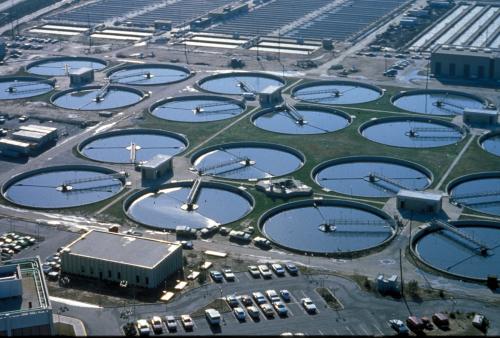
2352. EPA Bans Fracking Wastewater from Sewage Treatment Plants

By Environment America, June 19, 2016
Swege treatment facility
The U.S. Environmental Protection Agency (EPA) has banned fracking wastewater from public sewage plants, citing the inability of these plants to handle toxic and radioactive pollutants.
Clean water and public health advocates, along with more than 30,000 Americans, had submitted comments in favor of the EPA rule, finalized earlier this week.
“Allowing toxic, radioactive wastewater to be treated at the same place as dirty bathwater defies all logic,” Rachel Richardson, Stop Drilling Program director for Environment America, said. “This is a commonsense step to help protect our water and our health from the dangers of fracking.”
The final rule formalizes a practice in place since 2011, when fracking chemicals were detected in some Pennsylvania rivers and officials ordered 15 treatment plants to stop accepting and treating fracking waste.
Fracking or hydraulic fracturing, is the process by which large volumes of water along with sand and toxic chemicals are injected underground to extract shale gas. Much of this fracking fluid mixture returns to the surface as toxic wastewater, often with radioactive elements.
Municipal water treatment plants, which treat waste and then release it into drinking water supplies, aren’t suited to treat such hazards. The mixture of bromides in wastewater and the chlorine used at sewage treatments plants also can produce a toxin linked to bladder cancer, miscarriages and still-births.
Even under the rule issued this week, fracking wastewater disposal still presents a conundrum for public health and safety. Plants designed to treat fracking waste are far from foolproof, as Duke University researchers found in Pennsylvania. Waste often spills into rivers and streams during storage and shipment. And studies show injecting the waste deep underground is likely causing earthquakes.
While no known municipal treatment plants currently accept fracking waste, the option could have become more attractive to drillers as standards tightened on other waste disposal methods.
“Fracking wastewater is a big problem for which there is simply no adequate solution,” Richardson said. “We applaud EPA for taking this step to protect families on the frontlines of fracking. To fully protect our drinking water and the health of our families, we need to ban this practice altogether and transition to 100 percent clean energy.”

Monday, April 25, 2016

2290. Australian MP Sets River on Fire, Blames Nearby Fracking

Fire on the Condamine RiverAn Australian MP is blaming seeping methane from a nearby fracking site for making it possible for him to set Queensland's Condamine River on fire.
Jeremy Buckingham — a Greens party MP for New South Wales — posted a video of the incident to his Facebook page on Friday. As of Saturday afternoon, it had been shared more than 50,000 times.
"Unbelievable! A river on fire. Don't let it burn the boat," he says in the video. "The most incredible thing I've seen. A tragedy in the Murray-Darling Basin."
The Murray-Darling Basin is the largest river system in southeastern Australia and a significant source of fresh water for drinking and agriculture.
Buckingham said the river burned for more than an hour. He believes the nearby coal seam gas (CSG) operations were to blame.
"This area has been drilled with thousands of CSG wells and fracked. This river for kilometres is bubbling with gas and now it's on fire," he said.
"This is the future of Australia and the Murray-Darling Basin if we do not stop the frackers who wants to spread across all states and territories ... this is utterly unacceptable."
The Greens are campaigning to ban fracking in Australia.

Reports of gas seeps in river

There have been reports of methane seeps in the Condamine River— located near Chinchilla in southwest Queensland — since 2012, triggering a series of investigations.
A report by Norwest Corporation, a scientific analysis firm, outlined several scenarios that could be contributing to the bubbling in the river. These included natural events such as drought and the recharging of aquifers after floods.
Human activity such as CSG operations and water bore drilling were the other possible contributing factors.
Australian Greens MP Jeremy Buckingham posted a video of himself lighting Queensland's Condamine River on fire. He blames a nearby fracking site. (Photo courtesy of Max Phillips)
Professor Damian Barrett, the lead researcher into unconventional gas with Australia's Commonwealth Scientific and Industrial Research Organization, has been monitoring the river's gas seeps.
"The isotopic signature is telling us it's coming from coal at that point in the landscape but coal is quite close to the surface and there's a naturally existing small fault line, which cuts the river at that point," he said.
Barrett said research over the past 12 months showed the rate of the gas bubbling in the river was increasing.

Fracking company says 'no risk'

Origin Energy, which operates CSG wells in the district, has also been monitoring the bubbling.
"We're aware of concerns regarding bubbling of the Condamine River, in particular, recent videos demonstrating that this naturally occurring gas is flammable when ignited," a statement from the company said.
"We understand that this can be worrying, however the seeps pose no risk to the environment, or to public safety, providing people show common sense and act responsibly around them.
Origin Energy converts coal seam gas to LNG for export to Asia from Australia. 
"Ongoing research has identified several scenarios that could be contributing to the seeps including the natural geology and faults (formed tens-of-millions of years ago), natural events such as drought and flood cycles as well as some human activity, which includes water bores and coal seam gas operations."