By George Monbiot, Doouble Down News, July 14, 2020
Showing posts with label Racism. Show all posts
Showing posts with label Racism. Show all posts
Sunday, July 26, 2020


Saturday, June 13, 2020
3381. To Do Away With the Police, We Must Do Away With Locks
By Kamran Nayeri, June 13, 2020

Why is there locks?
In the fall of 1969, as a freshman in physics at the University of Texas at Austin recently arrived from Iran I lived at the University House. A small business owned and operated by an older white Texan couple with help from three black women and a black man it provided room and board at $100 a month for a very modest double occupancy rooms with southern-style breakfast and dinner. As there was no room to study at the dormitory, I studied until the closing time at mifgnight at the Academic Center, the library, and then walked the empty streets west of the campus to the Methodist Study Room which was an unstaffed room with several tables and desk lamps to study until 4 a.m. before that too closed. I would then go to my dorm nearby to get some sleep, eat my breakfast and attend classes.
In my four years in Austin, Texas, I never felt the need to lock my room’s door in the dorm or later my apartment door. When I bought a used Opel Kadet and parked it on the street, I never locked it.
Nothing ever went wrong.
I knew this was not the case elsewhere in the United States by the experiences of living in big cities like Chicago and New York. In the summer of 1969, I went to work in Chicago and everybody locked everything and it was consider unsafe to walk the streets of the city at night.
Living in New York, in the late 1970s and later 1980s and 1990s, I learned the need to use multiple locks on the apartment’s door. I was targeted for mugging three times. Each time, the muggers had knives. When I bought a small used car to drive to St. John’s University in Queens to teach a night course, it was broken into the first night even though I lived in Park Slope, Brooklyn, which was considered a “safe neighborhood.” They took its dingy radio. I learned to leave the car doors open with sign for the potential thieves: “Doors are open. There is nothing of value inside.” This was supposed to deter the thieves from breaking into the car by smashing a window.
Social alienation and State formation
In due time and with some help from Karl Marx, I realized locks are symbolic of our alienated social relations. Locks arose in socially stratified early states where the elite extracted wealth from nature by exploiting working people, most of whom held in bondage, at the dawn of civilization. These are topics that Frederick Engels addressed in his Origins of the Family, Private Property, and the State (1884), an extended commentary on Ancient Society (1877 ), by the American anthropologist Lewis H. Morgan. The State arose as part of the same process of social alienation and class exploitation. As Engels notes:
“How the state developed, how the organs of the gentile constitution were partly transformed in this development, partly pushed aside by the introduction of new organs, and at last superseded entirely by real state authorities, while the true ‘people in arms,’ organized for its self-defense in its gentes, phratries, and tribes, was replaced by an armed ‘public force’ in the service of these state authorities and therefore at their command for use also against the people – this process, at least in its first stages, can be followed nowhere better than in ancient Athens. The changes in form have been outlined by Morgan, but their economic content and cause must largely be added by myself.” (Engels, 1884)
The petty thieves I encountered were entirely unsympathetic toward me even though I too was a simple, low-income young working person like they were. But I looked different and they figured I had some material things they wished to take for themselves.
The social function of the police
These forms of inner-conflict among alienated working people helps to confuse the actual role of the police. As Engels explains, the State of which the police is a part arose historically to serve the ruling classes. Its primary role is to ensure that the generation of wealth for the elite through expropriation of nature by exploitation of working people proceed smoothly. That is the primary purpose of “law and order” in a capitalist society. It is masked or otherwise justified by law. The pillars of the U.S Constitution are the sanctity of private property and commerce. That is private ownership of social means of production and freedom of the capitalist firm in pursuit of profit that are protected by the police. We can see this in every labor strike and every social protest against the capitalist class and its state institutions. The police’s function is to contain and when necessary suppress the working people and protect the ruling capitalist class and its institutions.
But as Engels reminds his readers before the rise of the State in history, self-organized and self-mobilized “bodies of armed people” carried out the tasks of public safety.
Closely tied to the capitalist function of the police is the criminal justice system and prisons. Thus, there is close cooperation between the police and these institutions.
Of course, like the State itself, the police and the criminal justice system as institutions, are historically formed in each country. In the United States, the formation of capitalist institutions, in particular, the collection of repressive agencies on the local, regional, state and Federal level have been heavily influenced by its origin as a colonial-settler State in which the European white minority initially wiped out much of the indigenous native population through systematic genocide and by viruses they brought with them from Europe for which the native population had no immunity. In due time, the white settlers established slave-plantations in the South as part of the transatlantic slave trade. Thus, the U.S. capitalist state has been racist by design since its inception. There has been much written about the causes and consequences of the Civil War. But one thing is clear: it was essentially an inner capitalist struggle in which the industrial North needed freed black wage workers and the Southern plantation owners wanted to continue to profit from slavery. Isn’t this odd that a century and half after the end of the civil war there are still statues of Souther Army generals standing across the cities and even on college campuses in the U.S. (many have been brought down in the last few years due to mass protests) and military bases are still named after these generals who were traitors to the Union? In fact, the two-party system of the American capitalism has never disagreed on the question of human rights of the African slaves. The recent change of heart by the mostly socially liberal politicians is partly due to the mass protests and partly because holding on to the legacy of slavery is now counter-productive to the interests of U.S. capitalist rulers.
As Mariame Kaba (June 12, 2020) points out in her opinion essay in The New York Times,
“Policing in the South emerged from the slave patrols in the 1700s and 1800s that caught and returned runaway slaves. In the North, the first municipal police departments in the mid-1800s helped quash labor strikes and riots against the rich. Everywhere, they have suppressed marginalized populations to protect the status quo.”
Capitalist crisis and the police
Since the 1970s, industrialized capitalist economies including the U.S. have entered a long cycle of stagnation caused by the falling average rate of profit. The capitalist response has been “neoliberalism,” that is, an ideological offensive coupled with a series of policies to increasing commodify, monetize, and otherwise expand the realm of profit making operations of the capitalist class that coincides with systemic and unceasing assault against the standard of living and institutional forms of working people’s power including an assault on the Bill of Rights.
An early vicious attack was the initiation of the War on Drugs which President Richard Nixon declared in a press conference on June 18, 1971. While the War on Drugs engulfed the American continent for decades, in the U.S. it systematically targeted African-Americans and Latios who have been increasingly arrested and sentenced to long terms for alleged often minor violations charges. Later, aides to Richard Nixon admitted that the policy decision was racially motivated. The social costs of the marijuana laws are vast. In 2012, for example, there were 658,000 arrests for marijuana possession, according to F.B.I. figures, compared with 256,000 for cocaine, heroin and their derivatives used mostly by the well to do Whites. Black men were targeted.
An early vicious attack was the initiation of the War on Drugs which President Richard Nixon declared in a press conference on June 18, 1971. While the War on Drugs engulfed the American continent for decades, in the U.S. it systematically targeted African-Americans and Latios who have been increasingly arrested and sentenced to long terms for alleged often minor violations charges. Later, aides to Richard Nixon admitted that the policy decision was racially motivated. The social costs of the marijuana laws are vast. In 2012, for example, there were 658,000 arrests for marijuana possession, according to F.B.I. figures, compared with 256,000 for cocaine, heroin and their derivatives used mostly by the well to do Whites. Black men were targeted.
As the legal scholars Richard Bonnie and Charles Whitebread explain in their authoritative history, The Marihuana Conviction (1974), the drug’s popularity among minorities and other groups practically ensured that it would be classified as a “narcotic,” attributed with addictive qualities it did not have, and set alongside dangerous drugs like heroin and morphine. By the early 1930s, more than 30 states had prohibited the use of marijuana for non-medical purposes. Cannabis was officially outlawed for any use (medical included) with the passage of the 1970 Controlled Substances Act (CSA).
As a result, the United States has now the dubious distinction of having the highest per capita prisoner population. In 2018 in the US, there were 698 people incarcerated per 100,000 Americans. The demographic of the prison population show the racist character of this policy. In 2017, blacks represented 12% of the U.S. adult population but 33% of the sentenced prison population. Whites accounted for 64% of adults but 30% of prisoners. And while Latios represented 16% of the adult population, they accounted for 23% of inmates.
The militarization of the police
SWAT (special weapons and tactics) team is a law enforcement unit which uses specialized or military equipment and tactics. Introduced in the 1960s to contain civil protests and suppress riot in communities of the minorities or violent confrontations with criminals, the number and usage of SWAT teams increased in the 1980s and 1990s during the War on Drugs and later in the aftermath of the September 11 attacks. As of 2005, SWAT teams were deployed 50,000 times every year, almost 80% of the time to serve search warrants, most often for narcotics. SWAT teams are increasingly equipped with military-type hardware and trained to deploy against threats deemed “high-risk" for ordinary police force. The militarization of the police is responsible for even more police brutality even though that has been with us for centuries. The Lexow Committee that undertook the first major investigation into police misconduct in New York City in 1894 found that the most common complaint against the police was about “clubbing” — “the routine bludgeoning of citizens by patrolmen armed with nightsticks or blackjacks,” as the historian Marilynn Johnson has written. (cited in Kaba, June 12, 2020)
The response to the police murder of George Floyd
Broadly speaking, there has been two types of responses to the George Floy murder by police officer Derek Chauvin in Minneapolis protected by his fellow police officers while passerby civilians looked in horror. One is a call for police reform. There is nothing new in the idea of reforming the police. This includes new codes of conduct for the police, more training for the police, and sometimes even more funds for the police. None of these has ever worked as Kaba points out.
There is a second more perceptive point of view: police cannot be reformed it must be abolished. Kaba, an activist and organizer against criminalization, is an eloquent voice. In her opinion piece she writes:
“When people, especially white people, consider a world without the police, they envision a society as violent as our current one, merely without law enforcement — and they shudder. As a society, we have been so indoctrinated with the idea that we solve problems by policing and caging people that many cannot imagine anything other than prisons and the police as solutions to violence and harm.”
Her response is:
“People like me who want to abolish prisons and police, however, have a vision of a different society, built on cooperation instead of individualism, on mutual aid instead of self-preservation. What would the country look like if it had billions of extra dollars to spend on housing, food and education for all? This change in society wouldn’t happen immediately, but the protests show that many people are ready to embrace a different vision of safety and justice.”
Thus, she envisions the solution in a society in which cooperation instead of individualism, and mutual aid instead of self-preservation are valued.
However, to envision such a society is one thing to understand the root cause of the problem we wish to solve is another. As I have explained the racist police and the racist State arose as part of the constitution and development of the United States capitalism.
However, to envision such a society is one thing to understand the root cause of the problem we wish to solve is another. As I have explained the racist police and the racist State arose as part of the constitution and development of the United States capitalism.
Anthropocentric industrial capitalist civilization
In his Origins of Family, Private Property, and the State in which Engels underscores the institutional roots of the rise of the State, including the police, he follows Morgan's theory of the three stages of human progress, from Savagery through Barbarism to Civilization. Morgan himself was influenced by the Enlightenment ideas of progress and its four stages theory defined as hunting, pasturage, agriculture, and commerce. Morgan divided each of his own three stages of human progress into three “lower,” “intermediate,” and “upper” stages. He considered his own era, capitalism, as the “modern” stage of civilization.
The rise of the state coincides with the rise of civilization roughly 5,000 years ago. Before that the bulk of humanity lived as small hunter-gatherers bands which Morgan and Engels referred to as “primitive communism.” They were egalitarian and relatively peaceful. Recent scholarship has also confirmed that they were “contrary to earlier assumptions, … nothing like the famine-stricken, one-day-away-from-starvation desperados of folklore. Hunters and gathers, in fact, never looked so good—in terms of diet, their health, and their leisure.” (Scott, 2017, pp. 9-10)
On the other hand, the march of civilization, has brought humanity to the brink of extinction. Today humanity faces three existential crises: catastrophic climate change, the Sixth Extinction, and nuclear holocaust. To these, Covid-19 pandemic adds a new threat to civilization which has especially impacted the most vulnerable sections of human society. In this U.S., it has especially impacted the African-American community.
Thus, it must be clear that the problem of the police in the U.S., and elsewhere in the world as solidarity demonstrations in Europe and elsewhere remind us, is a systemic problem of what I have called the ecologial-social crisis of the anthropocentric industrial capitalist civilization (Nayeri, 2020; Nayeri, 2018). In my view, ecological and social crises are part and parcel of the crisis of civilization.
If this is true, then the police cannot be reformed to rid it of racism and brutality. Kaba cogently argues that past reforms have been ineffective. But it also means that we cannot simply do away with the police by envisioning a society based on “cooperation” and “mutual aid” as she proposes. What is needed a a massive strauggle to transcend the anthropocentric industrial capitalist civilization based on institutions like the capitalist market and the State in the direction of an Ecocentric Socialist future when there will be no market and no State.
Ecocentric socialism
Our hunter-gatherer ancestors lived in relative harmony among themselves and with the rest of nature. With the rise of farming which required domestication of plants and animals, hence domination and control of nature, anthropocentrism arose. Anthropocentrism is alienation from nature as it is the ideology of human-centrism, human superiority, over the rest of nature. With the rise of a sustainable economic surplus by early agricultural societies, social alienation also arose and with it social differentiation, social strata and social classes. Power relations that originally arose in farmers relation with the rest of nature—to domesticate some species and to eradicate wild species which continues to this day—new power relations emerged in human society to serve the exploiting ruling classes.
Human salvation, let alone human emancipation, depends on whether billions of working people would be convinced to begin the long process of undoing all these power relations between humanity and the rest of nature and in human society.
Given that the market and, the State, which includes the police, are key enabling institutions of the anthropocentric industrial capitalist civilization, we must immediately begin undoing them. To do away we the police, we must begin the work to undo the capitalist economy and the capitalist state by working our way to Ecocentric Socialism, a short hand for a much smaller society of humans that live by a culture of being instead of a culture of having who live in harmony amongst ourselves and with the rest of nature. That is a long porcess of dealienation from nature and in society. The progress in this process of dealienation will be marked with withering away of all power relations.
To use my youthful symbolism for an alienated society, to do away with the police, we must do away with locks.
Dedication: To George Floyd and untold number of other victims of racist police brutality.
Dedication: To George Floyd and untold number of other victims of racist police brutality.
References:
Bonnie, Richard J. and Charles H. Whitebread II. The Marihuana Conviction: A History of Marihuana Prohibition in the United States. 1974.
Engels, Frederick. The Origin of the Family, Private Property and the State. 1884.
Kaba, Mariame. “Yes, We Mean Literally Abolish the Police.” The New York Times. June 12, 2020.
Morgan, Lewis H. Ancient Society: Researches in the Lines of Human Progress from
Savagery through Barbarism to Civilization. 1877.
Savagery through Barbarism to Civilization. 1877.
Nayeri, Kamran. “The Crisis of Civilization and How to Resolve It: An Introduction to Ecocentric Socialism.” Our Place in the World: A Journal of Ecosocialism. October 15, 2018.
————————. “The Coronavirus Pandemic as the Crisis of Civilization.” Our Place in the World: A Journal of Ecosocialism. March 19, 2020.
Scott, James C. Against the Grain: A Deep History of the Earliest States. 2017.
Monday, March 6, 2017
2577. The Confederacy Was a Con Job on Whites. And Still Is
By Frank Hyman, The News Observer, March 2, 2017

I’ve lived 55 years in the South, and I grew up liking the Confederate flag. I haven’t flown one for many decades, but for a reason that might surprise you.
I know the South well. We lived wherever the Marine Corps stationed my father: Georgia, Virginia, the Carolinas. As a child, my favorite uncle wasn’t in the military, but he did pack a .45 caliber Thompson submachine gun in his trunk. He was a leader in the Ku Klux Klan. Despite my role models, as a kid I was an inept racist. I got in trouble once in the first grade for calling a classmate the N-word. But he was Hispanic.
As I grew up and acquired the strange sensation called empathy (strange for boys anyway), I learned that for black folks the flutter of that flag felt like a poke in the eye with a sharp stick. And for the most prideful flag waivers, clearly that response was the point. I mean, come on. It’s a battle flag.
What the flag symbolizes for blacks is enough reason to take it down. But there’s another reason that white southerners shouldn’t fly it. Or sport it on our state-issued license plates as some do here in North Carolina. The Confederacy – and the slavery that spawned it – was also one big con job on the Southern, white, working class. A con job funded by some of the ante-bellum one-per-centers, that continues today in a similar form.
You don’t have to be an economist to see that forcing blacks – a third of the South’s laborers – to work without pay drove down wages for everyone else. And not just in agriculture. A quarter of enslaved blacks worked in the construction, manufacturing and lumbering trades; cutting wages even for skilled white workers.
Thanks to the profitability of this no-wage/low-wage combination, a majority of American one-per-centers were southerners. Slavery made southern states the richest in the country. The South was richer than any other country except England. But that vast wealth was invisible outside the plantation ballrooms. With low wages and few schools, southern whites suffered a much lower land ownership rate and a far lower literacy rate than northern whites.
My ancestor Canna Hyman and his two sons did own land and fought under that flag. A note from our family history says: “Someone came for them while they were plowing one day. They put their horses up and all three went away to the War and only one son, William, came back.”
Like Canna, most Southerners didn’t own slaves. But they were persuaded to risk their lives and limbs for the right of a few to get rich as Croesus from slavery. For their sacrifices and their votes, they earned two things before and after the Civil War. First, a very skinny slice of the immense Southern pie. And second, the thing that made those slim rations palatable then and now: the shallow satisfaction of knowing that blacks had no slice at all.
How did the plantation owners mislead so many Southern whites?
They managed this con job partly with a propaganda technique that will be familiar to modern Americans, but hasn’t received the coverage it deserves in our sesquicentennial celebrations. Starting in the 1840s wealthy Southerners supported more than 30 regional pro-slavery magazines, many pamphlets, newspapers and novels that falsely touted slave ownership as having benefits that would – in today’s lingo – trickle down to benefit non-slave owning whites and even blacks. The flip side of the coin of this old-is-new trickle-down propaganda is the mistaken notion that any gain by blacks in wages, schools or health care comes at the expense of the white working class.
Today’s version of this con job no longer supports slavery, but still works in the South and thrives in pro trickle-down think tanks, magazines, newspapers, talk radio and TV news shows such as the Cato Foundation, Reason magazine, Rush Limbaugh and Fox News. These sources are underwritten by pro trickle-down one-per-centers like the Koch brothers and Rupert Murdoch.
For example, a map of states that didn’t expand Medicaid – which would actually be a boon mostly to poor whites – resembles a map of the old Confederacy with a few other poor, rural states thrown in. Another indication that this divisive propaganda works on Southern whites came in 2012. Romney and Obama evenly split the white working class in the West, Midwest and Northeast. But in the South we went 2-1 for Romney.
Lowering the flag because of the harm done to blacks is the right thing to do. We also need to lower it because it symbolizes material harm the ideology of the Confederacy did to Southern whites that lasts even to this day.
One can love the South without flying the battle flag. But it won’t help to get rid of an old symbol if we can’t also rid ourselves of the self-destructive beliefs that go with it. Only by shedding those too, will Southern whites finally catch up to the rest of the country in wages, health and education.
Frank Hyman lives in Durham,where he has held two local elected offices. He’s a carpenter and stonemason and policy analyst for Blue Collar Comeback.
Frank Hyman lives in Durham,where he has held two local elected offices. He’s a carpenter and stonemason and policy analyst for Blue Collar Comeback.
Thursday, March 2, 2017
2572. Is Palestinian Right to Self-Determination Compatible with the Israel's "Right to Exist?"
By Kamran Nayeri, March 1, 2017
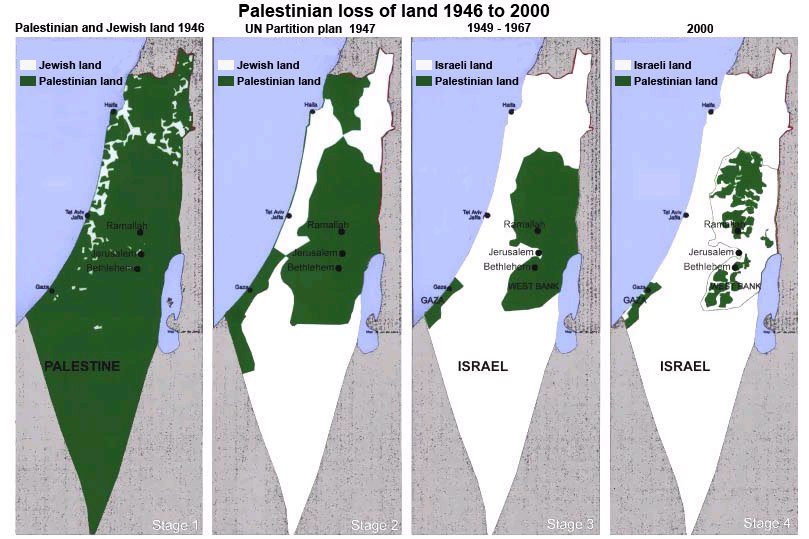 |
In discussions and debates about the “Arab-Israeli conflict” the questions of Palestinian right to self-determination and Israel’s “right to exist” come up frequently. It came up in a Facebook discussion I had with Mark (not his real name) the other day. What do these mean? Mark has been a life long socialist and for years I rode the subway with him back to Brooklyn where we both lived from political events in Manhattan. A printer by profession, he is a book lover and reads voraciously. When I knew Mark in the 1980s and early 1990s, he was a staunch supporter of the Palestinian right to self-determination and advocated a secular democratic Palestine where Palestinians, Jews and others would live as equals. This idea was first raised in the late 1960s by the PLO leadership and was embraced by some Jews. But in our Facebook discussion Mark raised the idea of the “right of Israel to exist.” This notion is part of the demands of the Zionist movement in the so-called peace process that began in 1993. I pointed out to him that the two positions are mutually exclusive. The “right of Israel to exist” denies Palestinian right to self-determination. Palestinians have not "accepted" Israel unless when they are under to condition of duress. revolutionary socialist would continue to oppose any imposition of a colonial-settler occupation on any part of Palestine and Palestinian right to self-determination requires dissolution of the Israeli state. In what follows I expand on the question of the right of self-determination for Palestinians and why it matters to the entire world to support, including the Jewish people, especially the Jewish working class.
The historical basis of the state of Israel
Zionist ideology
There are three claimed basis for the “right of the Israel to exist.” The first is the Zionist ideology itself. Zionists regularly claim that they have a “right to the Jewish people historical homeland.” By that, they mean when the Israelites inhabited historical Palestine some 3,700 years ago. But Christians can trace their religious origins to the historical Palestine. Should they also claim to have a right to the historical Palestine? And Judaism, like Christianity, is a religion open to anyone who wants and is admitted to join it. To say a European Jew, a Japanese Jew, an African Jew all have a right to Palestine because they are all adherents to the same religion is unreasonable. In fact, Zionism originated as a colonial ideology in the late nineteenth century in Eastern Europe and with expressed interest of finding a “homeland" for the European Jews who were facing anti-semitic prosecution in the countries of their birth, especially in Tsarist Russia.
British imperialism and the Balfour Declaration
Despite the prevalent Zionist propaganda that tries to justify the occupation of Palestine on the basis of the Jewish mythology of The Chosen People returning to The Promised Land, the Zionist movement considered a number of other locations for colonization. For example, in 1903 at the sixth Zionist Congress Theodor Herzl, the “Father of Modern Zionism,” proposed Uganda as the site for the Jewish State. However, in the aftermath of the First World War and division of the Middle East and North Africa between the English and French imperialism, Palestine became the target of the Zionist movement. This was codified in the Balfour Declaration that was first proposed in a letter from the British Foreign Secretary Arthur James Balfour to the British Zionist financier Baron Walter Rothschild dated November 2, 1917, and later incorporated into the Sèvres peace treaty with the Ottoman Empire and the Mandate for Palestine.
American imperialism and partition of Palestine
Subsequently, the Zionist movement organized settlements of European Jews in the historical Palestine to lay the basis for a Jewish State. Like in all European colonies, the process of land grab was pursued by any means necessary, including through the use of force and terrorist Zionist groups such as the Irgun, the Lehi, the Haganah and the Palmach. In fact, Menachem Begin, a leader of the terrorist group Irgun, later became Israel’s Prime Minster (He was succeeded by another terrorist, Ariel Sharon).
The Nazi persecution of Jews and the Holocaust caused the mass migration of European Jews. However, key destination countries such as the United States limited Jewish immigration and encouraged their settlement in Palestine, a policy supported by the Zionist leaders. By the end of the World War II, the United Stated had emerged as the undisputed imperialist power. As part of the consolidation of its empire, the United States moved to establish Israel as its outpost in the Middle East. The recently formed United Nations very much under the sway of the Allies, especially the United States, drew the partition plan for Palestine voted for by the General Assembly on November 29, 1947. All existing Arab countries opposed it. On May 14, 1948, David Ben-Gurion, the head of the Jewish Agency, proclaimed the establishment of the State of Israel. U.S. President Harry S. Truman recognized the new nation on the same day.
Thus, the establishment of Israel as the Jewish State in Palestine has been a violation of the right to self-determination of the Palestinian people by the colonial-settler Zionist movement with the support of the British and American imperialism. No rational human being, no humanitarian, not to mention any revolutionary socialist, can accord Israel a “right to exist” because it’s creation and continued existence has been based on the use of violence against an entire people, the Palestinian people. The very existence of the state of Israel is the negation of the Palestinian people’s right to self-determination. The United Nations Resolution 181 that called for the partition was opposed by all Arab leaders and governments because they argued, it violated the principles of national self-determination in the UN Charter which granted people the right to decide their own destiny. The Jewish Agency for Palestine that represented the Zionist movement accepted the portion. The history of Israel as the Jewish State has been a relentless push to expand its territory and its ongoing violence against the Palestinians. It has also been marked by wars with its Arab neighbors (for a history see, "Primer on Palestine, Israel and the Arab-Israeli Conflict," Middle East Research and Information Project).
Israel: Imperialism’s outpost in the Middle East and North Africa
Today, seven decades later, Israel occupies more of the historical Palestine as well as portions of land from its neighboring states, such as the Golan Height that belong to Syria. What has enabled this historical injustice is the unconditional military, political and diplomatic, and economics support for the Zionist regime as the outpost of imperialism in the strategically important Middle-East and North Africa.
According to the Federation of American Scientists, Israel began pursuit of nuclear weapons right after its establishment in 1948. It began the search for uranium in 1949 and Israel Atomic Energy Commission (IAEC) was founded in 1952. On October 3, 1957, France and Israel signed an agreement to build a 24 MWt reactor (although the cooling systems and waste facilities were designed to handle three times that power) and, in protocols that were not committed to paper, a chemical reprocessing plant. This complex was constructed in secret, and outside the International Atomic Energy Agency (IAEA) inspection regime. In 1968, the CIA issued a report about Israel’s successful production of nuclear weapons. Although United States was aware of Israel’s nuclear ambitions and activities it turned a blind eye allowing its strategic ally in the Middle East to join the Nuclear Club outside the purview of the IAEA. Today, it is an open secret that Israel is armed with 300 nuclear weapons. Israel is the largest cumulative recipient of U.S. foreign assistance since World War II. To date, the United States has provided Israel $127.4 billion (current, in non-inflation-adjusted, dollars) in bilateral assistance. Almost all U.S. bilateral aid to Israel is in the form of military assistance, although in the past Israel also received significant economic assistance (for a detailed discussion, see, Jeremy M. Sharp, “U.S. Foreign Aid to Israel,” Congressional Research Service, December 22, 2016). In his waning day, Obama administration that was shunned by the Israeli government ensured the Zionist regime gets a record $38 billion military aid package for the next decade.
Today’s Zionist settlers movement
Those who speak of the right of the State of Israel to exist support this bloody colonial-settler and imperialist legacy that has denied the right to self-determination of Palestinians and has become a pillar of oppression and exploitation in the Middle East and North Africa. Seven decades after imposition of the State of Israel, and almost quarter of century after the Oslo Accord where the demoralized PLO leadership recognized the State of Israel in exchange for a promised Palestinian state, the so-called two-state solution, an estimated 400,00 Zionist settlers live on occupied land in the West Bank (there were only 480 in 1948), about 350,000 live in East Jerusalem (2,300 in 1948) , and 21,000 live in the Golan Height (it belongs to Syria and no Jews lived there in 1948 or in 1967). No Jews live the Gaza Strip now but 30 lived there in 1948.
What do these Zionist settlers think about the Palestinian people whose land they forcibly takeover and what they foresee as the future of Israel? In an Op-Ed piece in the New York Times (“A Settler’s View of the Future of Israel,” February 14, 2017), Yishai Fleisher who describes himself as the “ international spokesman of the Jewish community of Hebron,” offers some insight. Mr. Fleisher marshals the same facts as noted above, wrapped in Zionist phraseology, to argue that the so-called “two-state” solution “will never come to pass” “because Judea and Samaria belong to the Jewish people.”
What do these Zionist settlers think about the Palestinian people whose land they forcibly takeover and what they foresee as the future of Israel? In an Op-Ed piece in the New York Times (“A Settler’s View of the Future of Israel,” February 14, 2017), Yishai Fleisher who describes himself as the “ international spokesman of the Jewish community of Hebron,” offers some insight. Mr. Fleisher marshals the same facts as noted above, wrapped in Zionist phraseology, to argue that the so-called “two-state” solution “will never come to pass” “because Judea and Samaria belong to the Jewish people.”
Now, this honest but openly racist expression of the Zionist ideology faces the reality of the Palestinian people who were the great majority of those who lived in Palestine before the Zionist movement to occupy it to build a Jewish State got underway. The estimated number of Palestinians in the world at the end of 2012 is 11.6 million, of whom 4.4 million are in the West Bank, Gaza Strip and East Jerusalem and 1.4 million live inside Israel (Palestinian Central Bureau of Statistics, cited in Haaretz, “Palestinians to Outnumber Jewish Population by 2020, Says PA Report,” January 1, 2013) Mr. Fleisher offers a catalogue of Zinonist “solutions” to deal with this reality.
- Proposed by two former members of parliament, Aryeh Eldad and Benny Alon, Israel would assert Israeli law in “Judea and Samaria” while Palestinians living there would have Israeli residency and Jordanian citizenship. That is, they are considered Jordanian living inside Israel as expats.
- Proposed by Israel’s education minister, Naftali Bennett, Israel will annex Area C — the territory in the West Bank as defined by the Oslo Accords (about 60 percent by area), where a majority of the 400,000 settlers live — while offering Israeli citizenship to the relatively few Arabs there. But Arabs living in Areas A and B — the main Palestinian population centers — would have self-rule but no Israeli citizenship and continue to live by the "good grace" of Israel.
- Proposed by Professor Mordechai Kedar of Bar-Ilan University, near Tel Aviv, seven non-contiguous “emirates” will be established in major Arab cities, as well as Gaza. Israel would annex the rest of the West Bank and offer Israeli citizenship to Arab villagers outside those cities. Most West Bank Palestinians will not have Israeli citizenship and continue to live under occupation.
- Proposed by Caroline Glick, a Jerusalem Post journalist, “Judea and Samaria” will be annexed because new demographic research shows, she claims, that thanks to falling Palestinian birth rates and migration, combined with opposite trends among Jews, a stable Jewish majority of above 60 percent will exist between the Jordan River and the Mediterranean (excluding Gaza); and this is projected to grow to about 70 percent by 2059. Israel’s president, Reuven Rivlin, and deputy foreign minister, Tzipi Hotovely, back a variety of this proposal.
- Proposed by Israel’s deputy foreign minister, Tzipi Hotovely, Israel will annex “Judea and Samaria” but offers residency to the Palestinians there with a pathway to citizenship.
- Proposed by the head of the new Zehut party, Moshe Feiglin, and Martin Sherman of the Israel Institute for Strategic Studies, Israel will pay “generous” compensation for Palestinians in Judea and Samaria to emigrate “voluntarily.”
I do not need to point out to the reader that all of these “proposals” to solve the “Palestinian problem” and to expand the Jewish State are based on the assumption of Israel’s right to exist and in open defiance to the principle of the right of the Palestinian people to self-determination.
Palestinian right to self-determination matters to the world
It must now be entirely clear to the reader that Zionism and its state, Israel, is part and parcel of the history imposed on the humanity by colonialism and imperialism. If revolutionary politics concerns itself with the art and science of understanding and changing oppressive power relations in the interest of human emancipation (which also depends on harmony with the rest of nature) then defending the right to self-determination of all the oppressed and exploited, including the Palestinian people, must be evident as central to the progress of humanity. While revolutionary socialists have concerned themselves primarily with social class power relations because of the centrality of the working class in the capitalist world economy and the potential and desirability of replacing capitalist social relations with socialist ones, they have also realized that to unite the working classes of the world it is absolutely necessary to educate the working classes of the oppressor nations to respect and defend the right to self-determination of the oppressed nationalities and nations. That is why the wave of anti-colonial revolutions after the Word War II were of historic importance. Notable in this context were two historic events: creation of Israel as the Jewish State in 1948 as the imperialist outpost in the strategically important Middle East and North Africa where most of the known oil reserve was located and the Cuban revolution of 1959 that demonstrated that any consistent fight for national self-determination in the capitalist world requires going beyond capitalist social relations in the direction of socialism. Revolutionary socialism condemned the former without giving up its long-held position against anti-Semitism and upheld the latter.
This is how the Socialist Workers Party, a revolutionary socialist current at the time, explained it in a 1971 political resolution:
“Our revolutionary socialist opposition to Zionism and the Israeli state has nothing in common with anti-Semitism, as the pro-Zionist propagandists maliciously and falsely assert. Anti-Semitism is anti-Jewish racism used to justify and reinforce oppression of the Jewish people. Marxists have been and remain the most militant and uncompromising fighters against anti-Semitism and the oppression of Jews.
“The source of the oppression of the Jewish people in this era is the capitalist system, which in its period of decay carries all forms of racist oppression to the most barbarous extremes. This was horribly illustrated in the holocaust directed against the Jews of Europe by German imperialism under the Nazi regime. Today, anti-Semitism remains widespread in all of the Western imperialist countries. Until the capitalist system is abolished in these countries there is the ever-present danger that a new variety of virulent anti-Semitism can arise.” (Socialist Workers Party, “Resolution on Israel and the Arab Revolution,” 1971).
Seven decades later, we must add that Zionism itself is a source of anti-Semitism since the Jewish State has been an instrument of racist, colonialist oppression of the Palestinian people and directly and indirectly involved in a myriad of imperialist campaigns in the Middle East and North Africa and beyond. To blame the existence of anti-Semitism among some Palestinians and Arabs and in groups that campaign for Palestinian rights ignores this reality.
Revolutionary socialists confront prejudice in every social movement we participate in, including labor unions. Working people are not immune from racism, sexism, homophobia, xenophobia, Islamophobia or anti-Semitism. But to turn one’s back to these social movements because some who participate in them are prejudiced neither helps to fight against such prejudices nor contribute to the fight to remove the root-cause of them, the class society in general and the capitalist system in particular. Why should we treat fight for the liberation of the oppressed nationalities and nations any differently?
By becoming the best builders of the solidarity movement with the Palestinian struggle, we can and must educate about the problem of anti-Semitism. However, this educational and political campaign unfolds only in the context of unconditional support for the right of Palestinians to self-determination. Any support for Zionism and for its institutional form, Israel, undermines both efforts.
To root out anti-Semitism, Jewish people, especially Jewish workers, must become staunch supporters of the Palestinian right to self-determination and opponents of the colonial-settler ideology of Zionism.
The rock solid support of the U.S. ruling class for Zionism certainly has its pragmatic reasons; it has served as the beachhead for imperialism in the Middle East and North Africa for decades. But there is also an ideological synergy. Having moved to the front and center with the rise to power of Donald Trump, American White Nationalism is actually as old as the colonial-settler occupation of the Pre-Columbus America that eventually became the United States. The entire Euro-centric narrative that has filled the history textbooks begining with the of “discovery” of the Americas by Christopher Columbus to today, as radical historians have pointed out (e.g. Howard Zinn’s A People History of the United States: 1494 to Present, 2003), serve the colonial-settler dominant power relations that has served the ruling capitalist class to this day. In the United States, White Nationalism has been a movement to dispossess America Indians, plunder the ecosystems, super-exploit African slaves, and waves of immigrants that were brought in to do hard labor. Until 1965, immigration policy in the United States was a “whites only” policy (see, May M. Ngai, Impossible Subjects: Illegal Aliens and the Making of Modern America, 2014).
Thus, the unwavering support of the U.S. ruling class for Zionism is based on a shared common colonial-settlers ideology. That is why Israel is the “best friend” of the ruling class the United States and the latter is the ultimate protector of the former. How else can one explain the grip of the Zionist lobby on the U.S. politics where both Democratic Party and Republican Party outcompete each other in their support for Israel?
Israel’s right to exist or Palestinian right to self-determination?
But why has Mark changed his mind about unconditional right to self-determination for Palestinians? Of course, only Mark himself can answer that question. But allow me to make an educated guess. Mark has been a dedicated active supporter of the Socialist Workers Party (SWP) for decades, the fact that the SWP has just recently fundamentally changed its position on Israel and the Palestinian fight for self-determination perhaps has something to do with it.
In its editorial of July 25, 2014, The Militant, SWP’s weekly paper, took an adaptationist position towards Zionism that essentially gave up its historic position of unconditional defense of the Palestinian right to self-determination. The editorial sums up its new position as follows:
-
“Recognition of a Palestinian state, as it is today, as a stepping stone to fight for a single, viable geographical homeland for the Palestinian people.
“Recognition of Israel, as it is today, both a Jewish and increasingly multinational secular state. This includes the right of return for the Jews, which will become increasingly relevant as the world crisis of capitalism kindles Jew hatred as a reactionary bludgeon against fighting labor.” (The Militant, July 25, 2014)
Notice that The Militant editorial comes in the middle of Israeli war against the 1.8 million Palestinians who are squeezed into less than 141 square miles in the Gaza Strip who have no army, no air force, no navy to defend themselves against the most modern and powerful air force, navy and army in the Middle East, courtesy of U.S. imperialism. According to the United Nations, Operation Protective Edge (Israel’s name for its military offensive), at least 2,104 Palestinian died, including 1,462 civilians, of whom 495 were children and 253 women. Only 66 military personnel and 7 civilians were killed on the Israeli side. Yet, the editorial places the primary responsibility on "Hamas terrorism and murderous retaliation of Tel Aviv’s armed forces." Thus, the Militant editors were following the Israeli propaganda by turning the victim into the criminal to justify a genocidal war.
The Militant editors call for the "right of return" for Jews citing the capitalist world crisis but they fail to call for the right of return for Palestinians after seven decades of Zionist ethnic cleansing. Are not Palestinians not affected by the capitalist world crisis? This is how radically the editors negate the SWP's historical position. But the entire idea of a supposed "right of return" for Jews to Palestine was cooked up by the Zionist colonial-settler movement after it gave up plans for creating a "Jewish Homeland" somewhere else after reaching an agreement with British imperialism after World War I to carve up Palestine for a Jewish State. There is no other basis for any "right of return" of Jews to Palestine. Jews have lived for thousands of years in many other countries of the world and they are from various races and ethnic groups just like Muslims and Christians. But the Palestinians were forced from their home and homeland in millions by the Zionist colonial-settler terrorism and war only in the contemporary history. The poorest are still living in refugee camps in the Middle East. Those in the West Bank in effect live under military occupation and their land is gradually being taken from them for new Zionist settlements. Those in the Gaza Strip are even worse off even though the Israeli army dismantled settlement and withdrew in 2005 because the Zionist State has then imposed a harsh land and sea blockade and has waged three murderous wars against its population in the last 12 years. In reality, the Gaza Strip is the largest open-air prison in the world. The Palestinians who still remain inside Israel have been second class citizens subject to ongoing racism--how else can life be for non-Jews in the Jewish State? In brief, the new SWP position is to support the Zionist colonial policy.
Writing about the Second International Congress in Stuttgart in 1907, Lenin commented on the dispute in the Colonial Commission where a majority led by representative of the German Social Democracy included
“…the following monstrous phrase appeared in the draft resolution: ‘The Congress does not in principle and for all time reject all colonial policy, which, under a socialist regime, may have a civilising effect.’ In reality, this proposition was tantamount to a direct retreat towards bourgeois policy and a bourgeois world outlook that justifies colonial wars and atrocities. It was a retreat towards Roosevelt, said one of the American delegates. The attempts to justify this retreat by the tasks of a ‘socialist colonial policy’ and of constructive reform work in the colonies were unfortunate in the extreme. Socialism has never refused to advocate reforms in the colonies as well; but this can have nothing in common with weakening our stand in principle against conquests, subjugation of other nations, violence, and plunder, which constitute ‘colonial policy’. The minimum programme of all the socialist parties applies both to the home countries and the colonies. The very concept 'socialist colonial policy' is a hopeless muddle. The Congress quite rightly deleted the above-quoted words from the resolution and substituted for them a condemnation of colonial policy that was sharper than that contained in former resolutions.” (V. I. Lenin, "The International Soialist Congress in Stuttgart", Marxist Internet Archive, 1907),
The revisionist SPW position is similarly proposing a “Marxist colonial policy” by recognizing Israel’s right to exist and thereby denying the Palestinian right to self-determination. But why such a revision? Part of the answer lies in a fundamental revision of the SWP’s historic program, strategy and tactics, as well as organization principles and norms, that began in the early 1980s and continues to this day (for a discussion of these see, Art Young, “Decline and Fall: The US SWP’s Final Embrace of Zionism,” 2014; John Leslie. “The U.S. Socialist Workers Party Accommodates to Zionism,” 2016; Kamran Nayeri, “The Historic Women's Marches of January 21, 2017,” 2017 that discuss particular cases of the political crisis of the Socialist Workers Party). Why a majority of the SWP leadership and membership opted for this revision of the party’s revolutionary heritage is a more complex question. The interested reader can find a number of arguments about the root-causes of the SWP’s demise of which I would recommend Paul Le Blanc’s incisive essays “Leninism in the United States and the Decline of American Trotskyism,” and “Trotskyism in the United States: The First Fifty Years,” in Trotskyism in the United States (Paul Le Blanc, ed., 2016).
The pressure to cave into Zionism is greater today as the shift to the right in capitalist politics continues and political polarization puts small socialist groups to test. Some like the SWP are more prone to give in and embrace a pro-Zionist position. Others that have tried to maintain their revolutionary heritage have embraced the new generation of working people that are waking up to the plight of the Palestinian people as evidenced by the massive support for the Palestinian-led Boycott, Divest, Sanction movement. The conversation with Mark began with me posting a BDS-related news item on Facebook which he opposed initially with a myriad of excuses. When the conversation continued a bit, he came out with the argument that the BDS undermines Israel’s right to exist, which he, to my surprise endorsed.
For an ecosocialist Middle East and North Africa
Of course, unconditional defense of the Palestinian right to self-determination is as important today as it has always been as is the vision of a democratic secular Palestine where Palestinians, Jews, and other peoples residents in the historical Palestine to live as equals. However, today as the world is becoming aware of the ecological crisis that poses a threat to human survival and much of other life on earth, we must envision an ecological socialist Middle East and North Africa. That is why it is such a shame that the people who dedicated their lives to socialism are now caving in to the colonial-settler ideology of Zionism. Zionism is not only the scourge against the Palestinian. It is also a barrier to the union of all peoples of the Middle East and North Africa who should unite in the fight for an ecological socialist region. Instead of fighting for a nineteenth-century colonial-settler racist ideology of a “Jewish Homeland,” Jews and all opponents of anti-Semitism must be fighting for our common humanity and the future of our true homeland, the planet Earth and life in all its magnificent variety. It is time to contemplate that we are really one species that has been fractured by the rise of class societies since the dawn of Agricultural Revolution into many feuding social groups. The promise of Marx’s socialism was to emancipate humanity. Consistent with Marx's own understanding (Paul Burkett, Marx and Nature: A Red and Green Perspective, 1999; John Bellamy Foster, Marx's Ecology: Materialism and Nature, 2000) ecological socialism promises to do so by returning humanity to the wisdom of ecocentric cultures that our ancestors shared for 95% of our existence, cultures that value and celebrate all life and the Mother Earth (Kamran Nayeri, "Economics, Socialism, and Ecology: A Critical Outline, Part 2, 2013).
References:
Burkett, Paul. Marx and Nature: A Red and Green Perspective, 1999.
Fleisher, Yishai. “A Settler’s View of the Future of Israel,” The New York Times, February 14, 2017.
Foster, John Bellamy. Marx's Ecology: Materialism and Nature, Monthly Review, 2000.
Fleisher, Yishai. “A Settler’s View of the Future of Israel,” The New York Times, February 14, 2017.
Foster, John Bellamy. Marx's Ecology: Materialism and Nature, Monthly Review, 2000.
Le Blanc, Paul. Trotskyism in the United States. Haymarket Books, 2016.
Lenin. V. I. “The International Socialist Congress in Stuttgart,” Marxist Internet Archive, 1908.
Leslie, John. “Israel, Palestine, Anti-Semitism and the US Left,” Left Voice, September 13, 2016. Republished as “The U.S. Socialist Workers Party Accommodates to Zionism,” in Our Place in the World: A Journal of Ecosocialism.
Middle East Research and Information Project. "Primer on Palestine, Israel and the Arab-Israeli Conflict." No date.
Nayeri, Kamran. "Economics, Socialism, and Ecology: A Critical Outline, Part 2, Our Place in the World: A Journal of Ecosocialism, 2013.
-------------------.“The Historic Women's Marches of January 21, 2017,” Our Place in the World: A Journal of Ecosocialism, February 2, 2017.
-------------------.“The Historic Women's Marches of January 21, 2017,” Our Place in the World: A Journal of Ecosocialism, February 2, 2017.
Ngai, May M. Impossible Subjects: Illegal Aliens and the Making of Modern America, 2014.
Palestinian Central Bureau of Statistics, “Palestinians to Outnumber Jewish Population by 2020, Says PA Report,” Haaretz, January 1, 2013.
Sharp, Jeremy M. “U.S. Foreign Aid to Israel,” Congressional Research Service, December 22, 2016.
Socialist Workers Party. “Resolution on Israel and the Arab Revolution,” Marxist Internet Archive, 1971.
————————————. Editorial: "Chart Road Forward for Toilers of Palestine and Israel,” The Militant, July 25, 2014.
Young, Art. “Decline and Fall: The US SWP’s Final Embrace of Zionism,” Links International Journal of Socialist Renewal, September 18, 2014. Republished in Our Place in the World: A Journal of Ecosocialism.
Zinn, Howard. A People History of the United States: 1494 to Present, 2003.
Subscribe to:
Posts (Atom)