Abstract
Purpose – The question of violence in hunter-gatherer society has animated philosophical debates since at least the seventeenth century. Steven Pinker has sought to affirm that civilization, is superior to the state of humanity during its long history of hunting and gathering. The purpose of this paper is to draw upon a series of recent studies that assert a baseline of primordial violence by hunters and gatherers. In challenging this position the author draws on four decades of ethnographic and historical research on hunting and gathering peoples.
Design/methodology/approach – At the empirical heart of this question is the evidence pro- and con- for high rates of violent death in pre-farming human populations. The author evaluates the ethnographic and historical evidence for warfare in recorded hunting and gathering societies, and the archaeological evidence for warfare in pre-history prior to the advent of agriculture.
Findings – The view of Steven Pinker and others of high rates of lethal violence in hunters and gatherers is not sustained. In contrast to early farmers, their foraging precursors lived more lightly on the land and had other ways of resolving conflict. With little or no fixed property they could easily disperse to diffuse conflict. The evidence points to markedly lower levels of violence for foragers compared to post-Neolithic societies. Research limitations/implications – This conclusion raises serious caveats about the grand evolutionary theory asserted by Steven Pinker, Richard Wrangham and others. Instead of being “killer apes” in the Pleistocene and Holocene, the evidence indicates that early humans lived as relatively peaceful hunter- gathers for some 7,000 generations, from the emergence of Homo sapiens up until the invention of agriculture. Therefore there is a major gap between the purported violence of the chimp-like ancestors and the documented violence of post-Neolithic humanity.
Originality/value – This is a critical analysis of published claims by authors who contend that ancient and recent hunter-gatherers typically committed high levels of violent acts. It reveals a number of serious flaws in their arguments and use of data.
Keywords: Violence, Warfare, Chimpanzees, Dominant ideologies, Evolutionary anthropology, Steven Pinker
Paper type: Research paper
Introduction
The question of violence in hunter-gatherer society has animated philosophical debates since at least the seventeenth century. In Hobbes’ social evolutionary view, life in the “state of nature” was “nasty, brutish, and short” (Hobbes, 1651/1969, while Rousseau launched humanity’s trajectory from a baseline of the “noble savage” (Rousseau, 1749/2003). In the twentieth century more ethnographically and archaeologically grounded understandings of hunter-gatherer life have replaced the speculations of the savants. Nevertheless the underlying debate has remained.
Steven Pinker, an avowed Hobbesian, has added a new twist to the debate. Despite humanity’s deep flaws, there is reason for hope. Things are getting better. Like Voltaire’s Dr Pangloss, Pinker’s string of best-sellers has sought to affirm that civilization, if not the best-of-all-possible- worlds, is at least vastly superior to the state of humanity during its long history of hunting and gathering (this view has antecedents in Immanuel Kant’s 1795 vision of “perpetual peace” only being achieved through universalizing republican forms of government (Bohman, 1997)). In “The Better Angels of our Nature” (2011) and elsewhere (2002, 2007), Pinker draws upon a series of recent studies that assert a baseline of primordial violence by pre-state peoples. Pinker cites these as the clincher for the Hobbesian view.
In a magisterially dense and comprehensive study of 800 pages, and 1,100 references cited, Pinker appears to cover every conceivable issue and to provide the definite answer to all outstanding questions. In view of the seemingly overwhelming documentation, how accurate is Pinker’s reading of human history and pre-history? Does it survive the serious scrutiny to which all truth claims should be subjected? Our task here is finite and doable: to document the levels of violence in hunter-gatherer societies – recent and pre-historic – and understand their causes and consequences. However, our task is made more challenging by the fact that current debates on the issue of hunter-gatherer violence are overshadowed by an even more ambitious and cosmic agenda: nothing less than the question of violence and the formation of human nature itself. The issue of hunter-gatherer violence, it turns out, is a lynchpin of a current grand theory of human evolution.
In The Better Angels of our Nature, Pinker attempts to trace the contours of violence all the way from our primate ancestors through pre-history and history up to the present day. He argues that, despite the history of modern slaughters and advanced weaponry, the world is actually getting more and more peaceful. But in order to make this case even remotely plausible, he has to posit inordinately high rates of violence for the earliest time periods.
In supporting the latter thesis, which I label the “Bellicose School” – and drawn more or less directly from Thomas Hobbes’ 1651 classic Leviathan (1651/1964) – Pinker draws heavily on several modern sources from within anthropology: American archaeologists Lawrence Keeley (1996) and LeBlanc and Register (2003), and especially Richard Wrangham, a British-trained US based, biological anthropologist and evolutionist. In “Demonic Males” (1996) Wrangham and Peterson, draw a direct line between evidence for chimpanzee males killing male conspecifics, through the purported violence in Homo erectus and archaic Homo sapiens and on to the undisputed evidence for warfare in historical human societies. As Wrangham and Peterson starkly put it “We are the dazed survivors of a continuous 5-million-year habit of lethal aggression”.
Keeley and LeBlanc offer the “evidence” for extensive warfare in Band, Tribal and Chiefly societies in pre-history and inordinately high fatality rates. Statements like “We need to recognize and accept the idea of a non-peaceful past for the entire time of human existence” and “[y] from overwhelming evidence warfare has indeed shaped human history [y]” (LeBlanc and Register, 2003, p. 8) provide the ammunition for Pinker’s thesis for an unbroken line from primatological, through hominid, to pre-modern human societies, all exhibiting high levels of aggression tantamount to warfare. Pinker adopts from J.M.G. Van der Deenen (2005), the phrase “Peace and Harmony Mafia” to label critics who challenge the primordial violence thesis.
Is the primordial violence thesis accurate?
Long-term trending towards declining violence is a plausible thesis. We recognize that in earlier centuries Genghis Khan and Attila the Hun killed many thousands, not to mention the slaughterhouses of the Columbus, Cortez and Pizarro expeditions to the New World, but is it fair to characterize all of human history this way?
As comforting and reassuring as it is, Pinker’s thesis of a steady decline in violence from pre-history to the present suffers from two serious flaws. First, by arguing for high death rates from warfare throughout history and pre-history, in band and tribal societies, as well as continuing into the era of states and empires, he ignores or bypasses a large body of anthropological literature on the wide variability in war making through history and the crucial significance of the advent of agriculture and animal domestication. The Neolithic Transition saw evidence for warfare ramp up dramatically when compared to the prior period of humans as exclusive foragers.
A second major flaw is at the other end of the temporal continuum: modernity and its putative ushering in of peace. Pinker argues unproblematically for the benevolent influences of modern states and rule of law on declining violence, and ignores a mountain of disturbing evidence to the contrary.
A pre-historic vale of tears?
In his detailed exposition of warfare in non-state societies (2011, pp. 40-56), Pinker more or less conflates warfare and homicide and subsumes the latter under the former. This finesses the point that homicide is often individual and spontaneous, while warfare is always collective and premeditated. Of even greater consequence is his conflation of all pre-state societies under a general heading and his glossing over a very well documented and durable tenet of Anthropology, namely that with a few exceptions, warfare as commonly understood, is rare or uncommon in hunting and gathering societies. Evidence for it and its dire effects become prevalent only with the dramatic changes brought about by the Neolithic Revolution. The domestication of plants and animals, the transition from nomadic to sedentary living, and the subsequent growth of population and of fixed property, brought profound changes to human societies, including rising rates of intergroup conflict and its deadly consequences. Among the authorities who have addressed this issue are Marvin Hairris and William Divale (Divale and Harris, 1976), Mark Nathan Cohen (1977), Haas (1990), Raymond C. Kelly (2000), Kent Flannery and Joyce Marcus (2012, pp. 66-109), Brian Ferguson (1997), Ferguson and Whitehead (1992), Rowthorn and Seabright (2010), and Douglas Fry (2006, 2013). Lawrence Keeley himself has contributed to this topic through his own research, documenting the intensification of intergroup violence in the LBK (Linearbandkeramik) cultures as Neolithic farmers succeeded Mesolithic hunters at the Mesolithic-to-Neolithic transition across northern Europe (1997).
In marked contrast to early farmers, their foraging precursors lived more lightly on the land and although violence was present, they had other ways of resolving conflict. Foragers living at very low densities had fewer things to fight over and with little or no fixed property could easily disperse to diffuse conflict (Lee, 1979, pp. 370-400).
The distinction, between pre-farming and post-farming societies is not a trivial one, since for 95 per cent of human history we lived as hunter-gatherers, and the archaeological record, despite attempts to cherry-pick exceptions, demonstrates, if not the absence of deadly conflict, its statistically lower levels.
At the empirical heart of this question is the evidence pro- and con- for high rates of violent death by other humans in human populations in the absence of agriculture. Here we take two approaches: first, the evidence for warfare in recorded hunting and gathering societies; and second, the evidence for warfare in pre-history prior to the advent of agriculture.
Ethnography of foraging peoples: the “Historically Nomadic Foragers (HNF)” and others
For this analysis I am indebted to the pioneering work of Brian Ferguson (2013a, b), Ferguson and Whitehead (1992) and Douglas Fry (2006, 2013). Some studies purport to show high rates of violence in historic hunter-gatherer societies (Keeley, 1996; LeBlanc and Register, 2003; Bowles, 2009). But which groups do they include under the rubric of hunter-gatherer? HNF, small in scale, mobile and egalitarian, reflect most closely the characteristics of ancient foragers, a point emphasized by Fry (2006, 2013). But the bellicose school loads their sampling procedures with groups which depart sharply from this pattern.
Mounted foragers of the American Great Plains (De Maillie, 2000) and sedentary non-egalitarian foragers of California (Heizer, 1978) and the North West Coast of North America (Suttles, 1990; Daly, 2014), all demonstrated significant levels of war-like behaviour. Yet horse-transport on the plains, and stockaded settled villages on the west coast are almost completely absent from the archaeological record of pre-Neolithic foragers. But at least these are examples of hunter-gatherers.
To these anomalous cases, some analysts of the “bellicose school” add the famous war-like South American Yanomamo and Jivaro, and the war-like pig raising farmers of highland New Guinea. All are included under the rubric “hunter-gatherers”, and all are war-like, yet as practicing farmers (and for New Guinea, pig raisers as well) they are emphatically not hunters and gatherers! With sampling procedures like these, the apparent level of warfare is artificially jacked up.
In a recent TED talk Steven Pinker (2007) put up a slide showing the alleged high kill rates for seven allegedly “hunting and gathering” societies. The sample included four horticulturalists from highland New Guinea: the Mae Enga, the Dugum Dani, the Huli and the Gebusi, two from lowland South America, the Yanomamo and the Jivaro, and only one actual foraging group, the Murngin (Yolngu) of northern Australia (Ryan and Jetha, 2010, pp. 183-85; Corry, 2013; for the Murngin see below).
In his 2011 book Pinker does address the differences between foragers and farmers, but still loads his sample with cases that are not representative of HNF. See, for example in his table “Rate of death in warfare in non-state and state societies” (fig. 2-3, p. 53), the 27 non-state cases are heavily loaded with New Guinean and nearby farming societies (12/27) and Californian and Plain Indians (5/27), with only 5/27 of the cases remotely qualifying as HNF.
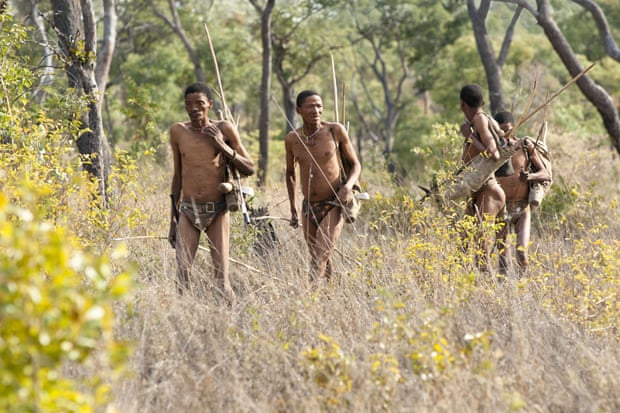
But what about examples of small-scale nomadic hunter-gatherers who do exhibit high rates of war-like behaviour? From my own area of study, there are historic southern African San/ Bushman groups who did wage war. The nineteenth century Nharo and #Dau//ei ( 1⁄4 Kx’ao//’ aen) San of the Ghanzi district in what is now Botswana, and their cousins in the northern Cape province of South Africa were famous in colonial history for their fighting prowess (Moodie, 1840- 1842). Regarding the Kalahari, in his 1907 monograph Siegfried Passarge (1907), discusses the #Dau//ei-speaking San of the Ghanzi area south of Dobe. Passarge insisted that the “Buschma ̈nnreich” of mid-nineteenth century Ghanzi was an independent polity based on hunting that fiercely defended its territory with force of arms. He wrote:
The honour of the chief was hereditary in those days and the Bushmen were totally independent. The Batuana did not dare set foot into their region and the Hottentots only entered it on raids (p. 115).
Given the #Ddau//ei circumstances as an embattled and encapsulated minority, their defense of their land from neighbouring African chiefdoms and especially from predatory European settlers with guns is understandable. But it has nothing remotely to do with Pleistocene conditions under which Homo sapiens evolved. It should be added that by the time Passarge went through the Ghanzi area at the turn of the century, the “Buschmannreich” had been destroyed and the Bushmen reduced to vassals of Tswana and European hunter-traders.
Their fierceness in defence of their land was admirable, but their military posture, far from being an expression of innate aggression, was largely an artifact of their historical positioning. This important ground has been well covered by the Tribal Zone thesis of Ferguson and Whitehead (1992) which accounts for high rates of militarism and violence observed in non-state societies by their positioning, caught in the meat-grinder of colonial history.
My colleague Mathias Guenther and I have analysed historic accounts of Kalahari San peoples (see Lee and Guenther, 1993; Guenther, 2005; Lee, 2002). In his chapter for this special issue Guenther thoroughly analyses and deconstructs an alleged case study of armed violence among !Kung San that Pinker and others have used as a key support of the bellicose thesis (Guenther, 2014). J.H. Wilhelm, a German settler in South West Africa in the early years of the twentieth century, provides what he purports to be an extended narrative of a dawn sneak attack by one !Kung group on another !Kung village (Guenther, 2005, pp. 149-52). Guenther questions the veracity of this account, itself a literary construction, as a hypothetical composite, and not a historically grounded incident with a specific date and place. While not unsympathetic to the !Kung in other areas, Wilhelm here sees the !Kung through a characteristic German colonial-imperialist lens, as ungovernable savages, justifying German military action and overlordship. A recent study of the German colonial period in South-West Africa (1885-1915), now Namibia, documents Germany’s unrestrained use of genocidal tactics against indigenous peoples, practices that clearly anticipated Germany’s mass-killings of 1939-1945 (Olusoga and Erichsen, 2010).
This is not to argue that the San never engaged in violence (see infra). But we need to be aware of the historical circumstances under which these observations were made. The San of colonial southern Africa had been under systematic attack by white settlers for several centuries. Dunbar Moodie’s “The Record” (1840-1842) is a compilation of the genocidal campaigns waged by Boer settlers against the San in the Cape. The research of Shula Marks (1972), Nigel Penn (2006) and Mohamed Adhikari (2010) makes it clear that in order to survive, the southern African San had to organize militarily, and under increasing pressure from the advancing colonial frontier, San bands were forced into each other’s space generating decades of conflict.
In addition to critiquing the Wilhelm account itself, Guenther performs a valuable service by chronicling the genealogy of its introduction and adoption into the evolutionary biology literature, first, by I. Eibl-Eibesfeldt, and from him to other authors, until by the time Pinker (2002) uses it had become a canonical element in the bellicose school’s core orthodoxy.
Additional clues highlight the inapplicability of the bellicose school’s general thesis to HNF hunters and gatherers. Regarding the alleged !Kung San sneak attacks and massacres, in addition to the issues raised by Guenther we need to consider the absence of fortifications. In post-Neolithic societies, subject to such raids, such as the Middle Mississippian cultures of North America, the Haudenosaunee Iroquois of the Lower Great Lakes, the LBK cultures of Neolithic northern Europe, and countless others, villages under threat take appropriate measures by building palisades and defensive earthworks. These are completely absent in !Kung and Ju/’hoansi settlements in Namibia and Botswana.
Palisaded settlements do occur among historic northern !Kung speakers in Angola. But villages there lay in the direct path of Portuguese slaving raids, confirming the validity of Ferguson’s and Whitehead’s “Tribal Zone” thesis (De Almeida, 1965). Another clue one could add for the southern Ju/’hoansi/!Kung: there is also no evidence of a tradition of posting of sentries, which would be an obvious step if sneak attacks were as common as Pinker, Keeley and LeBlanc assert they are.
Among HNF one significant exception to the general observation of the rarity of deadly conflict may be the Australian aborigines. Nicolas Peterson (2013) argues that indigenous Australians appear to have higher rates of fatalities from interpersonal violence. Two of the better documented cases, the Tiwi of Bathurst and Melville Island and the Murngin (Yolngu) of Arnhem Land, show evidence for a significant percentage of deaths as a result of violent conflict. Located on the northern edge of the Australian continent, these groups had been subject, for several centuries, to attacks by Macassan raiders from the Indonesian archipelago.
While these two cases may be extreme (and note the use of the Murngin case in Pinker’s TED talk and both Tiwi and Murngin in “Better Angels” 2011, pp. 49, 53) there is evidence of elevated levels of violence to a lesser extent from elsewhere in aboriginal Australia, including archaeological evidence. While the Australian data does appear to offer limited support for Pinker’s thesis, Peterson acknowledges that the aboriginal case offers evidence for causes not common elsewhere. For example, the Tiwi and Yolngu practiced extreme gerontocracy/ polygyny in which a few older men monopolized available wives, generating intense competition over women. Peterson also argues there is no reason to assert that the circumstances in aboriginal Australia can be extended or generalized to HNF elsewhere in the world.
Warfare in hunter-gatherer pre-history
Ultimately the evidence on warfare from recent hunter-gatherers may suffer from a major methodological conundrum. How seriously has the behaviour of modern hunter-gatherers been shaped by the colonial forces surrounding them and does this compromise their utility as a window on pre-historic conditions? The ultimate arbiter of the presence, absence and frequency of warfare in the past must be the archaeological record. Here we turn to the work of Jonathan Haas, an archaeologist with a track record in the pre-history of warfare (1990). Haas and Piscitelli (2013, pp. 168-90) take the bold step of disqualifying all ethnographic sources as appropriate models for illuminating warfare in deep pre-history. Whether we agree with this position or not, they do present compelling evidence for the absence of warfare in pre-history. Instead of cherry-picking sites purporting to show high rates of violence they embark on inventorying all sites prior to 8,000 BCE.
Among the evidence commonly adduced for signs of violent human-to-human conflict Haas and Piscetelli cite the following:
- osteological evidence of skull fractures indicating a blow sustained;
- osteological evidence of healed or unhealed “parry” fractures of the forearm indicating warding off a blow;
- arrow points or spear tips embedded in bone or associated with a burial; and
- rock art showing human figures with what appear to be spears or projectiles protruding.
Regarding the rock art, Haas and Piscitelli make two points. First, the evidence for human figures punctured by “spears” is sparse, boiled down to four figures from three French caves, yet cited repeatedly by authors in the “bellicose school”. Close study of these figures reveals confusing anomalies: two have tails, three have bodies that resemble antelopes more than humans and the putative “spears” are usually curved not straight. Second, these ambiguous four figures dated to the Palaeolithic stand in sharp contrast to the abundant and unambiguous evidence of warfare portrayed in cave art dated to the Neolithic (Haas and Piscitelli, 2013, pp. 178-81).
Turning to the skeletal evidence they surveyed a grand total of 400 sites with 2,900 skeletons gleaned from a review of over 75 published sources on skeletal remains in Europe, western Asia and the Levant. They report that, in a vast array of pre-historic sites, there is scant evidence of warfare. Clear evidence of some violence is found in two Italian and two Ukrainian sites with individual skeletons with embedded points. Over 390 other sites are completely lacking in such evidence. Haas and Piscitelli state:
Rather than demonstrating the commonness of ancient warfare amongst humans, consideration of the entire archaeological data set shows the opposite [y] Comparing the total number of known individuals [skeletal remains] before 8,000 B.C to the small sample showing signs of violence demonstrates the infrequency of conflict in the ancient past. The archaeological record is not silent on the presence of warfare in early human history. Indeed the record shows that warfare was the rare exception prior to the Neolithic pressures of population densities and insufficient resources for growing populations (Haas and Piscitelli, 2013, pp. 182-83, emphasis added).
The one exception to this general picture from the pre-historic record, Haas and Piscatelli and others note (e.g. Flannery and Marcus, 2012, pp. 40-42; Ferguson, 2013b, pp. 116-18) is the Upper Nile site of Jebel Sahaba excavated by Fred Wendorf (1968) and dated to 12-10,000 BCE. Here 24 of the 58 skeletons found, showed instances of parry fractures indicating violent struggle before death. But what is important to note here is not Jebel Sahaba’s typicality for pre-historic foraging sites, but rather its uniqueness in the pre-Neolithic archaeological record.
Brian Ferguson (2013a, b) conducts a similar investigation, deconstructing Pinker’s list of pre- historic sites and finding a similar paucity of confirmable instances of warfare in deep pre-history. Ferguson makes the important point that, despite this relative scarcity of actual evidence, interpersonal violence in pre-history has become axiomatic in certain branches of evolutionary psychology and human evolutionary biology. Given the confident statements of Keeley, LeBlance and Pinker, the actual empirical basis for these flat-out assertions are surprisingly shaky. For example, Pinker’s List (2011, fig. 2-2, p. 49) appears to be carefully assembled set of 21 archaeological cases demonstrating high violent death rates, but Ferguson systematically deconstructs the List and demonstrates that it is not a representative sample of the total spectrum of hunter-gatherers in pre-history but a carefully chosen subset demonstrating high levels of violence (Ferguson, 2013a, pp. 112-31).
What is the conclusion derived from the actual science behind these ambitious laundry lists of sites and cases claiming to show constant battles of war-like hunter-gatherers? We can state with some confidence that the case for primordial bellicosity has not been vindicated. Closer to the consensus is Raymond C. Kelly’s statement:
Warfare is not an endemic condition of human existence but an episodic feature of human history (and prehistory) observed at certain times and place but not others (R.C. Kelly, 2000, p. 75; cited in Haas and Piscitelli, 2013, p. 168).
This conclusion raises serious caveats about the grand evolutionary theory asserted by Wrangham. Instead of being “killer apes” in the Pleistocene and Holocene, the evidence indicates that early humans lived as relatively peaceful hunter-gathers for some 7,000 generations, from the emergence of Homo sapiens up until the invention of agriculture (roughly from 150,000 to 10,000 years BCE). Therefore there is a major gap between the purported violence of our chimp-like ancestors and the documented violence of post-Neolithic humanity.
Chimpanzee evidence and the Bellicose school
The thesis of chimpanzees as murderously violent is itself sharply contested. First, in Jane Goodall’s early years (1961-1965) of observation of the Gombe stream chimp populations (Goodall, 1971), she initially noted a conspicuous rarity of intra-specific violence. Chimp groups tended to occupy large spaces in the forest and avoid conflict by keeping their distance from other groups. However, soon after the researchers began systematically provisioning the chimps with food at a fixed location, the existence of this fixed source created conditions for heightened competition between males, and the researchers began to observe the now iconic instances of male-male chimp violence. This dramatic change in behaviour raises the possibility that the violence observed, far from being primordial, is an artifact of the researchers’ presence (de Waal, 1998; Power, 1991).
A second source of criticism of chimpanzees as indicators of proto-human propensity for violence is the frequently ignored fact that there are two species of chimpanzees in Africa, not one. The Bonobos (Pan paniscus) or “pygmy chimps”, unlike the more common Pan troglodytes, are famous in the primatological literature for the frequency of sexual behaviour and multiple partnering and the apparent rarity of inter-individual aggression. Considering the two species, what accounts for the readiness, even eagerness, of some evolutionary theorists to accept P. troglodytes as a stand-in for hominid behaviour, while ignoring P. paniscus? This is a question to which we will return below (de Waal, 2001; Power, 1991).
Pinker and the ju/’hoansi/!kung case study
It is important to point out that the HNF are not non-violent. They fight and sometimes kill, but there is an enormous distance from that statement to the canonical assertion of the bellicose school that 5-15 or even 50 per cent of all hunter-gatherers deaths are due to interpersonal violence. For example my work on the Dobe !Kung of Botswana (now generally known as the Ju/’hoansi) (1979) gained notoriety in the 1980s for the data I collected on homicides. I collected and documented 22 cases of homicide in the period 1920-1970. And colleagues added three more for a total of 25. Calculating a rate based on the mean population over that period yielded a homicide rate estimated at 33.3 per 100,000 person years.
In “Better Angels” Pinker (2011), examined the !Kung data specifically and he set the !Kung homicide death rate at 40.0/100,000 (p. 55). These levels are comparable to the high US homicide cities of the 1960s and 1970s, which for example in 1972 was 32.8 in Washington DC, 36.8 for Baltimore, and 40.1 for Detroit (Lee, 1979, pp. 397-98). The overall US homicide rate for 1972 was 9.2 per 100,000 population.
Situating this research within the framework of “The Better Angels of our Nature” requires some methodological adjustments (Lee, 1979, pp. 397-99). Despite the apparent magnitude of the Ju/’hoan/!Kung homicide rate, there are crucial differences to consider.
First is the question of US assault victims – unlike the !Kung – having access to excellent emergency room and trauma centre facilities. Lois Beckett recently addressed this issue: “While the number of gun murders has decreased in recent years, there’s a debate over whether this reflects a drop in the total number of shootings, or an improvement in how many lives emergency room doctors can save” (Beckett, 2014). One can only surmise how much higher a US inner city homicide rate would be if there were zero access to trauma centres.
Second, the 25 listed killings represented all the !Kung homicides our research group collected. The Ju/’hoansi waged no wars in the twentieth century, and the Americans and other modern nations did (and still do). Adding the deaths on both sides in the World Wars, Korea and Vietnam (and many other smaller conflicts) to the twentieth century totals more than triples the modern violent death rates. In my 1979 monograph, I estimated the violent death rates for Europeans in the period 1914-1945 at close to 100 per 100,000 population (Lee, 1979, p. 399).
Calculating the number of violent deaths as a percentage of
Violent deaths 1920-1970: 25
Annual overall death rate all causes (Howell, 2000): 33/1,000
Mean Base Population 1920-1970: 1,500
Overall estimated deaths 1920-1970: 2,500
Violent deaths as a percentage of overall mortality: 1.0 per cent
Violent deaths as a per cent of mortality using Pinker’s figures: 1.6 per cent
A figure of 1.0 or 1.6 per cent of deaths due to interpersonal deadly conflict for the Ju/’hoansi/ !Kung is not negligible, but it is far below the percentages asserted by Pinker as indicative of the putative norm for “hunter-gatherer” male deaths due to violence, which ranges from 8 per cent (Gebusi) to 58 per cent (Jivaro) and an overall average of 29 per cent of violent deaths for the seven cases in his TED talk. And recall, only one of the seven cases was an actual hunter-gatherer society.
Pinker (2011, pp. 54-5) also argues that his overall thesis is strengthened by the evidence that !Kung homicide rates declined as a result of the assertion of Britain’s colonial authority in Botswana (1948) and South Africa’s in South West Africa (1959). He neglects to note that despite the “Leviathan’s” beneficent presence, homicide reappeared in the 1970s. At Tsumkwe, South West Africa, John Marshall recorded six homicides in drunken brawls in a 24-month period, 1978-1980 (Marshall and Ritchie, 1984). Homicides thus constituted 10 per cent of all deaths occurring in that community in those years. One can only wonder how Pinker’s theory would accommodate easy access to alcohol as one of the benefits conferred by civilization?
Peace and harmony: a deathbed reprieve
Our primary goal in this paper has been to evaluate the hunter-gatherer data from ethnography and archaeology for the light that this body of evidence sheds on the theses put forward by the “bellicose school”. The clear rarity of the evidence for humans killing humans in deep pre-history leads us to conclude, in essence that the violent ways observed in post-Neolithic, pre-modern and modern societies are products of our recent history, under conditions of population pressure unique to the history of the last 8,000 years, and therefore cannot be seen as an unbroken inheritance from our primate evolutionary past.
Taking all the evidence together, the empirical basis for the bellicose view of HNF is unsupported. The image of the HNF held by the bellicose school is almost unrecognizable in light of a century of careful ethnographic research on dozens of HNF from the Arctic to the Americas to Africa. Consider the evidence for sharing, cooperation, personal autonomy, and modes of conflict resolution presented in the writings of such authors as Tim Ingold (1999), Kirk Endicott (1979), Peter Gardner (2000), Bird-David (1990), Jean Briggs (1971), Eleanor Leacock (1982), Lorna Marshall (1976), and James Woodburn (1982) (see also Leacock and Lee, 1982; Lee and Daly, 1999). But all of this is lost when the bellicose school attempts to squeeze recalcitrant data to fit their pre-conceived theories.
Pinker at the “modern” end of the violence continuum
Earlier I referred to two flaws in Pinker’s theories. By way of conclusion, I now address the second one. Pinker is undeniably a booster for modernity, more specifically the modernity of Euro-American Capitalism which he portrays as liberal, humane and civilized. His account of undeniable declines in death by violence and improvements in the status of women offers reasons for optimism. But the impacts he so glowingly describes extend primarily to the middle and upper classes of Euro-America and other parts of the developed world.
In the farms and favelas of the global South the reality for billions of the world’s poor remains sadly out of reach of “the better angels of our nature”. Poverty, blighted lives, and women’s oppression remain all too common. So even if we accept the now rather dubious “reduction” of death rates from war, it does not address the effects of the other horsemen of the apocalypse, now reframed by the more modern-term structural violence, the contemporary term to describe harm to life and well-being without actual physical blows. Examples include the effects of racism, discrimination, overcrowding, poverty, environmental insult, occupational injustice and women’s oppression (Farmer, 2005; see also Thomas Piketty’s (2014) “Capital in the Twenty-first Century”, a landmark study of accelerating global economic inequality).
But even in Pinker’s (2011) stated focus on physical violence declining, the record is highly skewed. He portrays the post-1945 global political scene as “the Long Peace”, the “Democratic Peace”, and other benevolent terms (pp. 189-294). Yet as Herman and Peterson (2012) have documented in a detailed 85 page analysis of his treatment of modern wars, Pinker seriously glosses over no fewer than five major high-fatality wars-of-choice waged by the USA during that same era of “Long Peace”, in Korea, Vietnam, Iraq, Bosnia, and Afghanistan, and lesser but still lethal interventions in Angola, Congo Dominican Republic, Grenada, Guatemala, Nicaragua, Panama, Pakistan, Philippines, Yemen, and the list goes on; in all, armed interventions and/or subversion with proxies in over 30 countries since Second World War (Herman and Peterson, 2012; see also William Blum’s (1998, 2006) documentation of post-Second World War US militarism and subversion).
On the ideological playing field
Before concluding, it is useful to attempt to understand better the particular ways that this body of evidence is used and misused in contemporary intellectual and ideological debates. Although the authors of the bellicose school don the mantle of objective empiricists, their work is not without an ideological dimension. Their opponents are dismissed as “the peace and harmony Mafia” (Van der Deenen, 2005). And Keeley (1996, pp. 17-24) and LeBlanc and Register (2003, pp. xii-xiv) criticize the advocates of “the pacified past”, and purveyors of “the myth of the peaceful savage”, implying that this blind spot is ideologically driven. Being hard-nosed empiricists themselves, their reasoning goes, they follow the evidence wherever it leads even if the evidence is unpalatable. But in such ideologically driven debates, as Marshall Sahlins, Robert Sussman, Susan McKinnon and others have effectively argued, the playing field is not level. In modern America’s take on “human nature”, victory goes to the darkest vision (Sahlins, 2008; Sussman, 2013; McKinnon, 2006).
In the bellicose school’s perspective, only those who acknowledge humankind’s beastly nature are looking reality straight in the eye. The rest of us, who dispute these baleful conclusions, are dismissed as soft-headed romantics. To take just one example, this marked skewing of the ideological “playing field” may account in part for why the murderous chimps of Gombe are so much more readily accepted as modelling our putative ancestors than the more peaceful (and highly sexual) Bonobos (Ryan and Jetha, 2010, pp. 187-89; see also MacKinnon and Fuentes, 2005; Power, 1991).
By constantly asserting the dominance of the side of human nature that emphasizes war over peace and competition over cooperation, the dominant forces in the modern world order can more plausibly maintain a permanent war economy, justify the obscene profits of multinational corporations and their CEOs, and affirm the inevitability of winners and losers in life’s sweepstakes (Abercrombie et al., 1991; Chatterjee and Maira, 2014).
By contrast, the work of Douglas Fry, Brian Ferguson, Jonathan Haas and Matthew Piscitelli make no claims to ideological purity. They simply evaluate the evidence using the same methodologies as Pinker, Keeley and LeBlanc and subject them to the same rules of evidence. It is encouraging that scholars working within the human behavioural evolution/ecology paradigm are also challenging proponents of the bellicose school (e.g. Hrdy, 2009; Howell, 2010; Gurven, 2004; Hill et al., 2009).
To conclude, Pinker’s Panglossian functionalism argues that the human condition is getting better and better. But he employs a most curious and tortured calculus: one considers the twentieth century’s wars and genocidal slaughters and the blighted lives of billions in the violence-ridden shantytowns of the Global South and, in comparison with the lives of band and tribal peoples, he judges the latter our moral inferiors.
Apart from this curious tunnel vision, Pinker’s “The Better Angels of our Nature” fails on empirical grounds. His lofty theses do not match the evidence and his treatment of hunter-gatherer societies is a cruel caricature, seeing them through a distorted lens of Euro-American class bias and American exceptionalism. If we as a species were as violent and aggressive as Pinker, Wrangham and others make us out to be, it is no small miracle that we survived those putative dark ages of constant battles that stretched over millions of years.
To his credit Lawrence Keeley (1996), does relinquish some ground at the very end of his book, acknowledging that humanity cannot live by war alone and to do so would lead to early extinction. He concedes “If Rousseau’s primitive golden age is imaginary, Hobbes’ perpetual donnybrook is impossible” (p. 178). Given the evidence presented here and in the other papers in this special issue, I say Amen to that.
References
Abercrombie, N., Hillyard, S. and Turner, B.S. (1991), Dominant Ideologies, Unwin Hyman Publishers, London.
Adhikari, M. (2010), The Anatomy of a South African Genocide: The Extermination of the Cape San People, University of Cape Town Press, Cape Town.
Beckett, L. (2014), “Why don’t we know how many people are shot each year in the US?”, available at: www.truth-out/news/item/23772
Bird-David, N. (1990), “The giving environment: another perspective on the economic system of gatherer- hunters”, Current Anthropology, Vol. 31 No. 2, pp. 189-96.
Blum, W. (1998), Killing Hope: US Military and C.I.A. Interventions since World War II, Black Rose Books, Montreal.
Blum, W. (2006), Rogue State: A Guide to the World’s Only Superpower, Zed Books, London.
Bohman, J. (Ed.) (1997), Perpetual Peace: Essays on Kant’s Cosmopolitan Ideal, MIT Press, Cambridge, MA. Bowles, S. (2009), “Did warfare among ancestral hunter-gatherers affect the evolution of human social behavior?”, Science, Vol. 324, pp. 1293-8.
Briggs, J. (1971), Never in Anger: Portrait of an Eskimo Family, Harvard University Press, Cambridge, MA.
Chatterjee, P. and Maira, S. (Eds) (2014), The Imperial University: Academic Repression and Scholarly Dissent, University of Minnesota Press, Minneapolis, MN.
Cohen, M.N. (1977), The Food Crisis in Prehistory: Overpopulation and the Origins of Agriculture, Yale University Press, New Haven, CT.
Corry, S. (2013), “Why Steven Pinker, like Jared Diamond, is wrong”, available at: http://truth-out.org/ opinion/item/16880 (accessed 11 June 2013).
Daly, R. (2014), “War, peace and complex hunter-gatherers”, Journal of Aggression, Conflict, and Peace Research, Vol. 6 No. 4.
De Almeida, A. (1965), Bushmen and other Non-Bantu Peopes of Angola: Three Lectures, Witwatersrand University Press, Johannesburg.
De Maillie, R.C. (Ed.) (2000), Handbook of the North American Indians, Vol. 13 (Parts 1 and 2) Plains, Smithsonian Press, Washington, DC.
de Waal, F. (1998), Chimpanzee Politics: Power and Sex among the Apes, Johns Hopkins University Press, Baltimore.
de Waal, F. (2001), Tree of Origin: What Primate Behavior can tell us About Human Social Evolution, Harvard University Press, Cambridge, MA.
Divale, W. and Harris, M. (1976), Population, Warfare, and the Male-Supremacist Complex, Vol. 78, American Anthropologist, pp. 521-38.
Endicott, K. (1979), Batek Negrito Religion, Clarendon Press, Oxford.
Farmer, P. (2005), Pathologies of Power: Health, Human Rights and the New War on the Poor, University of
California Press, Berkeley, CA and Los Angeles, CA.
Ferguson, B. (1997), “Violence and war in prehistory”, in Martin, D. and Frayer, D. (Eds), Troubled Times:
Violence and Warfare in the Past, Psychology Press, London, pp. 321-46.
Ferguson, B. (2013a), “Pinker’s list: exaggerating prehistoric war mortality”, in Fry, D. (Ed.), War, Peace and
Human Nature, Oxford University Press, Oxford, pp. 112-31.
Ferguson, B. (2013b), “The prehistory of war and peace in Europe and the Near East”, in Fry, D. (Ed.), War,
Peace and Human Nature, Oxford University Press, Oxford, pp. 191-240.
Ferguson, B. and Whitehead, N. (Eds) (1992), War in the Tribal Zone: Expanding States and Indigenous
Warfare, School of American Research, Santa Fe, NM.
Flannery, K. and Marcus, J. (2012), The Creation of Inequality, Harvard University Press, Cambridge, MA.
Fry, D. (2006), The Human Potential for Peace: An Anthropological Challenge to Assumptions About War and Violence, Oxford University Press, Oxford.
Fry, D. (Ed.) (2013), War, Peace and Human Nature: The Convergence of Evolutionary and Cultural Views, Oxford University Press, Oxford.
Gardner, P. (2000), Paliyans: Persistent Hunter-Gatherers of South India, Edwin Mellen Press, Lewiston, NY and Toronto.
Goodall, J. (1971), In the Shadow of Man, Collins, Glasgow.
Guenther, M. (Ed.) (2005), Kalahari und Namib Bushmen in German South-West Africa: Ethnographic
Reports by Colonial Soldiers and Settlers, Rudiger Koppe Verlag, Koln.
Guenther, M. (2014), “War and peace among the Kalahari San”, Journal of Aggression, Conflict and Peace
Research, Vol. 6 No. 4, pp. 229-239.
Gurven, M. (2004), “The evolution of contingent cooperation”, Current Anthropology, Vol. 47, pp. 185-92.
Haas, J. (Ed.) (1990), The Anthropology of War, Cambridge University Press, Cambridge.
Haas, J. and Piscitelli, M. (2013), “The prehistory of warfare: misled by ethnography”, in Fry, D. (Ed.), War, Peace and Human Nature, Oxford University Press, Oxford, pp. 169-90.
Heizer, R. (Ed.) (1978), Handbook of the North American Indians, Vol. 8, California, Smithsonian Press, Washington, DC.
Hill, K., Barton, M. and Hurtado, M. (2009), “The emergence of human uniqueness: characteristics underlying behavioural modernity”, Evolutionary Anthropology, Vol. 18, pp. 187-200.
Herman, E. and Peterson, D. (2012), “Reality Denial: Steven Pinker’s apologetics for western imperial violence”, available at: www.zcommunications.org (accessed 17 July 2012).
Hobbes, T. (1651/1964), Leviathan, Routledge and Kegan Paul, London.
Howell, N. (2000), Demography of the Dobe !Kung, 2nd ed., Aldine DeGruyter, New York, NY.
Howell, N. (2010), Life Histories of the Dobe !Kung, University of California Press, Berkeley, CA and Los Angeles, CA.
Hrdy, S. (2009), Mothers and Others: The Evolutionary Origins of Mutual Understanding, Belknap Press, Cambridge, MA.
Ingold, T. (1999), “On the social relations of hunter-gatherer bands”, in Richard, B.L. and Richard, H.D. (Eds), The Cambridge Encyclopedia of Hunters and Gatherers, Cambridge University Press, Cambridge, pp. 399-410.
PAGE 226 jJOURNAL OF AGGRESSION, CONFLICT AND PEACE RESEARCH jVOL. 6 NO. 4 2014
Keeley, L.H. (1996), War Before Civilization: The Myth of the Peaceful Savage, Oxford University Press, New York, NY.
Kelly, R.C. (2000), Warless Societies and the Origin of War, University of Michigan Press, Ann Arbor, MI. Leacock, E. (1982), “Relations of production in band societies”, in Eleanor, L. and Richard, B.L. (Eds), Politics
and History in Band Societies, Cambridge University Press, Cambridge, pp. 159-70.
Leacock, E. and Lee, R.B. (Eds) (1982), Politics and History in Band Societies, Cambridge University Press,Cambridge.
LeBlanc, S. and Register, K.E. (2003), Constant Battles: The Myth of the Peaceful, Noble Savage, St Martins Press, New York, NY.
Lee, R. and Guenther, M. (1993), “Problems in Kalahari historical ethnography and the tolerance of error”, History in Africa, Vol. 20, pp. 185-235.
Lee, R.B. (1979), The !Kung San: Men, Women and Work in a Foraging Society, Cambridge University Press, New York, NY and Cambridge.
Lee, R.B. (2002), “Solitude or Servitude? Ju/’hoan Images of the Colonial Encounter”, in Kent, S. (Ed.), Ethnicity and Hunter-Gatherers: Association or Assimilation, Smithsonian Institution Press, Washington, DC, pp. 178-96.
Lee, R.B. and Daly, R.H. (Eds) (1999), The Cambridge Encyclopedia of Hunters and Gatherers, Cambridge University Press, Cambridge.
McKinnon, S. (2006), Neoliberal Genetics: The Myths and Moral Tales of Evolutionary Psychology, Prickly Paradigm Press, Chicago, IL.
MacKinnon, K.C. and Fuentes, A. (2005), “Reassessing male aggression and dominance: the evidence from primatology”, in McKinnon, S. and Silverman, S. (Eds), Complexities: Beyond Nature and Nurture, University of Chicago Press, Chicago, IL, pp. 83-105.
Marks, S. (1972), “Khoisan resistance to the Dutch in the seventeenth and eighteenth centuries”, Journal of African History, Vol. 13, pp. 55-80.
Marshall, J. and Ritchie, C. (1984), Where are the Bushmen of Nyae Nyae? Changes in a Bushman Society, 1958-81, Communication No. 9, University Center for African Studies, Cape Town.
Marshall, L. (1976), The !Kung of Nyae Nyae, Harvard University Press, Cambridge, MA.
Moodie, T.D. (1840-1842), The Record, or a Series of Official Papers Relative to the Condition and Treatment of the Native Tribes of South Africa, A.A. Balkema, Amsterdam.
Olusoga, D. and Erichsen, C.W. (2010), The Kaiser’s Holocaust: Germany’s Forgotten Genocide, Faber and Faber, London.
Passarge, S. (1907), Die Buschmanner der Kalahari, Dietrich Reimer, Berlin.
Penn, N. (2006), The Forgotten Frontier: Colonist and Khoisan on the Cape’s Northern Frontier in the 18th Century, Ohio University Press, Athens.
Peterson, N. (2013), paper presented at Conference on Hunting and Gathering Societies (CHAGS 10), Liverpool, 27 May.
Piketty, T. (2014), Capital in the Twenty-First Century, Belknap Press, Cambridge, MA.
Pinker, S. (2002), The Blank Slate: The Modern Denial of Human Nature, Viking, New York, NY.
Pinker, S. (2007), “TED talk: on the myth of violence”, available at: www.ted.com/index./php/talks/ steven_pinker_on_the_myth_of_vioence.html
Pinker, S. (2011), The Better Angels of our Nature: Why Violence has Declined, Viking, New York, NY. Power, M. (1991), The Egalitarians: Humans and Chimpanzee, Cambridge University Press, Cambridge.
Rousseau, J.J. (1749/2003), On the Social Contract, (Trans by G.D.H. Cole), Dover, New York, NY.
Rowthorn, R. and Seabright, P. (2010), “Property rights, warfare and the Neolithic transition”, IDEI Working Paper No. 654, Institut d’Economie Industrielle, Toulouse.
Ryan, C. and Jetha, C. (2011), Sex at Dawn, Harper, New York, NY.
Sahlins, M. (2008), The Western Illusion of Human Nature, Prickly Paradigms Press, Chicago, IL.
Sussman, R. (2013), “Why the legend of the Killer Ape never dies: the enduring power of cultural beliefs to distort our view of human nature”, in Fry, D. (Ed.), War, Peace and Human Nature, Oxford University Press, Oxford, pp. 97-111.
Suttles, W. (Ed.) (1990), Handbook of the North American Indians, Vol. 7, Northwest Coast, Smithsonian Press, Washington, DC.
Van der Deenen, J.M.G. (2005), “Querela pacis: confession of an irreparably benighted researcher on war and peace”, An open letter to Frans de Waal and the Peace and Harmony Mafia, University of Groningen, The Neatherland.
Wendorf, F. (Ed.) (1968), The Prehistory of Nubia, SMU Press, Dallas, TX. Woodburn, J. (1982), “Egalitarian societies”, Man, Vol. 17 No. 3, pp. 431-51.
Wrangham, R. and Peterson, D. (1996), Demonic Males: Apes and the Origins of Human Violence, Houghton Mifflin, New York, NY.
Further reading
Gowdy, J. (Ed.) (1998), Limited Wants, Unlimited Means: A Hunter-Gatherer Reader in Economics and the Environment, Island Press, Washington, DC.
Guenther, M. (2013), “‘Fighting like a cornered mongoose’: the intensification of violence in Kalahari sociality in pre-colonial and colonial times”, paper presented at CHAGS X, University of Liverpool, 25 June.
Keeley, L. (1997), “Frontier warfare in the early Neolithic”, in Martin, D. and Frayer, D. (Eds), Troubled Times: Violence and Warfare in the Past, Psychology Press, London, pp. 303-20.
Lee, R.B. and Mathias, G. (1993), “Problems in Kalahari historical ethnography and the tolerance of error”, History in Africa, Vol. 20, pp. 185-235.
Ryan, C. (2011), “Pinker’s Stinker on the Origin of War”, available at: www.psychologytoday.com/blog/sex- dawn/201103
Ryan, C. and Cacilda, J. (2010), Sex at Dawn, Harper, New York, NY.
Wilhelm, J.H. (2005/1953), “The !Kung Bushmen”, in Guenther, M. (Ed.), Kalahari and Namib Bushmen in German South-west Africa: Ethnographic Reports by Colonial Soldiers and Settlers, Rudiger Koppe Verlag, Koln, pp. 97-184.
Corresponding author
Dr Richard B. Lee can be contacted at: richardb.lee@utoronto.ca