Showing posts with label Capitalist agriculture. Show all posts

Thursday, July 28, 2016

2383. Toxic Concoctions: How the EPA Ignores the Dangers of Pesticide Cocktails

By Nathan Donley, Center for Biological Diversity, July 2016


Executive Summary

More than 1 billion pounds of pesticides are used in the United States each year, applied to agricultural fields and orchards, residential lawns, playgrounds and parks. Pesticides are often mixed with other pesticides and chemicals before application or after, and the individual ingredients in these mixtures can interact in such a way as to enhance their toxic effects. This is referred to as “synergy,” and it can turn what would normally be considered a safe level of exposure to people, wildlife and the environment into one that causes considerable harm.

Although pesticide mixtures in the environment have been extensively documented, the Environmental Protection Agency generally only assesses the toxicity of pesticides individually, in isolation from potential real-life scenarios where these pesticides may interact with other chemicals. The EPA, which is tasked with ensuring that pesticides do not result in unreasonable harm to human health and the environment, often rationalizes this approach by stating that studies measuring mixture toxicity are often not available for analysis.

Our analysis, however, contradicts that claim by utilizing a publicly available information source (data from the U.S. Patent and Trademark Office) that provides a disturbing snapshot of pesticide synergy and the potential for widespread danger to people, waterways and wildlife — risks the EPA has repeatedly failed to identify and consider during its approval process.

For this report we conducted an intensive search of patent applications that were germane to all pesticide products containing two or more active ingredients approved by the EPA in the past six years from four major agrochemical companies (Bayer, Dow, Monsanto and Syngenta).

Among our key findings:
• 69 percent of these products (96 out of 140) had at least one patent application
that claimed or demonstrated synergy between the active ingredients in the
product;
• 72 percent of the patent applications that claimed or demonstrated synergy
involved some of the most highly used pesticides in the United States, including glyphosate, atrazine, 2,4-D, dicamba and the controversial neonicotinoids thiamethoxam, imidacloprid and clothianidin, among others, indicating that potential impacts could be widespread.

This suggests that synergistic action between pesticide active ingredients is much better documented and more common than current EPA pesticide assessments would indicate. Further, it appears that pesticide companies are in fact collecting information about the synergistic effects of their products that they are not sharing with the EPA. Recognizing that pesticide synergy data are widely available and that the synergistic relationships between pesticides can have serious implications for human and environmental health, the EPA must now take action to properly consider the potential consequences of pesticide synergy.

For the full PDF version of the report click here

Wednesday, May 25, 2016

2334. The Unholy Alliance, Five Western Donors Shape a Pro-Corporate Agenda for African Agriculture

By The Oakland Institute, May 2016


Oakland, CA - The Unholy Alliance, Five Western Donors Shape a Pro-Corporate Agenda forAfrican Agriculture, a new report released today by the Oakland Institute, exposes how a coalition of four donor countries and the Bill and Melinda Gates Foundation is shaping a pro- business environment in the agricultural sector of developing countries, especially in Africa.

“‘Enabling Business’ has become a buzzword for development agencies, but it is vital to understand what this entails,” said Anuradha Mittal, Executive Director of the Oakland Institute. “Our research shows that, in order to foster private investments, governments are being forced to open their agricultural sector to seed, pesticide and fertilizer corporations, release land for commercial agriculture, and reduce taxes and tariffs for agribusinesses. In short, facilitate the destruction of family farming and natural resources for the sake of corporate profit.”

The Unholy Alliance comes as the G7 leaders gather at their summit in Ise-Shima, Japan, on May 26, 2016. A meeting of the G7 Agriculture Ministers preceded the grand gathering – for the first time in seven years. While this might suggest that food and agriculture is of concern to the rich nations, their track record suggests otherwise.

Instead of following through on the $20 billion commitment to support “country-owned” food security strategies, agreed upon at the 2009 G8 L’Aquila Summit, rich nations have made an unprecedented push to favor private sector and market-driven food systems through aid programs.

The 2012 G8 initiative, the New Alliance for Food Security and Nutrition, launched in partnership with agribusinesses, aimed at increasing private investments in Africa’s agriculture. The imposition of this agenda comes with new aid conditionality. In order to receive aid through the New Alliance, African partner countries have to commit to reforms to facilitate business in agriculture. Globally, reforms are to be guided by a business ranking of countries that the G8 tasked the World Bank to put in place. The “Enabling the Business of Agriculture” (EBA) index, launched in 2013, is financed by the US, UK, Danish, and Dutch governments along with the Bill and Melinda Gates Foundation.

These five donors are rapidly expanding bilateral and multilateral ‘aid’ programs to support corporate agriculture. Through aid-funded grants, loans, or insurance mechanisms, taxpayers’ money is increasingly subsidizing agribusinesses’ activities. Promotion of hybrid and GMO seeds, pesticides, and synthetic fertilizers by such aid programs is turning Africa into a new market for agrichemical corporations.

“Opening markets and creating space for multinationals to secure profits is leading to blatant land grabs across the continent, displacing farmers from their lands and imposing large-scale production structures for export,” said Mariam Mayet, director of the African Center for Biodiversity, which works to dismantle inequalities in the food and agricultural systems in Africa.

“Many farmers are marginalized by growing concentration and corporate control over seeds, land, and water, and forced into poorly paid and insecure wage work. All historical and cultural connection to the land is being severed by commodification and commercialization, a result of promotion of self-interest by a few rich nations,” Mayet continued. 

Saturday, December 26, 2015

2136. Earth Has Lost a Third of Arable Land in Past 40 Years, Scientists Say

By Oliver Milman, The Guardian, December 2, 2015


The world has lost a third of its arable land due to erosion or pollution in the past 40 years, with potentially disastrous consequences as global demand for food soars, scientists have warned.

New research has calculated that nearly 33% of the world’s adequate or high-quality food-producing land has been lost at a rate that far outstrips the pace of natural processes to replace diminished soil.

The University of Sheffield’s Grantham Centre for Sustainable Futures, which undertook the study by analysing various pieces of research published over the past decade, said the loss was “catastrophic” and the trend close to being irretrievable without major changes to agricultural practices.

The continual ploughing of fields, combined with heavy use of fertilizers, has degraded soils across the world, the research found, with erosion occurring at a pace of up to 100 times greater than the rate of soil formation. It takes around 500 years for just 2.5cm of topsoil to be created amid unimpeded ecological changes.

“You think of the dust bowl of the 1930s in North America and then you realise we are moving towards that situation if we don’t do something,” said Duncan Cameron, professor of plant and soil biology at the University of Sheffield.

“We are increasing the rate of loss and we are reducing soils to their bare mineral components,” he said. “We are creating soils that aren’t fit for anything except for holding a plant up. The soils are silting up river systems – if you look at the huge brown stain in the ocean where the Amazon deposits soil, you realise how much we are accelerating that process.

“We aren’t quite at the tipping point yet, but we need to do something about it. We are up against it if we are to reverse this decline.”

The erosion of soil has largely occurred due to the loss of structure by continual disturbance for crop planting and harvesting. If soil is repeatedly turned over, it is exposed to oxygen and its carbon is released into the atmosphere, causing it to fail to bind as effectively. This loss of integrity impacts soil’s ability to store water, which neutralizes its role as a buffer to floods and a fruitful base for plants.

Degraded soils are also vulnerable to being washed away by weather events fueled by global warming. Deforestation, which removes trees that help knit landscapes together, is also detrimental to soil health.

The steep decline in soil has occurred at a time when the world’s demand for food is rapidly increasing. It’s estimated the world will need to grow 50% more food by 2050 to feed an anticipated population of 9 billion people. According to the UN’s Food and Agriculture Organisation, the increase in food production will be most needed in developing countries.

The academics behind the University of Sheffield study propose a number of remedies to soil loss, including recycling nutrients from sewerage, using biotechnology to wean plants off their dependence upon fertilizers, and rotating crops with livestock areas to relieve pressure on arable land.

Around 30% of the world’s ice-free surfaces are used to keep chicken, cattle, pigs and other livestock, rather than to grow crops.

“We need a radical solution, which is to re-engineer our agricultural system,” Cameron said. “We need to take land out of production for a long time to allow soil carbon to rebuild and become stable. We already have lots of land – it’s being used for pasture by the meat and dairy industries. Rather than keep it separated, we need to bring it into rotation, so that that there is more land in the system and less is being used at any one time.”

Cameron said he accepted this would involve direct government intervention, funding for farmers and “brave” policymaking.

“We can’t blame the farmers in this. We need to provide the capitalisation to help them rather than say, ‘Here’s a new policy, go and do it,’” he said. “We have the technology. We just need the political will to give us a fighting chance of solving this problem.

Saturday, December 19, 2015

2122. In the Last 50 Year, Iran Has Used-Up 70 Percent of Its Ground Water Supplies

By Thomas Erdbrink, The New York Times, December 18, 2015
A dried-up salt lake near Sirjan, Iran. A seven-year drought in the country shows no sign of ending. Photo: Newsha Tavakolian for The New York Times.

POUZE KHOON, Iran — The early-morning sun meagerly brightened the gloom of this sad township, a collection of empty, crumbling houses along a highway through the dusty desert landscape in southeastern Iran.

Until a decade or so ago, Amin Shoul would come here every year to help his father harvest pistachios, the nuts that are as much a symbol of Iran as caviar. Now, with the last reserves of groundwater tapped out, the family’s grove and the seemingly endless fields beyond it are filled with dead trees, their bone-colored branches a deathly contrast to the turquoise sky.

Mr. Shoul, 32, a journalist, said he and his family had moved away years ago, leaving the house to squatters, unemployed laborers living off meager government stipends — and even they had started to leave. “I don’t see how we can ever return to the past,” he remarked, matter-of-factly.

As Iran emerges from isolation after signing a nuclear agreement with the West, attention has focused on its business relations, particularly in the oil and airline industries. But Iran needs expertise in a number of areas, including the environment. Most pressing in that regard is its impending water crisis.

Iran is in the grip of a seven-year drought that shows no sign of breaking and that, many experts believe, may be the new normal. Even a return to past rainfall levels might not be enough to head off a nationwide water crisis, since the country has already consumed 70 percent of its groundwater supplies over the past 50 years.

Always arid, Iran is facing desertification as lakes and rivers dry up and once-fertile plains become barren. According to the United Nations, Iran is home to four of the 10 most polluted cities in the world, with dust and desertification among the leading causes.
In Zanjan, northwest of Tehran, the historic Mir Baha-eddin Bridge crosses a riverbed of sand, stones and weeds. In Gomishan, on the shores of the Caspian Sea, the fishermen who once built houses on poles surrounded by freshwater now have to drive for miles to reach the receding shoreline. In Urmia, close to the Turkish border, residents have held protests to demand that the government return water to a once-huge lake that is now the source only of dust storms.

More than 15 percent of the approximately 150,000 acres of pistachio trees in the main producing area in Kerman Province have died in the last decade or so.

A nationwide network of dams, often heralded by state television as a sign of progress and water management, is adding to water shortages in many places while helping deplete groundwater. In Isfahan, the once-iconic Zayanderud River is now a dusty scar the size of the Seine snaking through the city, because officials were forced to divert its water to the desert city of Yazd.

In Tehran, officials barely managed to keep the water running this summer as reservoirs shrank to dangerously low levels. Subsidies for water and electricity encourage overconsumption in urban areas. Isa Kalantari, a former minister of agriculture, warns that more than half of Iran’s provinces could become uninhabitable within 15 years, displacing millions of people.

As in drought-stricken California, agriculture accounts for about 90 percent of water consumption in Iran. And here, matters are not helped by the prevalence of crude, centuries-old irrigation methods and other wasteful practices.

Where there are no longer rivers and lakes to be tapped, desperate farmers and municipalities are turning to dwindling groundwater supplies. Drillers report that they are increasingly coming up dry, even at depths of more than 600 feet. When they do find water, they say, it is often polluted with heavy metals and arsenic, released as the drill bits break through sediment.

The changing landscape is all too visible in Kerman Province. In a not-so-distant past, the area was a beltway of green stretching for hundreds ofsquare miles, using groundwater to produce grain and pistachios. Now, the sun bakes treeless plains that are increasingly giving way to deserts. During storms, the dead trees lose their branches, turning them into stumps, while the dust swirls about in ever-growing quantities.

In the dead pistachio grove, a rare rainstorm recently left white lines in the red soil.

“Salt and other things,” Mr. Shoul said — residue from the contaminated water brought up by wells that sucked the last remaining groundwater years ago. He said he had kidney stones, as do many others in the region: a result, he said, of their drinking water from the taps.

“The irony,” he said, “is that I have to drink even more water to reduce the pain.”

Just over 50 miles north, in the city of Sirjan, decisions long postponed have begun to impose themselves on local officials, forcing them to make difficult choices in allocating scarce water supplies.
Wedged between two newly built neighborhoods of five-story apartment buildings, a convoy of water trucks waited in line to fill their 5,000-gallon tanks. Under a deal with the local water management company, up to 400 of these trucks a day draw water from the city’s main well and head to the Golgohar iron mine, the largest such mine in the Middle East. It employs over 7,000 people, many of them from Sirjan, and a water shortage has compounded an already difficult situation brought on by collapsing iron ore prices.

“It is internationally unprecedented to carry water with tankers, but we have no other way,” Naser Taghizadeh, chief executive of the Golgohar Iron Ore Company, told the local Negarestan news outlet. “If water is not taken to the complex, projects are stopped, and many people will lose their jobs.”

Residents have objected and even staged a sit-in, but the tankers keep coming for the water, kicking up clouds of fine dust as they drive off. The drivers, often from the city, say they are scorned by their neighbors. “We need to feed our families too,” one of them, Saaed Salimizadeh, said. “When the water runs out, it will run out for all of us. We have to choose between jobs and drinking water.”

Sirjan is by no means alone in its water shortages. In surrounding Kerman Province, 1,455 of 2,064 village reservoirs have dropped below levels needed to sustain the population, according to the local water management agency. The semiofficial Mehr news agency reported in July, citing local statistics, that 541 villages were dependent on tanker deliveries for their water.

It is not just water levels that are declining. “The quality of the water has decreased dramatically, as have the levels of the underground water,” Akbar Mahmoud Abadi, a deputy at the local department of the Ministry of Agricultural Jihad in Sirjan, said in a written reply to questions. “The condition is very worrisome.”

Kerman Province remains one of the largest producers of pistachios in the world, but its irrigation methods are frequently outdated. In one field, a farmer, Ismael Alizadeh, opened an eight-inch water pipe during the middle of the day, under the burning sun, flooding a field of pistachio trees. “We have always done it like this,” he said with a shrug.

Soheil Sharif, a major producer in the area, said other farmers had ridiculed him when he installed a $600,000 drip irrigation system in his 90-acre pistachio grove a few years ago. But now his farm is green, while others around it have dried up.

He blamed the government for keeping energy and water prices low, saying that he paid only $270 a month for his electricity bill, covering his huge pump and 20 employees. “It’s ridiculous,” he said. “And while we have no water, its price is also dirt cheap.”

His investment has paid off, Mr. Sharif, 44, acknowledged. “I have bought myself another 15 years,” he said as he walked among freshly picked pistachio trees. That is just enough to last to his retirement.

“After that,” he said, “this place, like everything else here, is done for.”

Wednesday, June 3, 2015

1870. Since April 2014, Honey Bee Population in the U.S. Has Declined More Than 40%

By Claire Burnish, AntiMedia, May 14, 2015 


In the worst colony die-off in nine years, American beekeepers lost 42.1% of their hives since April 2014, with the heaviest loss occurring in summer — a fact that has alarmed entomologists. As part of an annual survey in partnership with the US Dept of Agriculture, beekeepers reported that over two in five of their colonies had died, and now the task of bringing numbers back, means they will have to divide the surviving hives.

According to study co-author Keith Delaplane, “What we’re seeing with this bee problem is just a loud signal that there’s some bad things happening with our agro-ecosystems. We just happen to notice it with the honeybee because they are so easy to count.”

Extremely heavy losses were seen in Delaware, Illinois, Iowa, Maine, Maryland, Oklahoma, Pennsylvania, and Wisconsin, where 60% of the bees were wiped out.

And though these figures are startlingly high, what really has entomologists’ attention, is that more loss occurred in summer than winter — for the first time. In the summer of the previous year’s survey, beekeepers lost 19.8% of their bees, but that number rose to 27.4% this time around. Jeff Pettis, a scientist with the USDA, who studies bees, said the unusual summertime deaths also featured heavy queen loss concentrated in more mobile colonies, in itself a noteworthy characteristic.

What happened?
Scientists who worked on the survey believe poor nutrition, mites, and pesticides are the likely culprits. Dick Rogers, chief beekeeper for Bayer — the pesticide manufacturer — downplayed the die-off as “not unusual at all”, adding that hives increased from 2.64 million for the survey period to 2.74 million in 2015.

Though a statistical improvement, this increase doesn’t indicate the overall health of the population.  According to Delaplane, dividing the remaining hives to force population growth means the bees are pushed to their limit.

One of the possible culprits for such a decline has been gaining some attention — nicotine-derived, neonicotinoid pesticides, the vast majority of which are manufactured by Bayer. Neonics, as they’re known, are coated onto various crop seeds, so once planted, the crop grows with a built-in insecticide — but there is heated debate over whether neonics offer any benefit to crops at all, and their overuse appears to coincide with declining bee populations.

The European Union recognizes the connection and has placed restrictions on the use of neonics. In one study, the European Commission found indications that the pesticide could potentially be acting as a neurotoxin in humans.

Bayer, of course, vehemently denies any connection to either the colony die-off or negative effects in humans.

Many campaigns seek to educate the public about bee health and why this is such an important issue. For more information, visit the #SaveOurBess Campaign or Friends of the Earth Bee Action Campaign and a petition and information is available from Save-Bees.org.

Tuesday, February 11, 2014

1319. Water: The Dust Bowl Returns

By Blain Roberts and Ethan J. Kytle, The New York Times, February 9, 2014

FRESNO, California — EVERY Saturday in late December and January, as reports of brutal temperatures and historic snowfalls streamed in from family in Vermont, New York and even southern Louisiana, we made weekly pilgrimages to our local beer garden to enjoy craft brews and unseasonably warm afternoons.
Normal winters here in Fresno, in the heart of California’s Central Valley, bring average highs in the 50s, steady periods of rain and drizzle, and the dense, bone-chilling Tule fog that can blanket the valley for days and even weeks on end.
But not this year. Instead, early 2014 gave us cloudless skies and midday temperatures in the 70s. By the end of January, it seemed like April, with spring trees in full bloom.
We fretted over the anomalous weather, to be sure. A high-pressure system parked off the Alaskan coast had produced not just our high temperatures but also soaring levels of fine particulate matter in the air and more than 50 rainless days, worsening a three-year drought, the most severe in half a millennium. If it’s this bad in January, we wondered, what’s it going to be like in July? But then we’d return to the beer taps, or meander over to peruse food truck menus.
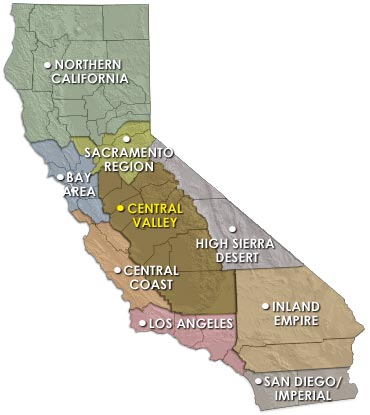
Life in the Central Valley revolves around two intricately related concerns: the quality of the air and the quantity of the water. Although Fresno is the state’s fifth-largest city, it is really just a sprawling farm town in the middle of the nation’s most productive agricultural region, often called “America’s fruit basket.” Surrounded by mountains, which trap the pollution created by a surging population, interstate transportation and tens of thousands of farms, the valley has noxious air, even on good days.
The political atmosphere surrounding crop irrigation is equally toxic. Some farms in the western Valley — crippled by cuts in water allocations, salt buildup in the soil and depleted aquifers — now resemble the dust bowl that drove so many Tom Joads here in the 1930s. Farmers line highways with signs insisting that “food grows where water flows,” while environmentalists counter that the agriculture industry consumes 75 percent of the water transported by California’s byzantine water system.
Locals assess the situation in numbers and colors. Meteorologists compile and trade rainfall statistics with all the regularity and precision of batting averages, but without any of the fun. The air quality index — ranging from a “healthy” green to a “hazardous” maroon — occupies an ominous presence in the day, not unlike the color-coded terrorism alert scale adopted after 9/11.
Experts offer dire warnings. The current drought has already eclipsed previous water crises, like the one in 1977, which a meteorologist friend, translating into language we understand as historians, likened to the “Great Depression” of droughts. Most Californians depend on the Sierra Nevada for their water supply, but the snowpack there was just 15 percent of normal in early February. And the dry conditions are likely to make the polluted air in the Central Valley — which contributes to high rates of asthma and the spread of Valley Fever, a potentially fatal airborne fungus — even worse.
The current crisis raises the obvious question: How long can we continue to grow a third of the nation’s fruit and vegetables?
Tom Willey — an organic farmer from nearby Madera with the genial manner and snowy beard of a Golden State Santa Claus — certainly wonders. For six and a half years, he and his wife, Denesse, have provided most of our family’s fresh produce through their community-supported agriculture program. The Willeys taught us to appreciate kohlrabi and even turned our 5-year-old into a fan of brussels sprouts, which she likes to eat straight from the farm box.
Twenty years ago, the water table under the Willeys’ farm measured 120 feet. But a well test in late January revealed that it is now 60 feet lower. Half of that decline, Tom estimates, has occurred in the last two years.
The Willeys have done what they can to cope. They’ve cut back on less profitable crops, and they are already dedicated practitioners of sustainable agriculture. But many farmers aren’t, and the future is worrisome. Pumping from aquifers is so intense that the ground in parts of the valley is sinking about a foot a year. Once aquifers compress, they can never fill with water again. It’s no surprise Tom Willey wakes every morning with a lump in his throat. When we ask which farmers will survive the summer, he responds quite simply: those who dig the deepest and pump the hardest.
Yet for all the doom around us, here in Fresno itself it is hard to find evidence that the drought is changing the behavior of city dwellers. Locals have made a few concessions, though mainly to mitigate the effects of the bad air. The two of us, for instance, have skipped afternoon jogs to ease the strain on our lungs.
And while religious communities around the valley organized a day of prayer and fasting, entreating God to send rain, concrete efforts to solve the water problem are less apparent. Gov. Jerry Brown has called on all Californians to reduce their water use by 20 percent, but residential lawns, seeded each year with winter ryegrass, continue to glow in brilliant, bright-green hues, kept alive by sprinkler systems that are activated in the dark of night.
Fresnans have long resisted water-saving measures, clinging tenaciously to a flat rate, all-you-can-use system. Nudged by state and federal officials, Fresno began outfitting new homes with water meters in the early 1990s, but voters passed a ballot initiative prohibiting the city from actually reading them. It took two decades for all area homes to acquire meters and for the city to start monitoring the units. To its credit, Fresno has a watering schedule, limiting when residents can water their lawns. But enforcement, to put it charitably, is lax.
Our behavior here in the valley feels untenable and self-destructive, and for much of it we are to blame. But we also find support among an enthusiastic group of enablers: tens of millions of American shoppers who devour the lettuce and raisins, carrots and tomatoes, almonds and pistachios grown in our fields.
Rain showers moved in Thursday morning, for the third time in a week. The faithful will see signs of divine intervention, but it seems clear we need to stage one of our own. These storms brought less than two inches of rain — merely a drop in our tired, leaky bucket.

Blain Roberts, the author of the forthcoming book “Pageants, Parlors, and Pretty Women: Race and Beauty in the Twentieth-Century South,” and Ethan J. Kytle, the author of the forthcoming book “Romantic Reformers and the Antislavery Struggle in the Civil War Era,” are associate professors of history at California State University, Fresno.