Showing posts with label Confederacy. Show all posts

Saturday, August 26, 2017

2697. Birds of a Feather: White Supremacy and Zionism

By Nada Elia, Middle East Eye, August 24, 2017
The Israel flag and the Confederate-battle flag hung outside a house in Wise County, Virginia, 2016 (Chris Arnade / Twitter)
A Confederate flag appeared in an apartment window in Manhattan’s East Village in New York City last week, and the neighbors were outraged. A few pelted it with stones, calling it a hate crime. Many said it did not belong in such a diverse city.
What few seem to have noticed is that the flag was raised right alongside an Israeli flag, sharing the same window. Clearly, the unnamed occupant understood the similar ideologies behind white supremacy and the state of Israel, which hinges on government-sanctioned Jewish supremacy. 
The New York resident displaying both flags is not alone. One image that has gone viral on social media, after being first posted on Twitter by a Chris Arnade, shows a house in a rural setting also flying a Confederate flag just above the Israeli flag.
But the reasoning behind the linking of the two symbols - white supremacy and Zionism - is far from torturous. The two are not strange bedfellows, but rather natural allies. Both represent a desire to establish and maintain a homogeneous society that posits itself as superior, more advanced, more civilized than the “others” who are, unfortunately, within its midst, a “demographic threat” to be contained through border walls and stricter immigration law. American fascism, then, is holding up a mirror to Zionism.
Richard Spencer, the de facto leader of the “alt-right” white supremacist movement in the US, lucidly articulated that argument when he answered a reporter on Israel’s Channel 2, who asked him about the chants of “blood and soil” which his followers were declaiming at the Charlottesville rally in Virginia earlier this month.
Spencer explained that, logically, Zionists should “respect” his views: “... an Israeli citizen, someone who understands your identity, who has a sense of nationhood and peoplehood, and the history and experience of the Jewish people, you should respect someone like me, who has analogous feelings about whites. You could say that I am a white Zionist – in the sense that I care about my people, I want us to have a secure homeland for us and ourselves. Just like you want a secure homeland in Israel".
You could say that I am a white Zionist – in the sense that I care about my people, I want us to have a secure homeland for us and ourselves. Just like you want a secure homeland in Israel
- Richard Spencer
This was not the first time Spencer has compared his supremacist views with Zionism. In December 2016, he argued with a rabbi that Israel does not accommodate diversity.
“You come here with a message of radical exclusion. My tradition teaches a message of radical inclusion, as embodied by Torah,” Rabbi Matt Rosenberg of Texas A&M University told Spencer, before offering: “Would you sit down and study Torah with me and learn love?” 
"Do you really want radical inclusion into the State of Israel?” Spencer replied. “Jews exist precisely because you did not assimilate to the gentiles… I respect that about you. I want my people to have that same sense of themselves.” Rosenberg was left speechless, unable to effectively rebuke Spencer.
Capitalising on this understanding of similar ideologies, a website actually sells friendship pins with the Confederate flag and the Israeli flag crossing over.

Anti everyone 

This is not to suggest that fascists, neo-Nazis, and white supremacists “like” Jews. There is no misinterpreting or minimising the hateful anti-Semitism of blood-curdling chants such as “Jews will not replace us.” Indeed, racists tend to dislike anyone and everyone who is not from their community, and white supremacists, in particular, are not only anti-Semitic but also, obviously, anti-Black, anti-indigenous, anti-Latina, Islamophobes, homophobic and misogynist. 
The “national history” fascist rallies celebrate is one of the dispossessions of the Indigenous people of this continent, alongside the enslavement of African Americans. The immigrants they would have their government deport come mostly from Latin America, as well as the Arab and Muslim world. Yes, racist whites are once again proudly proclaiming their heinous anti-Semitism. But with their embrace of Israel, they are also, indirectly, confirming that anti-Semitism and anti-Zionism are completely different worldviews.
One, anti-Semitism, is a blanket, indiscriminate hatred of people simply for who they are, by accident of birth. The other, anti-Zionism, is grounded in the political conviction that a system of racial supremacy is wrong, regardless of who is engaging in it. Indeed, anti-Zionists fully understand that, with tens of thousands of churches in the US and around the globe supporting Israel, there are actually more Christian than Jewish Zionists in the world. Many of those Christian Zionists are also white supremacists.
Americans are speaking of a “moment of revelation,” one in which the historical undercurrent of white supremacy is surfacing again because it is sanctioned by the present administration. Such a “moment” of revelation has been happening for many years in Israel, whose government is embracing ever more discriminatory measures, leading the UN to name the law of the land for what it is: apartheid, a crime against humanity. It is imperative to expose and denounce both. 
Nada Elia is a Diaspora Palestinian writer and political commentator, currently working on her second book, Who You Callin' "Demographic Threat?" Notes from the Global Intifada. A professor of Gender and Global Studies (retired), she is a member of the steering collective of the US Campaign for the Academic and Cultural Boycott of Israel (USACBI)

Monday, August 21, 2017

2691. Confederate Statues and ‘Our’ History

By Eric Foner, The New York Times, August 20, 2017
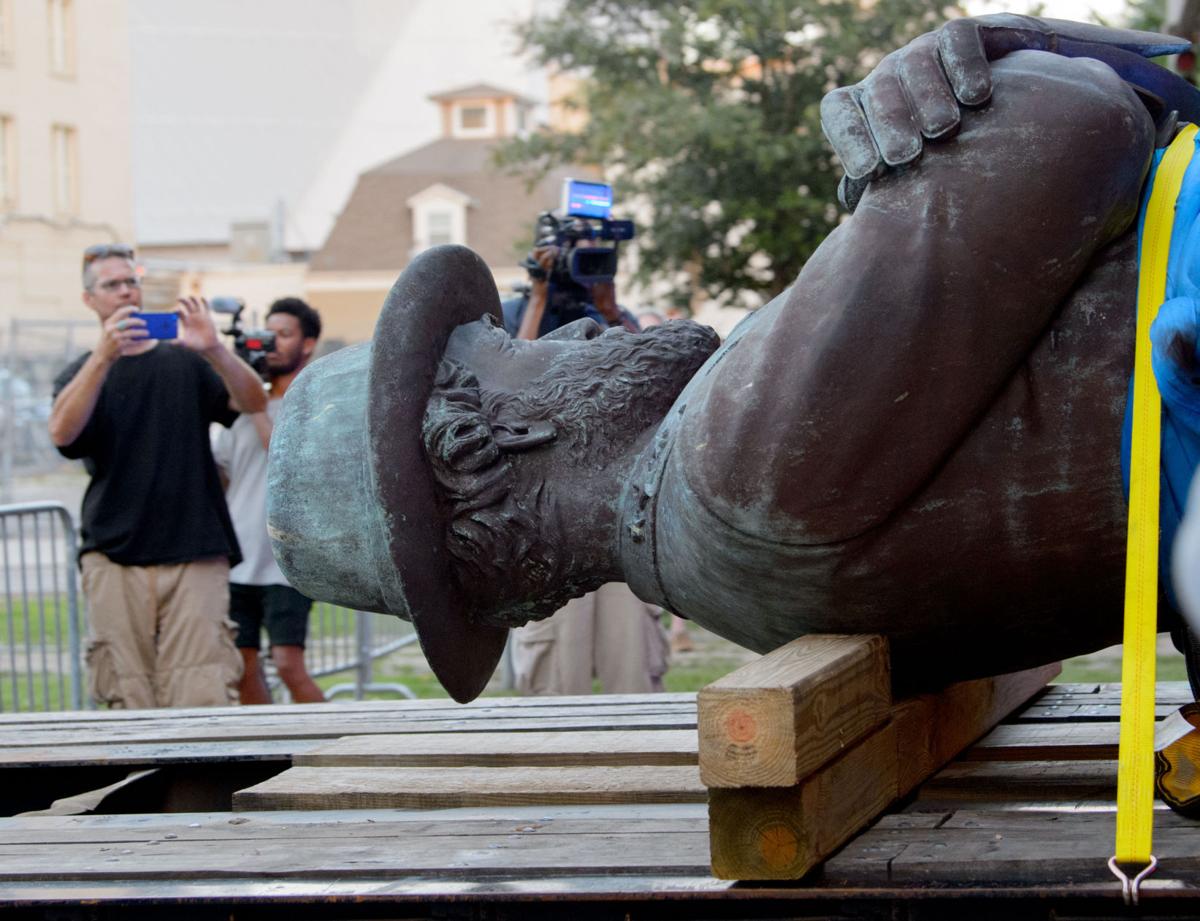
Statue of Rober E. Lee brought down in New Orleans
President Trump’s Thursday morning tweet lamenting that the removal of Confederate statues tears apart “the history and culture of our great country” raises numerous questions, among them: Who is encompassed in that “our”?

Mr. Trump may not know it, but he has entered a debate that goes back to the founding of the republic. Should American nationality be based on shared values, regardless of race, ethnicity and national origin, or should it rest on “blood and soil,” to quote the neo-Nazis in Charlottesville, Va., whom Trump has at least partly embraced?

Neither Mr. Trump nor the Charlottesville marchers invented the idea that the United States is essentially a country for white persons. The very first naturalization law, enacted in 1790 to establish guidelines for how immigrants could become American citizens, limited the process to “white” persons.

What about nonwhites born in this country? Before the Civil War, citizenship was largely defined by individual states. Some recognized blacks born within their boundaries as citizens, but many did not. As far as national law was concerned, the question was resolved by the Supreme Court in the infamous Dred Scott decision of 1857. Blacks, wrote Chief Justice Roger B. Taney (a statue of whom was removed from public display in Baltimore this week), were and would always be aliens in America.

This was the law of the land when the Civil War broke out in 1861. This is the tradition that the Southern Confederacy embodied and sought to preserve and that Mr. Trump, inadvertently or not, identifies with by equating the Confederacy with “our history and culture.”

Many Americans, of course, rejected this racial definition of American nationality. Foremost among them were abolitionists, male and female, black and white, who put forward an alternative definition, known today as birthright citizenship. Anybody born in the United States, they insisted, was a citizen, and all citizens should enjoy equality before the law. Abolitionists advocated not only the end of slavery, but also the incorporation of the freed people as equal members of American society.

In the period of Reconstruction that followed the war, this egalitarian vision was, for the first time, written into our laws and Constitution. But the advent of multiracial democracy in the Southern states inspired a wave of terrorist opposition by the Ku Klux Klan and kindred groups, antecedents of the Klansmen and neo-Nazis who marched in Charlottesville. One by one the Reconstruction governments were overthrown, and in the next generation white supremacy again took hold in the South.

When Mr. Trump identifies statues commemorating Confederate leaders as essential parts of “our” history and culture, he is honoring that dark period. Like all monuments, these statues say a lot more about the time they were erected than the historical era they evoke. The great waves of Confederate monument building took place in the 1890s, as the Confederacy was coming to be idealized as the so-called Lost Cause and the Jim Crow system was being fastened upon the South, and in the 1920s, the height of black disenfranchisement, segregation and lynching. The statues were part of the legitimation of this racist regime and of an exclusionary definition of America.

The historian Carl Becker wrote that history is what the present chooses to remember about the past. Historical monuments are, among other things, an expression of power — an indication of who has the power to choose how history is remembered in public places.

If the issue were simply heritage, why are there no statues of Lt. Gen. James Longstreet, one of Gen. Robert E. Lee’s key lieutenants? Not because of poor generalship; indeed, Longstreet warned Lee against undertaking Pickett’s Charge, which ended the battle of Gettysburg. Longstreet’s crime came after the Civil War: He endorsed black male suffrage and commanded the Metropolitan Police of New Orleans, which in 1874 engaged in armed combat with white supremacists seeking to seize control of the state government. Longstreet is not a symbol of white supremacy; therefore he was largely ineligible for commemoration by those who long controlled public memory in the South.

As all historians know, forgetting is as essential to public understandings of history as remembering. Confederate statues do not simply commemorate “our” history, as the president declared. They honor one part of our past. Where are the statues in the former slave states honoring the very large part of the Southern population (beginning with the four million slaves) that sided with the Union rather than the Confederacy? Where are the monuments to the victims of slavery or to the hundreds of black lawmakers who during Reconstruction served in positions ranging from United States senator to justice of the peace to school board official? Excluding blacks from historical recognition has been the other side of the coin of glorifying the Confederacy.

We have come a long way from the days of the Dred Scott decision. But our public monuments have not kept up. The debate unleashed by Charlottesville is a healthy re-examination of the question “Who is an American?” And “our” history and culture is far more complex, diverse and inclusive than the president appears to realize.

Monday, March 6, 2017

2577. The Confederacy Was a Con Job on Whites. And Still Is

By Frank Hyman, The News Observer, March 2, 2017


I’ve lived 55 years in the South, and I grew up liking the Confederate flag. I haven’t flown one for many decades, but for a reason that might surprise you.

I know the South well. We lived wherever the Marine Corps stationed my father: Georgia, Virginia, the Carolinas. As a child, my favorite uncle wasn’t in the military, but he did pack a .45 caliber Thompson submachine gun in his trunk. He was a leader in the Ku Klux Klan. Despite my role models, as a kid I was an inept racist. I got in trouble once in the first grade for calling a classmate the N-word. But he was Hispanic.

As I grew up and acquired the strange sensation called empathy (strange for boys anyway), I learned that for black folks the flutter of that flag felt like a poke in the eye with a sharp stick. And for the most prideful flag waivers, clearly that response was the point. I mean, come on. It’s a battle flag.

What the flag symbolizes for blacks is enough reason to take it down. But there’s another reason that white southerners shouldn’t fly it. Or sport it on our state-issued license plates as some do here in North Carolina. The Confederacy – and the slavery that spawned it – was also one big con job on the Southern, white, working class. A con job funded by some of the ante-bellum one-per-centers, that continues today in a similar form.

You don’t have to be an economist to see that forcing blacks – a third of the South’s laborers – to work without pay drove down wages for everyone else. And not just in agriculture. A quarter of enslaved blacks worked in the construction, manufacturing and lumbering trades; cutting wages even for skilled white workers.

Thanks to the profitability of this no-wage/low-wage combination, a majority of American one-per-centers were southerners. Slavery made southern states the richest in the country. The South was richer than any other country except England. But that vast wealth was invisible outside the plantation ballrooms. With low wages and few schools, southern whites suffered a much lower land ownership rate and a far lower literacy rate than northern whites.

My ancestor Canna Hyman and his two sons did own land and fought under that flag. A note from our family history says: “Someone came for them while they were plowing one day. They put their horses up and all three went away to the War and only one son, William, came back.”

Like Canna, most Southerners didn’t own slaves. But they were persuaded to risk their lives and limbs for the right of a few to get rich as Croesus from slavery. For their sacrifices and their votes, they earned two things before and after the Civil War. First, a very skinny slice of the immense Southern pie. And second, the thing that made those slim rations palatable then and now: the shallow satisfaction of knowing that blacks had no slice at all.

How did the plantation owners mislead so many Southern whites?

They managed this con job partly with a propaganda technique that will be familiar to modern Americans, but hasn’t received the coverage it deserves in our sesquicentennial celebrations. Starting in the 1840s wealthy Southerners supported more than 30 regional pro-slavery magazines, many pamphlets, newspapers and novels that falsely touted slave ownership as having benefits that would – in today’s lingo – trickle down to benefit non-slave owning whites and even blacks. The flip side of the coin of this old-is-new trickle-down propaganda is the mistaken notion that any gain by blacks in wages, schools or health care comes at the expense of the white working class.

Today’s version of this con job no longer supports slavery, but still works in the South and thrives in pro trickle-down think tanks, magazines, newspapers, talk radio and TV news shows such as the Cato Foundation, Reason magazine, Rush Limbaugh and Fox News. These sources are underwritten by pro trickle-down one-per-centers like the Koch brothers and Rupert Murdoch.

For example, a map of states that didn’t expand Medicaid – which would actually be a boon mostly to poor whites – resembles a map of the old Confederacy with a few other poor, rural states thrown in. Another indication that this divisive propaganda works on Southern whites came in 2012. Romney and Obama evenly split the white working class in the West, Midwest and Northeast. But in the South we went 2-1 for Romney.

Lowering the flag because of the harm done to blacks is the right thing to do. We also need to lower it because it symbolizes material harm the ideology of the Confederacy did to Southern whites that lasts even to this day.

One can love the South without flying the battle flag. But it won’t help to get rid of an old symbol if we can’t also rid ourselves of the self-destructive beliefs that go with it. Only by shedding those too, will Southern whites finally catch up to the rest of the country in wages, health and education.

Frank Hyman lives in Durham,where he has held two local elected offices. He’s a carpenter and stonemason and policy analyst for Blue Collar Comeback.