Showing posts with label Air pollution. Show all posts

Friday, December 23, 2016

2517. Smog Refugees Flee Chinese Cities as 'Airpocalypse' Blights Half a Billion

By Tom Phillips, The Guardian, December 21, 2016
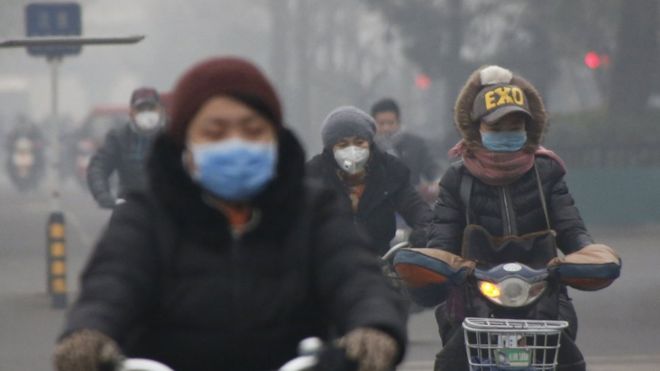
First ever "Red Alert"
Tens of thousands of “smog refugees” have reportedly fled China’s pollution-stricken north after the country was hit by its latest “airpocalyse” forcing almost half a billion people to live under a blanket of toxic fumes. 

Huge swaths of north and central China have been living under a pollution red alert since last Friday when a dangerous cocktail of pollutants transformed the skies into a yellow and charcoal-tinted haze.

Greenpeace claimed the calamity had affected a population equivalent to those of the United States, Canada and Mexico combined with some 460m people having to breathe either hazardous pollution or heavy levels of smog in recent days.

Lauri Myllyvirta, a Beijing-based Greenpeace activist who has been chronicling the red alert on Twitter, said that in an attempt to shield his lungs he was avoiding going outside and using two air purifiers and an industrial grade dust mask “that makes me look like Darth Vader”. 

“You just try to insulate yourself from the air as much as possible,” said Myllyvirta, a coal and air pollution expert.

According to reports in the Chinese media, flights to some pollution-free regions have been packed as a result of the smog. 

Ctrip, China’s leading online travel agent, said it expected 150,000 travellers to head abroad this month in a bid to outrun the smog. Top destinations include Australia, Indonesia, Japan and the Maldives. 

Jiang Aoshuang, one of Beijing’s “smog refugees”, told the state-run Global Times she had skipped town with her husband and 10-year-old son in order to spare their lungs.
Jiang’s family made for Chongli, a smog-free ski resort about three hours north-west of the capital, only to find it packed with other fugitives seeking sanctuary from the pollution.

“It really felt like a refugee camp,” she was quoted as saying. 

Yang Xinglin, who also fled to Chongli, said she had requested time off from her job at a state-owned real estate firm so she did not have to inhale the smog. 

“You ask me why I left Beijing? It’s because I want to live,” Yang, 27, told the Guardian. 
Emma Zhang, a third “smog refugee”, told the South China Morning Post she and her young son had swapped their home in the western city of Chengdu, which has also been blighted by severe pollution, for a hotel in the temperate south-western province of Yunnan.

“I finally saw the blue sky. It was wonderful!” she said.

Li Dongke, a 27-year-old Beijinger, said her entire family had decamped to Kunming, capital of Yunnan province, or the tropical island of Hainan in the South China Sea. “It’s terrible,” she complained of the current pollution crisis.

Fleeing the danger zone has not been completely straightforward for China’s environmental exiles.

The China Daily reported that smog had paralysed airports in Beijing and across the country’s northern industrial heartland in cities such as Tianjin and Shijiazhuang, making escape impossible.
Beijing’s domestic Nanyuan airport cancelled all flights on Tuesday while the Beijing Capital international airport cancelled at least 273 flights.

Myllyvirta, the Greenpeace activist, said his group had been warning of a winter smog crisis since July when it began noticing the government was pumping economic stimulus into heavily-polluting industries such as cement and steel.

“A big part of what happened is that the steel price went up when the government started a huge wave of construction projects to stimulate the economy,” he said.

One consequence was that a large number of smaller, poorly-regulated steel producers had “gone on a tear” leading to increased emissions that were now blackening the skies over northern China.

Myllyvirta said he was convinced the future looked brighter for China’s environment, despite its latest airpocalypse.

A fall in the use of coal and air pollution were likely over the next three to five years as more urgent steps were taken to restructure the economy and preserve the environment.
For now, however, some locals saw temporary or permanent exile as their only option while many outsiders refused to come at all.

“People are definitely thinking about how to get out and … companies are complaining that it is hard to recruit talent [to come to China],” Myllyvirta said. 

“People don’t want to live in places with terribly polluted air.”

Wednesday, November 16, 2016

2491. A Noxious Smog Decends on Tehran

By Thomas Erdbrink, The New York Times, November 16, 2016
Tehran: What Is Wrong With This Picture?

TEHRAN — This week, as a yellow blanket of smog settled in for what is typically a winter-long stay, Reza Shajiee, a prominent hipster socialite, posted a picture of himself on Instagram wearing a gas mask under his motorcycle helmet. The text reads, “My city is better than yours, its air is better than yours,” and is accompanied by an emoticon wearing a gas mask.

One of his followers, @j.barzegar, responded, “Tehran gas chamber, slow death.”

Mr. Shajiee said he posted the picture in protest, but he didn’t know against whom. “No one can solve this, and it’s only getting worse,” he said.

Schools were closed for a second day in Tehran on Tuesday, and many citizens stayed home as the capital was covered in an unusually noxious cloud for a fifth day.

Like many other metropolises in developing countries, including New Delhi and Beijing, Tehran and other Iranian cities regularly disappear under a thick blanket of smog. Every year in the autumn, the pollution gets trapped by the Alborz Mountains that hug the city like an overbearing mother. It happens so often that it is hardly news anymore.

For most Iranians, the pollution is the new normal, a problem so large and complex that it is better just to pretend that it is not there.

Of course, the consequences are undeniable. On Tuesday, a City Council member said that 412 people had died because of the pollution in recent days. Iranian officials estimate that the pollution causes the premature deaths of about 45,000 people nationwide each year.

Hospital wards are filled with coughing patients. Children are told to cover their mouths when they go outside. With the increase in air pollution over the past decade, cases of bone marrow and lung cancer related to high levels of lead in the air have exploded, health experts say.

Iranian officials are at loss. A Health Ministry official told the Asr-e Iran news site that people can shield themselves from the cancerous pollution by staying indoors and drinking lots of milk and eating fresh vegetables. “This will strengthen the body,” said the official, Khosrow Sadeghniyat.

The office of Iran’s supreme leader, Ayatollah Ali Khamenei, issued a religious edict on Monday that said using cars during times of pollution without a good reason was religiously forbidden. A member of Parliament, Elias Hazrati, apologized to the nation on Tuesday, saying the conditions were “shameful.”

Mr. Shajiee, the socialite, said, “There are too many cars, too many people, the only solution is to stop everyone from going out, and everybody knows that will never happen.”

“I hate this city,” he added. “I’ll move out at the first opportunity.”

But he kept driving around on his chocolate-colored Vespa, churning out smoke. “What else to do?” he asked.

Under the city’s yellow blanket, most Tehranis go about their business as if the skies were blue and the air was clean. The traffic jams that define much of Tehran life are as insane as ever, despite emergency regulations aimed at keeping cars out of the center. Cafes and restaurants are full, and people even continue exercising in the city’s many parks.

“I can’t just sit at home,” said Pani Aghavan, 24, a musician. “I need to work and make money.” She wears a mask for protection, one of the few Tehranis to do so. “Most people simply don’t care; they prefer not to think of the pollution and the poison it is,” she said.

There has been pollution in Tehran for quite a while, but it picked up after the Iranian government was forced by sanctions to refine its own gasoline — a poisonous, high-octane brew. The sanctions were lifted after the nuclear agreement with world powers in January, but Iran continues to produce gasoline locally instead of sending its oil abroad for refining.

Many Iranians say that ignoring the problem is their only option. In a country where participation in politics is mostly limited to voting in elections, citizens simply learn to endure whatever comes their way.

“I work two jobs, have no money even to have a child and really don’t see how I can stop this pollution,” said Morteza Hosseinzadeh, who has a master’s degree in theater studies but sells fruit to survive. “Without hardship and taking risks I won’t get anywhere, so I can’t focus on solving such big problems.”

President Hassan Rouhani on Sunday called on citizens to help solve “national problems,” including pollution, an extreme water shortage and unemployment. Warning that there were several crises in the country, especially concerning the environment, Mr. Rouhani somewhat unhelpfully lauded the nuclear agreement for bringing “a breath of fresh air” to the country.

In response, the conservative Javan newspaper posted a picture of Tehran covered in smog with the headline: “Fresh air; Gradual death of citizens.” Other newspapers pointed out that the government’s obsession with car manufacturing was taking a toll. Over the past year, Iranian state-owned car manufacturers have closed deals with the French automakers Renault and Peugeot, aiming to increase the production of cars to two million a year.

“Even one additional car is too many,” said Mojgan Faraji, a journalist who is normally supportive of the government. Auto policies should change, she said. “As long as our gasoline is substandard, every new car worsens the situation.”

Children, elderly people and those with weak lungs are most affected by the pollution, but the effects of the smog go beyond the lungs, health experts say.

“It makes people agitated, depressed and even aggressive,” said Parisa Pakdel, a psychoanalyst in Tehran. “Youths lose their ability to concentrate, become hyperactive and develop sleep disorders. It’s not a pretty picture.”

Wednesday, January 20, 2016

2162.Air Pollution Killing Millions, Threatening Global Health Systems

By Nadia Prupis, Common Dreams, January 18, 2016


The World Health Organization (WHO) over the weekend warned that skyrocketing air pollution levels are killing millions of people in thousands of cities and are poised to take an "enormous" toll on public health services worldwide.

"We have a public health emergency in many countries from pollution. It’s dramatic, one of the biggest problems we are facing globally, with horrible future costs to society," said Dr. Maria Neira, head of public health at WHO.

"Air pollution leads to chronic diseases which require hospital space. Before, we knew that pollution was responsible for diseases like pneumonia and asthma," Neira said. "Now we know that it leads to bloodstream, heart and cardiovascular diseases, too—even dementia."

The latest figures come from pollution data in 2,000 cities, where growing populations have led to a surge in traffic, construction, and power generation—leaving huge areas to grapple with toxic smog and rising greenhouse gases that cannot be resolved without an overhaul of infrastructure. The WHO next month will issue more in-depth statistics showing the steady rise of pollution in urban areas since 2014.

"We are storing up problems," Neira said Saturday. "These are chronic diseases that require hospital beds. The cost will be enormous."

The announcement comes as activists around the world call on governments to do more to tackle the crisis.

In China last month, the government issued its most severe air pollution warning for the second time in as many years, requiring a reduction in cars on the road and a halt in production at certain factories. Recent research there has found that pollution kills more than 1.5 million people in China annually, or 4,400 per day—comprising 17 percent of the country's total deaths every year.

Lord Stern, a leading British economist, told the Guardian on Saturday, "Air pollution is of fundamental importance. We are only just learning about the scale of the toxicity of coal and diesel. We know that in China, 4,000 people a day die of air pollution. In India it is far worse. This is a deep, deep problem."

Saturday, August 15, 2015

1982. Study Links Polluted Air in China to 1.6 Million Deaths a Year

By Dan Levin, The New York Times, August 13, 2015
Waiting on a roadside this month for a highway from Beijing to Hebei Province to reopen after it was closed because of low visibility on a day of heavy smog. Photo: Damir Sagolj/Reuters.

BEIJING — Outdoor air pollution contributes to the deaths of an estimated 1.6 million people in China every year, or about 4,400 people a day, according to a newly released scientific paper.

The paper maps the geographic sources of China’s toxic air and concludes that much of the smog that routinely shrouds Beijing comes from emissions in a distant industrial zone, a finding that may complicate the government’s efforts to clean up the capital city’s air in time for the 2022 Winter Olympics.

The authors are members of Berkeley Earth, a research organization based in Berkeley, Calif., that uses statistical techniques to analyze environmental issues. The paper has been accepted for publication in the peer-reviewed scientific journal PLOS One, according to the organization.

According to the data presented in the paper, about three-eighths of the Chinese population breathe air that would be rated “unhealthy” by United States standards. The most dangerous of the pollutants studied were fine airborne particles less than 2.5 microns in diameter, which can find their way deep into human lungs, be absorbed into the bloodstream and cause a host of health problems, including asthma, strokes, lung cancer and heart attacks.

The organization is well known for a study that reviewed the concerns of people who reject established climate science and found that the rise in global average temperatures has been caused “almost entirely” by human activity.

The researchers used similar statistical methods to assess Chinese air pollution. They analyzed four months’ worth of hourly readings taken at 1,500 ground stations in mainland China, Taiwan and other places in the region, including South Korea. The group said it was publishing the raw data so other researchers could use it to perform their own studies.

Berkeley Earth’s analysis is consistent with earlier indications that China has not been able to successfully tackle its air pollution problems.

Greenpeace East Asia found in April that, of 360 cities in China, more than 90 percent failed to meet national air quality standards in the first three months of 2015.

The Berkeley Earth paper’s findings present data saying that air pollution contributes to 17 percent of all deaths in the nation each year. The group says its mortality estimates are based on a World Health Organization framework for projecting death rates from five diseases known to be associated with exposure to various levels of fine-particulate pollution. The authors calculate that the annual toll is 95 percent likely to fall between 700,000 and 2.2 million deaths, and their estimate of 1.6 million a year is the midpoint of that range.

The Chinese government is sensitive about public data showing that air pollution is killing its citizens, or even allusions to such a conclusion. Though the authorities have gradually permitted greater public access to air quality readings, censors routinely purge Chinese websites and social media channels of information that the ruling Communist Party worries might provoke popular unrest. In March, after a lengthy documentary video about the health effects of air pollution circulated widely online, the party’s central propaganda department ordered Chinese websites to delete it.

Much of China’s air pollution comes from the large-scale burning of coal. Using pollution measurements and wind patterns, the researchers concluded that much of the smog afflicting Beijing came not from sources in the city, but rather from coal-burning factories 200 miles southwest in Shijiazhuang, the capital of Hebei Province and a major industrial hub.

Promises to clean up Beijing’s air were a centerpiece of the nation’s bid to host the 2022 Winter Olympics. The mayor of Beijing, Wang Anshun, championed restrictions on vehicles in the city, and state news media outlets lauded projects to replace coal-fired heating systems in urban areas with systems that use natural gas and generate far less particulate pollution.

“We will improve the air quality not only for the Games, but also for the demand of our people,” said Shen Xue, an Olympic gold medalist and ambassador for the 2022 bid, according to a report last month by Xinhua, the state news agency.

The Berkeley Earth paper showed, however, that to clear the skies over Beijing, mitigation measures will be needed across a broad stretch of the country southwest of the capital, affecting tens of millions of people. “It’s not enough to clean up the city,” said Elizabeth Muller, executive director of the organization. “You’re going to also have to clean up the entire industrial region 200 miles away.”

Sunday, April 13, 2014

1380. Greenland Ice Cores Show Industrial Record of Acid Rain, Success of US Clean Air Act

By Science Daily, April 11, 2014

South Dakota State University's Jihong Cole-Dai is
 logging an ice-core sample at Summit, Greenland.
Credit: Joel Savarino, Laboratory of Glaciology and
 Geophysics of the Environment (LGGE)

By analyzing samples from the Greenland ice sheet, University of Washington atmospheric scientists found clear evidence of the U.S. Clean Air Act. They also discovered a link between air acidity and how nitrogen is preserved in layers of snow, according to a paper published this week in the Proceedings of the National Academy of Sciences.

Forty-five years ago, acid rain was killing fish and dissolving stone monuments on the East Coast. Air pollution rose beginning with the Industrial Revolution and started to improve when the U.S. Clean Air Act of 1970 required coal power plants and other polluters to scrub sulfur out of their smokestacks.

UW researchers began their study of ice cores interested in smog, not acid rain. They discovered a link between the two forms of pollution in the geologic record.

Nitrogen is emitted as a short-lived compound, NOx, which causes ground-level ozone, the main ingredient in smog, and relates to compounds that are the "detergent" of the atmosphere. Sources of NOx include smokestacks and vehicle tailpipes, as well as wildfires, soil microbes or reactions triggered by lightning strikes.

Teasing out the sources of NOx through history might tell us about the atmosphere of the past, how methane, ozone and other chemicals change in the atmosphere, and also provide a measure of global human emissions.

"How much the nitrate concentrations in ice core records can tell about NOx and the chemistry in the past atmosphere is a longstanding question in the ice-core community," said lead author Lei Geng, a UW postdoctoral researcher in atmospheric sciences.
Unlike other gases, short-lived NOx can't be measured directly from air bubbles trapped in ice cores. Within a day or two most of the NOx changes into nitrate, a water-soluble molecule essential to life that gets deposited in soil and snow.

Earlier research by co-author Eric Steig, a UW professor of Earth and space sciences, suggested that comparing amounts of the two stable forms of nitrogen -- nitrogen-15 and nitrogen-14 -- in nitrate could pinpoint the emission sources of NOx. Ice cores from Greenland and North American lake sediments showed the nitrogen-15 ratio gradually decreasing since 1850, suggesting a corresponding rise in human emissions.

The new research says: not so fast. The detailed measurements of nitrate, NOx and sulfur show the nitrogen isotope ratio leveling off in 1970, and suggests that ratio is sensitive to the same chemicals that cause acid rain.

"This shows that the relationship between emissions and the isotopes is less direct than we thought, and the final signal recorded in the Greenland ice cores is actually not just the nitrogen emission, but the combined effect of sulfur and nitrogen emissions," Steig said.
The ice cores used in the study were collected in 2007 at Summit Station, Greenland. Total amounts of nitrate for each year were measured and calculated at South Dakota State University, where Geng did his doctoral work. The different forms, or isotopes, were measured in UW's IsoLab. Geng's work showed that the long-term decrease in the nitrogen-15 isotope since 1850, and its leveling off in 1970, are linked to changes in air chemistry. Airborne nitrate can exist as a gas or a particle, and nitrate with lighter isotopes tends to exist as a gas. But he found that the total fraction of nitrate present as gas or particle varies with the acidity of the atmosphere, and the acidic air causes more of the light isotopes to exist as a gas.

"The isotope records really closely follow the atmospheric acidity trends," said co-author Becky Alexander, a UW associate professor of atmospheric sciences. "You can really see the effect of the Clean Air Act in 1970, which had the most dramatic impact on emission of acid from coal-fired power plants."

What's more, airborne nitrate dissolves in water and falls at the poles as snow. While that snow sits on the ground, sunlight bouncing off the surface triggers chemical reactions that send some of it back into a gas form. Acid air can also influence the reactivity of nitrate in snow and thus the preservation of nitrate in ice cores.

Other ice core records might also be affected by acidity in air, Alexander said. No effect would be expected for stable gases like carbon dioxide and oxygen, or for the water molecules used to calculate temperature variations through time. But acidity in air could influence deposition and preservation of other volatile compounds such as chlorine, mercury or organic materials in ice cores.

Eventually, better understanding of the air chemistry during formation of the layers could allow researchers to correct for the effect, extracting better information of the past from these compounds in the geologic record.


Story Source:
The above story is based on materials provided by University of Washington. The original article was written by Hannah Hickey. Note: Materials may be edited for content and length.

Journal Reference:

1. L. Geng, B. Alexander, J. Cole-Dai, E. J. Steig, J. Savarino, E. D. Sofen, A. J. Schauer. Nitrogen isotopes in ice core nitrate linked to anthropogenic atmospheric acidity change. Proceedings of the National Academy of Sciences, 2014; DOI: 10.1073/pnas.1319441111

Friday, February 7, 2014

1309. Fire Is Blackening 'Earth's Lungs'

By Erik Stokstad, Science Now, February 7, 2014
Leonardo F. Freitas/Flickr
The vast expanses of rainforest that make up the Amazon Basin have been called the lungs of the planet, as they breathe in carbon dioxide and release oxygen. Now, findings from biweekly airplane flights over the jungle show how a severe drought choked these lungs, constricting the uptake of carbon dioxide, a greenhouse gas. Worse, fires released tremendous amounts of carbon into the atmosphere, exacerbating global warming. 
The measurements started in 2010, during a drought year, and showed that the Amazon overall released 480 million metric tons of carbon into the atmosphere, the team reports today in Nature. (Slightly more went up in smoke, but the difference was taken up by the vegetation.) The next year was wet. The plants stored 250 million tons of carbon, just about compensating for the carbon released by forest fires. Scientists are concerned that climate change—with rising temperatures and more droughts—will reduce the rainforest’s storage of carbon and in turn hinder its ability to slow the pace of global warming.