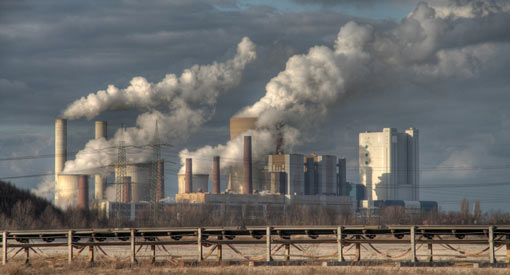
WASHINGTON — In a major setback for President Obama’s climate change agenda, the Supreme Court on Tuesday temporarily blocked the administration’s effort to combat global warming by regulating emissions from coal-fired power plants.
The brief order was not the last word on the case, which is most likely to return to the Supreme Court after an appeals court considers an expedited challenge from 29 states and dozens of corporations and industry groups.
But the Supreme Court’s willingness to issue a stay while the case proceeds was an early hint that the program could face a skeptical reception from the justices.
The 5-to-4 vote, with the court’s four liberal members dissenting, was unprecedented — the Supreme Court had never before granted a request to halt a regulation before review by a federal appeals court.
“It’s a stunning development,” Jody Freeman, a Harvard law professor and former environmental legal counsel to the Obama administration, said in an email. She added that “the order certainly indicates a high degree of initial judicial skepticism from five justices on the court,” and that the ruling would raise serious questions from nations that signed on to the landmark Paris climate change pact in December.
In negotiating that deal, which requires every country to enact policies to lower emissions, Mr. Obama pointed to the power plant rule as evidence that the United States would take ambitious action, and that other countries should follow.
The White House said in a statement that it disagreed with the court’s decision and remained confident that it would ultimately prevail. “The administration will continue to take aggressive steps to make forward progress to reduce carbon emissions,” it said.
Opponents of Mr. Obama’s climate policy called the court’s action historic.
“We are thrilled that the Supreme Court realized the rule’s immediate impact and froze its implementation, protecting workers and saving countless dollars as our fight against its legality continues,” said Patrick Morrisey, the attorney general of West Virginia, which has led the 29-state legal challenge.
“There’s a lot of people who are celebrating,” said Jeff Holmstead, a lawyer with Bracewell & Giuliani, a firm representing energy companies, which are party to the lawsuit. “It sends a pretty strong signal that ultimately it’s pretty likely to be invalidated.”
The challenged regulation, which was issued last summer by the Environmental Protection Agency, requires states to make major cuts to greenhouse gas pollution created by electric power plants, the nation’s largest source of such emissions. The plan could transform the nation’s electricity system, cutting emissions from existing power plants by a third by 2030, from a 2005 baseline, by closing hundreds of heavily polluting coal-fired plants and increasing production of wind and solar power.
“Climate change is the most significant environmental challenge of our day, and it is already affecting national public health, welfare and the environment,” Solicitor General Donald B. Verrilli Jr. wrote in a brief urging the Supreme Court to reject a request for a stay while the case moves forward.
The regulation calls for states to submit compliance plans by September, though they may seek a two-year extension. The first deadline for power plants to reduce their emissions is in 2022, with full compliance not required until 2030.
The states challenging the regulation, led mostly by Republicans and many with economies that rely on coal mining or coal-fired power, sued to stop what they called “the most far-reaching and burdensome rule the E.P.A. has ever forced onto the states.”
A three-judge panel of the United States Court of Appeals for the District of Columbia Circuit in January unanimously refused to grant a stay.
The court did expedite the case and will hear arguments on June 2, which is fast by the standards of complex litigation.
The states urged the Supreme Court to take immediate action to block what they called a “power grab” under which “the federal environmental regulator seeks to reorganize the energy grids in nearly every state in the nation.” Though the first emission reduction obligations do not take effect until 2022, the states said they had already started to spend money and shift resources.
Eighteen states, mostly led by Democrats, opposed the request for a stay, saying they were “continuing to experience climate-change harms firsthand — including increased flooding, more severe storms, wildfires and droughts.” Those harms are “lasting and irreversible,” they said, and “any stay that results in further delay in emissions reductions would compound the harms.”
In a second filing seeking a stay, coal companies and trade associations represented by Laurence H. Tribe, a law professor at Harvard, said the court should act to stop a “targeted attack on the coal industry” that will “artificially eliminate buyers of coal, forcing the coal industry to curtail production, idle operations, lay off workers and close mines.”
The E.P.A., represented by Mr. Verrilli, called the requests for a stay “extraordinary and unprecedented.” The states challenging the administration’s plan, he said, could point to no case in which the Supreme Court had “granted a stay of a generally applicable regulation pending initial judicial review in the court of appeals.” In a later brief, the states conceded that point.
Mr. Verrilli said judicial review of the plan, including by the Supreme Court, will be complete before the first deadline for emissions reductions in 2022.
“There is no reason to suppose that states’ duties under the rule will be especially onerous,” Mr. Verrilli wrote. “A state can elect not to prepare a plan at all, but instead may allow E.P.A. to develop and implement a federal plan for sources in that state.”
The two sides differed about whether current declines in coal mining and coal-fired power generation are attributable to the administration’s plan. “Some of the nation’s largest coal companies have declared bankruptcy, due in no small part to the rule,” a group of utilities told the justices.
A coalition of environmental groups and companies that produce and rely on wind and solar power said other factors were to blame for coal’s decline.
“These changes include the abundant supply of relatively inexpensive natural gas, the increasing cost-competitiveness of electricity from renewable generation sources such as solar and wind power, the deployment of low-cost energy efficiency and other demand-side measures, and increasing consumer demand for advanced energy,” they wrote.


