Showing posts with label World Health Organization. Show all posts

Friday, May 26, 2017

2616. Cuba Calls for Universal Health Coverage at WHO World Assembly

By  


“Cuba supports the strengthening of systems geared toward achieving universal health coverage, recognizing that health is a fundamental human right and at the center of public policies for sustainable development,” stated Dr. Roberto Morales Ojeda, Cuban Minister of Public Health, during the World Health Organization’s 70th World Assembly plenary session, taking place at the body’s headquarters in Geneva through May 31. 

Morales Ojeda reported that by the end of 2016, life expectancy at birth in Cuba was 78.45 years, while the country also has an immunization program which protects against 13 diseases, and is comprised of 11 vaccines; eight of which are produced on the island, providing for over 98% coverage. 


He also noted that Cuba continues to maintain key indicators which, in 2015, saw the island become the first country in the world to officially eliminate mother-to-child transmission of HIV and syphilis. 


“The foundations for the National Health System in Cuba were drawn up in 1959, the driving force behind which was the historic leader of the Cuban Revolution, Fidel Castro Ruz,” he stated. 


The Cuban official also commented on the damage caused by the U.S. blockade to Cuba’s healthcare services, which in 2016 amounted to more than $87 million dollars. 


Morales Ojeda once again condemned policies such as the “brain drain” which encourage Cuban professionals, above all those linked to the healthcare sector, to emigrate. Human capital is our most valuable resource. We have 493,000 healthcare sector workers and over 50,000 collaborators offering services in 63 countries, he added. 


Among the challenges currently facing Cuba he noted the country’s rapidly ageing population, non-communicable chronic diseases, low birth rates, and the negative effects of climate change. 


The UN 2030 Sustainable Development agenda provides the opportunity to develop better health systems and improve the population’s wellbeing in an unequal world, stated Dr. Roberto Morales Ojeda, noting that political will and collaboration are vital to such efforts. 

Wednesday, January 20, 2016

2162.Air Pollution Killing Millions, Threatening Global Health Systems

By Nadia Prupis, Common Dreams, January 18, 2016


The World Health Organization (WHO) over the weekend warned that skyrocketing air pollution levels are killing millions of people in thousands of cities and are poised to take an "enormous" toll on public health services worldwide.

"We have a public health emergency in many countries from pollution. It’s dramatic, one of the biggest problems we are facing globally, with horrible future costs to society," said Dr. Maria Neira, head of public health at WHO.

"Air pollution leads to chronic diseases which require hospital space. Before, we knew that pollution was responsible for diseases like pneumonia and asthma," Neira said. "Now we know that it leads to bloodstream, heart and cardiovascular diseases, too—even dementia."

The latest figures come from pollution data in 2,000 cities, where growing populations have led to a surge in traffic, construction, and power generation—leaving huge areas to grapple with toxic smog and rising greenhouse gases that cannot be resolved without an overhaul of infrastructure. The WHO next month will issue more in-depth statistics showing the steady rise of pollution in urban areas since 2014.

"We are storing up problems," Neira said Saturday. "These are chronic diseases that require hospital beds. The cost will be enormous."

The announcement comes as activists around the world call on governments to do more to tackle the crisis.

In China last month, the government issued its most severe air pollution warning for the second time in as many years, requiring a reduction in cars on the road and a halt in production at certain factories. Recent research there has found that pollution kills more than 1.5 million people in China annually, or 4,400 per day—comprising 17 percent of the country's total deaths every year.

Lord Stern, a leading British economist, told the Guardian on Saturday, "Air pollution is of fundamental importance. We are only just learning about the scale of the toxicity of coal and diesel. We know that in China, 4,000 people a day die of air pollution. In India it is far worse. This is a deep, deep problem."

Wednesday, July 8, 2015

1920. Cuba Is First To Earn World Health Organization's Seal For Ending Mother-Baby HIV Transmission

By Susan Brink, NPR, June 6, 2015

This maternity home in Havana provides residential care for pregnant women with medical or social issues. Courtesy of Pan American Health Organization/WHO


A woman has HIV. She becomes pregnant. What are the chances that she can deliver a baby who is not infected?

In some countries, like Yemen, for example, only 11 percent of pregnant women with HIV receive treatment to prevent their babies from being infected. For women who aren't part of that fortunate group, the chance of passing HIV to their infant is as high as 45 percent.

But in Cuba, the chances are now practically nil. On June 30, Cuba became the first country to receive what can be seen as a global seal of approval — the World Health Organization validation — for essentially eliminating transmission of AIDS from a mother to her baby. (Cuba has eliminated transmission of syphilis as well.)

That doesn't mean Cuba is on a pedestal all by itself. By 2014, more than 40 countries were testing and treating more than 95 percent of pregnant women; some places, including Anguilla, Barbados, Canada, Montserrat, Puerto Rico and the United States, have likely hit the mark as well. But Cuba is the first to go through the WHO monitoring program, which requires data on transmission for at least two years and an on-site visit by WHO members examining care in all parts of the country, including remote, impoverished and underserved areas.

Here's how Cuba did it.

When a Cuban woman becomes pregnant, odds are extremely high she already knows whether she is infected with HIV. She was likely diagnosed at a family clinic near her home, and then referred to a policlinico, or a clinic with a higher level of specialized services, to monitor and treat her HIV, according to Sonja Caffe, regional adviser on HIV and the Pan American Health Organization, the WHO regional office for the Americas.

If she is infected with HIV, when she becomes pregnant, she begins oral antiretroviral treatment, shown to prevent transmission to her newborn in 98 percent of cases.
At about 38 weeks into her pregnancy, if she agrees, she gives birth by cesarean section, which has been shown to reduce transmission of the disease through the birth canal. To further protect the baby from the virus, she is counseled not to breastfeed her child and the child is given antiretroviral treatment for four to six weeks.

The regimen, developed beginning in 1991 by the National Institutes of Health and the French National Institute for AIDS Research, can reduce the chances that the baby will be infected with HIV to less than 2 percent. And it's now being used by health services around the world. But Cuba became the first country in the world to receive WHO validation.

"I think the rest of the world can learn from the way the system is designed in Cuba," says Caffe. "In Cuba, the health services are very close to the people. There is universal coverage, and the services are free. They don't simply invest in hospitals. There is a philosophy of bringing health care to the people in the community.”

The same system of care in Cuba helped to improve the population's health in other ways. "When you have a robust primary care system, you get other good results, like low infant mortality," says Caffe. And eliminating the transmission of syphilis from mother to child. About a million pregnant women in the world are infected with syphilis, which can cause miscarriage, stillbirth and serious complications in infants. Syphilis transmission to babies can be eliminated by screening and simple treatment, with penicillin, for example.

In the United States, the rate of transmission of HIV through pregnancy and childbirth is below the 2 percent mark set as the WHO standard. But the U.S. has underserved pockets of health care in both rural areas and inner cities. "We visit municipalities, regions and specific sites within a country," says Caffe. The team looks at many areas of the country, including the lowest-performing health centers, to see if, even in those areas, good preventive care is provided. "In Cuba, it was difficult to identify the lowest coverage areas because it has very high coverage of preventive services in all areas," she says.

That's not so true in the U.S., where rates of HIV transmission to infants are higher in poor, minority and underserved areas. "On a national level, the United States has already achieved the elimination target," says Caffe. "But a criteria for validation is that it be met in an equal manner, even in subgroups of the lowest performing areas." In 2009 in the U.S., 162 babies were born infected with HIV — far below the elimination standard, even for poor and minority patients. But while whites had a mother-to-child AIDS transmission rate of 0.1 per 100,000, and Hispanics a rate of 1.7 per 100,000, the rate among African-Americans was 9.9 per 100,000.

As for the total picture worldwide, there were 240,000 babies born with the infection in 2013, down from 400,000 in 2009. WHO's goal is 40,000 a year, so countries still have a long way to go.

Friday, September 12, 2014

1548. Cuba to Commit Large Health Corps to Ebola Fight

By Kai Kupferschmidt, Science Insider, September 12, 2014
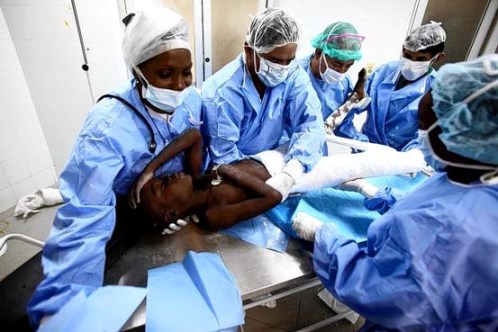
Cuban medical workers treating a cholera patient in Haiti
The Cuban government is sending 165 doctors and nurses to battle the Ebola outbreak in West Africa, the World Health Organization (WHO) announced this morning in Geneva, Switzerland, at a joint press conference with Cuba’s minister of public health, Roberto Morales Ojeda. The health care workers, 103 nurses and 62 doctors, are going to be deployed to Sierra Leone in the first week of October.
It is the biggest contribution of health care staff by any single country so far to help control the epidemic, noted WHO Director-General Margaret Chan. “This will make a significant difference in Sierra Leone,” Chan said.
To put the numbers in perspective: WHO has deployed about 500 foreign medical experts to the region. Because they rotate, at any one time about 170 of them are in the affected countries, Chan said.
Ebola has already sickened at least 4784 people and killed 2400 in the biggest outbreak on record, and its spread is still accelerating. Several governments have pledged support. For instance, the British government and the Wellcome Trust medical charity have announced they will spend £6.5 million to speed up research on Ebola vaccine candidates. Germany’s Ministry for Economic Cooperation and Development has announced it is increasing its contribution to WHO to fight Ebola from €1 million to €10 million. And the Bill & Melinda Gates Foundation has pledged $50 million to fight Ebola. But that does not address the main problem, experts say. “Money, materials are important, but those alone cannot stop Ebola transmission,” Chan said at the press conference. “The thing we need most of all is people.”
According to WHO, more than 200 health care workers are needed to run an isolation ward with 70 beds. While it is still unclear how many Ebola patients there are altogether, WHO estimates several hundred extra beds are needed in Liberia alone. At the moment there is not a single bed available in the whole country to treat Ebola patients, Chan said.
Several people on the ground in Liberia have confirmed that Ebola patients are being turned away at the treatment center in Monrovia to avoid staff being overwhelmed. “We need more actions. We need to surge at least two to four times in order to catch up with the outbreaks in these three countries,” Chan said. “I hope the announcement today will stimulate more countries to surge their support.”

*The Ebola Files: Given the current Ebola outbreak, unprecedented in terms of number of people killed and rapid geographic spread, Science and Science Translational Medicine have made a collection of research and news articles on the viral disease freely available to researchers and the general public.