Saturday, September 26, 2015

2035. Raging Wildfires in California: Part 2: Regenerative Disturbances and Building Bridges Across Cultural Divides

By Erik Ohlsen, Resilience, Septermber 23, 2015

For Part 1 click here.  KN


*     *     *

A “regenerative disturbance” is a management regime or natural occurrence that provides a degree of disturbance to an ecosystem that in turn encourages conditions that lead to better health, resilience and regeneration. Multiple regenerative disturbance techniques are introduced in this article.

The issues of wildfires, forestry, drought, and climate change are highly complex, and their solutions are just as complex—and highly debatable. These issues are at the nexus of a variety of political, social, cultural and economic challenges in our communities. The opportunity is to build bridges across these cultural divides - to unify historically opposing groups towards common goals and solve some of these problems as a result.

Nobody wants to see their own or someone else’s home burn to the ground. Nobody wants to see a person's livelihood decimated. Nobody wants to see wildlife and forest ecosystems destroyed. Whether you're a forester, an environmentalist, an indigenous community member, a firefighter, a homeowner or a government official, these are places where we have common ground.

There are real solutions being modeled out there and we need to remove the political obstacles and financial shackles that keep them from being implemented at the scale that will provide real benefit to people and planet.

It is vital to understand that every ecosystem on earth has its own unique set of circumstances, issues, and management needs. Any solutions we talk about here or elsewhere may be appropriate in some areas and inappropriate in others. And because of the inherent complexity, it’s not enough to solely focus on the physical needs of an ecosystem, but it is just as important to look at the economic, social, and political will as well.

We are not going to agree about all of these things but hopefully we can at least try for the sake of our communities and our ecosystems to take serious action on solutions that care for both.

To be clear, I'm not a professional forester or firefighter. Rather, I’m a professional ecological land manager who's been practicing land stewardship for nearly 20 years in forest management, watershed restoration, pastoral restoration, and landscape development. I've worked alongside professional foresters, certified rangeland managers, and indigenous land managers.

Years ago, I had the honor of taking training from Dennis Martinez, an indigenous land manager and the chairman of Indigenous peoples restoration network. Organizations like IPRN are vital for leading us in the right management direction of our landscapes. The integration of indigenous wisdom for the modern day crisis, and bridging Traditional Ecological Knowledge (TEK) with Western science is key to unlocking solutions moving forward as Dennis writes so eloquently on their website. To be clear, Dennis and Indigenous Peoples Restoration Network have not endorsed this article. I am highlighting them as an important resource for this discussion.

Prescribed burning (large-scale solution)
Many First Nation communities in the United States sustained extremely long cycles of ecological health for themselves and the ecosystems they were maintaining. We need to harness the wisdom of indigenous communities who managed California and U.S. landscapes for tens of thousands of years with prescribed burning and other forgotten methods. No Western civilization has any chance of achieving this with our current land management practices as we’ve destroyed much of our ecology in just 150 years and counting. We must immediately shift our practices of land management towards ecological place-based appropriate management techniques with a timescale managing health for multiple generations into the future.

Prescribed burning is the practice of intentionally setting low intensity fires in the forest to consume and reduce the accumulated fuel load of dead limbs, thatch and outcompeted smaller trees. The timing, technique, and location are thoroughly assessed for optimal effect and mitigation of catastrophic consequences. These burns are often carried out in spring when plants are still green and humidity is present in the ecosystem to ensure the fire cannot spread into the canopy of established trees and people managing the prescribed burn can keep it controlled. There’s no way I could do justice in describing this ancient practice here. To learn more, watch the video Catching Fire, which I just saw after posting my original article.

Ecological Forest Thinning (large-scale solution)
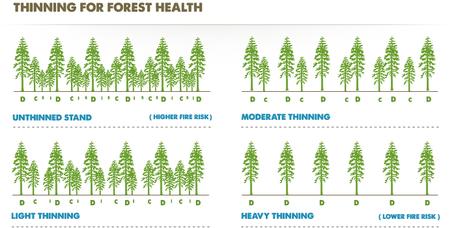
I have intentionally avoided using the term "sustainable thinning" in this article. Much of what is shared here does fall into that category, but that term may have been co-opted by the logging industry in the past to open up harvesting of old-growth trees. From an ecological perspective thinning trees to provide a more open canopy, less fuel load, and more light to the forest floor, if done right, provides a host of benefits for the forest, wildlife, and human communities that live there.

When we talk about fuel load management through ecological thinning I'm not talking about large-scale commercial logging activity, although logging companies may be some of the best situated to provide ecologically based thinning practices in our forests.

Nor am I advocating for clear cuts or cutting old-growth trees in any way shape or form. Instead, I am advocating for a systems-level view of forest health. A healthy forest does not feature only mature or only young trees. Rather, it will have a succession of different-aged trees to provide a multi-generational outlook of the forest so it can live for tens of thousands if not millions of years into the future if that is appropriate to a place.

This view can be controversial and both those in the logging industry or communities affect by logging will likely have strong feelings about “thinning.” When we talk about thinning a forest in an ecological way we are talking about removing second and third growth trees, and dead and diseased trees that were never removed from the system early on due to fire suppression lack of large animal disturbances and regenerative human driven management practices. In many cases our forests have become congested with hundreds or thousands of stems per acre. This creates a host of ecological problems such disease, lack of diversity, erosion, soil acidification and the threat of catastrophic fires.

To manage a forest with ecological thinning practices takes a very informed view of what trees to remove and to leave. In many cases forests are so congested that they have become fuel load nightmares. Fire ladders are now in such abundance that if a fire came into such a congested forest it may quickly become a crown fire, swiftly escalating to the kind of catastrophes that are seen throughout California and other parts of the world right now.

So what is a healthy forest? A healthy forest is one that has fewer stems per acre and where there's more space in between the trees. The question of how many stems per acre depend on the species of trees, the climate, and many other factors. The best place to learn what is the right balance for a place is to work with the indigenous communities of that place who have tracked these forests for tens of thousands of years.

An ecologically thinned forest (fewer stems per acre, balance of different ages of trees) also has the benefit of increased light on the forest floor and an increase of air. Airflow helps reduce disease and parasites from establishing themselves in the forest. Just as houses with poor ventilation can be subject to mold, the same goes for forests. In keeping the forest light, not congested and in a healthy balance we allow for a reduction of potential disease and pathogens. Many of our forests today are severely infested with either pathogens or parasitic insects as a result of forests that are too dense.

Light on the forest floor is key because the floor is home to a staggering diversity of native vegetative life. This native vegetation is often edible, medicinal, and provides incredible food source for wildlife, as well as many other ecological processes that we are still learning about

Ecologically based forest products as a result of thinning may provide a small-scale economic solution to some of the financial obstacles to making this work happen. Entrepreneurial thinkers made be able to make small-scale businesses selling furniture, tools, soil building products, mushrooms, sustainably harvested building materials and other potential value-added products that come from ecological management of the forest.

Animals in ecosystem management (large-scale solution)
As described in part one of this article, large animals have played an important management role in our ecosystems for millions of years. Extensive hunting and industrialization have wiped out many of these important species in our ecosystem.

Grazing ungulates like elk and antelope stomp accumulated and dead organic matter (fuel load) into the ground where it can come into contact with soil-level moisture and microorganisms that will cause it to further decompose. Other animals like bears have always been important forest managers as they break down the low branches and small trees in the forest as they scavenge for food. As a result, material that would otherwise volatilize and release greenhouse gases into the atmosphere—namely, CO2—instead builds organic matter and stores carbon in the soil.

Elk and antelope never "overgrazed" areas because they were followed by wolves, coyotes, and mountain lions that kept these hooved animal herds bunched up and on the move. This predator-prey relationship results in a beautiful and dynamic ecosystem management pattern that has been lost in our contemporary ecosystems.

Putting all debates around humans eating animals aside for now, if we specifically look at the activities of well-managed animals in the right environment and the impact it has on an ecosystem we can easily see that from an ecological point of view integrating animals (even domestic) into land management may have huge benefits if managed appropriately.

Models like the Dehesa systems in Spain and Portugal have been incredibly effective in regenerating devastated landscapes while being economically and ecologically sound and managed over many generations. Another benefit of using ruminants to manage landscapes is that in the dry season the guts of these animals actually provide the bacterial decomposition function of the ecology. Therefore as they eat down grasses, forbs, leaves and branches they are actually decomposing that material in their guts whereas in the middle of summer many temperate ecosystems don't have the moisture level to decomposes material any other way.

To be realistic, it's unlikely that we will see a huge resurgence of elk and antelope in the California environment in the near future. So, in the near-term, we may need to utilize domestic animals to provide some of the same functions and management regimes as these amazing animals once did.

Pigs, goats, cow and sheep could all play important roles on public and private lands in managing fuel load and getting carbon into the ground. The realities of such endeavors will have to be specific to each site and carefully monitored by the community for optimum ecological health. There will be plenty cases where the use of domestic animals in managing our ecosystems may not be appropriate either from social or economic issues or cultural and ecological ones. In all cases success depends on understanding the specific needs of an ecosystem and community to decide on the best practices for that place. The Holistic Management model provides a great framework for decision-making in this regard.

Managing carbon (small to large scale solution)
It's important that we look at the solutions to these issues through a systemic lens. If we manage our fuel load ecologically, and look at this material as something beneficial rather than "waste" then we have an opportunity to not only mitigate destructive fire but also address drought at the same time.

When it comes to managing carbon, we get to create a scenario where the benefits of the whole are greater than the sum of the parts. A forest is made of many tons of carbonaceous material. Forests and pastures are magical in their ability to pull carbon dioxide out of the atmosphere and transfer it into matter, creating a carbon sink for long-term storage. The matter the carbon is getting locked into is of course in the roots, trunks, branches and leaves. It's important to understand how these ecological processes relate to climate change.

On smaller scales, we can actually manage this material without burning it which enables us to halt carbon from escaping into the atmosphere altogether. By accelerating decomposition instead of burning material, we not only avoid the risks posed by fire but we can build topsoil as a result. Adding carbon to the soil also increases the soil's ability to absorb and hold water. In this way, we can think of soil as a carbon and water battery or storage device. An improved capacity to absorb and hold water in soil means that there's more humidity in the landscape, supporting more productive land and protecting against catastrophic wildfires and drought.

At the home scale, we need to look at woody material as an abundant source for a variety of potential functions: edible mushrooms, soil building, mulch, basketry material, craft wood, erosion control material, and more. This is a great example of moving from just restoration towards regeneration and must be the new standard for how we manage landscapes. Humans have been such a destructive force on ecosystems for the last 150 years that it's not enough to just restore ecosystems, we have to regenerate the ecological functions and processes of our environment in order for future generations to live on a healthy planet, we need to increase biological and ecological productivity for the sake of the earth itself.

Prescribed burns have an important role in managing the fuel load of multi-acre ecosystems. But if at all possible, not burning fuel load material and either chipping, inoculating with fungi, or strategically burying it on contour can all provide opportunities where we vastly increase topsoil and soil's ability to absorb storm water as part of our efforts to sequester carbon and mitigate drought.

Below are a few methodologies for doing just that.

Biochar
In other parts of the world Biochar has been used as a way to sequester carbon and build topsoil for agriculture productivity for millennia. Biochar may offer huge potential in combination with prescribed burning. This is an exciting innovation to combine these ancient management practices to manage fuel load while sequestering carbon, building topsoil and retaining water.

In simple terms a burn pile (often utilized in prescribed burning) can be created in such a way to tightly stack logs and light the top rather than the bottom of the pile. A pile like this burns off the least amount of carbon while still burning the rest of the fuel load of that material. What's left is a kind of charcoal where the carbon is so strongly bonded to the material that it takes hundreds of years to release into the atmosphere. Once this material comes in contact with microbes it becomes a highly sought after host for beneficial microorganisms. Used to amend soil to boost fertility, support the living biology in the soil, and improve water retention, this method has amazing potential.

In a strategic way we may be able to create large amounts of biochar and manage forest fuel load at the same time. Biochar is already an accepted and marketable soil amendment throughout the world.

Erosion solutions utilizing woody debris
Erosion has its own devastating effect on our ecosystems and relates to the mismanagement of our forests. Part of the devastation we experience, especially throughout Northern California and the Pacific Northwest, is erosion due to old badly graded logging roads. The way many logging roads convey water can vastly increase erosion in a watershed. Often this results in huge and deep gullies that continually destabilize parts of the forest and carry sediment into local streams and watersheds.

We can use some of our fuel load management techniques and ecological thinning practices by taking woody debris and literally using it to pack large erosion gullies. It's important when packing a gully to ensure that the organic material has direct contact with the earth at the bottom of the gully and that any winter moisture and fungal activity can wick into the material and sustain through the entire pile of debris. This helps reduce the fire danger in the area as the more moisture and fungi amongst and inside this debris will make it less likely to burn.

If there is great concern for fire you can also blow chips over the top of the systems and further increase the ability for this material to absorb water and stay moist. This is very effective in stopping erosion, and over time the gullies actually fill back up with sediment. The water slows down when it hits all the brush inside the gullies and the sediment carried by the water actually deposits and fills up the eroded area again over time. The flow and velocity of water, the size of the gully, and other factors may or may not make this approach appropriate. Again, solutions need to be matched to place.

Brush Check Dams
The erosion issue we see with logging roads is generally because of the way that the surface of the road is graded to slope into the hillside (in-sloping) with large ditches and culverts used to convey this runoff water away from roads into surrounding environments.

In some cases if we are unable to re-grade roads to slope away from the hillside (out-sloping) and pull out culverts or utilize other beneficial road management techniques, we will have areas where there are high volumes of water moving through drainages and gullies unnaturally. Where appropriate, we can take large logs and brush (again utilizing nearby fuel load material) and actually “key” (trench the ends into both banks) them into the banks of these unnatural drainages. Once we've keyed them in we can place perpendicularly across the drainage with logs and brush material to make a permeable dam. This will slow down water during storms and deposit sediment behind the check dams to help in repairing the erosion gully.

These brush check dams are permeable, meaning water is able to slowly pass through the material thus slow the water that would otherwise erode the banks to get around a non-permeable dam. At the center of these check dams are low points so that in large storm events overflow water pours down the middle and does not try to erode the sides where logs are keyed into the bank. This technique is only to be used in non-named, non-mapped unnatural eroded drainage ways. These drainage ways are not to be confused with natural creeks, streams and waterways where these sorts of systems may or may not be beneficial and permits would be required.

Carbon Sponges
To increase the ability of this water to stay around in the dry season, carbonaceous woody debris material (again, what would otherwise be fuel load) can be used to pack water retention structures placed in the landscape. Water retention structures can be a contour ditch, seasonal pool or rain garden and are ideally placed to capture surface runoff from roads or other structures. Again, the material must have ground contact and not be sticking up above the natural grade to avoid adding to fire danger. We can even inoculate these systems with desirable and beneficial fungi in order to yield edible mushroom crops and aid in decomposition where pollution is not present. Keep an eye out for my new article titled “From Drought to Deluge” in the near future to learn in detail about mitigating drought and harvesting water.

If the aesthetics of a system like this are of concern we can always cover the woody debris with wood chips or other material so that you do not see the debris; often, they just look like pathways. This material breaks down fairly quickly over a few years. As it breaks down, it builds topsoil in the surrounding area and provides for extra moisture absorption acting like a huge sponge for trees and shrubs planted in or near these systems to utilize.

Creative Economics for Management
As was discussed in Part 1 of this article, the amount of money spent to suppress fire and handle emergencies and rebuild infrastructure is astronomical. If governments and communities could act to fund fuel load management and ecosystem management techniques as part of mitigating disaster it's very likely that we can avoid the catastrophic fires currently threatening California. The mechanics of how this actually plays out is beyond my scope of knowledge and understanding. What I do know is that historically opposing groups need to come together to pressure decision-makers under unified banners to make funding for these management needs happen.

How do we integrate the management needs of the forest with creative and innovative ecological product production? As you can see, on the small and in some cases large scales there are so many potential opportunities for turning fuel load material into a variety of benefits including building topsoil, catching and storing storm water, growing fungi, yielding sustainably harvested wood products, feeding animals, and regenerating harvestable vegetation.

Once a forest gains more light to the forest floor due to ecological management, there is a resurgence of herbaceous vegetation. This creates an opportunity for harvesting medicinal and edible wild crafted plants that, if done in an appropriate and ecologically sensitive way, could provide another small-scale ecologically sound economic benefit.

The Political/Social/Economic/Cultural Challenge and Opportunity
As a permaculturist, I've been trained to design systems in nature’s image. One of our great goals is to design human settlements in such a way that they mimic all the patterns of a natural ecosystem. This can be a different way to look at caring for our environment, because we care for people and earth symbiotically as part of our ethical intent rather than separating human needs from natures. We see humans as an integral part of the ecosystem and therefore an integral part of its regeneration.

A permaculture design process looks at the beneficial role humans can play in their ecosystems and searches out innovative and creative relationships between people and their environment. In nearly 20 years of design and practicing this work, I can tell you humans have an innate and incredible ability to heal ecosystems and can at the same time have potential to create social and economic resiliency. Can we have our forest and eat it too? I believe we can, but it's going to take a multi-stakeholder and multigenerational effort.

These are tough questions to ask but are also among the most important and urgent in our time.

The greatest challenge is in ingrained mindsets that have grown up over the last couple of hundred years and all of the emotional and social battles that have taken place, either from the genocide of indigenous people, the battles between loggers and environmentalists or the mis-prioritization of public money in land management. How do we build bridges across these various mindsets? How do we put aside the differences of old-school environmentalism, forest management, indigenous wisdom, economic development, and political will? We need to focus on unifying the needs of humanity and the needs of ecology. This is the only way we will possibly be able to make it through the climate crisis and all that it brings: wildfires, drought, floods and economic destruction.

It's not enough to say that humans are the blight of this earth, and if we weren't here everything would be okay. We need to utilize the ingenuity and creativity of the human mind for the regeneration of this planet. It's also not enough to say we should just let the logging industry have their way and harvest our forests to oblivion.

So how do we translate these sentiments into action? There are many of you out there who have much better solutions than I can ever come up with. I hope you folks weigh in on the conversation, and do it with an open mind and heart.

We need to pressure the state and federal governments to be more innovative in how they utilize their funding in ecosystem management. Ecological land management is a great endeavor and it’s clear we can create thousands if not millions of jobs in this country managing our landscapes ecologically. The potential yield would be immense both for ecosystem processes, economic production, and disaster mitigation.

We desperately need to look to indigenous communities for guidance and action. If we want a way out of this mess then it's time to put the colonialist mindset aside and embrace the deep and generational wisdom of our indigenous communities. 50,000 + years of relationship to this land is more acute, more aware, and more able to assess solutions to these issues than the colonial mindset of the last few hundred years ever will be.

Maybe, if we have real intention in healing our landscapes we will also get an opportunity to heal cultural wounds at the same time. Maybe these "natural" disasters are our wake-up call, not only in ecological management needs but also in cultural healing; to develop an ecological based economic system and a more unified way forward. I'm ready to make it happen. Are you?

Friday, September 25, 2015

2034. A Summary of E. O. Wilson's "On Human Nature"


THE DILEMMAS CAUSED BY A BIOLOGICAL VIEWOF HUMAN NATURE

Sociobiology is defined (paraphrasing pp. 16 and 222 ) as the scientific or systematic study of the biological basis of all forms of social behavior, in all kinds or organisms including man, and incorporating knowledge from ethology, ecology, and genetics, in order to derive general principles concerning the biological properties of entire societies.  "If humankind evolved by Darwinian natural selection, genetic chance and environmental necessity, not God, made the species."   "The brain [and the mind] exists because it promotes the survival and multiplication of the genes that direct its assembly."  The two apparent dilemmas we face therefore are: 
  1. We lack any goal external to our biological nature (for even religions evolve to enhance the persistence and influence of their practitioners).  Will the transcendental goals of societies dissolve, and will our post-ideological societies regress steadily toward self-indulgence?  
  2. Morality evolved as instinct.  "Which of the censors and motivators should be obeyed and which ones might better be curtailed or sublimated?" 
GENETICS
Each species is an evolutionary experiment.  Human behavior has a large genetic component.  The 67 common human characteristics listed by Murdock include courtship, faith healing, penal sanctions, etc.  Human nature is one idiosyncratic hodgepodge of traits out of many conceivable.  Chimpanzees are our little-brother species and similar in many respects, but no human could successfully emulate the life and behavior of a chimpanzee.  Human behavior evolved during a 5 million year period as hunter-gatherers to confer genetic fitness: increased personal survival, increased personal reproduction, and the enhanced survival and reproduction of close relatives who share the same genes by common descent.  For example, incest taboos developed to prevent the physiological penalties of inbreeding and recessive genes which reduce fitness (e.g., the emergence of recessive disorders through homozygosity). 

Although much racial variation (diversity) in behavior is culturally influenced, some has been shown to be genetic.  "We are not compelled to believe in biological uniformity in order to affirm human freedom and dignity." 

LANGUAGE AND DEVELOPMENT
Noam Chomsky postulates an innate structuring of the mind (a "deep grammar") which permits a much more rapid acquisition of language than would occur by mere learning—the human mind is not a tabula rasa.  Phobias often deal with real ancient dangers.
Is our free will only an illusion?  Human behavior cannot be reliably predicted beyond generalizations, because of mathematical indeterminacy and the uncertainty principle.
A key to emergence of civilization is hypertrophy, the extreme growth of pre-existing structures—the basic social responses of the hunter-gatherers have metamorphosed into unexpectedly elaborate forms, e.g., nationalism and racism.

AGGRESSION AND WAR
Although we are not the most violence-prone species, humans are innately prone to aggression and war, the ultimate purpose of which is to promote genetic fitness—for example, by competing for limited food supply.  Hostility feeds on itself and ignites runaway reactions rather than serving as a release (i.e., the "drive-discharge" model is not valid).  War is usually based on an exaggerated ethnocentrism, an irrationally exaggerated allegiance to kin and fellow tribesmen.  We have a deep fear of strangers.  Particular forms of aggression are not inherited.  Militarism usually leads to expansionism, not just self-defense, and leads to survival of aggressive genes.  To provide a durable foundation for peace, we must promote political and cultural ties which create a confusion of cross-binding loyalties.  We must recognize our aggressive natures and work to overcome and master this tendency, which no longer serves us well. 

THE PURPOSE OF SEXUAL REPRODUCTION (AS OPPOSED TO ASEXUAL) REPRODUCTION
The purpose of sexual reproduction is the creation of diversity rather than merely procreation—it is too wasteful of resources for only the latter.  The two sexes allow the division of labor.  There are genetic male-female differences...  Male dominance is universal in primitive cultures.  Biological differences do not alone prescribe a course of action in dealing with the sexes but help to define the options.  The sexual bond transcends sexual activity, promoting the survival advantages conferred by family organization, etc.  Human sexual organs are hypertrophic among the animals, emphasizing the importance to humans of sexuality.  Sexual pleasure serves as an enabling device to promote bonding, not just procreation as Judeo-Christian tradition claims.  Homosexuality is a biologically normal, often altruistic behavior—it has a successful role in many primitive societies, promotes kin-survival through bonding, and is probably heritable. 

ALTRUISM
The predisposition toward altruistic acts is one of the distinguishing behaviors of humans compared to other vertebrates (but common in lower social animals such as ants and honeybees), although the specific forms of behavior are largely culturally determined.  Altruistic suicide, as exhibited by the early Christians and during WWII is the ultimate act of courage and is often accompanied by elaborate rituals and awards to encourage it, though it goes against the biological drive for survival.  Although it can be dangerous to subject this type of heroism to analysis, it cannot be considered off limits any more than any other sacred forms of human behavior.  Fallen heroes do not have children but their heroism promotes kin survival and the preservation of altruistic genes.  Moreover, death is held to be an apotheosis or nirvana (Yeats's "the artifice of eternity") rather than annihilation, and heroes often expect a reward in the form of personal immortality. 

Compassion for the plight of others is often selective and ultimately self-serving, often flexible and eminently adaptable to political reality.  "Hard-core altruism", in which the bestower expresses no expectation of personal gain, has likely evolved through kin selection or natural selection operating on entire competing family or tribal units, and is the enemy of modern civilization (e.g., it promotes nepotism).  In contrast, "soft-core altruism" is ultimately selfish and calculating, often based on lying, pretense, and deceit.  But it is the basis of modern civilization and a more nearly perfect social contract.  The drive for individual survival accounts for much of human behavior and our social organization is a melange of ambivalence, deceit, and guilt.  Deviation from the societal norms of expected behavior leads to derision and punishment.  Moreover, "the genius of human society is in fact the ease with which alliances are formed, broken, and reconstituted, always with strong emotional appeals to rules believed to be absolute."  Spiritual commitments are absolute until they are broken.  Ethnicity flourishes when it confers a survival advantage but dissolves when it does not (e.g., Chinese immigrants to Jamaica).  Income in society is distributed to the benefit of the class that controls government. 

The stages of ethical development according to Kohlberg are: (1) simple obedience to rules, (2) conformity to group behavior, (3) good-boy orientation (to avoid dislike or rejection), (4) duty orientation, (5) legalistic orientation, and (6) conscience or principle orientation.  Most people reach stages four and five readily because they are biologically determined for hunter-gatherer societies.  Stage six is the most non-biological and therefore the most subject to non-Darwinian influences and hypertrophy.  But human behavior and morality will always be constrained by the biological drive to keep the gene pool intact. 

RELIGION
The predisposition to religious belief is an ineradicable part of human behavior.  Mankind has produced 100,000 religions.  It is an illusion to think that scientific humanism and learning will dispel religious belief.  Men would rather believe than know.  "God's immanence has been pushed somewhere below the subatomic particles or beyond the farthest visible galaxy," leading to "process theology”.

A kind of Darwinistic survival of the fittest has occurred with religions.  The ecological principle called Gause's law holds that competition is maximal between species with identical needs.  "Religion is superbly serviceable to the purposes of warfare and economic exploitation."  "Religion is above all the process by which individuals are persuaded to subordinate their immediate self-interests to the interests of the group."  Simple rules are provided allowing quick decisions.  The structure of religion is at the surface ecclesiastic (chosen for emotional impact under contemporary social conditions), deeper still is ecological, and finally is genetic.  "Religious practices that consistently enhance survival and procreation of the practitioners will propagate the physiological controls that favor the acquisition of the practices during single lifetimes."  Unthinking submission to the communal will promotes the fitness of the members of the tribe. Even submission to secular religions such as Communism and guru cults involve willing subordination of the individual to the group.  Religious practices confer biological advantage. 

The mechanisms of religion include: (1) objectification (the reduction of reality to images and definitions that are easily understood and cannot be refuted); (2) commitment through faith (a kind of tribalism enacted through self-surrender); and (3) myth (the narratives that explain the tribe's favored position on the Earth, often incorporating supernatural forces struggling for control, apocalypse, and millennium). 
The three great religion categories of today are Marxism, traditional religion, and scientific materialism.  (In the glossary, the author defines the latter as "The view that all phenomena in the universe including the human mind, have a material basis, are subject to the same physical laws, and can be most deeply understood by scientific analysis".)  Though theology is not likely to survive as an independent intellectual discipline, religion will endure for a long time to come and will not be replaced by scientific materialism.  "God remains a viable hypothesis as the prime mover, however undefinable and untestable that conception may be. (p. 105)”

A NEW ETHICS BASED ON BIOLOGY
The guiding principles of a new ethic must include the following: (1) The human gene pool must be preserved; (2) diversity of the gene pool must be maintained; and (3) the universal human rights must be recognized.  The search for values must go beyond the utilitarian calculus of genetic fitness.  As our knowledge of the biologic basis of human behavior increases, we can start to elect a system of values on a more objective basis.  The mythopoeic drive can be harnessed to learning and the rational search for human progress by first conceding that scientific materialism is itself a noble mythology.  The "evolutionary epic" is the best myth we will ever have.  We must cultivate the relationship between science and the humanities.  The high culture of Western civilization must be updated to move beyond scientific understandings of the nineteenth century.  Science consists of competing disciplines (such as chemistry) and their next lower levels of organization (the "antidisciplines", e.g., physics).  A fusion of biology and the social sciences is inevitable, leading to a fusion of the "two cultures".  Human behavior should be studied as a natural science governed by empirical neurobiology.  Scientific materialism will serve as a kind of antidiscipline to the humanities.  This syncretism will hopefully lead to a new sense of wonder, defining new goals and voyages of discovery.  "The true Promethean spirit of science means to liberate man by giving him knowledge and some measure of dominion over the physical environment."  The dilemmas posed by the ability to manipulate human genes fortunately lie in the future.

Acknowledgment: This work has been summarized using the 1978 edition.  Quotations are for the most part taken from that work

Tuesday, September 22, 2015

2033. Siemens C.E.O.: Industry Can Lead on Climate Change

By Joe Kaeser, The New York Times, September 22, 2015
A Siemens factory in Germany
A NUMBER of major companies — from PepsiCo to Walmart to U.P.S. — have recognized that corporations have a responsibility to address the causes of climate change before it is too late.

We do not have to wait for an international treaty or new regulations to act. At Siemens, the global industrial manufacturing company I lead that makes everything from wind and gas turbines and automation systems to high-speed trains and M.R.I. machines, we understand that taking action is not just prudent — it’s profitable.

That’s why, today, we are committing to cut our global carbon footprint in half by 2020 and to make our global operations carbon neutral by 2030. We will accomplish this by eliminating a vast majority of our carbon emissions, while also supporting projects that reduce greenhouse gas emissions outside of Siemens, known as carbon offsets. Our net CO2 emissions will be zero.

Worldwide, Siemens employs more than 340,000 people, does business in more than 200 countries, and operates nearly 300 major production sites. Last year, we were responsible for 2.2 million metric tons of carbon emissions. That means our global carbon footprint is about three-quarters that of Washington, D.C., where our United States headquarters is located.

So how does a company cut its carbon footprint in half in just five years?
We’re targeting facilities, vehicles and fuel.

Over the next three years, we plan to invest more than $110 million to improve energy efficiency at offices and factories, including sites in the United States, Germany, China, Brazil and Britain. These investments are based on existing strategies and promising results.

At our gas turbine plant in Berlin, we installed automated heating and ventilation systems and moved to more energy-efficient lighting. At our plant in Sacramento, where we build light-rail vehicles and Amtrak locomotives, we installed solar panels that generate about 80 percent of the plant’s energy needs.

While time consuming and labor intensive, requiring us to go system by system and location by location, the effort is paying off. Between 2010 and 2014, we increased our facilities’ carbon efficiency by approximately 20 percent. We also will require Leadership in Energy and Environmental Design certification for all our new buildings, including our new global headquarters in Munich.

In addition, we will focus on our company fleet of about 45,000 vehicles, which produce roughly 300,000 metric tons of carbon emissions per year. In Germany and elsewhere, we have already lowered emissions by purchasing more fuel-efficient cars for our employees and service teams. Now we’ll do this on a global scale.

We will increase our use of distributed energy systems at our own sites — by combining solar panels, wind and highly efficient gas turbines with intelligent energy management, smart grids and energy storage solutions.

Finally, we will buy clean power. To make up for the emissions that cannot be avoided in the near term, we will purchase electricity from renewable sources like wind parks and “carbon credits” from credible organizations working to reduce carbon around the world, ranging from reforestation efforts to updating power plants.

And while this plan requires a substantial investment, it will pay off quickly. In fact, we expect our $110 million investment to pay for itself in just five years and generate $20 million in annual savings thereafter.

In other words, cutting your carbon footprint is not only good corporate citizenship — it’s also good business.

I do not want to make this effort sound simple. This requires major support at all levels of the company, particularly at the board level. It requires that we take a longer-term view when it comes to investment decisions. It means accepting a longer payback period for energy-efficiency measures.

But no effort can be spared, and all of us must do something. While we remain hopeful that global policy makers will come to an agreement at the United Nations Climate Change Conference in Paris later this year, we also know that the business community does not have to wait to act.

So, as we await Pope Francis’ expected call for decisive action on climate at the United Nations, the opportunity is clear: We have the technologies, we have the business incentive, and we have the responsibility. Now all we need is the commitment.

Joe Kaeser is the chief executive of Siemens, a global manufacturing company.

2032. Greenpeace Report Details Path to 100% Clean Renewable Energy by 2050

By Jon Qeally, CommonDreams, September 21, 2015 


With scientists and experts from around the world telling world leaders with increasing urgency ahead of upcoming climate talks in Paris that "It must be done," a new report says "It can be done." 

As the planetary impacts of global warming become more apparent with every passing day, the goal of building and maintaining an energy system run on 100 % renewable power has become one of the driving demands of the world's environmental and climate justice movements, new research presented by Greenpeace on Monday shows that if the political will can be mustered, there are neither technological nor economic barriers preventing humanity from building a fossil fuel- and nuclear-free world by 2050.

"The phase out of fossil fuels and transition to renewable energy is not only needed, but can be achieved globally by mid-century," said Kelly Mitchell, the climate and energy campaign director for Greenpeace USA. "In the US, we must prioritize keeping coal, oil and gas in the ground while accelerating the transition to clean energy like wind and solar. Doing so would both create new jobs and ensure a healthier planet for future generations.”

According to the report:
100% renewable energy for all is achievable by 2050, and is the only way to ensure the world does not descend into catastrophic climate change. Dynamic change is taking place in the energy sector. Renewable energies have become mainstream in most countries, and prices have fallen  dramatically.  The report shows we could transform our energy supply, switching to renewables, which would mean a stabilization of global CO2 emissions by 2020, and bringing down emissions  towards near zero emissions in 2050.
Produced in collaboration with researchers at the German Aerospace Centre (DLR), the new Greenpeace report—titled World Energy [R]evolution: A Sustainable World Energy Outlook 2015—is the latest global energy analysis which shows that not only is the transition to cleaner energy sources possibly in the coming decades, the actual financial costs of taking on a such a massive transition would actually be cheaper over the coming decades than retaining the "dirty energy" status quo in the face of climate change.

Greenpeace admits the cost of its plan is "huge" but that "the savings are even bigger." According to their estimates, the global average of additional investment needed in renewables is roughly $1 trillion a year until 2050. However, because renewables don’t require continuous fuel inputs, the savings over the same period would be $1.07 trillion a year, more than covering the costs of the required up-front investment.

Calling for a strategic phase-out of both fossil fuel and nuclear energy by mid-century, the Greenpeace plan targets the most carbon-intensive fossil fuels first—including lignite and coal—before moving on to less-polluting sources like oil and gas.

"We must not let the fossil fuel industry’s lobbying stand in the way of a switch to renewable energy, the most effective and fairest way to deliver a clean and safe energy future," said Greenpeace International Executive Director Kumi Naidoo. "I urge all those who say ‘it can’t be done’ to read this report and recognize that it can be done and must be done for the benefit of people around the world.”

What's more, the group says, this energy transformation would be a source of millions upon millions of jobs, more than enough to replace those lost by the shuttering of the coal, oil, and gas industries.

The report says that nearly 20 million jobs in the renewable energy sector could be created between now and 2030, because of strong growth and investment in renewables. The solar photovoltaic (PV) industry alone, the research estimates, will provide 9.7 million jobs, equal to the number of people now working in the coal industry today. In the wind sector—which has shown unprecedented growth in recent years--job growth will continue grow to over 7.8 million jobs, twice as many as are employed in oil and gas today.

"The solar and wind industries have come of age, and are now cost competitive with coal," said Greenpeace’s Sven Teske, the lead author of the report. "It is very likely they will overtake the coal industry in terms of jobs and energy supplied within the next decade. It’s the responsibility of the fossil fuel industry to prepare for these changes in the labor market and make provisions. Every dollar invested in new fossil fuel projects is high risk capital which could end up as stranded investment.”

With the UN climate talks in Paris fast-approaching, Greenpeace says the urgency of the crisis must compel political leaders to finally act—and act boldly—on the message that the scientific community and civil society leaders have been issuing with growing levels of intensity in recent years.

With their new report as a blueprint for what's possible, said Naidoo, "the Paris climate agreement must deliver a long term vision for phasing out coal, oil, gas and nuclear energy by mid-century, reaching the goal of 100% renewables with energy access for all.”


Monday, September 21, 2015

2031. Book Review: Laudato Si’: On Care for Our Common Home

By William D. Nordhaus, The New York Review of Books, October 8, 2015


Pope Francis’s encyclical on the environment and capitalism, Laudato Si’, is an eloquent description of the natural world and its relationship to human societies.1 An appreciation of its poetic and epic qualities is completely absent from secondhand accounts, most of which are devoted to explaining why the pope got it right (about climate science) or wrong (about climate science). In reading the encyclical, one senses the struggle of an ancient institution, immersed in its doctrine and history, slowly and incompletely adapting to modern science. Most commentaries have focused on the pope’s endorsement of climate science, but my focus here is primarily on the social sciences, particularly economics.

My major point is that the encyclical overlooks the central part that markets, particularly market-based environmental policies such as carbon pricing, must play if countries are to make substantial progress in slowing global warming.

Laudato Si’ is a document that draws on the traditions of the Catholic Church and Catholic doctrine. Its quotations and references are virtually entirely to pronouncements of earlier popes or others in the church hierarchy. There are a few references to secular environmental documents, such as the UN Framework Convention on Climate Change (1992), as well as to a handful of Catholic philosophers such as Teilhard de Chardin, but no references to any scientific studies. Similarly, there is much discussion about economics, finance, and inequality, but no citations of any data or sources.

I will not attempt to reconcile the economic doctrines in Laudato Si’ with earlier statements, such as in Compendium of the Social Doctrine of the Church (2004). Rather, I will focus primarily on the economic analysis, starting with its general position toward the goals and means of the globalized market economy, and then discussing the views on environmental economics and policy.

Laudato Si’ contains an extensive discussion of the features of markets and modern capitalism. It emphasizes certain dysfunctional tendencies and distortions. For example, there is criticism of excessive consumption:

Since the market tends to promote extreme consumerism in an effort to sell its products, people can easily get caught up in a whirlwind of needless buying and spending. Compulsive consumerism is one example of how the techno-economic paradigm affects individuals. [Paragraph 203]

And of the distorting effect of profits:

Once more, we need to reject a magical conception of the market, which would suggest that problems can be solved simply by an increase in the profits of companies or individuals. Is it realistic to hope that those who are obsessed with maximizing profits will stop to reflect on the environmental damage which they will leave behind for future generations? [Paragraph 190]

Another statement, which argues that profit-seeking is the source of environmental degradation, is this:

The principle of the maximization of profits, frequently isolated from other considerations, reflects a misunderstanding of the very concept of the economy. As long as production is increased, little concern is given to whether it is at the cost of future resources or the health of the environment; as long as the clearing of a forest increases production, no one calculates the losses entailed in the desertification of the land, the harm done to biodiversity or the increased pollution. In a word, businesses profit by calculating and paying only a fraction of the costs involved. [Paragraph 195]

The financiers of the world receive special disapproval:

In the meantime, economic powers continue to justify the current global system where priority tends to be given to speculation and the pursuit of financial gain, which fail to take the context into account, let alone the effects on human dignity and the natural environment…. [Paragraph 56]

This paradigm [consumerism] leads people to believe that they are free as long as they have the supposed freedom to consume. But those really free are the minority who wield economic and financial power. [Paragraph 203]

A mainstream economic account might share many of these views, but it would have a different starting point. Modern economics judges the performance of an economy according to its achievement of three general goals. Does the economy produce efficiently and expand the available quantity and quality of appropriately priced goods and services? Are the resources equitably distributed among different people? And does the economy perform without either high unemployment or ruinous inflation?

In considering the moral aspects of economic activity, the major questions involve the functioning of private market activities. Markets perform the function of coordinating individuals with differing goals and resources through a system of prices, wages, and profits. Compared to other systems, markets have proven a mighty engine of growth in living standards around the world. The chaos of daily life without smoothly functioning markets was vividly illustrated in July 2015 when Greece’s banking system was closed.

Mainstream economics contains one major and paradoxical insight about ethical behavior in a market economy. This insight (first described by Adam Smith in 1776 and later proved by Kenneth Arrow and others about a half-century ago) is that the efficient performance of a market economy does not depend upon the ethics of individual behavior. This is put eloquently in The Wealth of Nations:

It is not from the benevolence of the butcher, the brewer, or the baker that we expect our dinner, but from their regard to their own interest.

Trade and exchange tend to benefit both parties. Therefore, most economic activities in a well-regulated market are ethically neutral or positive because they do not harm and may improve the welfare of others. Moreover, from an ethical vantage point, it does not matter whether I buy my meat or beer or bread in a charitable or a foul mood because my actions are transmitted through the impersonal market forces of prices and quantities. What is needed for ethical behavior is to behave as responsible members of the market community: to earn and to pay, but not to steal or to cheat.

The idealized world of Adam Smith ignores two major shortcomings of a realistic market economy. The first is the presence of market failures, such as monopoly or unregulated pollution, that distort market decisions and outcomes, and the second is inequality of opportunities and income.

In his magnificent book on the tradeoff between equality and efficiency, Arthur Okun wrote that he would award two cheers for the market but not three. He referred to the fact, often overlooked by market zealots, that markets contain no automatic mechanisms to guarantee that market outcomes lead to an equitable distribution of income and wealth:

Given the chance, [the market] would sweep away all other values, and establish a vending-machine society. The rights and powers that money should not buy must be protected with detailed regulations and sanctions, and with countervailing aids to those with low incomes. Once those rights are protected and economic deprivation is ended, I believe that our society would be more willing to let the competitive market have its place.2

Pope Francis is clearly deeply concerned about global poverty and the inequalities generated by markets. He argues that resource abuse and exploitation are major contributors to global poverty. Much has been written about rising inequality, particularly in important recent books on the subject by Anthony Atkinson, Thomas Piketty, and Joseph Stiglitz. However, it would be inaccurate to point to degradation of resources or pollution as major causes of rising poverty. In accounting for the causes of inequality, careful studies of the US by scholars such as David Autor, Claudia Goldin, and Lawrence Katz point, as important causes, to forces such as the labor-saving nature of technological change, rising imports from low- and middle-income countries, and the distortions of the financial system.3

Moreover, while inequality in both income and wealth in the US has risen sharply over the last half-century, trends for the world as a whole have moved in the other direction. Because of rapid growth in low- and middle-income countries, global inequality has been stable or declined slightly in recent years.4

Most contemporary economists would argue that Okun gave one cheer too many to the market. They point out that markets can distort incentives and produce inefficient and potentially dangerous “free-market” outcomes. So far as the environment is concerned, the most important market failure is called an externality. This is the term for byproducts of economic activity—such as pollution—that cause damages to innocent bystanders. These externalities occur because those who pollute do not pay for that privilege, and those who are harmed are not compensated.

Laudato Si’ has an eloquent discussion of many local, national, and global environmental problems. The discussion of biodiversity is particularly insightful. It points to the fact that many popular analyses incorrectly look primarily to the market value of lost species (such as the stock market value of some potential miracle drug lurking on a tropical tree) and ignore their intrinsic value (Paragraphs 32–42). But the discussion of solutions in Laudato Si’ provides little guidance on effective policies. The encyclical points out the need to replace fossil fuels with renewable energy and conservation. It also acknowledges that this will be expensive. But who will develop the new energy technologies that will replace fossil fuels? And, more important, why would people use more expensive fuels when cheap fossil fuels are available?

The encyclical states that the advances in slowing climate change have been regrettably few. There is a lack of “honesty, courage and responsibility.” Progress has been slow because countries have shown “failure of conscience and responsibility” (Paragraph 169).

But the growing peril of climate change and many other environmental problems arises primarily not from unethical individual behavior such as consumerism or cowardice, bad conscience or excessive profiteering. Rather, environmental degradation is the result of distorted market signals that put too low a price on harmful environmental effects.

Putting a low price on valuable environmental resources is a phenomenon that pervades modern society. Agricultural water is not scarce in California; it is underpriced. Flights are stacked up on runways because takeoffs and landings are underpriced. People wait for hours in traffic jams because road use is unpriced. People die premature deaths from small sulfur particles in the air because air pollution is underpriced. And the most perilous of all environmental problems, climate change, is taking place because virtually every country puts a price of zero on carbon dioxide emissions.

To understand environmental problems today—whether local ones like congestion or national ones like air pollution or global ones like global warming—requires understanding markets. Markets can work miracles when they work properly, but that power can be subverted and do the economic equivalent of the devil’s work when price signals are distorted. For climate change, the major need is to raise the price of CO2 emissions sufficiently high that they are reduced sharply. This can be done either by taxing emissions or by a system of cap-and-trade.

Unfortunately, Laudato Si’ does not recognize the fact that environmental problems are caused by market distortions rather than by markets per se. This is seen in the condemnation of “carbon credits”:

The strategy of buying and selling “carbon credits” can lead to a new form of speculation which would not help reduce the emission of polluting gases worldwide. This system seems to provide a quick and easy solution under the guise of a certain commitment to the environment, but in no way does it allow for the radical change which present circumstances require. Rather, it may simply become a ploy which permits maintaining the excessive consumption of some countries and sectors. [Paragraph 171]

The target of the pope’s criticism is unclear. The term “carbon credits” is not a term of art in environmental policy. The Spanish version (from which the criticism may originate) refers to “bonos de carbono,” which are certified emissions reductions under the Kyoto Protocol.5 Many commentators have interpreted this passage as a condemnation of cap-and-trade, the most widely used system of limiting market-based emissions today. Whatever the specific target, this part of the encyclical is clearly a critique of market-based environmental approaches.

Because market-based environmental policies are so central, it will be useful to describe how they work. As with other environmental externalities, appropriate pricing is a central mechanism for reducing carbon dioxide emissions and slowing climate change. There are two market mechanisms by which countries can raise the price of emissions in order to reduce them: cap-and-trade and carbon taxes. I will focus on cap-and-trade because that is a system of buying and selling of credits that the encyclical criticizes.

How does cap-and-trade work and why is it effective? Cap-and-trade begins with actions by which a country, through its government, caps or limits its carbon dioxide emissions. The country then auctions or issues a limited number of “emissions permits.” These convey the right to emit a given quantity of emissions. Firms that own the permits can use them or sell them on carbon markets, while firms who need them can purchase permits. The advantage of establishing a market in permits is that it ensures that emissions are used in the most productive manner.

Here is a hypothetical example. Suppose that there are two types of firms, power plants and biotech companies. Both would be profitable in a world with no emissions limits, and each sector would emit one million tons of carbon dioxide. Next assume that the country decides to limit the total emissions of all these companies to one million tons, and it auctions the permits on a special environmental market.

The biotech companies, we can assume, have much higher economic value per unit of emissions, so they outbid the power plants. The auction price might be $25 per ton of carbon, which would be the market price of carbon and indicates the cost of reducing emissions by one ton. At that price, the power plants would find it unprofitable to continue using fossil fuels, while the biotech companies would emit one million tons and still earn a neat profit. The power plants would use nonfossil fuels or shut down, and total emissions would then be limited to one million tons.

So the high carbon price serves two functions. It serves as an economic incentive to stop emissions and at the limiting price will accomplish the desired reductions of emissions. But just as important is that it ensures that the scarce and valuable emissions permits are used by firms who can squeeze out the highest economic value per ton of emissions.
Additionally, the carbon price is an indicator of how much emissions should be reduced. A high price signals large required reductions, a low price requires smaller reductions, and a zero price (as in most countries today) signals that there need be no reductions. Ensuring a high price on carbon emissions is the single most important tool for slowing emissions.

Cap-and-trade has in fact been successfully used, for example to phase out lead from gasoline, to limit sulfur dioxide emissions in the United States by more than half, and to limit carbon dioxide emissions both in the European Union and more recently in major Chinese municipalities. The alternative to cap-and-trade is carbon taxation, which raises carbon prices by taxing carbon emissions. Such a tax is simpler and avoids any of the potential corruption, market volatility, and distributional issues that might arise with cap-and-trade systems.

Given the successes of cap-and-trade and other market mechanisms to improve the environment, it is unfortunate that they are the target of Pope Francis’s criticism. Permits for emissions are traded like other financial assets, and indeed they are often highly volatile; but there is no evidence that they are the favored instrument of financial speculators. Rather, they are volatile because future economic conditions (such as electricity demand or natural gas prices) are uncertain.

Perhaps no one will attend to Pope Francis’s attack on trade in permits and implicitly on carbon pricing. Perhaps his endorsement of climate science and the reality of warming and environmental damage will be effective in turning the tide toward strong actions.

But he has missed a unique opportunity to endorse one of the two crucial elements of an effective strategy for slowing climate change. He does indeed acknowledge the soundness of the science and the reality of global warming. It is unfortunate that he does not endorse a market-based solution, particularly carbon pricing, as the only practical policy tool we have to bend down the dangerous curves of climate change and the damages they cause.

Endnotes:
1 Readers might also refer to a set of essays from a 2014 conference at the Pontifical Academy of Sciences, Sustainable Humanity, Sustainable Nature, Our Responsibility, edited by Partha S. Dasgupta, Veerabhandran Ramanathan, and Marcelo Sánchez Sordono (Vatican City, 2015), available at www.casinapioiv.va. ↩
2 Arthur M. Okun, Equality and Efficiency: The Big Tradeoff (Brookings Institution, 1975), p. 119. ↩
3 Anthony B. Atkinson, Inequality: What Can Be Done? (Harvard University Press, 2015); Thomas Piketty, Capital in the Twenty-first Century (Harvard University Press, 2014); Joseph E. Stiglitz, The Price of Inequality: How Today’s Divided Society Endangers Our Future (Norton, 2012); David H. Autor, “Polanyi’s Paradox and the Shape of Employment Growth,” proceedings of a conference of the Federal Reserve Bank of Kansas City, “Re-Evaluating Labor Market Dynamics,” August 2014, available at www.kansascityfed.org; Claudia Goldin and Lawrence F. Katz, The Race Between Education and Technology (Harvard University Press, 2008). ↩
4 Branko Milanovic , Worlds Apart: Measuring International and Global Inequality (Princeton University Press, 2005); Branko Milanovic, “Global Income Inequality by the Numbers: In History and Now: An Overview,” Global Policy, Vol. 4, No. 2 (May 2013). ↩
5 The Kyoto Protocol allows emission-reduction projects in developing countries such as renewable power to earn certified emission reduction ( CER ) credits. These CER s can be traded and sold, and used by industrialized countries to meet a part of their emission reduction targets under the Kyoto Protocol. ↩