Showing posts with label Climate policy. Show all posts

Saturday, March 9, 2019

3208. An Ecosocialist Green New Deal: Guiding Principles


Humankind has reached a moment of existential crisis. Human activity is causing disastrous climate disruption and Earth’s sixth mass extinction event, triggering critical losses of biodiversity. We are already locked in for global warming that will have catastrophic effects, and we are on a slippery path to our own extinction. The 2018 Special Report from the Intergovernmental Panel on Climate Change (IPCC) warns unequivocally that “without societal transformation and rapid implementation of ambitious greenhouse gas reduction measures, pathways to limiting warming to 1.5°C and achieving sustainable development will be exceedingly difficult, if not impossible, to achieve.”
Yet, the crisis we face exceeds ecological breakdown. Deepening inequality, suppressed democracy, precarious jobs, racial and gendered violence, border hostility, and endless wars make up the terrain on which climate destabilization will be unleashed. The most vulnerable members of society will be hit hardest, first, and suffer most.
We must solve the climate crisis and the inequality crisis together. Climate remedies in the context of austerity will produce a popular backlash, as we see in the yellow vest protests against a fuel tax. Corporations profiting from fossil extraction have long worked to turn workers against environmentalists, claiming that clean energy would be a job killer. But working class and poor people’s quality of life, gravely threatened by climate disruption, would greatly improve in a just transition.  Because corporate capitalism rewards extraction to concentrate wealth, it must be replaced by a sustainable economy. A Green New Deal can begin the transition from exploitative capitalism to democratic ecological socialism.
The urgency and scale of the crisis we face demand solutions that meet the magnitude of this moment. The ineffectual gradualism and corporate obedience demonstrated by the U.S. government’s climate response has proven to be a dead-end for humanity. We need rapid, systemic transformation that heals the stratification of wealth and power while putting decarbonization and justice at the forefront.
We need a Green New Deal. We demand a Green New Deal, and we demand that it serve people and planet—not profit.
For too long, our livelihoods have been undermined by the pursuit of profit. Land expropriation, mass murder, and slavery on a vast scale built the great fortunes, the markets in cotton and industrial goods, and the system of finance and extraction that are with us today. Their legacy is plain to see. People are starving while we throw away food. Buildings are empty while people sleep on the streets. Working class communities, especially those of color, are being poisoned by polluting industries that are wrecking the climate, all for the sake of making the rich richer.
We can no longer allow our lives and liberation to be undermined by an extractive system that uproots wealth from nature, communities, workers, and vulnerable peoples, while imposing onto them all of the costs. We will no longer allow corporate monopolies and their political servants to control the resources we need and the outcome of our lives. We demand justice and power for The People to determine our future—a future that belongs to everyone living and yet to live.
Future generations are entitled to a beautiful planet with a vibrant natural world that can sustain a good life for all people.  Creating a fully ecological society will require a revolutionary transformation to replace the capitalist social order based on exploitation and oppression with a new society based on cooperation, equity, and justice. A Green New Deal must serve as a bridge toward this future. To that end, we support the resolutions introduced by Rep. Alexandria Ocasio-Cortez in the House and Sen. Ed Markey in the Senate while recognizing that they are conversation starters—not complete and adequate blueprints. Their proposals are facing fierce opposition from corporate politicians and nervous ridicule from Wall Street pundits, but the opportunity to campaign for a radical and effective Green New Deal remains in our hands. Comments by the Climate Justice Alliance and the Indigenous Environmental Network advance the vision of what a Green New Deal rooted in a truly just transition should look like.
The radical Green New Deal we need will not be introduced in a single bill or resolution—it can only emerge from the grassroots struggles of working people and social movements. Together with our allies, we can organize a powerful multi-faceted movement to catalyze the major left turn in American politics and massive structural changes that are necessary to ensure climate justice and human survival.
Because we see the fight for the climate as a struggle against capitalism itself and the myriad forms of oppression which sustain it, we propose to organize within Democratic Socialists of America (DSA) and without around the following guiding principles for a radical Green New Deal:
1.) Decarbonize the economy fully by 2030. We need to set a more ambitious timeframe than the IPCC 1.5°C pathways suggest because of the United States’ historical responsibility for carbon pollution, because highly industrialized societies have the greatest capacity to rapidly reduce emissions and afford the shift from endless fossil-fueled growth to regenerative systems, and because faster decarbonization will give us the greatest chance of avoiding more catastrophic climate tipping points. We must mobilize all carbon-intensive sectors of the economy to eliminate greenhouse gas emissions at the source, and to scale up processes that safely and naturally draw down and remove excess carbon from the atmosphere—not as market-based “offsets” for ongoing emissions, but to begin restoring a safe climate for all.
2.)Democratize control over major energy systems and resources. Nationalize fossil fuel producers to phase them out as quickly as necessary—no new fossil fuel projects can be authorized or built. Socialize fossil-dependent industries so that they can be scaled back or transformed to fossil-free processes. Establish public ownership of utilities and the electric grid, and support energy cooperatives and community solar and wind projects for democratic control of the shift to 100% renewable energy. Shift from monoculture and factory farms to diversified agroecology. Expand municipal and state public banks, finance community land trusts, and end water privatization. Reinvest in and expand national parks; vastly expand national forests, grasslands, and wildlife preserves to enable natural carbon capture; and preserve public lands for future generations. Encourage replacement of individually-owned vehicles and short-haul air travel with expanded regional and high-speed electric rail, free public transit, shared vehicles, bicycles and other non-fossil-fuel modes of transportation in ways that benefit disadvantaged communities. The future is a public good, not a private luxury.
3.) Center the working class in a just transition to an economy of societal and ecological care. Guarantee a job with union wages and benefits to everyone who wants one by creating millions of public sector jobs and funding massive direct investments to build decarbonized infrastructure in critical sectors like renewable energy, regenerative agriculture, soil and ecosystem restoration, environmental impact mitigation, and climate adaptation while also expanding support for low-carbon care sectors like healthcare, education, and domestic work. Empower workers with stronger labor protections and rights to collectively organize. Promote worker-owned and worker-controlled cooperatives and enterprises at all levels of the economy. Ensure workers’ democratic control over the use of technological innovation and automation at work. Reduce the work week and guarantee substantial, paid parental leave and vacation time for all workers.
4.) Decommodify survival by guaranteeing living wages, healthcare, childcare, housing, food, water, energy, public transit, a healthy environment, and other necessities for all. Ensure market forces do not displace frontline and working class communities from their neighborhoods by implementing universal rent control, and work cooperatively with communities in the line of climatic danger to relocate to safer grounds.  Make college education free so everyone has access to learning skills that may better facilitate the rapid transition of society. Ensure land and resources are prioritized for building resilient communities and ecosystems for the many, not the few.
5.) Reinvent our communities to serve people and planet, not profit. Facilitate the creation of neighborhood transition councils as hubs of distribution, education, participatory planning, and democratic decision-making. Prioritize funding for projects that build community health and wealth, beginning with working class, racialized, and Indigenous communities that are on the frontlines of the climate crisis and collective struggles for environmental justice. Decriminalize, decarcerate, and demilitarize spaces across all areas of society. Legally and materially empower communities to meet human needs in ways that redress social and environmental injustices, including economic, racial, colonial, and gender-based oppression. Work within cities, towns, and rural communities to provide better and more sustainable lives through improved land use, sprawl repair, and support for household and neighborhood downshifting. Fund targeted cleanup efforts to address environmental injustices and meet a demand of clean air, water, and soil for all. Help communities plan resilience and prepare for climate shocks, material shortages, and other consequences of blowing past planetary boundaries.
6.) Demilitarize, decolonize, and strive for a future of international solidarity and cooperation. Enact policies and join in treaties to meet the existential threat of climate change and abandon the doomed strategy of global military domination. United States treaty commitments must account for our historical responsibility for the largest total and per capita greenhouse gas emissions, which will drive climate change for generations to come. Build consensus throughout the Global North for decarbonization targets that greatly outpace those of less industrialized countries, which have contributed the least to and will suffer the most from global warming. Welcome refugees, share life-saving technologies freely, and provide mitigation and adaptation resources requested by peoples in the Global South to whom we are materially and energetically indebted. Recognize the sovereignty of Indigenous peoples, with rights to free, prior, and informed consent before activities that will affect their territory or environment. Accept the decisions of Indigenous communities regarding the construction of future green infrastructure projects that impact their lands and the living beings they support. Remove United States military presence, influence, and occupation around the world; end military aid and arms exports; and demilitarize our borders.
7.) Redistribute resources from the worst polluters with just and progressive taxes on the rich, on big corporations, and on dirty industry, as well as by diverting funds away from policing, prisons, and our government’s bloated military budget, which have nothing to do with defense of people living within American borders and everything to do with maintaining imperial dominance over other nations and capitalist control of the world’s resources. United States monetary policy has financed endless wars and wealth extraction by elites for long enough—it’s time to use it to fund the transformation we need.  
These guiding principles are just a beginning, not an endpoint, for DSA’s engagement in the campaign for a Green New Deal. We agree with the call of CJA to develop a Green New Deal process that is transparent, inclusive, and democratic. We must warn all politicians that we will not accept a watered-down Green New Deal that they exploit as a mere electoral slogan. They will either fight for the radical Green New Deal that emerges from our coalition or be exposed as collaborators with the ecocidal elite who have no concern for our future.
Our role is to help build a militant mass working-class movement that is powerful enough to secure human flourishing for all beyond the critical next decades, not just survival for some. Together, we can break the power of capitalists and guarantee the regeneration of a vibrant natural world that is home for humanity—and all forms of life—for many generations to come.

Monday, September 21, 2015

2031. Book Review: Laudato Si’: On Care for Our Common Home

By William D. Nordhaus, The New York Review of Books, October 8, 2015


Pope Francis’s encyclical on the environment and capitalism, Laudato Si’, is an eloquent description of the natural world and its relationship to human societies.1 An appreciation of its poetic and epic qualities is completely absent from secondhand accounts, most of which are devoted to explaining why the pope got it right (about climate science) or wrong (about climate science). In reading the encyclical, one senses the struggle of an ancient institution, immersed in its doctrine and history, slowly and incompletely adapting to modern science. Most commentaries have focused on the pope’s endorsement of climate science, but my focus here is primarily on the social sciences, particularly economics.

My major point is that the encyclical overlooks the central part that markets, particularly market-based environmental policies such as carbon pricing, must play if countries are to make substantial progress in slowing global warming.

Laudato Si’ is a document that draws on the traditions of the Catholic Church and Catholic doctrine. Its quotations and references are virtually entirely to pronouncements of earlier popes or others in the church hierarchy. There are a few references to secular environmental documents, such as the UN Framework Convention on Climate Change (1992), as well as to a handful of Catholic philosophers such as Teilhard de Chardin, but no references to any scientific studies. Similarly, there is much discussion about economics, finance, and inequality, but no citations of any data or sources.

I will not attempt to reconcile the economic doctrines in Laudato Si’ with earlier statements, such as in Compendium of the Social Doctrine of the Church (2004). Rather, I will focus primarily on the economic analysis, starting with its general position toward the goals and means of the globalized market economy, and then discussing the views on environmental economics and policy.

Laudato Si’ contains an extensive discussion of the features of markets and modern capitalism. It emphasizes certain dysfunctional tendencies and distortions. For example, there is criticism of excessive consumption:

Since the market tends to promote extreme consumerism in an effort to sell its products, people can easily get caught up in a whirlwind of needless buying and spending. Compulsive consumerism is one example of how the techno-economic paradigm affects individuals. [Paragraph 203]

And of the distorting effect of profits:

Once more, we need to reject a magical conception of the market, which would suggest that problems can be solved simply by an increase in the profits of companies or individuals. Is it realistic to hope that those who are obsessed with maximizing profits will stop to reflect on the environmental damage which they will leave behind for future generations? [Paragraph 190]

Another statement, which argues that profit-seeking is the source of environmental degradation, is this:

The principle of the maximization of profits, frequently isolated from other considerations, reflects a misunderstanding of the very concept of the economy. As long as production is increased, little concern is given to whether it is at the cost of future resources or the health of the environment; as long as the clearing of a forest increases production, no one calculates the losses entailed in the desertification of the land, the harm done to biodiversity or the increased pollution. In a word, businesses profit by calculating and paying only a fraction of the costs involved. [Paragraph 195]

The financiers of the world receive special disapproval:

In the meantime, economic powers continue to justify the current global system where priority tends to be given to speculation and the pursuit of financial gain, which fail to take the context into account, let alone the effects on human dignity and the natural environment…. [Paragraph 56]

This paradigm [consumerism] leads people to believe that they are free as long as they have the supposed freedom to consume. But those really free are the minority who wield economic and financial power. [Paragraph 203]

A mainstream economic account might share many of these views, but it would have a different starting point. Modern economics judges the performance of an economy according to its achievement of three general goals. Does the economy produce efficiently and expand the available quantity and quality of appropriately priced goods and services? Are the resources equitably distributed among different people? And does the economy perform without either high unemployment or ruinous inflation?

In considering the moral aspects of economic activity, the major questions involve the functioning of private market activities. Markets perform the function of coordinating individuals with differing goals and resources through a system of prices, wages, and profits. Compared to other systems, markets have proven a mighty engine of growth in living standards around the world. The chaos of daily life without smoothly functioning markets was vividly illustrated in July 2015 when Greece’s banking system was closed.

Mainstream economics contains one major and paradoxical insight about ethical behavior in a market economy. This insight (first described by Adam Smith in 1776 and later proved by Kenneth Arrow and others about a half-century ago) is that the efficient performance of a market economy does not depend upon the ethics of individual behavior. This is put eloquently in The Wealth of Nations:

It is not from the benevolence of the butcher, the brewer, or the baker that we expect our dinner, but from their regard to their own interest.

Trade and exchange tend to benefit both parties. Therefore, most economic activities in a well-regulated market are ethically neutral or positive because they do not harm and may improve the welfare of others. Moreover, from an ethical vantage point, it does not matter whether I buy my meat or beer or bread in a charitable or a foul mood because my actions are transmitted through the impersonal market forces of prices and quantities. What is needed for ethical behavior is to behave as responsible members of the market community: to earn and to pay, but not to steal or to cheat.

The idealized world of Adam Smith ignores two major shortcomings of a realistic market economy. The first is the presence of market failures, such as monopoly or unregulated pollution, that distort market decisions and outcomes, and the second is inequality of opportunities and income.

In his magnificent book on the tradeoff between equality and efficiency, Arthur Okun wrote that he would award two cheers for the market but not three. He referred to the fact, often overlooked by market zealots, that markets contain no automatic mechanisms to guarantee that market outcomes lead to an equitable distribution of income and wealth:

Given the chance, [the market] would sweep away all other values, and establish a vending-machine society. The rights and powers that money should not buy must be protected with detailed regulations and sanctions, and with countervailing aids to those with low incomes. Once those rights are protected and economic deprivation is ended, I believe that our society would be more willing to let the competitive market have its place.2

Pope Francis is clearly deeply concerned about global poverty and the inequalities generated by markets. He argues that resource abuse and exploitation are major contributors to global poverty. Much has been written about rising inequality, particularly in important recent books on the subject by Anthony Atkinson, Thomas Piketty, and Joseph Stiglitz. However, it would be inaccurate to point to degradation of resources or pollution as major causes of rising poverty. In accounting for the causes of inequality, careful studies of the US by scholars such as David Autor, Claudia Goldin, and Lawrence Katz point, as important causes, to forces such as the labor-saving nature of technological change, rising imports from low- and middle-income countries, and the distortions of the financial system.3

Moreover, while inequality in both income and wealth in the US has risen sharply over the last half-century, trends for the world as a whole have moved in the other direction. Because of rapid growth in low- and middle-income countries, global inequality has been stable or declined slightly in recent years.4

Most contemporary economists would argue that Okun gave one cheer too many to the market. They point out that markets can distort incentives and produce inefficient and potentially dangerous “free-market” outcomes. So far as the environment is concerned, the most important market failure is called an externality. This is the term for byproducts of economic activity—such as pollution—that cause damages to innocent bystanders. These externalities occur because those who pollute do not pay for that privilege, and those who are harmed are not compensated.

Laudato Si’ has an eloquent discussion of many local, national, and global environmental problems. The discussion of biodiversity is particularly insightful. It points to the fact that many popular analyses incorrectly look primarily to the market value of lost species (such as the stock market value of some potential miracle drug lurking on a tropical tree) and ignore their intrinsic value (Paragraphs 32–42). But the discussion of solutions in Laudato Si’ provides little guidance on effective policies. The encyclical points out the need to replace fossil fuels with renewable energy and conservation. It also acknowledges that this will be expensive. But who will develop the new energy technologies that will replace fossil fuels? And, more important, why would people use more expensive fuels when cheap fossil fuels are available?

The encyclical states that the advances in slowing climate change have been regrettably few. There is a lack of “honesty, courage and responsibility.” Progress has been slow because countries have shown “failure of conscience and responsibility” (Paragraph 169).

But the growing peril of climate change and many other environmental problems arises primarily not from unethical individual behavior such as consumerism or cowardice, bad conscience or excessive profiteering. Rather, environmental degradation is the result of distorted market signals that put too low a price on harmful environmental effects.

Putting a low price on valuable environmental resources is a phenomenon that pervades modern society. Agricultural water is not scarce in California; it is underpriced. Flights are stacked up on runways because takeoffs and landings are underpriced. People wait for hours in traffic jams because road use is unpriced. People die premature deaths from small sulfur particles in the air because air pollution is underpriced. And the most perilous of all environmental problems, climate change, is taking place because virtually every country puts a price of zero on carbon dioxide emissions.

To understand environmental problems today—whether local ones like congestion or national ones like air pollution or global ones like global warming—requires understanding markets. Markets can work miracles when they work properly, but that power can be subverted and do the economic equivalent of the devil’s work when price signals are distorted. For climate change, the major need is to raise the price of CO2 emissions sufficiently high that they are reduced sharply. This can be done either by taxing emissions or by a system of cap-and-trade.

Unfortunately, Laudato Si’ does not recognize the fact that environmental problems are caused by market distortions rather than by markets per se. This is seen in the condemnation of “carbon credits”:

The strategy of buying and selling “carbon credits” can lead to a new form of speculation which would not help reduce the emission of polluting gases worldwide. This system seems to provide a quick and easy solution under the guise of a certain commitment to the environment, but in no way does it allow for the radical change which present circumstances require. Rather, it may simply become a ploy which permits maintaining the excessive consumption of some countries and sectors. [Paragraph 171]

The target of the pope’s criticism is unclear. The term “carbon credits” is not a term of art in environmental policy. The Spanish version (from which the criticism may originate) refers to “bonos de carbono,” which are certified emissions reductions under the Kyoto Protocol.5 Many commentators have interpreted this passage as a condemnation of cap-and-trade, the most widely used system of limiting market-based emissions today. Whatever the specific target, this part of the encyclical is clearly a critique of market-based environmental approaches.

Because market-based environmental policies are so central, it will be useful to describe how they work. As with other environmental externalities, appropriate pricing is a central mechanism for reducing carbon dioxide emissions and slowing climate change. There are two market mechanisms by which countries can raise the price of emissions in order to reduce them: cap-and-trade and carbon taxes. I will focus on cap-and-trade because that is a system of buying and selling of credits that the encyclical criticizes.

How does cap-and-trade work and why is it effective? Cap-and-trade begins with actions by which a country, through its government, caps or limits its carbon dioxide emissions. The country then auctions or issues a limited number of “emissions permits.” These convey the right to emit a given quantity of emissions. Firms that own the permits can use them or sell them on carbon markets, while firms who need them can purchase permits. The advantage of establishing a market in permits is that it ensures that emissions are used in the most productive manner.

Here is a hypothetical example. Suppose that there are two types of firms, power plants and biotech companies. Both would be profitable in a world with no emissions limits, and each sector would emit one million tons of carbon dioxide. Next assume that the country decides to limit the total emissions of all these companies to one million tons, and it auctions the permits on a special environmental market.

The biotech companies, we can assume, have much higher economic value per unit of emissions, so they outbid the power plants. The auction price might be $25 per ton of carbon, which would be the market price of carbon and indicates the cost of reducing emissions by one ton. At that price, the power plants would find it unprofitable to continue using fossil fuels, while the biotech companies would emit one million tons and still earn a neat profit. The power plants would use nonfossil fuels or shut down, and total emissions would then be limited to one million tons.

So the high carbon price serves two functions. It serves as an economic incentive to stop emissions and at the limiting price will accomplish the desired reductions of emissions. But just as important is that it ensures that the scarce and valuable emissions permits are used by firms who can squeeze out the highest economic value per ton of emissions.
Additionally, the carbon price is an indicator of how much emissions should be reduced. A high price signals large required reductions, a low price requires smaller reductions, and a zero price (as in most countries today) signals that there need be no reductions. Ensuring a high price on carbon emissions is the single most important tool for slowing emissions.

Cap-and-trade has in fact been successfully used, for example to phase out lead from gasoline, to limit sulfur dioxide emissions in the United States by more than half, and to limit carbon dioxide emissions both in the European Union and more recently in major Chinese municipalities. The alternative to cap-and-trade is carbon taxation, which raises carbon prices by taxing carbon emissions. Such a tax is simpler and avoids any of the potential corruption, market volatility, and distributional issues that might arise with cap-and-trade systems.

Given the successes of cap-and-trade and other market mechanisms to improve the environment, it is unfortunate that they are the target of Pope Francis’s criticism. Permits for emissions are traded like other financial assets, and indeed they are often highly volatile; but there is no evidence that they are the favored instrument of financial speculators. Rather, they are volatile because future economic conditions (such as electricity demand or natural gas prices) are uncertain.

Perhaps no one will attend to Pope Francis’s attack on trade in permits and implicitly on carbon pricing. Perhaps his endorsement of climate science and the reality of warming and environmental damage will be effective in turning the tide toward strong actions.

But he has missed a unique opportunity to endorse one of the two crucial elements of an effective strategy for slowing climate change. He does indeed acknowledge the soundness of the science and the reality of global warming. It is unfortunate that he does not endorse a market-based solution, particularly carbon pricing, as the only practical policy tool we have to bend down the dangerous curves of climate change and the damages they cause.

Endnotes:
1 Readers might also refer to a set of essays from a 2014 conference at the Pontifical Academy of Sciences, Sustainable Humanity, Sustainable Nature, Our Responsibility, edited by Partha S. Dasgupta, Veerabhandran Ramanathan, and Marcelo Sánchez Sordono (Vatican City, 2015), available at www.casinapioiv.va
2 Arthur M. Okun, Equality and Efficiency: The Big Tradeoff (Brookings Institution, 1975), p. 119. 
3 Anthony B. Atkinson, Inequality: What Can Be Done? (Harvard University Press, 2015); Thomas Piketty, Capital in the Twenty-first Century (Harvard University Press, 2014); Joseph E. Stiglitz, The Price of Inequality: How Today’s Divided Society Endangers Our Future (Norton, 2012); David H. Autor, “Polanyi’s Paradox and the Shape of Employment Growth,” proceedings of a conference of the Federal Reserve Bank of Kansas City, “Re-Evaluating Labor Market Dynamics,” August 2014, available at www.kansascityfed.org; Claudia Goldin and Lawrence F. Katz, The Race Between Education and Technology (Harvard University Press, 2008). 
4 Branko Milanovic , Worlds Apart: Measuring International and Global Inequality (Princeton University Press, 2005); Branko Milanovic, “Global Income Inequality by the Numbers: In History and Now: An Overview,” Global Policy, Vol. 4, No. 2 (May 2013). 
5 The Kyoto Protocol allows emission-reduction projects in developing countries such as renewable power to earn certified emission reduction ( CER ) credits. These CER s can be traded and sold, and used by industrialized countries to meet a part of their emission reduction targets under the Kyoto Protocol. 

Sunday, June 28, 2015

1905. Climate Change Cannot Be Addressed Without Breaking From Capitalism

By James Plested, REDFLAG, June 27, 2015


“Marx says that revolutions are the locomotive of world history. But perhaps it is quite otherwise. Perhaps revolutions are an attempt by the passengers on this train – namely, the human race – to activate the emergency brake.”
– Walter Benjamin

The longer the capitalist system goes on, the more it resembles the “runaway train” of Walter Benjamin’s imagining. And nowhere is this clearer than in the case of climate change.

Here we face a challenge with potentially devastating consequences – rising sea levels, more frequent extreme weather events, the destruction of ecosystems and an accelerating rate of extinctions. Yet the current “drivers” of the train, the world’s business and political elite, show little interest in changing track.

Reforms, half-measures and market-friendly solutions have gotten us nowhere. Only when we pull the “emergency brake” on the system, forcefully wresting power away from the minority who are currently at the controls, can we hope to avert catastrophe and begin the task of building a better, more sustainable world.

The scale of the problem
The global average temperature has increased by 0.85 degrees Celsius since records began in 1880. This warming is concentrated in the past three decades; all of the warmest 20 years on record have been since 1990.

According to the joint Bureau of Meteorology and CSIRO State of the Climate 2014 report, if carbon emissions continue to climb at the rate of the last decade, Australia can expect a rise in average temperatures of up to 5 degrees by 2070.

Five degrees might not sound like much. But for the natural systems on which our lives depend it would be catastrophic. Don’t think of it as simply having more balmy winters. Take the analogy of the human body: our temperature usually is within 0.5 degrees of 37 degrees Celsius. If it increases to more than 37.7 degrees, we don’t experience it simply as “feeling warmer”. It’s a medical condition called a fever. Hit 40 degrees and it’s a life-threatening emergency.

In the longer term, increasing global temperatures would cause the widespread collapse of the earth’s natural support systems. This would be devastating for humanity. For untold numbers of people, it would threaten the already precarious provision of the barest minimum of food and water. Entire cities and countries would be swallowed up by rising seas. Millions would be driven from their lands and homes.

There’s no guarantee this won’t happen sooner, and be more severe, than current models suggest. Notably, numerous “real time” measures of climate change, such as summer sea-ice coverage in the Arctic, are currently tracking beyond even the worst case projections drawn by bodies like Bureau of Meteorology, the CSIRO and the Intergovernmental Panel on Climate Change.

Rhetoric and reality
We’re encouraged to believe that the worst case scenario won’t be allowed to eventuate. World leaders, most recently at the G7 summit in Bavaria in early June, often wax lyrical about limiting warming to the supposedly “safe limit” of 2 degrees.

Yet many scientists say that the 2 degree warming limit is far from safe. One of the world’s leading climatologists, NASA’s James Hansen, calls it “a prescription for long term disaster”.  What would be required to achieve this goal? According to analysis by the Carbon Brief, emissions would need to start falling by at least 5.5 percent a year from now. The “facts on the ground” don’t give much cause to hope that such a rapid turnaround will be achieved.

Globally, fossil fuel companies are estimated to have around US$27 trillion worth of proven oil, gas and coal reserves on their books. Even under the most optimistic scenario, if the world is to avoid going beyond a temperature rise of 2 degrees, around US$20 trillion of this needs to stay in the ground.

All of it, however, has already been incorporated in the behemoth of global finance. The fuel may lie underground, but the money has already been booked by bankers and wealthy shareholders, who are unlikely to accept a US$20 trillion hit to their bottom-line.

Is there any sign that governments around the world are preparing the captains of industry for something like this? Far from it. Instead, we’re seeing a mad scramble to secure vast untapped reserves in remote and environmentally fragile regions.
The melting of the Arctic ice sheet, for example, is viewed as an opportunity to exploit previously inaccessible supplies of deep-sea oil and gas. Countries bordering the region are desperate to claim as large a portion of the territory as possible.

According to the International Energy Agency’s World Energy Investment Outlook 2014, annual investment in new fossil-fuel infrastructure has more than doubled in real terms since 2000, reaching more than US$1 trillion a year in 2013.

A competitive drive to oblivion
A World Wide Fund for Nature report from 2011 found that, based on existing technology, the transition to a 100 percent renewable global energy system could be achieved by 2050 for an investment of no more than US$4 trillion a year. This might sound like a lot. But when you compare it with the colossal amounts sloshing around in other parts of the economy – the up to US$32 trillion stashed away in offshore tax havens, the US$3.1 trillion lost annually to tax evasion, or global military spending of US$1.7 trillion a year, for example – it’s peanuts.

The technology is there. The money is there. So why isn’t it happening?

The short answer is that such action would run counter to the basic logic of the capitalist system, on which the immense wealth and power of the world’s ruling class is based.
Capitalism rests on the ability of business owners and investors to turn a profit. The amount of return that capitalists get depends on minimising costs while maximising the price they receive for the goods or services they produce. Each business is competing against others in a common market, so they must ensure that their costs don’t rise above those of their competitors.

The history of capitalism is a history of more profitable businesses eating up their less competitive rivals. That’s why, as the system develops, we see an ever greater concentration and centralisation of capital in the form of giant multinational corporations that dominate the world economy.

These dynamics feed into competition between nations – imperialism. The relationship between nation states and the businesses based within them is one of mutual interdependence. Businesses rely on states to provide the “armed might” they need to secure their interests in an increasingly “globalised” world. For nation states, the success of businesses based within their borders is crucial to secure a revenue base and to avoid civil unrest and other issues that could arise were economic growth to falter.“globalised” world. For nation states, the success of businesses based within their borders is crucial to secure a revenue base and to avoid civil unrest and other issues that could arise were economic growth to falter.

States, like businesses, cannot afford to “opt out” of the competitive global scramble for control over resources and markets. To do so would be to erode their position in the global pecking order.

Capitalism’s fossil fuel addiction
In terms of “inputs” to the global economy, a cheap, reliable supply of fossil fuels is, with few exceptions, central to the competitiveness of businesses and the standing of the nations in which they operate. You only need to look at the tumultuous and violent history of the most oil-rich region in the world – the Middle East – to see the lengths to which the world’s major powers will go to secure it.

In the years since the global financial crisis, cheap energy has become more important.
The US in particular has undertaken a massive expansion of domestic oil and gas production based on the new, and highly environmentally damaging, method of hydraulic fracturing (fracking). Since 2010, oil production from fracking in the US has more than tripled.

According to Fatih Birol, chief economist at the International Energy Agency, the US is on track to overtake Saudi Arabia as the world’s top oil producer in less than two years. It is already the number one gas producer, having beaten Russia to that title in 2012.
Cheap energy has provided a significant boost to the US. It has lowered business costs across the economy, improving the competitiveness of US-based corporations in global markets. And it has given a boost to consumer spending without the need for any increase in wages.

Perhaps most important is the leverage that increasing energy independence promises to give US imperialism. For example, it will reduce the importance of the Middle East for US foreign policy, allowing it to free up military resources for its “pivot to Asia”.
US president Barack Obama parades about as someone who takes climate change seriously. However, he is presiding over a long term geopolitical strategy that is based firmly on the continued exploitation of fossil fuels for decades to come.

If the world’s leading economic and military power, far from transitioning away from fossil fuels, has rapidly expanded production in an effort to gain an advantage over others, why should any other country act differently? Why should any other country with an existing or potential abundance of cheap fossil fuels not fully utilise them to maximise their own power and influence?

The answer is they neither can nor will act otherwise. That’s why we’re currently seeing countries around the world, in the face of often significant community opposition, follow the US example and build up their own fracking industries. And that’s why the UN Climate Change Conference in Paris later this year will likely be another case of fiddling while the planet burns.

What kind of movement?
Despite increasing awareness of the problem and the rise of environmental NGOs with multi-million dollar budgets and an army of paid staff and volunteers, we’re in a much worse position now than we were 20 years ago. The rate of destruction of the earth’s natural support systems continues to accelerate.

A large part of the failure of the environment movement can be attributed to its inability to recognise that serious action on climate change would entail a direct challenge to the logic of capitalism and to the interests of those whose wealth and power depend on it. Environmentalists have all too often striven for a “respectability” that, while it may provide access to the corridors of power, renders them easy prey for the big money interests that dominate within.

This has meant that solutions proposed have been either sadly inadequate to the scale of the issue or completely ineffective in reducing emissions.

Thus, on the one hand, we have farces like “Earth hour” and various other corporate-friendly sustainability initiatives that amount to little more than exercises in “greenwashing”. Alternatively, there’s the focus on individual consumption – a phenomenon largely limited to small enclaves of relatively well-to-do people living, by and large, in the trendy suburbs of major Western cities.

Finally, there are the various forms of carbon taxes and emissions trading schemes that, in an effort to avoid any significant impact on business competitiveness, have tended to over-compensate polluters and/or allow for the passing on of costs to income-poor consumers.

In her book This changes everything: capitalism vs. the climate, Naomi Klein describes such approaches as trying to fit the “square peg of climate crisis” into capitalism’s “round hole”. What’s needed, as she sees it, is a mass movement that’s not afraid to take direct action to disrupt “business as usual” – whether that’s the business of companies directly involved in fracking, tar-sands mining and other acts of climate vandalism, of the big-banks and investors who profit from it or of governments that facilitate and support them.

The question remains, however: what kind of mass movement could realistically hope to pose a genuine challenge to the entrenched and well-protected interests of the global capitalist ruling class?

The case for socialism
Under capitalism, there are areas of life in which meaningful reforms can be fought for and won: the eight-hour day, the abolition of slavery, reproductive rights, equal pay, universal health care, half decent age pensions, voting rights, an end to legal discrimination of various kinds. Socialists have been at the forefront of many if not most past struggles for such reforms.

Climate change is different. Things have progressed to the point where nothing short of getting rid of capitalism could conceivably allow us to address the issue in the timeframe required to avoid the potentially irreversible damage to the earth’s natural support systems. As Terry Eagleton put it in his book After theory, this is “plain realism”: “No enlightened, moderately intelligent observer could survey the state of the planet and conclude it could be put to rights without a thorough-going transformation”.
On one hand this means the total restructuring of the economy on socialist lines – building a society in which workers exercise direct, collective and democratic control over the entire productive apparatus of society. This is the pulling of the “emergency brake” on the runaway train of capitalism. The replacement of the current economy with production for human need would completely undermine the current drive to environmental calamity.

However, the rich and powerful have made it abundantly clear that they are prepared to watch the world burn in order to protect their interests. This should not come as a surprise. They were prepared to destroy Europe in two world wars and brought humanity to the brink of nuclear Armageddon last century for the same reason. Nothing has changed.

 No fundamental economic restructure is possible so long as the capitalist class remains in power. So the struggle for a socialist economy, which is the only basis for dealing with climate change, must be a struggle to strip the rich of their economic, military and political power.

Recognising something of this, there is a trend today to say we need to put the “eco” in socialism. Workers clearly have a stake in fighting for sustainability. The exploitation of workers and the degradation of the environment – whether through carbon emissions or the myriad other forms of pollution that currently blight our world – go hand in hand. Global capitalism’s fossil fuel addiction has its origins in the same competitive dynamic that drives the scramble to undermine workers’ wages and conditions.

Workers stand to lose the most in a runaway warming scenario. Particularly for workers in developing countries, but increasingly also in the West, questions of sustainability, far from being something that can be put off into the indefinite future, are already having a direct impact on lives and livelihoods. It makes sense, then, for workers to play a central role in environmental struggles.

Yet it is highly unlikely, at least in the West, that a revolutionary challenge to the power of the ruling class will be driven by concerns for “the natural environment”. Historically, mass revolutionary struggles have been triggered by other issues of immediate concern – economic crisis, war, poverty and so on.

Mass revolutionary struggle, whatever drives it, holds the promise of liberation from the logic of the market and the pursuit of profit at all cost. Then we could build the kind of society in which the world is no longer treated simply as a resource for exploitation, but, as Marx famously put it, as humanity’s “inorganic body” – something that we should care for and nurture in the same way as our own flesh and blood.

Friday, June 26, 2015

1904. The Climate Movement Should Demand: "Tax Greenhouse Gases Emissions With Subsidies for Low-Income People"

By Kamran Nayeri, June 26, 2015
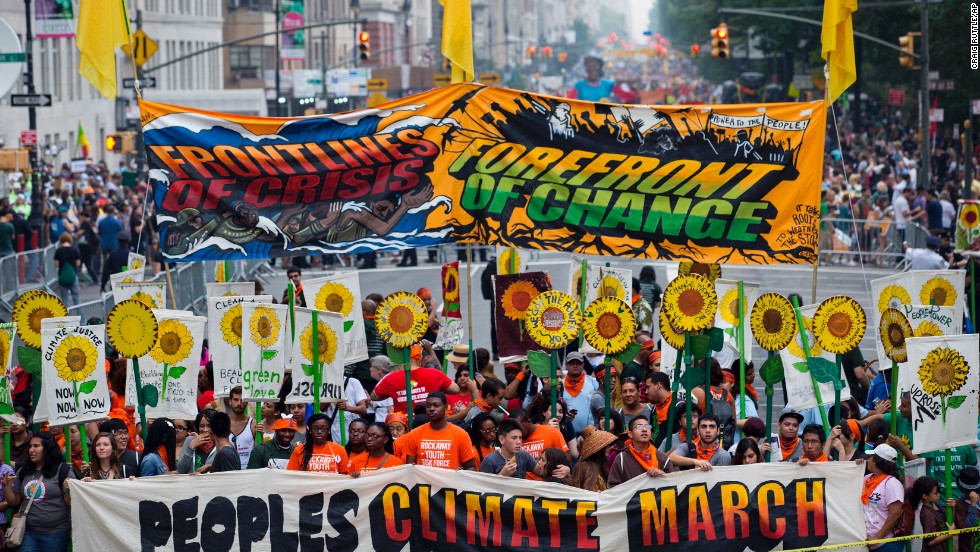
Climate March in New York City, Septermber 2014


The climate movement must take the initiative
The world governments, in particular, the American government, have failed miserably to adopt and implement effective policies to mitigate global warming and catastrophic climate change despite scientific knowledge that it threatens the very existence of human species and much besides. 

While the grassroots movement demanding action to mitigate catastrophic climate change has been gaining momentum its focus so far has been on registering opposition to government inaction.  It is high time that the climate movement raise specific policy demands because government devised policies  have failed to work so far.  This is because governments place corporate and economic interests above protecting the climate. Precious time is wasted as the world edges closer to the tipping point when it will become impossible to stop the coming catastrophe due to feedback effects. 

For an emissions tax with subsidies to low-income people
The movement needs to adopt as its central demand a carbon/emissions tax with subsidies for low-income people.  This is easy to explain and to understand. Economic activities producing greenhouse gases (GHGs) do not factor in the cost of pollution.  Economists call this “externalities.” Since the Industrial Revolution, this has served as a generous subsidy to industries that cause emissions.  It is high time to add in this environmental cost through an emission tax.  However, the low-income people should be cushioned against such a tax eroding their already low purchasing power.  A subsidy is necessary which can be funded from the emission tax itself.  Emission taxes can also be used for subsidies to speed up transition to clean renewal energy (those that have minimal adverse effect on the environment—solar, wind and geothermal but not natural gas and nuclear).

The climate movement can enhance its effectiveness by focusing its campaigns on nine countries and European Union that are responsible for more than 70% of greenhouse gases. Ranked by their “absolute emissions,” they are China, U.S., E.U., India, Russian Federation, Indonesia, Brazil, Japan, Canada, and Mexico. 

Seven of these countries and E.U. have higher per capita emissions than the world average: Canada, U.S., Russian Federation, Japan, E.U., Indonesia, China and Brazil.  In eight countries and E.U.,  the transition to clean renewables energy will be largely accomplished by phasing out fossil fuels through a carbon tax (a form of emissions tax).  In Indonesia where key sources of GHGs are deforestation and land use an emission tax is required.

Climate Club
Early industrializers of the West and Japan as well as China should take the lead because of the historic responsibility of the former and the fact that China’s pollution is largely driven by industrial production for the West that makes China the leading emitter today. The E.U., in particular some of its member states like Germany, have taken notable steps to cut emissions already.  Last year, United States and China announced intention to reduce emissions in the coming years. And on Germany’s urging the recent G-7 meeting announced its intention to work for a world free of fossil fuels by the end of the century; a largely symbolic gesture. But all these have been rather timid action boxed in by each country's corporate and economic interests.  The climate movement should demand that they honor and exceed these intentions by creating a Climate Club through adopting meaningful emissions (or when appropriate carbon) taxes with subsidies to low-income people.  

Emissions tariff and Climate Change Assistance Fund
Key to the international success of emissions taxes is that Climate Club countries impose import tariffs on leading emitters who are not yet in compliance. The combination of emissions tax and import tariffs will benefit any country that joins the Climate Club and make it unfeasible economically not to join it.  All such tariff should go to a Climate Change Assistance Fund that gives assistance to the countries most affected by climate change and least able to face it alone and to help them transition to a post-carbon economy.  

How to proceed
In sum, I believe it is high time for each organization in the climate movement to discuss this and other policy proposals in their general meetings. What to do about climate change is too important to leave to politicians, bureaucrats, technocrats and business interests who routinely place corporate and economic interests before the health of the planet and all who live on it. 

Whenever we plan for protest actions various participating groups propose demands or slogans close to their own vision. There is usually harmony with the directions and goals of the climate movement.  However, it is time to strive for greater unity by adopting clear and concise policy of our own on how to combat climate change.  

The policy proposals here will run into opposition by many politicians, bureaucrats, and corporate leaders. However, climate movement is a political movement precisely because we must overcome such oppositions by our ever-more powerful mobilizations and unity in action.  Who else will design and implement solutions to climate crisis if not the climate movement?  At the same time, there may be criticism by some of us who have proclaimed “System Change, Not Climate Change.”  Of course, there is truth in the notion that the capitalist system is responsible for global warming and the planetary crisis. However, most people who raise this slogan do not subscribe to the idea that effective policy to combat climate change has to wait for the downfall of capitalism. In fact, it is the reverse.  Only through building a mass climate movement that can forge and force an effective climate policy on the existing capitalist world order that we can take genuine steps to overcome it.  

We can win the fight to reverse 250 years of greenhouse gas emissions if enough social forces are organized and mobilized in key countries and across the world.  It requires a clear understanding of policies, strategies and tactics that can achieve our goal.  Of course, we will continue with campaigns to end fracking, tar sands oil, explorations in particularly dangerous locations, coal trains and bomb trains.  But emission taxes with subsidies to low-income people and formation of a Climate Club that impose import tariff on major emitting countries and provide assistance to the countries of Global South to cope with climate change and transition to a post-carbon economy will be a powerful complement that will unify the movement across the world and point the way forward. 

Technical Appendix
It is well known among economists that in the global capitalist economy individual countries have no incentive to limit emissions that bring them economic benefits as long as they do not have to share its costs.  It is a typical free rider problem.  Given this, in a recent article in the American Economic Review, Yale climate economist William Nordhaus has argued for the formation of a Climate Club to combat climate change.  The two basic conditions for membership are: (1) to impose a meaningful carbon tax; and, (2) to impose import tariffs on countries not in the Club.  Professor Nordhaus discusses estimates for Social Cost of Carbon (environmental costs) to estimate proper tax rates as well as proper import tariff rates. Professor Nordhaus does not consider subsidies for low-income people nor a Climate Change Assistance Fund for countries of the Global South.  However, his work shows that relying on “peer pressure” and a “cap and trade” system will not work.  His policy proposal is also simple to understand and easy to implement if accepted.  Even in the environmentalist movement proposed policies to confront climate change is often a laundry list of options that work if they are undertaken at the same time and by a range of economic and social actors.  Taxing GHGs emissions and cutting off subsidies given to the fossil fuel industry historically are easy to understand and explain and effective. 


Notes
 1. They failed to arrive at any common policy for 21 years of Conference of the Parties (COP) and 11 years of Meetings of the Parties (MOP). Meanwhile CO2 concentration in atmosphere has continued to rise rapidly reaching 403 ppm in May 2015. 
 2. See, Kamran Nayeri, “People’s Climate March Was a Huge Success; What to Do Next?,” October 1, 2014
 3. See, for example, June 23, 2015 Letter to the White House by thirteen environmentalist organizations protesting EPA’s intended policy to substitute biomass for coal instead of transition to clean energy. 
 4.Mengpin Ge, “6 Graphs Explain the World’s Top 10 Emitters,” World  Resources Institute, November 25, 2014. 

Related posts:

1913. Discussion: Emissions Tax, The Climate Movement, and Radical Social Change