Monday, December 22, 2014

1691. As US Media Awake to a ‘Nightmare’ Israel, NYT Brings Blumenthal in From the Cold

By Phillip Weiss, Mondoweiss, December 10, 2014
Fascist Lehava youth demonstrating in Israel

We’re in the midst of a sea change in the American mainstream’s treatment of the conflict. US media are beginning to reflect the awareness that the two-state solution is over and that violence around Jerusalem and the West Bank is caused by occupation and fostered by rightwing intolerance inside Israeli political culture– the “nightmare” of greater Israel. There are countless examples of the shift. Last night on MSNBC Richard Engel said many people are angry at the US because of torture and drones, but also “because of Israel/Palestine, and Gaza.”  When Israeli finance minister Naftali Bennett was confronted by Khaled Elgindy at the Brookings Institution last Saturday to explain why Palestinians are “the only group of humans in the world that do not have the right to self-determination,” the Beltway audience was evidently on Elgindy’s side. Leon (AIPAC) Wieseltier is gone from the New Republic. The New York Times is publishing Max Blumenthal. And the New Yorker‘s David Remnick is staying in East Jerusalem.

A roundup:

The New York Times published two anti-Zionists in a forum on the Israeli government’s turn to the right. After more than a year of ignoring his book about tyranny and intolerance in Israel, Goliath, The Times gave Max Blumenthal a platform to explain that Israel has always been rightwing.

Over 60 years before [anti-Arab group] Lehava’s segregationist crusades, there was the socialist Zionist “Conquest of Labor” that organized Jews-only work collectives and boycotted businesses that employed Palestinians. Before the settlements, there was the kibbutz movement whose admissions committees denied residency to anyone but Jews. Before the wave of vigilante “price tag” attacks on Palestinians, there was the Nakba that expelled some 750,000 Palestinians in order to establish Israel’s Jewish majority. And as Marzel mentioned, there is the Jewish National Fund, a para-governmental group founded by Theodore Herzl to provide land exclusively to Jews which recently oversaw a program that would have led to mass expulsion of Bedouin called the Prawer Plan.

If a shift is underway in Israeli politics, it is primarily tonal. Israel’s rightists intend to carry on the Zionist project as originally conceived, but without the pretense of democracy. In a way, their honesty is refreshing.

Blumenthal’s non-marginalization is a crushing blow to Zionists. Liel Leibovitz,who wrote a book saying we are the chosen people, labels Blumenthal an anti-Semite and says that the Times should apologize for the publication. Tablet is marginalizing itself with this kind of smear, as well as draining even more meaning from the term, anti-Semitism.

That Times forum also features Diana Buttu bringing news to Americans: Palestinians have always seen Zionism as a colonial movement that forces them off their land; the continuation of these policies will only produce violent reprisals; and the US is supporting Israel against its own interest.

Whoever wins these elections and whatever the composition of the next government, the same situation will prevail for Palestinians.We will continue to live under inequality or under foreign military rule in our homeland. Israel will continue to steal our land, demolish our homes, strip us of our rights and demand our loyalty and subservience to a system and society that seek to oust us.

Israel’s perpetual rightward shift reflects the hubris of America’s spoiled child. Every elected American official pampers and lavishes support for Israel, even as Israel’s actions defy U.S. interests and presidential statements. The world’s unwillingness to halt Israel’s illegal behavior, cements a mindset that illegality is permissible.

It is nonsensical that Palestinians, occupied and stateless, must negotiate their freedom with their occupier and oppressor. It is the role of the international community to make known that it will not tolerate colonialism in the 21st century.

As the New Republic fallout demonstrates, anti-Arab racism is at last becoming problematic in the U.S. mainstream. Six weeks ago the Times ran Rula Jebreal’s op-ed saying that Israel needs a civil rights movement to end a “pervasive institutionalized system of discrimination.” While Foreign Policy readers lately learned of Israel’s Jim Crow conditions from Sayed Kashua in “The Country That Never Wanted Me,” citing facts you used to only hear at Palestinian solidarity events:

 “[N]ot a single Arab town has been established since the State of Israel was founded — in contrast with some 700 Jewish settlements.”

New Yorker editor David Remnick shapes opinion among the elites, and maybe most important in this roundup was his piece last month reporting that Israeli claims to the West Bank have established a “one-state reality” and Israeli political culture is getting scarier by the minute. While few elements of that piece would surprise readers of this site (Naomi Klein talked about the one-state reality long ago), the mood was surprising: Remnick seems to want a trial separation from Zionism, noting pointedly that he was staying in the American Colony hotel in East Jerusalem. He quoted Meron Benvenisti explaining that 1967 was merely a continuation of 1948, and name-checked Ali Abunimah (without interviewing him).

Even better at conveying the “nightmare” was Henry Siegman at Huffpo, “Will Greater Israel Transform Into Greater Palestine?” filled with bleak realist pronouncements about Israel’s future. Israel is losing contact with world opinion and the enlightened are leaving the place (just watch Naftali Bennett’s manic performance at Brookings, dismissing “a little thing called the rest of the world”). Seigman sketches an Algeria-like scenario of decolonization in which political violence plays an important role. Just as political violence played a role in creating Israel.

If the slaughter in the Jerusalem synagogue will make the Palestinian dream of statehood an even more unreachable dream, it will also turn Israel’s illusion of the sustainability of the occupation into a nightmare. For the more hopeless the expectation of Palestinian moderates that non-violent means can bring about the promised and repeatedly denied two-state solution, the more Palestinians will believe that violence is the only way to change Israel’s cost-benefit calculations for its theft of Palestinian territory in the West Bank and in East Jerusalem.

Palestinian violence against non-combatants discredits the Palestinian national cause. But who is to say it may not work for the Palestinians as well as it worked for the Jews in their War of Independence, for it achieved Ben Gurion’s goal of triggering the flight of over 700,000 Palestinians. Palestinian violence may similarly serve to drive many of Israel’s most creative and productive elements to abandon the Jewish state and renew their lives in the Diaspora, a reaction that is already discernible.

Jay Michaelson at the Forward is also bleakly realistic. He confesses that Israeli racism and Sheldon Adelson’s political crudeness have caused him to become “binational-curious.”

Like everyone else in the peace camp, I am dejected by the current state of affairs and pessimistic about the future. I’m exhausted by Israel’s unethical behavior, by renewed (and condoned) Palestinian terrorism and by vulgar, bloviating billionaires dictating policy by checkbook. I am ready to stray from my two-state views, and I am open to all other realistic options.

Unfortunately, there aren’t any.

So Michaelson finds himself shifting. So does Princeton student Maya Wahrman, writing in Haaretz, “Despair is driving me towards BDS.” Wahrman has long condemned boycott of Israel, but if BDS can change Israel’s political climate, she must support BDS.

Some people fear BDS because they think it will be harmful to Israel. I answer that most of Israel’s current policies regarding Palestinians harm Israel because they harm humanity. If we fear anti-Semitism, let us be just, and our strong allies will support us. I suspect that others fear BDS because they are afraid it might actually work. Which makes it all the more promising….

[D]o not immediately disqualify [BDS] because it is harsh on Israel. Nor should you immediately support it without considering the wide-reaching and serious consequences.

I have by no means run the full gamut of important considerations. I do not know if BDS is the answer. But if commercial sanctions effectively pressure the Israeli government and show them that the injustice must end, potentially leading to commitment to a peaceful resolution, then who am I to stand in the way?

All this talk is getting some pushback. I mentioned Liel Leibovitz’s smear on Blumenthal. Even the Times ran Caroline Glick and Jonathan Schanzer in its forum with Blumenthal and Buttu. Even more regrettably, the Atlantic asked Matti Friedman to rehash/expand his argument in Tablet of last August that Israel is a “tiny village” situated on a volcano of Islamic hatred. Friedman says that foreign correspondents hanging out at the American Colony hotel have fashioned/imbibed “the ‘Israel story,’ which is a story of Jewish moral failure”–

Mingling occurs at places like the lovely Oriental courtyard of the American Colony hotel in East Jerusalem, or at parties held at the British Consulate’s rooftop pool. The dominant characteristic of nearly all of these people is their transience. They arrive from somewhere, spend a while living in a peculiar subculture of expatriates, and then move on.

Isn’t that orientalism? Remnick left it at: “a beautiful old hotel in East Jerusalem.”
Wahrman, Remnick, Michaelson, and Siegman all seem to fear the future, how far this could all go, and suggestions that Jews must decolonize. This is the biggest argument for BDS; it respects the human rights of everyone in the country; Those fears are also the greatest argument for democracy I can think of. How many liberal American Zionists would wash their hands of the ideology entirely if they could only be assured that there could be a nonviolent resolution of Israel’s predicament. A lot, I’m sure. (There is one way to marginalize rightwing racists; and that is to grant everyone who is governed by Israel the right to vote for the government of the land. The UK losing Scotland would have swung hard right. The Congress, if Jim Crow were in place, would be absent many progressive urban representatives. Advocates of the two state solution say that the great Palestinian middle and the great Israeli middle just want peace. Well, let them work together, in political combination. Right now Israeli national political candidates have to appeal to religious zealots. Imagine if they had to campaign to Palestinians.)


- See more at: http://mondoweiss.net/2014/12/nightmare-brings-blumenthal#sthash.vaGpJq1f.dpuf

Sunday, December 21, 2014

1690. A Climate Accord Based on Global Peer Pressure

By Coral Davenport, The New York Times, December 14, 2014


LIMA, Peru — Shortly before 2 a.m. on Sunday, after more than 36 straight hours of negotiations, top officials from nearly 200 nations agreed to the first deal committing every country in the world to reducing the fossil fuel emissions that cause global warming.

In its structure, the deal represents a breakthrough in the two-decade effort to forge a significant global pact to fight climate change. The Lima Accord, as it is known, is the first time that all nations — rich and poor — have agreed to cut back on the burning oil, gas and coal.

But the driving force behind the new deal was not the threat of sanctions or other legal consequences. It was global peer pressure. And over the coming months, it will start to become evident whether the scrutiny of the rest of the world is enough to pressure world leaders to push through new global warming laws from New Delhi to Moscow or if, as a political force, international reproach is impotent.

The strength of the accord — the fact that it includes pledges by every country to put forward a plan to reduce emissions at home — is also its greatest weakness. In order to get every country to agree to the deal, including the United States, the world’s largest historic carbon polluter, the Lima Accord does not include legally binding requirements that countries cut their emissions by any particular amount.

Instead, each nation will agree to enact domestic laws to reduce carbon emissions and put forth a plan by March 31 laying out how much each one will cut after 2020 and what domestic policies it will pass to achieve the cuts.

Countries that miss the March deadline will be expected to put forth their plans by June. The plans from every country, known within the United Nations as “Intended Nationally Determined Contributions,” will form the basis of a sweeping new deal to be signed in Paris in 2015.

By asking countries to put forward plans dictated by their own economies and domestic politics, rather than a top-down mandate, the Lima Accord helped secure the agreement of every nation to some kind of carbon-cutting action, experts say.

But with no language requiring the significant cuts scientists say are needed to stave off the costly effects of global warming, countries can put forth weak plans that amount to little more than business as usual. Countries can even choose to ignore the deal and submit no plan at all.

“If a country doesn’t submit a plan, there will be no punishment, no fine, no black U.N. helicopters showing up,” said Jennifer Morgan, an expert on climate negotiations with the World Resources Institute, a research organization.

Instead the architects of the plan, including top White House officials, hope that the agreement will compel countries to act to avoid international condemnation.
“It relies on a lot of peer pressure,” Ms. Morgan said.

The structure of the deal is what political scientists often call a “name-and-shame” plan.
Under the Lima Accord all countries must submit plans that would be posted on a United Nations website and made available to the public.

A requirement that all countries submit plans using identical metrics, for easy comparison, was deleted from the accord because of the objection of developing nations.
“What’s essential for naming and shaming is that the individual contributions be comparable,” said Robert Stavins, a professor of Environmental Economics at Harvard University.

But already, a number of research groups and universities expect to crunch the numbers of the plans, producing apples-to-apples assessments. The hope, negotiators said, is that as the numbers and commitments of each country are publicized, compared and discussed, countries will be shamed by the spotlight into proposing and enacting stronger plans.

“We see the sunlight as one of the most important parts of this,” said Todd D. Stern, the senior climate-change negotiator for President Obama.
The motivations of the world leaders and whether they care about those assessments are essential to the success of the deal.

Mr. Obama wants to sign on to the plan because he sees his role in fighting climate change as a cornerstone of his legacy, both he and his advisers say. But whether the United States will follow through on his commitment depends on whether his successors and fellow politicians feel the same.

The president has pledged that the United States will cut emissions by as much as 28 percent by 2025. The nation can achieve some of that under new regulations of tailpipe and power plant emissions enacted by his administration.

But further laws or regulations, enacted after Mr. Obama leaves office, must be put in place for the United States to meet its pledge, experts say. Most in the emerging field of Republican presidential contenders have come out fiercely against Mr. Obama’s domestic climate-change policies, and they may not be swayed by international scorn if the United States does not follow through on its Lima pledge.

In China, the political motivations for reducing emissions are more internal. China’s president, Xi Jinping, has pledged that China’s emissions will peak by 2030 and decline after that. To meet that goal, the Chinese government is looking into creating a national cap-and-trade system by 2016 that would force polluters to pay for their greenhouse gas emissions.

But China was driven to cut pollution largely to quell domestic unrest, as citizens protested against the increasingly bad air caused by coal power production. The previous decade of international criticism, as China surpassed the United States as the world’s largest polluter, did not compel it to take domestic action.

There is much speculation about how India, the world’s third largest carbon polluter, will respond. Prime Minister Narendra Modi has declared repeatedly that his top priority is economic growth and lifting people out of poverty, even if that means the construction of hundreds of new coal-fired power plants to deliver cheap electricity. Mr. Modi is also seen wanting to resist being viewed as caving in to pressure from Mr. Obama.

In New Delhi, critics have already begun pushing back against the deal.
“The burden of tackling climate change will decisively shift to developing countries, making their efforts toward poverty reduction and sustainable development difficult and expensive,” said Sunita Narain, director of the Centre of Science and Environment, an Indian advocacy group.

However, India’s environment minister, Prakash Javadekar, noted last week in Lima that climate change has already affected his nation, and that his government intends to submit a plan by June that would show how India would lower the rate at which it produces pollution.

Observers are also closely watching Russia, the world’s fifth-largest polluter, for its response to the plan. President Vladimir V. Putin has publicly scoffed at the science of human-caused climate change and shown a willingness to defy international opinion.
But this week in Lima, Russian delegates said that Moscow is at work on an emissions reduction plan.

Climate change policy observers will also closely watch Australia. This year, the Australian government voted to repeal a carbon tax, and the administration of Prime Minister Tony Abbott has also eliminated its Department of Climate Change. On Sunday morning in Lima, as delegates from around the world praised the passage of the Lima Accord, the Australian delegation chose not to make remarks.

Still, the delegation did say it will submit a climate change plan to the United Nations this spring.

Friday, December 19, 2014

1689. Climate Change: Catholicism and Communism

By Richard Greeman, December 18, 2014


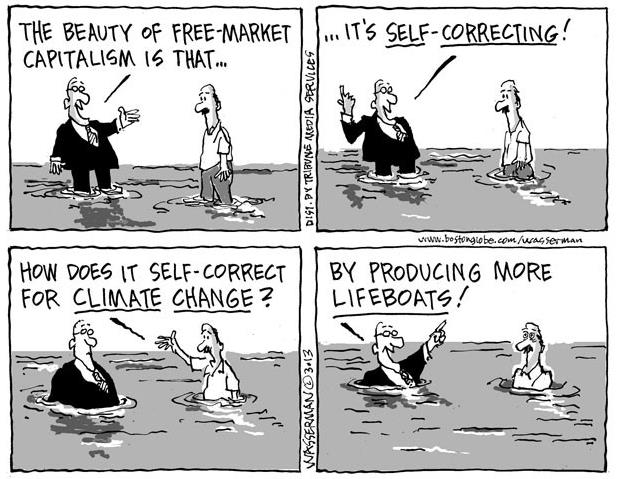
Last week, as yet another mega-typhoon laid waste to the Philippines, the leaders of 183 capitalist governments met in Lima, Peru to face the imminent threat of climate catastrophe at a U.N. Climate Conference called COP20. (Yawn.) In case you missed the headlines (they were small), the world leaders agreed to nothing.[1]

Since the fiasco of the Helsinki Summit, it has become obvious that the U.S. and the other  governments, all of them dominated by mega-banking and energy corporations, are quite simply unwilling to make actual commitments to reduce carbon emissions. This year at Lima, with the human race spinning at an ever more accelerated rate towards extinction, the U.N. chose to invite Shell and other big energy corporations to participate inside the conference, while keeping protesters (indigenous, climate refugees, peasants, climate justice activists) miles away under military guard in U.S.-style ‘free speech zones.’

Bishops: End Fossil Fuels Now!
 The only voice within the Conference that dared to call for an end to the use of fossil fuels was that of Catholic Bishops from every continent. The Bishops also urged nations to keep the rise in global temperatures below 1.5°C (rather than the proposed 2°C). Moreover, they explicitly pointed to capitalism as the basic cause of impending global catastrophe and called for a new economic order:

The main responsibility for this situation lies with the dominant global economic system, which is a human creation. In viewing objectively the destructive effects of a financial and economic order based on the primacy of the market and profit, which has failed to put the human being and the common good at the heart of the economy, one must recognize the systemic failures of this order and the need for a new financial and economic order. [2]

In other words: “System Change, Not Climate Change!” What more could one ask for? This slogan happens to be the name of the minuscule, far-left, ecosocialist coalition I am active in. The only difference is that the Catholic Church has 1.2 billion members.

Unfortunately, the Bishops’ remarkable declaration was not reported in any major media that I could find. And even Amy Goodman, who broadcasted her progressive ‘War and Peace Report’ www.democracynow.org live from Lima all boring week, failed to note it. However, it is not really a surprise in the context of the rapid changes in Catholic attitudes in the less than two years since the ascension to the Throne of Saint Peter on Feb. 28, 2013, of Pope Francis, of whom more in a moment.

“While this is a first by some markers,” writes Jeff Spross of Climate Progress, “the Bishops’ statement also continues a long tradition of engagement with environmental issues and climate change by the Catholic Church.” Pope Francis himself has made the religious case for combating climate change, warning that “if we destroy Creation, Creation will destroy us!” Francis has also singled out the destruction of the rainforest as a “sin,” and is working on an official papal encyclical tackling the environment and humanity’s relationship to it.[3]

Catholicism and Communism
 These radically anti-capitalist Catholic positions have got me wondering: “Is Catholicism the new Communism?” “Rome the new Moscow?” “The Church the new Comintern???” What a paradox! Growing up as a ‘red diaper baby’ during the Cold War, Catholicism seemed to me synonymous with militant anti-Communism (not to mention militant virginity). New York’s powerful Cardinal Spellman was a virulent McCarthyite, and the martyrdom of Cardinal Mindszenty in Hungary (persecuted first by both fascist and then communist regimes) made folks forget the complicity of Pope Pius XII with the Nazis – based on their common hatred of Communism. 

Then, in 1958, things changed radically with the election of Pope John XXIII. The Vatican Council proclaimed the Christian doctrine of ‘a preferential option for the poor.’ Liberation Theology, which affirmed the right to resist oppression, spread all over Latin America. I was privileged to witness it in action in Nicaragua in 1984 during the U.S.-sponsored Contra war. Indeed, my years of activism in the Latin America solidarity movement had convinced me that Liberation Theology Catholics were consistently more revolutionary than Leftist of all stripes.[4] But sadly by the 80s my comrades among activist priests and nuns were being side-tracked and persecuted by the new dispensation in the Vatican after the election of fervently anti-Communist Polish Pope in 1978.

Reaction and Disgrace
 John-Paul II put the Church firmly back on the side of the privileged. Then the 2005 election of former Hitler Youth Josef Ratzinger as Pope Benedict XVI set the Church on an even more reactionary course, turning back the clock on women and reproductive rights, offending Moslems, trying to cover up major scandals over pedophile priests and Vatican finances, and launching an inquisition of progressive U.S. nuns, accused of feminism and meddling in social issues.

So severe was the disgrace to the Church’s reputation, that Benedict took the unprecedented step of resigning more or less in disgrace in Feb. 2013, but by then even the most loyal Catholics had given up on the rigid, self-protective, seemingly immovable Church hierarchy. ‘New Pope? I’ve Given Up Hope’ headlined Gary Wills in the N.Y. Times. In my own analysis (‘Pope Quits: So What?’[5]) I contrasted the history of popular movements inspired by Christianity’s radical social content and the Church’s vast potential for good with the apparent death-grip of the geriatric, reactionary hierarchy on the institution. But my conclusion was nearly as despairing.

A Miracle?
 I didn’t dare dream that a mere twenty months later Benedict’s successor, Pope Francis, would have called a World Meeting of Popular Movements  and invited to the Vatican organizations of the marginalized and excluded of all ethnic and religious origins -- landless campesinos, urban workers from the informal sector, recyclers, struggling native peoples, women demanding their rights, etc. (Oct. 2014) There, in the presence of Bolivia’s radical President Evo Morales, Francis declared that “ solidarity with the poor is the very grounding of the Gospels" and that "Agrarian reform is not only a political need, but also a moral one!" These sound like the words of a popular leader, reaching out to his base.
“It was the direct involvement of Pope Francis that drove the event,” according to Canadian delegate Judith Marshall reporting in  Links International Journal of Socialist Renewal . Her amazing report is definitely worth reading in full.[6]  “As the newly installed head of a major institution of the global establishment, Pope Francis has arguably made the Papacy the most radical and consistent voice in pointing to the profanity of global inequality and exclusion. He has also repeatedly named the inordinate power of multinational corporations and finance capital as key factors in reproducing global poverty and destruction of the planet [...] The meeting was built on the strength of the Pope’s long-standing connections with these key popular movement leaders in Argentina.”

Who is Pope Francis?
 Jorge Mario Bergoglio was born in Buenos Aires, Argentina, in 1936. After working briefly as chemical technician and a night club bouncer, he joined the progressive Jesuit order, became a priest during the heyday of Liberation Theology and got involved in social movements.

As a bishop, Bergoglio had already developed an incessant but discreet support for workers and their organizations. The anecdotes are without number: solidarity with persecuted militants, support for campesino organizations, protection for peddlers, promotion of “shanty town priests”, accompanying factor workers who had reopened closed factories and a forthright attitude of struggle against exploitation and exclusion, traffic in persons, drug-trafficking and the consumer culture. All of this, added to his legendary austerity and simple life style, his constant interpolation against the self-satisfied life style of the petty bourgeoisie, postmodern consumerist hedonism and “elite progressivism”, had made him an uncomfortable figure, not only for the reactionary right but also for the liberals of the centre.”[7]

Francis is the first Jesuit pope, the first from the Americas, the first from the Southern Hemisphere and the first non-European pope in over 1,000 years. These ‘firsts’ signify a major shift in the power equilibrium within that vast Internationale of the global poor. The Catholic (‘Universal’) Church is the only actually existing organized world-party. Its vast wealth and influence are now in Francis’ hands. Imagine, for example, that this Jesuit remains true to his Order’s mission and devotes some of the billions salted away in the Vatican to promoting Catholic education on a global scale, teaching billions of poor children how to read, write, think for themselves in a world organization that affirms the right to resist oppression. If the Church truly stands for ‘System Change Not Climate Change,’ this it itself would be a revolutionary development, and we have only just seen the beginning.

How Did this ‘Miracle’ Happen?
 How did such an openly radical priest manage to get elected? Francis’ absolute authority at the apex of the hierarchy is a major defeat for the old power brokers who would rather see the living Church wither on the vine than compromise, as witness their circling the wagons during the pedophile priest scandals, their adamant refusal to allow priests to marry or to give women a sacerdotal role of some sort in order to keep the parishes alive, and their unwillingness to fund Catholic education -- once the Church’s proud monopoly and major source of its ideological influence. The Catholic hierarchy (like the military, the world of finance, and the Communist nomenklatura) has long functioned as a closed corporation, a state within a state, impenetrable, opaque, a law unto itself, protected by its intimate ties with other corrupt hierarchies in politics, the military, banking, law enforcement and the Mafia.

The Vatican bureaucracy sits on a pot of gold equal to the wealth of many nations, and one can only imaging the silent struggles going on right now behind the closed walls of the Curia over control of that wealth as Francis and his allies conduct their purge of the apparatus. These developments may take time.

Excluding Divine Intervention, what made this revolution within the Church possible? The most obvious answer is that the Church had reached a dead end. The faithful were leaving in droves, the priesthood was dying out with few new recruits, especially among ‘Europeans,’ and the laity were in despair. Another reason is the demographic shift among practicing Catholics. There is also the solid organization and discipline of the international Jesuit Order whose attempts to take over the Church and influence in Latin America go back centuries. (Not for nothing did members of the Communist International think of themselves as ‘red Jesuits.’)

Breaking Through Parish Walls
 To these material explanations I would like to add another, less obvious: the Internet and social media. Whereas over the centuries, the hierarchy has had a monopoly of communication, all of it top down. Today, Catholic lay people are no longer isolated, voiceless and passive before immense wealth and influence of the hierarchy. Just as Guttenberg’s movable type helped catalyze the Protestant Reformation in the 16th century by making the Bible accessible to the laity, so the Internet in the 21st century may have catalyzed the unprecedented resignation of arch-conservative Pope Benedict XVI and the Church’s apparent new course under Francis.

As Internet guru Clay Shirky points out, “social tools don’t create collective action, they merely remove the obstacles to it.”[8]  Shirky cites the example of the campaign among lay Catholics to end sex-abuse of children by priests. It began in the 90s when victims started coming forward and the scandals were exposed in newspapers like The Boston Globe, but the Church hierarchy, led by Cardinal Law (himself guilty of protecting pedophile priests by rotating them through new, unsuspecting parishes), was able to squash the victims’ movement.

The instigators were denounced via press and pulpit and banned from Church facilities, while lay groups were forbidden to organize outside of their local parish. However ten years later, Cardinal Law was forced to resign in disgrace after Internet tools had enabled victims to aggregate their testimony, post it on line, spread information and organize nationally and internationally. Meanwhile, the revolt against the coddling of pedophile priests has caused the laity to openly question reactionary dogmas like refusing Communion to divorced and LGBT Catholics and maintaining the celibacy of priests.

The Internet did not cause this potentially momentous change, but social media and its world-wide reach enabled the smoldering revolt of the Catholic laity to overcome the institutional barriers that enabled the hierarchy to isolate and dominate the rank-and-file movements for reform and renewal. What is striking in today’s revolution within Roman Catholicism is the intersection of ‘horizontal’ and ‘vertical’ forms o organization. For if horizontal internet networking has given the Catholic laity a chance to come together and express itself, the capture of a powerful vertically-structured Catholic ‘world-party’ by progressive forces opens huge possibilities for human liberation and perhaps a chance for the planet to avoid climate catastrophe.

Nuns Vindicated
Let us end this hopeful story with the news, released today, of another victory for the progressive Catholic rank-and-file: a Vatican report reversing Benedict XVI’s crude attempt to stifle the socially-engaged, self-governing orders of U.S. nuns, accused of preaching ‘feminism’ and advocating ‘social justice.’ Catholics across the country had been stunned and outraged by the Vatican’s attempt to threaten the women who have been the backbone of this church for centuries. Thousands of faithful Catholics held more than 50 vigils across the country and more than 57,000 people signed a petition organized by the Nun Justice Project in support of the nuns. With these actions, Catholics made it clear that they stand in solidarity with the sisters and their good works among the poor and marginalized.[9]  As of  today, they are vindicated.

The report concluded by citing Pope Francis’ call “to create still broader opportunities for a more incisive female presence in the church.”[10] Meanwhile, it also transpired today that Pope Francis brokered the agreement between Obama and Raul Castro to resume diplomatic relations after more than a half-century of U.S. sanctions against Cuba, long condemned by the rest of Latin America. Also, it was the Holy Father’s birthday. Mazeltov, Francis!

Notes
[1]  I exaggerate. The world leaders formally agreed that each country will prepare its own voluntary goals in preparation for next years Paris Climate Summit. The Lima conference was thus not a ‘failure’, but a success (for the corporate agenda).
[2] http://www.bbc.com/news/science-environment-30408022  “Global group of Catholic bishops call for end to fossil fuels,” by Matt McGrath Environment correspondent, BBC News, Lima.
[3] http://thinkprogress.org/climate/2014/12/11/3602596/bishops-end-fossil-fuels/
[4] For example they supported the distribution of lands abandoned by émigré landowners, while the Sandinistas refused to give legal titles to poor peasant occupiers, thus undermining their own popularity during the Contra war.
[5] https://richardgreeman.wordpress.com/wp-admin/post.php?post=228&action=edit&message=6&postpost=v2
[6] http://links.org.au/node/4172 “Challenging the globalization of indifference: Pope Francis meets with popular movements” by Judith Marshall, November 21, 2014.
[7] According to Juan GRABOIS, activist in the Movement of Excluded Workers and as one of the national coordinators of the Confederation of Popular Economy Workers in Argentina, quoted by Marshall, above.
[8] Clay Shirky, Here Comes Everybody: The Power of Organizing without Organizations  (2008)
[9] http://www.nytimes.com/roomfordebate/2012/06/12/will-the-vaticans-crackdown-on-nuns-work/the-vaticans-fear-tactics-will-not-work

Thursday, December 18, 2014

1688. Citizens Revolt in Burkina Faso

By Ernest Harsch, African Futures, December 9, 2014


Even the long months of demonstrations and strikes that came before did not fully prepare the people of Burkina Faso for what they would accomplish during the last week of October 2014. In Ouagadougou, the capital, hundreds of thousands—organizers claimed a million—packed the central square on Tuesday, 28 October, to protest President Blaise Compaoré’s “constitutional coup,” as they called his plan to force through an amendment enabling him to run for reelection yet again, after more than a quarter century in power. Similar outpourings hit Koudougou, Ouahigouya, Kaya, Koupéla, Dori, and other towns across the country. Most were disciplined and peaceful, in line with opposition instructions. In the eastern town of Fada N’Gourma, however, several thousand burned the headquarters of Compaoré’s ruling party. In Bobo-Dioulasso, a commercial center in the west, young protesters symbolically pulled down a statue of Compaoré—while leaving untouched one of the late Libyan leader Muammar Qaddafi right next to it.[1]

Despite those massive turnouts, and despite women’s demonstrations the day before and trade union demonstrations the day after, Compaoré and his allies persisted. They announced that on 30 October their deputies in the National Assembly would vote to change the constitution. If adopted, their amendment would have permitted Compaoré to run not just for one more term but for three more. Some party leaders were already looking beyond the next election in 2015 and only half-jokingly suggested that their slogan should be Blaise Compaoré 2020.

Disgusted by the arrogance, people again occupied the streets and squares of major cities the morning of the planned vote. Their mood was now angrier, as protesters insisted more forcefully that Compaoré resign, and their tactics turned confrontational. Thousands sacked the National Assembly, preventing the vote. They attacked the government’s television network, forcing it off the air. The mayor’s office, ruling party headquarters, and homes of high officials were burned. Some protesters were killed as security forces tried to disperse them. Thousands marched to the presidential palace, but were blocked by troops. Similar scenes of rage swept the country. Only days later did reports trickle in confirming the extent of the destruction, much of it carefully targeted against government symbols and supporters.

Although the embattled president now agreed to leave the constitution intact, he still insisted on staying in office until the end of his term, provoking huge crowds to again fill the streets on 31 October. Already, some soldiers from Camp Guillaume in central Ouagadougou had joined the anti-Compaoré demonstrators, while other troops simply let protesters pass unhindered. Facing a split within their own ranks, military officers quickly decided to declare the government’s dissolution, before the situation in the streets escaped anyone’s control. Compaoré, finally bowing to reality, resigned that same day, and with French assistance fled to neighboring Côte d’Ivoire. Army officers led by Lieutenant Colonel Isaac Zida took charge temporarily, and opened talks with opposition parties and civil society groups on a speedy handover to a caretaker civilian-led transitional government. Michel Kafando, a retired diplomat, was selected by consensus as the new interim president and sworn in on 18 November, with the prime task of preparing elections within a year.

Revolutionary inspiration
These events recalled the popular revolutions in North Africa three years earlier, in both scope and the aim of bringing down long-entrenched authoritarian rulers. In fact, one of the more popular slogans in Burkina Faso, shouted by protesters and painted on walls, was “Blaise dégage” (Blaise, clear out), adapted from the Tunisian uprising.
In the immediate wake of the 2011 Arab Spring, activists throughout sub-Saharan Africa took inspiration and tried to initiate comparable movements, gaining some traction here and there, though not to the extent they had hoped.[2] The popular insurrection in Burkina Faso is now also drawing attention across the region, where mobilizations on such a scale have been rare—and rarer still in actually toppling a president. “A veritable democratic harmattan [desert wind] is sweeping Africa,” commented Francis Kpatindé, a well-known political scientist from Benin. “People who have been stifled can now legitimately think that what was possible in Ouagadougou could also be in Brazzaville, Kinshasa, Banjul, and elsewhere.” Across these capitals, as well as in other corners of the African continent (Burundi, Uganda, Rwanda and Angola), the events of Burkina have invigorated on-going debates about term limits, their constitutional provisions, and the future of longstanding rulers.

Where and to what extent the sparks from Burkina Faso may ignite fires elsewhere will depend largely on the combustibility of local conditions: Are social and political elites united behind the regime, or have cracks emerged at the top? Are people sufficiently aggrieved and their rulers so impervious to change that activists see no alternative but to risk open, mass defiance? And are they organized enough, especially at the grassroots level? As Mathias Dzon, an opposition leader in Brazzaville, the Republic of Congo Republic, noted,  “we can’t say that Burkinabè went out into the streets to change their president in a spontaneous fashion. Some work went into it.”

“27 years is enough!”
The conditions for revolt in Burkina Faso certainly did not emerge overnight. They built up over a quarter of a century, encapsulated in the demonstrators’ slogan “27 years is enough!” By pointing to how long Compaoré had been in office, critics often recalled how the former army captain originally took power: through a military coup and the assassination of President Thomas Sankara, a popular and charismatic revolutionary leader.[3] Compaoré’s junta not only jailed, tortured, killed, or drove into exile those loyal to Sankara but also undid many of the innovations of Sankara’s revolutionary era, such as self-help mobilizations to build schools and health clinics and a greater reliance on domestic resources to develop the economy. The Compaoré regime chose instead to ally itself with conservative social elites and externally leaned more heavily on foreign aid and close ties with major Western capitals, especially Paris, the country’s former colonial ruler.[4]

The early 1990s brought a wave of prodemocracy movements across Africa, including in Burkina Faso. Facing domestic discontent and some pressure from France, Compaoré carefully orchestrated a shift to constitutional rule and multiparty elections. He erected a dominant party machine that relied partly on electoral fraud but mainly on the use of state resources and patronage favors to undermine opposition and secure high vote tallies in election after election. Though Burkina Faso now had the trappings of democracy, it was by most definitions a “semi-authoritarian” state.[5]

The regime’s repressive underbelly was dramatically highlighted by the 1998 assassination of independent journalist Norbert Zongo. Evidence pointed to Compaoré’s elite presidential guard, acting to keep Zongo from exposing a scandal implicating the president’s brother. The murder sparked a prolonged countrywide revolt.[6] Compaoré—a master of deflection, delay, and cooptation—survived only by promising reform. That included reinstating the constitution’s two-term presidential limit, which he had scrapped in 1997. But the subservient Constitutional Court ruled that the new limit did not apply retroactively, enabling Compaoré to run again in 2005 and 2010.

In early 2011, just a few months after Compaoré latest reelection, the country again plunged into crisis. This time the provocation was the death of a student from a severe police beating. Starting with angry youth demonstrations, the unrest persisted for months with a cascading series of labor marches, merchants’ protests, judges’ strikes, army and police mutinies, farmers’ boycotts, and attacks on mining sites.[7] The protests had no central direction, however, and opposition parties’ attempts to mobilize failed miserably.

On-the-ground organization
With the government now weakened by the mass unrest, the main opposition parties secured some advances in the December 2012 legislative election, increasing their representation from a dozen deputies to twenty-eight, more than a fifth of the total. The opposition’s new parliamentary leadership, headed by Zéphirin Diabré, forged a broad alliance of more than forty parties (the country has many others as well), with better organization and coordination than ever before.[8] When the ruling party pushed through a constitutional amendment to create a new senate, an upper house that would have been dominated by Compaoré loyalists, the opposition saw it as a maneuver to pave the way for lifting the presidential term limit. Through the latter half of 2013, the opposition parties, supported by labor unions and civil society groups, mounted large anti-senate demonstrations, effectively blocking its establishment.

Meanwhile, grassroots activists launched several new initiatives. Two popular musicians, the rapper Smockey and reggae artist Sams’k Le Jah, launched Balai Citoyen (Citizens’ Broom) in mid-2013. It was inspired in part by Y’en a Marre, a rapper-initiated citizens’ group in Senegal that had sparked a broad—and successful—popular movement against constitutional manipulation. Although not aligned with any party, Balai Citoyen had explicit political goals: to “sweep out” poor governance and preserve the presidential term limit. Within two months it had affiliated “clubs” in all of Ouagadougou’s neighborhoods and in most major cities. Its ability to speak the language of disaffected youth drew many more into active participation in antigovernment protests.

In early 2014, as the authorities began talking more seriously about a constitutional referendum, a new activist network emerged, the Collectif Anti-Référendum (CAR, Anti-Referendum Collective). Initially formed by 365 associations in Ouagadougou, it soon spread across the country and prompted the opposition parties to form their own local antireferendum action committees. Later in the year yet another grouping arose, the Front de Résistance Citoyenne (FRC, Citizens’ Resistance Front), comprising two dozen civil society associations and headed by prominent prodemocracy intellectuals. The trade unions, meanwhile, built their own alliances with consumer associations and others; they demonstrated and went on  strike to voice worker grievances and protest high prices, with defense of the constitution prominent among their demands.

The work of such activists did much to boost the demonstrations called by the opposition party leaders. They also contributed to an increasingly notable feature in many antigovernment actions: references to the late revolutionary leader Thomas Sankara. More than a quarter century after his death, Sankara remained a hero and inspiration to many young Burkinabè, his portrait carried by marchers, voice recordings played over demonstration sound systems, and sayings quoted in slogans and speeches. In the huge antigovernment outpourings of late October, Al Jazeera reported that many young protesters were inspired by the spirit of “Africa’s Che Guevara,” while the Paris daily Le Monde saw Compaoré’s overthrow as “the revenge of Thomas Sankara’s children. Acknowledging such popular sentiments, Lt.-Col. Zida, the interim military leader, said that the Burkinabè people’s decision to rise up reflected an “identity of integrity that we have carried proudly since the August 1983 revolution” led by Sankara.

Whether motivated by revolutionary visions or just determined to see Compaoré gone, it was the young activists who spurred the final push to insurrection. Diabré and other senior opposition leaders had called the demonstrations and even urged their followers to engage in civil disobedience against the amendment vote. But it was members of Balai Citoyen, the CAR, and others on the frontlines who decided to breach the security lines around the National Assembly. According to Hervé Ouattara, president of the CAR and an initiator of the huge marches on the presidential palace on 30–31 October, leaders of his network understood that if Compaoré had to be forced out, “peaceful demonstrations would not be enough.” They prepared for confrontation, but also opened lines of communication with army officers. Those officers, convinced of the protesters’ determination, chose to avoid more bloodshed by deposing Compaoré.

Over the next year, the transition away from the Compaoré era will be full of uncertainties. The opposition leaders are focused on new elections, which they clearly hope to win. Others, closer to the activist networks, are also pushing for more fundamental changes: to improve people’s economic and social conditions, root out corruption, reform state institutions, and bring to justice the worst criminals of the ancien régime. Drawing analogies with the French revolution, one local journalist pointed to the rise of Burkina Faso’s own sans-culottes,” “these revolutionaries from the popular strata, distinct from the dominant social categories.” Now awakened to their ability to alter the course of events, they will surely demand a voice in shaping the changes ahead.

Notes: 
[1]  Agence d’information du Burkina (Ouagadougou), October 28, 2014.
[2]  Ernest Harsch, “An African Spring in the Making: Protest and Voice Across a Continent,” Whitehead Journal of Diplomacy and International Relations, Vol. 13, No. 1, Winter/Spring 2012, pp. 45-61.
[3]  Ernest Harsch, Thomas Sankara: An African Revolutionary, Athens, OH: Ohio University Press, 2014.
[4]  René Otayek, Filiga Michel Sawadogo, and Jean-Pierre Guingané, eds. Le Burkina entre révolution et démocratie (1983-1993). Paris: Karthala, 1996.
[5]  Mathieu Hilgers and Jacinthe Mazzocchetti, eds. Révoltes et oppositions dans un régime semi-autoritaire: Le case du Burkina Faso. Paris: Karthala, 2010.
[6]  Ernest Harsch, “Trop, c’est trop!: Civil Insurgence in Burkina Faso, 1998-99,” Review of African Political Economy, No. 81, 1999, pp. 395-406
[7]  Leila Chouli, Burkina Faso 2011: Chronique d’un mouvement social, Lyon: Tahin Party, 2012.
[8]  “Burkina Faso: The Opposition Becomes Better Organized,” Economist Intelligence Unit (London), 9 July 2013.


- See more at: http://forums.ssrc.org/african-futures/2014/12/09/citizens-revolt-in-burkina-faso/#sthash.MJs7YPdJ.dpuf