The 200-kilogram ‘bear otter’ is one of several large carnivores that became extinct around 2 million years ago. illustration: Victor Leshyk
New research disputes a long-held view that our earliest tool-bearing ancestors contributed to the demise of large mammals in Africa over the last several million years. Instead, the researchers argue that long-term environmental change drove the extinctions, mainly in the form of grassland expansion likely caused by falling atmospheric carbon dioxide (CO2) levels.
Tyler Faith, curator of archaeology at the Natural History Museum of Utah and assistant professor in the Department of Anthropology at the University of Utah, led the study. The research team also includes John Rowan from the University of Massachusetts Amherst, Andrew Du from the University of Chicago, and Paul Koch from the University of California, Santa Cruz.
The study is published today in the journal Science.
"Despite decades of literature asserting that early hominins impacted ancient African faunas, there have been few attempts to actually test this scenario or to explore alternatives," Faith says. "We think our study is a major step towards understanding the depth of anthropogenic impacts on large mammal communities, and provides a convincing counter-argument to these long-held views about our early ancestors."
To test for ancient hominin impacts, the researchers compiled a seven-million-year record of herbivore extinctions in eastern Africa, focusing on the very largest species, the so-called 'megaherbivores' (species over 2,000 lbs.) Though only five megaherbivores exist in Africa today, there was a much greater diversity in the past. For example, three-million-year-old 'Lucy' (Australopithecus afarensis) shared her woodland landscape with three giraffes, two rhinos, a hippo, and four elephant-like species at Hadar, Ethiopia.
When and why these species disappeared has long been a mystery for archaeologists and paleontologists, despite the evolution of tool-using and meat-eating hominins getting most of the blame.
"Our analyses show that there is a steady, long-term decline of megaherbivore diversity beginning around 4.6 million years ago. This extinction process kicks in over a million years before the very earliest evidence for human ancestors making tools or butchering animal carcasses and well before the appearance of any hominin species realistically capable of hunting them, like Homo erectus," says Faith.
The team analyzed more than 100 sites in East Africa with rich fossil records to track the longterm decline of megaherbivore diversity. Credit: J. Tyler Faith
Taking a Closer Look
Faith and his team quantified long-term changes in eastern African megaherbivores using a dataset of more than 100 fossil assemblages spanning the last seven million years. The team also examined independent records of climatic and environmental trends and their effects, specifically global atmospheric CO2, stable carbon isotope records of vegetation structure, and stable carbon isotopes of eastern African fossil herbivore teeth, among others.
Their analysis reveals that over the last seven million years substantial megaherbivore extinctions occurred: 28 lineages became extinct, leading to the present-day communities lacking in large animals. These results highlight the great diversity of ancient megaherbivore communities, with many having far more megaherbivore species than exist today across Africa as a whole.
A fossil tooth of a hippo (Hippopotamus amphibius) (left) and a fossil tooth of a white rhinoceros (Ceratotherium simum) (right) , two of the few surviving megaherbivores, from the Late Pleistocene of western Kenya (left). Credit: J. Tyler Faith
Further analysis showed that the onset of the megaherbivore decline began roughly 4.6 million years ago, and that the rate of diversity decline did not change following the appearance of Homo erectus, a human ancestor often blamed for the extinctions. Rather, Faith's team argues that climate is more likely culprit.
"The key factor in the Plio-Pleistocene megaherbivore decline seems to be the expansion of grasslands, which is likely related to a global drop in atmospheric CO2 over the last five million years," says John Rowan, a postdoctoral scientist from University of Massachusetts Amherst. "Low CO2 levels favor tropical grasses over trees, and as a consequence savannas became less woody and more open through time. We know that many of the extinct megaherbivores fed on woody vegetation, so they seem to disappear alongside their food source."
The loss of massive herbivores may also account for other extinctions that have also been attributed to ancient hominins. Some scientist suggest that competition with increasingly carnivorous species of Homo led to the demise of numerous carnivores over the last few million years. Faith and his team suggest an alternative.
The decline of African megaherbivore diversity (gray curve) over the last seven million years was driven by falling atmospheric carbon dioxide and the expansion of grasslands, not ancient hominin impacts. The onset of the megaherbivore …more
"We know there are also major extinctions among African carnivores at this time and that some of them, like saber-tooth cats, may have specialized on very large prey, perhaps juvenile elephants," says Paul Koch. "It could be that some of these carnivores disappeared with their megaherbivore prey."
"Looking at all of the potential drivers of the megaherbivore decline, our analyses suggest that changing climate and environment played the key role in Africa's past extinctions," said Faith. "It follows that in the search for ancient hominin impacts on ancient African ecosystems, we must focus our attention on the one species known to be capable of causing them—us, Homo sapiens, over the last 300,000 years."
Nigeria with over 195 million people is the seventh most populous county in the world and the largest economy in Africa. Its purchasing power parity per capita income was $5740 in 2016.
ABUJA, Nigeria — Clashes between armed herdsmen and farmers in Nigeria are escalating to increasingly violent episodes as a battle for scarce resources stirs long-held tensions over religion and ethnicity.
By some estimates, the clashes have taken more than 500 lives this year.
In recent days, at least 86 people were killed in several villages in Plateau State in the middle of the country, among the deadliest of the episodes.
On Friday and Saturday night dozens of suspected armed herders, who are Muslim and of the Fulani ethnicity, descended from surrounding hills into several villages, opening fire, burning homes and shooting to death some people, most of them Christian and of the Berom ethnicity, as they slept.
The killings immediately triggered reprisals as young people from the villages set up road blocks and killed anyone suspected of being Muslim and Fulani. One police commissioner in the area said at least five people died at checkpoints.
Conflict between herders and farmers over natural resources has a long history throughout sub-Saharan Africa. In Mali, officials on Sunday said more than 30 herders and their children were killed in an area where disputes have raged over competition for land.
The issue has particularly polarized Nigeria, especially in the Middle Belt, the agrarian bread basket that stretches across the country.
As the nation’s population has soared and available grazing land has shrunk, farmers have settled on land that herders have used for hundreds of years as grazing routes to move their cattle seasonally.
Many parts of the country have been affected by the conflicts, including in the north, where Muslims constitute most of the farmers. But much of the recent surge in violence has taken place in the Middle Belt, where the herders are typically ethnic Fulani and Muslim, and the farmers are mostly Christian.
Many of the herders near the site of last weekend’s violence farm in addition to taking care of livestock, creating all the more competition for land.
It appears that many of those killed this year have been farmers, but the pastoralists have also been attacked in reprisals.
In January, seven Fulani died after being set ablaze by a mob in Benue State. Fulani pastoralists, which include not only herders but older women who sell milk from the livestock, are often referred to disparagingly in local media reports from the nation’s mostly Christian urban centers.
The attacks are testing the government of President Muhammadu Buhari, who came to office in 2015 vowing to instill security. Many Nigerians say that promise has been unfulfilled on a number of fronts — including a war with Islamist militants as well as rampant banditry in some areas.
Mr. Buhari, a Muslim and Fulani, has been accused of allowing the attacks to continue, and his vice president, Yemi Osinbajo, a Christian, has been faulted for failing to speak out.
After the weekend attacks on villages, Mr. Buhari tweeted, “We will not rest until all murderers and criminal elements and their sponsors are incapacitated and brought to justice.”
In Benue State alone, in the heart of the Middle Belt, more than 300,000 people have been displaced by violence this year, most ending up in government-run camps, according to official statistics. More than 50 villages have been attacked by armed men, and about as many more have been deserted by residents fearful of attacks.
Though most of the uprooted residents were subsistence farmers, some had produced enough that their displacement has cut food production and driven up prices in the region.
In Plateau, one of the most ethnically diverse states in Nigeria, disputes between indigenous and settler groups over resources and representation exploded into deadly conflicts for more than a decade; more than 7,000 people died between 2001 and 2011.
More recently, violence has been rare in Plateau. Yet the city and surrounding towns remain partly segregated along religious lines, with Muslims and Christians living in divided communities, and so the conflict over land is particularly explosive.
The killings over the weekend appeared to be revenge for attacks on pastoralists earlier in the week. On Thursday, five cattle-rearers riding in a truck full of cattle were ambushed, their cows stolen and truck set ablaze. The five men are still missing.
One of the cattle breeders associations in Plateau complained to the state government and security forces that more than 400 of their cattle had been stolen with their herders attacked or killed in recent months.
In late April, about 30 nomadic Fulani herdsmen were blamed for storming St. Augustine’s Roman Catholic Church in the rural Middle Belt and killing at least 17 worshipers and two priests.
Paulina Shimakaha had just slipped into the front row for the 6 a.m. Mass, when the quiet was shattered by shouting and gunshots.
“Several men came in, some of them from the back entrance, some from the altar,” said Ms. Shimakaha, 60, who teaches nursery school in the farming village of Mbalom. “They started killing straight away.”
The April attack triggered protests as thousands gathered to decry the violence in Catholic Church-organized rallies across Nigeria. Other Christian groups have pointedly cited religion in faulting the government. Adebayo Oladeji, a spokesman for the Christian Association of Nigeria, said that Mr. Buhari had overseen a period in which the safety of Christians had deteriorated.
“The emergence of President Muhammadu Buhari has emboldened the Fulani herdsmen who have been invading Christian communities, killing, maiming and destroying with impunity,” he said. “These criminals are being treated with kid gloves.”
Abiodun Baiyewu, the director of Global Rights Nigeria, a human rights group, said the government’s failure to combat the violence has deepened ethnic and religious suspicions and widened divisions.
“The religious dimension is being seized on because the government has failed to provide security while so many have died,” Ms. Baiyewu said. “So people are explaining the failings with what reasons they can.”
Mr. Buhari has condemned the killings, and the military had deployed more than 1,000 troops in past weeks in a special operation intended to curb the violence, said Gen. John Agim, a spokesman.
Military officials have attributed the surge in killings, in part, to a migration of pastoralists from neighboring Chad, Niger and Cameroon that is being propelled by changing climate conditions and insecurity. Specifically, the war with Boko Haram has spilled into areas where nomadic herders typically roam, forcing them to find new terrain.
But they also note that criminals and militias are behind at least some of the recent attacks. Often, the Fulani are used as the scapegoat.
Many of the recent attacks attributed to pastoralists have been carried out by men armed with AK-47s, the police say, although herders have not traditionally carried such weapons.
Because many herders lead a nomadic culture, they have few advocates. One of them, Mohammed Bello, a former adviser to a local cattle breeders association, said pastoralists are routinely, and often wrongly, characterized as perpetrators.
“The conflict has become so politicized and driven by a specific narrative that the media no longer distinguish between banditry, other criminal factors and the traditional conflict,” Mr. Bello said.
An ineffective security structure in rural areas is fueling fears, said Sola Tayo, a fellow at the Chatham House research group.
“People in rural communities are incredibly exposed and response times to reports of attacks are poor,” Ms. Tayo said. “The police service in Nigeria is inadequate for the size of the population and is very much urbanized, leaving people in remote areas vulnerable.”
Every year, human activity moves more sediment and rock than all natural processes combined, including erosion and rivers. This might not shock you. In fact, you’ve probably seen similar soundbites circulating online, signals of the sheer scale of how we’re terraforming the planet in the era of the Anthropocene. Natural and social scientists argue passionately about almost everything Anthropocenic, from the nuances of nomenclature to the start-date of the new geological epoch, but most agree on one thing: the Earth will outlive humanity. What’s in doubt is how long we will populate the planet, and under what conditions.
But who, exactly, are ‘we’?
Consider the cover of Nature in March 2015, in which two Earths, one blue-green and one grey, are entangled in a human body. The title emblazoned across the man’s six-pack invites us to see this body as representative of ‘thehuman’. But there’s no such thing as a generic human, of course; the image repeats the centuries-old conflation of human with white man. Perhaps the artist sought to subvert such racist overtones by obscuring the man’s eyes, making him an unseeing subject blind to the damage he’s wreaked on his body and his planet. Still, the image impels a common critique of the Anthropocene concept: it attributes ecological collapse to an undifferentiated ‘humanity’, when in practice both responsibility and vulnerability are unevenly distributed.
While the Anthropocene continually inscribes itself in all our bodies – we allhave endocrine disruptors, microplastics and other toxic things chugging through our metabolisms – it manifests differently in different bodies. Those differences, along with the histories that generated them, matter a great deal – not just to the people who suffer from them, but also to humanity’s relationship with the planet.
What picture of the Anthropocene, for example, emerges when we begin our analytic adventure in Africa instead of in Europe? Minerals from Africa played a big role in motivating colonialism and powering industrialisation. Their extraction fuelled the Anthropocene. Saying that ‘we’ move more rock than all natural processes combined doesn’t even begin to capture these violent dynamics. Who actually moved the rock? How did this movement affect the people and ecosystems around the mines, not just at the time of extraction but decades later?
frica is a large continent with a complex history, and answers differ by place and time. So let’s begin by considering two minerals with global significance: gold and uranium. A common means of exchange for centuries, gold became a major lubricant of industrial capitalism, underpinning national currencies in Europe and North America during periods of massive industrial expansion and investment. Uranium, for its part, fuelled the Cold War. Some of the waste from its fission in power plants and weapons will remain radioactive for more than 100,000 years – a clear flag of the Anthropocene epoch for future geologists (if there are any).
Over the course of the 20th century, South Africa’s Witwatersrand plateau – known more commonly as the Rand – supplied ample quantities of both minerals. Industrial gold mining began there in 1886. During the century that followed, hundreds of thousands of men migrated to the Rand for work, tunnelling deeper underground than anywhere else on the planet and making South Africa the world’s top gold producer. Workers lugged ore to the surface through narrow, hot, poorly ventilated stopes. Many lost their lives to rock bursts. Among those who survived, tens of thousands contracted silicosis from breathing dust year after year. The term did not yet exist, but the Anthropocene was nevertheless etching itself into the lungs of generation after generation of young African men.
In the early decades, much of the rock hauled so laboriously to the surface was too low-grade to justify processing costs. These residues (known in the industry as tailings) were dumped near the shaft openings. By the 1930s, enormous tailings piles had reshaped the region’s topography. In the months of July and August, winter winds blew dust from these dumps across the plateau and over the urban sprawl around Johannesburg. Recognising the mounting pollution problems, a handful of botanists looked into how to vegetate the mine dumps to prevent erosion. But their efforts remained underfunded for decades, eventually shut down altogether by their opponents in the mining industry. This too followed a quintessentially Anthropocenic dynamic, one that has operated since at least the 19th century: industries knowingly pollute; scientists investigate the extent of the pollution and propose solutions; industries, often with state approval, deem mitigation too expensive; scientists are starved of resources; the problems are ignored.
After the Second World War, rocks previously deemed waste acquired new economic value. Bound in their matrix was uranium, the element whose fission had levelled two Japanese cities, Hiroshima and Nagasaki. The gold industry rejoiced to discover this new source of revenue. In 1952, South Africa’s new Apartheid government launched its first uranium-processing plant with considerable fanfare. In short order, the tailings piles yielded 10,000 tons of uranium oxide, which was exported to the US and the UK for their nuclear arsenals. Today, much of this uranium remains locked in ageing missiles. But during the frenzied nuclear-testing of the late 1950s and early ’60s, some of it exploded in the atmosphere, plummeting back to Earth in the form of chemical products created by fission. Today, earth scientists searching for indicators of a definitive break from the Holocene argue that these radioactive deposits constitute the ‘golden spike’ that marks the startof the Anthropocene.
At least two of South Africa’s contributions to the Anthropocene, uranium and gold, are distributed all over the planet. But the consequences of these contributions for South Africans have barely begun. Pierced by hundreds of shafts and tunnels, the Rand has become what the architect Eyal Weizman at Goldsmiths University of London calls, in a different context, a ‘hollow land’. And hollow lands are treacherous. Over time, water has filled the abandoned stopes, where it reacts with the pyrite in the exposed rock and becomes acidic. Heavy metals previously trapped in the conglomerate rock – including known toxins such as arsenic, mercury and lead – readily dissolve in the acidified water. This toxic soup has been rising steadily; in many spots it has ‘decanted’ onto the surface or into the water table. Thousands of people – farmers, informal settlement residents, and others with no access to alternative sources – use this water for irrigation, drinking and bathing. And while many of the tailings dumps have been remined, many still remain, unvegetated. The winter winds still blow dust – some of it radioactive, with uranium residue – across the farms, settlements and suburbs. For the 14 million residents of Gauteng province, mine residues form a major signature of the (African) Anthropocene.
As African minerals continue to fuel industrialised life across the globe, the toxic residues of their extraction plague communities throughout the continent. Take the Niger delta, one of the world’s most significant sources of petroleum. In the past half-century, more than 7,000 oil spills have contaminated water, land and communities in this vast region. Converted into fuel and poured into gasoline tanks, this oil generates additional Anthropocenic signatures that also scream for attention – particularly in dense urban conglomerations such as Cairo, Dakar, Lagos and Nairobi (among many others). Residents of these cities spend hours working and commuting in fearsome traffic jams, inhaling the diesel fumes emitted by mopeds, taxis and buses. The problem steadily worsened in recent decades, closely following the continent’s increased pace of urbanisation. According to one recent report, the annual premature death-rate attributable to outdoor pollution in African cities rose by 36 per cent between 1990 and 2013; current estimates put it at a quarter of a million lives a year.
Air pollution is by no means unique to urban Africa, of course. It’s at least as old as British industrialisation, powered by exponential increases in the extraction and burning of coal. Some researchers date the start of the Anthropocene to around 1750, when the first massive displacements of carbon into the atmosphere began. A century and a half later, Claude Monet’s painterly renditions of the British Houses of Parliament depicted the colourful consequences of this displacement, refracted in the dense smog of late 19th-century London. In 2017, the prestigious medical journal TheLancet published a robust research report that showed pollution is the world’s leading environmental cause of disease. Pollution caused some 9 million premature deaths in 2015, and 16 per cent of all deaths worldwide – ‘three times more deaths than from AIDS, tuberculosis and malaria combined, and 15 times more than from all wars and other forms of violence’, the report added. The vast majority of these deaths took place in low- and middle-income countries, and in the poor communities of rich countries.
None of which should come as a surprise. Chances are you’ve seen photos of masked residents in Beijing and Delhi struggling through grey and brown air. Yet despite similarly hazardous breathing conditions, African cities rarely turn up in media reports about urban smog. Just take a look at Wikipedia’s entry on smog: you’ll find paragraphs on cities in North and South America, Europe and Asia, but not a single mention of Africa at the time of writing.
Similarly, scientific research pays disproportionately little attention to African cities. In part this is because of the difficulty in obtaining good data, due to the near-absence of infrastructures for monitoring air quality, but that is not the only reason. Among large sections of the scientific community, there’s a tacit assumption that since so much of Africa is rural, outdoor air pollution isn’t a major concern. But Africa currently has the highest rate of urbanisation in the world. So the casualties from outdoor air pollution are climbing quickly, and will continue to accelerate. The ultra-rapid growth of cities intensifies pollution problems, especially in poor countries, where public services can’t keep up with the population increase. Many city-dwellers inhale a toxic synergy of both outdoor and indoor air pollution, the latter from burning the likes of wood, coal or plastics in the home – another way in which the Anthropocene etches itself onto African lungs.
Consider the example of Ouagadougou, the capital of Burkina Faso, where a team of researchers has been studying ambient air pollution for the past few years. The population is projected to grow by 81 per cent between 2010 and 2020, when the city is likely to reach 3.4 million people. Most of Ouagadougou’s new residents live in informal settlements, with no electricity, water or sanitation. Lacking access to modern infrastructures leaves them with few choices. They must burn fuel on open fires to cook. To earn their livelihoods, they must travel unpaved roads, where dust exacerbates the effects of other pollutants. Lower respiratory infections form Burkina Faso’s leading cause of death.
Ouagadougans are not alone. Respiratory and other health problems posed by ambient particulate matter – composed of compounds such as sulphur dioxide, nitrogen dioxide and black carbon – are well-known. For several years now, the World Health Organisation (WHO) has flagged pollution as the world’s most severe environmental health problem, one whose effects were intensified by poverty. Yet, as critics have noted, the WHO does nothave air-quality programmes in place for sub-Saharan Africa, though it does for Europe, the Western Pacific, and the Americas. Scientific studies of outdoor air pollution in African settings – although ramping up in recent years – still remain few and far between.
Of course, urban pollution is both visible and palpable to those who experience it firsthand. The residents of Port Harcourt in Nigeria – no strangers to smoke from the oil refineries and other factories that dominate their city’s economy – certainly noticed when the smoke grew denser and darker in late 2016, enveloping the town in layers of soot. They noticed the black phlegm they coughed up in the mornings, and the black powder that covered their food and homes. They felt the stinging in their throats and the labouring in their lungs as they wheezed their way to work. Furious in the face of government inaction, some took to social media with the hashtag #StopTheSoot. Thanks to this and other forms of activism, the problem became more visible, but the soot has not disappeared.
Beyond the particularities of any single case, systemic issues remain. Until recently, the inattention to air quality in African cities helped to obscure a startling fact. The diesel fumes emitted by motorists in Accra, Bamako or Dakar contain substantially higher proportions of deadly pollutants, measured in parts per million, than those breathed by denizens of Paris, Rome or Los Angeles.
This is not a matter of consumer choice or carelessness. Rather, the high contaminant content results from a deliberate strategy on the part of fuel brokers such as Trafigura and Vitol. These commodity traders blend the fuel stocks that they purchase from refineries, using different recipes for different destinations. Taking advantage of relaxed (or non-existent) regulatory limits across much of Africa, commodity traders maximise their profits by creating high-sulphur blends that are outlawed in Europe and North America. The Swiss NGO Public Eye found that some amalgams in Africa contain up to 630 times more sulphur than European diesel. Much of the blending takes place in the giant port region of Amsterdam, Rotterdam and Antwerp, but the process is so cheap and easy that it can be conducted on ships, off the West African coast. Traders unabashedly name these blends ‘African-quality’ fuels, as they are saleable only on the continent – often in the very same countries that produced the initial stocks of crude oil. Such ‘dirty diesel’ is a significant part of why Lagos air contains 13 times more particulate matter than London air.
When these practices were documentedby Public Eye in 2016, brokers insisted that their actions were legal. Which was true. European limits on sulphur in fuel stood at 10 parts per million (ppm). North America offered polluters a bit more leeway, with 15 ppm. Across Africa, however, the average limit was 2,000 ppm; Nigeria, the continent’s largest oil producer, had a standard of 3,000 ppm. By leveraging these differences, commodity traders engaged in an utterly ordinary profit-maximisation strategy known as ‘regulatory arbitrage’: avoiding legal restrictions in rich countries by moving manufacturing and waste to poor countries.
In this case, media attention mattered. In November 2016, Ghana lowered its sulphur standard for imported diesel to 50 ppm. The city of Amsterdam voted to ban the blending and export of fuels whose contaminant content exceeded EU limits. In December, the United Nations Environmental Programme (UNEP) convened a meeting in Abuja, where the host country Nigeria and several others announced that they too would lower sulphur limits in diesel to 50 ppm.
Sulphur is just one particulate among many. Thousands of chemicals spew, spray and spurt into the air every day, all over the world. So far, the main mode of mitigation has been to legislate substance by substance – a laborious and inherently inadequate approach. Plus, tighter regulation is only one step. Enforcing rules requires extensive infrastructures: government agencies, experts to staff them, labs and monitoring networks, data-processing capacity, and much more. All this costs money, putting pressure on already strained state resources. Furthermore, it would be foolish to assume that companies will obediently comply with new rules. Recall the diesel scandal of 2015 in which Volkswagen was caught using ‘defeat devices’ to falsify nitrogen-oxide emissions in laboratory testing. Other manufacturers engaged in similar practices. In the face of emission controls aimed at limiting Anthropocenic damage, such tactics seem like polluters’ middle-finger response. And some are much larger than a little sensor in an engine.
Regulatory arbitrage is a defeat device that operates on a planetary scale. The oil industry complies with tighter restrictions on some continents by offloading dirtier fuel on others. Diesel vehicles that no longer adhere to European standards end up in African cities, increasing the incentive to export highly toxic fuel. Ultimately, all the pollutants end up in the atmosphere, driving climate change. But along the way, some people pay a higher price than others. This is why understanding the Anthropocene requires tacking between particular places and planetary perspectives.
Some writers insist that a change in terminology can best capture these differences. The ‘Capitalocene’ has attracted special favour from social scientists because it signals how global inequality and capitalism’s dependence on ‘cheap’ nature have produced the current predicament. Nomenclature does political work; a single word can create a discursive infrastructure for political change. (Consider the potency of ‘communism’ – which also, not incidentally, led to regimes with toxic legacies.)
But words have such power only if they’re widely adopted, and it’s hard to imagine geologists or climate scientists embracing alternatives. The political leverage of the Anthropocene concept lies precisely in its analytic potential to bring together researchers across the natural, social and human sciences – as well as the arts – in order to better understand the complex dynamics that put our species at risk.
Obviously, capitalism plays an inescapable role in these historical and biophysical connections. But it is too blunt and inadequate a tool for analysing many of the other dynamics that shape these connections: hydrological patterns, radioactive particles, security imperatives, informal economic activities, and much else besides. We need social scientists and humanists to trace the connections between North American cars and African lungs. But we also need natural scientists and medical doctors to detail the molecular compositions that make air and water toxic to biological life. Putting these studies in conversation under the rubric of the Anthropocene clarifies connections between planetary and individual suffering. It shows the importance of attending to both simultaneously. To be sure, understanding and acknowledging complexity does not suffice to address harm. But it’s a crucial step.
Confronting the Anthropocene, in Africa and elsewhere, requires fresh sources of imagination. And these sources must be found at the frontlines of planetary transformation – from the urban advocates for cleaner air and water, to intellectuals who challenge European and North American paradigms for studying the world. That’s why Africa plays a huge role not only in our planet’s present, but also in its future, as the Cameroonian philosopher Achille Mbembe, the Senegalese economist Felwine Sarr and other African scholars have argued. Africa is the continent where population growth is projected to be the highest. It contains 60 per cent of the world’s uncultivated arable land. Some pockets of Africa lie at the forefront of decentralised energy systems (such as solar power) that promise to mitigate climate change. And that’s only for starters.
If the Anthropocene is to have real value as a category of thought and a call to action, it must federate people and places, not just disciplines. It requires thinking from, and with, Africa. ‘They’ are ‘us’, and there is no planetary ‘we’ without them.
By Emma Graham-Harrison, The Guardian, April 10, 2017
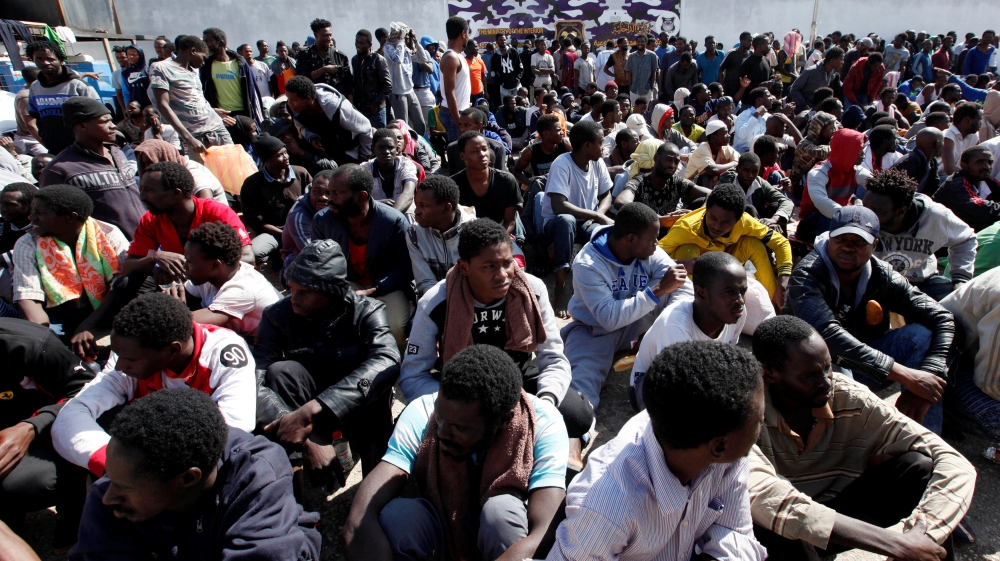
A slave market in Libya. Individuals are sold for as low as $400.
West African migrants are being bought and sold openly in modern-day slave markets in Libya, survivors have told a UN agency helping them return home.
Trafficked people passing through Libya have previously reported violence, extortion and slave labour. But the new testimony from the International Organization for Migration suggests that the trade in human beings has become so normalised that people are being traded in public.
“The latest reports of ‘slave markets’ for migrants can be added to a long list of outrages [in Libya],” said Mohammed Abdiker, IOM’s head of operation and emergencies. “The situation is dire. The more IOM engages inside Libya, the more we learn that it is a vale of tears for all too many migrants.”
The north African nation is a major exit point for refugees from Africa trying to take boats to Europe. But since the overthrow of autocratic leader Muammar Gaddafi, the vast, sparsely populated country has slid into violent chaos and migrants with little cash and usually no papers are particularly vulnerable.
One 34-year-old survivor from Senegal said he was taken to a dusty lot in the south Libyan city of Sabha after crossing the desert from Niger in a bus organised by people smugglers. The group had paid to be taken to the coast, where they planned to risk a boat trip to Europe, but their driver suddenly said middlemen had not passed on his fees and put his passengers up for sale.
“The men on the pick-up were brought to a square, or parking lot, where a kind of slave trade was happening. There were locals – he described them as Arabs – buying sub-Saharan migrants,” said Livia Manante, an IOM officer based in Niger who helps people wanting to return home.
She interviewed the survivor after he escaped from Libya earlier this month and said accounts of slave markets were confirmed by other migrants she spoke to in Niger and some who had been interviewed by colleagues in Europe.
“Several other migrants confirmed his story, independently describing kinds of slave markets as well as kinds of private prisons all over in Libya,” Manente said. “IOM Italy has confirmed that this story is similar to many stories reported by migrants and collected at landing points in southern Italy, including the slave market reports. This gives more evidence that the stories reported are true, as the stories of those who managed to cross-match those who are returning back to their countries.”
After his sale, the Senegalese migrant was taken to a makeshift prison of a kind that has been well documented in Libya. Those held inside are forced to work without pay, or on meagre rations, and their captors regularly call family at home demanding a ransom. His captors asked for 300,000 west African francs (about £380), then sold him on to a larger jail where the demand doubled without explanation.
Men who lingered there too long without the ransom being paid were taken away and killed, he said. Some wasted away on meagre rations in unsanitary conditions, dying of hunger and disease, but overall numbers never fell. “If the number of migrants goes down, because of death or someone is ransomed, the kidnappers just go to the market and buy one,” Manente said.
His terrified family began scraping together loans. As he spoke fluent English, French and some local languages, he translated for his jailers to win time for relatives to collect the money.
Many other migrants flee Libya with similar stories, said Giuseppe Loprete, chief of mission at IOM Niger. “Its very clear they see themselves as being treated as slaves,” he said.
Loprete’s office has arranged for the repatriation of 1,500 people in the first three months of this year – almost the same number as in the whole of 2015. He fears more horrors are likely to emerge.
“There are now more migrants coming back from Libya, so that’s also why all these stories are coming to the surface,” he said. “And conditions are worsening in Libya so I think we can also expect more in the coming months.”
Even growing international awareness of the problems migrants face is being exploited. IOM has had credible reports of criminals posing as aid groups that help migrants to lure in people who have escaped or bought their freedom and want to return home.
The organisation is working to spread awareness across west Africaof the horrors of the journey through the personal stories of those who return. Though most migrants know the boat trips to Europe are extremely risky, fewer realise they may face even worse dangers in Libya before even reaching the coast.
“Tragically, the most credible messengers are migrants returning home with IOM help,” said spokesman Leonard Doyle. “Too often they are broken, brutalised and have been abused. Their voices carry more weight than anyone else’s.”
Tanzania has emerged as the epicentre of Africa’s elephant poaching crisis after a government census revealed it had lost a “catastrophic” 60% of its elephants in just five years.
The results will pile pressure on a government that has been heavily criticised for its inability to stop a flood of poached ivory being stripped from its national parks.
Tanzania’s elephant population is one of the continent’s largest. But data, released on Monday by the Tanzanian government, showed that between 2009 and 2014 the number dropped from 109,051 to 43,330. When an annual birth rate of 5% is taken into account the number of dead is 85,181.
The country’s minister for natural resources and tourism Lazaro Nyalandu said the situation was “unimpressive”.
“It is evident that elephant population in Tanzania has reached unprecedented low level,” he said. Tanzania’s wildlife rangers may be trained as a paramilitary as part of a government action plan to combat poaching, which Nyalandu identified as the “probable reason” for the decline.
John Scanlon, the secretary general of Cites, the UN authority that oversees the trade in endangered species, said: “These figures reinforce our grave concerns about the scale of poaching of elephants in Tanzania for their ivory, and the smuggling routes through Dar es Salaam and neighbouring ports.”
Steven Broad, executive director of wildlife trade monitor Traffic, said: “It is incredible that poaching on such an industrial scale has not been identified and addressed before now.”
Traffic said the numbers were “catastrophic” but said they aligned with their observations of ivory flows from the country. Since 2009, at least 45 tonnes have reached the international black market from Tanzania, making it Africa’s largest source of poached ivory.
The losses were not uniform, and were at their worst in the Ruaha–Rungwa, Malagarasi-Muyovosi and Selous-Mikumi ecosystems which all lost more than two-thirds of their elephants. In these reserves the “carcass ratio”, a number used to assess the death rates within populations, indicated elephants were dying at four times the natural rate.
There were more than 34,000 elephants in Ruaha–Rungwa in 2009. This declined to around 20,000 in 2013 before a massive collapse to just 8,000 in 2014 . Nyalandu said the decline in Ruaha–Rungwa was “alarming”.
WWF’s global species programme director Carlos Drews said the disappearance of so many elephants from Ruaha–Rungwa could only be explained by the involvement of the international crime gangs who have industrialised the killing of Africa’s megafauna.
“The slaughter of thousands of elephants in Ruaha–Rungwa clearly points to the involvement of international organised crime, which is compounded by corruption and weak enforcement capacity in Tanzania – and to the urgent need to scale up efforts to tackle the poaching epidemic before the area’s remaining elephant herds are destroyed,” he said.
In the Selous reserve, which has previously been identified as a poaching hotspot, the numbers dropped from almost 45,000 to around 15,000. Last year Unesco added Selous to its World Heritage in Danger list.