Showing posts with label Israel as a colonial settler state. Show all posts

Saturday, May 15, 2021

3504. The Cuban Government Denounces US Support for the Israeli Crimes in Gaza

By Resumen, May 12, 2021
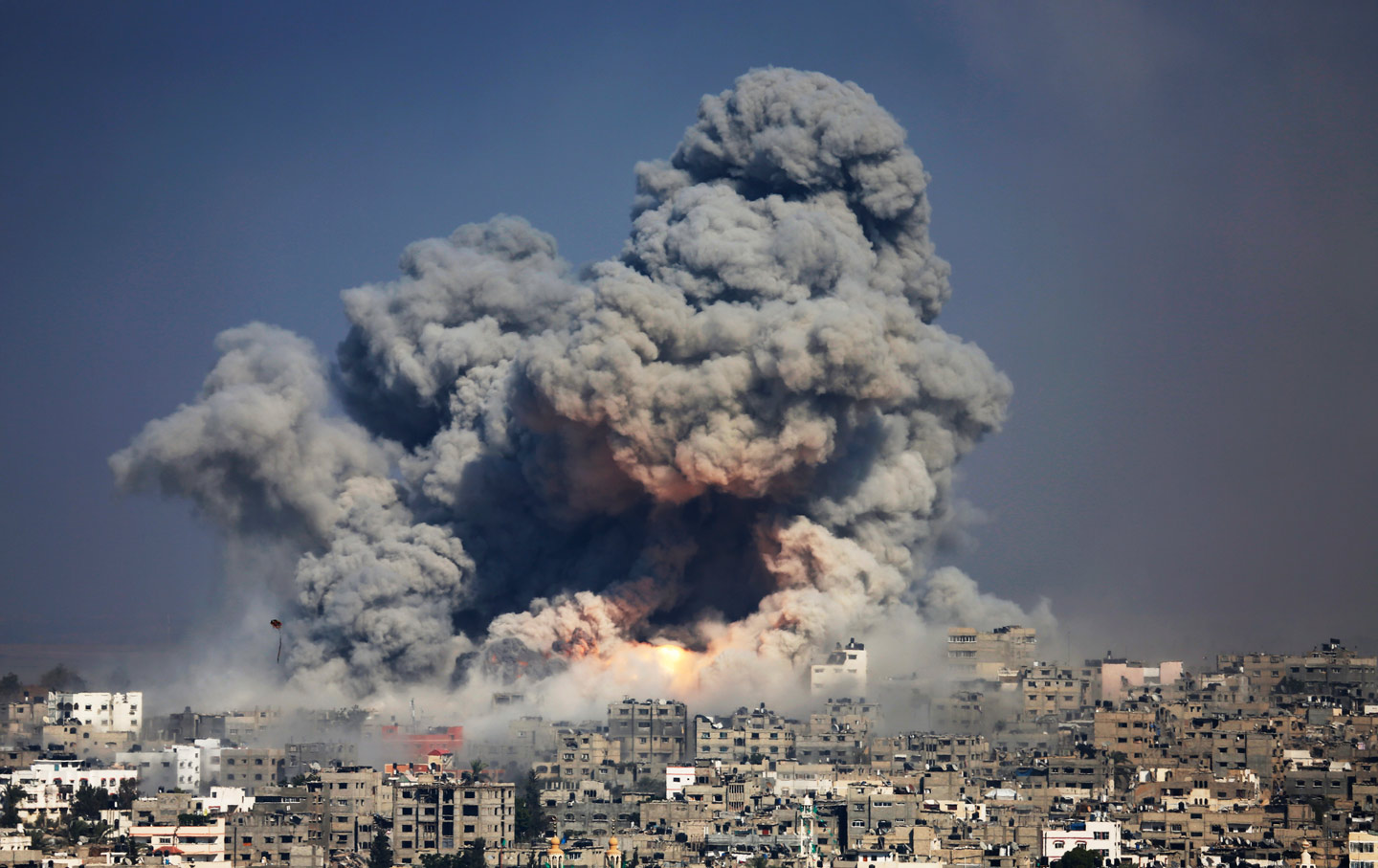

An Israeli strike over Gaza City. (AP Photo / Hatem Moussa)

Cuba has charged the United States with supporting the Israeli regime in their indiscriminate bombings of the Palestinian people. Yesterday Cuban Minister of Foreign Affairs Bruno issued Havana’s repudiation of the attacks carried out by the Israeli regime in the last two days, which have caused at least 48 deaths in Gaza, 14 of whom were children, according to the Gaza Ministry of Health.

“Cuba vigorously condemns the indiscriminate bombardments by Israel against the Palestinian population of Gaza,” Rodriguez wrote in his Twitter account.  The head of International Relations for Cuba also denounced the “consistent support of the United States for these crimes” perpetrated by the Zionist nation against the blockaded population of Gaza.

The Gaza Strip, a zone called by some as “the largest prison in the world” since its almost two million inhabitants are prevented from receiving food, fuel, and medical supplies by the Israeli blockade, was the target Tuesday of a fierce aerial bombardment directed against civilian structures, including homes.

In addition, in the occupied city of Al-Quds (Jerusalem) at least 500 Palestinians were wounded by the Israeli repression of the protests against the profanation of the Al-Aqsa Mosque, and the prohibition of Palestinian access to this site, one of the three most sacred Islamic sites.

In international forums, Cuba has always expressed repudiation of the Israeli aggression in Palestine and has denounced the role played by the US in the Israeli-Palestinian conflict. In this regard, Havana has rejected the so-called “Deal of the Century” crafted by the previous U.S. administration, and has warned that that the process of normalizing diplomatic relations with Israel constitutes a serious violation of the rights of the Palestinians.

This new wave of violence was provoked and fanned by the restrictions imposed by the Israeli regime on Palestinian access to the Al-Aqsa Mosque, located in the Trans-Jordan city of Al-Quds, and by the announcement of the expulsion of the Palestinian residents of the neighborhood of Sheikh Jarrah, to be replaced with Israeli colonizers.  However, the spark that has generated the cross-fire of rockets between Israel and the Palestinian Resistance was the Israeli repression against the Palestinians in Al-Quds on Monday.

The Palestinian resistance had been issuing warnings about the hostile acts of the Israelis against Palestinian civilians.  Nevertheless, the Israeli aggressions against Palestinians did not cease and they continued their attacks against the demonstrators in Al-Aqsa, in addition to carrying out air attacks against the Gaza Strip.  Among these attacks were the Israeli Air force bombings of Palestinian homes in Beit Hanun, in Gaza, on Monday, an attack that caused a number of deaths.  In addition to that, a night aerial bombing by the Tel Aviv regime on Tuesday caused the total destruction of a 13 story building in the Gaza Strip.  In retaliation, Hamas, the Palestinian Islamic Resistance Movement, as well as the Palestinian Islamic Jihad have launched hundreds of missiles against the occupied territories, including the heart of Tel Aviv.

Sunday, May 28, 2017

2618. On the So-Called Palestinian-Israeli Peace Accord

By Diana Buttu, The New York Times, May 26, 2017
Israeli soldiers detain wounded Palestinian protesters during clashes near the Jewish settlement of Bet El, which is located near the West Bank city of Ramallah. Mohammad Torokman/Reuters.

RAMALLAH, WEST BANK — President Trump’s meeting this week with the president of the Palestinian Authority, Mahmoud Abbas, was pitched as an effort by the author of “The Art of the Deal” to restart the United States-sponsored peace process, long stalled. But as next month’s 50th anniversary of the Israeli occupation approaches, this much is certain: The process is worse than stalled. In the face of an intransigent right-wing government in Israel, which doesn’t believe Palestinians should have full rights, negotiations are futile.

Many now question whether the Palestinian Authority plays any positive role or is simply a tool of control for Israel and the international community. The inescapable logic is that it’s time for the authority to go.

Established in 1994 under the Oslo Accords, the Palestinian Authority was intended to be a temporary body that would become a fully functioning government once statehood was granted, which was promised for 1999. The authority’s jurisdiction has, therefore, always been limited. It is in charge of a mere 18 percent of the West Bank (divided into eight areas). Compared with Israel’s overall control of the occupied West Bank and the Gaza Strip, the Palestinian Authority’s powers are paltry.

To many Palestinians, however, the establishment of their own government was a dream realized. Finally, those who had lived under occupation since 1967 would be free from repressive Israel’s military rule to govern themselves. Palestinians clamored to assume posts in the new body and took pride in establishing institutions despite the obstacles imposed by Israeli rule. As the negotiations dragged on under Oslo, these blocks became only more entrenched.

After more than two decades, the talks have produced no progress. I spent several years involved on the Palestinian side of the negotiations and can attest to their futility. 
Palestinian delegates, who needed permits to enter Israel to participate in talks, were routinely held up at Israeli checkpoints. When we spoke of international law and the illegality of settlements, Israeli negotiators laughed in our faces. Power is everything, they would say, and you have none.

As time went on, it became clear that the authority’s budget and its priorities were primarily geared toward ensuring that Palestinians remained one of the most surveilled and controlled people on earth. In effect, the Palestinian Authority served as a subcontractor for the occupying Israeli military. The overwhelming focus on security, we were told, was necessary for the duration of peace talks. Today, fully a third of the authority’s roughly $4 billion budget goes to policing, more than for health and education combined.

These security forces do not provide a normal police service to Palestinians, but instead, aid the Israeli Army in maintaining the occupation and Israel’s ever-expanding settlements. The internationally lauded “security cooperation” between Israel and the Palestinian Authority has resulted only in the arrest and imprisonment of Palestinians, including nonviolent human rights activists, while armed and violent Israeli settlers are allowed to terrorize Palestinians with impunity. The Palestinian Authority has no jurisdiction over the settlers, and the Israeli Army almost always looks the other way.

The raison d’ĂȘtre of the Palestinian Authority today is not to liberate Palestine; it is to keep Palestinians silent and quash dissent while Israel steals land, demolishes Palestinian homes, and builds and expands settlements. Instead of becoming a sovereign state, the Palestinian Authority has become a proto-police state, a virtual dictatorship, endorsed and funded by the international community.

Look at its leader. Eighty-two years old, Mr. Abbas has now controlled the authority for more than 12 years, ruling by presidential decree for most of that time, with no electoral mandate. He has presided over some of the worst days in Palestinian history, including the disastrous, decade-long split between his Fatah party and Hamas, the other major player in Palestinian politics, and three devastating Israeli military assaults on Gaza.

Under his presidency, the Palestinian Parliament has become moribund and irrelevant. Many Palestinians have never voted in presidential or parliamentary elections because Mr. Abbas has failed to hold them, even though they are called for in the Basic Law governing the Palestinian Authority. The latest opinion polls show that his popularity is at its lowest ever, with two-thirds of Palestinians so discontent that they want him to resign.

An equally high number no longer believe that negotiations will secure their freedom. The Palestinian Authority institutionalizes dependency on international donors, which tie the authority’s hands with political conditions. As a result, even using the International Criminal Court to hold Israel accountable for its illegal settlement-building has to be weighed against the likely financial repercussions of such a simple act.

To remove this noose that has been choking Palestinians, the authority must be replaced with the sort of community-based decision making that predated the body’s establishment. And we must reform our main political body, the Palestine Liberation Organization, which Mr. Abbas also heads, to make it more representative of the Palestinian people and their political parties, including Hamas. Hamas has long indicated that it wants to be part of the P.L.O., and its revised charter, recently released in Doha, Qatar, affirms this aspiration.

With the negotiation process dead, why should Palestinians be forced to cling to the Palestinian Authority, which has only undermined their decades-long struggle for justice and helped to divide them?

Given that there are about 150,000 employees who depend on the authority for their salaries, I am under no illusion that closing it down will be easy or painless. But this is the only route to restoring our dignity and independent Palestinian decision-making. A reformed P.L.O., with its credibility renewed, will be able to raise funds from Palestinians and friendly nations to support those living under the occupation, as it did before the Oslo process.

To some, this may sound like giving up on the national dream of self-rule. It is not. By dismantling the authority, Palestinians can once again confront Israel’s occupation in a strategic way, as opposed to Mr. Abbas’s merely symbolic bids for statehood. This means supporting the community-based initiatives that organize nonviolent mass protests and press for boycotts, divestment, and sanctions against Israel, like those that helped to end apartheid in South Africa.

This new strategy may mean calling for equal rights within a single state, an infinitely more just and attainable outcome than the American-backed process that pretended peace could come without addressing the rights of Palestinian refugees and the Palestinian citizens of Israel. Already, more than one-third of Palestinians in the occupied territories support a single-state solution, without any major political party advocating this policy.

By dismantling the Palestinian Authority and reforming the P.L.O., the real will of Palestinians will be heard. Whether the endgame is two states or one state, it is up to this generation of Palestinians to decide.

Diana Buttu is a lawyer and a former adviser to the negotiating team of the Palestine Liberation Organization.


Tuesday, January 13, 2015

1696. Why I Won't Serve Israel

By Moriel Rothman Zecher, The New York Times, January 11, 2015
Palestinian child brutalized by Israeli forces, Photo: Reuters

TEL AVIV — “WHAT are you,” he asked, “a leftist?”

We were both wearing the surplus United States Marines uniforms given to prisoners at Israeli Military Jail No. 6.

“It depends how you define ‘left,’ ” I said.

“Don’t get clever with me. Why are you here?”

“I didn’t want to be part of a system whose main task is the violent occupation of millions of people.”

“In other words: You love Arabs, and don’t care about Israeli security.”

“I think the occupation undermines all of our security, Palestinians’ and Israelis’.”

“You’re betraying your people,” he said.

“Why are you here?” I asked.

“Me? Desertion.”

There is a growing chasm between Israeli rhetoric and reality. In the discourse of Israel’s Knesset and media, the Israel Defense Forces represent a “people’s army.” Refusal to serve is portrayed by politicians and pundits — many of whom began their careers through service in elite units — as treacherous and marginal. This rhetoric becomes the common wisdom: A popular bumper stickers reads, “A real Israeli doesn’t dodge the draft.”

The outrage is disproportionate. Rarely do more than a few hundred Jewish Israelis publicly refuse to serve each year in protest against Israel’s occupation of the Palestinian territories. The shrill condemnation of refusers is thus an indication of the establishment’s panic.

Last year brought something of a surge in refusals. Open letters of refusal were published by a group of high schoolers, a group of reservists, veterans of the elite intelligence Unit 8200 and alumni and former staff members of the prestigious Israel Arts and Sciences Academy. All were denounced by politicians and in the media: In September, the Knesset’s opposition leader, the Labor member Isaac Herzog, blasted the letter from Unit 8200 as “insubordination.”

Aggression toward refusers is widespread. When I accompanied a refuser named Udi Segal to his draft station during the Gaza war this summer, we were met by a group draped in Israeli flags and chanting, “Udi, you’re a traitor! Go live in Gaza!” After signing the scholars’ letter, Raya Rotem, a former literature teacher whose husband was killed in the 1973 Yom Kippur War, received a threatening phone call. And a friend of 50 years severed ties with her.

The idea that the “real Israelis” serve and those who refuse are “traitors” is a false dichotomy. As Ms. Rotem told me, “Israeli patriotism today means resisting anything which frames the occupation as normal.” It’s also inaccurate: The reality is that a majority of Israeli citizens do not serve in the military, including Palestinian citizens of Israel, or the “fifth column,” as they are often branded, and the ultra-Orthodox, or “leeches,” as they’ve been called.

The largest group is the 1.7 million Palestinian citizens of Israel. Members of this community are not required by law to enlist, and only a tiny fraction volunteer (about 100 Christians and a few hundred Muslims in 2013). In 2014, the defense forces began sending “voluntary draft notices” to Christian Arab citizens, inciting Palestinian protests at Hebrew University and in Tel Aviv.


Even among the Druze, an Arabic-speaking minority whose male members have been drafted since 1956 and whose Arab and Palestinian identities are often played down or denied, dissent is rising. Omar Saad, a soft-spoken viola player, is the most prominent of a rising number of Druze refusers. He spent the first half of 2014 in and out of jail. In his letter of refusal, he wrote, “How can I bear arms against my brothers and people in Palestine?”

The next biggest group of nonserving Israelis are the Haredim, ultra-Orthodox Jews. Historically, they have been exempted from service as long as they were enrolled full-time in a yeshiva. Recently, though, a coalition formed in the Knesset over a proposal to draft the Haredim — which resulted in a 500,000-strong public demonstration. Most Haredim cite religious reasons for refusing, but the Haredi refusenik Uriel Ferera, recently released after six months in jail, gave the occupation as a primary factor in his decision.

There are also thousands of “gray refusers,” who find quieter ways to get out of the army, mostly by seeking mental health exemptions, known as a “Profile 21.” Like most public refusers in recent years, I was released after a month in military jail with a Profile 21.

Most of the prisoners with me in Military Jail No. 6 were Mizrahim (Jews of Middle Eastern origin), Ethiopians and Russians. Many of these members of Israel’s most marginalized Jewish communities told me of their intention to “get out on 21,” despite the risk this entailed for their future: Employment and educational opportunities often depend on completing military service.

In a recent interview, the Israeli author Amos Oz urged politicians to act as “traitors,” and make peace. But the type of traitors Mr. Oz wishes for — visionary ministers, peace-minded military men — are nonexistent. The most left-wing of Prime Minister Benjamin Netanyahu’s potential challengers in Israel’s coming election is the same Mr. Herzog who attacked the 8200 refusers.

Peace won’t come from the next Knesset, or the one after that. But some hope for a less violent, more decent future lies with the real traitors, the disregarded millions of Israeli citizens who have refused to serve in the army.

The reasons for not serving may differ between a Palestinian youth from Acre and a Haredi from Beit Shemesh, between an 8200 veteran and an Ethiopian immigrant, between me and the deserter in Military Jail No. 6, but there is a deeper consensus: We all refuse to see the government as a moral guide and military service as sacrosanct. As the Israeli government leads us further from peace, and the army faithfully executes its violent orders, this is the kind of treachery we need most.

Moriel Rothman-Zecher is working on a book about his experience refusing to serve in the Israel military.

Monday, December 22, 2014

1691. As US Media Awake to a ‘Nightmare’ Israel, NYT Brings Blumenthal in From the Cold

By Phillip Weiss, Mondoweiss, December 10, 2014
Fascist Lehava youth demonstrating in Israel

We’re in the midst of a sea change in the American mainstream’s treatment of the conflict. US media are beginning to reflect the awareness that the two-state solution is over and that violence around Jerusalem and the West Bank is caused by occupation and fostered by rightwing intolerance inside Israeli political culture– the “nightmare” of greater Israel. There are countless examples of the shift. Last night on MSNBC Richard Engel said many people are angry at the US because of torture and drones, but also “because of Israel/Palestine, and Gaza.”  When Israeli finance minister Naftali Bennett was confronted by Khaled Elgindy at the Brookings Institution last Saturday to explain why Palestinians are “the only group of humans in the world that do not have the right to self-determination,” the Beltway audience was evidently on Elgindy’s side. Leon (AIPAC) Wieseltier is gone from the New Republic. The New York Times is publishing Max Blumenthal. And the New Yorker‘s David Remnick is staying in East Jerusalem.

A roundup:

The New York Times published two anti-Zionists in a forum on the Israeli government’s turn to the right. After more than a year of ignoring his book about tyranny and intolerance in Israel, Goliath, The Times gave Max Blumenthal a platform to explain that Israel has always been rightwing.

Over 60 years before [anti-Arab group] Lehava’s segregationist crusades, there was the socialist Zionist “Conquest of Labor” that organized Jews-only work collectives and boycotted businesses that employed Palestinians. Before the settlements, there was the kibbutz movement whose admissions committees denied residency to anyone but Jews. Before the wave of vigilante “price tag” attacks on Palestinians, there was the Nakba that expelled some 750,000 Palestinians in order to establish Israel’s Jewish majority. And as Marzel mentioned, there is the Jewish National Fund, a para-governmental group founded by Theodore Herzl to provide land exclusively to Jews which recently oversaw a program that would have led to mass expulsion of Bedouin called the Prawer Plan.

If a shift is underway in Israeli politics, it is primarily tonal. Israel’s rightists intend to carry on the Zionist project as originally conceived, but without the pretense of democracy. In a way, their honesty is refreshing.

Blumenthal’s non-marginalization is a crushing blow to Zionists. Liel Leibovitz,who wrote a book saying we are the chosen people, labels Blumenthal an anti-Semite and says that the Times should apologize for the publication. Tablet is marginalizing itself with this kind of smear, as well as draining even more meaning from the term, anti-Semitism.

That Times forum also features Diana Buttu bringing news to Americans: Palestinians have always seen Zionism as a colonial movement that forces them off their land; the continuation of these policies will only produce violent reprisals; and the US is supporting Israel against its own interest.

Whoever wins these elections and whatever the composition of the next government, the same situation will prevail for Palestinians.We will continue to live under inequality or under foreign military rule in our homeland. Israel will continue to steal our land, demolish our homes, strip us of our rights and demand our loyalty and subservience to a system and society that seek to oust us.

Israel’s perpetual rightward shift reflects the hubris of America’s spoiled child. Every elected American official pampers and lavishes support for Israel, even as Israel’s actions defy U.S. interests and presidential statements. The world’s unwillingness to halt Israel’s illegal behavior, cements a mindset that illegality is permissible.

It is nonsensical that Palestinians, occupied and stateless, must negotiate their freedom with their occupier and oppressor. It is the role of the international community to make known that it will not tolerate colonialism in the 21st century.

As the New Republic fallout demonstrates, anti-Arab racism is at last becoming problematic in the U.S. mainstream. Six weeks ago the Times ran Rula Jebreal’s op-ed saying that Israel needs a civil rights movement to end a “pervasive institutionalized system of discrimination.” While Foreign Policy readers lately learned of Israel’s Jim Crow conditions from Sayed Kashua in “The Country That Never Wanted Me,” citing facts you used to only hear at Palestinian solidarity events:

 “[N]ot a single Arab town has been established since the State of Israel was founded — in contrast with some 700 Jewish settlements.”

New Yorker editor David Remnick shapes opinion among the elites, and maybe most important in this roundup was his piece last month reporting that Israeli claims to the West Bank have established a “one-state reality” and Israeli political culture is getting scarier by the minute. While few elements of that piece would surprise readers of this site (Naomi Klein talked about the one-state reality long ago), the mood was surprising: Remnick seems to want a trial separation from Zionism, noting pointedly that he was staying in the American Colony hotel in East Jerusalem. He quoted Meron Benvenisti explaining that 1967 was merely a continuation of 1948, and name-checked Ali Abunimah (without interviewing him).

Even better at conveying the “nightmare” was Henry Siegman at Huffpo, “Will Greater Israel Transform Into Greater Palestine?” filled with bleak realist pronouncements about Israel’s future. Israel is losing contact with world opinion and the enlightened are leaving the place (just watch Naftali Bennett’s manic performance at Brookings, dismissing “a little thing called the rest of the world”). Seigman sketches an Algeria-like scenario of decolonization in which political violence plays an important role. Just as political violence played a role in creating Israel.

If the slaughter in the Jerusalem synagogue will make the Palestinian dream of statehood an even more unreachable dream, it will also turn Israel’s illusion of the sustainability of the occupation into a nightmare. For the more hopeless the expectation of Palestinian moderates that non-violent means can bring about the promised and repeatedly denied two-state solution, the more Palestinians will believe that violence is the only way to change Israel’s cost-benefit calculations for its theft of Palestinian territory in the West Bank and in East Jerusalem.

Palestinian violence against non-combatants discredits the Palestinian national cause. But who is to say it may not work for the Palestinians as well as it worked for the Jews in their War of Independence, for it achieved Ben Gurion’s goal of triggering the flight of over 700,000 Palestinians. Palestinian violence may similarly serve to drive many of Israel’s most creative and productive elements to abandon the Jewish state and renew their lives in the Diaspora, a reaction that is already discernible.

Jay Michaelson at the Forward is also bleakly realistic. He confesses that Israeli racism and Sheldon Adelson’s political crudeness have caused him to become “binational-curious.”

Like everyone else in the peace camp, I am dejected by the current state of affairs and pessimistic about the future. I’m exhausted by Israel’s unethical behavior, by renewed (and condoned) Palestinian terrorism and by vulgar, bloviating billionaires dictating policy by checkbook. I am ready to stray from my two-state views, and I am open to all other realistic options.

Unfortunately, there aren’t any.

So Michaelson finds himself shifting. So does Princeton student Maya Wahrman, writing in Haaretz, “Despair is driving me towards BDS.” Wahrman has long condemned boycott of Israel, but if BDS can change Israel’s political climate, she must support BDS.

Some people fear BDS because they think it will be harmful to Israel. I answer that most of Israel’s current policies regarding Palestinians harm Israel because they harm humanity. If we fear anti-Semitism, let us be just, and our strong allies will support us. I suspect that others fear BDS because they are afraid it might actually work. Which makes it all the more promising….

[D]o not immediately disqualify [BDS] because it is harsh on Israel. Nor should you immediately support it without considering the wide-reaching and serious consequences.

I have by no means run the full gamut of important considerations. I do not know if BDS is the answer. But if commercial sanctions effectively pressure the Israeli government and show them that the injustice must end, potentially leading to commitment to a peaceful resolution, then who am I to stand in the way?

All this talk is getting some pushback. I mentioned Liel Leibovitz’s smear on Blumenthal. Even the Times ran Caroline Glick and Jonathan Schanzer in its forum with Blumenthal and Buttu. Even more regrettably, the Atlantic asked Matti Friedman to rehash/expand his argument in Tablet of last August that Israel is a “tiny village” situated on a volcano of Islamic hatred. Friedman says that foreign correspondents hanging out at the American Colony hotel have fashioned/imbibed “the ‘Israel story,’ which is a story of Jewish moral failure”–

Mingling occurs at places like the lovely Oriental courtyard of the American Colony hotel in East Jerusalem, or at parties held at the British Consulate’s rooftop pool. The dominant characteristic of nearly all of these people is their transience. They arrive from somewhere, spend a while living in a peculiar subculture of expatriates, and then move on.

Isn’t that orientalism? Remnick left it at: “a beautiful old hotel in East Jerusalem.”
Wahrman, Remnick, Michaelson, and Siegman all seem to fear the future, how far this could all go, and suggestions that Jews must decolonize. This is the biggest argument for BDS; it respects the human rights of everyone in the country; Those fears are also the greatest argument for democracy I can think of. How many liberal American Zionists would wash their hands of the ideology entirely if they could only be assured that there could be a nonviolent resolution of Israel’s predicament. A lot, I’m sure. (There is one way to marginalize rightwing racists; and that is to grant everyone who is governed by Israel the right to vote for the government of the land. The UK losing Scotland would have swung hard right. The Congress, if Jim Crow were in place, would be absent many progressive urban representatives. Advocates of the two state solution say that the great Palestinian middle and the great Israeli middle just want peace. Well, let them work together, in political combination. Right now Israeli national political candidates have to appeal to religious zealots. Imagine if they had to campaign to Palestinians.)


- See more at: http://mondoweiss.net/2014/12/nightmare-brings-blumenthal#sthash.vaGpJq1f.dpuf