By Olga Fernandez Rio, CubaDebate, November 7, 2017
Lenin with Leon Trotsky as the leader of the Red Army at his side at the second anniversary of the Russian October revolution
The October Revolution of 1917 in Russia has a lot to do with the current search for a better world to which millions of human beings aspire for having provoked a far-reaching revolutionary transformation, beyond the Russian - later Soviet - borders, and for being the first experience of disconnection from capitalist and imperialist domination.
The merits of this important event are multiplied if we take into account the economic conditions of Russia at the beginning of the 20th century, an immense semi-feudal country, with millions of illiterate people and only a few pockets of industrial development. Added to this is that when he overthrew the reactionary tsarist monarchy and embarked on revolutionary change, he had to face the economic and military aggression of practically all the capitalist powers of the time.
In those difficult conditions, the revolution caused a colossal socioeconomic, political and cultural transformation in favor of the interests of the dispossessed majorities and excluded from wealth and rights.
It was an experience of search and discovery of a cultural and civilizational change and, as many recognize, it was a hurricane of hope, not only for Russia and for the Soviet republics that were later formed, but for the workers of the world determined to achieve a better distribution of wealth and the cessation of exploitation, along with the dignity of work.
The Great October Socialist Revolution revolutionized the world, motivated the implementation of organizational formulas to confront capital and like a wave, communist parties, unions, worker and peasant movements, along with women's organizations in defense of their rights, multiplied. time the confrontation with colonialism and neocolonialism grew.
That revolution infused with new vigor the popular struggle on our continent, brewing since the end of the 19th century when North American imperialism - as José Martí had foresaw - expanded with interventionist boots and usurpers of natural wealth. In this context, the working class grew in some countries with greater industrial development under the influence of revolutionary ideas, Marxist in many cases, anarchist in others, brought by European immigrants who arrived in Latin America and the Caribbean. They were revolutionary ideas and actions that multiplied after 1917.
The revolution of 1917 in Russia had a lot to do with the social conquests obtained by broad popular masses throughout the 20th century and with the patriotic and internationalist capacities developed in the people of the Soviet republics who, together with the Red Army, were decisive. in the confrontation and defeat of fascism. It also had a lot to do with the reasons that led the USSR to become the second world power, to become a balancing factor that made possible better conditions for the achievement of independence of many colonial countries. That immense country was the one that sent the first man, the first woman and the first Latin American to space, which is not simple symbolism, but a sign of scientific and technological development in favor of peace.
Capitalism itself could not avoid the impacts of the revolution and was forced to adapt to a new context in which a strong rival appeared that later led to bipolarity. The reformist theses and actions in favor of the so-called “Welfare State” in the formations of European capitalism was one of those impacts, as was the policy of the so-called New Deal (1933-1938) adopted by the President of the United States Franklin Delano Roosevelt. .
It was a genuine revolution with incalculable historical and political value, which cannot be underestimated due to the deviations that at some point distanced leaders and sectors of Soviet society from the conceptual and political bases of the revolution and from the honest Marxist roots of the ideals and actions of Vladimir I. Lenin and other leaders of that feat.
It is not on this occasion that we are going to judge the distortions about the socialist ideal, nor the perversion of democratic practices that later permeated the USSR, nor will we stop with points of view about the dismantling of the construction of socialism that led to the collapse of a society that rose with notable successes as an alternative to capitalism. But much less are we going to detract from what the October Revolution and the existence of the USSR and the European socialist camp meant for the underdeveloped world and for the advancement of the Cuban Revolution.
The truth is that what happened was an extraordinary experience whose achievements and errors require deepening and analysis. The first as a sample of what is possible for the people to achieve in favor of their interests, and the second to reflect on endogenous factors in a process of socialist transition that can lead to its dismantling, even in a very short time, if not They adequately resolve the contradictions inherent to that type of process.
These are topics that must be explored in depth along with questions about conceptual, socioeconomic and political approaches that were established in the USSR on very sensitive problems, especially for the people.
This is the case of the correlation between development and economic growth without the deployment of an individual and social consciousness permeated by socialist and communist values; the distancing of party, state and government structures from the masses and the State from civil society, along with the undervaluation of the subjective factor in a revolutionary process and its role in the necessary renewal of socialist hegemony. Also the social impact of distortions in the field of culture, dogmatism, bureaucratism and corruption deserve serious reflection if we take into account the warnings raised by Lenin before the triumph of the revolution, but especially between 1918 and 1923.
Of many works, notes and reflections presented during a little more than the first five years of the revolution in power, we highlight his analyzes in "The immediate tasks of Soviet power" and Will the Bolsheviks remain in power? where he delved into the complexities associated with the task of governing while representing the interests of workers and peasants. We also highlight the projections on issues of party organization and politics presented in his letter of December 1922 to the party congress, which for many constitutes his political testament with clear references to the important role of workers and peasants, of the popular masses, in a process towards socialism.
The truth is that what led to the collapse of the USSR cannot be attributed to Lenin or Marxism, nor can it be used to disqualify the historical and political value of the Bolshevik Revolution of 2017, an event that is highly topical beyond the celebration of its centenary. It is not about wrapping ourselves in nostalgia, but about analyzing in a balanced way the historical facts, the achievements, the errors, the contradictions that existed, but also the inconsistency of myths and traps that have arisen, especially since 1989, with a view to "substantiating" the supposed unviability of socialism and the inevitability of capitalism, which constitutes an unacceptable historical fatalism.
But above all, the analysis of the October Revolution demonstrates that the lessons of history are an inalienable legacy that nourishes the anti-capitalist and anti-imperialist movement today, they are resources that fuel the actions to face the present and project the future of those who aspire. to a better world. They are lessons for the deployment of socialist transition processes that will always be developed with many unprecedented conditions because no two countries are the same, but at the same time they require compasses that allow directing the course towards a strategy of socialist order. Therefore, it not only contributes to the evaluation of the past, but also to the projection of the present and future of humanity.
Sadly, I just learned that Paul Burkett died last Sunday from complications of acute myeloid leukemia. I came to know Paul as a fellow Union of Radical Political Economics (URPE) member in the late 1980s and if I remember correctly, he was twice co-participating in the same URPE panel discussion at the American Economic Association annual conferences. Like me, Paul was interested in late capitalist development, which was the theme of his earlier presentation. He collaborated with Martin Hart-Landsberg of Lewis and Clark (Development, Crisis, and Class Struggle 2000). But by the early 1990s, he began researching capitalism and nature, leading to his excellent book Marx and Nature: A Red and Green Perspective (1999). In that book, Paul gave a reading of Marx that illuminates his views on aspects of the problem of society and nature, or what he and John Bellamy Foster later called Marx's ecological insight.
The last time I saw Paul was in Havana, Cuba, in May 2003 during The Works of Karl Marx and the Challenges of the 21st Century conference, the first of such conferences organized by the Philosophy Institute of Cuba. That conference attracted leftists from the Americas, Europe, and elsewhere and took place in a tense political moment. In March, George W. Bush invaded Iraq under false claims and overthrew Saddam Hussein's regime. Already, Bush's administration was threatening to invade Cuba. On April 2, six men using arms hijacked a ferry in Havana Bay and ordered the captain to sail to the United States. The Cuban government captured and tried those involved, and three ring leaders, Lorenzo Enrique Copello Castillo, Barbaro Leodan Sevilla Garcia, and Jorge Luis Martinez Isaac, were sentenced to death for endangering lives and threatening the security of the country and were executed.
Some of the participants in the conference created a petition to the Cuban government that condemned the execution of these men and demanded that Cuba end capital punishment on the books since the triumph of the revolution in 1959. Paul and I disagreed on signing the petition. He did, and I did not. I did not, not because I am not against capital punishment; I am. But at the same time, if a revolution faces imperialist invasion and some armed individuals threaten the safety of some citizens and provide a pretext for imperialist invasion, they must be held accountable and dealt with according to the law. In this situation, I would not second guess the government of Cuba at such a critical time. Soon after the petition had circulated, one late afternoon before dinner time, Fidel Castro unexpectedly arrived in the lobby of our hotel. He held a conversation with some of the conference participants. I do not know if Paul attended that meeting; I was already gone for another meeting elsewhere. But Fidel discussed the situation and presented the reason for the executions to those present.
While I respected his views, I disagreed with Paul's uncritical support for Bernie Sanders. However, he was not alone among socialists and ecosocialists in such illusions. I left System Change, not Climate Change, a network of ecosocialists in part because its key leaders uncritically supported Alexandria Ocasio-Cortez after she was elected and promoted herself as the champion of the vague idea she called Green New Deal to combat climate change from the halls of U.S. Congress.
Paul was several years ahead of me in recognizing and embracing ecosocialism. I considered myself an ecosocialist starting in 2000, and Paul's book, among others, was part of my coming up to speed about the theories of ecosocialism. I differed with Paul in his rereading of Marx in that while he was a pioneer in finding valuable aspects of Marx's interest in nature, he, Foster, or Saito, who claimed Marx was an ecosocialist, never tried to ask how these insights relate to historical materialism and his labor theory of value which quite consciously set aside nature to focus only on society (see, Nayeri, 2003). I tried to engage Paul in discussing these issues, but he was dismissive. I know now that this lack of interest in such discussion was at least in part due to his critical illness, which he did not disclose to me.
Like Paul, I love jazz and wanted to learn to play saxophone. After the death of his beloved son, Paul picked up the saxophone, learned to play it well, and even composed short pieces he shared with me. However, I noticed there was always something dark in his music, which I attributed to the continued grieving of the loss of his son. Perhaps his failing health was also responsible.
Paul was a creative and passionate human being and contributed significantly to our understanding of Marx's evolving view of society and nature. I will miss him.
TERRE HAUTE - Dr. Paul Burkett, 67, of Terre Haute, IN, died from sudden complications of acute myeloid leukemia on January 7, 2024. He died at home, lovingly attended by his wife Suzanne and son Shaun.
Paul was born in Wyandotte, MI in 1956 to William Loyd Burkett and Dorothy Whalen Burkett. Paul attended Wyandotte Roosevelt High School, Kalamazoo College, and received his PhD in Economics at Syracuse University. His teaching career began at Syracuse and took him to Auburn Correctional Facility in New York, the University of Miami, and Indiana State University, from which he retired in June of 2020.
Paul was preceded in death by his parents, his twin brother Patrick J. Burkett, and his youngest son Patrick M. Burkett. He is survived by his wife of 38 years, Suzanne (Zann) Carter; sons Ian (Lisa) Hussey and Shaun Hussey; daughter Molly Burkett; granddaughters Sophia Hussey and Raven Renn, and his brothers Philip (DeAnn) Burkett, Charles Burkett, and Richard (Karen) Burkett; as well as many loving nephews and nieces.
An intellectual and scholar, Paul published many books, journal articles, notes, reviews, and book chapters in his field. He felt his most important books are Marx and Nature: A Red And Green Perspective (1999) and Marxism and Ecological Economics (2006). He was passionate about his work, Socialism, the planet, and justice.
And Jazz! He began playing the saxophone when his son Patrick died, as a way to cope with deep grief, and proceeded to bring to his study of the instrument, of jazz, and of music in general, the same focus and fierce dedication he brought to his academic work. Calling himself PapaPatty in honor of Patrick, he played in many venues all around the area for almost two decades. He asked only for a simple memorial gathering in late spring so that's what we'll do. Any donations in his honor can be made to Doctors Without Borders. www.debaunfuneralhomes.com
Almost 90,000 Palestinians, four percent of the total population of Gaza, died, were injured or are missing after three months of Israeli aggression against the territory, the Euro-Mediterranean Human Rights Monitor reported on January 6.
The non-governmental organization denounced in a statement that the Army's continuous air, land and sea attacks destroyed 70 percent of the civil facilities and infrastructure in the enclave.
The approach of the Israeli bombings seems to be aimed at carrying out collective punishment against the population and turning the area into an uninhabitable place, he stressed.
Gaza authorities estimate that since October 7, 22,600 Palestinians have died there and another 58,000 have been injured as a result of military operations by the Armed Forces of the neighboring nation.
The Observatory pointed out that the majority of Gazans were displaced from their homes by the bombs and detailed that during the ongoing war campaign, almost 68,000 homes were destroyed and another 179,000 were damaged.
Israel deliberately destroyed or caused serious damage to essential facilities, including 318 schools, 1,612 industrial centers, 23 hospitals, 57 clinics, 201 mosques and three churches, as well as 169 press and media offices, he stressed.
That country's troops deliberately target Palestinian civilians in order to force them to emigrate, in violation of the norms of international law, he noted.
The entity stated that these actions amount to crimes against humanity and war crimes, including genocide.
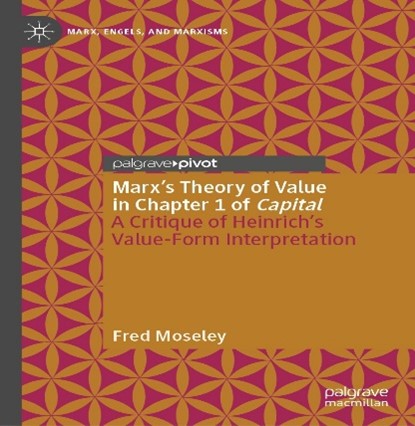
Moseley’s book is an examination of Marx’s theory of value in Chapter 1 of Capital, almost paragraph by paragraph in Sections 1 and 2, and a detailed critique of Heinrich’s value-form interpretation of Chapter 1, as presented in his 2021 book How to Read Marx’s Capital, which is a translation of his 2018 book Wie das Marxsche Kapital Lesen?
Heinrich is a well-known German Marxist who has published widely on his value-form interpretation of Marx’s theory of value, and his work is influential not only in Germany, but also in the UK and other countries in Europe and around the world. He criticises the traditional interpretation of the labour theory of value, according to which the value of commodities is determined solely in production, and he argues that value is created only when it is converted into money through the sale of commodities on the market.
Moseley is one of the foremost scholars in the world today on Marxian economic theory. He has written or edited many books on Marxist theory. He reckons instead that Marx presented a labour theory of value according to which the value of commodities is determined solely in production by the socially necessary labor time required to produce the commodities. And Moseley argues in his book that the textual evidence in Chapter 1 overwhelmingly supports the labour theory of value interpretation of Marx’s theory of value.
The relevance and importance of this debate may seem obscure to many readers of Marx. So Fred Moseley kindly agreed to be interviewed on his new book and the controversy with Heinrich.
MR: How did this book come about?
FM: ”First of all, I want to thank you for the opportunity to discuss my book with you and your many readers.
Heinrich’s book cited above is a detailed textual study of the first seven chapters of Capital. Heinrich is not very well known in the US, but he is very influential in Germany and other European countries. He is something like a David Harvey of Europe. But I am convinced that Heinrich’s book is a fundamental misinterpretation of Marx’s theory, so I decided to engage critically with Heinrich’s book.
I started by writing a paper on Chapter 1, the foundation of Marx’s theory and Heinrich’s interpretation. I presented this paper in a Zoom conference in June 2021 sponsored by Gyeongsang National University in South Korea. An assistant editor of Palgrave’s Marx, Engels and Marxism series, Paula Rauhala, watched the my presentation and she contacted me and suggested that I write a longer version of my paper as a Palgrave Pivot book. A Pivot book is a new initiative by Palgrave of short books, with a limit of 50,000 words (which I exceeded by 10,000 words!). I am grateful to Paula for that suggestion and this little book is the result.”
MR: Please give us an overview of your book
FM: “My little book is a detailed textual study of Marx’s Chapter 1 and Heinrich’s interpretation of Chapter 1. The book consists of only 4 chapters.
Chapter 1 of this book presents my interpretation of Marx’s theory of value in Chapter 1 of Capital, including a section on each of the four sections of Marx’s Chapter 1. Chapter 2 presents Heinrich’s interpretation of Chapter 1 of Capital and my detailed critique of Heinrich’s interpretation 1, with the same four sections.
Chapter 3 is about a 55-page manuscript that Marx wrote in 1872 in preparation for the 2nd German Edition of Volume 1, which is mainly about Section 3 of Chapter 1, entitled ‘Additions and Changes to the First Volume of Capital’, which Heinrich has emphasised in his book and in previous works to provide textual support for his ‘value-form interpretation’ of Chapter 1. This important manuscript has not yet been translated into English. A translation of a 4-page excerpt of this manuscript is included in Heinrich’s book as an appendix. So Chapter 3 of my book presents my interpretation of this manuscript and a critique of Heinrich’s interpretation. A translation of this entire manuscript should be a high priority of Marxian scholarship.
My book is very abstract theory, about the most abstract part of Marx’s theory, the beginning of Marx’s theory in which he presents the foundation of his labour theory of value. Marx said in the Preface to the 1st edition of Volume 1 of Capital that “beginnings are always difficult in all sciences”, and that is certainly true of Marx’s theory. The best way to read my book is to have Heinrich’s book and Volume 1 of Capital close at hand.”
MR: How would you summarise the main conclusions of your book?
FM: “The main conclusions of my book are the following:
1. The subject of analysis of Chapter 1 is the commodity, not a separate, isolated commodity, but a representative commodity, a commodity that represents all commodities and the properties that all commodities have in common (use-value and exchange-value). In the Preface to the 1st edition, Marx described the commodity as the “elementary form” or the “cell form” of capitalist production. So Marx analyses the properties of a representative commodity similar to the way cellular biology analyses the properties of a representative cell. It’s like putting a commodity under a microscope and analysing its main properties.
Marx’s representative commodity in Chapter 1 is assumed to have been produced, but not yet exchanged. This is crucial for the critique of Heinrich’s interpretation. According to Heinrich, the subject of analysis of Chapter 1 is not the properties of a representative commodity, but instead is what he calls an “exchange relation” between two commodities, which he argues is the end result of two actual exchanges between the two commodities and money on the market.
2. The value of commodities is derived in Section 1 of Chapter 1 from the property of the exchange-value of the representative commodity (i.e. from the property that each commodity is equal to all other commodities in definite proportions). And this general relation of equality between each commodity and all commodities requires a common property that is possessed by all commodities and that determines the proportions in which different commodities are equal.
Marx argued that this common property of all commodities that determines their exchange-values is the objectified abstract human labour contained in commodities. And this is the result of the abstract human labour expended in production to produce the commodities.
According to Heinrich, on the other hand, the value of commodities is not derived from a relation of equality between all commodities, but instead is derived from an analysis of an “exchange relation” between two commodities, which he argues presupposes actual exchanges of the two commodities with money on the market.
3. The magnitude of the value of each commodity is “exclusively determined” (p. 129) by the quantity of socially necessary labour-time expended in production to produce each commodity. Heinrich argues, on the other hand, that the magnitude of value of a commodity depends in part on the relation between supply and demand for the commodity on the market. This is the best-known assumption of the value-form interpretation of Marx’s theory of value.
4. The labour that produces commodities has a dual character in production: both concrete labour and abstract labour are characteristics of the same labour process in production. Section 2 of Chapter 1 in particular presents very strong textual evidence to support this interpretation of the dual character in production of labour that produces commodities.
Weaving and tailoring are Marx’s two examples in Section 2. The labour process of weaving produces the use-value of linen, its dual character also being abstract human labour that produces the value of the linen. The same dual character is true of the labour process of tailoring (and all other particular labour activities). The values of the linen and the coat are compared by comparing the labour-time required to produce each one of them and nothing is said in this about exchange in this section.
Heinrich argues, on the other hand, that labour in production is only concrete labour and is not yet abstract labour. Abstract labour comes to exist only in exchange, and thus the dual character of the labour that produces commodities comes to exist only in exchange. According to Heinrich’s interpretation, tailoring and weaving (and any other labour process) possess only a single character in production, not a dual character. This interpretation is clearly contradicted by Section 2.”
MR: Please say more about Heinrich’s interpretation of “exchange relation”. That seems to be a central concept in Heinrich’s interpretation.
FM: “Heinrich’s concept of “exchange relation” is completely original with him. No one else puts so much emphasis on this term and defines it the way he does. And it is a new concept in his interpretation; it was not included in his 2012 book Introduction to Marx’s Capital. And unfortunately, he does not explain this very well in this book, especially for such a fundamental concept. There is nothing in his Introduction about this concept; there are only 1½ pages in an appendix in the back of the book on the abstractions that result in this concept (which he doesn’t refer to once in the rest of the book) and 1½ pages in his first discussion of this concept on pp. 53-54. And from then on, he just presumes his interpretation of exchange relation and applies it to different passages in Marx’s text.
I am pretty sure that most readers of Marx (especially beginning readers) will not understand the meaning and significance of Heinrich’s concept of exchange relation in his interpretation. A young Marx scholar from Australia wrote a 2000-word review of Heinrich’s book for Marx and Philosophy and she didn’t mention the concept of exchange relation at all. I myself had to work pretty hard to understand it because it is so poorly presented.
Heinrich defines exchange relation as an exchange between two commodities. To take one of his examples that is borrowed from Marx:
1 quarter of wheat is exchanged for x boot-polish.
Heinrich comments that this definition seems like direct barter exchange between the two commodities, but he states that this is not so, because direct barter seldom actually happens in capitalism. Instead, Heinrich interprets the exchange relation between two commodities as the end result of two actual acts of exchange between the two commodities and money on the market. Thus…
1 qtr. of wheat is sold for 10 shillings and 10 shillings is used to purchase x book-polish
The important point is that Heinrich’s concept of exchange relation between two commodities presupposes actual exchanges between these two commodities and money on the market.Heinrich does not clearly specify whether these acts of exchange that are presupposed in his interpretation of the exchange relation are assumed to be actual acts of exchange on the market. However, theymust be actual acts of exchange in order to be consistent with Heinrich’s general value-form interpretation, according to which commodities possess value only if they have been actually exchanged on the market.
Before actual exchange, according the Heinrich’s interpretation, commodities do not possess value (indeed, products are not even commodities) before exchange. Products of labour become commodities and commodities come to possess value only as a result of actual exchanges on the market. Therefore, since the commodities that Marx analyses in Section 1 (e.g. wheat and boot-polish) are assumed to possess value, in order to be consistent with Heinrich’s general value-form interpretation, he must also assume that these commodities have been actually sold and bought on the market. If the commodities have not been actually exchanged on the market, then these commodities would not possess value, according to Heinrich’s general value-form interpretation.
However, there is absolutelyno textual evidence in any of Marx’s several drafts of Chapter 1 to support Heinrich’s idiosyncratic interpretation of the exchange relation between two commodities – that it presupposes actual acts of exchange between these two commodities and money on the market. This interpretation is Heinrich’s invention. He does not cite any other authors with a similar interpretation of exchange relation, because there are none. And the exchange relation is the most important concept in Heinrich’s interpretation of Chapter 1. If his fundamental concept of exchange relation is a misinterpretation of Marx’s theory, then the rest of Heinrich’s interpretation of Chapter 1 is a misinterpretation and is unacceptable.
I think it is clear that the subject of analysis of Chapter 1 is thecommodity, a representative commodity that is used to analyse the properties that all commodities have in common – use-value and value. Chapter 1 is not about exchange at all. The commodity that is analysed in Chapter 1 has been produced, but not yet exchanged. Exchange is not considered until Chapter 2 (“The Process of Exchange”).
In recent weeks, while preparing for the HM conference and for this interview, I have come to realise more clearly that there is a fundamental contradiction in what Heinrich is trying to accomplish in his recent book. In his previous works, he has presented (many times and all over the world) a strong value-form interpretation of Marx’s theory of value, according to which the value of a commodity exists only as a result of an actual exchange on the market. Before exchange, a commodity does not possess value (it only possesses use-value). For the textual evidence to support this interpretation, he has used a handful of key passages that are taken from various texts in isolation and out of context. As we know, one can always find passages that seem to support almost any interpretation of Marx’s theory. And Heinrich is very good at this quotation game.
However, his most recent book is different; it is an attempt to interpret the first seven chapters of Volume 1, especially Chapter 1, as a value-form theory – and that Marx was the original value-theorist! Heinrich goes from page to page in Chapter 1 and consistently tries to interpret key passages in a value-form way. This is a very difficult task because there are so many passages in these chapters, especially Chapter 1, that contradict a value-form interpretation. Indeed, in my view, Heinrich’s task is an impossible task. My book follows his detailed commentaries point by point and exposes the errors in his value-form interpretation.”
MR: What was the main disagreement between you and Heinrich in your book launch at the recent Historical Materialism conference?
FM: “Not surprisingly, the main disagreement in the session was over the meaning of exchange relation in two paragraphs in Section 1. He argued that I misinterpreted Marx’s concept of exchange relation, not as an act of exchange between two commodities, but as a relation of equality between two commodities, and that I just substituted my meaning of exchange relation for Marx’s meaning in the two passages. And he argued that these two passages are proof that that Section 1 analyses individual commodities as part of an exchange relation.
But that is not true. I did not just substitute my meaning of exchange relation for Marx’s meaning in these paragraphs. Rather, I argued that the exchange relation in these paragraphs is a synonym forexchange-value. The exchange-value of each commodity is defined in the preceding paragraphs in Section 1 as the property of each commodity that is equal to all other commodities in definite proportions that are mutually consistent. That implies that all commodities possess a common property that determines the proportions in which different commodities are equal. Therefore, the exchange relation between two commodities in these paragraphs is also a relation of equality between two commodities, which implies the necessity of a common property possessed by each one of them.
Instead I argued that Heinrich is the one who misinterprets Marx’s concept of exchange relation with his strange definition as the end result of actual exchanges between the two commodities and money on the market,. There is absolutely no textual evidence to support this interpretation of actual market exchanges presupposed in Chapter 1. My interpretation of exchange relation as a relation of equality between commodities is much more reasonable and plausible than Heinrich’s complicated and idiosyncratic interpretation of the end result of actual exchanges between commodities and money on the market. “
MR: Are there other points that you would like to emphasise?
“I also want to mention Heinrich’s unusual interpretation of the word “common” in Marx’s derivation of value in Section 1 – that value is the common property of commodities that determines their exchange-values – because it is an important point in his interpretation that he has emphasised in all his writings, including in the book I am criticising.
Take the concluding paragraph of Marx’s derivation of value on p. 128: “All these things now tell us is that human labour-power is expended to produce them, human labour is accumulated in them. As crystals of this social substance, which is common to them all, they are values – commodity values. ” I argue that Marx’s meaning of “common to them all” in this passage is the usual meaning of “common” , namely that the same property is possessed by each individual commodity by itself, on its own.
Heinrich argues, on the other hand, that the meaning of “common” in this passage and in other passages is ambiguous – i.e. it could also mean a property that each individual commodity possesses, not by itself, but only together with another commodityin an exchange relation (exchange relation again!), and this is what Marx means here and elsewhere when he says that value is a common property of commodities. According to Heinrich, outside of an exchange relation, an individual commodity does not possess the ‘common property’ of value.
However, I don’t think Marx’s meaning of “common to them all” is ambiguous at all; Marx states that the common property of commodities is the human labour accumulated in them as a result of the labour expended to produce them (each one of them), prior to and independent of its exchange with another commodity. Nothing is said about exchange and exchange relation in this key concluding passage.
Three paragraphs before the passage just quoted, Marx presents a geometric example of area as a common property of different geometric figures. Area is a ‘”common property” of each figure, independent of its comparison to the area of another figure. The similarity between the area of geometric figures and the value of commodities is that, in both cases, the objects possess a common property independently of a quantitative comparison between them. Heinrich does not comment on this illuminating geometric example which contradicts his interpretation that the common element of value is created in the exchange itself. Clearly, the area of geometric figures is not created by a comparison of their areas.
One other point I want to mention. In working on this book, I noticed for the first time that Marx repeatedly used the phrase the “own value” of an individual commodity in Section 3 of Chapter 1 (seven times); for example, the “own value” of 10 yards of linen or the “own value” of a coat (see pp. 100 and 104-06 of my book). The own values of the linen and the coat are compared and equated, but nothing is said about exchange. These passages are clear and unambiguous textual evidence that each individual commodity possess its “own value”, independent of acts of exchange between commodities and money on the market. This directly contradicts Heinrich’s interpretation that an individual commodity possesses value only if it has been actually exchanged with money on the market. Heinrich quotes only 3 of these 7 ‘own value’ passages and presents little or no commentary on any of them. Twice he quotes the adjoining sentences, but not these revealing sentences.”
MR: What difference does this debate over the details of Marx’s value theory make in the bigger picture?
FM: “I think it is important to get the details of Marx’s theory of value straight, because it is the foundation for Marx’s theory of surplus-value as a theory of exploitation in Volume 1. And the theory of value is also the foundation of his theory of the falling rate of profit and crises that you have presented so well in your own work. In the Preface to the 1st edition of Capital, Marx stated: “To the superficial observer, the analysis of these forms [the commodity-form of the product of labor and the value-form of the commodity] seems to turn upon minutiae. It does in fact deal with minutiae, but so does microscopic anatomy.” Microscopic anatomy is necessary for the understanding of organic bodies, and similarly Marx’s theory of value is necessary for an understanding of the capitalist economy.
My book is specifically about Heinrich’s book, but it applies to the value-form interpretation of Marx’s theory in general. And my conclusion is that Marx’s theory of value cannot be reasonably be interpreted as a value-form theory. I think that is an important conclusion. We should move on from the value-form interpretation of Marx’s theory.
I worry about Heinrich’s influence on the understanding of Marx’s theory. His interpretation is very influential in Germany and elsewhere in the world, especially among young people. And I am convinced that it is a fundamental misinterpretation of Marx’s theory. So I think it is important to engage with his popular but mistaken interpretation. I hope that my book will be read especially by young people and it will encourage them to make a deeper study of Marx’s theory of value in Chapter 1 of Capital and beyond.
Let me add my pennyworth to what I think are the wider issues arising from this debate between Heinrich and Moseley (MR).
Marx put it this way: “As the commodity is immediate unity of use value and exchange-value, so the process of production, which is the process of the production of a commodity, is the immediate unity of process of labour and process of valorisation.” So, for Marx, it’s the process of production, the exertion of human labour that creates value. As Marx once put it: “Every child knows that any nation that stopped working, not for a year, but let us say, just for a few weeks, would perish. And every child knows, too, that the amounts of products corresponding to the differing amounts of needs demand differing and quantitatively determined amounts of society’s aggregate labour.”
The value-form approach of Heinrich is implicitly a simultaneist approach. Its characteristic feature is the belief that value comes into existence only at the moment of realisation on the market. Consequently, production and realisation are collapsed into each other and time is wiped out. But the process of production and circulation (exchange) is not simultaneous, but temporal. At the start of production there are inputs of raw materials and fixed assets from a previous production period. So there is already (constant or ‘dead labour’) value in the commodity before exchange. Then production takes place to make a new commodity using human labour. This creates ‘potential’ new value, which is realised later (in a modified quantity) when sold.
But why does all this matter? For me, Marx’s value theory is about showing the fundamental contradiction in capitalism between production for social need (use-value) and production for profit (exchange value). Under capitalism, units of production are commodities that have a dual character which epitomises this contradiction.
For Marx, money is a representative of value, not value itself. If we think that value is only created when selling the commodity for money and not before, then the labour theory of value is devalued into a theory of money. Then, as mainstream neoclassical economics argues, we don’t need a labour theory of value at all because the money price will do. Money prices are what mainstream economics looks at, ignoring or dismissing value by human labour power – and therefore the exploitation of labour by capital for profit. It removes the basic contradiction of capitalist production.
If profits (surplus value) from human labour disappear from any analysis to be replaced by money, then we no longer have a Marxist theory of crisis or any theory of crisis at all.
We have been writing annual Christmas messages of peace, for human rights, and relating sometimes what happened in the passing year for decades. Since I returned to Bethlehem in 2008, these messages have been special. Since founding the Palestine Institute for Biodiversity and Sustainability (PIBS) in 2014, we also added greeting from PIBS. This year writing seems tougher than ever considering the ongoing and unprecedented genocide/holocaust occurring in Palestine. In the ten weeks before Christmas, more than 20,000 civilians (>8000 of them children) were killed. 2.3 million people were denied food, water and medicines while all means of life around them was systematically targeted. Palestinians (Muslims and Christians) are literally starving to death and dying from lack of medical care. 65% of Gaza residential buildings were destroyed or heavily damaged. Israel also targeted schools, hospitals, clinics, churches, mosques, bakeries, sewage and water facilities, electrical, communication and other infrastructure.
Rubble Nativity scene in Lutheran Church, Bethlehem
We local Christians cannot “celebrate” or do decorations while injustice persists. The Church of Nativity during this season usually received hundreds of thousands of pilgrims. Today it is shrouded in dark cloud. We can only pray and meditate on the need for peace and justice in the birthplace of the prince of peace. We native Christian Palestinians (the first Christians) reflect that some 2.5 billion human beings believe in a message that originated with a Palestinian baby born in a manger here. We reflect on the real message of Jesus of love and caring for the oppressed and the suffering. The harsh reality on the ground reminds us of our responsibility to shape a better future. Bethlehem is home to 260,000 Palestinian Christians and Muslims including over 60000 refugees. We natives are limited to live in only 13 percent of our district while over 150000 colonial Jewish settlers live on stolen Palestinian lands of the district. Bethlehem is besieged and blockaded. Bethlehem University like other universities is mostly offering courses online due to the apartheid system. Bethlehem is isolated from its urban twin city Jerusalem (5 miles away) via an apartheid wall destroying the economy for Palestinians on both sides of the wall. Israeli Jewish settlers and soldiers move freely and have taken over most of our land and natural resources and regularly attack us.
Nativity Square 2022
Nativity square 2023
Eight million of the 15 million Palestinians in the world are refugees or displaced people thanks to a meticulous Western-backed program of ethnic cleansing. The vast majority of Palestinians who remain are living in concentration camps like Bethlehem, Jenin, and Gaza under a ruthless apartheid fascist Israeli regime. Despite all of this, we are still hopeful because we take a long view of history. Some 100,000 years ago humans migrated from Africa using Palestine as the passageway to Western Asia and then the rest of the world. This is where our ancestors first domesticated plants and animals (agriculture and pastoralism) some 11 millennia ago. This allowed development of the earliest civilizations (in the Fertile Crescent), the first writings and the first thoughts of deities. Our Canaanite ancestors spoke a language we refer to now as proto-Aramaic. From this language and its first alphabet came the Arabic, Syriac and Hebrew languages and alphabets. Aramaic was the language of Jesus. Phoenician Canaanites evolved the Latin alphabet delivered it to Europe and it is the alphabet you are reading now. ‘A’ is from Aramaic Alleph (turn upside down to be the symbol of the bull) and ‘b’ from Beit (house) turn to side to see a domed house and so on.
People lived in relative harmony here with nature and with each other for thousands of years. Thankfully very few attempts to transform Palestine from a mixed society of various religions and backgrounds to make it monolithic. The latest such foolish attempt was to transform Palestine into a “Jewish state” (apartheid and ethnocentric chauvinistic state), a state that is failing though with significant bloodshed.
As we reflect this Christmas from Bethlehem, we aspire to a certain future when refugees are allowed to return and all people of all religions live in equality and justice. Jerusalem/Bethlehem will then become a true light unto the world. We are grateful that there has been tremendous growth of actions by civil society around the world to push for human rights and justice in this “Holy Land”. This has included some significant actions for boycotts divestments and sanctions (BDS) from Israel in the same way we did with Apartheid South Africa.
So this Christmas we remember what Jesus said: “Blessed are they that mourn for they shall be comforted. Blessed are the meek for they shall inherit the earth. Blessed are they that hunger and thirst after righteousness for they shall be satisfied. Blessed are the merciful for they shall obtain mercy. Blessed are the pure in heart for they shall see God. Blessed are the peacemakers for they shall be called sons of God. Blessed are they that have been persecuted for righteousness’ sake for theirs is the kingdom of heaven” (Luke 6). So think of us Palestinians as you think of Christmas and do boycott products that aid the occupation/oppression, see bdsmovement.net
History teaches us that injustice cannot last long especially when so many people join the struggle. We in this land will continue to struggle and yearn for freedom. We at at PIBS, Bethlehem University ask for your prayers and for your support (time and money) which helps us expand our work with thousands of Palestinians especially from marginalized communities (see palestinenature.org). And do come visit us or at least email us/stay in touch. Such are the best of of Christmas gifts.