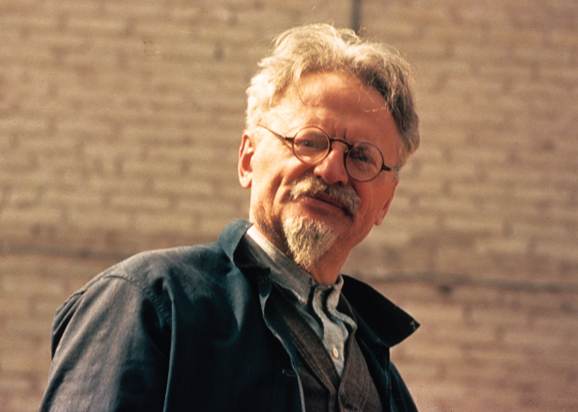
Leon Trotsky was one of the central leaders of the Russian Revolution. As the organiser and Commissar of the Red Army that saved the Soviet power and leading light of the struggle against Stalinism, he is surely one of the great heroic — and tragic — figures of the Twentieth Century.
Taken together these two books provide an insight into the major theoretical dilemma that emerged from the Russian experience: how a successful revolution could degenerate into a parody of workers’ democracy to the point of becoming a murderous dictatorship.
Because Trotsky’s revolutionary integrity remained untarnished after his murder in 1940 at the hands of a Stalinist assassin it is easy to fall into a deification of his work — something that competing Trotskyist sects have delighted in doing.
Paul Le Blanc steers clear of those rocks in his very fine, short biography. He demonstrates a very clear-eyed and measured approach, combined with an unqualified opposition to Stalinist tyranny.
He writes of Trotsky’s life together with the full gamut of his relationships — including sexual, Trotsky was not a paragon of bourgeois family virtue — and both critiques and defends his legacy. Trotsky was often accused of arrogance, which Le Blanc deals with fairly. However, despite his personal failings Trotsky genuinely demanded honesty and dissent from his comrades, not the spiritual desert that Joseph Stalin inhabited.
Trotsky’s final battle
Given Trotsky’s epic achievements both as a revolutionary leader and as a writer, it might come as something of a surprise that Le Blanc concentrates his attention on Trotsky’s work in the period after his fall from power — his time of exile when he laboured to produce the Fourth International.
But Le Blanc is being true both to the intention of the Reaktion Books’ Critical Lives series and to Trotsky’s perception of his own legacy. Each Critical Lives book “relates and brings alive” the subject’s life “and assesses their major works at the same time.”
Le Blanc writes that Trotsky remained true to “the ideals that animated his entire life,” and that he “followed a trajectory that took him out of the centre of power. This was the doomed but determined fighter who sought to defend and explain the relevance of the heroic best that was in the early Communist tradition.”
Trotsky regarded the last period of his life, where he battled to keep revolutionary Marxism alive, as his most important work. This was the time when he analysed fascism and tried to influence politics during the Great Depression while responding to the Moscow trials (at which he was the chief defendant in absentia). He also intervened from afar in the Spanish Civil War and other events leading to World War II.
His fundamental disagreement with Stalin was over how best to defend the USSR against capitalist encirclement. At the theoretical level it boiled down to their two divergent concepts: Permanent Revolution (Trotsky) versus Socialism in One Country (Stalin).
Behind those two theories were two totally different understandings of working class democracy and how capitalism operates in a globalised world. Should the encircled Soviet Union have depended on internal workers’ democracy to build its state or on a specialised bureaucracy? Should it attempt to make class peace with one or other imperialist power, even the most repugnant, in order to secure its own position?
This is where Thomas Twiss’s book dives in deep. Like Le Blanc, Twiss is both sympathetic to and uncompromising in appraising Trotsky’s strengths and weaknesses. But where Le Blanc uses a rather broad narrative brush, Twiss is microscopic.
Twiss follows Trotsky’s thinking from the first years of the Bolshevik Revolution through the internal party faction fights of the 1920’s and the 1930’s Moscow Show Trials up to his demise. This is an exacting history that covers the development of Trotsky’s ideas in relation to his political battles.
He explains how Trotsky’s perceptions of political developments both blinkered and illuminated his evolving theoretical understandings. In turn Trotsky’s theories shaped his political stands — both for good and for ill.
Theories of workers’ democracy
The question of democracy has been central to the socialist movement at least since Karl Marx and Frederick Engels famously stated that the first step in the communist revolution “is to raise the proletariat to the position of ruling class” by winning “the battle of democracy.”
Going further, in 1871, while writing of the Paris Commune, Marx concluded that the working people, in making their revolution must smash what he called the “bureaucratic-military machine” that is the bourgeois state. Vladimir Lenin further expanded on this in State and Revolution.
Lenin argued that the Russian socialist revolution would establish a Commune-like regime based on the unique creation forged by the Russian revolutionary experience, the soviets or popular councils. The Bolsheviks confidently expected that popular sovereignty would be ensured by some fairly simple organisational structures — starting with state power founded on workers’ soviets and peasants’ organisations.
Following that, the danger of a bureaucracy forming would be warded off by replacing the standing army with a militia, eradicating the division between executive and legislative functions, having the right of recall of all elected officials, and regulating officials’ salaries to the level of workers’ wages.
Eventually, Lenin wrote, as the need for the repressive aspects of the state became redundant, even this radically democratic proletarian state would itself wither away.
However, soon after the revolution many within the Bolshevik Party, including Trotsky and Lenin, were discussing Soviet bureaucracy as a growing problem. In time, the Soviet Union became synonymous with anti-democratic bureaucracy, mass murder of revolutionaries and the cult of personality around Stalin, the chief of the bureaucracy.
Trotsky’s name, on the other hand became synonymous with the most effective analysis of and opposition to the Revolution’s bureaucratic degeneration. Yet, as Thomas Twiss demonstrates his understanding did not develop in a straight line.
As he grappled with the question Trotsky was guided by aspects of classical Marxist thinking as well as the conjunctural issues confronting the Revolution. He also engaged with and debated competing analyses that emerged in and around the Communist Party.
Phases of Trotsky’s theorising
Far from being a mystical prophet, Trotsky was fully human in this work. There were many hesitations and developments in his thinking, which can be divided into three distinct phases.
During the 1918-1921 civil war and the first years of the New Economic Program (NEP) he identified bureaucracy as the cause of inefficiency throughout the economy but most especially in the Red Army supply chain. That is, he saw it as a technical question and he was lightning fast in coming up with technical solutions - which often rode roughshod over democracy.
However, by 1923, just five years after the Revolution, in the second phase of his thinking, he became worried by the growing divergence of the state and party apparatuses from democratic control and the rising influence of alien class forces. From 1926 onwards he deepened his appreciation of the roots of the bureaucracy and the danger it presented to the revolution.
But it was only after the defeat of the German working class by the Nazis that Trotsky came to see the bureaucracy as a distinct social formation with its own interests. While not terminating the achievements of the Russian Revolution, it had attained a high degree of autonomy from all Soviet social classes.
In the immediate post-1917 revolutionary period all the Bolsheviks saw bureaucracy in terms of classical Marxist formulations that are scattered throughout the writings of Marx and Engels on the state. Following Marx and Engels, they essentially held that bureaucracy was an embodiment of political alienation, that is, separation of the state apparatus from democratic control.
Marxist thinking about bureaucracy
Marx first dealt with bureaucracy in his The Critique of Hegel’s Philosophy of Right, in which he rejected Hegel’s idealistic belief that the Prussian civil service was motivated by the interests of the whole of society. Marx argued that the central institution of the modern state, which he named “bureaucracy,” was just one more self-seeking, “particular, self-contained society within the state.”
Marx believed that the bureaucracy simply redefined the common good to correspond with its own particular interests.
Going further, in his book On the Jewish Question, Marx, while still using Hegelian language, contested Hegel’s assertion that the state resolved civil society conflicts: “Far from abolishing these factual distinctions, the state presupposes them in order to exist … It is only in this way, above the particular elements, that the state constitutes itself as a universality.”
Thus, for Marx the state and its bureaucracy, rising out of social conflicts, depended upon the continued existence of those conflicts for its legitimacy — while simultaneously claiming to represent the interests of everyone.
In the years immediately after the revolution, leading Bolshevik views on bureaucracy — including those of both Lenin and Trotsky — derived from these Marxist concepts but also from the more prosaic view of bureaucracy as simply the rule by faceless, paper-shuffling officials. That is, while influenced by Marxism, they saw bureaucracy as a secondary (though negative) phenomenon characterised by excessive formalism, paperwork and inefficiency.
They believed that bureaucracy would be curtailed significantly by the dictatorship of the proletariat, and that it would ultimately disappear in the socialist society that they were building — based on the soviets that neither Marx nor Engels had lived to see or theorise about.
Realities of War Communism
The Bolsheviks failed to recognise that these democratic ideals were being undermined by facts-on-the-ground created during and after the Civil War. For example, the Bolshevik government was hamstrung by Russian workers’ abysmally low level of literacy.
Far from being able to assign government functions to workers, as predicted in State and Revolution, the Bolsheviks were forced to rehire Tsarist bureaucrats, at inflated wages, to “coach” workers in their responsibilities. The “specialists” were paid a premium above the wages of the workers who they tutored, which became a source of demoralising envy.
It did not take long before the old, corrupt Tsarist ways infested the structure, especially as the most class-conscious workers went to the front line of the Civil War. Far worse, the war destroyed the factory base of the soviets, undermining one of the central tenets of the Bolshevik state project.
This nascent bureaucracy thrived in the atmosphere of economic privation the Civil War created. As the war smashed the economy, the population survived physically through a combination of rationing and barter, and morally via a superlative level of political commitment.
This moral commitment, based on shared hardship, was known as War Communism. It was regarded as an emergency period. Fully-fledged communism was expected to follow victory, based on material plenty.
During War Communism, Trotsky headed the largest Soviet government department: the War Commissariat. He demonstrated the fiercest reactions to administrative inefficiency. He had a short fuse when it came to obstructions and looked for short cuts around them.
Trotsky particularly hated excessive centralism and inadequate coordination of economic resources. “From 1919 through 1922,” Twiss says, “Trotsky wrote more extensively and coherently about this form of bureaucracy that any other.”
Confusion in Bolshevik debates
A difficulty in the Bolshevik discussion at this point was that different leaders were using the same vocabulary to refer to different aspects of the bureaucratic phenomenon. What was occurring was, while facing the totally new phenomenon — bureaucracy in a workers state — leaders attacked varied characteristics and raised competing solutions, all using very similar terminology.
As Twiss notes:
During the party controversies of these years, these semantic differences occasionally generated confusion when Trotsky, under attack for his “bureaucratic”-authoritarian methods, responded by hurling the charge of “bureaucracy” back at his critics. In fact, the wide differences within the party over the real meaning of bureaucracy were a reflection of the vastly differing concerns of those who used the term.
For contemporary readers of these debates, sometimes the language becomes even more confusing because often references to events in the French Revolution were used as shorthand to describe current events.
In this early period most Bolshevik leaders persisted in seeing the problem of bureaucracy in terms of the separation of political institutions from the masses and the intrusion of bourgeois influences.
Trotsky saw it quite differently. He was knee-deep in waging the Civil War and he defined the problem as that of inefficiency and poor coordination. That led him to his life-long interest in economic planning and to support increased autonomy to enterprises and economic organs.
Only in later years would Trotsky return to his Marxist roots in analysing the bureaucracy — by which time it had become a life and death issue, not just for the Soviet Union but for him personally.
Lenin had his own ideas about how to tackle the problem and advocated the Workers’ and Peasants’ Inspectorate — a sort of super-auditor — to eliminate waste. While Trotsky had misgivings about adding yet another layer to the bureaucracy in the hope of reforming it, he nonetheless came to an anti-bureaucratic alliance with Lenin in late 1922 and supported his policy.
The Twelfth Party Congress in April 1923 passed motions endorsing improved economic planning, but immediately following that the majority of the Bolshevik leadership failed to carry out the line. Trotsky deduced from this that the problem required more than a technical fix.
Trotsky deepens his analysis
Twiss says that between 1923 and 1925, “Trotsky’s critique of Soviet bureaucracy underwent a dramatic transformation.”
Beginning in late 1923 Trotsky wrote a series of articles in Pravda in which he elaborated on the question of the bureaucracy, even raising the spectre of “bureaucratic degeneration” within the Party Old Guard. His articles were later published as a pamphlet under the title The New Course.
He began to regard bureaucratism as a political problem within the party and state. Market forces, alien class pressures and specialisation among officials were pushing the party and state to the right. This sparked his oppositional activity on behalf of party democracy, which he saw as essential to changing economic policy.
Trotsky was defeated in that struggle but returned to the political fray again in 1926 when the United Opposition coalesced, bringing Trotsky together with other Old Bolsheviks, led by Grigory Zinoviev and Lev Kamenev.
Meanwhile, Stalin, as party General Secretary, used his control to marginalise revolutionaries he distrusted and foster those who supported him. Over time, he became “king” of the bureaucrats by protecting their interests.
Trotsky led the United Opposition in enunciating a comprehensive theory of the bureaucracy derived from the notion that rightward shifts in the USSR’s economic life had taken the Party itself to the right. He began warning of the danger of a Soviet “Thermidor”.
Meaning of thermidor
Thermidor was the eleventh month in the French Republican Calendar, created by the French Revolution. It was the month in which Robespierre, the radical leader, was overthrown. Being drenched in the history of the French Revolution, Bolsheviks understood that Trotsky was describing a counter-revolution that changed political leaders and eliminated radicalism, but which did not dismantle the basic gains of the revolution.
Twiss says that the term “Thermidor” was first employed by Lenin in early 1921. But, as used by Trotsky in 1927, it indicated an opening for capitalist restoration, if not in a straightforward manner. Trotsky said Thermidor was “a special form of counterrevolution carried out on the instalment plan … and making use, in the first stage, of elements of the same ruling party — by regrouping them and counterposing some to others.”
However, while warning of the danger, Trotsky believed that the Soviet Thermidor had not yet arrived. Other Oppositionists, particularly those who had come from the Democratic Centralist and Workers’ Opposition groupings, believed that the Soviet Thermidor had already occurred.
The Stalinists used their statements as weapons against the entire United Opposition, which in turn led Trotsky and other leaders to publicly disavow the position.
The Opposition’s political strategy was formed by its analysis that Thermidor was a danger but not yet a reality. This analysis dictated that, for the time being, the Opposition would attempt to reform Soviet political institutions, and not to organize a new revolution.
Internal democracy within the Party became a farce as Oppositionists were arrested and Trotsky and other leaders subjected to abuse and even forms of violence during Central Committee meetings.
In November 1927, in celebrations marking the tenth anniversary of the October Revolution, Oppositionists marched in the official parades in Moscow and Leningrad, carrying banners with their own slogans: “Strike against the NEPman and the bureaucrat!”, “Down with opportunism!”, “Carry out Lenin’s testament!”, “Beware of a split in the party!” and “Preserve Bolshevik unity!”
Stalin responded by expelling them from the party the next month for constituting a faction. Following this Zinoviev and Kamenev capitulated to Stalin, leaving Trotsky alone as the only significant opposition to the bureaucracy.
Stalin and the German debacle
Trotsky expected that the Stalin faction would turn further to the right, but that anticipation was confounded when Stalin turned dramatically leftwards with his forced-march industrialisation and ultra-left “Third Period” international turn.
This strained Trotsky’s theoretical understanding. He had insisted that there was a direct relationship between the leadership’s rightist orientation and its undemocratic behaviour. However, it was pursuing a near crazed ultraleftism while worsening its internal regime.
In early 1933 Trotsky was still warning of the danger of a Soviet Thermidor, not that it had already taken place. Meanwhile, in Germany, Stalin’s ultraleftism was destroying any hope of a united working class response to Adolf Hitler’s rise.
It was the German Communist Party’s betrayal that pushed Trotsky to finally clarify his thinking about the Soviet bureaucracy. An interesting aside in this is that, just as Lenin turned to reading Hegel’s Science of Logic immediately after the outbreak of WWI and fed it into his Imperialism, the Highest Stage of Capitalism, Twiss says that Trotsky also turned to Hegel after the German debacle.
Over the next eighteen months Trotsky gnawed at the bone of his theory and produced The Revolution Betrayed. Le Blanc says that it covered “a broad array of economic, social, political and cultural issues”. Twiss says it was “the culmination of the development” of Trotsky’s thinking.
Trotsky argued that the “Soviet state and society were fluid and transitional,” Le Blanc explains. While the capitalist profit motive was missing from the USSR, socialism “could not be reduced to a state-owned economy with top-down centralised planning in a single country.”
Trotsky referred to the Soviet reality as “a contradictory society”. He hoped for the restoration of proletarian democracy and feared the eventual restoration of capitalism.
His vision of workers’ democracy included freedom of speech and genuine elections. He called for the restoration of internal Bolshevik democracy within the party and for the legalisation of other workers’ parties to participate in reinvigorated Soviets.
While Trotsky amplified this theory up until his death he did not alter it.
Meanwhile, Stalin began a mad purge within the USSR using show trials to slander all alternative Bolshevik leaders – especially Trotsky – and murdering tens of thousands of loyal Party members. This paved the way for possibly his most notorious betrayal: the German-Soviet Non-Aggression Treaty, which opened the gates to the mass slaughter of World War II.