By Fred Moseley, December 16, 2020
Showing posts with label Labor theory of value. Show all posts
Showing posts with label Labor theory of value. Show all posts
Sunday, December 24, 2023


3629. Marx’s Value Theory and the Value Form Interpretation
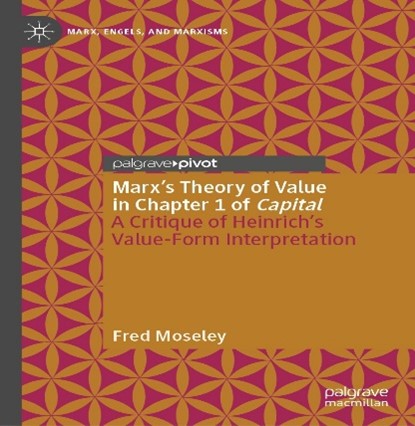 As I mentioned in a recent blog, at the Historical Materialism conference in London in November, there was a book launch for Fred Moseley’s new book Marx’s Theory of Value in Chapter 1 of Capital: A Critique of Heinrich’s Value-Form Interpretation. Michael Heinrich and Winfried Schwarz (a German Marxist who is also critical of Heinrich’s interpretation) participated in the book launch.

Moseley’s book is an examination of Marx’s theory of value in Chapter 1 of Capital, almost paragraph by paragraph in Sections 1 and 2, and a detailed critique of Heinrich’s value-form interpretation of Chapter 1, as presented in his 2021 book How to Read Marx’s Capital, which is a translation of his 2018 book Wie das Marxsche Kapital Lesen?

Heinrich is a well-known German Marxist who has published widely on his value-form interpretation of Marx’s theory of value, and his work is influential not only in Germany, but also in the UK and other countries in Europe and around the world. He criticises the traditional interpretation of the labour theory of value, according to which the value of commodities is determined solely in production, and he argues that value is created only when it is converted into money through the sale of commodities on the market.

Moseley is one of the foremost scholars in the world today on Marxian economic theory. He has written or edited many books on Marxist theory. He reckons instead that Marx presented a labour theory of value according to which the value of commodities is determined solely in production by the socially necessary labor time required to produce the commodities. And Moseley argues in his book that the textual evidence in Chapter 1 overwhelmingly supports the labour theory of value interpretation of Marx’s theory of value.

The relevance and importance of this debate may seem obscure to many readers of Marx. So Fred Moseley kindly agreed to be interviewed on his new book and the controversy with Heinrich.
MR: How did this book come about?
FM: ”First of all, I want to thank you for the opportunity to discuss my book with you and your many readers.
Heinrich’s book cited above is a detailed textual study of the first seven chapters of Capital. Heinrich is not very well known in the US, but he is very influential in Germany and other European countries. He is something like a David Harvey of Europe. But I am convinced that Heinrich’s book is a fundamental misinterpretation of Marx’s theory, so I decided to engage critically with Heinrich’s book.
I started by writing a paper on Chapter 1, the foundation of Marx’s theory and Heinrich’s interpretation. I presented this paper in a Zoom conference in June 2021 sponsored by Gyeongsang National University in South Korea. An assistant editor of Palgrave’s Marx, Engels and Marxism series, Paula Rauhala, watched the my presentation and she contacted me and suggested that I write a longer version of my paper as a Palgrave Pivot book. A Pivot book is a new initiative by Palgrave of short books, with a limit of 50,000 words (which I exceeded by 10,000 words!). I am grateful to Paula for that suggestion and this little book is the result.”
MR: Please give us an overview of your book
FM: “My little book is a detailed textual study of Marx’s Chapter 1 and Heinrich’s interpretation of Chapter 1. The book consists of only 4 chapters.
Chapter 1 of this book presents my interpretation of Marx’s theory of value in Chapter 1 of Capital, including a section on each of the four sections of Marx’s Chapter 1. Chapter 2 presents Heinrich’s interpretation of Chapter 1 of Capital and my detailed critique of Heinrich’s interpretation 1, with the same four sections.
Chapter 3 is about a 55-page manuscript that Marx wrote in 1872 in preparation for the 2nd German Edition of Volume 1, which is mainly about Section 3 of Chapter 1, entitled ‘Additions and Changes to the First Volume of Capital’, which Heinrich has emphasised in his book and in previous works to provide textual support for his ‘value-form interpretation’ of Chapter 1. This important manuscript has not yet been translated into English. A translation of a 4-page excerpt of this manuscript is included in Heinrich’s book as an appendix. So Chapter 3 of my book presents my interpretation of this manuscript and a critique of Heinrich’s interpretation. A translation of this entire manuscript should be a high priority of Marxian scholarship.
My book is very abstract theory, about the most abstract part of Marx’s theory, the beginning of Marx’s theory in which he presents the foundation of his labour theory of value. Marx said in the Preface to the 1st edition of Volume 1 of Capital that “beginnings are always difficult in all sciences”, and that is certainly true of Marx’s theory. The best way to read my book is to have Heinrich’s book and Volume 1 of Capital close at hand.”
MR: How would you summarise the main conclusions of your book?
FM: “The main conclusions of my book are the following:
1. The subject of analysis of Chapter 1 is the commodity, not a separate, isolated commodity, but a representative commodity, a commodity that represents all commodities and the properties that all commodities have in common (use-value and exchange-value). In the Preface to the 1st edition, Marx described the commodity as the “elementary form” or the “cell form” of capitalist production. So Marx analyses the properties of a representative commodity similar to the way cellular biology analyses the properties of a representative cell. It’s like putting a commodity under a microscope and analysing its main properties.
Marx’s representative commodity in Chapter 1 is assumed to have been produced, but not yet exchanged. This is crucial for the critique of Heinrich’s interpretation. According to Heinrich, the subject of analysis of Chapter 1 is not the properties of a representative commodity, but instead is what he calls an “exchange relation” between two commodities, which he argues is the end result of two actual exchanges between the two commodities and money on the market.
2. The value of commodities is derived in Section 1 of Chapter 1 from the property of the exchange-value of the representative commodity (i.e. from the property that each commodity is equal to all other commodities in definite proportions). And this general relation of equality between each commodity and all commodities requires a common property that is possessed by all commodities and that determines the proportions in which different commodities are equal.
Marx argued that this common property of all commodities that determines their exchange-values is the objectified abstract human labour contained in commodities. And this is the result of the abstract human labour expended in production to produce the commodities.
According to Heinrich, on the other hand, the value of commodities is not derived from a relation of equality between all commodities, but instead is derived from an analysis of an “exchange relation” between two commodities, which he argues presupposes actual exchanges of the two commodities with money on the market.
3. The magnitude of the value of each commodity is “exclusively determined” (p. 129) by the quantity of socially necessary labour-time expended in production to produce each commodity. Heinrich argues, on the other hand, that the magnitude of value of a commodity depends in part on the relation between supply and demand for the commodity on the market. This is the best-known assumption of the value-form interpretation of Marx’s theory of value.
4. The labour that produces commodities has a dual character in production: both concrete labour and abstract labour are characteristics of the same labour process in production. Section 2 of Chapter 1 in particular presents very strong textual evidence to support this interpretation of the dual character in production of labour that produces commodities.
Weaving and tailoring are Marx’s two examples in Section 2. The labour process of weaving produces the use-value of linen, its dual character also being abstract human labour that produces the value of the linen. The same dual character is true of the labour process of tailoring (and all other particular labour activities). The values of the linen and the coat are compared by comparing the labour-time required to produce each one of them and nothing is said in this about exchange in this section.
Heinrich argues, on the other hand, that labour in production is only concrete labour and is not yet abstract labour. Abstract labour comes to exist only in exchange, and thus the dual character of the labour that produces commodities comes to exist only in exchange. According to Heinrich’s interpretation, tailoring and weaving (and any other labour process) possess only a single character in production, not a dual character. This interpretation is clearly contradicted by Section 2.”
MR: Please say more about Heinrich’s interpretation of “exchange relation”. That seems to be a central concept in Heinrich’s interpretation.
FM: “Heinrich’s concept of “exchange relation” is completely original with him. No one else puts so much emphasis on this term and defines it the way he does. And it is a new concept in his interpretation; it was not included in his 2012 book Introduction to Marx’s Capital. And unfortunately, he does not explain this very well in this book, especially for such a fundamental concept. There is nothing in his Introduction about this concept; there are only 1½ pages in an appendix in the back of the book on the abstractions that result in this concept (which he doesn’t refer to once in the rest of the book) and 1½ pages in his first discussion of this concept on pp. 53-54. And from then on, he just presumes his interpretation of exchange relation and applies it to different passages in Marx’s text.
I am pretty sure that most readers of Marx (especially beginning readers) will not understand the meaning and significance of Heinrich’s concept of exchange relation in his interpretation. A young Marx scholar from Australia wrote a 2000-word review of Heinrich’s book for Marx and Philosophy and she didn’t mention the concept of exchange relation at all. I myself had to work pretty hard to understand it because it is so poorly presented.
Heinrich defines exchange relation as an exchange between two commodities. To take one of his examples that is borrowed from Marx:
1 quarter of wheat is exchanged for x boot-polish.
Heinrich comments that this definition seems like direct barter exchange between the two commodities, but he states that this is not so, because direct barter seldom actually happens in capitalism. Instead, Heinrich interprets the exchange relation between two commodities as the end result of two actual acts of exchange between the two commodities and money on the market. Thus…
1 qtr. of wheat is sold for 10 shillings and 10 shillings is used to purchase x book-polish
The important point is that Heinrich’s concept of exchange relation between two commodities presupposes actual exchanges between these two commodities and money on the market. Heinrich does not clearly specify whether these acts of exchange that are presupposed in his interpretation of the exchange relation are assumed to be actual acts of exchange on the market. However, they must be actual acts of exchange in order to be consistent with Heinrich’s general value-form interpretation, according to which commodities possess value only if they have been actually exchanged on the market.
Before actual exchange, according the Heinrich’s interpretation, commodities do not possess value (indeed, products are not even commodities) before exchange. Products of labour become commodities and commodities come to possess value only as a result of actual exchanges on the market. Therefore, since the commodities that Marx analyses in Section 1 (e.g. wheat and boot-polish) are assumed to possess value, in order to be consistent with Heinrich’s general value-form interpretation, he must also assume that these commodities have been actually sold and bought on the market. If the commodities have not been actually exchanged on the market, then these commodities would not possess value, according to Heinrich’s general value-form interpretation.
However, there is absolutely no textual evidence in any of Marx’s several drafts of Chapter 1 to support Heinrich’s idiosyncratic interpretation of the exchange relation between two commodities – that it presupposes actual acts of exchange between these two commodities and money on the market. This interpretation is Heinrich’s invention. He does not cite any other authors with a similar interpretation of exchange relation, because there are none. And the exchange relation is the most important concept in Heinrich’s interpretation of Chapter 1. If his fundamental concept of exchange relation is a misinterpretation of Marx’s theory, then the rest of Heinrich’s interpretation of Chapter 1 is a misinterpretation and is unacceptable.
I think it is clear that the subject of analysis of Chapter 1 is the commodity, a representative commodity that is used to analyse the properties that all commodities have in common – use-value and value. Chapter 1 is not about exchange at all. The commodity that is analysed in Chapter 1 has been produced, but not yet exchanged. Exchange is not considered until Chapter 2 (“The Process of Exchange”).
In recent weeks, while preparing for the HM conference and for this interview, I have come to realise more clearly that there is a fundamental contradiction in what Heinrich is trying to accomplish in his recent book. In his previous works, he has presented (many times and all over the world) a strong value-form interpretation of Marx’s theory of value, according to which the value of a commodity exists only as a result of an actual exchange on the market. Before exchange, a commodity does not possess value (it only possesses use-value). For the textual evidence to support this interpretation, he has used a handful of key passages that are taken from various texts in isolation and out of context. As we know, one can always find passages that seem to support almost any interpretation of Marx’s theory. And Heinrich is very good at this quotation game.
However, his most recent book is different; it is an attempt to interpret the first seven chapters of Volume 1, especially Chapter 1, as a value-form theory – and that Marx was the original value-theorist! Heinrich goes from page to page in Chapter 1 and consistently tries to interpret key passages in a value-form way. This is a very difficult task because there are so many passages in these chapters, especially Chapter 1, that contradict a value-form interpretation. Indeed, in my view, Heinrich’s task is an impossible task. My book follows his detailed commentaries point by point and exposes the errors in his value-form interpretation.”
MR: What was the main disagreement between you and Heinrich in your book launch at the recent Historical Materialism conference?
FM: “Not surprisingly, the main disagreement in the session was over the meaning of exchange relation in two paragraphs in Section 1. He argued that I misinterpreted Marx’s concept of exchange relation, not as an act of exchange between two commodities, but as a relation of equality between two commodities, and that I just substituted my meaning of exchange relation for Marx’s meaning in the two passages. And he argued that these two passages are proof that that Section 1 analyses individual commodities as part of an exchange relation.
But that is not true. I did not just substitute my meaning of exchange relation for Marx’s meaning in these paragraphs. Rather, I argued that the exchange relation in these paragraphs is a synonym for exchange-value. The exchange-value of each commodity is defined in the preceding paragraphs in Section 1 as the property of each commodity that is equal to all other commodities in definite proportions that are mutually consistent. That implies that all commodities possess a common property that determines the proportions in which different commodities are equal. Therefore, the exchange relation between two commodities in these paragraphs is also a relation of equality between two commodities, which implies the necessity of a common property possessed by each one of them.
Instead I argued that Heinrich is the one who misinterprets Marx’s concept of exchange relation with his strange definition as the end result of actual exchanges between the two commodities and money on the market,. There is absolutely no textual evidence to support this interpretation of actual market exchanges presupposed in Chapter 1. My interpretation of exchange relation as a relation of equality between commodities is much more reasonable and plausible than Heinrich’s complicated and idiosyncratic interpretation of the end result of actual exchanges between commodities and money on the market. “
MR: Are there other points that you would like to emphasise?
“I also want to mention Heinrich’s unusual interpretation of the word “common” in Marx’s derivation of value in Section 1 – that value is the common property of commodities that determines their exchange-values – because it is an important point in his interpretation that he has emphasised in all his writings, including in the book I am criticising.
Take the concluding paragraph of Marx’s derivation of value on p. 128: “All these things now tell us is that human labour-power is expended to produce them, human labour is accumulated in them. As crystals of this social substance, which is common to them all, they are values – commodity values. ” I argue that Marx’s meaning of “common to them all” in this passage is the usual meaning of “common” , namely that the same property is possessed by each individual commodity by itself, on its own.
Heinrich argues, on the other hand, that the meaning of “common” in this passage and in other passages is ambiguous – i.e. it could also mean a property that each individual commodity possesses, not by itself, but only together with another commodity in an exchange relation (exchange relation again!), and this is what Marx means here and elsewhere when he says that value is a common property of commodities. According to Heinrich, outside of an exchange relation, an individual commodity does not possess the ‘common property’ of value.
However, I don’t think Marx’s meaning of “common to them all” is ambiguous at all; Marx states that the common property of commodities is the human labour accumulated in them as a result of the labour expended to produce them (each one of them), prior to and independent of its exchange with another commodity. Nothing is said about exchange and exchange relation in this key concluding passage.
Three paragraphs before the passage just quoted, Marx presents a geometric example of area as a common property of different geometric figures. Area is a ‘”common property” of each figure, independent of its comparison to the area of another figure. The similarity between the area of geometric figures and the value of commodities is that, in both cases, the objects possess a common property independently of a quantitative comparison between them. Heinrich does not comment on this illuminating geometric example which contradicts his interpretation that the common element of value is created in the exchange itself. Clearly, the area of geometric figures is not created by a comparison of their areas.
One other point I want to mention. In working on this book, I noticed for the first time that Marx repeatedly used the phrase the “own value” of an individual commodity in Section 3 of Chapter 1 (seven times); for example, the “own value” of 10 yards of linen or the “own value” of a coat (see pp. 100 and 104-06 of my book). The own values of the linen and the coat are compared and equated, but nothing is said about exchange. These passages are clear and unambiguous textual evidence that each individual commodity possess its “own value”, independent of acts of exchange between commodities and money on the market. This directly contradicts Heinrich’s interpretation that an individual commodity possesses value only if it has been actually exchanged with money on the market. Heinrich quotes only 3 of these 7 ‘own value’ passages and presents little or no commentary on any of them. Twice he quotes the adjoining sentences, but not these revealing sentences.”
MR: What difference does this debate over the details of Marx’s value theory make in the bigger picture?
FM: “I think it is important to get the details of Marx’s theory of value straight, because it is the foundation for Marx’s theory of surplus-value as a theory of exploitation in Volume 1. And the theory of value is also the foundation of his theory of the falling rate of profit and crises that you have presented so well in your own work. In the Preface to the 1st edition of Capital, Marx stated: “To the superficial observer, the analysis of these forms [the commodity-form of the product of labor and the value-form of the commodity] seems to turn upon minutiae. It does in fact deal with minutiae, but so does microscopic anatomy.” Microscopic anatomy is necessary for the understanding of organic bodies, and similarly Marx’s theory of value is necessary for an understanding of the capitalist economy.
My book is specifically about Heinrich’s book, but it applies to the value-form interpretation of Marx’s theory in general. And my conclusion is that Marx’s theory of value cannot be reasonably be interpreted as a value-form theory. I think that is an important conclusion. We should move on from the value-form interpretation of Marx’s theory.
I worry about Heinrich’s influence on the understanding of Marx’s theory. His interpretation is very influential in Germany and elsewhere in the world, especially among young people. And I am convinced that it is a fundamental misinterpretation of Marx’s theory. So I think it is important to engage with his popular but mistaken interpretation. I hope that my book will be read especially by young people and it will encourage them to make a deeper study of Marx’s theory of value in Chapter 1 of Capital and beyond.
Let me add my pennyworth to what I think are the wider issues arising from this debate between Heinrich and Moseley (MR).
Marx put it this way: “As the commodity is immediate unity of use value and exchange-value, so the process of production, which is the process of the production of a commodity, is the immediate unity of process of labour and process of valorisation.” So, for Marx, it’s the process of production, the exertion of human labour that creates value. As Marx once put it: “Every child knows that any nation that stopped working, not for a year, but let us say, just for a few weeks, would perish. And every child knows, too, that the amounts of products corresponding to the differing amounts of needs demand differing and quantitatively determined amounts of society’s aggregate labour.”
The value-form approach of Heinrich is implicitly a simultaneist approach. Its characteristic feature is the belief that value comes into existence only at the moment of realisation on the market. Consequently, production and realisation are collapsed into each other and time is wiped out. But the process of production and circulation (exchange) is not simultaneous, but temporal. At the start of production there are inputs of raw materials and fixed assets from a previous production period. So there is already (constant or ‘dead labour’) value in the commodity before exchange. Then production takes place to make a new commodity using human labour. This creates ‘potential’ new value, which is realised later (in a modified quantity) when sold.
But why does all this matter? For me, Marx’s value theory is about showing the fundamental contradiction in capitalism between production for social need (use-value) and production for profit (exchange value). Under capitalism, units of production are commodities that have a dual character which epitomises this contradiction.
For Marx, money is a representative of value, not value itself. If we think that value is only created when selling the commodity for money and not before, then the labour theory of value is devalued into a theory of money. Then, as mainstream neoclassical economics argues, we don’t need a labour theory of value at all because the money price will do. Money prices are what mainstream economics looks at, ignoring or dismissing value by human labour power – and therefore the exploitation of labour by capital for profit. It removes the basic contradiction of capitalist production.
Also, it leads to a failure to understand the causes of crises in capitalist production. It is no accident that Heinrich dismisses Marx law of profitability as illogical, ‘indeterminate’ and irrelevant to explaining crises and instead looks to excessive credit and financial instability as the causes. Heinrich even claims that in later years, Marx dropped his law of profitability although the evidence for that is non-existent.
If profits (surplus value) from human labour disappear from any analysis to be replaced by money, then we no longer have a Marxist theory of crisis or any theory of crisis at all.
Saturday, January 7, 2023
3615. How the Anthropocentric Industrial Capitalist Civilization Exploits Nature
By Kamran Nayeri, December 31, 2022

An industrial chicken farm
Many socialists, particularly Marxists, focus their attention on the exploitation of the working class. In fact, Marx's theory of exploitation of wage workers (theory of surplus value) is a specific application of Marx's and Engels's theory of society and history, historical materialism. In his speech at Marx's burial, Engels credited Marx with two theoretical contributions: Historical materialism (with Engels himself) and the theory of surplus value. The latter is developed in Marx's Capital.
In Capital volume 1, Marx shows how the origin of industrial capitalist profit is surplus value created in the production process. In Capital volume 3, he also demonstrates how the process of capitalist production and the distribution of surplus value provide land owners with rent and financial/merchant capitalists with interest. What Marx himself and Marxists so far have ignored is that Marx's analysis can be used to show how the exploitation of nonhumans contributes to the creation of surplus value and capitalist profit and, in fact, helps sustain the capitalist economy and society.
Let me provide a sketch of my argument. Following Marx in Capital volume 1, the value of a capitalist firm's final product (λ) produced in one production cycle is defined as follows.
C + V + S => λ where:
λ = The value of the product
M = Invested money capital (C + V)
C = The value of constant capital
V = The value of labor power paid as wages
S = Surplus value created by the application of labor power during production
M’ = New money capital gained upon selling the final product
p = M’ – M, the profit gained upon selling the final product
It is assumed that S = p.
The capitalist firm starts with money capital M spent on purchasing means of production divided by Marx into constant capital and variable capital. By constant capital, he denotes that part of the means of production that do not undergo any change in their quantitative value during the production process, such as the raw material, auxiliary material, and the instruments of labor. (Marx 1867; Chapter Eight) The value of various components of constant capital used up in one production cycle is transferred to the final product without change. On the other hand, variable capital is the value of labor power employed; that is, "the aggregate of those mental and physical capabilities existing in a human being, which he exercises whenever he produces a use-value of any description." (Marx 1867, Chapter Six) Thus, the source of capitalist profit is the surplus value the workers produce in the process of production (for a detailed discussion, see Shaikh, 1990). Surplus value is equal to unpaid labor time, as shown in the diagram below:
The working day
A B
[<---------------><--------------->]
A = The part of the working day necessary to produce a new value equivalent to the workers’s wages.
B = Unpaid surplus labor time.
Thus, workers' wages reflect the value of labor power but not the surplus value they produce during production. The capitalist firm pockets the surplus value as profit upon selling the product. Thus, capitalist profit is p = M’ - M.
But what is the value of labor power? It is the value of the means of subsistence necessary for the maintenance and reproduction of the laborer paid as wages. A key component in the worker's consumption basket is food. A reduction in the value of food will result in an equal magnitude reduction of the value of labor power, all other things being equal. Mechanization and industrialization of the meat industry have been part of the process of reducing the value of food necessary for the working class's maintenance and reproduction, hence contributing to a reduction of the value of labor power and a corresponding increase in surplus value. Thus, reducing the value of the nonhuman nature that workers consume will increase surplus value, expanding capitalist exploitation from the social realm to the natural realm.
To take one example, according to the National Chicken Council, dressed chicken which was retailed in the U.S. for $6.48 a pound in 1930 (in today's dollar), now costs $1.57 a pound: "Costs came down partly because scientific breeding reduced the length of time needed to raise a chicken to slaughter by more than half since 1925, even as a chicken's weight doubled. The amount of feed required to produce a pound of chicken has also dropped sharply." (Kristof, March 12, 2014) Poultry Science journal has calculated that if humans grew at the same rate as modern chickens, a human by the age of two months would weigh 660 pounds! Among the scientific techniques used to raise farm animals in increasingly cramped spaces is the intensive use of hormones and antibiotics. (For a discussion of the misery of chickens raised by the food industry, see Farm sanctuary, March 2004A). To appreciate the magnitude of the crime against a sentient being, in one year, in 2011, 58,110,000,000 chickens were slaughtered by the food industry.
There is a similar drop in the unit cost of other food items in the working class consumption basket, such as eggs, butter, milk, and steak, all taken from farm animals. However, a similar drop can be observed in plant-based food items like flour, potatoes, oranges, coffee, and sugar (Bureau Labor of Statistics, 2011, 2015).
Thus, Marx's labor theory of value can also be used to show capitalist profit also come from the exploitation of nonhuman species and inanimate nature as well as the labor power of wage workers. In particular, surplus value is increased by increasing subordination, oppression, and exploitation of farm animals.
The magnitude of the oppression and exploitation of farm animals will find no match in even the worst atrocities committed by a group of humans against another group of humans. Just consider these statistics: In 2011, more than 58 billion chickens (more precisely, 58,110,000,000), nearly 3 billion ducks (2,917,000,000), and more than a billion pigs (1,383,000,000) were slaughtered for food worldwide. Other farm animals killed for food numbered hundreds of millions each: 654 million turkeys, 649 million geese and guinea fowl, 517 million sheep, 430 million goats, and 296 million cattle (Heinrich Böll Foundation, 2014, p. 15).
Yet, no Marxist current has ever raised their voices or acted accordingly against these historically horrific conditions. How is that possible?
Indeed, the bulk of humanity has turned a blind eye to this as well. I have argued elsewhere that this is rooted in anthropocentrism as a manifestation of alienation from nature. The situation is analogous to the slave-owning societies including in the United States, the Apartheid regime in South Africa, and the Zionist colonial settlers who established Israel by murdering and subjugating Palestinians; in each case, the oppressors and exploiters turned a blind eye to the crimes again humanity by dehumanizing their victims. What is common to all these cases is that the oppressors alienated the oppressed as less than human in moral standing. This ideological prop, called racism in some cases or antisemitism in the case of Nazis, is necessary for such historical atrocities to happen. Alienation from nature and its ideological reflection, anthropocentrism, is similarly required for the domination, control, and exploitation of nature in search of wealth and power.
Of course, to realize and empathize with the oppression and exploitation of farm animals and the rest of nature does not require Marxian theory. The very fact of their subjugation as domesticated animals must give any open-minded individual pause. Many who have rebelled against these horrific conditions have not been socialists.
As I suggested above, working people must have every sympathy and empathy towards the farm animals which they either raise and murder for the meat industry or consume themselves as food. In fact, working people must realize that their oppression and exploitation are only possible because the rest of nature has been dominated and exploited since the dawn of civilization. In fact, they and the rest of nature have been exploited for the wealth and power of the ruling classes for 5,000 years.
We must also revise our view of the post-capitalist society. The Marxian theory of socialist revolution depends on the assumption of state power by the working class dismantling the capitalist state and beginning the transition to socialism. There is nothing in Marx's writings or any of the theories of transition to socialism that would break with the oppression of farm animals or gives up domination and control of nature to expropriate wealth. The goal is to distribute such wealth equally among the working people. But if all wealth comes from nature, a wealthy socialist society can only be envisioned as one expropriating nature. In fact, the Marxist literature on sustainable development is, in essence, nature managed by the socialist society for its own anthropocentric reasons. In this view, human exceptionalism is the prevailing view of our place in the world, not as a part of it but as its apex.
Thus, human emancipation requires animal liberation and, more generally, the elimination of alienation from nature. These will require not just a socialist revolution but also a cultural revolution to replace anthropocentrism with ecocentrism as society's environmental ethics.
References:
Bureau of Labor Statistics. Historical Statistics of the United States, Colonial Times to 1970. Bicentennial Edition, Part 2. 2011; 2015.
Heinrich Böll Foundation. Meat Atlas: Facts and Figures About Animals We Eat. 2014.
Kristof, Nicholas. "Industrial Farming and Your Diet." The New York Times, March 12, 2014.
Marx, Karl. Capital: A Critique of Political Economy, Volume 1, translated by Ben Fowkes, Vintage, 1867/1977.
Shaikh, Anwar. “Surplus Value.” John Eatwell, Murry Milgate, and Peter Newman (Ed’s.), The New Palgrave Marxian Economics. 1990.
Tuesday, August 14, 2018
2997. Marx, Value, and Nature
By John Bellamy Foster, Monthly Review, July 1, 2018

Raoul Peck’s 2017 film The Young Karl Marx opens with a quiet scene of poor “peasant proletarians,” men, women, and children, dirty and in rags, gathering dead wood in a forest. Suddenly they are attacked by a troop of mounted police armed with clubs and swords. Some of the gatherers are killed; the rest are captured. The scene then cuts to Karl Marx, age twenty-four, in the Cologne offices of the Rheinische Zeitung, where he was editor, writing an article on “The Debates on the Law on the Theft Wood.” He penned five installments under this title from October to November 1842, and it was this more than anything else that brought the Prussian censors down on the newspaper and its talented young editor and writers.1 In the film, we see the young Marx and his associates debating the course that had led them to defy both the Prussian state and their own liberal industrialist paymasters. Marx was intransigent; there was no other possible path. As he later explained in his famous 1859 Preface to a Critique of Political Economy, it was his attempt to address the expropriation of the customary forest rights of the poor that first drove him to the systematic study of political economy.2
The criminalization of forest usufruct was a major issue in Germany at the time. In 1836, at least 150,000 of the 207,478 total prosecutions in Prussia were for “wood pilfering” and related offenses. In the Rhineland, the proportion was even higher. These prosecutions led to heavy fines and imprisonment. In Baden in 1842, one in every four inhabitants had been convicted of wood-stealing. Central to Marx’s argument was the application of “the category of theft where it ought not to be applied”: not only the gathering of dead wood, but also the gathering of dead leaves and the picking of berries (a customary right accorded to children) were declared to be theft, even though these were long-established forms of traditional appropriation for the poor. The “customary right” of the poor to the free appropriation of dead wood, Marx insisted, did not apply to the live, “organic” tree or to “hewn timber”—which could be seen as the property of the private owners—but only to what was already dead. The forest usufruct of the poor was being turned “into a monopoly of the rich,” through a process of expropriation by “money-grubbing petty traders…and Teutonic landed interest[s].” Marx in response referred to the “elemental nature” of the forest system and, as historian Peter Linebaugh indicates, rooted his argument in an appeal to “the bioecology of the forest” and the “complex society” that it supported, including the way that the right of the poor to dead wood mirrored their more general impoverished position and relation to nature.3
Questions regarding the expropriation of land/nature and of human beings never ceased to occupy Marx in his subsequent works, appearing in his Economic and Philosophical Manuscriptsand in his two great discussions of “so-called primitive accumulation” in the Grundrisse and Capital. In Peck’s film, the assault of the forest police on the poor is a recurring nightmare, in which Marx sees himself running alongside the landless rural workers as they are being chased down by the authorities.
The Appropriation and Expropriation of Nature
Marx’s crucial distinction between appropriation and expropriation, around which his ecological as well as economic critique of capitalism revolves, is evident in his response to Pierre-Joseph Proudhon, as dramatically portrayed in The Young Karl Marx. Proudhon is shown giving a speech in which he makes his famous declaration that “property is theft.”4 From the audience, Marx asks, “what kind of property, bourgeois property?” Proudhon answers, “property in general.” Marx remarks that this is “an abstraction.”5
For Marx, as he indicates in a later encounter with Proudhon in the film, the latter’s statement is logically untenable, for if property in general is defined as theft, and all proprietary claims are thus invalid, then the question arises: what is theft? It was necessary, in Marx’s view, to distinguish appropriation, or property in its many varied historical forms, from expropriation, i.e., appropriation without an equivalent (in Marx’s terms, also without exchange and without reciprocity).6 Classical political theory, from John Locke to G. W. F. Hegel to Marx, locates the basis of civil society and the state in appropriation—the active term for property or the right to possession through labor.7
As Marx explained in The Poverty of Philosophy and in the Grundrisse, all human society rests on free appropriation from nature, which is the material basis of labor and production. This is another way of saying that all society depends on property. There can be no human existence without the appropriation of nature, without production, and without property in some form. “All production is appropriation of nature on the part of an individual within and through a specific form of society. In this sense it is a tautology to say that property (appropriation) is a precondition of production.” For Marx, to declare that “property is theft,” as Proudhon did, was therefore to skirt the fundamental issue—the development of various forms of appropriation in human history from the communal to the more extreme forms of private commodification.8This approach allowed Marx to develop a powerful critique of capitalist society that was both economic and ecological.9 Proudhon’s conception left no way out for humanity; since appropriation in some form was a universal basis of society and life itself, to declare that property in general was theft, irrespective of particular property forms, was a dead end for revolutionary movements.10
A parallel can be drawn here with Hegel’s notion of alienation as objectification, which in his philosophy could be transcended through the unification of subject and object, but only in thought, i.e., in the absolute knowledge of the Hegelian philosopher. For Marx, who rejected the idealist solution, objectification was inherent in human existence, since human beings were objective, sensuous, material beings, deriving their sustenance from outside themselves. Hence it was not objectification, in Marx’s view, but rather the “alienated mediation” intrinsic to capitalist commodity production that was subject to transcendence, and this had to be accomplished in material reality, not simply in thought.11 Similarly, human beings, as objective, material beings, could not be freed from the appropriation from nature, i.e., from property in all its varied forms, which was an objective condition of their existence. What was possible, however, was the revolutionary liberation of humanity from the more alienated, expropriative forms of the human social metabolism with nature.
These same issues have reemerged today in debates on the meaning and method of what is broadly termed ecosocialism. For Raj Patel and Jason W. Moore, in their A History of the World in Seven Cheap Things, “appropriation” in general, as in Proudhon, is defined as “a kind of ongoing theft.”12 Both here and in Moore’s earlier Capitalism in the Web of Life, the focus is on the “appropriation of work” in all of its forms—by which he meant “work” in the sense of physics (i.e., the measure of the energy transfer that occurs when an external force is applied to an object and moves it). In this naturalistic sense, we can speak of the “work” of a river or oil well, in the same terms as that of a human being. Appropriation, or property, conceived by Patel and Moore as the theft of “work,” is thus universal and inescapable, associated with physical motion itself.13 Such appropriation of external nature, Moore tells us, outweighs the exploitation of labor in production.14
No one of course would doubt that the appropriation of nature underlies all human production. Human beings are objective, material beings; as every child knows, we, like all other living beings, cannot exist without free appropriation from nature. Indeed, all material human production, as Marx stresses, is nothing but the change in form of what nature itself creates.15 But to argue, as do Patel and Moore, that the human appropriation of nature in general (that is, of its “work” or energy) is “a kind of ongoing theft,” and that this is the core of the ecological crisis, implicitly attributes the whole problem to the very existence of human beings—a misanthropic position.
Such a perspective, common to most mainstream environmental thought, necessarily distracts from the alienated mediation of the human-social metabolic relation to nature, and from capitalism’s specific forms of expropriation of nature and their effects on ecosystems. In the classical Marxian perspective, it is precisely because human history has created a mode of production (capitalism) that alienates the metabolic relations between human beings and nature, thereby creating a metabolic rift and rupturing the conditions of ecological reproduction, that we can hope to restore that essential metabolism—through a revolutionary overturning of the capitalist integument and the creation of a new, coevolutionary material reality. This is Marx’s core ecological message.
In the classical historical materialist view, the free appropriation of nature by humanity (the use of nature’s free gifts) is not to be condemned out of hand as theft. Indeed, “actual labor,” for Marx, “is [nothing but] the appropriation of nature for the satisfaction of human needs, the activity through which the metabolism between man and nature is mediated.”16 Nor should the concern be primarily, as in bourgeois society, with the mere “cheapness” of nature.17 Rather, it is the expropriation of nature in the sense of the appropriation of land or resources without reciprocity (maintenance of the “conditions of reproduction”) by capital that constitutes theft in this sphere.18 In Marx’s view, this reflects the “law of ‘expropriation’ not ‘appropriation'” underpinninng capitalism.19 It is associated in its environmental aspects with capitalism’s systematic violation of what the nineteenth-century German chemist Justus von Liebig called the natural-material “law of replenishment” (or “law of compensation”) necessary for ecological reproduction.20
Capitalism’s destructive relation to the ecological realm depends on this robbery of what Marx referred to as “the elemental powers of nature”—robbery not in the sense that these elements are not “paid,” as Moore says, but rather in the violation of the law of replenishment.21 Like Erysichthon in Greek mythology, capital requires ever more rounds of expropriation just to keep going, even to the point of eating everything in existence—including, ultimately, itself.22The dialectic of expropriation and exploitation, leading in the end to exterminism, thus lies at the core of the classical historical-materialist critique of capital. For Marx, it was not the appropriation of dead wood from the forest by peasant-proletarians, but rather capital’s alienated expropriation of all wood (and all land) to feed its insatiable drive for accumulation that constituted the essential reality of the plundering of the material world: a “tragedy of the commodity,” not a tragedy of the commons.23
If the exploitation of labor is the force behind capitalist valorization and accumulation, it follows that it cannot continue this contradictory process on an ever-increasing scale without new rounds of creative destruction at the boundaries of the system—the expropriation of the natural environment, along with the expropriation of social reproductive work, human communication, knowledge, and more.24 In Capital and in his later writings, Marx pointed to attempts under capitalism to speed up the turnover time in timber production by relying on faster-growing trees and in meat production through the breeding of livestock, arguing that this necessarily pressed against natural laws (and in the case of livestock, promoted cruelty toward animals).25
For Marx, the metabolic rift—the alienated mediation between humanity and nature—was a product of the “robbing” or expropriation of the soil, and thus of nature, thereby hindering “the operation of the eternal natural condition for the lasting fertility of the soil.” This in turn demanded the “systematic restoration” of this metabolism in a future society of associated producers capable of governing “the human metabolism with nature in a rational way…accomplishing it with the least expenditure of energy,” and developing most fully their individual and collective human powers.26
Value and Nature
With the rise of ecosocialism, brought on by the planetary rift, ecological critiques of the capitalist system have deepened and multiplied. But as in any period of headlong theoretical advance, this has yielded starkly different perspectives and positions, resulting in new debates over the conception, scope, and purpose of Marx’s value critique. Left environmentalists and political ecologists such as Stephen Bunker, Alf Hornborg, Zehra Taşdemir Yaşin, and Giorgos Kallis have sought to jettison or deconstruct the labor theory of value altogether, arguing that nature in general, energy, and individual species create value in the abstract, which is not restricted to human labor—or that, in Hornborg’s case, economic value is simply normative.27Such analyses frequently come from theorists working outside the field of critical political economy, who tend to confuse concepts of energy use, use value, intrinsic value, and normative value with the economic system of commodity value based on abstract labor under capitalism.
In Marx’s critique of the historically specific capitalist valorization process, value is the crystallization of socially necessary abstract labor—”labour as the expenditure of labour power.”28 Essential to this critique is the recognition that natural-material use values, while elemental to each and every commodity and the basis of all real wealth, are excluded from capitalism’s value generation calculus, insofar as no labor is incorporated in their production. As Marx himself put it in the Grundrisse, “the purely natural material in so far as no human labor is objectified in it…has no [economic] value under capitalism.”29 This contradictory character of capitalist commodity production, manifested in the opposition between use value and exchange value, places the narrow form of the capitalist value calculus at loggerheads with real wealth, which has its sources in both natural-material use values and concrete human labor.30
Since use value plays no direct role in the internal logic of valorization under capitalism, this gives rise, in both classical and neoclassical economics, to the notion of the “free gift of Nature to capital.”31 Capitalist exploitation and accumulation, as Marx explains, ultimately depend on capital’s usurping of nature’s gifts for itself, thereby monopolizing the means of production and wealth in its entirety.32 This alienation of nature has its counterpart in the alienation of labor—that is, in the emergence of a class with no basis of existence except the sale of its own labor power.
Understood in this way, the historically constructed commodity value form under capitalism is not one in which energy or bees directly participate, but is instead a product of human social-class relations.33 To see nature or energy, not just socially necessary abstract labor, as generating commodity value would only serve to naturalize and universalize the capitalist value process, eliding its specific social and historical character and its relation to the alienation and exploitation of labor. Even neoclassical economics—along with the ecological economics of Nicholas Georgescu-Roegen—attributes all value-added in the economy to labor or human services, and none to nature or energy.34 Capitalism thus excludes nature, (including the corporeal nature of human beings) from its value form—a fundamental and in many ways fatal contradiction of the system.
In contrast to the frontal attacks on Marx’s value theory described above, Moore’s subtler approach appears at first to conform to Marxian value theory, attributing value to labor. But on closer examination, his analysis effectively robs Marx’s own approach of all significance and undermines any coherent ecological (or economic) critique of capitalism. As Moore puts it, his “argument proceeds from a certain destabilization of value as an ‘economic category.'”35 Unlike Marx’s critique of capitalist valorization, which recognizes that under capitalism all value is the crystallization of socially necessary labor, and which makes a hard and fast distinction between value and wealth, Patel and Moore, in A History of the World in Seven Cheap Things, seek to obliterate these distinctions altogether. Hence they pronounce that “value is a specific crystallization of ‘the original sources of wealth’: human and extrahuman work.”36 Here Marx is quoted against himself, presenting his famous definition of wealth as the basis of a definition of value, thereby erasing an absolutely crucial distinction separating Marx from bourgeois economics. Indeed, the core of Marxian critique rests on the distinctions between use value and exchange value and between wealth and value.
Likewise, in Capitalism in the Web of Life, Moore seeks to transform Marx’s notion of the “law of value,” which focused on quid pro quo as the basis of capitalist commodity exchange, into its opposite, in relation to the “world ecology” as a whole.37 For Moore, the “law of value” centers on the absence of a quid pro quo (in exchange terms) between capital and Cheap Nature—an absence which then becomes the ultimate basis, in his “expansive value” analysis, of capitalist valorization—in total contradiction to Marx’s own analysis.38 He thus contends that value in its all-encompassing expansive form (including non-labor value) derives primarily from the appropriation of work/energy in general, of which the exploitation of labor is simply an epiphenomenon.
Hence, for Moore, the secret of accumulation is “capitalism’s unified logic of appropriating human and extra-human ‘work’ that is transformed into value.” In this view, the capitalist world ecology/economy and the entire human interaction with nature amount to the appropriation of the “four cheaps”: labor-power, food, energy, and raw materials.39 Labor-power is thus presented as no more significant with respect to the law of value than food, energy, and natural resources. (In his later work with Patel, Moore expanded the framework from four to seven cheaps, adding nature, work, money, lives, and care work and dropping labor-power and raw materials.) This convoluted formulation, however, effectively inhibits any coherent critique of capitalist value production, much less any meaningful understanding of the ecological crises engendered by the capitalist system.40
Moore’s argument regarding the four (or seven) cheaps is rooted in his more elastic conception of what constitutes value under capitalism and in civilization in general, with which he aims to present nothing less than a “new law of value,” encompassing both labor exploitation and the appropriation of physical nature/energy.41 “Laws of value,” he writes, are phenomena “that shape and cohere a civilization.” They are the product in large part of the appropriation of the physical “work,” i.e., energy of the universe. Such “expansive value relations,” as he calls them, “lead a double life,” extending beyond the labor process and value production proper, as well as beyond the phenomenon of unpaid human labor, to include all the “extra-human work” involved in the capitalist world ecology. These wider realms of “unpaid work/energy” associated with the “zone of appropriation” far outweigh the exploitation of labor in the determination of the overall, expansive value dimensions of a given civilization.42
“The law of value,” Moore thus contends, “far from reducible to abstract social labor, finds its necessary conditions of self-expansion through the creation and subsequent appropriation of Cheap Nature,” i.e., appropriation of the web of life in general.43 Again, we are left at a level of obscurity equivalent to Proudhon’s “property is theft.” The “law of value” is said to be based ultimately on the “appropriation of the unpaid ‘work of nature'” (along with the unpaid labor of women in the household and other forms of unpaid human labor). Both “the accumulated work/energy of fossil fuel formation” and the exploitation of labor power in a factory are “moments inscribed in the law of value.” The atmosphere is “put to work” in absorbing greenhouse gases, for which it too is “unpaid,” thus contributing to capitalist valorization.44
Here Moore’s expansive law of value, based on a “world of unpaid work” in which the “law of value in capitalism is the law of Cheap Nature,” runs into an unresolved problem, since such a conception is virtually without bounds, encompassing not just the planetary environment but the entire universe. As he is forced to admit, an entire “world of unpaid work” in this sense simply “cannot be quantified.”45 Although he declares that “value does not work unless most work is not valued,” this rests on a simple tautology, since the “work” referred to includes everything subject to the laws of motion of physics, insofar as it relates in the last instance to the economy—from subsistence agriculture to a beehive to a waterfall to a radioactive isotope to a nuclear reaction.46 “Coal and oil,” he writes, “are dramatic examples of this process of appropriating unpaid work.”47
It is this universal “unpaid” appropriation of the work/energy of the earth, as an eternal condition of human existence, which Patel and Moore describe as “ongoing theft,” leading in the end to ever more expensive “cheaps.”48 Yet although capital may end up possessing natural powers for which it does not pay, just as it does not pay for the worker’s ability to think, only confusion can result from attempts to treat such appropriation of nature’s capacity for work, in the sense of physics, as quantifiable and somehow commensurate with economic value production in capitalist social relations.49 Nor does it help much to characterize a waterfall, even one used to generate electricity, as “unpaid.”
In Moore’s “new law of value,” all of material existence, whether paid social labor, unpaid social labor, or the unpaid work/energy of the universe, matters largely to the extent that it is harnessed to the capitalist valorization process. The work/energy carried out by the sun, and that of the Earth System that over millions of years led to the formation of coal and oil deposits—plus the physical work that coal and oil perform in present-day production as low-entropy energy sources—all enter into the determination of Moore’s expanded law of commodity value, which he claims can account for the “transforming [of] nature’s work into the bourgeoisie’s [economic] value.” Physics, ecology, and economy all get rolled into one, erasing fundamental distinctions, crucial to Marx’s ecological (and economic) critique. Indeed “the capital relation,” for Moore, “transforms the work/energy of all nature into…value.”50
The viewpoints discussed above either deny the labor theory of value under capitalism outright (as in Bunker, Hornborg, Yaşin, and Kallis), or stretch it to the point of absurdity in search of “a single logic of wealth, power, and nature” under capitalism (as in Moore). In contrast, it is argued here that the metabolic relation between human beings and nature is an alienated and contradictory one, driving a wedge between the antagonistic laws of motion (and law of value) of capitalism and the Earth System.51 Ecological crises do not arise simply or even mainly because the world economy (or the world ecology) appropriates the work of external nature without payment, nor because Cheap Nature is becoming Expensive Nature, undermining capitalism’s bottom line. Properly understood, an ecological crisis, or crisis of sustainable human development, cannot be quantified in dollars and cents, or in terms of Cheap Nature, much less “unpaid nature.”
Rather, at the heart of today’s metabolic rift, as Marx argued, is the logic of the alienated capitalist system of accumulation, in which all natural boundaries are treated as mere barriers to be surmounted, opening up anthropogenic rifts in the fundamental biogeochemical cycles that constitute the overall Earth System.52 Ecological crises proper are thus not crises of economic value, but of the disruption and destruction of conditions of ecological reproduction and human development at the expense of future human generations and living species more generally.53 Viewed in this way, the primary ecological contradiction resides in the expropriationof nature as a free gift to capital, leading to “the squandering of the powers of the earth.” This is what Marx meant when he said that the soil was “robbed” of the conditions of its reproduction, thereby generating a rift in the metabolism of humanity and the earth.54
It is not so much the appropriation of nature’s work/energy as an inherent condition of human society and production, and indeed of life itself, that we should be primarily concerned with—although the increase in environmental throughput is central—so much as the ever-expanding ecological rifts imposed on the Earth System by the antagonistic logic of capital. Put differently, it is not the mere fact of the free appropriation of physical work/energy by human beings (an objective condition of existence) that is the chief source of our ecological contradictions, but rather the rapacious expropriation of nature by capital and the metabolic rift itself—i.e., the commodity system’s historically specific disruption of the elemental conditions and biogeochemical cycles of natural reproduction on which human existence and that of countless other species ultimately depend.
Against the Expropriation of the Earth
One of Marx’s most profound insights was that “productive forces” under capitalism turned into “destructive forces.” The very “productivity of labor” under capitalism led to “progress here, regression there.” He attributed this regression specifically to the degradation of “natural conditions,” to “the exhaustion of forests, coal and iron mines, and so on”—even extending to the negative effects of regional climate change.55 Beginning with his earliest works, he conceived of the expropriation and alienation of land/nature as a necessary counterpart, even a prior condition, of the expropriation and alienation of the laborer. In the Economic and Philosophical Manuscripts, he observed that capitalism, even more than feudalism before it, was rooted in “the domination of the earth as of an alienated power over man.”56 The expropriation and removal of human beings from the natural conditions of production through the capitalist seizure of the earth, created the alienated conditions for the exploitation of workers. By the same token, private riches were everywhere enhanced by the destruction of public wealth (the Lauderdale Paradox).57
“So-called primitive accumulation,” Marx went on to explain in Capital, “means the expropriation of the immediate producers,” involving the dual expropriation of the direct producers and of the earth.58 The imposition of these conditions (marked by the historic enclosures of the commons), the growth of the proletariat, and the alienation of both labor and land, produced the elemental destructiveness of the capitalist system. As Max Weber observed during his trip to Indian Territory (today Oklahoma) in 1905, “with almost lightning speed everything that stands in the way of capitalist culture is being crushed.” Like Liebig and Marx before him, Weber pointed to capitalist culture in this sense as a system of robbery, Raubbau (or Raubsystem), that destroyed the earth and natural resources along with any precapitalist economic formations standing in its way.59 This Raubsystem, however, was not attributed to the notion that property (appropriation) was theft, but to the specific historical forms of the capitalist expropriation of humanity and nature.
The expropriation of the earth has invariably been accompanied by the expropriation of humans as corporeal beings, through innumerable forms of labor bondage and servitude always present at the logical and historical boundaries of the system, helping to make capitalism possible. Such expropriation is always an essential part of the system, determining its parameters. The system of capital, Marx famously remarked, “comes dripping from head to toe, from every pore, with blood and dirt.”60 The role of slavery, genocide, and every kind of human servitude, including the vile robbing of the earth itself, was crucial both to capitalism’s origins and to its continuing antagonistic reproduction. Today the gross exploitation (or superexploitation) through the global labor arbitrage of the mass of the workers in the global South is giving rise to a “planet of slums” and imperialist warfare imposed on the periphery, along with the continued expropriation of women’s unpaid labor.61
During what Eric Hobsbawm called “the Age of Capital”—the system’s period of greatest vitality, coming out of the Industrial Revolution—it was possible to focus mainly on capitalism’s progressive features, abstracting somewhat from expropriation.62 Marx’s critique thus centered not on expropriation as such, but on the exploitation of labor, and it was on proletarianized labor in this sense that he placed his hopes of revolutionary transition. Today, however, despite some remarkable technological developments—only partially attributable to the system—we are seeing a breakdown of the main mechanisms of capitalist accumulation, with all that is solid once again melting into air. Rates of exploitation are so heightened today as to pose problems of surplus absorption associated with the “overproduction of the means of production.”63 Hence, in the neoliberal era, capitalism, in its attempt to surmount the material conditions of its existence, has sought to bring all of reality within the logic of valorization, via financialization—reflecting what Karl Polanyi called the “utopian” conception of the market society.64
In this new age of global plunder and dispossession, the struggle has increasingly shifted to profit upon expropriation, the seizing of all monetary flows, assets, and individual property, wherever they exist. Land grabs are a dominant factor in much of the global South.65 Carbon trading has been introduced ostensibly to address climate change, but instead creating markets to profit upon it. The Earth System itself is being destroyed as a habitable place for humanity. Labor is being deconstructed, growing ever more precarious and insecure. In these circumstances, Marx’s sardonic dictum, “Accumulate, accumulate! That is Moses and the Prophets!” is more than ever the goal of the system, even as all life as we know it is imperiled.66
To reduce the ecological problem of capital merely to a question of Cheap Nature, as if it were all simply a matter of internalizing nature’s contributions into the market—a view ideologically justified by various theories of natural capital and ecological services—would be a grave mistake.67 Rather, at the root of the contemporary environmental emergency is the sheer incompatibility of a system of capital accumulation with human existence and the Earth System. If capital has been immensely successful at exploiting human labor, its resulting crises of overaccumulation and surplus absorption now have as their counterpart the visible deconstruction of the planet as a place of human habitation, as the oceans fill with plastic and the atmosphere with carbon. The renewed thrust toward the expropriation of the planet in these circumstances is not a sign of capitalism’s vitality but its threatened dissolution.
The world ecological movement arose in what is now commonly called the Anthropocene epoch in geological history, brought on by the Great Acceleration—the period of a rapidly increasing anthropogenic rift in biogeochemical cycles, usually dated to 1945 with the advent of the atomic bomb, or to the early 1950s with the above-ground nuclear testing of the hydrogen bomb and the resulting nuclear fallout.68 The answer to the crisis of the Anthropocene, however, has to be far more revolutionary than that of the Green movement that arose in the 1960s, and which sought simply to preserve the environment and combat pollution, while hardly questioning the social system. Today it can no longer rationally be denied that capitalist valorization is an inherently destructive process, the enemy not only of the free, creative labor of human beings, but also of the earth as a place of habitation for humanity and many other species. Capitalism’s famed “creative destruction,” if allowed to continue, threatens the annihilation of “the chain of human generations.”69
In this century, the battle against the expropriation of the earth must unite with the fight against the expropriation of human beings, ultimately challenging the dialectic of expropriation and exploitation, and the entire “barbaric heart” of capital.70 The future lies with the development of the twenty-first-century socialist/ecosocialist movement, to be rooted in a diverse, all-inclusive environmental working class. What is needed is the revolutionary reconstitution of the interdependent social metabolism with nature, bringing it under the rational control of human beings—aiming not only at ecological sustainability and the conservation of energy, but also at the full development of human needs and powers in and through society. Nothing else will do.
Notes
- ↩ Karl Marx and Frederick Engels, Collected Works, vol. 1 (New York: International Publishers, 1975), 224–63. On the term “peasant proletariat,” see V. I. Lenin, Collected Works, vol. 20 (Moscow: Progress Publishers, 1972), 132–35.
- ↩ Karl Marx, Contribution to a Critique of Political Economy (Moscow: Progress Publishers, 1970), 19–20.
- ↩ Marx and Engels, Collected Works, vol. 1, 225, 233–35; Peter Linebaugh, Stop Thief! (Oakland: PM, 2014), 43–60; T. C. Banfield, Industry of the Rhine, Series I (London: Knight, 1846), 111; John Bellamy Foster, Marx’s Ecology (New York: Monthly Review Press, 2000), 66–68; David McLellan, Karl Marx (New York: Harper and Row, 1973), 56.
- ↩ Joseph-Pierre Proudhon, What Is Property? (Cambridge: Cambridge University Press, 1993),13–16, 70. Marx first referred to Proudhon in October 1842, around the time he wrote the first installment of his piece on the theft of wood. Marx and Engels, Collected Works, vol. 1, 220. In The Holy Family Marx and Engels argued that Proudhon’s critique of political economy in What Is Property? was “the criticism of political economy from the standpoint of political economy,” that is, he took the bourgeois criterion of the exchange of equivalents as the sole basis of his critique. Marx and Engels, Collected Works, vol. 4, 31–32; David McNally, Against the Market (London: Verso, 1993), 141–45.
- ↩ The encounter between Proudhon and Marx in Peck’s film is of course imaginary, but fits well enough with the known facts. See J. Hampden Jackson, Marx, Proudhon and European Socialism (London: English Universities Press, 1957), 50–70. The point on property in general as an “abstraction” is taken from Karl Marx, Grundrisse (London: Penguin, 1973), 85. Marx originally thought highly of the critique of private property in What Is Property?, but faulted Proudhon for his lack of analysis of property forms. Marx and Engels, Collected Works, vol. 4 (New York: International Publishers, 1975), 31–32.
- ↩ On Marx’s distinction between appropriation and expropriation, see John Bellamy Foster and Brett Clark, “The Expropriation of Nature,” Monthly Review 69, no. 10 (2018): 1–27.
- ↩ C. B. Macpherson, The Political Theory of Possessive Individualism (Oxford: Oxford University Press, 1962), 194–62; John Locke, Two Treatises on Government (Cambridge: Cambridge University Press, 1988), 297–301; G. W. F. Hegel, The Philosophy of Right (Oxford: Oxford University Press, 952), 41–45. In Locke’s case the bourgeois concept of appropriation was used to justify expropriation, as from Native Americans, on the fallacious grounds that they had not transformed the land through their labor. Locke, an investor in the Royal African Company, also justified the physical expropriation of human beings, in the case of the enslavement of Africans. See Barbara Arneil, John Locke and America: The Defense of English Colonialism (Oxford: Oxford University Press, 1996), 168–200; Peter Olsen, “John Locke’s Liberty Was for Whites Only,” New York Times, December 25, 1984.
- ↩ Karl Marx, The Poverty of Philosophy (New York: International Publishers, 1963), Grundrisse, 87–88, 488–49. See also Engels’s reference to “Proudhon’s theft thesis” in Marx and Engels, Collected Works, vol. 6 (New York: International Publishers, 1976), 260.
- ↩ Karl Polanyi, Primitive, Archaic, and Modern Economies (Boston: Beacon, 1968), 8–93, 106–07, 149–56.
- ↩ Marx and Engels, Collected Works, vol. 1, 228.
- ↩ Karl Marx, Early Writings (London: Penguin, 1970), 389–92; Georg Lukács, History and Class Consciousness (London: Merlin, 1971), xxiii–xxiv; István Mészáros, Marx’s Theory of Alienation (London: Merlin, 1975); John Bellamy Foster and Brett Clark, “Marxism and the Dialectics of Ecology,” Monthly Review 68, no. 5 (October 2016): 1–17.
- ↩ Raj Patel and Jason W. Moore, A History of the World in Seven Cheap Things (Berkeley: University of California Press, 2017), 81, 95. Elsewhere Moore defines appropriation as the identification, channeling, and securing of “unpaid work” outside the commodity system and embracing everything in nature that is “unpaid.” But since nature is never “paid,” this amounts in practice in his work to the notion of the appropriation of extra-human work encompassing all physical forces, i.e., appropriation in its very broadest sense (even divorced from the classical political-economic and philosophic sense of appropriation as property).
- ↩ For a concise discussion of the relation of physics to capitalism and ecological crisis, see Erald Kolasi, “The Physics of Capitalism,” Monthly Review 70, no. 1 (May 2018): 29–43.
- ↩ In The Condition of the Working Class in England, Engels defined “work” as “the expenditure of force.” See Marx and Engels, Collected Works, vol. 4, 431. Lancelot Hogben declared that Engels later welcomed the new developments in thermodynamics and the general theory of work that arose in physics through James Prescott Joule and others as, in Hogben’s words, “the beginning of a new chapter in the history of knowledge.” But no one could suggest that Marx and Engels’s analysis confused the specificity of human labor with “work” in the sense of physics. Lancelot Hogben, Science for the Citizen (New York: Knopf, 1938), 65; Marx and Engels, Collected Works, vol. 25 (New York: International Publishers, 1987), 370, 505.
- ↩ Karl Marx, Capital, vol. 1 (London: Penguin, 1976), 133–34.
- ↩ Marx and Engels, Collected Works, vol. 30 (New York: International Publishers, 1988), 40.
- ↩ Marx can only be ironic when addressing the demands for “Cheap Food” by the bourgeois free traders of his time. See Marx, The Poverty of Philosophy, 207.
- ↩ Paul Burkett, “Nature’s Free Gifts and the Ecological Significance of Value,” Capital and Class 68 (1999): 89–110; Foster and Clark, “The Expropriation of Nature.”
- ↩ Marx and Engels, Collected Works, vol. 33, 301.
- ↩ Justus von Liebig, Letters on Modern Agriculture (London: Walton and Maberly, 1859), 254–55; Kohei Saito, Karl Marx’s Ecosocialism (New York: Monthly Review Press, 2017), 197. The law of compensation, which related to replenishment of renewable resources, should be supplemented by Herman Daly’s broader rules of sustainability: (1) Renewable resources must be used no faster than they regenerate; (2) Non-renewable resources should be used no faster than renewable substitutes can be put into place; (3) Pollution and wastes should be emitted no faster than they can be absorbed, recycled, or made harmless. See the Sustainable Water Resources Roundtable, “What Is Sustainability?” http://acwi.gov.
- ↩ Marx and Engels, Collected Works, vol. 1, 234.
- ↩ Ovid, Metamorphoses (New York: Norton, 2004), 298; Richard Seaford, Ancient Greece and Global Warming (London: Classical Association, 2009).
- ↩ See Stefano B. Longo, Rebecca Clausen, and Brett Clark, The Tragedy of the Commodity (New Brunswick, NJ: Rutgers University Press, 2015).
- ↩ On capitalism’s need for unlimited environmental expansion, see John Bellamy Foster, Brett Clark, and Richard York, The Ecological Rift (New York: Monthly Review Press, 2010), 207–11. Nancy Fraser, “Behind Marx’s Hidden Abode: For an Expanded Conception of Capitalism,” New Left Review 86 (2014): 55–72, and “Expropriation and Exploitation in Racialized Capitalism,” Critical Historical Studies 3, no. 1 (2016): 163–78; Michael C. Dawson, “Hidden in Plain Sight: A Note on Legitimation Crises and the Racial Order,” Critical Historical Studies 3, no. 1 (2016): 143–61; John Bellamy Foster and Brett Clark, “Women, Nature, and Capital in the Industrial Revolution,” Monthly Review 69, no. 8 (2018): 1–24.
- ↩ Karl Marx, Capital, vol. 2 (London: Penguin, 1978), 321–22; John Bellamy Foster, “Marx as a Food Theorist,” Monthly Review 68, no. 7 (December 2016): 14–15.
- ↩ Marx, Capital, vol. 1, 637–38; Capital, vol. 3 (London: Penguin, 1981), 959.
- ↩ See, for example, Stephen Bunker, Underdeveloping the Amazon (Chicago: University of Chicago Press, 1985), 31–36, 44–45; Alf Hornborg, “Towards an Ecological Theory of Unequal Exchange,” Ecological Economics 25, no. 1 (1998): 130, and Global Ecology and Unequal Exchange (London: Routledge, 2011), 104; Zehra Taşdemir Yaşin, “The Adventure of Capital with Nature: From the Metabolic Rift to the Value of Nature,” Journal of Peasant Studies 44, no. 3 (2017): 391–93; Giorgos Kallis and Erik Swyngedouw, “Do Bees Produce Value?” Capitalism Nature Socialism 28, no. 3 (2017): 1–15. For critiques of such views, see Matthew T. Huber, “Value, Nature, and Labor: A Defense of Marx,” Capitalism Nature Socialism 28, no. 1 (2017): 39–52, and Paul Burkett, Marx and Nature (Chicago: Haymarket, 2014).
- ↩ Karl Marx, Texts on Method (Oxford: Basil Blackwell, 1975), 200.
- ↩ Marx, Grundrisse, 366. In classical political economy, rent, defined as a deduction from total surplus value, does serve to give certain natural resources exchange values, without these resources in any way generating commodity value as such—for the latter has its source exclusively in abstract labor.
- ↩ Karl Marx, Critique of the Gotha Programme (New York: International Publishers, 1938), 3–4.
- ↩ Marx and Engels, Collected Works, vol. 37 (New York: International Publishers, 1998), 732–33. The notion of the “free gift of nature” to capital was not invented by Marx but was axiomatic in the work of all the classical political economists, including Thomas Robert Malthus and Adam Smith. It was left to Marx, however, to give this concept a critical reading by explaining that these free gifts were monopolized by capital in the context of the alienation of nature and humanity.
- ↩ None of this of course means, for example, that raw materials utilized in production lack commodity value, in Marx’s conception. They acquire value as a result of the labor-power expended in obtaining and processing them. Additionally, rent of land is a deduction from total surplus value, which then enters into the costs to industry. Still, it remains true that while raw materials and other natural-material use values employed in production (as constant capital) have value, they do not generate value, as does socially necessary abstract labor. Further, capital’s monopoly of the productive powers provided by nature, viewed as a “free gift of Nature to capital,” constitutes the ultimate source of its class domination and its wider destructive tendencies. Karl Marx, Theories of Surplus Value, Part Two(Moscow: Progress Publishers, 1968), 45–46.
- ↩ See Foster and Burkett, Marx and the Earth, 107–10.
- ↩ For a critical description of how standard capitalist economic accounting fails to incorporate household and subsistence labor (mainly by women) and nature into value-added accounting, see Marilyn Waring, Counting for Nothing (Toronto: University of Toronto Press, 2009). On Georgescu-Roegen’s position, see John Bellamy Foster and Paul Burkett, Marx and the Earth (Chicago: Haymarket, 2016), 135.
- ↩ Jason W. Moore, “The Capitalocene, Part II: Abstract Social Nature and the Limits to Capital” (June 2014): 29, http://researchgate.net; accessed April 13, 2018.
- ↩ Patel and Moore, A History of the World in Seven Cheap Things, 101.
- ↩ As Paul Baran wrote: “The law of value [can be seen] as a set of propositions describing the characteristic features of the economic and social organization of a particular epoch of history called capitalism. This organization is characterized by the prevalence of the principle of quid pro quo in economic (and not only economic) relations among members of society; by the production (and distribution) of goods and services as commodities; by their production and distribution on the part of independent producers with the help of hired labor for an anonymous market with the view to making profit…. It is by the dominance of this law of value that the capitalist order differs from all others: from antiquity in which slavery dominated the conditions of production and distribution; from feudalism which system was based on a comprehensive network of rights, duties and traditions; from socialism in which planning becomes the overriding principle” (Paul A. Baran to Stanley Moore, August 5, 1960, in Paul. A. Baran and Paul M. Sweeezy, The Age of Monopoly Capital [New York: Monthly Review Press, 2017], 253).
- ↩ Moore, Capitalism in the Web of Life, 14, 191. The fact that much of nature or the Earth System is necessarily outside the value circuit of capital gives rise to the Lauderdale Paradox, in which public wealth (particularly the wealth of nature outside the economy) is destroyed by the enhancement of private riches in a commodity exchange economy. Private wealth depends on scarcity as one of its conditions, and thus on the destruction of nature’s abundance, such as ample clean water, breathable air, and so on. To try to incorporate both private riches and public wealth in this sense within the “law of value,” as in Moore’s analysis, only confuses matters by eliding the contradiction between capitalist commodity production and the world of nature as a whole—i.e., between the robber and the robbed. See Foster, Clark, and York, The Ecological Rift, 53–72.
- ↩ Moore, Capitalism in the Web of Life, 14, 17.
- ↩ Moore argues that capitalism produces (or “co-produces”) the natural world, effectively placing the activities of the physical universe and those of society on the same plane. In contrast, as Marx explains, the most that any form of social production can accomplish is to change the form in which biogeochemical processes occur and shift them around, often disrupting them and leading to unforeseen and often dangerous consequences. To speak of the anthropogenic production of nature is thus to attribute supranatural, godlike forces to human society. Karl Marx, Letters to Kugelmann (New York: International Publishers, 1934), 73; Marx, Capital, vol. 1, 133–34; Foster, Marx’s Ecology; Brett Clark and Richard York, “Rifts and Shifts: Getting to the Root of Environmental Crises,” Monthly Review 60, no. 6 (2008): 13–24.
- ↩ Moore, Capitalism in the Web of Life, 69–70.
- ↩ Jason W. Moore, “Value in the Web of Life, or, Why World History Matters to Geography,” Dialogues in Human Geography 7, no. 3 (2017): 327–28, Capitalism in the Web of Life, 53–54, 65–66, 73, and “The Rise of Cheap Labor,” in Moore, ed., Anthropocene or Capitalocene (Oakland: PM, 2016), 98. The critique of Moore’s expansive value-related analysis here was influenced by Kamran Nayeri, “Capitalism in the Web of Life—A Critique,” Climate and Capitalism, July 19, 2016, http://climateandcapitalism.com; Jean Parker, “Ecology and Value Theory,” International Socialism 153 (2017); Ian Angus, “Do Seven Cheap Things Explain the History of Capitalism?” Climate and Capitalism, January 10, 2018; Andreas Malm, The Progress of this Storm (London: Verso, 2018), 178–96.
- ↩ Moore, Capitalism in the Web of Life, 67.
- ↩ Moore, Capitalism in the Web of Life, 101–02. By defining appropriation as drawing on the “work” of nature in general, while also claiming that appropriation as such is theft, Moore implicitly categorizes all human property and production as theft. Moreover, there is no basis here for distinguishing bourgeois appropriation (property) from other forms of appropriation (property), a distinction that lay at the core of Marx’s own analysis.
- ↩ Moore is referring not only to human labor outside the formal economy but, more importantly, to all the “work” performed in the physical world of nature as well. Moore, Capitalism in the Web of Life, 95.
- ↩ Moore, Capitalism in the Web of Life, 54. Hornborg has argued that “Moore’s attempts to theorize the appropriation of ecological framework yields a turgid and obscure idiom,” which Hornborg blames on “Marxian dogma.” But Moore’s approach does not reflect any inherent shortcomings in Marxian theory, but rather Moore’s own neglect of crucial theoretical distinctions in the classical Marxian mode. This can be seen most starkly in his attempt to use a Marxian idiom, without its necessary conceptual framework, to develop a theory that erases distinctions between bourgeois appropriation and all other property forms (by relying on the concept of appropriation in general), and between human social labor and the expenditure of work/energy in the universe. None of this can be blamed on Marx or Marxian theory. Alf Hornborg, Global Magic (London: Palgrave Macmillan, 2016), 169.
- ↩ Moore, Capitalism in the Web of Life, 71. To be clear, there can be no doubt that capitalism depends on the physical appropriation of nature generally, and in ever greater quantities. Thus Moore writes of my own work that “Foster’s insight was to posit capitalism as an open-flow metabolism, one that requires more and more Cheap Nature just to stay in place.” Rather, the issue is how this relates to value, accumulation, expropriation, and ecological crisis under capitalism. Moore, Capitalism in the Web of Life, 84.
- ↩ Patel and Moore, A History of the World in Seven Cheap Things, 81, 95.
- ↩ Marx, Grundrisse, 357–58. For a good discussion of some of these issues, see Ali Douai, “Value Theory in Ecological Economics,” Environmental Values 18 (2009): 257–84.
- ↩ Moore, Capitalism in the Web of Life, 71, 101–02, “Value in the Web of Life,” 328, and “The Rise of Cheap Labor,” 89. It should be noted that classical rent theory, which was concerned with the incorporation of natural resources in the capitalist economy and which was key to Marx’s own economic analysis in this area, is completely ignored in Capitalism in the Web of Life. On the ecological aspects of Marx’s rent theory, see Burkett, Marx and Nature, 74–75, 90–103.
- ↩ Moore, “Value in the Web of Life,” 327, Capitalism in the Web of Life, 85, 137, 236. On Moore’s social monism, see Moore, Capitalism in the Web of Life, 85. For a critique, see John Bellamy Foster, “Marxism in the Anthropocene: Dialectical Rifts on the Left,” International Critical Thought 6, no. 3 (2016): 393–421; John Bellamy Foster and Brett Clark, “Marx’s Ecology and the Left,” Monthly Review 68, no. 2 (2016): 1–25.
- ↩ On the dialectic of barriers and boundaries, see Marx, Grundrisse, 334–35, 409–10, 539; Foster, Clark, and York, The Ecological Rift, 53–72, 284–86.
- ↩ On the contradictions that arise when ecological crisis is seen mainly as a question of economic crisis brought on by increased costs of natural resources, and not in terms of the degradation of nature itself, see John Bellamy Foster, “Capitalism and Ecology: The Nature of the Contradiction,” Monthly Review 54, no. 4 (September 2002): 6–16.
- ↩ Marx, Capital, vol. 1, 637–38, vol. 3 949.
- ↩ Marx, Capital, vol. 3, 369; Marx and Engels, Collected Works, vol. 5 (New York: International Publishers, 1975), 52; John Bellamy Foster, “Capitalism and the Accumulation of Catastrophe,” Monthly Review 63, no. 7 (December 2011): 1–17; Saito, Karl Marx’s Ecosocialism, 239–55.
- ↩ Marx, Early Writings, 318.
- ↩ Foster, Clark, and York, The Ecological Rift, 53–72.
- ↩ Marx, Capital, vol. 1, 871, 927.
- ↩ John Bellamy Foster and Hannah Holleman, “Weber and the Environment,” American Journal of Sociology 117, no. 6 (2012): 1650–55.
- ↩ Marx, Capital, vol. 1, 926.
- ↩ Sven Beckert, Empire of Cotton (New York: Vintage, 2014); Fraser, “Behind Marx’s Hidden Abode”; Fraser, “Expropriation and Exploitation in Racialized Capitalism”; Dawson, “Hidden in Plain Sight”; Foster and Clark, “The Expropriation of Nature”; John Smith, Imperialism in the Twenty-First Century (New York: Monthly Review Press, 2016); Mike Davis, Planet of the Slums (London: Verso, 2007).
- ↩ Eric Hobsbawm, The Age of Capital (New York: Vintage, 1996).
- ↩ Paul M. Sweezy, “The Communist Manifesto Today,” Monthly Review 50, no. 1 (May 1998): 8–10.
- ↩ Karl Polanyi, The Great Transformation (Boston: Beacon, 1944), 178.
- ↩ Costas Lapavitsas, Profiting without Producing (London: Verso, 2013), 141–46.
- ↩ Marx, Capital, vol. 1, 742.
- ↩ Moore’s framework of Cheap Nature relies heavily on the monetary estimates of environmental services or ecosystem services developed by neoclassical environmental economics. Moore, Capitalism in the Web of Life, 64. See also the critique of natural-capital theory in John Bellamy Foster, “The Ecological Tyranny of the Bottom Line,” in Richard Hofrichter, ed., Reclaiming the Environmental Debate(Cambridge, MA: MIT Press, 2000): 135–53.
- ↩ Ian Angus, Facing the Anthropocene (New York: Monthly Review Press, 2016), 54–58; J. R. McNeill and Peter Engelke, The Great Acceleration (Cambridge, MA: Harvard University Press, 2014), 184–90.
- ↩ Karl Marx, Capital, vol. 3 (London: Penguin, 1981), 754.
- ↩ Curtis White, The Barbaric Heart (Sausalito: PoliPoint, 2009).
Subscribe to:
Posts (Atom)