By Fred Moseley, December 16, 2020
Showing posts with label Marx's labor theory of value. Show all posts
Showing posts with label Marx's labor theory of value. Show all posts
Sunday, December 24, 2023


3629. Marx’s Value Theory and the Value Form Interpretation
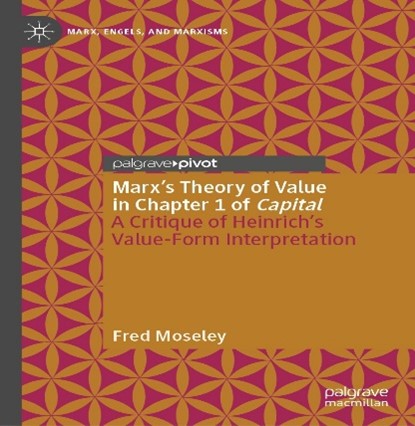 As I mentioned in a recent blog, at the Historical Materialism conference in London in November, there was a book launch for Fred Moseley’s new book Marx’s Theory of Value in Chapter 1 of Capital: A Critique of Heinrich’s Value-Form Interpretation. Michael Heinrich and Winfried Schwarz (a German Marxist who is also critical of Heinrich’s interpretation) participated in the book launch.

Moseley’s book is an examination of Marx’s theory of value in Chapter 1 of Capital, almost paragraph by paragraph in Sections 1 and 2, and a detailed critique of Heinrich’s value-form interpretation of Chapter 1, as presented in his 2021 book How to Read Marx’s Capital, which is a translation of his 2018 book Wie das Marxsche Kapital Lesen?

Heinrich is a well-known German Marxist who has published widely on his value-form interpretation of Marx’s theory of value, and his work is influential not only in Germany, but also in the UK and other countries in Europe and around the world. He criticises the traditional interpretation of the labour theory of value, according to which the value of commodities is determined solely in production, and he argues that value is created only when it is converted into money through the sale of commodities on the market.

Moseley is one of the foremost scholars in the world today on Marxian economic theory. He has written or edited many books on Marxist theory. He reckons instead that Marx presented a labour theory of value according to which the value of commodities is determined solely in production by the socially necessary labor time required to produce the commodities. And Moseley argues in his book that the textual evidence in Chapter 1 overwhelmingly supports the labour theory of value interpretation of Marx’s theory of value.

The relevance and importance of this debate may seem obscure to many readers of Marx. So Fred Moseley kindly agreed to be interviewed on his new book and the controversy with Heinrich.
MR: How did this book come about?
FM: ”First of all, I want to thank you for the opportunity to discuss my book with you and your many readers.
Heinrich’s book cited above is a detailed textual study of the first seven chapters of Capital. Heinrich is not very well known in the US, but he is very influential in Germany and other European countries. He is something like a David Harvey of Europe. But I am convinced that Heinrich’s book is a fundamental misinterpretation of Marx’s theory, so I decided to engage critically with Heinrich’s book.
I started by writing a paper on Chapter 1, the foundation of Marx’s theory and Heinrich’s interpretation. I presented this paper in a Zoom conference in June 2021 sponsored by Gyeongsang National University in South Korea. An assistant editor of Palgrave’s Marx, Engels and Marxism series, Paula Rauhala, watched the my presentation and she contacted me and suggested that I write a longer version of my paper as a Palgrave Pivot book. A Pivot book is a new initiative by Palgrave of short books, with a limit of 50,000 words (which I exceeded by 10,000 words!). I am grateful to Paula for that suggestion and this little book is the result.”
MR: Please give us an overview of your book
FM: “My little book is a detailed textual study of Marx’s Chapter 1 and Heinrich’s interpretation of Chapter 1. The book consists of only 4 chapters.
Chapter 1 of this book presents my interpretation of Marx’s theory of value in Chapter 1 of Capital, including a section on each of the four sections of Marx’s Chapter 1. Chapter 2 presents Heinrich’s interpretation of Chapter 1 of Capital and my detailed critique of Heinrich’s interpretation 1, with the same four sections.
Chapter 3 is about a 55-page manuscript that Marx wrote in 1872 in preparation for the 2nd German Edition of Volume 1, which is mainly about Section 3 of Chapter 1, entitled ‘Additions and Changes to the First Volume of Capital’, which Heinrich has emphasised in his book and in previous works to provide textual support for his ‘value-form interpretation’ of Chapter 1. This important manuscript has not yet been translated into English. A translation of a 4-page excerpt of this manuscript is included in Heinrich’s book as an appendix. So Chapter 3 of my book presents my interpretation of this manuscript and a critique of Heinrich’s interpretation. A translation of this entire manuscript should be a high priority of Marxian scholarship.
My book is very abstract theory, about the most abstract part of Marx’s theory, the beginning of Marx’s theory in which he presents the foundation of his labour theory of value. Marx said in the Preface to the 1st edition of Volume 1 of Capital that “beginnings are always difficult in all sciences”, and that is certainly true of Marx’s theory. The best way to read my book is to have Heinrich’s book and Volume 1 of Capital close at hand.”
MR: How would you summarise the main conclusions of your book?
FM: “The main conclusions of my book are the following:
1. The subject of analysis of Chapter 1 is the commodity, not a separate, isolated commodity, but a representative commodity, a commodity that represents all commodities and the properties that all commodities have in common (use-value and exchange-value). In the Preface to the 1st edition, Marx described the commodity as the “elementary form” or the “cell form” of capitalist production. So Marx analyses the properties of a representative commodity similar to the way cellular biology analyses the properties of a representative cell. It’s like putting a commodity under a microscope and analysing its main properties.
Marx’s representative commodity in Chapter 1 is assumed to have been produced, but not yet exchanged. This is crucial for the critique of Heinrich’s interpretation. According to Heinrich, the subject of analysis of Chapter 1 is not the properties of a representative commodity, but instead is what he calls an “exchange relation” between two commodities, which he argues is the end result of two actual exchanges between the two commodities and money on the market.
2. The value of commodities is derived in Section 1 of Chapter 1 from the property of the exchange-value of the representative commodity (i.e. from the property that each commodity is equal to all other commodities in definite proportions). And this general relation of equality between each commodity and all commodities requires a common property that is possessed by all commodities and that determines the proportions in which different commodities are equal.
Marx argued that this common property of all commodities that determines their exchange-values is the objectified abstract human labour contained in commodities. And this is the result of the abstract human labour expended in production to produce the commodities.
According to Heinrich, on the other hand, the value of commodities is not derived from a relation of equality between all commodities, but instead is derived from an analysis of an “exchange relation” between two commodities, which he argues presupposes actual exchanges of the two commodities with money on the market.
3. The magnitude of the value of each commodity is “exclusively determined” (p. 129) by the quantity of socially necessary labour-time expended in production to produce each commodity. Heinrich argues, on the other hand, that the magnitude of value of a commodity depends in part on the relation between supply and demand for the commodity on the market. This is the best-known assumption of the value-form interpretation of Marx’s theory of value.
4. The labour that produces commodities has a dual character in production: both concrete labour and abstract labour are characteristics of the same labour process in production. Section 2 of Chapter 1 in particular presents very strong textual evidence to support this interpretation of the dual character in production of labour that produces commodities.
Weaving and tailoring are Marx’s two examples in Section 2. The labour process of weaving produces the use-value of linen, its dual character also being abstract human labour that produces the value of the linen. The same dual character is true of the labour process of tailoring (and all other particular labour activities). The values of the linen and the coat are compared by comparing the labour-time required to produce each one of them and nothing is said in this about exchange in this section.
Heinrich argues, on the other hand, that labour in production is only concrete labour and is not yet abstract labour. Abstract labour comes to exist only in exchange, and thus the dual character of the labour that produces commodities comes to exist only in exchange. According to Heinrich’s interpretation, tailoring and weaving (and any other labour process) possess only a single character in production, not a dual character. This interpretation is clearly contradicted by Section 2.”
MR: Please say more about Heinrich’s interpretation of “exchange relation”. That seems to be a central concept in Heinrich’s interpretation.
FM: “Heinrich’s concept of “exchange relation” is completely original with him. No one else puts so much emphasis on this term and defines it the way he does. And it is a new concept in his interpretation; it was not included in his 2012 book Introduction to Marx’s Capital. And unfortunately, he does not explain this very well in this book, especially for such a fundamental concept. There is nothing in his Introduction about this concept; there are only 1½ pages in an appendix in the back of the book on the abstractions that result in this concept (which he doesn’t refer to once in the rest of the book) and 1½ pages in his first discussion of this concept on pp. 53-54. And from then on, he just presumes his interpretation of exchange relation and applies it to different passages in Marx’s text.
I am pretty sure that most readers of Marx (especially beginning readers) will not understand the meaning and significance of Heinrich’s concept of exchange relation in his interpretation. A young Marx scholar from Australia wrote a 2000-word review of Heinrich’s book for Marx and Philosophy and she didn’t mention the concept of exchange relation at all. I myself had to work pretty hard to understand it because it is so poorly presented.
Heinrich defines exchange relation as an exchange between two commodities. To take one of his examples that is borrowed from Marx:
1 quarter of wheat is exchanged for x boot-polish.
Heinrich comments that this definition seems like direct barter exchange between the two commodities, but he states that this is not so, because direct barter seldom actually happens in capitalism. Instead, Heinrich interprets the exchange relation between two commodities as the end result of two actual acts of exchange between the two commodities and money on the market. Thus…
1 qtr. of wheat is sold for 10 shillings and 10 shillings is used to purchase x book-polish
The important point is that Heinrich’s concept of exchange relation between two commodities presupposes actual exchanges between these two commodities and money on the market. Heinrich does not clearly specify whether these acts of exchange that are presupposed in his interpretation of the exchange relation are assumed to be actual acts of exchange on the market. However, they must be actual acts of exchange in order to be consistent with Heinrich’s general value-form interpretation, according to which commodities possess value only if they have been actually exchanged on the market.
Before actual exchange, according the Heinrich’s interpretation, commodities do not possess value (indeed, products are not even commodities) before exchange. Products of labour become commodities and commodities come to possess value only as a result of actual exchanges on the market. Therefore, since the commodities that Marx analyses in Section 1 (e.g. wheat and boot-polish) are assumed to possess value, in order to be consistent with Heinrich’s general value-form interpretation, he must also assume that these commodities have been actually sold and bought on the market. If the commodities have not been actually exchanged on the market, then these commodities would not possess value, according to Heinrich’s general value-form interpretation.
However, there is absolutely no textual evidence in any of Marx’s several drafts of Chapter 1 to support Heinrich’s idiosyncratic interpretation of the exchange relation between two commodities – that it presupposes actual acts of exchange between these two commodities and money on the market. This interpretation is Heinrich’s invention. He does not cite any other authors with a similar interpretation of exchange relation, because there are none. And the exchange relation is the most important concept in Heinrich’s interpretation of Chapter 1. If his fundamental concept of exchange relation is a misinterpretation of Marx’s theory, then the rest of Heinrich’s interpretation of Chapter 1 is a misinterpretation and is unacceptable.
I think it is clear that the subject of analysis of Chapter 1 is the commodity, a representative commodity that is used to analyse the properties that all commodities have in common – use-value and value. Chapter 1 is not about exchange at all. The commodity that is analysed in Chapter 1 has been produced, but not yet exchanged. Exchange is not considered until Chapter 2 (“The Process of Exchange”).
In recent weeks, while preparing for the HM conference and for this interview, I have come to realise more clearly that there is a fundamental contradiction in what Heinrich is trying to accomplish in his recent book. In his previous works, he has presented (many times and all over the world) a strong value-form interpretation of Marx’s theory of value, according to which the value of a commodity exists only as a result of an actual exchange on the market. Before exchange, a commodity does not possess value (it only possesses use-value). For the textual evidence to support this interpretation, he has used a handful of key passages that are taken from various texts in isolation and out of context. As we know, one can always find passages that seem to support almost any interpretation of Marx’s theory. And Heinrich is very good at this quotation game.
However, his most recent book is different; it is an attempt to interpret the first seven chapters of Volume 1, especially Chapter 1, as a value-form theory – and that Marx was the original value-theorist! Heinrich goes from page to page in Chapter 1 and consistently tries to interpret key passages in a value-form way. This is a very difficult task because there are so many passages in these chapters, especially Chapter 1, that contradict a value-form interpretation. Indeed, in my view, Heinrich’s task is an impossible task. My book follows his detailed commentaries point by point and exposes the errors in his value-form interpretation.”
MR: What was the main disagreement between you and Heinrich in your book launch at the recent Historical Materialism conference?
FM: “Not surprisingly, the main disagreement in the session was over the meaning of exchange relation in two paragraphs in Section 1. He argued that I misinterpreted Marx’s concept of exchange relation, not as an act of exchange between two commodities, but as a relation of equality between two commodities, and that I just substituted my meaning of exchange relation for Marx’s meaning in the two passages. And he argued that these two passages are proof that that Section 1 analyses individual commodities as part of an exchange relation.
But that is not true. I did not just substitute my meaning of exchange relation for Marx’s meaning in these paragraphs. Rather, I argued that the exchange relation in these paragraphs is a synonym for exchange-value. The exchange-value of each commodity is defined in the preceding paragraphs in Section 1 as the property of each commodity that is equal to all other commodities in definite proportions that are mutually consistent. That implies that all commodities possess a common property that determines the proportions in which different commodities are equal. Therefore, the exchange relation between two commodities in these paragraphs is also a relation of equality between two commodities, which implies the necessity of a common property possessed by each one of them.
Instead I argued that Heinrich is the one who misinterprets Marx’s concept of exchange relation with his strange definition as the end result of actual exchanges between the two commodities and money on the market,. There is absolutely no textual evidence to support this interpretation of actual market exchanges presupposed in Chapter 1. My interpretation of exchange relation as a relation of equality between commodities is much more reasonable and plausible than Heinrich’s complicated and idiosyncratic interpretation of the end result of actual exchanges between commodities and money on the market. “
MR: Are there other points that you would like to emphasise?
“I also want to mention Heinrich’s unusual interpretation of the word “common” in Marx’s derivation of value in Section 1 – that value is the common property of commodities that determines their exchange-values – because it is an important point in his interpretation that he has emphasised in all his writings, including in the book I am criticising.
Take the concluding paragraph of Marx’s derivation of value on p. 128: “All these things now tell us is that human labour-power is expended to produce them, human labour is accumulated in them. As crystals of this social substance, which is common to them all, they are values – commodity values. ” I argue that Marx’s meaning of “common to them all” in this passage is the usual meaning of “common” , namely that the same property is possessed by each individual commodity by itself, on its own.
Heinrich argues, on the other hand, that the meaning of “common” in this passage and in other passages is ambiguous – i.e. it could also mean a property that each individual commodity possesses, not by itself, but only together with another commodity in an exchange relation (exchange relation again!), and this is what Marx means here and elsewhere when he says that value is a common property of commodities. According to Heinrich, outside of an exchange relation, an individual commodity does not possess the ‘common property’ of value.
However, I don’t think Marx’s meaning of “common to them all” is ambiguous at all; Marx states that the common property of commodities is the human labour accumulated in them as a result of the labour expended to produce them (each one of them), prior to and independent of its exchange with another commodity. Nothing is said about exchange and exchange relation in this key concluding passage.
Three paragraphs before the passage just quoted, Marx presents a geometric example of area as a common property of different geometric figures. Area is a ‘”common property” of each figure, independent of its comparison to the area of another figure. The similarity between the area of geometric figures and the value of commodities is that, in both cases, the objects possess a common property independently of a quantitative comparison between them. Heinrich does not comment on this illuminating geometric example which contradicts his interpretation that the common element of value is created in the exchange itself. Clearly, the area of geometric figures is not created by a comparison of their areas.
One other point I want to mention. In working on this book, I noticed for the first time that Marx repeatedly used the phrase the “own value” of an individual commodity in Section 3 of Chapter 1 (seven times); for example, the “own value” of 10 yards of linen or the “own value” of a coat (see pp. 100 and 104-06 of my book). The own values of the linen and the coat are compared and equated, but nothing is said about exchange. These passages are clear and unambiguous textual evidence that each individual commodity possess its “own value”, independent of acts of exchange between commodities and money on the market. This directly contradicts Heinrich’s interpretation that an individual commodity possesses value only if it has been actually exchanged with money on the market. Heinrich quotes only 3 of these 7 ‘own value’ passages and presents little or no commentary on any of them. Twice he quotes the adjoining sentences, but not these revealing sentences.”
MR: What difference does this debate over the details of Marx’s value theory make in the bigger picture?
FM: “I think it is important to get the details of Marx’s theory of value straight, because it is the foundation for Marx’s theory of surplus-value as a theory of exploitation in Volume 1. And the theory of value is also the foundation of his theory of the falling rate of profit and crises that you have presented so well in your own work. In the Preface to the 1st edition of Capital, Marx stated: “To the superficial observer, the analysis of these forms [the commodity-form of the product of labor and the value-form of the commodity] seems to turn upon minutiae. It does in fact deal with minutiae, but so does microscopic anatomy.” Microscopic anatomy is necessary for the understanding of organic bodies, and similarly Marx’s theory of value is necessary for an understanding of the capitalist economy.
My book is specifically about Heinrich’s book, but it applies to the value-form interpretation of Marx’s theory in general. And my conclusion is that Marx’s theory of value cannot be reasonably be interpreted as a value-form theory. I think that is an important conclusion. We should move on from the value-form interpretation of Marx’s theory.
I worry about Heinrich’s influence on the understanding of Marx’s theory. His interpretation is very influential in Germany and elsewhere in the world, especially among young people. And I am convinced that it is a fundamental misinterpretation of Marx’s theory. So I think it is important to engage with his popular but mistaken interpretation. I hope that my book will be read especially by young people and it will encourage them to make a deeper study of Marx’s theory of value in Chapter 1 of Capital and beyond.
Let me add my pennyworth to what I think are the wider issues arising from this debate between Heinrich and Moseley (MR).
Marx put it this way: “As the commodity is immediate unity of use value and exchange-value, so the process of production, which is the process of the production of a commodity, is the immediate unity of process of labour and process of valorisation.” So, for Marx, it’s the process of production, the exertion of human labour that creates value. As Marx once put it: “Every child knows that any nation that stopped working, not for a year, but let us say, just for a few weeks, would perish. And every child knows, too, that the amounts of products corresponding to the differing amounts of needs demand differing and quantitatively determined amounts of society’s aggregate labour.”
The value-form approach of Heinrich is implicitly a simultaneist approach. Its characteristic feature is the belief that value comes into existence only at the moment of realisation on the market. Consequently, production and realisation are collapsed into each other and time is wiped out. But the process of production and circulation (exchange) is not simultaneous, but temporal. At the start of production there are inputs of raw materials and fixed assets from a previous production period. So there is already (constant or ‘dead labour’) value in the commodity before exchange. Then production takes place to make a new commodity using human labour. This creates ‘potential’ new value, which is realised later (in a modified quantity) when sold.
But why does all this matter? For me, Marx’s value theory is about showing the fundamental contradiction in capitalism between production for social need (use-value) and production for profit (exchange value). Under capitalism, units of production are commodities that have a dual character which epitomises this contradiction.
For Marx, money is a representative of value, not value itself. If we think that value is only created when selling the commodity for money and not before, then the labour theory of value is devalued into a theory of money. Then, as mainstream neoclassical economics argues, we don’t need a labour theory of value at all because the money price will do. Money prices are what mainstream economics looks at, ignoring or dismissing value by human labour power – and therefore the exploitation of labour by capital for profit. It removes the basic contradiction of capitalist production.
Also, it leads to a failure to understand the causes of crises in capitalist production. It is no accident that Heinrich dismisses Marx law of profitability as illogical, ‘indeterminate’ and irrelevant to explaining crises and instead looks to excessive credit and financial instability as the causes. Heinrich even claims that in later years, Marx dropped his law of profitability although the evidence for that is non-existent.
If profits (surplus value) from human labour disappear from any analysis to be replaced by money, then we no longer have a Marxist theory of crisis or any theory of crisis at all.
Monday, June 29, 2020
3387. Marx’s Law of Value: A Debate Between David Harvey and Michael Roberts
By Michael Roberts, Michael Roberts Blog, April 2018

 |
| David Harvey (top) and Michael Roberts |
This is going to be a long post, so bear with me. First, you will have to read a paper (attached below) by Professor David Harvey, then a critique by me below – and finally a reply to my critique by Professor Harvey. And then it’s up to you readers to see what you make of it: is this like a medieval religious debate about how many angels there are on the head of a pin; or is it a debate that leads to something really worth knowing?
For more on the nature of Marx’s law of value and its relation to crises, see my new book, Marx 200
David Harvey’s misunderstanding of Marx’s law of value (Michael Roberts)
Recently, Professor David Harvey (DH) sent out an email to several people, including me, attaching a short paper for discussion (see Harvey paper). The paper outlines DH’s view that Marx’s theory of value in capitalist economies has been badly misunderstood.
Just in case you are unaware (difficult to believe), Professor Harvey is probably the most eminent Marxist scholar alive today with a host of books, papers and educational videos to his name on Marxist economic theory. The short paper circulated expressed succinctly his view of Marx’s value theory that he has recently outlined more expansively in his latest book, Marx, Capital and the madness of economic reason.[i]
In the paper, entitled Marx’s refusal of the labour theory of value, DH argues that Marx did not have a ‘labour theory of value’ at all. His theory of value was distinctive from that of the classical economist, David Ricardo. Instead, according to DH, Marx argued that value was a reflection of labour embodied in a commodity which is only created/revealed in exchange in the market. As DH puts it: “if there is no market, there is no value”. If this correct, then it is in the realization of value as expressed in money that value emerges, not in the production process as such.
DH then goes on to argue that if wages are forced down to the minimum or even to nothing, then there will be no market for commodities and thus no value – and this is the “real root of capitalist crises”. And thus it follows that a policy for capital to avoid crises would be by “raising wages to ensure “rational consumption” from the standpoint of capital and colonizing everyday life as a field for consumerism”. This is the consequence of a correct view of Marx’s value theory, according to DH.
DH points out that this interpretation of value theory “is far beyond what Ricardo had in mind and equally far away from that conception of value usually attributed to Marx.” It certainly is. But is DH right in his interpretation of Marx’s value theory and, even if he is, does such interpretation have any empirical validity? I would answer both these questions with: ‘no’, ‘non’, ‘nein’, to use Marx’s three best known languages.
DH starts by saying that “It is widely believed that Marx adapted the labour theory of value from Ricardo as a founding concept for his studies of capital accumulation” and “since the labour theory of value has been generally discredited, it is then often authoritatively stated that Marx’s theories are worthless.” It is not clear who DH is referring to here. Clearly bourgeois mainstream economists consider Marx’s law of value as discredited. The neoclassical marginalists have long rejected the concept of labour-value by labelling it ‘metaphysical’. Neo-Ricardian, post-Sraffian, and post-Keynesian economists, in particular, are also strongly inclined to dismiss any notion of ‘value’ as an ideological mystification.
But most Marxist economists are aware of the distinction between Marx’s value theory and Ricardo’s. And the difference is not what DH says it is, namely, Ricardo had a ‘labour theory of value’ and Marx did not. The difference is that Ricardo had a theory of (use-) value based on ‘concrete labour’ (physical amounts of labour) measured in labour time. Marx’s law of value was based on ‘abstract labour’ (value measured in labour time when ‘socially’ tested on the market).
Under capitalism, human labour power itself is a commodity to be sold on the market. Indeed, this is a key characteristic of the capitalist mode of production where the majority has no means of production and so must sell their labour power to the owners of the means of production. So, just as with other commodities, labour has a dual property. On the one hand, it is useful labour, that is, expenditure of human labour in a concrete form and for a specific purpose and with this property creates use values. On the other hand, it is abstract labour, that is, expenditure of human ‘labour power’ without specific characteristics which creates the value of the commodity in which it is represented. Thus Marx made the distinction between labour and labour power, a distinction that is absolutely crucial for the understanding of the source of profit.
This was the great advance in Marx’s law of value. The labour time embodied in the commodities normally purchased by the worker for the reproduction of himself and his family in a day is less than the labour time that a worker actually offers to the owner of capital during the same time period. The result is that for any given time period, the worker produces more value than the wage equivalent which is paid by the owner of capital for the use of the labour power. This difference, Marx calls “unpaid labour” and “surplus labour”- or surplus value. Marx’s value theory of abstract labour exposes the exploitative nature of the capitalist mode of production, while neither Ricardo’s nor Adam Smith’s labour theory of value does.
DH mentions just once (and in passing) this vital discovery of Marx (i.e. abstract labour) that distinguishes Marx’s law from the classical labour theory of value. And that is because DH wishes to press on to his interpretation of Marx’s theory as one where value is created/realized only in exchange, and not in the process of production using labour power. DH says that “value is initially taken to be a reflection of the social (abstract) labour congealed in commodities.” But “as a regulatory norm in the market place, value can exist, Marx shows, only when and where commodity exchange has become “a normal social act.” So, without money, there is no value.
Yes, but the value of a commodity is still the labour contained in it and expanded during the production process before it gets to market. Value is expended physical and mental human labour which is then abstracted by the social process of production for the market. Value is not a creature of money – on the contrary. Money is the representation or exchange value of labour expended, not vice versa. I think Marx is clear on this crucial point. He says in Capital Volume One: ‘The value of a commodity is expressed in its price before it enters into circulation, and it is therefore a pre-condition of circulation, not its result.”[ii]
Murray Smith in his new and forthcoming edition of his book, Invisible Leviathan[iii], provides a concise explanation of the difference between Marx’s law of value and DH’s interpretation. Marx said that: “Money as the measure of value is the necessary form of appearance of the measure of value which is immanent in commodities, namely labour-time.” Smith comments that this “is certainly inconsistent with the idea that value can be created in the act of exchange. ..It is precisely because exchange effects a process of ‘equalisation of products of lab our on the market’ (that is, involves a real abstraction) that production oriented toward exchange must take account of the fact that ‘physiological labour’ is both utility-shaping and value-creating – that is, both concrete and abstract at one and the same time. To try and argue that that value is created ‘not in production but at the articulation of production and circulation’ is a notion replete with circular reasoning and requiring the most robust of mental gymnastics to entertain…. The problem with this approach is that if one accepts that abstract associated labour has no substantial existence apart from the value form, money, then commodity values appear to be severed entirely from any determination in the conditions of their production, and the way is paved for an effective identification of value and price.”
Instead, Marx’s law of value is based on the view that the labour involved in the production of commodities produces value, while exchange realises it in money-form. It is only because of this that Marx can distinguish between the amounts of value and surplus-value created in commodity production, and the generally different amounts realised through exchange.
Contrary to the view of the mainstream and neo-Ricardian economists, there is no ‘mystification’ here. Value is objective and real and not just expressed in money. Marx’s law of value, where abstract labour (measured in labour time) explains exchange value and prices, can be empirically validated.[iv]
There is reason behind DH’s interpretation. If value is created only at the moment of exchange for money and ‘money rules’, then it will be (effective) demand that will decide whether capitalism smoothly accumulates without recurring crises. To show this, DH describes in some detail the impact of capitalist accumulation on the conditions and living standards as capitalists strive to raise relative surplus value through the introduction of machinery. He uses some of the graphic examples provided Marx in Chapter 25 of Volume One. DH emphasises that capitalist accumulation aims to minimize the value of labour power – even to the point of pauperism.
DH concludes that “If this is a typical outcome of the operation of the capitalist law of value accumulation, then there is a deep contradiction between deteriorating conditions of social reproduction and capital’s need to perpetually expand the market. As Marx notes in Volume 2 of Capital, the real root of capitalist crises lies in the suppression of wages and the reduction of the mass of the population to the status of penniless paupers.” So the ‘real root of crises’ is found in the “suppression of wages” and the “reduction of the mass of population to the status of penniless paupers”. This is an underconsumptionist theory of crises.
There are several points here. First, Chapter 25 entitled, The general law of capitalist accumulation, does not just refer to the pauperization of the working class. DH leaves out a very important aspect of that general law: the tendency for the organic composition of capital to rise[v]. This is what drives up relative surplus value but is also a key factor in the tendency of the rate of profit to fall (developed in Volume 3), ‘the most important law of political economy’[vi], which lays the basis for Marx’s theory of crises. DH ignores this aspect.
But DH goes further in his underconsumptionist interpretation. “Value depends on the existence of wants, needs and desires, backed by ability to pay in a population of consumers……It also means that the diminution of wages to almost nothing will be counterproductive to the realization of value and surplus value in the market. Raising wages to ensure “rational consumption” from the standpoint of capital and colonizing everyday life as a field for consumerism are crucial for the value theory.” Thus DH argues that capitalism goes into crises because wages are suppressed; and so raising wages, ensuring ‘rational consumption’, would provide the ‘ability to pay’ and so end the crisis.
This underconsumptionist interpretation of Marx’s crisis theory has been firmly dismissed – by Marx himself – in the famous note in the same Volume 2 that DH refers to (underlines are my emphasis).
“It is sheer tautology to say that crises are caused by the scarcity of effective consumption….That commodities are unsaleable means only that no effective purchasers have been found for them. But if one were to attempt to give this tautology the semblance of a profounder justification by saying that the working-class receives too small a portion of its own product and the evil would be remedied as soon as it receives a larger share of it and its wages increase in consequence, one could only remark that crises are always prepared by precisely a period in which wages rise generally and the working-class actually gets a larger share of that part of the annual product which is intended for consumption. From the point of view of these advocates of sound and ‘simple‘ (!) common sense, such a period should rather remove the crisis.”[vii]
In my view, Marx rejected both the law of value as DH interprets it and also the conclusion that crises caused by an inability to pay for the ‘wants, need and desires’ of people. But Marx could be wrong and DH right on the cause of crises. Empirical evidence does not support DH, however.
Let me cite just three facts. The first is that workers’ consumption is not the largest sector of ‘demand’ in a capitalist economy; it is productive capital consumption. Gross domestic product or expenditure is a measure of annual demand for ‘wants, needs and desires’. In the US, consumption would seem to constitute 70% of GDP. However, if you look at ‘gross product’ which includes all the intermediate value-added products not counted in GDP, then consumption is only 36% of the total product; the rest constitutes demand from capital for parts, materials, intermediate goods and services. It is investment by capitalists that is the swing factor and driver of demand, not consumption by workers.
This is shown in the second fact. If we analyse the changes in investment and consumption prior to each recession or slump in the post-war US economy, we find that consumption demand has played little or no leading role in provoking a slump. In the six recessions since 1953, personal consumption fell less than GDP or investment on every occasion and does not fall at all in 1980-2. Investment fell by 8-30% on every occasion.
Percentage change in US real personal consumption (PC), investment and GDP

The third fact relates directly to wages and DH’s claim that raising them would help capital. Carchedi finds that of the 12 post-WWII crises, 11 have been preceded by rising wages and only one by falling wages (the 1991 crisis)[viii]. That confirms Marx’s view in the note in Volume 2 above.
I conclude from DH’s short paper that he aims to establish an argument that class struggle is no longer centred or decided between labour and capital at the point of production of surplus value. Instead in ‘modern’ capitalism, it is to be found in other places in his ‘circuit of capital’ that he presents in latest book and in various presentations globally. For DH, it is in the point of realisation (ie over rents, mortgages, price gouging by pharma firms etc) or in distribution (over taxes, public services etc) that the ‘hotspots’’ of class struggle are now centred. The class struggle in production is now less important (even non-existent).
In my view, to support this, DH presents a series of theoretical confusions in this paper. First, Marx did not have a labour theory of value. Second, value is only created in exchange (in realisation). Third, the rate of profit (or even profit alone) is irrelevant to crises: what matters is the driving down of the value of labour power to the minimum (or even zero!) so that workers are unable to meet their ‘wants, desires, etc’. This becomes a crude underconsumption theory – cruder than Keynes.
DH deliberately ignores the difference (and duality) between concrete and abstract labour, and its counterpart, use value and exchange value. The dual nature of value in a commodity, as Marx discovered, is reduced by Harvey to the lack of the ability of workers to buy their use values. Use value (wants and desires) is the key, not exchange value in value, for DH. Marx’s theory of crisis (based on insufficient surplus value) is replaced with insufficient use values for workers as consumers. Overaccumulation is replaced by underconsumption. The class struggle becomes not workers versus capitalists; but consumers versus capitalists or taxpayers versus governments.
It’s not Marx’s view. More important, the whole approach is confusing to a class analysis and strategy for the working class struggle.
And now here is David Harvey’s response to my critique of his paper on Marx’s value theory.
The misunderstandings of Michael Roberts (David Harvey)
There are, obviously, some serious points for discussion over Marx’s value theory and I hope that some dialogue with Michael Roberts can help clarify them. Before getting to them, I need to remove a number of misreadings and misrepresentations of my position in Roberts’ response. Let me be clear. Value is always created in the act of production. But it is realized in the moment of market exchange. I therefore think of value in terms of what Marx calls “the contradictory unity of production and realization.” Value cannot be produced through market exchange. But it cannot be realized outside of market exchange. Marx is clear enough about that.
The essence of value is abstract labour or, as I prefer to refer to it, “socially necessary labour time”. Roberts is obviously correct to say that Marx’s definition is entirely different from the concrete labour time that Ricardo postulated. No matter whether we say “abstract labour” or “socially necessary”, however, the onus then falls on how the abstraction is made and how socially necessary is to be understood. The answer to such questions has to be grounded in material processes and not constructed through idealist exercises. So by what materialist process is value constructed if it is not “immanent” in commodities but historically created.
The answer is given in Marx’s starting point in Capital which is the idealized material act of commodity exchange. If the capitalist takes a commodity to market and there is no want, need or desire for it, then the labour congealed in it is socially unnecessary and it therefore has no value (this is what Marx says at the end of the first section of Capital – p.131 in Penguin/Vintage edition). This does not mean that value is created in the market (which Roberts incorrectly accuses me of saying). But – and here this may be my peculiar way of looking at it – I take the value created in production to be only a potential value until it is realized. An alternative way would be to say that the value is produced but then the value is lost if there is no demand for it in the market. In which case, we would need to construct a strong theory of devaluation to account for what happens in the market place. Devaluation rarely appears in Roberts’ accounts and has no role in his response. Given my interest in the relation between value and not-value or anti-value this latter formulation might also work for me. But in either case I think it undeniable that the state of wants, needs and desires backed by ability to pay has an important role to play in sustaining the circulation of capital. This does not mean, as Roberts again and again infers, that this is the only relevant factor in crisis formation. I have gone out of the way many times to say that this is just one important moment in the circulation of capital where devaluations (sometimes but not always of crisis proportions) can occur.
But again and again Roberts loves to relegate me into that pejorative category of underconsumptionist whenever I mention such matters. It was Marx, not me, who said “the real root of crises” lies in the diminished purchasing power of the working classes and if I cite Marx on that point it is because it is a neat antidote to all those who endlessly cite the falling rate of profit. Crises come in many shapes and forms, I have argued. The falling rate of profit or the collapse of consumer demand are two of many other explanations (I note in passing that Marx in his comments on the crises of 1847- and 1857 – crises that had an uncanny resemblance to 2007-8 – described the crises as commercial and financial crises without any mention of either falling profit rates or insufficient consumer demand).
My objection to any exclusionary productivist interpretation (to cite a matching pejorative characterization!) is that it casts to one side the whole history of creation of wants, needs and desires (let alone the mechanics of ensuring an ability to pay) in the history of capital accumulation. I think we should pay much more attention to this aspect of things. This does not mean I downplay, deny or refute all the work that has been done on the labour process and the importance of the class struggles that have occurred and continue to occur in the sphere of production. But these struggles have to be put in relation to struggles over realization, distribution (e.g. rental extractions, debt foreclosures), social reproduction, the management of the metabolic relation to nature and the free gifts of culture and nature. These have all figured large in recent anti-capitalist movements and I insist that we take them all seriously along with the more traditional focus on the Marxist left favoring class struggle at the point of production as the key moment for struggle. This is why I think the diagram I offer of circulation and the definition of capital as value in motion is so important. Strange to have it all dismissed in the citation from Murray Smith as “circular reasoning”!!
This perspective opens up some interesting lines of enquiry and points of difference. Marx’s account over struggles over the working day and the forces that drive technological and organizational changes in the search for relative surplus value all depend upon the “coercive laws of competition”. That term comes up at various key points in Marx’s argument throughout Capital. Where is this force mobilized and most clearly felt? In the market of course! We cannot understand what goes on in the realm of production (or social reproduction for that matter) without market forces playing their part. It is the coercive laws of competition in the market that mandate capitalist reinvestment and the lengthening of the working day etc.
But this tracks back to how Marx sets up how the abstraction of value – which, by the way, is in Marx’s view, a social relation hence “immaterial but objective” and not “immanent” and “real” as the quote from Murray Smith proposes (“not an atom of matter enters into the objectivity of commodities” says Marx in Capital– p.138). Value arises not as a product of thought but as a product of a historical material process. Marx’s study of equivalent and relative forms of value leads into the generalization of exchange which underpins the rise of value as a regulatory norm operating in the market and it is this regulatory norm of value that then returns to dominate behaviors not only in the market but also in the realm of production and social reproduction. This is a very dialectical move that Marx make but quite commonly encountered in Marx’s work. Only in this way, for example, can we understand how it is that workers make the capital which then returns to dominate them and how we can all become prisoners of our own products (academics beware!!).
Finally, let me comment on the empirical example on which Roberts reduces final demand to 30 from 70 percent. To be sure, there is a complicated question of how to deal with value relations across commodity chains (there is an interesting piece by Starosta on Commodity Chains and Marx’s Value Theory in Antipode for 2011). But imagine a situation where iron ore is mined and the mining company produces value and surplus value that is realized through a sale to a company that produces steel which realizes more value and surplus value through a sale to an auto company that produces yet more value and surplus value that is realized by a sale of autos to final consumers who want and need an auto and have the money to buy one. The value of the auto is all the accumulated past abstract labour applied. Suppose for some reason the final consumers cannot pay or get fed up with autos. Then all the accumulated value is lost (devalued). In practice, as Marx observed, the chain of payments might take a while to work through but when it does then all value production in the chain disappears.
Of course, all sorts of other scenarios can be imagined. But the point here is that no one apart from crazy people and speculators will want to accumulate steel in the absence of a market for it. So what happens to value in all of this becomes problematic and Robert’s account makes it seem as if investment in the production of means of production is independent of final demand and can occur without any mind for final market conditions. Of course, there are certain kinds of investments with all sorts of time lags (fixed capital and infrastructures) like the Chinese overproduction of cities funded by doubling down on indebtedness, where things get very complicated (as I outlined in the final chapter of the madness of economic reason book). But Roberts’ empirical example makes no sense to me whatsoever as an elucidation as to why realization and the politics of realization are irrelevant or at best a sidebar to the main action at the point of production.
All this and we have yet to get to the thorny questions of money and the politics of distribution along with the circulation of interest-bearing capital in relation to value theory. Can banks produce value? They are clearly producing representations of value hand over fist…..Are they a mere side-bar too?
For more on the nature of Marx’s law of value and its relation to crises, see my new book, Marx 200
Notes:
[i] https://profilebooks.com/marx-capital-and-the-madness-of-economic-reason.html
[ii] Capital Volume One, p260 trans. Ben Fowkes, New York: Vintage 1977
[iii] Murray Smith, Invisible Leviathan, Historical Materialism, forthcoming 2018
[iv] Cockshott and Cottrell broke down the economy into a large number of sectors to show that the monetary value of the gross output of these sectors correlates closely with the labour concurrently expended to produce that gross output. Anwar Shaikh also did something similar. He compared market prices, labour values and standard prices of production calculated from US input-output tables and found that on average labour values deviate from market prices by only 9.2 per cent and that prices of production (calculated at observed rates of profit) deviate from market prices by only 8.2 per cent. Lefteris Tsoulfidis and Dimitris Paitaridis investigated the question of price-value deviations using the input-output Table of Canada. They found for the Canadian economy the results are consistent with Marx’s law of value. And G Carchedi, in a recent paper, showed that the validity of Marx’s law of value can be tested with official US data, which are deflated money prices of use values. He found that money and value rates of profit moved in the same direction (tendentially downward) and tracked each other very closely.
[v] “The accumulation of capital, though originally appearing as its quantitative extension only, is effected, as we have seen, under a progressive qualitative change in its composition, under a constant increase of its constant, at the expense of its variable constituent.” Capital Vol 1, Chapter 25
[vi] Grundrisse p748
[vii] Capital Volume 2, Chapter 20
[viii] https://thenextrecession.files.wordpress.com/2017/09/carchedi-the-old-and-the-new.pdf
Subscribe to:
Posts (Atom)