Wednesday, June 7, 2017

2623. The Red and the Rainbow: The Life and Work of Daniel Guérin

By Cole Strangler, Dissent, Spring 2017
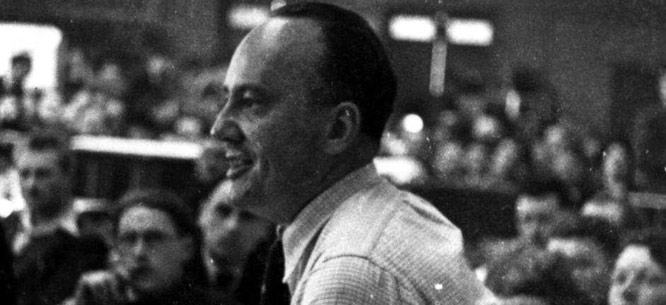
Daniel Guérin speaking at a Popular Front meeting, 1936. Source unknown.
Class traitors are a rare breed. Some young bourgeois like to experiment but most end up repenting for their political transgressions. There are more Hitchenses than Guevaras; more David Horowitzes than Tariq Alis; more Brit Humes than John Reeds. After one’s newfound politics suffer a few rounds of defeat or fall out of fashion—or both—the home-spun comforts of privilege seem to have a way of making themselves hard to resist.
Fortunately, French activist and writer Daniel Guérin stayed the course—and with style, crafting an iconoclastic blend of history, journalism, criticism, and literature across the twentieth century. Born in 1904 into a well-to-do liberal family on the Left Bank of Paris, Guérin ditched what would have been a comfortable life in the bookselling business in order to live out his political convictions. He blossomed into an uncompromising champion of the labor movement, a sharp critic of authoritarianism both left and right, and an early defender of what we now call gay rights. Long before today’s debates pitting identity against class politics, Guérin showed how the two were inextricably bound in capitalism’s systems of exploitation and equally intertwined in the struggle to replace it.
Guérin is perhaps best known in his native country for a pair of historical polemics that undermined Communist Party mythologies from the left. Class Struggle in the First French Republic (1946) is a seminal account of the French Revolution that laid blame on Robespierre and the Jacobins, long venerated as “heroes of the people,” for betraying the mass movement of the sans-culottes. The other, Popular Front: A Missed Revolution (1963), decried France’s Communist-Socialist coalition government of 1936–1937 for putting the brakes on a worker-led revolution.
The rest of Guérin’s work is similarly inquisitive and teeming with disregard for his country’s left-wing establishment. In it, one finds sobering skepticism of the Soviet regime, clairvoyant critiques of fascism and colonialism, and an avant-garde defense of the sexual minority to which he belonged. Present throughout is a deep faith in the ability of ordinary people to make extraordinary social change. His perceptiveness for different forms of exploitation and his resilience in the face of political times grimmer than we can imagine make him essential reading for the left today.
Guérin’s penchant for self-criticism and reevaluation saw him drift between party labels and families within the Marxist tradition. He started off on the left fringes of what would become the Socialist Party, flirted with Trotskyism, and died a “libertarian Marxist,” intent on reviving the anarchist movement’s historic ties with organized labor. Through it all, he never lost sight of the original socialist ideal: a collectively owned and operated economy serving human needs, as the basis for a society at once freer and happier.
In Autobiographie de jeunesse : D’une dissidence sexuelle au socialisme (Autobiography of Youth: From Sexual Dissidence to Socialism), we get his conversion story. Until the small left-wing publisher La Fabrique released an edition last October, it had been out of print since 1972. Guérin first published the work in 1965, before the events of May 1968 paved the way for a second version to incorporate more self-reflection on gay identity. As with much of Guérin’s work, no English translation of Autobiography exists. This is a shame. He rightly belongs with figures like C.L.R. James and E.P. Thompson in the twentieth-century canon of engaged left-wing historians and journalists.
Guérin showed literary talent at a young age. A book of poems he published at age eighteen was particularly well received. Future Nobel Prize winner François Mauriac declared to have found in Guérin’s poetry an “exceptional gift.” The novelist Colette, some thirty years his senior, wrote to young Daniel that his work marked “the birth of a true poet.” “I hope you stay eighteen forever,” she added.
Guérin found little value in formal education. After attending the prestigious prep school Louis-le-Grand, he enrolled in the Institute of Political Sciences, or Sciences Po, the university of choice for France’s political elite. He quickly grew bored. “For me, studies are idiocies that make life hardly worth living,” Guerin quips.* At Sciences Po, he felt unmistakably out of place among his classmates, “future ministers and inspectors of finance, experts in their fields, hungry to succeed and to be in charge.”
After Daniel graduated and completed his obligatory military service, his father Marcel, a well-connected art dealer, used the family’s good name to land his son a job working for a bookstore in Paris. This, too, though, left Daniel restless. When a job offer surfaced at one of the company’s branches in Beirut—at the time under France’s flimsy postwar protectorate—Guérin jumped at the opportunity. The voyage would prove pivotal.
In Damascus and Beirut, Daniel describes witnessing the hypocrisies and brutalities of French colonialism. Amid meetings with high-ranking authorities and modest forays into journalism, Guérin catches wind of a grave miscarriage of justice: a murder ordered by a powerful Christian bishop results in the prosecution of two Arab hitmen, while the mastermind of the plot walks free. Not only do colonial authorities turn a blind eye, they award the bishop a position in the Legion of Honor.
In December 1929, Guérin’s employer opted to close its Levantine branch, forcing the writer back to Paris. Even as like-minded Americans flocked to the city for its “moveable feast,” Guérin was eager to get out. Almost immediately after his return, he set out again across France’s vast colonial empire—this time to Indochina, encompassing present-day Vietnam, Cambodia, and Laos. By this time, he had developed a detached and bookish interest in politics.
On the journey over, the budding intellectual studied the socialist classics, plowing through works from Marx, Trotsky, Kautsky, and Lenin. But as Guérin himself acknowledges, the reading alone wasn’t enough to inspire political conversion. It isn’t until he visits villages in northern Vietnam that he feels a genuine transformation take hold: “Slowly but surely, the marvel inspired by landscapes and folklore gave way to political observation. I learned, at the same time, how Europeans treated indigenous peoples and how the colonized despised their yoke.”
The precise motivation for the trip is unclear—it seems guided mostly by a kind of angsty wanderlust. But the colonial enterprise quickly becomes an obsession. Like a good reporter, Guérin meets with representatives of both sides to chip away at the truth of the matter at hand. With authorities and businessmen, he plays the part of dispassionate observer. With Vietnamese nationalist intellectuals, he assumes the more comfortable role of sympathizer and traitor to the French Republic. Upon return to Paris, he declares to have “more or less found [him]self.” Much to the chagrin of his family, he moves to the working-class neighborhood of Belleville and begins a new career as a rank-and-file labor activist. The transformation is complete.
Autobiography ends here, but Guérin’s political life was just getting started. After a few years roughing it in Belleville and Brest—a shipyard job in the early 1930s was likely more dirty and dangerous than Orwell’s gig as a Parisian busboy just a few years prior, memorably recounted in Down and Out in Paris and London—he set off on a bike tour of Nazi Germany seeking to better understand fascism before returning to foment revolt in Popular Front–era France. For this, and accounts of a trip to the United States in the 1940s, readers will have to turn to Guérin’s other autobiography, Le Feu du Sang (Fire in the Blood), published in 1977.
At any rate, it was during this two-decade period that Guérin produced most of his defining work. It remains painfully relevant today.
Fascism and Big Business (1936) sheds light on the intimate ties between economic elites and the bloodthirsty regimes that took root in Germany and Italy. A comparative study published on the eve of the Second World War, the book charts how industry-backed fascist groups seeking to eliminate the threat of organized labor and socialist revolution rode popular unrest to seize state power and build regimes that relentlessly served corporate profits. Guérin expounds on the class base of fascism—dispossessed small business owners joined by a swath of disillusioned workers—and the mystical appeal of the strongman ruler. He chides the labor movement and left-wing parties for their misplaced faith in bourgeois legal institutions and their general inability to grasp the depth of the threat before them. Perhaps most importantly, Guérin demonstrates how easily capitalist profit can go hand in hand with ruthless authoritarianism.
The latter point is especially vital to recognize in the age of Trump, whose victory was as nauseating for anyone concerned about the prospects of American democracy as it was thrilling for Wall Street. As Guérin shows, there’s nothing contradictory about this. The largest corporations in Italy and Germany didn’t just survive under fascist rule—they thrived, thanks to the war machine, a steady stream of state subsidies, and the decimation of trade unions.
Since the Second World War, the “fascist” label has become so saturated with meanings that employing it is rarely worth the headaches it induces. Current admirers seldom embrace the term in public; it’s typically meant as an insult; it’s famously hard to define; and it’s often used to connote a kind of closed-mindedness rather than an actual system of government. Against this backdrop, Guérin’s level-headed analysis ages well. It’s refreshingly cogent and to the point, beckoning contemporary readers to measure today’s right-wing populists with their ghastliest forerunners.
Writing in 1936, Guérin doesn’t examine fascism as an abstract ideology but as a concrete political process taking place in two neighboring states. While it’s probably futile to debate whether the current U.S. president is a fascist—the term bound to a set of economic and political circumstances that characterized 1930s Europe—Guérin reminds us that Trump’s rise has much in common with these prior movements.
Like those Europeans who saw their work lives crushed by technological change and economic crisis, Trump’s base, too, has felt the ravages of a rapidly changing economy. Like his predecessors across the Atlantic, Trump masterfully camouflages a radically pro-business agenda with populist messaging. His countless attacks against Muslims and immigrants recall the scapegoating practiced by the twentieth century’s most vicious ethno-nationalists, including the Nazis. And the mix of military and corporate power at the highest levels of government is uncannily reminiscent of arrangements under Hitler and Mussolini.
While we know what this toxic blend went on to produce in Europe, it remains unclear what will become of its American variant. At the very least, Fascism and Big Business suggests the United States is headed down an extremely dangerous path. Not only do major corporations not share this concern, but many actually stand to gain from it. One can only hope that the embattled left and labor movements rise to the occasion since, if history is any guide, the liberal-Democratic opposition will only go so far.
Guérin did not stop at analyzing fascism; as a member of the French Socialists’ Revolutionary Left tendency, he and fellow activists fought in vain to steer the party toward working-class interests and embrace revolution over reform. In the aftermath of a failed fascist coup at home, France’s socialists and communists joined forces to form the Popular Front alliance and won a parliamentary majority in the elections of 1936, sparking a massive and unexpected wave of nationwide strikes. While the spontaneous work stoppages troubled the country’s ruling coalition, Guérin’s comrades cheered the surging movement and the writer-activist himself helped manage a strike support committee in the eastern suburbs of Paris. After the Socialists disbanded the feisty minority fraction in 1938, Guérin co-founded the Workers’ and Peasants’ Socialist Party, itself outlawed by the newly installed Vichy regime just two years later.
On the dawn of war in 1939, Guérin moved to Oslo to work on behalf of the International Revolutionary Marxist Centre, a London-based group of small socialist parties that upheld an internationalist and pacifist line, a delicate position in defiance of the Second and Third Internationals. In April 1940, he was detained by invading Nazi troops and spent several months in a civilian internment camp in Bavaria—only to be released, remarkably, for health reasons and sent back to Oslo by the end of the year. In 1942, Guérin followed Germany’s order for French civilians abroad to return home, settling back in Paris where he went on to edit radical, antiwar propaganda aimed at both sides until the end of the conflict.
His penchant for seeking openings for the left in difficult circumstances may also be what inspired him to travel to the United States soon after the war, an unusual move for a French socialist at the time. European radicals in the immediate postwar years tended to view the States as a kind of wasteland for the left. Guérin was drawn to it, likely for this very reason. A two-year trip in the late 1940s gave him the sort of broad political insights about the United States that foreigners seem more predisposed to reach than its native inhabitants. Guérin originally published his findings in a two-volume collection entitled Où va le peuple américain? (Where Are the American People Going?), released in 1950 and 1951. Parts of these were later translated and published as Negroes on the March: A Frenchman’s Report on the American Negro Struggle (updated and published under the more provocative title Décolonisation du noir américain in 1963) and 100 Years of Labor in the United States of America.
Guérin, as others have noted, espoused a kind of  “intersectionality” avant la lettre: in other words, he was interested in different forms of oppression and how they related to one another. While his stances on racism and colonialism might seem like standard fare for socialists today, they were relatively original and nuanced for their time. During the early-to-mid-twentieth century, many French Communists and Socialists paid lip service to the idea of self-determination for colonized peoples but also tended to downplay the urgency of the matter. Guérin didn’t accept this logic. He saw the fight for national liberation and for socialism in France as different scenes in the same revolutionary drama, political subjugation in the colonies and industrial exploitation in the metropole fueling one another for the benefit of a privileged few. Likewise, as Guérin concluded during his travels to the United States, it was impossible to conceive of American socialism without addressing racism—and vice versa.
Autobiography of Youth sheds light on the roots of this sensitive and expansive political vision. “My move in the direction of socialism wasn’t objective, or of an intellectual order,” Guérin writes of his political transformation in Vietnam. “It was more subjective, physical, coming from feeling and the heart. It wasn’t in books, it was in me, first of all, through years of sexual frustration, and it was through contact with young oppressed people that I learned to hate the established order. The carnal quest freed me from social segregation.” Along with his experiences in the French colonies, it was coming to terms with his homosexual identity that pushed Guérin toward socialism, and he doesn’t spare us the details. The great theme of Autobiography of Youth is gay sex.
There is a lot to unpack here. On the one hand, Guérin brings to light the powerful connection between social stigma and political consciousness. As someone who shares the author’s preferences in both politics and sleeping partners, I have no doubt the two are interconnected: experiencing prejudice firsthand has a way of sensitizing oneself to the suffering of others—and it leaves a lasting suspicion of what passes for conventional wisdom. If society has discouraged two members of the same sex from holding hands in the street, then it must have gotten some other things wrong too.
This insurgent edge of coming out is often forgotten at a time when leading corporations and politicians claim to “accept people for who they are.” But gays have rallied to the side of other oppressed peoples for decades, from the early days of the Gay Liberation Front and its support for the Black Panthers to the Coors beer boycott designed to boost Teamsters’ organizing efforts in the 1970s. The dynamic was also on moving display in the recent film Pride (2014), which recounts the story of gay activists coming to the aid of striking coal miners in 1984 Wales under the banner of Lesbians and Gays Support the Miners. “Mining communities are being bullied just like we are,” declares the group’s cofounder Mark Ashton.
It’s what you might call the inherent empathy of gayness and it’s the stuff solidarity is made of. Guérin has plenty of it.
This is an especially subversive trait for someone born into the elite. One can easily imagine the life led by an alternative, straight Daniel Guérin: rather than being depressed and traveling to the colonies, he gets married and becomes an apolitical bookstore manager with a mildly successful literary career. Instead, his fondness for boys triggers an early break with bourgeois life and drives him to identify with those in direct conflict with it.
As Guérin often does with subjects, however, he takes the gay-revolutionary dialectic and pushes it to the limit. It’s not just sympathy with oppressed people and revulsion at mainstream society that turn him against capitalism. If we take the author at his word, it’s the actual physical desire to have sex with working-class men that ultimately leads him to embrace socialism.
Setting aside the paternalistic undertones, the ultimate outcome is a positive one. Still, one can’t help but see the argument as a bit forced.
Context is worth noting. To be a left-wing thinker in early 1970s France was to be obsessed with revolution, to be on watch for the slightest signs of rebellion. This lookout began at the workplace, but often extended across the banalities of day-to-day life. And understandably so: four years prior, the country had witnessed the largest wildcat strike in modern history and the stirrings of radical feminist, gay, and environmental movements. The events left intellectuals in search of new theories to explain the outburst and prolong the struggle against authority. Naturally, Marx and Freud were the great starting points, but they were insufficient.
Other than Foucault and Derrida—both of whom, for better or worse, have withstood the test of time—Guérin’s contemporaries included lesser-known thinkers like Guy Hocquenghem, Félix Guattari, and Gilles Deleuze. Bridging the gap between philosophy and psychoanalysis, their works share a frenetic urge to destabilize, unpack, and uncover the revolutionary elements of daily life and desire. This theory was cutting-edge at the time, but now comes across as dated and, at its worst, as an obstacle to actual organizing.
In positing gay desire itself as revolutionary, Guérin is speaking the language of high theory. But he’s also responding to concrete political struggles: this was also, more or less, the line of France’s first gay liberation movement, which grew out of May 1968. The so-called Homosexual Front for Revolutionary Action counted both Hocquenghem and Guérin as members, though Guérin eventually left after deciding it wasn’t serious enough of a political organization. In any event, the conclusion of Autobiography of Youth gives a nod to the group. The outburst of May ’68, Guérin writes in the final sentences of the book, “allowed many homosexuals to come to terms with themselves: in contesting class society more broadly, they’re led to unmask their sexuality against the ‘hetero-police’ at the same time as they fight for the Revolution.”
At a time when homosexuality was still classified as a mental disorder and prejudice widespread, including in left-wing organizations, Guérin’s emphasis on overtly gay themes was nothing short of courageous. He deserves immense credit for demystifying gay sex and tackling the idiocy of homophobia head on. Yet there are limits to the equation linking queerness and socialist politics. Attraction to the same sex alone hardly makes one revolutionary. After all, the likes of Tim Cook and Milo Yiannopoulos populate our ranks. Something else is going on here.
Although Guérin doesn’t stress it as much as one might expect, his other great radicalizing influence was unquestionably his experience in the colonies. Nowhere was the hypocrisy of the “advanced countries” more visible than in the colonial endeavor; likewise, nowhere was the need for an uncompromising solution more clear. Revolution and independence, nothing less, were absolutely necessary.
In an era of Walmart-sponsored pride parades and branded tweets for gay rights, Daniel Guérin’s youthful memoirs are a refreshing reminder of homosexuality’s radical political potential. And in a twentieth century marked both by fascism and by Marxist apologetics for all kinds of horrors, they offer valuable insight into the mind of someone who wasn’t fooled by any of the smoke and mirrors. Guérin was forever critical and principled. We could have used more like him.
* All quotes from Autobiographie de jeunesse translated by the author.

Tuesday, June 6, 2017

2622. Short Story: The Two Times Zaadi Cried

By Kamran Nayeri, June 6, 2017

The Iranian rock and roll group the Black Cats was a favorite of the youth in the 1960s. Photo: Kaveh Farrokh. 


Tehranpars District of Tehran, July 13, 1980

The Execution

It was a warm summer night and I had just sat down with my parents for dinner when I was shocked to see Zaadi on the national TV news!  There could be no mistake. It was Zaadi (pronounced ZĀ-dee) with his imposing face: A squared jaw; big, round, piercing eyes with long eyelashes; broad eyebrows; a boxer nose by birth; large meaty lips that looked at if they were sending off a kiss when he drew on a cigarette; soft, shiny, light brown hair with a dash of it hanging over his forehead.  The long table he was sitting behind hid his shorter than the average muscular body and strong quick legs that he put to good use in high school soccer games. 

I knew immediately this was not good news.  As if to confirm my worse fears a bearded, solemn looking man sitting next to him began to speak: “This is Colonel Farroukhzad Jahangiri who was the leading air force pilot in the Nuzhih coup plot that was nipped in the bud by the ever-alert Islamic Revolution forces…. He and other renegade air force pilots planned to hijack F-4 and F-5 fighter-bomber jets from Nuzhih air force base near Hamedan to attack targets in Tehran and elsewhere in the country. Their primary mission was to attack the residence of Imam Khomeini in Jamaran to martyr the leader of the Islamic Revolution…”  At that point, he turned to Zaadi as if demanding a confirmation and receiving no response, adding: “Did you not think that after such a hideous crime you could never land anywhere in Iran without being lynched by the Muslim Nation?” 

As the camera rolled back to Zaadi’s face I saw a river of tears rushing down his cheeks.   Always being the tough guy, I had only seen him cry once fifteen years earlier when we were in the eleventh grade. 

Within the next few days, on Khomeini’s direct orders many of the military participants in the coup plot were executed.  Zaadi was among the first group that was placed in front of the firing squad.  

        *

The Nuzhih coup plot turned out to be the most significant coup attempt to overthrow the Islamic Republic and to bring back as much as the pre-1979 order to Iran as possible.   Its leaders were drawn from the remnants of the Shah’s armed forces, the pillar of his dictatorial regime.  They reached out to and received support from Shahpour Bakhtiar, the last appointed prime minister of the Shah’s regime who had escaped to Paris just before the February 1979 revolution, to organize a counter-revolutionary group.  As the leader of the very small secular nationalist Iran Party, Bakhtiar enjoyed a measure of respectability in the eyes of a section of the Westernized middle classes that were uncomfortable both with the Shah’s dictatorial rule and with the clerical Islamic Republic regime that followed but most of all feared the anti-capitalist dynamics unleashed by the working masses organizations and mobilizations that led to or ensued from the February 1979 revolution.  But the military leaders of the Nuzhih coup plot harbored no liberal illusions and were outright monarchists.  They wanted Bakhtiar’s support to give their militarist plot a liberal cover to gain as much support as possible.  Once signed onto the coup plot, the “liberal” Bakhtiar reached out to the regional dictators who also feared the Iranian revolution, including in the Saudis and Saddam Hussein.  While there is no hard evidence that the Americans and Israelis were involved—it would be difficult to imagine that they sat outside the most significant coup plot against the Iranian revolution.  

    *    *

As planned for some time, the morning after I found out about Zaadi's involvement in the coup I flew to Brussels to attend a much anticipated political meeting of the leadership of the Fourth International to discuss the crisis in the Iranian Trotskyist movement.  When the plane circled over Tehran so I see the Alborz mountain range and the snow-capped Damavand mountain, I imagined myself back in that neighborhood in the Narmak district of Tehran where I had met and befriended Zaadi. 


Narmak District of Tehran, Summer of 1964-December 1969

The Ring Leader

I first met Zaadi in the summer of 1964.  After three years living in the southern town of Borazjan my family had returned to our house in Narmak.  Borazjan was a small out of the way town of 5,000 about 70 kilometers north of the port of Bushehr by the Persian Gulf. To reach Borazjan, minibusses and trucks had to navigate treacherous narrow mountainous dirt roads famed for sending many travelers to their death often because of failing brake system.  Borazjan was notable for its prison and its hot and muggy climate.  The 70-year-old prison used to be a caravanserai and it housed prisoners political and non-political often for life.  Prisoners and government employees were sent there for hardship, except the government employees received bonuses for serving in the bad climate. 

The reason my parents became early settlers of Narmak was the 1952 campaign by the nationalist Mohammad Mossadegh’s government to raise funds, including by selling public land to state employees, to resist the British imposed embargo in response to the nationalization the Anglo-Iranian Oil Company.  In August 1953, the CIA and MI6 overthrew Mossadegh’s government and reinstalled Mohammad Reza Shah who ruled as the pro-Western dictator until the 1979 revolution. My father, who was a young civilian employee of Shahrbani (National Police), was offered 600 square meters at four tomans (fifty cents) per square meter, a bargain at the time.  Over the years, I witnessed them borrow and build the house piece by piece. Thus, Narmak, at the time a largely barren area to the northeast of Tehran, named after a small village in the north most part of it, was originally settled by lower and middle-income government employees. 

Zaadi’s father was a colonel in the army who drove a 1957 Chevrolet.  Those days there were very few families that had a car.  Zaadi’s family had the nicest house in the neighborhood that had a large painted iron gate to allow them to park the Chevy inside. Those days, houses were mostly built with brick and mortar surrounded by tall walls and an iron gate for entry.  In part, the high walls were due to Islamic norms to keep women away from the evil eyes of men.  But both the walls and the iron or wooden gates also were built to discourage thieves who occasionally raided homes.  To make up for the arid climate, most homes had a garden and often a small pond that occasionally was populated with goldfish.  

Zaddi had an older brother and sister and a younger sister. His brother worked at the Customs Agency, known for being a good place to pocket bribes. He wore tailor-made stylish two-piece suits, shiny or not shiny shoes depending on the latest fashion, and always wore dark sunglasses. We never saw his eyes.  Zaadi bragged about the wild parties and steamy sex life his brother enjoyed. Zaadi’s older sister was a fine arts student at the Tehran University. I liked her a lot because she treated us as if we were adults and her equal. Zaadi’s younger sister who was also in high school and had blonde hair and very light skin. I never met his mother.  Zaadi himself consciously cultivated a Western persona.  He spoke about the latest European fashion, knew of music bands in England and the U.S. and hummed some of their songs to the rest of us. He turned me on to “rock and roll” music.  Because of his influence, I had my mother buy fustian cloth of latest style for me that I took to the tailor Zaadi recommended to make me a new suit each Noruz.  I also followed Zaadi’s lead in buying my shoes.  When I was a small child a cobbler named Majid who had a tiny shop made my shoes for me. He placed my small feet on a piece of cardboard and with a pencil drew a line around them.  In a week or so he would have my shoes ready for me to try on. Invariably, he had to make minor adjustments and the shoes often had the same style. But they fit me perfectly. By the time I was a teenager, Majid was out of his job as factory made shoes dominated the market.  Many handicrafts were lost after the industrialization wave that began in the 1960s. 

Through Zaadi I met Ebbi and Bahman who both lived on the same street as him.  Ebbi was thin and tall but showed an unfortunate early thinning of hair at the top of his skull of which he was embarrassed. Zaadi called him Ebbi the Bald (Ebbi garreh).  Ebbi’s family were traditional Muslims. His father who I never saw was an old man who worked in the Tehran’s big bazaar, although I never learned about his type of work.  All Ebbi's siblings were grown ups and had left home already.  Ebbi himself was neither traditional nor a practicing Muslim.  He combed his hair after the Beatles’ style except it accentuated his growing baldness.  But he figured it was fashionable and people wouldn’t see his thinning hair as he was so tall. He wore jeans and acted as modern as he could, including by wearing dark sunglasses even when it was getting dark. Perhaps because of Ebbi’s modern ways his mother, an old woman by our standards who he affectionately called Aziz (Dear), intensely disliked us as a bad influence on her son. We all tried our best to avoid Aziz. 

Bahman was short and stocky with closely cut, dense, curly black hair and very bright dark eyes.  Because his family was from Ardabil, Azerbaijan, Zaadi called him Bahman the Turk (Bahman turke).  His father worked in a nearby storefront real estate office with sparse, old furniture.  Bahman was so intimidated by his father that he couldn't leave the house to join the rest of us when he was at home.  Zaadi’s father was also intimidating to him but in a different way.  One day when we were standing by Zaadi’s house and Zaadi was smoking a cigarette his father surprised us. Zaadi placed the still-burningcigarette in the pocket of his jacket as his father exchanged a few words with the rest of us.  By the time he left the cigarette had burned a hole Zaadi’s jacket.  Zaadi called his father the Magnificent Bald (Gareh ba obohat).  He adored him but also feared him. 

Even at age 16, Ebbi and Bahman needed a close shave each day. Zaadi’s beard was mostly on his chin and mine was still too soft and sparse to need attention even though both of us had electric shavers.

Hanging Out

There was not a whole lot for teenage boys to do in Narmak. An arid land, it would turn green in patches when it rained which was not often or when some authority allowed pumping out water from the well in Narmak village to the north.  The water then would flow southwards down the slope that began on the heels of the Alborz mountain range into many trenches in various neighborhoods.  By these occasional streams, planted sycamore seedlings had grown into young trees to provide much-appreciated shade.   Sparse native plants were mostly low to the ground.  Shepherds who took their herd of goats grazing through Narmak partly fed them dumped newspapers due to a lack of enough vegetation. Of birds, sparrows, finches, swallows, doves, pigeons, crows and vultures were common. But there was a paucity of mammals except for rodents and feral dogs and cats.  Insects and occasional butterflies visited, especially in home gardens.  Although Narmak was a planned future district of Tehran, some plots were subdivided by the owners and sold for a profit making for houses of various shapes and size homes scattered among unbuilt plots. Planned squares, circles and streets were yet to be built.  The only paved road was the main one called unimaginatively Simetri (30-meter-wide road) that was carved north to south in the middle of the Narmak connecting it to the paved Tehran-no road that ended in the Fawzieh Circle to the west and the Aab-Ali that tool travelers to mountainside villages that served as summer resort for Tehranis and the northern and eastern providences.  The Circle was named after Princess Fawzia Fuad of Egypt who became the first Queen to the Shah.  Soon, he divorced her for infertility. Red double-decker buses and Mercedes 180, 190 and 220 owner-driven taxicabs carried residents to Fawzieh Circle for one rial for the buses and five rials for the cabs. 

So the four of us spent the summer of 1964 hanging out outside of one our houses where there was shade and access to facilities at home.  Most of our time was spent to pulling each other's legs.  In this, as most other things, Zaadi was the ring leader.  Often, it was the Islamic traditionalism of Ebbi’s family or the Turkish heritage of Bahman’s that Zaadi picked on.  Unbeknown to us, the 1960s and 1970s were the decades of spreading of capitalist modernity in Iran. The peculiar Fars (Persian) chauvinism that was supposed to be its Iranian cultural form served the Pahlavi monarchy that was in conflict with the religious hierarchy and secular socialist ideology.  In 1963, the Shah initiated his White Revolution to undermine his opponents to the left and right.  Ayatollah Khomeini who was a rising cleric became the chief religious opponent of the White Revolution objecting strongly to the proposed women’s right to vote and land reform.  He was roundly defeated and exiled and a peculiar form of capitalist modernization proceeded until 1979.  To provide ideological support for the monarchy, the Pahlavi dynasty had from the beginning relied on Fars chauvinism that still claims Iranians are Persians going back to the Persian empire of  2,500 ago.  Of course, the Persian empire was never purely Persian as it covered a vast territory that included many ethnic and religious groups. Modern Iran has also been a multiethnic, multilingual, and multi-religious country.  Part of the Fars chauvinist campaign was to single out the largest national minority, the Azerbaijanis, for crude jokes, calling them stupid (Turk-e khar).  Because the monarchy had pretentious to nobility, in fact, it was not, there was a disdain for peasants and day laborers from the villages (dahati or ghorbati).  In the 1960s, it was not uncommon for relatively well-off families to have a servant who was typically from the countryside.  Thus, anyone who was not up with the “modern norms” was a dahati, a peasant. Zaadi was the instigator of Fars chauvinism and anti-peasant and anti-day laborer behavior among us.  When the bread man on his bicycle went by Zaadi would call out kooni (faggot) making the bread man think someone is calling him for bread (nooni, the breadman).  When the poor man would stop and look back we turned the other way giggling.  When Zaadi picked on Ebbi or Bahman they played along to fit in better with the prevailing culture.  

We also played games: arm-wrestling, pull-up and push-up competitions, and volleyball.  I was no match for any of them. In fact, in volleyball whichever team had me would serve first as a bonus.  Among fancier games was billiard that Zaadi taught us.  The billiard hall was in an air-conditioned basement with several large billiard tables and a couple of foosball tables. Strangely, while Zaadi was often the best in competitive games and part of his high school soccer team he was sometimes beaten in foosball.   

Another cooler spot to spend the entire day away from home was the privately-owned and operated Zomoroad swimming pool near Tehranpars, an even newer district of Tehran to the east of Narmak.  It was difficult to get to but not for teenage boys who did not mind getting burned by Tehran’s summer sun.  We walked on dirt roads for about an hour to get to the pool and back,  But we joked and carried on, sometimes stopping for an ice cream treat by Half-Hose (Seven Ponds) Circle opposite on the movie house. 

Zaadi was the best swimmer among us. He was the only one who knew how to dive.  I did not dare to jump from the dive perhaps because being myopic and without my glasses, the water seemed to be too far away!  But Bahman was brave and dived often hitting the water surface with his stomach causing a splash.  Still, it was great fun and a great way to spend a hot summer day.  Whatever swimming I know now is due to those early learning-by-doing experiences.  

Of course, we did most things teenage boys do to become a man. Smoking cigarettes was one of them.  The first time I smelled a Winston it was like a perfume.  When Zaadi, Bahman and Ebbi smoked, I felt they were drawing into their lungs the smell of perfume and that made them high.   When I smoked my first cigarette, Zaadi urged me to inhale deeply. That It quickly made me dizzy and sick in the stomach.  But eventually, I got used to the poison.  The reason I and perhaps the rest of the boys smoked was to appeal to the girls by looking more mature of age.  This was most on display when we smoked the most unusual foreign brands, like Camel filterless, in theaters before the movie started or during the intermission.  Going to the movies was a big pastime among modern and younger urban Iranians.  The movie houses themselves looked like the New York Broadway theaters built to convey a sense of elegance. They served sandwiches, pastries, and cold and hot drinks.  People spent about half-an-hour before the movie started and about fifteen minutes during the intermission, talking together, eating, drinking, and smoking.  We also smoked when waiting in line for the city bus to go to school or to come back home to charm the girls.

Zaadi also urged us to drink. One day when we were alone at his house he brought in his father’s Johnny Walker so we could taste it. He then added some water to the bottle to make up for what we had sipped.  We did not have the funds to buy Johnny Walker. One day we all pitched in our pocket money and bought a bottle of Khorshid (Sun), the cheapest aragh, the Iranian raisin vodka. We all got sick drinking it. 

Rock- 'n'-Roll

As I spent my early childhood at home with my mother who listened to the radio while she worked I developed a taste for the popular Iranian music of the 1950s. Zaadi introduced us to “rock-'n'-roll”—or what we called “rock-'n'-roll.” That is, we liked leading  English bands from the Beatles and the Rolling Stones to The Animals and the Yardbirds.  Ebbi and even less so Bahman was as much of a fan. But I fell for it immediately.  My mother, who always responded positively to my wishes, bought me a Teppaz 45 rpm player. Those records had a single song on each side.  The first record I bought had two of the Beatles “Girl” and “No reply.” I had set up the record player with “No reply” side up ready to play and turned the volume up. Each morning when I woke up, I would turn on the record player and the Beatles blasted throughout the house with: "This happened once before. I came to your door. No reply..."  Unsurprisingly this became a source of friction between my parents as my father hated “rock-'n'-roll” especially “No Reply!”

Nonetheless, my room became a gathering place for the boys. My mother was most tolerant of us and as long as we remained relatively quiet and polite my father did not object either.  We also gathered each Saturday night at 9 to listen to the top ten singles of the week on Radio Tehran, a public station.

Zaadi, who knew more English and claimed to have a voice like Eric Bordun, sang along with The House of the Rising Sun and really impressed us.  He also liked to sing along  (I Can't Get No) Satisfaction with Mick Jagger.  

About a year into our friendship two others joined our group. The first was a first-year college student from Arak who attended the Science and Technology College in the northern part of Narmak.  His name was Reza Chegini but Zaadi called him Agha Reza Chegonegi (How is Mr. Reza) or simply ghorbati (someone from the countryside).  Reza never really became a part of our group partly because of the age difference but also perhaps he was intimidated by our chauvinistic behavior. Poor guy even tried to impress us by a trip to Italy from which he returned with a photo taken next to an Italian girl. The other guy was Hossein who was of the same age as us and the only male in his household, as his father had died young, so he was treated as the man of the household. Hossein's eyesight was poorer than mine.   He was a chain smoker with tarred teeth.  He did not look healthy.  But he was perhaps the only one among us with some actual musical talent. He could play on the kitchen pots to make them sound like drums giving Zaadi's desire to be a rock singer some musical backing.  

One of our wishes was to dance to the “rock-'n'-roll” songs we loved so much.  But gender segregation made this almost impossible.  So after talking to my mother and sister who was two years younger than me, we threw a   party. I invited my friends and my sister invited hers and my mother also served as hostess to make sure all was for fun only.  We had a ball! 

Love or Sex

The Iranian social mores of the 1960s denied teenagers sexuality and at the same time tried to limit our conception of it.  Teenage boys and girls were segregated by schools and there was no publicly supported venue for them to mix.  Sex was not discussed, hence no parental or school sex education.  The socially accepted rule was to postpone sex until marriage, hence the sanctity of virginity.  In fact, one way to force young women into prostitution was to deflower them by a cunning lover and future pimp. 

Being a patriarchal society, parents often turned a blind eye to sexual adventures of their sons.  Some teenage boys in Tehran of the 1960s visited the city’s red-light district, shahre-no (New City). Despite its name, Shahre-no was a walled-off slum where women who were one way or another coerced into prostitution lived and worked under the watchful eyes of their pimps and the police.  Islamic zealots destroyed Shahre-no after the 1979 revolution and drove the entire criminal enterprise underground throughout the ever-growing city landscape.  While despicable, Shahre-no still provided a home for the sex workers and some measure of protection for them and their clients against the spread of sexually transmitted diseases.  In such a “moral society” the sex workers are utterly oppressed and exploited women in bondage to their pimps and the police who live off their labor and continually replenished the supply of new, young women through all the dirty tricks in the book. 

When we were in the last year of high school and all of us were studying for the fearsome standardized countrywide final exam before graduation, one night Zaadi with Hossein, Ebbi and Bahman came after me.  When I responded to their call, they said they are heading to Shahre-no to help them better focus on their studies!  They asked me to go along.  When we got on our way, it became clear that they came for me because they did not have enough money for themselves.  Shahre-no was on the opposite side of Tehran, to the southwest.  To save our collective stash of money, we walked most of the way.  Once we got there, Zaadi and Hossein made a deal with a woman they knew for all five of us.  When it was my turn to go inside, I was shaking inside. I could not bring myself to engage the woman who laid naked on her bed. After a few minutes of trying, the woman who knew better told me in a kind voice: “Don’t worry. It happens to a lot of men. I will not tell any of your friends.” I was heartbroken over her situation and glad to go back home as quickly as possible.

For the majority of teenagers, those days masturbation sometimes with a guilty conscience was the only form of sex before marriage.

Just as our sexuality was distorted so was our notion of romantic love which was debased from its sexual aspect which supposedly turned it into lust.  I learned about love from the Iranian folk tales that my grandmother and mother told me when I was a child and from Farsi translations of European romance novels.  In these accounts, romantic love was like a lightning that struck suddenly and deeply and it was entirely devoid of lust. 

Due to gender segregation, some of us found a sexual partner or romantic love among the members of our extended family.  Zaadi and Farzeen, his cousin on the mother-side, were a prime example.  Farzeen’s family lived in Tehranpars, a newer district of Tehran to the east of Narmak.  Zaadi sometimes talked to me in private about his love for Farzeen who was about the same age.  Because they were cousins, they could talk on the telephone from time to time. But they had to do it watching over their shoulders to ensure their parents didn’t get any idea of their romantic feelings.  Falling in love and marrying a cousin was not, and still is not, at all unusual in Iran. But Zaadi was a troublemaker and the lovers feared with some justification that Farzeen’s parents would certainly object to them pursuing it.  Once in a while, when the situation in Farzeen’s house allowed, Zaadi would rent a motorcycle and ride to Tehranpars to see Farzeen.  Once he took me along and I got to see Farzeen who was standing on the balcony overlooking the garden of their two-story house.  She was thin, of average height with long black hair as she waved at us.  

High School

Zaadi was a year older than me but somehow we ended up going through the last four years of high school together.  In the summer of 1964, on Zaadi’s urging, I registered for the ninth grade at Hadaf High School no. 3.  In the 1950s, Ahmad Birashk and others established Hadaf Educational Group to provide superior high school education using the modern methodology and employing well-qualified teachers.  There were four Hadaf high schools, with Hadaf no. 2 reserved for girls.  In practice, Hadaf high schools provided such things as laboratories with one or two microscopes, tools for dissecting some poor frogs, a chemistry lab where we saw base and acid interactions, a handicraft program, which was intended to develop our skills but we ended up having our final project done by professional carpenters or metal workers outside, and enhanced sports facilities.  The latter included ping-pong tables, a basketball court, and a soccer team. There was also a vendor at the school that sold sandwiches, soft drinks, and ice cream during breaks. Some of our teachers were also university professors.  I had excellent chemistry, English and literature teachers. But even these excellent teachers probably were not as motivated as we hoped.  One day when I bought some snack from the vendor outside the school I found them wrapped in my own English homework handed out to the teacher for grading! 

Despite its pretensions to modern educational methods, the school still followed a disciplinarian approach to education.  Our assistant principal who was also the soccer team coach sometimes beat up trouble making students in front of other students to set an example.  Although I was studious and made good grades, I was physically punished twice. In ninth grade, the calligraphy teacher who also taught us Arabic and the Quran placed a pencil between my two fingers and pushed them towards each other. A form of torture carried out in broad daylight. In my senior year, somebody made a rude noise and students laughed.  The students in the row in front of me ducked their heads to hide their laughter exposing my wide open smile to the angry teacher Mr. Samiee, a professor of literature at Tehran University. As he rushed towards me he recited a revised version of a well-known poem: “Jesus is dying of frailty…Are you being raised as an ass?”  And slapped me in the face hard enough for me to see stars.  There was no recourse for any such abuse. 

Of course, Zaadi was treated much worse as he hung out with the athletes who were also troublemakers and laggards as students.  They sat in the back of the classroom making trouble. In truth, Zaadi was very smart and applied himself to subjects he liked. He excelled in English and, of course, sports.  His group of friends at school, all athletes, were popular kids.  I hung out with the more studious classmates.  There was a tiny group of schoolmates who were interested in political issues and brought to school Ferdosi magazine which published articles about the Vietnam war and the Palestinian struggle as well as literary squabbles among the Iranian intellectuals. My own interest was in the sciences. 

A Broken Heart

We were in the eleventh grade that one-night Zaadi called me. He seemed very upset and I asked him to come over. He sat on my bed when he arrived still looking very upset as if the weight of the world was on his shoulders. When I asked what was wrong, instead of a response he turned his face away from me burying it in the pillow on my bed and began to weep uncontrollably.  That was the first time I saw Zaadi cry. I placed my hand on his shoulder and when he calmed down a little I heard him say:  “They have promised Farzeen to a suitor.”  

Clearly, there was nothing a teenager in eleventh grade could do to stop this cruelty. Clearly, Farzeen’s parent wanted to wed their daughter to a grown man with a good job and good prospect.  Even in his own mind, Zaadi had no alternative to offer Farzeen, her parents or even his own parents.  Gradually, as the pain was internalized Zaadi seemed resigned to letting go of Farzeen.  And so it seemed was with Farzeen.  She married her suitor soon after. 

At about the same time, my family moved to a large rented apartment in the Koye Kallad neighborhood of Narmak, next to my aunt’s house, one bus stop to the North. The move was the result of my parents' calculation that if they rented our house to Mr. Soltani who wanted to establish a private school, they could benefit from the differential in the rent they received and the rent they paid.  It turned out that Mr. Soltani himself was a day dreamer: his school project was a money loser and he did not pay his rent.  After a few year, my parents had to evict him and sell the house at a loss.  Monetary matters aside, my childhood house was lost in the process and with it all that reminded me of precious moments I spent growing up. 

 After the move, my contact with the old neighborhood friends dwindled.  Although Zaadi and I were classmates in twelve grade, we hung out with different groups of schoolmates. 

In June 1968, we all graduated from high school.  Ebbi had already signed up to become a Homafar, an airplane technician with the air force.  But the others had no clear plan. None was considering going to college which was an impossibility for a great majority of the high school graduates. Only a small minority of high school graduates were able to pass the entrance examination that afforded them a place in one of the public colleges. More attractive fields such as medicine and engineering were almost impossible for all but the best students.  Others studied in fields they really did not like or did not provide a secure employment once they graduated from college.  

On January 8, 1969, after a battle to convince my father, I left Iran to study physics at the University of Texas at Austin.  The choice of college was because an older cousin who was just graduating from there.  He sent me an application form and I followed up receiving an admission necessary to secure a student visa. My parents bought me a one-way ticket and sold a small piece of land to give me $900 that, as it turned out, paid for one semester of an English as a Second Language at Louisiana State University in Baton Rouge and room and board.

The cultural shock was huge as I quickly became immersed in the ongoing youth radicalization in the U.S.  The Iranian students were the most politically active foreign students organizing and campaigning against the Shah’s dictatorship. By 1971, I recognized myself as a socialist and a student of Karl Marx.  By 1974, I was the fifteenth member of the organized Iranian Trotskyists in the U.S.  The 1979 Iranian revolution surprised everyone and I found myself in Tehran 10 days before the February 11 mass insurrection that brought down the American-backed Shah’s dictatorship.   

The Gisha neighborhood of Tehran, April 1979

Towards the end of my studies at U.T. Austin, I received a letter from Zaadi with a photo of him in the Iranian air force uniform standing under a large framed poster of the Shah in his military uniform. In that letter, Zaadi explained that after I left Iran he decided to become an air force fighter jet pilot. He passed all the necessary tests and training in Iran and was then sent to the American air base in Pakistan for further training.  It delighted me that Zaadi had found a way forward in his life and that he was happy and back in touch with me.  At the same time, I feared that our paths have diverged.  I wrote him back expressing my joy and hope that maybe we could meet again soon. 

Soon after graduation, I left Austin for Cambridge, Massachusetts in May 1974 and returned to Amarillo, Texas, to get married to my college love on April 9, 1975. When I was in Cambridge, I received another letter from Zaadi saying that he would be at Lackland Air Force Base in Texas training for F-4 Phantom fighters. Perhaps we could see each other, he suggested.  Of course, that was not possible because of my open opposition to the Shah's regime. Zaadi received his training and returned to Iran.

After my return to Tehran on February 1, 1979, I was preoccupied with the revolutionary activities and mass mobilizations that never ceased and with the affairs of the Iranian Trotskyist movement that was regrouping and coming to terms with being transplanted inside Iran.  In April I received a message from my parents that Zaadi had called and left them his phone number.  I called him back immediately and made plans to meet him at his house in the upscale Gisha neighborhood of Tehran. 

When I rang the bell of the large iron gate, Zaadi buzzed me inside.  I walked through the garden and passed the fish pond.  In a shady spot next to the pond there was Zaadi sitting on a wooden platform covered with a Persian rug in front of him a wood charcoal stove (manghal) with an opium pipe.  Around him, there were bowls of fruits, sweets, and nuts.  He was ready to greet me.  We embraced. He offered me tea and we sat down talking for about an hour. 

Zaadi’s eyes were bright and happy when he told me the big news. He and Farzeen were now married living in that house together. Farzeen was pregnant with their child.  Zaadi’s fortune changed when Farzeen and her former husband agreed to divorce after an unhappy 10-year old loveless marriage. There were no children.  Soon after, Zaadi and Farzeen renewed their love and married about a year earlier.  Farzeen was out of the house on some business so I did not get to meet and congratulate her. But I embraced Zaadi with moist eyes.  Their love had triumphed against all odds.

Over a few puffs of opium and a few sips of whiskey for the good old times sake, Zaadi and I also talked about the revolution.  I quickly understood that our views are the world apart.  Zaadi saw the collapse of the monarchy as a severe blow to Iran hatched by foreign powers. Needless to say, it was also a blow to his self-image.  The very ghorbati and dahati masses, have revolted against the modernizing monarchy and handed the power to Ayatollah Khomeini.  He identified the revolution with Shai clerics who were trying to squash it. Raising his voice Zaadi protested: “I do not want an ayatollah to tell my wife how to dress.”  While I too opposed the imposition of the Islamic Republic and certainly opposed the ongoing assault on the civil and democratic rights, I knew how different Zaadi’s point of departure was from my own.  His was rooted in the Fars chauvinist Pahlavi dynasty ideology that demeaned the working people, including those who were Fars.  He was not only upset with the rise of Khomeini but even more so with the fact that millions of ordinary people defeated the Shah regime and his military of which he was a part.  It was a personal defeat as much as a political defeat. 

We said goodbye as two old friends. I wished Zaadi and Fazeen the best.  As if to anticipate the future I urged him to be careful.  When I stepped outside the house I felt like I was leaving my teenage memories behind and wished to give all my energies to a future for Iran and the world where generations of prejudices we had accumulated can be washed away. 

Tehran, July 14, 1980

As the plane headed for the west towards Europe, what I thought was Narmak faded from the view. Looking into the vast blue sky ahead, I pondered who was responsible for Zaadi’s and Farzeen’s tragedy.  Was it the firing squad and Khomeini who personally ordered the executions? Or the coup leaders who recruited Zaadi knowing full well of the dangers to him? Or the Shah’s regime that created the conditions that Zaadi absorbed as the golden rule? Or American and British imperialism that reinstalled the Shah, denying Iranians of a liberal bourgois regime? Or the accumulation of cultural norms that oppress us and set us on the path to annihilation? 

Wednesday, May 31, 2017

2621. CRISPR Gene Editing Can Cause Hundreds of Unintended Mutations

By phys.org, May 29, 2017
CRISPR-associated protein Cas9 (white) from Staphylococcus aureus based on Protein Database ID 5AXW. Credit: Thomas Splettstoesser (Wikipedia, CC BY-SA 4.0)
As CRISPR-Cas9 starts to move into clinical trials, a new study published in Nature Methods has found that the gene-editing technology can introduce hundreds of unintended mutations into the genome.

"We feel it's critical that the scientific community consider the potential hazards of all off-target mutations caused by CRISPR, including single nucleotide mutations and mutations in non-coding regions of the genome," says co-author Stephen Tsang, MD, PhD, the Laszlo T. Bito Associate Professor of Ophthalmology and associate professor of pathology and cell biology at Columbia University Medical Center and in Columbia's Institute of Genomic Medicine and the Institute of Human Nutrition.

CRISPR-Cas9 editing technology—by virtue of its speed and unprecedented precision—has been a boon for scientists trying to understand the role of genes in disease. The technique has also raised hope for more powerful gene therapies that can delete or repair flawed genes, not just add new genes.

The first clinical trial to deploy CRISPR is now underway in China, and a U.S. trial is slated to start next year. But even though CRISPR can precisely target specific stretches of DNA, it sometimes hits other parts of the genome. Most studies that search for these off-target mutations use computer algorithms to identify areas most likely to be affected and then examine those areas for deletions and insertions.

"These predictive algorithms seem to do a good job when CRISPR is performed in cells or tissues in a dish, but whole genome sequencing has not been employed to look for all off-target effects in living animals," says co-author Alexander Bassuk, MD, PhD, professor of pediatrics at the University of Iowa.

In the new study, the researchers sequenced the entire genome of mice that had undergone CRISPR gene editing in the team's previous study and looked for all mutations, including those that only altered a single nucleotide.

The researchers determined that CRISPR had successfully corrected a gene that causes blindness, but Kellie Schaefer, a PhD student in the lab of Vinit Mahajan, MD, PhD, associate professor of ophthalmology at Stanford University, and co-author of the study, found that the genomes of two independent gene therapy recipients had sustained more than 1,500 single-nucleotide mutations and more than 100 larger deletions and insertions. None of these DNA mutations were predicted by computer algorithms that are widely used by researchers to look for off-target effects.

"Researchers who aren't using whole genome sequencing to find off-target effects may be missing potentially important mutations," Dr. Tsang says. "Even a single nucleotide change can have a huge impact.”

Dr. Bassuk says the researchers didn't notice anything obviously wrong with their animals. "We're still upbeat about CRISPR," says Dr. Mahajan. "We're physicians, and we know that every new therapy has some potential side effects—but we need to be aware of what they are.”

Researchers are currently working to improve the components of the CRISPR system—its gene-cutting enzyme and the RNA that guides the enzyme to the right gene—to increase the efficiency of editing.

"We hope our findings will encourage others to use whole-genome sequencing as a method to determine all the off-target effects of their CRISPR techniques and study different versions for the safest, most accurate editing," Dr. Tsang says.

The paper is titled, "Unexpected mutations after CRISPR-Cas9 editing in vivo." Additional authors are Kellie A. Schafer (Stanford University), Wen-Hsuan Wu (Columbia University Medical Center), and Diana G. Colgan (Iowa).