By Lynn Henderson, January 2017
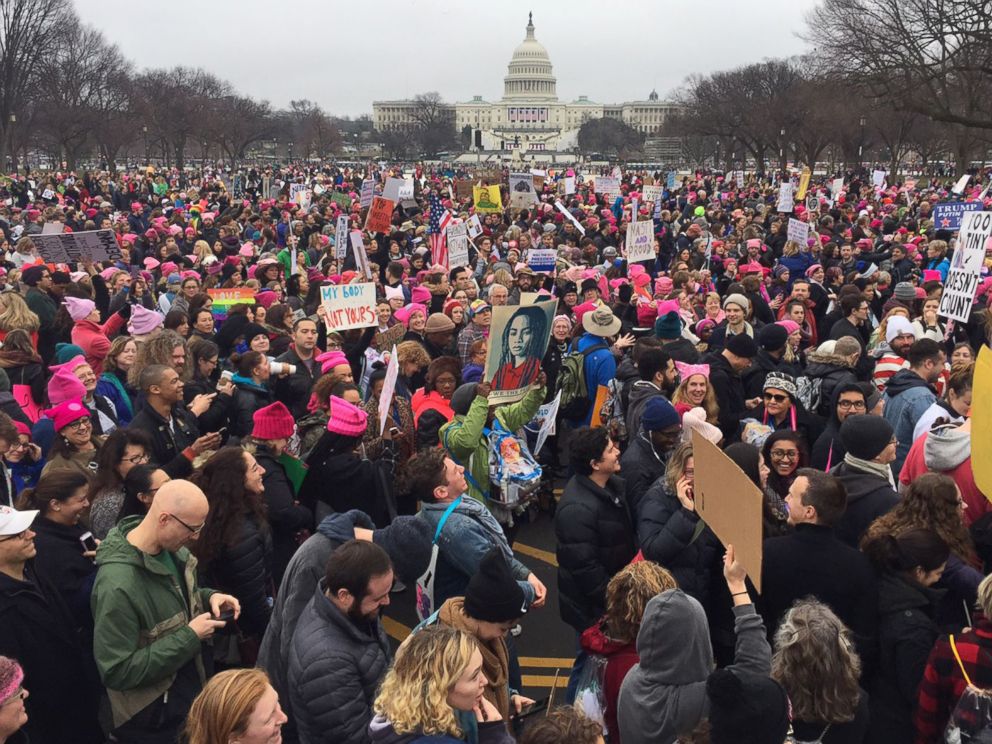 |
| Women's March in Washington D.C., January 21, 2017; Photo: Ron Haviv/VII for ABC News |
The 2016 presidential election concluded with the improbable election of real estate billionaire and reality show celebrity Donald Trump. In this historic 2016 election, the dual parties of U.S. capitalism ended up presenting the American electorate with the choice between two individuals who were universally recognized as the most unpopular, distrusted candidates in the history of U.S. presidential politics. How did this happen? Was it just a fluke? Was it just the accidental luck of the draw?
A large army of professional media commentators, pundits, and political gurus continue to struggle mightily to explain the election and ponder its results. Initially, the best they could do was comment that “people were angry.” While true, this was hardly an adequate explanation. People have been angry for quite some time now. Continued anger alone is an insufficient explanation. The American “middle-class” (a more accurate label would be “working class”) have seen their standard of living and future prospects not only stagnate but steadily decline for well over three decades. Until recently most hoped, and half convinced themselves that this situation was temporary—that there would be a reversal in this long downturn for the “middle class” and a return to more “normal” times. This election cycle, however was faced with a dramatic new shift in sentiment. In the main, the “middle-class” concluded that the steady deterioration in their prospects was not temporary but permanent. Not the function of some recurring business cycle, which would eventually be reversed, but rather something much more sweeping and fundamental.
And increasingly they correctly concluded that the existing political parties and the entire body of politicians that make them up, not only had no solutions, but no desire or self-interest in challenging this. They also knew of course that not everybody was hurting. Under the joint leadership and policies of both these capitalist parties the “one percent” has been doing fabulously well, even outstripping in concentrated wealth the fabled “one percent” of the notorious “Gilded Age.” This then was the reality in which the nation’s two party system approached the 2016 presidential elections.
Despite all this, in smug and blind confidence, these two parties then marched ahead with their original plans to present the U.S. electorate with the “democratic” privilege of choosing between another Bush and another Clinton as the nation’s 45th president. Their arrogance stunned much of the American electorate and opened the door for the improbable candidacies of two “outsiders” with no real support in the official two-party system. One was the billionaire reality TV host Donald Trump, the other a self-proclaimed “socialist” Bernie Sanders. Their candidacies were universally written off with derision and ridicule by all the political experts and commentators. Donald Trump became the official candidate of the Republican Party and Bernie Sanders came within a hair’s breadth of being the Democratic Party candidate despite an organized conspiracy by virtually the entire Democratic National Committee to secretly smear and sabotage his candidacy in favor of their anointed, Hillary Clinton.
The seemingly bizarre unfolding of the 2016 presidential election is not the product of some unfathomable accident or fluke. On one hand, much of the U.S. middle-class/working class, for the first time, lost all confidence in the ability of either wing of America’s two-party monopoly to address and reverse their long decline. In their desperate search for some alternative, we had the completely unforeseen emergence of the Trump and Sanders candidacies. But even more fundamentally the election represents the confused, disruptive reaction of America’s ruling elite to the painful ending of an almost century-long era of U.S. global domination. The present two party system and its political actors have been thrown into complete disarray by this new reality. Whatever name they may have used in the past to describe it—“American Exceptionalism”—“Leader of the Free World”—they certainly never contemplated its demise. Despite their growing confusion and deepening internal dissent, the U.S. ruling elite is determined that the costs of this new reality will be borne not by them but by America’s increasingly hard-pressed middle-class/working class.
The U.S. middle-class and the American century
The mass U.S. middle-class of today is a relatively recent development. It was primarily created through WWII and its aftermath. Prior to that, what was then called the middle-class was a much smaller and narrower phenomenon consisting primarily of professionals, small businessmen, managers, etc.
The United States won WWII. It won WWII big. It won WWII not just against the Axis powers but against its own allies as well. With the exception of the United States, the entire capitalist world came out of WWII in a shambles. Europe’s industrial plants were destroyed or in decay, its working classes were reduced, dispersed, and demoralized, its political structures in turmoil, and its national economies for the most part flat broke.
But the United States, on the other hand came out of WWII immeasurably stronger in every way than when it entered the war. U.S. industrial capacity had dramatically expanded, incorporating all the new technologies in manufacturing, electronics, chemicals, etc., developed during the war. The U.S. working class was intact with better skills and education than prior to the war. The U.S. was politically, militarily and financially the completely dominant capitalist nation in the world.
The war ushered in what Time/Life founder and publisher Henry Luce, triumphantly proclaimed as the coming “American Century.” The usual laws of capitalist international competition were temporarily in suspension. The dollar, freed from any monetary gold backing, was enthroned as the reserve currency for the entire capitalist world replacing the pound sterling. This gave the dollar and U.S. capitalism a uniquely advantageous position—the exorbitant privilege of paying its foreign bills in its own currency, which it could just print. This status lasted for decades. But not for a century.
This utterly unique and yet predictably unsustainable hegemony provided U.S. capitalism with the opportunity for an extended period of prosperity and astoundingly large profits. Faced with a strong trade union movement which had emerged out of the “Great Depression,” U.S. capitalism concluded that its best course was to concede some wage concessions where necessary, rather than disrupt the immense profit opportunities available to them by avoidable class conflicts. For now there were bigger fish to fry.
But this new era provided for more than just a general rise in wages. To take maximum advantage of these unique opportunities required a more skilled and educated workforce. For the first time, university and college education was made available and affordable to large sections of the working class through the GI Bill and other subsidies. Between 1944 and 1971 the U.S. government spent $95 billion on the G.I. Bill. The general prosperity created in this era also sustained a new consumer economy, primarily benefiting but not entirely limited to the white working class. This was marked by increased home ownership, widespread automobile ownership, leisure time activities, etc.
Continued class struggle
While this unique period of prosperity allowed for some tactical concessions to America’s middle-class/working class it did not mean the class struggle was suspended. U.S. capitalism also used the combination of post-WWII prosperity and its long reactionary cold war with the Soviet Union to housebreak the American labor movement. Through red-baiting, the Taft-Hartley Act, and support for “right-to-work” legislation they cleansed the labor movement of the class struggle radicals who were central to revitalizing the union movement coming out of the 1930s. They were able to reshape the trade union leadership into a conservatized bureaucracy utterly tied to the capitalist two-party system, converting it into little more than an adjunct to the Democratic Party. Because the Democratic Party was never a working-class party, it never initiated unions. However, once unions were formed the Democrats became quite good at absorbing them into their political machines.
To their immense advantage they also used their world hegemony to create a series of international institutions, which were utterly dominated and controlled by U.S. capitalism. Among these was the already mentioned reserve currency status of the U.S. dollar. Equally important was the World Bank, the International Monetary Fund, the North Atlantic Treaty Organization and the European Union.
With the inevitable reemergence of intense international capitalist competition, the hegemony of the “American Century” began to come to an end. How has U.S. capitalism responded to this new global reality? For one, in response to growing global competition in manufacturing, it shifted its profit-making focus. It concluded that the quickest, largest, and easiest profits were now to be made not in the making and selling of products, but in the so-called financial sector. Between 1973 and 1985, the U.S. financial sector accounted for about 16 percent of domestic corporate profits. In the 1990s, it ranged from 21 percent to 30 percent. In the recent decades, it soared to as high as 41 percent of all U.S. domestic corporate profits.
With the closing of this long post-WWII prosperity, U.S. capitalism also returned to the unavoidable necessity to cut wages and working conditions for the U.S. middle-class/working class. One typically revealing example as documented by Stephanie Coontz in her excellent article: Why the White Working Class Ditched Clinton—between 1947 and 1979, real wages for an average meatpacking worker, adjusted for inflation, increased by around 80 percent, reaching almost $40,000-per-year, a salary that could support a comfortable middle-class lifestyle. But between 1979 and 2012 the average meat packer’s wage declined by nearly 30 percent, to about $27,000. Also, the need to quickly upgrade the educational level of the domestic workforce was no longer required or “cost effective” for U.S. capitalism. Policies were put in place to return affordable college and university training to the province of the relatively wealthy.
As U.S. hegemony began to weaken, the international institutions it created and dominated since the close of WWII began to unravel. Despite U.S. capitalism’s increasingly frantic attempts to shore them up, this unraveling has significantly impaired their former ability to direct and control events. Last June’s “Brexit” vote by Britain, one of U.S. imperialism’s most loyal and reliable postwar allies, to leave the European Union was almost as big a shock then as the November Trump election was later on.
An earlier and at least equally stunning action was the August 2013 vote by the British Parliament refusing to support Obama’s imminent move to launch yet another Middle-East war, this time against Syria. The significance of this action and its aftermath is worthwhile reviewing as it has never been honestly reported and was largely ignored even by much of the American left.
The war against Syria
Despite the disastrous invasions of Afghanistan and Iraq, U.S. imperialism now under the Obama administration moved to initiate yet another major war in the Middle East, this time against Syria. Another regime change was projected with Obama’s announcement that Syria’s president Assad “must go.” The “mushroom cloud” justification this time centered on the use of chemical weapons, supposedly breaking a precedent adhered to by “all civilized countries” going back to the end of WWI. Ignored by the Obama Administration were the massive U.S. use of the deadly chemical “agent orange” in Vietnam and the massive use of poison gas during the Iraq-Iran war (1980-1988) by Saddam Hussein against the Kurds and Iranian military. The U.S. supported Saddam Hussein in that war and made no criticism of his use of poison gas. We know, through U.S. documents leaked by Manning, Snowden, and others that the U.S. government even used its satellite network to provide targeting intelligence to the Iraqi military during this U.S. backed war with Iran.
As Obama prepared to go to war against Syria it was clear that his only real partner would be Britain. The support for the Bush-era Middle East wars had over time been reduced to the so-called “coalition of the willing” which eventually became little more than Britain and places like American Samoa. Then to the shock of everyone, and especially U.S. imperialism, the British Parliament refused to sanction this latest war. With a fleet of American war ships and aircraft in place and publicly poised to launch a massive air and missile attack on Syria within days or at most weeks, Obama remained committed to go ahead. Now however he felt required to have a supporting war vote in Congress, something he had previously asserted was unnecessary. He was convinced he could get such a vote and orchestrated a crash media campaign to build support in Congress and with the American public.
Despite little in the way of an organized antiwar movement, there was an immediate and spontaneous outpouring of opposition to Obama’s war vote. Congress was inundated with thousands of messages demanding they vote no. As the date set for the vote loomed it became clear it would be defeated. Such a result would have been an unmitigated disaster for U.S. imperialism. As far as I know, never in the history of the nation has a presidential authorization for war been voted down.
The Obama administration and U.S. imperialism were forced to retreat. A cover strategy was concocted to allow for and explain away this retreat. Suddenly at a relatively minor news conference, a reporter asked Secretary of State Kerry if there was anything Assad could do to avoid the impending U.S. attack. Supposedly, Kerry off-handedly replied, “…only if Assad agreed to get rid of all his chemical weapons.” It is virtually certain this reporter’s question was a plant. A deal with Assad on chemical weapons, brokered by Putin, was then quickly announced, negating the need for U.S. military action and avoiding the scheduled war vote in Congress.
The most immediate cause of this imperialist defeat was the massive, spontaneous and successful opposition to the proposed congressional war vote. This was a major victory by and for the American people. The aid of Putin in helping to pull Obama’s chestnuts out of the fire didn’t come without a cost. Obama had to acquiesce to Russia’s military and diplomatic intervention in the Syrian civil war in support of the Assad regime. More broadly, the unfolding of the Syrian-Obama scenario demonstrated at each stage the continuing collapse of U.S. post-WWII hegemony and its decreased ability to control and shape events.
Today we continue to be inundated in the popular media with references to the “Special Relationship” between the U.S. and Britain as if it is some kind of mystical eternal institution. The U.S. for most of its history has had a hostile relationship with Britain and its Imperial Empire. The so-called “Special Relationship” is another product of WWII and its aftermath, which like much else is now unraveling. As a matter of fact, the term itself was first invented by Winston Churchill in his infamous 1946 Fulton, Missouri bellicose speech launching the cold war with the Soviet Union.
Imperialist institutions challenged
The U.S. created World Bank, which it has used to its advantage in directing and controlling major infrastructure investments throughout the world since WWII is also being challenged. More than a year ago China announced it was launching a competitor to the World Bank, the Asian Infrastructure Investment Bank. U.S. imperialism immediately moved to isolate and kill the Chinese initiative by pressuring its World Bank allies to boycott it. Almost immediately Britain broke ranks with the United States, becoming a member in the fall of 2014. Other members of the European Union, including France and Germany, quickly followed along with 27 other nations.
Closely related to the World Bank is the International Monetary Fund (I.M.F.). In the global economy U.S. imperialism set up following WWII, the I.M.F. functions as the thug debt collector and enforcer. In any national financial crisis the I.M.F. ensures that the first priority will be the repayment of debt obligations to the international banks. To guarantee this, the I.M.F. imposes cuts in wages, pensions, social safety nets and increases taxes on the middle-class/working class. It is the designer and enforcer of austerity. In Europe today its policies are generating increasingly fierce resistance, especially in Greece, Spain, and Italy. Given its increasing unpopularity, the I.M.F. has a difficult time finding credible people to act as its director. Former director Mr. Strauss-Kahn had to resign following accusations that he sexually assaulted a maid in a New York City hotel. The present director, Christine Lagarde, was convicted in December of criminal charges linked to the misuse of public funds. Despite her conviction, the 24 directors of the fund decided not to remove her explaining: “With international elites and their institutions facing populist criticism amid political, and social change in the United States and Europe this was not the time to leave the I.M.F. rudderless.”
The diminished ability for U.S. imperialism to direct and control events is reflected in the failure to consummate the Trans-Pacific Partnership (TPP). TPP was a major element in Obama’s “new tilt” toward Asia, and was never primarily just about trade. The deal, which excluded China, was conceived as a vital move for shoring up U.S. economic and military influence in this fastest-growing and strategically vital part of the world. Resistance to the deal is deeper than U.S. domestic opposition to yet another unpopular trade pact. With the end of U.S. post-WWII hegemony, it is China that is now the largest trading partner for most of the countries in the region. The Philippines, despite its long status as a colony and semi-colony of the United States, has under its new president, Rodrigo Duterte, begun dramatically shifting away from U.S. influence, and toward China instead. Even a long-time ally like Australia has shown little enthusiasm for TPP announcing just last month plans to push ahead with a Chinese-led trade pact that would cover Asian nations from Japan to India but exclude the United States. Perhaps even more revealing, Australia has also resisted pressure to join the United States in naval patrols in the South China Sea supposedly designed to ensure freedom of international traffic.
Of all the post-WWII institutions created by and for U.S. imperialism, none was more central to implementing the era of U.S. hegemony than NATO. What made NATO possible, and the glue which held it, and the otherwise competing capitalist nations in Europe together for so long, was the existence and threat of the Soviet Union. This was not essentially a military threat but rather a philosophical and ideological threat. Even under what emerged as the conservative, bureaucratized leadership of Stalinism, the example of the Soviet Union and the 1917 Russian Revolution posed a revolutionary alternative for workers that was a continuous threat to every capitalist regime in Europe. With the collapse of the Soviet Union, the NATO of old began coming apart and its days are now numbered.
NATO as any kind of unified bloc, especially any kind of unified bloc following U.S. imperialism’s direction and lead is disintegrating. The ability to get NATO support for U.S. directed sanctions against Russia, Iran or anyone else is becoming increasingly difficult. The recent evolution of NATO member, Turkey, is revealing. Not only does Turkey apparently believe that its national interests, at least for now, are closer to Russia than NATO, but Turkey even accuses the U.S. government of being involved in the recent military coup attempt against its president.
Even some of NATO’s oldest and formerly most supportive members are beginning to resist continued U.S. leadership and hegemony. With the collapse of the Soviet Union U.S. imperialism pushed an aggressive expansion of NATO, which placed NATO arms one thousand miles to the east closer to Russia’s borders, putting St. Petersburg, for instance, within the range of NATO artillery. In response to a recent U.S.-led NATO military exercise in Poland and the Baltic states, Germany’s foreign minister, Frank-Walter Steinmeier, warned U.S. officials that the action amounted to “saber-rattling and warmongering.”
The unraveling of these post-WWII international institutions certainly reflects an increasingly more difficult global environment for U.S. capitalism. But even more immediately frightening for U.S. capitalism is the massive political damage inflicted by the 2016 presidential election on its dual political parties. For the ruling elite of U.S. capitalism, there has been no more essential and valuable political institution than its stable two-party monopoly. This has been true for more than 150 years, ever since the smashing of the slavocracy in America’s great Civil War. But even prior to the election popular confidence in both the Democratic and Republican parties were at all time historical lows. The election itself has now resulted in a further dramatic deterioration.
The political damage inflicted by the 2016 campaign
On one hand, the Republican Party is captured by an extreme right wing, rogue billionaire, an open racist, who brags about his successful sexual assaults on women, banning individuals from entering the country on the basis of their religious affiliation, and among other things, promises to launch a global-wide trade war. The ruling class itself sees Trump as a loose cannon, dangerous and unstable—the kind of president that in this threatening new era for U.S. capitalism, demonstrates every potential for making things dramatically worse. For the first time in history, every major newspaper in the nation opposed his candidacy. Yet despite the overwhelming opposition within its ranks the U.S. capitalist class was unable to stop his election!
On the other hand, decade after decade of “lesser evil” politics made it easy to shift its entire two party monopoly further and further to the right. But this also has a downside for the U.S. capitalist class. The Democratic wing of their dual party system became less and less able to even demagogically present itself as a populist party posing to defend middle-class/working class Americans from an ever more austerity-driven capitalism. The term “populism” even becomes a pejorative among liberal commentators and Democratic Party functionaries. The Hillary Clinton candidacy was the perfect reflection of this right-wing evolution. The “super” capitalist Trump successfully claims to speak for an increasingly desperate blue-collar working class as the “change” candidate—“Make America Great Again.” Hillary spoke for the status quo—with her campaign theme of portraying America as “Still Great.”
The unchecked and uncheckable rightward evolution of the Democratic Party is reflected not only in the candidate but its entire electoral strategy. Especially after Trump’s capture of the Republican Party, the Democrats embraced a strategy built around a superficial turn to “diversity,” while promoting their pro-business policies in an attempt to win votes in traditional Republican bases in the white suburbs. New York’s Wall Street Senator Charles Schumer, who more and more emerges as the chief political strategist and spokesperson for the Democrats, predicted: “For every blue-collar Democrat we lose in western Pennsylvania, we will pick up two moderate Republicans in the suburbs in Philadelphia, and you can repeat that in Ohio and Illinois and Wisconsin.”
In addition, no other potential Democratic Party candidate was more closely tied to the disastrous results of “lesser evil” politics than Hillary Clinton. She was an enthusiastic supporter of the Clinton administration’s 1994 $30 billion crime bill that created dozens of new federal capital crimes, mandated life sentences for some three-time offenders, and authorized more than $16 billion for state prison grants and the expansion of police forces. In her full-throated support of the legislation, as Michelle Alexander documented in, “Why Hillary Clinton Doesn’t Deserve the Black Vote, she used racially coded rhetoric to cast Black children as animals. “They are not just gangs of kids anymore,” she said. “They are often the kinds of kids that are called ‘super-predators.’ No conscience, no empathy. We can talk about why they ended up that way, but first, we have to bring them to heel.” By the time Bill Clinton left office in 2001, the United States had the highest rate of incarceration in the world.
Hillary supported the Clinton administration welfare-reform legislation, which under the slogan of “ending welfare as we know it,” shredded the federal safety net for poor families. The legislation also barred undocumented immigrants from licensed professions, and initially slashed overall public welfare funding by $54 billion. As late as 2008 she continued to defend the legislation as a success. She also supported bank deregulation during the Clinton administration and the anti-gay Defense of Marriage Act.
Her most famous political act was her vote as Senator for the Iraq war. As the disastrous results of that war became more and more obvious she attempted to take her distance from it by claiming she was deceived by faulty intelligence. However, this did not prevent her continued attraction for an aggressive policy of military-imposed regime change. She enthusiastically supported the Libya military adventure, with again disastrous results. She then became the most vocal proponent for a “no-fly zone” in Syria, which like the “no fly zone” originally declared in Iraq, would have been nothing less than a conscious precursor to yet another regime-change war.
The 2016 election and the Trump presidency pose a dangerous threat to two opposite and opposing constituencies, on one side the U.S. capitalist class, on the other side America’s middle-class/working class. For the U.S. capitalist class, the immediate question becomes how best to spin the election to insulate their two-party system from the disastrous results and at the same time restore some level of confidence in the Democratic and Republican Parties? Their solution was the launching of a massive propaganda campaign absolving their two-party monopoly from any responsibility in the bizarre unfolding of the election and the dangerous Trump victory. The Trump success, they wish to assure us, is not because of any fundamental failings on the part of the Democratic and Republican Parties or U.S. capitalism or even Trump’s inept electoral opponent Hillary Clinton. Rather we are to believe the Trump victory is the product of a diabolical, foreign conspiracy engineered by the evil Russians. The prominent, liberal, New York Times columnist, Paul Krugman, even seriously proclaims, in a word play on the 1962 conspiratorial and reactionary film The Manchurian Candidate, that Trump is the “Siberian” candidate.
During the campaign the organization WikiLeaks released a series of documents damaging to Hillary Clinton and the Democratic National Committee. Among these were speeches Clinton gave to Wall Street fund-raising groups, the text of which she repeatedly refused to make public. In one she tried to assure her Wall Street backers not to worry about statements she might have to make on the campaign trail because as a politician you: “need both a public and a private position.” In another speech to wealthy campaign donors, she wrote off working-class voters attracted to Trump’s promise of change as “…the basket of deplorables. They’re racist, sexist, homophobic, xenophobic, Islamophobic—you name it.”
DNC documents also released by WikiLeaks revealed that the committee staff through scheduling, secret smears, and other maneuvers had been engaged in a conspiracy to sabotage the Sanders campaign in favor of Clinton. As a result, Debbie Wasserman Schultz was forced to resign her position as chair of the DNC. A few weeks later her replacement, Donna Brazile, also had to resign when other WikiLeaks documents showed she had secretly provided debate questions to the Clinton campaign prior to at least some of the Clinton-Sanders primary debates. CNN also had no choice but to fire Brazile from her lucrative and valuable position as a Democratic political commentator as her stunningly unethical activities were revealed.
No one challenges the authenticity and accuracy of these damning WikiLeaks documents. But the increasingly frantic campaign charging Russia with hijacking the U.S. election wants to pretend their authenticity is irrelevant. Pay no attention they say to Clinton’s secret speeches, to the actions of Wasserman, Brazile, and others. Rather focus on the claim that WikiLeaks obtained these documents from Russian hackers. That said, WikiLeaks denies their source was Russia. U.S. intelligence officials back up the claim of a Russian source “with high confidence.” WikiLeaks past record for veracity is excellent, for the U.S. intelligence community, not so much. It wasn’t that long ago that U.S. intelligence guaranteed the existence of weapons of mass destruction in Iraq as a “slam dunk.” In reality, the dispute over the WikiLeaks source is an irrelevant “red herring.” The undisputed authenticity and accuracy of the WikiLeaks documents, and what they reveal are not irrelevant.
The most cynical aspect of this entire campaign is the portrayal of the U.S. as an innocent victim of unprecedented foreign interference in the election. A December 23, 2016 article in the Washington Post by Lindsey A. O’Rourke, documents that since 1947 the U.S. has tried to change other nation’s governments 72 times. Sixty-six times by covert actions six by overt means. The article reports that 26 of the covert actions succeeded, apparently all six of the overt actions were successful. Often when U.S. intelligence services meddle in foreign elections it doesn’t hack—it murders. In 1963 the CIA organized a coup against their supposed South Vietnam ally, President Ngo Dinh Diem, in which he was killed. In 1973 the CIA organized a coup against the democratically elected president of Chile, Salvador Allende, in which he was killed. In truth, no government has been involved in more actions to subvert foreign governments and their elections than the United States.
The Obama legacy
To restore some level of confidence, especially for the Democratic Party, we have also witnessed the launching of an over-the-top campaign to burnish Obama’s lackluster, eight-year, presidential legacy. Typical of the tone is New York Time’s columnist David Leonhardt’s claim that: “Obama leaves office as the most successful Democrat since Franklin Roosevelt.”
On the index of income inequality, the Obama eight years saw essentially no reduction in the enormous gap between the one percent and the rest of society. In the eight years of the Obama administration, ninety-five percent of households have not seen their incomes regain 2007 levels. Income inequality in the United States continued to far exceed anything seen in other advanced nations. In new data just released by the World Economic Forum the United States ranked 23rd out of 30 advanced economies in wage and non-wage compensation, and it ranked last in social protection. And lately, things have hardly gone in the right direction. On January 27th the government reported that the economy grew by only 1.6 percent in 2016 a significant reduction from around 2.5 percent in both 2015 and 2014. Many of the white working-class, who voted for Trump, voted for Obama in 2008 and 2012, some no doubt despite holding racist views. Obama ran as the “change” candidate who they hoped would provide some relief in their desperate economic and social situation. They got eight more years of the same.
But the most telling part of Obama’s legacy is how much his administration has prepared the ground for Trump’s reactionary, extreme right-wing program. Trump in his promise of mass deportations, inherited a well-oiled deportation infrastructure from the Obama administration, which has deported 2.5 million people—more than every single U.S. president of the 20th century combined. In the spring of 2014 the National Council of La Raza (NCLR), the nation’s largest Latino advocacy organization, which had previously supported Obama, could no longer remain silent. NCLR President Janet Murguía delivered a speech lambasting Obama’s deportation policy: “We consider him the deportation president, or the deporter-in-chief.”
In 2007 before taking office Obama assured the public that he would oversee the nation’s extensive surveillance program without “undermining our Constitution and our freedom.” Once in office, however, the Obama White House failed to meaningfully scale back surveillance practices established by Obama’s predecessor, including the unlawful bulk collection of Americans’ domestic phone call records. Michael Hayden, the former director of the U.S. National Security Agency, praised Obama explaining that surveillance programs have “expanded” during Barack Obama’s time in office and said the spy agency has more powers now than when he was in command under President Bush. Expansion of dangerous surveillance rules continued right up to the end of the Obama administration. With mere days left before President-elect Trump took office, Obama finalized new rules to make it easier for the nation’s intelligence agencies to share unfiltered information about innocent people.
The Trump administration certainly plans to build on the already expanded surveillance program he inherited from Obama. Trump also promises to dramatically increase bombing in the Middle East and expand it to target family members of those he concludes are terrorists. Obama did not begin the drone-killing program but he did greatly expand it and greatly loosened its rules. Under Obama’s approach, many aspects of his targeted killing policy are, to say the least, on the dubious legal footing, which has set hugely dangerous precedents.
Obama administration officials have variously argued that targeted killing with drones is a state secret or a so-called political question that isn’t properly “justiciable,” (subject to trial in a court of law), even if the target is an American citizen. The Obama administration asked Americans to believe not only that it was empowered to kill an American in secret; but that after the fact courts should refrain from judging whether such killings violated the right to life of the target. Thanks to Obama’s actions, Donald Trump is inaugurated into an office that presumes the authority to secretly order the extrajudicial killings of American citizens.
Trump will also be inaugurated into an office that construes its mandate to kill with drones broadly, encompassing strikes in countries with which America is not at war and targeting groups and individuals that had nothing to do with the September 11, 2001 attacks. In effect, Obama has construed the 2001 Authorization to Use Military Force so broadly that it’s now hard to discern any meaningful limit.
Many Democratic officials are expressing shock over Trump’s nomination of the completely unqualified Betsy DeVos as U.S. Secretary of Education. DeVos, a Republican billionaire from Michigan who labeled the U.S. public education system a “dead end,” is an advocate for privatizing public education by requiring the use of public funds to pay for private school tuition. But a January 21, 2017 article in the Washington Post by its education reporter, Valerie Strauss, titled, “Democrats reject her, but they helped pave the road to education nominee DeVos,”[4] shows that Democrats can’t just blame Republicans for her ascension. “It was actually Democrats,” Strauss writes, “…who helped pave the road for DeVos to take the helm of the Education Department. Democrats have in recent years sounded—and acted—a lot like Republicans in advancing corporate education reform, which seeks to operate public schools as if they were businesses, not civic institutions. By embracing many of the tenets of corporate reform—including the notion of ‘school choice’ and the targeting of teachers and their unions as being blind to the needs of children—they helped make DeVos’s education views, once seen as extreme, seem less so.”
There is probably no position in which Trump invests more emotional capital than his promise to constrict and constrain what he calls the “lying press.” James Risen, an investigative reporter for the New York Times in an December 30, 2016 news analysis article for the Times titled, “If Donald Trump Targets Journalists, Thank Obama,” writes: “If Donald J. Trump decides as president to throw a whistle-blower in jail for trying to talk to a reporter, or gets the F.B.I. to spy on a journalist, he will have one man to thank for bequeathing him such expansive power: Barack Obama.”
Risen continues: “Over the past eight years, the administration has prosecuted nine cases involving whistle-blowers and leakers, compared with only three by all previous administrations combined. It has repeatedly used the Espionage Act, a relic of World War I-era red-baiting, not to prosecute spies but to go after government officials who talked to journalists.”
Risen concludes, “When Mr. Obama was elected in 2008, press freedom groups had high expectations for the former constitutional law professor…But today many of those same groups say Mr. Obama’s record of going after both journalists and their sources has set a dangerous precedent that Mr. Trump can easily exploit. ‘Obama has laid all the groundwork Trump needs for an unprecedented crackdown on the press,’ said Trevor Timm, executive director of the nonprofit Freedom of the Press Foundation.”
Trumpism
What is the political nature of Trumpism? Does it constitute a burgeoning fascist movement? The truly massive and uncontested anti-Trump demonstrations in dozens of cities throughout the nation, the day following his inauguration gives the answer to that. Where were Trump’s fascist “brownshirts?” The best Trumpism could do, was a few dozen “Hell’s Angels”-type motorcycle gangs that did not even make themselves visible.
However, this does not mean that Trump is just another right-wing Republican in the mold of Richard Nixon, Ronald Reagan or George W. Bush. The election of Donald Trump as president of the United States is a deeply dangerous development that dramatically escalates the threat to America’s middle-class/working class. It is a decisive shift, representing the growing failure of center-right and center-left parties not only here but in all the advanced capitalist countries. What makes it particularly dangerous for the U.S. middle-class/working class is the complete absence here of any mass working class party that could present a fighting alternative.
Trump will quickly launch an aggressive attack on the civil liberties and civil rights of Blacks, Latinos, the women’s movement, unions, immigrants (especially Muslims), the press, and anyone who dares to criticize him. As Barry Sheppard already highlighted in his excellent article “The Rise of Trumpism,”[6] he will first of all be the “law and order” candidate. He will greatly increase police powers including the further militarization of the police. There will be no rollback of the War on Drugs or mass incarceration, and there will be no more federal oversight (already weak) of police violence. Already within days of his inauguration Trump is proposing a large-scale federal policing intervention into Chicago with its large Black, Latino, and Muslim populations. Finally, he intends to use the expanded powers of a militarized police to suppress the anti-Trump demonstrations which he now knows are coming and which he takes as a personal affront.
He will increase the militarization of the border with Mexico and greatly step up the massive deportations begun under Obama. He will prevent, under one formula or another, most Muslims from immigrating to the U.S. including millions of desperate refugees from Washington’s wars against Arab countries.
Trump will move quickly on his promise of big tax cuts for the rich and large corporations. Regulations will be relaxed for the banks and other financial concerns and environmental regulations will be abolished or made inconsequential.
He will dismantle Obamacare, which was already wholly inadequate, providing the worst healthcare system of any advanced industrial country. Despite promises to the contrary, fewer it will be replaced with something covering even fewer people with even less healthcare.
He will put in place a massively expanded program of voter suppression. He does not intend to have his “legacy” besmirched by defeats in midterm elections in two years or his own reelection in four years. That is what is behind his seemingly ridiculous charge of massive voter fraud in the last election and his call for launching a voter fraud investigation.
Fighting Trumpism
How can we successfully fight Trumpism, which clearly does not represent the views or interests of an overwhelming majority of America’s middle-class/working class? In her penetrating article, “Why Hillary Clinton Doesn’t Deserve the Black Vote, [7] Michelle Alexander attempts a balanced evaluation of Senator Bernie Sanders and his call for a political revolution. Alexander concludes: “The biggest problem with Bernie, in the end, is that he’s running as a Democrat…I hold little hope that a political revolution will occur within the Democratic Party without a sustained outside movement forcing truly transformational change. I am inclined to believe that it would be easier to build a new party than to save the Democratic Party from itself.”
Alexander expresses considerable political wisdom here. It would be easier to build a new party, as difficult as that certainly would be than to save the Democratic Party. All the evidence, especially the recent history, demonstrates there is no “saved” Democratic Party that can successfully fight Trump. It is the dual parties of capitalism, the Democratic Party and the Republican Party together, that have created the conditions that gave rise to Trump. It’s not irrelevant that Trump, for his entire life, has supported and participated in both these parties.
This, of course, does not mean that the fight against Trump should wait on the creation of a new alternative political party. The fight against Trump has already gotten off to a pretty good start—the really massive anti-Trump demonstrations and the Women’s Marches in the streets that took place immediately following his inauguration. And this is certainly only the beginning. Trump sells himself as a “man of action,” and to bolster that image and his ego, he will quickly attack Black youth, immigration, the woman’s movement, Muslims, the labor movement, Latinos, Roe V. Wade, the environmental movement, and anyone who challenges him. His administration will be one that constantly provokes and energizes more people into opposition.
The mass demonstrations following Trump’s inauguration were not initiated by the Democratic Party, rather they were initiated independently by a small group of women activists. Trump was obviously stunned by their size and breath, but you can also be sure the Democratic Party leadership was more than a little apprehensive about its independent nature, remaining largely outside of their control. They recall the anti-Vietnam War movement, which despite their best efforts remained independent, successfully resisting being incorporated into the Democratic Party electoral machine.
This is the essential political debate which will take place as the anti-Trump movement evolves—the fight to keep it independent of the Democratic Party. New York Senator Charles Schumer, who is replacing a discredited Hillary Clinton as the principal spokesperson for the Democratic Party, is already pushing to channel the movement into Democratic electoral politics. It’s well to remember Schumer’s history and background. In his long political career he came to be known as “The Senator from Wall Street.”
He raises millions and millions of dollars from the finance industry, both for himself and for other Democrats. In return, he voted to repeal the Glass-Steagall Act in 1999 and voted to bail out Wall Street in 2008. In between, he slashed fees paid by banks to the Securities and Exchange Commission to pay for regulatory enforcement and eviscerated congressional efforts to crack down on rating agencies.
Schumer voted for the Patriot Act in 2001 and sponsored its predecessor, the Omnibus Counterterrorism Act of 1995. During a Senate hearing, Schumer explained that “it’s easy to sit back in the armchair and say that torture can never be used. But when you’re in the foxhole, it’s a very different deal.” Schumer also defended the New York Police Department’s surveillance of Muslims across the region, which Trump has cited as a national model.
Returning to Michelle Alexander’s perceptive quote, she describes what she believes would be necessary to accomplish a political revolution, “a sustained outside movement forcing truly transformational change.” That is what the anti-Trump movement which began with the Women's March on January 21, 2017 should aspire to become. A placard I saw being carried at the Washington March was prophetic, “FIGHT TRUMP—THE DEMS WON’T.”
Returning to Michelle Alexander’s perceptive quote, she describes what she believes would be necessary to accomplish a political revolution, “a sustained outside movement forcing truly transformational change.” That is what the anti-Trump movement which began with the Women's March on January 21, 2017 should aspire to become. A placard I saw being carried at the Washington March was prophetic, “FIGHT TRUMP—THE DEMS WON’T.”


