Showing posts with label Conspiracy theories. Show all posts

Friday, February 12, 2021

3478. How 5 Corrosive Conspiracy Theories Made Our Fight Against COVID-19 Even Harder

By Ruth Reader, Fast Company, December 24, 2020 
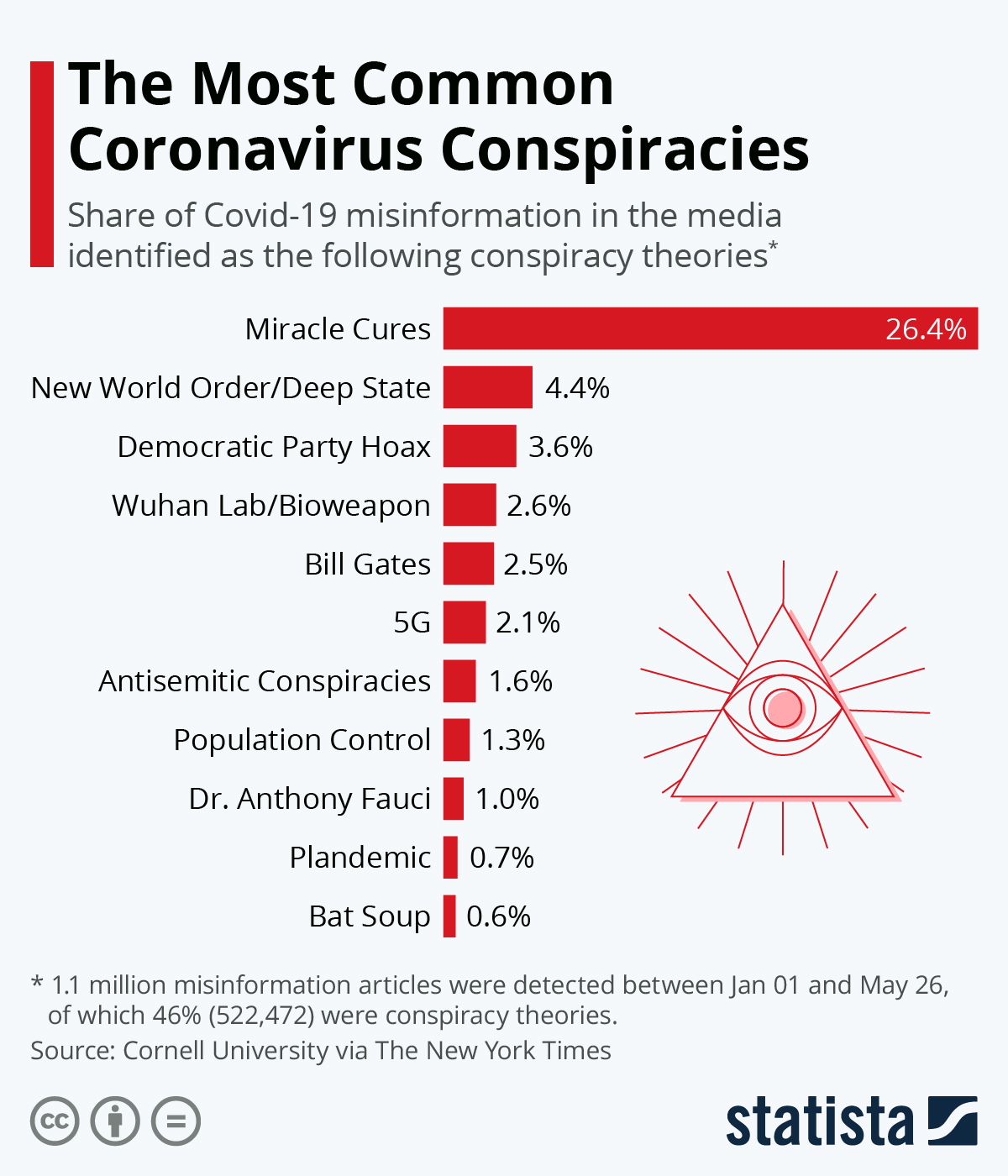

Conspiracy theories usually hide in the shadows, but this year they became mainstream. Because so little was known about COVID-19 when it emerged, people became more susceptible to narratives of which they might otherwise be skeptical. In the absence of authoritative, clear information, falsities floated to the top. By mid-February, the director general of the World Health Organization, Tedros Adhanom Ghebreyesus, was warning the world about an “infodemic.” Speculation and active misinformation about COVID-19 had become as dangerous as the disease itself.

It has proven incredibly difficult to tamp down misinformation about coronavirus and the surrounding public health initiatives to stop its spread. Over the course of this year, experts have been cautious to make definitive statements about COVID-19 until all the facts are in, while speculators have stepped in to fill the void with confident, baseless opinions. In addition to the usual purveyors of misinformation, President Trump amplified certain false stories, giving them a much bigger audience than they would ordinarily find. And while social networks like TwitterFacebook, and YouTube have stepped up with more efforts to identify, label, and take down COVID-19 misinformation, their work has been imperfect. The lack of consensus on COVID-19 has made even the most harmless of measures, like wearing a mask, look leery.

For opportunistic conspiracy theorists, COVID-19 also offered up fresh angles on old material. Anti-vaccination propagandists saw an opportunity to create an odious specter out of a future vaccine. Meanwhile, factions that had already been sowing doubt about the safety of 5G technology tried to give their disinformation campaign new life by tying it to COVID-19.

While disinformation has had a running start this year, there is a growing body of verified, trustworthy information about COVID-19. Doctors are learning how to respond to the myriad symptoms brought on by COVID-19. Two vaccines have been approved for emergency use under the Food and Drug Administration and several others are underway. There is now hope that sometime next year Americans may be able to leave the fox dens we’ve been confined to and finally catch a breath of fresh air. To do that, we’ll have to beat back the conspiracy theories and remind Americans that vaccines, including the COVID-19 vaccine, are safe and confer a great benefit to public health.

Here are the five conspiracies that most impacted the public’s understanding of COVID-19 in 2020.

COVID-19 WAS MADE IN A LAB

Not long after the World Health Organization announced that COVID-19 had reached pandemic levels of infection, a conspiracy theory started to swirl around where the disease came from. Early in the pandemic, conservative publications started to link the outbreak to China’s Wuhan Institute of Virology, which has studied coronaviruses.

However, scientists agree that SARS-CoV-2, the virus that causes COVID-19, very likely occurred in nature and was not engineered. If the virus were engineered, there would be evidence of the original genetic code in COVID-19’s DNA as well as any additions or deletions. There’s also no evidence that SARS-CoV-2 accidentally escaped from the Wuhan Institute of Virology. While there are other coronaviruses at the institute, SARS-CoV-2 was not among them. There’s also no evidence that COVID-19 descended from one of the other coronaviruses the institute was studying.

Despite its baseless claims, this conspiracy theory stuck in public consciousness because it had the backing of President Trump as well as certain conservatives. It has served as a distraction from the American government’s failure to adequately respond to the rising threat of COVID-19 when it first became public in January. This conspiracy theory is also dangerous because it foments racist distrust of China.

COVID-19 COMES FROM 5G

A lie connecting 5G high speed wireless technology to COVID-19 symptoms started spreading across Facebook, Twitter, and Instagram not long after the pandemic struck. By early April, in the United Kingdom, people started protesting and setting fire to 5G towers. There is no evidence that 5G is dangerous to human health. The technology works on higher frequency millimeter wave lengths that don’t appear to penetrate human skin, according to researchers. In addition, the virus spread far beyond the meager footprint of this nascent technology, to places where there is no 5G.

Conspiracy theories about 5G technology were brewing before COVID-19 emerged, though they were much less visible. Reporting from The New York Times suggests these narratives may be politically motivated. The technology is poised to make download speeds, upload speeds, and everything in between a lot faster—which could give countries with 5G an economic edge. While there are some people who believe without evidence that radiation associated with wireless technology has negative health impacts, there are also propagandists who may be trying to slow the adoption of this technology in countries that stand to benefit from it. Prior to the pandemic, Russian news outlet RT was pushing false stories linking 5G to adverse health affects. More disinformation about this technology is likely coming in future.

COVID-19 IS THE SAME AS THE FLU

In the first few months of the pandemic, both public officials and media outlets drew comparisons between COVID-19 and seasonal influenza. President Trump repeatedly compared COVID-19 to influenza. The intent seemed to be to quell public hysteria over the rapidly spreading illness. However, this perspective provided fodder for conspiracy theorists to propagate the idea that COVID-19 is a hoax.

Now we know that COVID-19 is much more deadly than the flu. While seasonal influenza has killed as many as 61,000 Americans in a given year, it is not nearly as deadly as COVID-19. The CDC estimates that by January 9, 2021, COVID-19 will have claimed somewhere between 357,000 to 391,000 American lives. While the two diseases have similar symptoms, about 15% of people will experience severe disease with COVID-19—a much higher percentage than seasonal flu. In order to tamp down the disease’s spread, Americans must treat it with the seriousness it deserves.

MASKS DON’T WORK

In comparison to the elaborate theories some have concocted to explain COVID-19, the falsity that masks don’t protect people from the coronavirus is one of the most banal pieces of misinformation about the pandemic—and simultaneously the most insidious.

The idea that masks don’t work to shield people from COVID-19 or prevent its spread was born out of a public health mishap. Because of a shortage of medical masks early on in the pandemic, surgeon general Jerome M. Adams tweeted that masks would not prevent the general public from contracting COVID-19 and people should stop buying masks. Scientists and public health officials have since learned that masks, even cloth masks, are quite effective at preventing transmission of COVID-19 because masks block the wearer’s potentially contagious respiratory droplets from hitting the air. When two people who are interacting wear masks, they are effectively protecting one another. The CDC has since updated its guidance on masks.

VACCINES CHANGE YOUR GENETIC CODE

Pharmaceutical companies had barely begun working on an COVID-19 vaccine when anti-vaccine propagandists started saying it was harmful. Much of the antagonism towards a COVID-19 vaccine has been built on existing anti-vaccine sentiment, which falsely sees vaccines as unnatural or potentially harmful.

There have been myriad lies concocted about COVID-19 vaccines. One even involved billionaire Bill Gates and a plot to microchip the masses (which has been thoroughly debunked as false). In reality, the Gates Foundation has been putting massive amounts of funding into several pandemic efforts including testing, vaccines, and ensuring that under-resourced countries have access to necessary medical resources. Some attacks on vaccines have come from religious groups and figures.

The new narrative anti-vaxxers are pushing about the COVID-19 vaccine, which uses different technology than past vaccines, is that it permanently changes a person’s DNA—which is simply not true. So far the FDA has approved vaccines from Moderna and Pfizer under emergency use authorization. Both use messenger RNA, which teaches the body how to develop antibodies to fight COVID-19. This technology does not fundamentally change a person’s DNA. Moreover, these vaccines have so far shown to be highly effective against symptomatic COVID-19.

There is still more to learn about both Moderna and Pfizer’s vaccines and whether they prevent against asymptomatic infection and how long they offer protection from the disease. What we do know is that they are safe. Outside of handwashing, social distancing, and wearing a mask, these vaccines represent the best opportunity to bring the virus under control.

Sunday, January 10, 2021

3467. Poll Finds Many Believe QAnon And Other Conspiracy Theories

By Joel Rose, NPR, December 30, 2020


A significant number of Americans believe misinformation about the origins of the coronavirus and the recent presidential election, as well as conspiracy theories like QAnon, according to a new NPR/Ipsos poll.

Forty percent of respondents said they believe the coronavirus was made in a lab in China even though there is no evidence for this. Scientists say the virus was transmitted to humans from another species.

And one-third of Americans believe that voter fraud helped Joe Biden win the 2020 election, despite the fact that courtselection officials and the Justice Department have found no evidence of widespread fraud that could have changed the outcome.

The poll results add to mounting evidence that misinformation is gaining a foothold in American society and that conspiracy theories are going mainstream, especially during the coronavirus pandemic. This has raised concerns about how to get people to believe in a "baseline reality," said Chris Jackson, a pollster with Ipsos.

"Increasingly, people are willing to say and believe stuff that fits in with their view of how the world should be, even if it doesn't have any basis in reality or fact," Jackson said.

"What this poll really illustrates to me is how willing people are to believe things that are ludicrous because it fits in with a worldview that they want to believe."

"That's terrifying"

The NPR/Ipsos poll of 1,115 U.S. adults was conducted Dec. 21 to 22. The credibility interval for the overall sample is 3.3 percentage points.

One of the most striking poll findings has to do with QAnon, the baseless conspiracy theory that gained widespread attention this year as two of its backers were elected to Congress.

The poll asked respondents whether they believe that "a group of Satan-worshipping elites who run a child sex ring are trying to control our politics and media" — the false allegation at the heart of QAnon. While only 17% said it was true, another 37% said they didn't know.

"It's total bonkers," said Jackson, "and yet ... essentially half of Americans believe it's true or think that maybe it's true. They don't really know. And I think that's terrifying that half of Americans believe that could be the case."

According to the poll, 39% of Americans believe another key tenet of the QAnon theory: that there is a deep state working to undermine President Trump.

The president is himself a major source of misinformation, as he continues to make baseless claims about election fraud on Twitter and elsewhere. Conservative media also have devoted hours of coverage to exaggerated or debunked claims.

The NPR/Ipsos poll suggests those claims are having an impact. Two-thirds of Republicans surveyed said they believe that voter fraud helped Biden win the election, and fewer than half of Republicans said they accept the outcome of the election.

"There's just too much information out there," said Brooke Williams, a Republican voter and self-described QAnon follower from Oro Valley, Ariz., during a follow-up interview with NPR. "I can't see how anybody is not thoroughly convinced that Biden was illegally elected."

In contrast, only 11% of Democrats think voter fraud helped Biden win the election, and 93% accept the outcome.

Whom Americans trust

Overall, most respondents said they do want to see a peaceful transition to a Biden administration in January, though many are worried about political violence over the next four years.

The vast majority of Americans said they're also worried about the spread of false information, with 4 out of 5 poll respondents saying they're concerned about misinformation related to the coronavirus and vaccines in particular.

But Republicans were more likely than Democrats to believe misinformation about the virus, including that it was created in a lab in China and that COVID-19 is no more of a "serious threat" than the seasonal flu.

"I think it was deliberately released by China," said Jon Costello, a Republican from Huntsville, Ala., who responded to the poll. "I think this big thing of shutting down businesses, shutting down education systems ... is all part of a plan to break the spirit and the will of Americans."

Poll respondents of both parties expressed skepticism about the vaccines that are now being distributed in the U.S., though Republicans were less likely than Democrats to say that they would "take the COVID-19 vaccine as soon as it is made available to me."

"I shouldn't have to take a vaccine for something that was man-made," said Shaena Castro, a Democrat who lives in New York City. "I guess you can call me a conspiracy theorist or whatever, but yeah, I am convinced that it's man-made."

When asked whom they trust, respondents mostly pointed to the people they encounter in their daily lives. Personal physicians scored highly, as did faith or spiritual leaders.

Politicians and media figures did not fare as well. Tucker Carlson of Fox News, Rachel Maddow of MSNBC and Wolf Blitzer of CNN were at the bottom of the list.

More Americans trust Biden than Trump, but both lagged behind Dr. Anthony Fauci, the director of the National Institute of Allergy and Infectious Diseases, who scored the highest of any specific person the poll asked about.

New misinformation vs. old conspiracy

Pollsters say that multiple factors make people more or less susceptible to misinformation — including educational attainment, media consumption and political affiliation — and that people are more likely to believe conspiracy theories that fit into their worldview.

For example, almost half of respondents said that the majority of racial justice protests over the summer were violent, when in fact the vast majority were peaceful. Poll respondents from all demographics answered this question incorrectly — but they were even more likely to do so if they were Republicans and if they got their news from Fox News or conservative online outlets like Breitbart or the Daily Caller.

Recent misinformation held more sway than some older conspiracy theories.

About 60% of Americans correctly answered that former President Barack Obama was born in the United States and that several mass shootings in recent years were not staged hoaxes. And about 70% correctly answered that humans do play a significant role in climate change — roughly the same percentage who believe astronauts landed on the moon in the 1960s and '70s.

It's also clear from the poll results that Americans are worried about misinformation, even if there's no clear prescription for what to do about it.

Nearly 70% of respondents said they are concerned that information they receive on social media is inaccurate; a similar percentage is concerned about foreign interference in U.S. social media.

"I'm concerned to see so many people living in a false reality, seeing relatives honestly believe that this was some kind of rigged election," said William Street, who lives in northeast Mississippi.

"It terrifies me that people can be that misled and believe conspiracy theories like that," Street tells NPR. "I'm concerned that with even just a little prodding from this man in office, they could be led to do very desperate things."

NPR senior producer Marisa Peñaloza contributed to this story.

Thursday, February 9, 2017

2552. How the Anti-Vaxxers Are Winning

By Peter J. Hotez, The New York Times, February 8, 2017
An unvaccinated child with measles

HOUSTON — It’s looking as if 2017 could become the year when the anti-vaccination movement gains ascendancy in the United States and we begin to see a reversal of several decades in steady public health gains. The first blow will be measles outbreaks in America.

Measles is one of the most contagious and most lethal of all human diseases. A single person infected with the virus can infect more than a dozen unvaccinated people, typically infants too young to have received their first measles shot. Such high levels of transmissibility mean that when the percentage of children in a community who have received the measles vaccine falls below 90 percent to 95 percent, we can start to see major outbreaks, as in the 1950s when four million Americans a year were infected and 450 died. Worldwide, measles still kills around 100,000 children each year.

The myth that vaccines like the one that prevents measles are connected to autism has persisted despite rock-solid proof to the contrary. Donald Trump has given credence to such views in tweets and during a Republican debate, but as president he has said nothing to support vaccination opponents, so there is reason to hope that his views are changing.

However, a leading proponent of the link between vaccines and autism said he recently met with the president to discuss the creation of a presidential commission to investigate vaccine safety. Such a commission would be a throwback to the 2000s, when Representative Dan Burton of Indiana held fruitless hearings and conducted investigations on this topic. And a documentary alleging a conspiracy at the Centers for Disease Control and Prevention, “Vaxxed: From Cover-Up to Catastrophe,” has recently been shown around the country.

As a scientist leading global efforts to develop vaccines for neglected poverty-related diseases like schistosomiasis and Chagas’ disease, and as the dad of an adult daughter with autism and other disabilities, I’m worried that our nation’s health will soon be threatened because we have not stood up to the pseudoscience and fake conspiracy claims of this movement.

Texas, where I live and work, may be the first state to once again experience serious measles outbreaks. As of last fall, more than 45,000 children here had received nonmedical exemptions for their school vaccinations. A political action committee is raising money to protect this “conscientious exemption” loophole and to instruct parents on how to file for it. As a result, some public school systems in the state are coming dangerously close to the threshold when measles outbreaks can be expected, and a third of students at some private schools are unvaccinated.

The American Academy of Pediatrics has produced a 21-page document listing all of the studies clearly showing there is no link between vaccines and autism, in addition to more recent epidemiological studies involving hundreds of thousands of children or pregnant women that also refute any association. A study of infant rhesus monkeys also shows that vaccination does not produce neurobiological changes in the brain.

Vaccines are clearly not the reason children develop autism. So what is? There is strong evidence that genetics play a role, and that defects in the brain of children on the autism spectrum occur during pregnancy. Exposure during early pregnancy to particular chemicals in the environment or infections could be involved. Researchers have suggested that damage could be done by the drugs thalidomide, misoprostol and valproic acid; by exposure to the insecticide chlorpyrifos; and by infection of the mother with the rubella virus.

This is what we need to be focusing on, not the myth that vaccines cause autism. Yet I fear that such myths will be used to justify new rounds of hearings or unwarranted investigations of federal agencies, including the C.D.C. This would only distract attention from these agencies’ crucial work, and the real needs of families with children on the autism spectrum, such as mental health services, work-entry programs for adults and support for the research being done by the National Institutes of Health.

Today, parents in Texas have to live in fear that something as simple as a trip to the mall or the library could expose their babies to measles and that a broader outbreak could occur. Perpetuating phony theories about vaccines and autism isn’t going to help them — and it’s not going to help children on the autism spectrum, either.

Peter J. Hotez, a pediatrician at Baylor College of Medicine, is director of the Texas Children’s Hospital Center for Vaccine Development.