Wednesday, April 15, 2015

1809. Chimps That Hunt Offer a New View on Evolution

By James Gorman, The New York Times, April 14, 2015
An adult male chimpanzee in Senegal, left, uses a tree branch with a modified end to stab into a tree cavity in a video image from the TV show "Life Story." A 10-year study found that females in Senegal play an unexpectedly big role in hunting. 


Studies of hunters and gatherers — and of chimpanzees, which are often used as stand-ins for human ancestors — have cast bigger, faster and more powerful males in the hunter role.
Now, a 10-year study of chimpanzees in Senegal shows females playing an unexpectedly big role in hunting and males, surprisingly, letting smaller and weaker hunters keep their prey.
The results do not overturn the idea of dominant male hunters, said Jill D. Pruetz of Iowa State University, who led the study. But they may offer a new frame of reference on hunting, tools and human evolution. “We need to broaden our perspective,” she said.

Among the 30 or so chimps Dr. Pruetz and her colleagues observed, called the Fongoli band, males caught 70 percent of the prey, mostly by chasing and running it down. But these chimps are very unusual in one respect. They are the only apes that regularly hunt other animals with tools — broken tree branches. And females do the majority of that hunting for small primates called bush babies.

Craig Stanford, an anthropologist at the University of Southern California who has written extensively on chimp hunting and human evolution, said the research was “really important” because it solidified the evidence for chimps hunting with tools, which Dr. Pruetz had reported in earlier papers.

It also clearly shows “the females are more involved than in other places,” he said, adding that it provides new evidence to already documented observations that female chimps are “much more avid tool users than males are.”

All chimpanzees eat a variety of plant and animal foods, including insects like termites. And all chimpanzees eat some other animals. The most familiar examples of chimpanzee hunting are bands of the apes chasing red colobus monkeys through the trees in the rain forests of East Africa.

In this kind of pursuit, the largest, strongest, fastest chimps dominate — and those are adult males. When females and smaller chimps do catch an animal, an adult male may simply take it away, although the meat is eventually shared. The theft rate in other groups of chimps is around 25 percent, Dr. Pruetz said. Those other chimps do not hunt with tools.

The Fongoli chimpanzees live in a mix of savanna and woodlands where prey is not as abundant as in rain forests. There are no red colobus monkeys, and although the chimps do hunt young vervet monkeys and baboons, the much smaller bush babies are their main prey.

Dr. Pruetz argues that less food may have prompted both technological and social innovation, resulting in new ways to hunt and new social interactions as well. Humans evolved in a similar environment, and, as she and her colleagues write in Royal Society Open Science, “tool-assisted hunting could have similarly been important for early hominins.”

The tools in question are broken branches that Dr. Pruetz calls jabbing tools. The season for bush baby hunting is June, when the temperature may be well over 100 and the humidity is suffocating. The Fongoli chimps find the bush babies in their dens in trees. Chimps will stab and poke one of the small animals, sometimes wounding but not impaling it, until it comes out of its hiding place. The chimps will grab it, Dr. Pruetz said, and immediately “bite the head off.”

Females, even those with infants, and juvenile chimps can do this kind of hunting. The process does not put a premium on speed and strength as the chase does, so big males do not have an advantage. But there is more than technique and technology involved. There is social change.

By and large, said Dr. Pruetz, the adult males, which could take away a kill, show a “respect of ownership.” Theft rates are only about 5 percent. The chimps she studies also have more mixed-sex social groups than chimp bands in East Africa.

Travis Pickering, an anthropologist at the University of Wisconsin, said that with less food available it seems that the Fongoli chimps, “have to be more inventive” and that “these hunting weapons even the playing field for non-adults and females.”

Early hominins may have been in a similar situation, he said. Hunting among human ancestors “very quickly became a male-dominated activity,” he said, but “female hominins could very well have been the inventors of weapons.”

When it comes to getting food, deciding who does what depends on definitions. Collecting insects, for example, is defined as gathering, not hunting. In the case of the bush babies, however, though they are small, they struggle and flee, and will bite. Any bite, no matter how small, can pose the danger of infection, so the pursuit of bush babies qualifies as hunting, Dr. Pruetz says, and Dr. Stanford and Dr. Pickering agrees. 

1808. Invasive Species: The Snake That’s Eating Florida

By Clyde Haberman, The New York Times, April 5, 2015
Burmese python consuming a deer it killed in Florida
Ever since a serpent enticed Eve to munch on that forbidden fruit in the Garden of Eden, relations between humans and snakes have been at best strained. But at least the gullible Eve and her mate had to cope with just the one snake. In South Florida, wildlife officials have struggled for years with tens of thousands of the creatures: specifically, a species known as the Burmese python, an interloper from Southeast Asia that has taken up what looks like permanent residence in Everglades National Park and other areas of the state.

This is some snake. At full maturity, a Burmese python routinely reaches lengths of 12 feet or more. Twenty-footers weighing 250 pounds are not unheard-of. The pythons are prodigious breeders, with voracious appetites to match. They are believed to have eaten their way through the Everglades, bringing about startling changes in the ecosystem. 

Some mammals native to those marshes, like foxes and rabbits, seem to have disappeared, researchers say. Other species — among them raccoons, deer, opossums and bobcats — are close to being wiped out. Pythons that migrated from the mainland to Key Largo have put indigenous wood rats in mortal peril.

Retro Report, a series of video documentaries exploring major news stories of the past, trains its lens on the dawning realization more than a dozen years ago that the Burmese python had the potential to alter Florida’s environment far more than people realized. But the issue is really greater than one breed of Asian snakes that ran wild after being imported into the country as pets. The United States is awash in invasive species exacting a heavy toll on native wildlife and vegetation. The list of intruders is long. To name but a few, they include Argentine tegus, large lizards that feast on sea turtle eggs; venomous lionfish from Asia, which prey on local varieties of fish; Nile monitor lizards from Africa, which love to eat frogs and crocodile eggs; zebra mussels from Russia, which harm waterways and damage water treatment plants; and Asian carp, which threaten the environmental balance of the Great Lakes.

Florida draws much of the attention because its swamps and tropical climate provide splendid shelter for all sorts of creatures that are not supposed to call this country home. The state, as more than one person has observed, is the Ellis Island of exotic species.
Like many animals previously unknown on the North American continent, the Burmese python arrived through the pet trade. (Language purists might reasonably ask if it is fair to describe these snakes as invasive. It is not as if they barged in on their own. People created the problem.) At least two million constrictor snakes — boas, anacondas and pythons — are believed to have been imported since the 1970s, part of a lucrative market for exotic species. Miami is an important hub for this trafficking.

One issue with Burmese pythons is that people cavalierly bought them when they were maybe a foot long. In short order, those little fellows grew to eight feet, 12 feet, 16 feet. Talk about buyer’s remorse. Unable to deal with these giants, owners often dumped them wherever seemed feasible. One way or another, snakes in South Florida found their way to the Everglades. There, they multiplied, again and again. Recent estimates by the National Park Service put the numbers there as high as 100,000. Walter E. Meshaka Jr. was the supervisory curator for national parks in southern Florida from 1995 to 2000. Even back then, Mr. Meshaka told Retro Report, the question was whether the python population would explode. And, he said, “Lo and behold, it did.”

Quite possibly, some experts in the field suggest, the local wildlife has been slow to appreciate the menace. “It’s probably a safe assumption that things like raccoons and possums probably don’t associate snakes with being something that really is a major threat to them,” Michael E. Dorcas, a herpetologist at Davidson College in North Carolina, said in a 2012 interview with Yale Environment 360, an online publication of the Yale School of Forestry and Environmental Studies. “Because,” Mr. Dorcas continued, “there really hasn’t been a snake big enough to eat a raccoon living in Florida for about 18 million years.”

While the python is more of a direct threat to native birds and animals than to people, attacks on humans are not unknown. One of the more horrifying instances occurred in 2009 when a 2-year-old girl in northern Florida was strangled by a Burmese python that belonged to her mother’s boyfriend. This eight-foot snake, which was later found to have been severely malnourished, broke free, coiled itself around the girl and squeezed her to death. Both the mother and the boyfriend were held responsible — convicted of manslaughter and sentenced to 12 years in prison.

The authorities in Florida have tried getting the unwelcome reptile population under control, but to little avail. A couple of years ago, they organized a Python Challenge, a come-one, come-all snake hunt on state land near Everglades National Park. It put barely a dent in the python population; no more than a few dozen of them were captured. Pythons have shown themselves to be masters of stealth. In a rather glum assessment, the United States Fish and Wildlife Service said in a statement last month that “scientists have not found any way of eradicating invasive constrictor snakes once they become established in the wild.” Some experts say the best hope to kill these creatures en masse may be a deep and prolonged freeze in southern Florida. Of course, everyone would then worry about the devastating effect on the state’s citrus crop.

Should other sections of the country start fretting about possible python incursions of their own? Yes, say some scientists who predict that, in coming decades, the invaders could slither their way across one-third of the United States — perhaps even reaching New York City by 2100. Other experts, however, wave off such fears as overblown.

The Obama administration has chosen to take a stand. Three years ago, the Fish and Wildlife Service banned imports and interstate transport of four species of constrictors: Burmese pythons, yellow anacondas and northern and southern African pythons. Last month, the prohibition was extended to four other species: reticulated pythons, DeSchauensee’s anacondas, green anacondas and Beni anacondas. (Boa constrictors, an important component of the pet snake trade, were spared a ban.) Not surprisingly, reptile sellers and breeders are not happy with the restrictions, with slippery slopesters among them warning that all kinds of animals, including more familiar household pets, could become the next government target.

Effective or not, the import bans are a recognition that some species labeled invaders were invited in by humans. It is a reality reminiscent of a famous line from no less than a swamp creature: the possum Pogo, whose name was the title of Walt Kelly’s long-running comic strip. Referring to unwelcome environmental change, Pogo said, “We have met the enemy and he is us.”

Tuesday, April 14, 2015

1807. Marijuana Liquid Extract May Bring Hope for Children With Severe Epilepsy

By Science Daily, April 13, 2015


A medicinal liquid form of marijuana may show promise as a treatment for children with severe epilepsy that is not responding to other treatments, according to a study released today that will be presented at the American Academy of Neurology's 67th Annual Meeting in Washington, DC, April 18 to 25, 2015.

The study involved 213 people, ranging from toddlers to adults, with a median age of 11 who had severe epilepsy that did not respond to other treatments. Participants had Dravet syndrome and Lennox-Gastaut syndrome, epilepsy types that can lead to intellectual disability and lifelong seizures, as well as 10 other types of severe epilepsy.
The participants were given the drug cannabidiol, a component of marijuana that does not include the psychoactive part of the plant that creates a "high." The drug is a liquid taken daily by mouth. Participants all knew they were receiving the drug in the open-label study, which was designed to determine whether the drug was safe and tolerated well.

Researchers also measured the number of seizures participants had while taking the drug. For the 137 people who completed the 12-week study, the number of seizures decreased by an average of 54 percent from the beginning of the study to the end. Among the 23 people with Dravet syndrome who finished the study, the number of convulsive seizures had gone down by 53 percent by the end of the study. For the 11 people with Lennox-Gastaut syndrome who finished the study, there was a 55 percent reduction in the number of atonic seizures, which cause a sudden loss of muscle tone.
A total of 12 people, or 6 percent, stopped taking the drug due to side effects. Side effects that occurred in more than 10 percent of participants included drowsiness (21 percent), diarrhea (17 percent), tiredness (17 percent) and decreased appetite (16 percent).
Study author Orrin Devinsky, MD, of New York University Langone Comprehensive Epilepsy Center and a Fellow of the American Academy of Neurology, said that these are early findings and larger, placebo-controlled, double-blind trials are needed to measure the effectiveness of the drug.

"So far there have been few formal studies on this marijuana extract," Devinsky said. "These results are of great interest, especially for the children and their parents who have been searching for an answer for these debilitating seizures."

The study was supported by GW Pharmaceuticals.

1806. Logging Undermines Dominance of Invertebrates Such as Ants and Worms

By Science Daily, April 13, 2015


Invertebrates perform essential functions for the smooth running of the ecosystems in tropical forests. For example, creatures such as termites and millipedes help dead leaves decompose and release their nutrients back into the soil, and carnivorous ants and spiders act as predators of herbivorous invertebrates that would otherwise munch through all the foliage.

Nearly a half of all tropical rainforests worldwide have been logged, and this often causes heavy changes to the number and type of invertebrates, with many species being lost from the ecosystem.

New research led by biologists from Imperial College London, published in Nature Communications, has discovered that when invertebrate diversity declines, their vital functions can be carried out by other members of the ecosystem.

The result shows that rainforest ecosystems have a remarkable resilience to change. "Invertebrates are often thought of as the controllers of tropical forests, so it's surprising that people can upset their dominance to this level," said lead author Dr Robert Ewers from the Department of Life Sciences at Imperial.

Although the ecosystem can continue to function with vertebrates taking more of a leading role, Dr Ewers says the situation leaves rainforests vulnerable: "The forest will keep maintaining itself, but it will be much more susceptible to further change. Relying on vertebrates is a bad tactic -- they are less diverse and vulnerable to new challenges such as land use change.”

For example, the switch to agricultural plots such as palm plantations would cause biodiversity to drop faster. "Knocking out one or two invertebrates might not be too bad, as there are many others to take their place, but knocking out one or two vertebrates could now be disastrous," said Dr Ewers.

By excluding certain organisms from patches of both natural and logged tropical rainforest in Borneo, the team were able to determine their contribution to the ecosystem. They found that in logged forests, the essential activities were still carried out at approximately the same speed, but that invertebrates contributed much less.
For example, the overall rate of invertebrate predation in natural and logged rainforests was the same. However, invertebrates were responsible for only around 60 percent of the activity in logged forests, compared to nearly all of it in natural forests. Instead, birds and bats were responsible for preying on many more invertebrates in logged forests.

The same trend was seen for seed disturbance, a vital function that helps maintain tree diversity, which was taken up by small mammals such as mice and tree shrews.
The decomposition of leaf litter also seemed to be unaffected by the lack of invertebrates, although this was not a function picked up by vertebrates. Instead, the researchers think the litter may have continued to decompose thanks to a changing microclimate or the activities of soil bacteria.

Story Source:
The above story is based on materials provided by Imperial College London. The original article was written by Hayley Dunning. Note: Materials may be edited for content and length.
end story_source

Journal Reference:

1 Robert M. Ewers, Michael J. W. Boyle, Rosalind A. Gleave, Nichola S. Plowman, Suzan Benedick, Henry Bernard, Tom R. Bishop, Effendi Y. Bakhtiar, Vun Khen Chey, Arthur Y. C. Chung, Richard G. Davies, David P. Edwards, Paul Eggleton, Tom M. Fayle, Stephen R. Hardwick, Rahman Homathevi, Roger L. Kitching, Min Sheng Khoo, Sarah H. Luke, Joshua J. March, Reuben Nilus, Marion Pfeifer, Sri V. Rao, Adam C. Sharp, Jake L. Snaddon, Nigel E. Stork, Matthew J. Struebig, Oliver R. Wearn, Kalsum M. Yusah, Edgar C. Turner. Logging cuts the functional importance of invertebrates in tropical rainforest. Nature Communications, 2015; 6: 6836 DOI: 10.1038/ncomms7836

1805. Should Cuba Repeat the Same, Old Elections?

By Pedro Campos, Havana Times, April 14, 2015


The municipal elections of Cuba’s People’s Power Assemblies will be held this coming April 19th. As in all previous elections, it is a question of choosing a representative that sits with their arms crossed, whose sole function is to give the process the semblance of legitimacy, to give credence to the claim that they were elected directly by the people in each of the different jurisdictions.

The electoral commission appointed in each of these jurisdictions is to ensure that the “suitable candidate” is advanced and elected, and it will be paying close attention to any move in support of a proposal that does not respond to “the interests of the revolution.” The candidates’ bios, demonstrating their “loyalty to the revolution,” will be the only information citizens will have at their disposal to choose the municipal assembly representatives.

In turn, these assemblies will elect their respective chairs from among the candidates advanced by the municipal commissions of the Cuban Communist Party (PCC) and their subordinate organizations.

Then, in 2017, we will hold elections to choose the provincial and national representatives, from among candidates who have been pre-selected by commissions run by the PCC and their “conveyor belts”, as Marxism-Leninism calls civil society organizations subordinate to and financed by the Party/government/State.

The Provincial and National Assembly representatives will be elected directly by citizens, that’s true. But people will vote for candidates who have been pre-selected by Cuba’s one party, at all levels. There will be no spaces left blank and there will be only one name on the ballet for each position. Once again, no one will know what plans these candidates have to solve the problems of their province or the nation – we will only be sure that they are to follow the policies advanced by the Party leadership.

The Provincial Assemblies will then elect the governors (provincial chairs) on the basis of a proposal advanced by the candidacy commission controlled by the Party at that level.

The National Assembly will then elect the president and vice president of the republic based on the proposal from the Party Politburo.

Neither mayors, nor governors nor the president of the country will be elected through a direct and secret citizen vote.

None of the candidates elected at different levels of government will defend any independent political, economic or social program, as all are expected to work to implement the Guidelines approved by the PCC, which is the body that stands above all popular sovereignty and is responsible for directing the course of the nation, according to Article 5 of the current constitution.

Any change to the current electoral law that does not entail the previous establishment of freedom of expression, association and election and maintains the premises of the single-party system, indirect vote, commissions and pre-selected candidates and the absence of any information about the candidates’ political programs, cannot guarantee a truly democratic and independent electoral process.

So, why hold the same old elections again? To continue to have the same results?
Those who want to change things stop using the same old means and methods. Those who do not want to change anything (and say they do) continue to do the same thing. It’s not that some are wiser than others, it’s simply that some want change and others do not. Without a doubt, there is wisdom to be found in doing things so that nothing will change.

Raul Castro has set out to define his government on the basis of austerity. This would be a good opportunity to put that austerity into practice and, rather than hold the same old elections and show that the government is truly willing to implement change, save on the expenses generated by this Soviet-styled election process and turn the situation around.

The road to follow could be the creation of a political atmosphere characterized by mutual trust and freedom of expression, association and election, an environment where a truly inclusive dialogue is possible. In addition, a new referendum for the establishment of a legally-constituted State should be held, and an electoral law should be passed that guarantees different political currents the right to defend their programs and advance their candidates in truly democratic, multi-party and free elections. The constitution and electoral law must be discussed in a broad, horizontal and free debate, and then approved through a nationwide referendum.

This process, leading up to the new elections, could take more or less a year, or the time left in Raul Castro’s presidency. It would be a democratic opening that the majority of the people would be grateful for, though the old mentality that the president himself has asked us to leave behind does not seem capable of generating any initiatives in this direction.

The Communist Party, convinced it’s done the best for the Cuban people over the past half century, and sure of its broad, popular support, should not fear losing the support of the majority in truly democratic and free elections.

This way, it would do justice to the demand of the Cuban people who took up arms against Fulgencio Batista’s dictatorship, which had suspended the constitution through its coup in March of 1952. The government that took power following the revolution of 1959 put aside the national demand for democratization, because its leaders decided to prioritize its social program and the new “socialist” course, leading to the counterrevolution, imperialist aggression and the blockade/embargo (all of which have been used to justify postponing such democratization).

This process, coupled with the removal of all obstacles, monopolies and regulations that curtail the country’s productive forces, that prevent people from enjoying Internet access, that bar medical doctors, dentists, architects, lawyers and other professionals from having their own, private practices, that hamper the development of independent cooperatives and other forms of free associated labor, that maintain the State wage system as the main axis of the economy and thwart the development of other needed forms of production and investment, is the only quick road to a society that includes everyone and works for everyone’s benefit.

Those who call for the democratization of Cuban society, no matter what our political tendency and without the need to waive or identity or renounce to our mid and long-term programs, could agree to the following, basic platform: 
  1. A nationwide debate characterized by freedom of expression, association and election.
  2. A new constitution. 
  3. 3 constitutional State and 4. A new electoral law.

Monday, April 13, 2015

1804. Pesticides Linked to Honeybee Deaths Pose More Risks, European Group Says

By David Jolly, The New York Times, April 8, 2015


PARIS — An influential European scientific body said on Wednesday that a group of pesticides believed to contribute to mass deaths of honeybees is probably more damaging to ecosystems than previously thought and questioned whether the substances had a place in sustainable agriculture.

The finding could have repercussions on both sides of the Atlantic for the companies that produce the chemicals, which are known as neonicotinoids because of their chemical similarity to nicotine. Global sales of the chemicals reach into the billions of dollars.

The European Commission in 2013 banned the use of three neonicotinoids — clothianidin, imidacloprid and thiamethoxam — on flowering plants after a separate body, the European Food Safety Authority, found that exposure to the chemicals created “high acute risks” to bees.

But the chemicals continue to be employed on an industrial scale in the United States. The Environmental Protection Agency is reviewing their use after President Obama last year established a national Pollinator Health Task Force to help address concerns about so-called colony collapse disorder, a not fully understood phenomenon that has devastated commercial apiaries.

Pesticides are thought to be only one part of the widespread deaths of bees, however. Other factors are believed to include varroa destructor mites, viruses, fungi and poor nutrition.

Two of the main producers of neonicotinoids — Syngenta, a Swiss biochemical company, and the German company Bayer CropScience — have sued the European Commission in an effort to overturn the ban, saying it is not supported by the science. That legal case is still pending.

Research has been directed largely at the effects of neonicotinoids on honeybees, but that focus “has distorted the debate,” according to the report released on Wednesday by the European Academies Science Advisory Council.

The council is an independent body composed of representatives from the national science academies of European Union member states. The European ban is up for review this year, and the council’s report, based on the examination of more than 100 peer-reviewed papers that were published since the food safety agency’s finding, was prepared to provide officials with recommendations on how to proceed.

A growing body of evidence shows that the widespread use of the pesticides “has severe effects on a range of organisms that provide ecosystem services like pollination and natural pest control, as well as on biodiversity,” the report’s authors said.

Predatory insects like parasitic wasps and ladybugs provide billions of dollars’ worth of insect control, they noted, and organisms like earthworms contribute billions more through improved soil productivity. All are harmed by the pesticides.

The report found that many farmers have adopted a preventive approach to insect control, soaking their seeds in the pesticides, a method that releases most of the chemicals directly into the environment. They said a farming approach known as integrated pest management, which takes a more natural approach to insect control, would allow for a sharp decrease in their use.

The authors were critical of studies of neonicotinoids on bee health that tested the insects’ ability to survive a single exposure to a given quantity of pesticide dust; they noted that the effect of the chemicals is cumulative and irreversible, meaning that repeated sublethal doses will eventually be deadly if a certain threshold is passed.
Considering the broad impact of the pesticides, they said, “the question is raised as to what extent widespread use of the neonicotinoids is compatible with the objectives of sustainable agriculture.”

Utz Klages, a spokesman for Bayer CropScience, said on Wednesday that the company stood by its position that its neonicotinoid products “can be used safely if they’re used according to the label.”

A European industry group to which Bayer CropScience and Sygenta belong sought on Wednesday to rebut the study, describing it as a “biased report.”

“This is not new research or even a meaningful review of all the studies available,” Jean-Charles Bocquet, director general of the European Crop Protection Association, said in a statement. “Rather, it is a misleading and very selective reading of some of the literature, especially from organizations well known for their opposition to neonicotinoids.”

The restrictive approach used by European regulators contrasts with the more lenient stance of United States regulators. In March, American opponents of neonicotinoid use delivered more than four million signatures to the White House calling for stronger action to protect pollinators.

The E.P.A. last week warned pesticide makers that it was unlikely to approve new uses for the class of pesticides “until new bee data have been submitted and pollinator risk assessments are complete.”

But critics say the E.P.A.’s interim policy is rife with loopholes, allowing continued use of existing products for approved applications, for example. They also criticized the agency for not halting the approval of some products that are chemically quite similar to neonicotinoids but classified differently for regulatory purposes.

A temporary ban on new uses “is going to have a negligible impact,” said Larissa Walker, director of a bee-protection campaign at the Center for Food Safety, an environmental advocacy group in Washington. “They really need to look at the bigger picture. They should prohibit all future registrations for all systemic pesticides.”

Pollination — the transfer of pollen from one flower to another, typically by wind, bug or bird — is essential to the global food supply. An estimated 75 percent of all traded crops, including apples, soybeans and corn, depend on pollination.

Neonicotinoids are absorbed by a plant so that the neurotoxic poison spreads throughout its tissues, including the sap, nectar and pollen. Far more deadly to insects than to mammals, they do not discriminate between harmful pests and beneficial pollinators.

But the pesticides are also among the most effective insecticides available to farmers. Proponents argue that they are essential to food security, and note that many of the chemicals they replaced were worse in important respects.

1803. A Radical Critique of Science: Writing the Next Chapter

cover1
By Gabriel Levy, People and Nature, April 13, 2015

Social and labour movements need a coherent critique of science and technology, it was argued at a meeting in London on Saturday.

On a practical level, battles against damaging technologies have often been waged separately from each other, and could do more to reinforce each other, it was pointed out.

This includes technologies deployed by corporate power in an anti-natural, anti-human way (e.g . “extreme energy” or genetic engineering of people or crops), technologies of social control (e.g. anti-crowd hardware or electronic surveillance), and technologies that harmed workers’ health and/or reinforced their exploitation (e.g. hazardous chemicals or building practices).

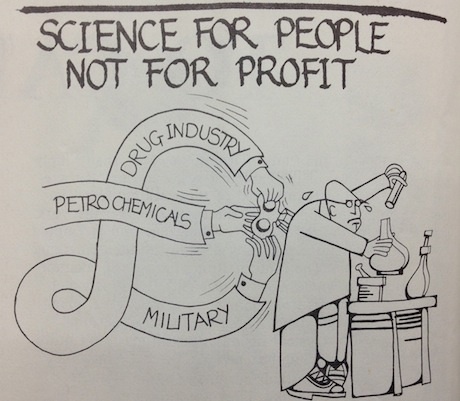
The use, misuse and abuse of science in developing these technologies is crucial. And the meeting highlighted the history of the British Society for Social Responsibility in Science (BSSRS), that in the 1970s and 80s successfully mobilised scientists to work with labour and protest movements. It considered the lessons of this experience for activists today.

The gathering (title: Radical Science and Alternative Technology) was organised by the Breaking the Frame group, and featured talks by veteran BSSRS activists and by present-day campaigners. Here are my impressions of an inspiring day’s discussion. (Stuff will be posted on the Breaking the Frame site and the BSSRS archive site, and I’ll update this post when I hear about that.)

That was then: scientists for social responsibility
The USA’s war on Vietnam (early 1960s to 1975), and its unprecedented use of chemical and biological warfare, helped push radical scientists into action, biologist Hilary Rose said. A direct precursor to the BSSRS was a Chemical and Biological Warfare conference.
UK scientists had learned from the movement on US university campuses and the wave of anti-war sit-ins and teach-ins, Steven Rose added.

It was fascinating to listen to the BSSRS veterans’ contrasting views of the theoretical and practical dilemmas the organisation had faced.
A key issue had been confronting the “old socialist view that ‘science is progress’”, brought to the BSSRS generation by scientists who had sided with labour and socialist movements in the 1930s, Steven Rose said. “We were insisting funding[in opposition to that view] that science is not neutral, that the very science itself was integrated into globalised capitalist society.” 

But BSSRS “could not have come into existence” without the support of that older generation.

Hilary Rose said there had been a “cheery anarchism” in the organisation, with local initiatives endorsed by the national executive. Jonathan Rosenhead, a mathematician, said he did not remember it that way. BSSRS had been united by a belief that “we could do something about [the misuse of science]”, but that there had been a tension about what to do. Some believed BSSRS should be “an elite pressure group”; others wanted it to be “something like the scientific wing of the revolutionary movement”. “We came down on the side of the latter”, he said.

Rosenhead recalled the meeting of the British Association for the Advancement of Science, the elite (and elitist?) professional body, at Durham in 1970. The BSSRS organised direct action-style interventions, disrupting the president’s dinner and asking provocative questions in sessions. “We broke the [elite pressure group] model completely. We went round making trouble. It was extremely vital stuff.” And that was a turning point.
Tony, who had been in a BSSRS group researching and taking action on workplace health hazards, recalled tensions between those wanting to consolidate in the scientific elite, and those developing a critique of science. “But there also came a point when some people wanted to carry on doing science, and be critical within it, and others felt they could not do science but needed to focus on political action.”

Part of the BSSRS’s function had been to strip away the mystique surrounding science, to encourage the wider public to ask who the “experts” were working for, where they were coming from so to speak. Tony argued that times have changed and that this battle has in large part been won. “There is no longer the deference to science [someone else recalled the BSE crisis as proof of that] – although the trouble is that that can turn into a cultural relativism [such as that over public hostility to vaccinations that are in fact safe.]” The problems have changed.

Hilary Rose said that a negative aspect of the BSSRS was that it had in some ways “resembled a boys’ club”. The dearth of women activists was partly (but not only) due to the very small number of women working in science then. She seemed confident that the current generation of women scientists, amongst whom are some “highly political feminists”, would put this right.

In the concluding session, Jonathan Rosenhead said that BSSRS had started with the central idea that “science is not neutral”, and “expanded into political spaces that were open”. Now, those spaces are largely populated by a “growing number of single-issue campaigns”. (I took this to mean that this is not necessarily better or worse, but that the political problems are now posed in a different way.)

Rosenhead and others pointed to the “proletarianisation” of the scientific workforce, that had also changed scientists’ relationship with society. In the 1970s, scientists who spoke out against power often did so from a relatively elite position and with the protection of secure full time jobs. Now, most people in university science departments are on temporary contracts, beholden to a small elite of senior academics.

BSSRS was wound up in the early 1990s. Is it time to try to establish a successor organisation? Scientists for Global Responsibility addresses many of the issues, someone pointed out. Maybe a coordinating and information-sharing network is the crucial thing now, someone else said. The consensus was that the BSSRS’s work should be built on, but could not simply be repeated, in a changed world.

This is now: a range of campaigns
There were three sessions at Saturday’s meeting on separate areas of science and technology:

■ The politics of food and energy. On energy, technologies researcher Les Levidow said that social and labour movements must not accept the issues being framed in terms of an “energy gap” to be filled by one or another technology. This approach leaves out energy workers’ efforts to take control of their own labour, and communities’ control over the way that their energy is provided. Levidow circulated “The Rigged Debate”, an excerpt from a 1981 BSSRS pamphlet on nuclear power. The specific issues about energy have changed, but the points the pamphlet made about how they are approached remain relevant. Read this text, on this site, here.

Helena Paul of Econexus recalled the debate on GM crops in 1986-87, which had showed that “people distrusted government and big corporations profoundly”. The current debate on synthetic biology poses many similar issues: breadfrontwe confront a view of “science as intervention [in nature] all the time, instead of as observation and understanding.” Paul Mobbs, speaking on “extreme energy” argued that “extreme technologies” such as fracking were related to “extreme economics and “extreme politics”.

■ Technologies of control and surveillance. Marie Farrell of the Open Rights Group, which campaigns for freedom of expression and the right to privacy on the internet, recalled the “crypto wars” of the 1990s. State authorities the world over tried to prevent non-state actors using encryption, which secures on-line communication. Eventually they were forced to retreat, opening the way for the growth of on-line commerce. (I assume it was the profit motive, rather than concerns for individuals’ privacy, that trumped it!)

Jonathan Rosenhead described the BSSRS’s long record of monitoring and opposing repressive technologies from rubber and plastic bullets to sensory-deprivation torture techniques, initially in the north of Ireland. Internationally, he pointed out, Vietnam had in the 1970s been the laboratory for many horrific new uses of technology; today the same is true of Palestine.

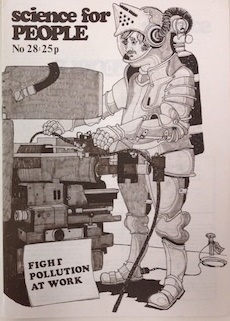
■ Work hazards. This session provided an example of a campaign pioneered by the BSSRS that took root in the labour movement from the 1980s, and persists today in organisations including the Hazards group and the Construction Safety Campaign. Pete Farrell of the CSC and London Hazards Centre explained the centrality of workplace safety issues to building workers. He appealed to scientists present to volunteer their expertise to help deal with hazardous substances used in workplaces.

Where it goes from here
Dave King of Breaking the Frame said that now, with bio-engineering coming close to the fabrication of human beings, the issues of who controls technology and for what purpose were more vital than ever. “The trouble is that we cover2have a series of single-issue campaigns, reacting to issues that come up from the corporate-industrial-technological complex, and these need to be united.”

We need to get to grips with the theoretical problems posed by a social system, and a world view, based on technological control of nature that in turn enables technological control of people, King said. That technocratic world view, which had been prevalent not only in the elite but in the labour movement, had been summed up in a banner over the entrance of the 1933 World Fair that said: “Science discovers. Technology executes. Man conforms.”

Technology is “not a side issue”, King said. He called for a discussion on (i) the democratic control of technology; (ii) the need to combat the ideology of “technology as progress”; and (iii) the idea first championed by the Luddites of resisting technology that is “hurtful to commonality”.

For details of Breaking The Frame meetings and events, see hereGL, 13 April 2015.
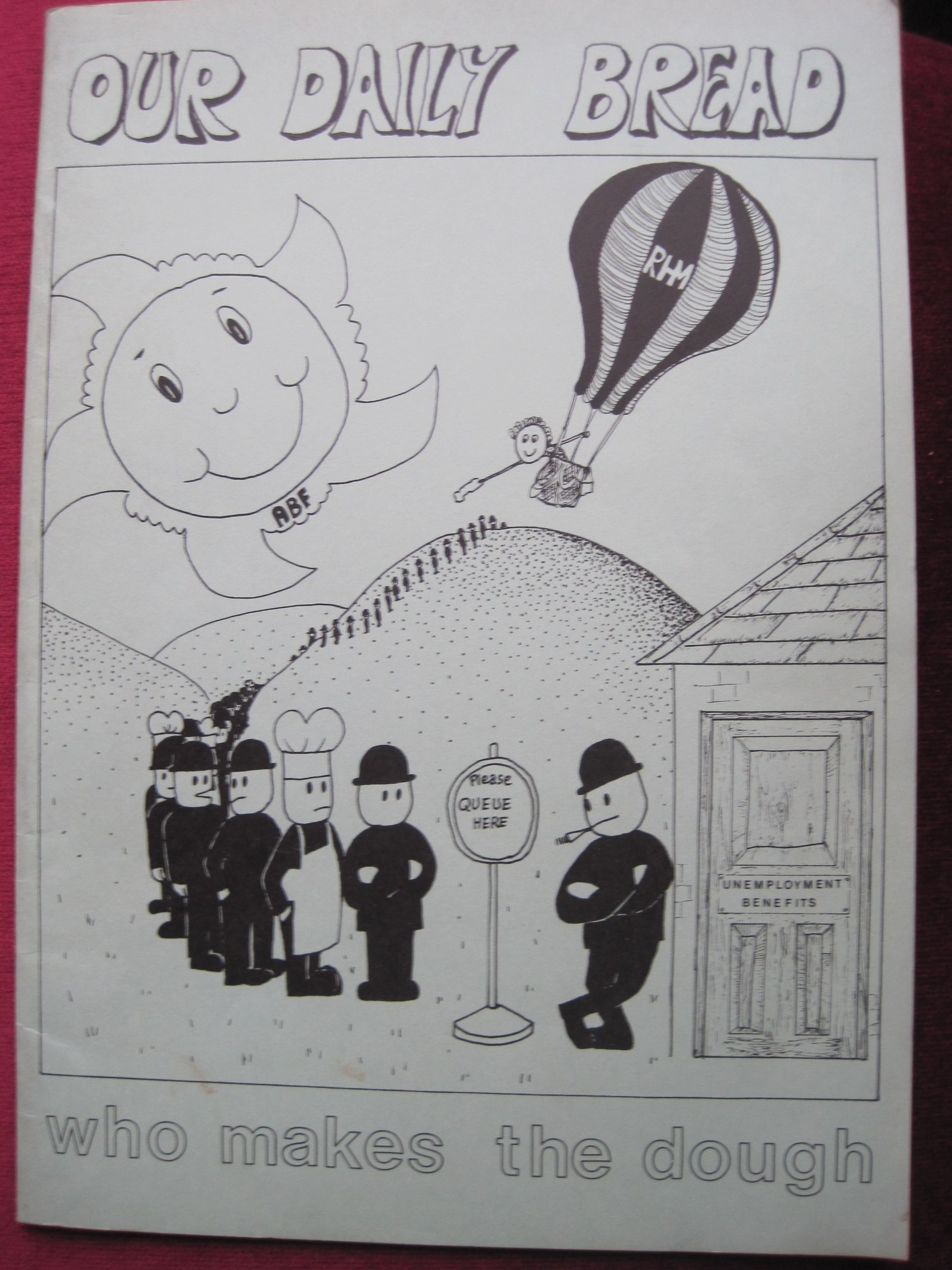
The pictures are from science campaign publications of the 1970s and 80s, available via the links below.

Links