Showing posts with label demographics. Show all posts

Wednesday, September 26, 2018

3035. The Changing U.S. Demographics, 1610-2010

By Manuel Garcia, Jr., manuelgarciajr, September 26, 2018
New York City
The population of English colonists on the eastern shores of what would eventually become the United States of America numbered 350 in 1610. Their descendants, along with those of the subsequent imported Black slaves, many immigrants (legal and illegal), and later remnants of the Native American population whose ancestors had populated this continent since as early as 14,000 years ago, reached a cumulative population of 308,745,538 individuals in 2010, within the political boundaries of the U.S.A.
This essay is a very general and simplified overview of how the population within the territory of the United States has grown over the 400 years between 1610 and 2010. While there is a very wide spectrum of “races” and ethnicities in the U.S.A., this essay will focus on only three groups: White people, Black people and Latino (a.k.a. Hispanic) people. Both White and Black people are thought of as two racial groups; while Hispanic people have Spanish as their original language, and their cultures are based on it, and they can be of any race: White, Black, Red, Yellow, and any mix of these. The summation of the White, Black and Hispanic populations in the U.S. makes up nearly the total US population. Asian and Pacific Islander people make up only 4.9% of the US population (in 2010); and American Indian, Eskimo and Aleut people make up only 0.9% of the US population (in 2010).
An aside on “races”: Based on genetics there is only one race of humans, but the concept of human races — popularly treated as species! — based on skin color, facial and physiological features, is still too widespread and embedded in popular culture to be dispensed with here. Also, race is tabulated in U.S. Census data, upon which this essay is based.
What I am interested to learn is if I can understand the politics of a period from the demographics of that time.
I have made a few simple charts of the racial and ethnic population fractions in the United States for Whites, Blacks and Latinos, based on historical census data spanning the years 1610 to 2010 (https://en.wikipedia.org/wiki/Historical_racial_and_ethnic_demographics_of_the_United_States).
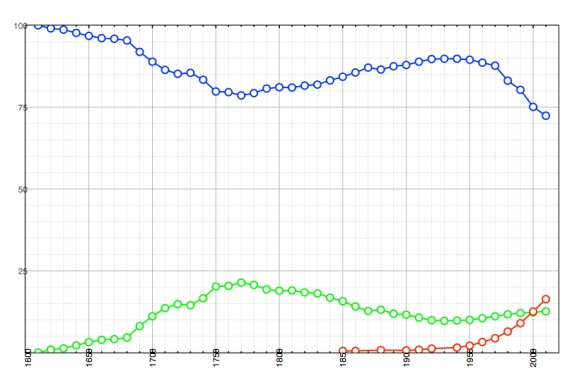
The first pair of charts (quantitatively identical, just with different data-set color schemes, for ease of viewing) show fractional populations as percents of the total US population, from 1610 to 2010. The top curve is for White people, the longer lower curve is for Black people, and the shorter lower curve, which begins at 1850, is for Latino (Hispanic) people.
This census data is not perfect. The United States Census has enumerated Whites and Blacks since 1790. Asians and Native Americans have been enumerated since 1860, though all Native Americans were not enumerated until 1890. A category enumerated since 1950 is “some other race,” and a category enumerated since 2000 is “two or more races.” Hispanics have been enumerated since 1940, with the exceptions of 1950 and 1960, but some estimates for the Hispanic population were made for certain years before 1940 as well as for 1950 and 1960.
The recorded percentages over time of the US population made up of Asian and Pacific Islander people are: 0 for 1610-1850; under 1% for 1860-1970; 1.5% for 1980; 2.9% for 1990; 3.8% for 2000; 4.9% for 2010.
The number of Native Americans in 1492 within the territory of the present day United States probably numbered 5 million people. By 1900 this population had dwindled to 237,196 (its minimum). It grew subsequently, reaching 1,420,400 in 1980, and 2,932,248 in 2010.
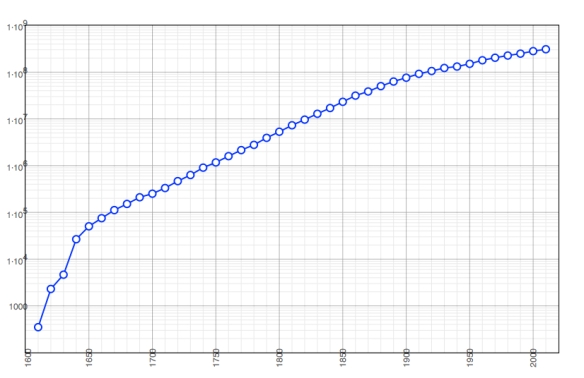
The growth of the total US population — as recorded by the imperfect census data — is shown in this next pair of charts.
The first chart of this second pair of graphics is best for visualizing the grow of population above 5 million people, after 1800. The recorded population grew from 350 in 1610 to about 5 million in 1800. The second chart of this pair of graphics is a logarithmic (linear-log) representation of the data, and makes it possible to see the quantitative trend, especially prior to 1800.
Returning to the fractional population charts, notice the following features:
1610-1770
The fractional population of Whites dropped from 100% in 1610, to under 80% in 1770; with a corresponding rise in the fractional population of Blacks from 0% (a relatively small number in actuality) in 1610, to over 20% in 1770. In the Colonial America of 1770, 1 out of very 5 people was Black (remember, Native Americans were not counted). This (20%) is the maximum that the fractional population of Blacks ever achieved in American history (but of course, the absolute Black population has grown throughout US history). This growth in Black population was a result of the importation of enslaved Blacks from Africa. The total Colonial American population during this period grew from 350 to 2,148,076.
1770-1850
The fractional population of Whites rose from its local minimum of less than 80% in 1770, to almost 85% in 1850. The fractional Black population dropped from its local maximum of over 20% in 1770, to about 16% in 1850. A law banning the importation of slaves into the United States took effect in 1808, but slavery itself was not outlawed. Blacks were born into slavery if their parents were enslaved, and the absolute population of Blacks in the U.S. grew. This period of 1770 to 1850 corresponds to the Industrial Revolution, which was the transition to new manufacturing processes in the period from about 1760 to sometime between 1820 and 1840. This transition included going from hand production methods to machines, new chemical manufacturing and iron production processes, the increasing use of steam power, the development of machine tools and the rise of the factory system. Immigrants from Europe added to the White population in the U.S., for example Irish people seeking escape from their Great Famine of 1845 to 1852. The total American population during this period grew from 2,148,076 to 23,191,876.
1850-1900
The recorded (estimated) percentage of the US population made up of Hispanic people was under 0.8% between 1850 and 1900. In 1845, the United States annexed the “Republic of Texas” (Mexican territory occupied by “illegal immigrant” American slave owners seeking to expand the slave plantation system of the Southern U.S., westward). Mexico’s defeat in the subsequent Mexican-American War of 1846-1848, resulted in the loss of one-third of its territory to the U.S. That new US territory is the present day American states of Texas, New Mexico, Colorado, Arizona, Utah, Nevada and California.
The fractional population of Whites rose from nearly 85% in 1850, to about 87% in 1900; while the fractional population of Blacks dropped from about 16% in 1850, to about 13% in 1900. This half-century period encompassed the Civil War, the Indian Wars in the American West, and the Spanish-American War, when the United States became an overseas empire. The total American population during this period grew from 23,191,876 to 75,994,575.
1900-1930
Between 1900 and 1930, the fractional White population rose from 87% to 90%, while the fractional Black population dropped from 13% to under 10%. This thirty year span included the latter Gilded Age, World War I, the Roaring Twenties, and the Crash of 1929, which was the beginning of the Great Depression. The total American population during this period grew from 75,994,575 to 122,775,046.
1930-1940
The years 1930 to 1940 spanned most of the Great Depression (which actually occurred from 1929 to 1942), and are a local maximum of fractional White population (~90%), and a local minimum of fractional Black population (~9%). The fractional Hispanic population during 1930 to 1940 rose from about 1.3% to 1.5%. The total American population during this period grew from 122,775,046 to 131,669,275.
1930-1950
Between 1930 and 1950, the fractional White population remained at close to 90%, while the fractional Black population remained at close to 10%. This twenty year period included the Great Depression, World War II, and the brief Cold War period just after World War II and just prior to the outbreak of the Korean War in 1950. The fractional population of Hispanics rose from about 1.3% to 2.1% during 1930 to 1950. The total American population during this period grew from 122,775,046 to 150,697,361.
1950-1970
Between 1950 and 1970, the fractional White population dropped from its highest proportion since 1700 (about 90%) to nearly 88%. The fractional Black population rose from 10% to 11%; and the fractional Hispanic population grew at an accelerating pace — more than doubling — from 2.1% to over 4.4%. The rapid increase in US Latino population was a result of their higher fertility, and increased immigration from Mexico, Central and South America, and the Caribbean.
The people on the island of Puerto Rico, captured during the Spanish-American War of 1898, were given US citizenship in 1917, but not the right to vote in US national elections, nor were Puerto Rico’s elected representatives allowed to vote in the U.S. Congress (to this day). But, that extension of US citizenship for Puerto Rico came just in the nick of time for the Wilson Administration to draft men from Puerto Rico to fight (and presumably some die) in World War I, and similarly in the subsequent wars of the United States. Puerto Ricans who want to vote in US elections have to migrate to the US mainland and settle there, which many did during the 1940s and 1950s, primarily to seek better economic opportunities. The musical “West Side Story” is an artistic artifact inspired by this wave of immigration from Puerto Rico to the US mainland.
The twenty year span of 1950 to 1970 included: most of the postwar boom (occurring primarily from 1948 to 1971), which encompassed the last two years of the Truman Administration, and the Eisenhower, Kennedy and Johnson Administrations, and the first two years of the Nixon Administration, as well as the Vietnam War up through the time of the American invasion of Cambodia, ordered by the Nixon-Kissinger Administration. The total American population grew from 150,697,361 in 1950, to 203,210,158 in 1970.
1970-2010
The total American population grew from 203,210,158 in 1970, to 308,745,538 in 2010.
During the 40 years between 1970 and 2010, the fractional White population dropped significantly from 88% to 72%. The fractional Black population rose modestly from 11% to 12.6%; and the fractional Hispanic population zoomed from 4.4% to 16.3%. In the year 2000, the fractional Black and fractional Hispanic populations were essentially equal (12.3% and 12.5%, respectively), and subsequently the fractional Hispanic population became larger, and continued growing faster.
The rapid rise of the fractional Hispanic population subsequent to 1950, and especially since 1970, is responsible for the accelerating drop in the fractional White population (since the fractional Black population has changed little, and other fractional populations, as for Asians, are still relatively small).
The increase of the Hispanic population beyond that of the Black population after 2000, along with the corresponding drop in the fractional White population, has fueled the racial tensions expressed today as the Trump Administration: widespread Black resentment of Latinos (“Mexicans”), and the overt exercise of political power by White Supremacy: anti-immigrant and deportation policies against “illegal” Mexicans and people from Muslim-dominant countries, as well as voter suppression efforts aimed at Blacks and poorer Hispanics (many ethnically Mexican and Central American).
Trumpism is the combination of fear of demographic dilution — held by previously dominant racial-ethnic sub-populations; and of insatiably desperate exclusionary avarice seeking climax before our Pompeii-like climapocalyptic termination — held by the traditional, dominant and uppermost classes of American wealth.
Most of the undocumented (“illegal”) Central American immigrants to the United States were and are actually refugees from countries whose economies have been withered by US corporate vampirism backed by both direct and indirect US military interventions propping up corrupt and viciously cruel oligarchic client regimes. This predatory US imperialism “south of the border” stretches back to the Mexican-American War of 1846-1848, and includes many US Marine invasions and occupations prior to World War II, as famously condemned by General Smedley Butler (who was awarded several Medals of Honor for his heroism during such actions, in his earlier years when he commanded troops in them).
During World War II, President Franklin Roosevelt instituted the “Good Neighbor Policy,” which amounted to the U.S. being nice to Latin America and buying its export products at good prices for the producers (for example buying the entire Cuban sugar output during the war years), so as to induce the countries of the Caribbean and Central and South America to remain neutral in that war, instead of cashing in by provisioning Germany, and allowing its submarines to harbor safely in Latin American ports, and thus be able to hunt for Allied (i.e., American) war supply ships close to US shores.
After World War II, the Good Neighbor Policy disappeared and it was back to the Monroe Doctrine modus operandi. And, Central American peasants fleeing economic starvation and political murder would go north (to this day). A particularly bad period in this regard was during the Nicaraguan Revolution (1962-1990), and during the Reagan Administration (1981-1988), which massively, overtly and surreptitiously prosecuted its proxy Contra War in Nicaragua, in support of the remnant army and police forces of the Somoza dictatorship, which had been deposed by Nicaraguan socialists during 1978-1979.
The Reagan Administration also carried on similar proxy wars in Guatemala and El Salvador. The neofascist forces the Reagan Administration backed and supplied were responsible for many excessively cruel and massively bloody deeds, which many people — including me — considered genocidal. After 1990, the Central American wars tapered off, but the fundamental struggle — of a peasantry seeking political freedom, economic control of their lives, social justice, and physical security from arbitrary exploitation, torture and murder by the death squads and militarized police forces employed by corrupt oligarchic client regimes — still continues in some Central American countries.
And so, streams of impoverished displaced living victims of American profiteering in Central America go north, hoping to find their personal salvations in the United States. Those that make it (legally or illegally) add to the Latino Population Tsunami that is altering the demographic layering of the US population.
How will our changing demographics change our future politics? Good question.

Wednesday, May 21, 2014

1421. Population Problem

By T. Vijayendra, FrontierOctober 14 - November 10 2012


Introduction
This is meant to be an article for activist education and therefore on the one hand it starts with explaining basic concepts; on the other hand it avoids academic references. The population problem is complex and has been debated since Marx's time. In the past leftists maintained that it is not a real problem, but a creation of capitalism. However in the last few decades resource constraints of the planet earth have been recognised and the present population of seven billions appears as a challenge. This article does not give definite ready solutions. It tries to present the problems and looks at possible solutions in a particular region.
Population Growth, Growth Rate and Doubling of Population
Population growth means increase in population which is computed by subtracting total deaths from total births per year. For a specific area or country one has to add total inmigration minus total outmigration.
Population grows at a 'compound rate' (like compound interest rate that we learn at school). The doubling of population is a function of growth rate. A simplified (but fairly accurate) formula is 70/growth rate = No. of years in which the population will double. Thus if we have 1 percent growth rate, in 70 years it will double. If we have 2 percent then in 35 years it will double and in 70 years it will be 4 times! If the growth rate is 10 percent it will double in 7 years - like our fixed deposits used to double in 7 years when the interest rates were 10 percent.
Zero Population Growth (ZPG) or Sustainable Population
Zero population rate (ZPG) means the rate of growth is zero or we have a stable population. We can even have negative population growths which results in the decline of the population. This happens at some time both in nature and in human history.
In nature sustainable population is based on high child mortality and normal/low longevity. High child mortality occurs because almost all animals have predators, which kill the weak and the slow. Also in nature they don't have 'health care' like humans have today, where the aim is to save every child and achieve as low child mortality as possible. High child mortality ensures lower growth rate and more effective genetic selection and therefore a ‘healthier’ population. Low longevity occurs because the predators kill the weak and the old because they cannot escape the predators. Animals that do not have predators (the top of the species) die due to inability to hunt or digest. For example, tigers die when they become too weak to hunt whereas elephants die due to losing their teeth.
In early human history human beings were not very different from other animals as the population growth charts show below. But human history is different because humans can modify the environment to suit themselves to a greater degree than any other species. This ability kept on increasing and it increased by a leap due to industrialisation in the last 200 years. That is the root of the population problem.
 The Problem
The population growth is essentially due to humans’ ability to modify the environment to suit their needs. While the invention of fire and other similar inventions were important, a significant change occurred around 12,000 years ago due to introduction and growth of agriculture. Agriculture provided food security by increasing the shelf life of food (mainly grains), made slavery possible and in turn increased population. The figures are well known. Thus:
World         India
Beginning of agriculture (10000 B. C.) 1 Million
Introduction of Iron (500 B. C.) 100 Million
Beginning of Christian Era 200 Million
 1800 A. D. 1000 Million or 1 Billion 260 Million
1900 A. D. 1.6 Billion 300 Million
1950 2.5 Billion 350 Million
2000 6 Billion 1 Billion
Today 7 Billion +           1.2 Billion
(All figures and dates are approximate).
Agriculture also destroyed forests, grasslands and wetlands endangering the flora and fauna and in the final analysis it can endanger human species too. We said above that agriculture created food security. It is debatable because it also increased population and created slavery thus creating food insecurity for the slaves. This has happened more dramatically in the 20th century.
The 20th Century
As we see from the data above, the 20th century was unique. It had the highest population growth rate in history. It was the only century in which the global population doubled and trebled! Several factors contributed to it. The green revolution (chemical fertilisers, pesticides, seeds, irrigation and mechanisation of agriculture), which was possible due to availability of cheap petroleum products, came only after World War I (in India it came in the 1970s). It contributed significantly to increased production of commodified food, particularly in the US, Canada and Australia and contributed to increase of population all over the world. On the other hand it also increased poverty, hunger and food insecurity for millions of people, especially in the third world.
 Secondly increased longevity and decreased child mortality occurred due to dramatic changes in the health care industry. This is opposite to what happens in nature. In the era of cheap oil longevity increases due to ‘zoo conditions’ of old people - no predators, assured food supply and a high eco foot print of old people due to geriatric health care. In nature, ’zoo conditions’ do not prevail and therefore longevity is low.
 Thirdly, decrease in the number, intensity and deaths due to famines. So we get a picture of a 7 billion population with millions of hungry people all around the world, particularly in the third world. The current UN data of hunger is around a thousand million or one billion.
Several other things happened too. A huge meat and poultry industry came up. These animals did not eat grass or insects as in the past but were fed agricultural produce (mainly corn in the US). So a greater area came under agriculture, further reducing grassland, wetland and forest. Several commercial crops like tobacco, tea, coffee and sugarcane also took up large agriculture areas. To feed this agriculture other industries and mining also increased. A huge resource drain occurred. 
  The 21st Century
There is a limit to growth of agriculture. It is limited by land and by input resources. The limit was artificially raised by cheap oil in the 20th century. This has ended in the 21st century. Oil production peaked (2005-2008), and it is now declining, never to rise again. This not only ushered an unending crisis of capitalism, it has also affected food production by increasing the input prices of agriculture. Today a billion people are starving the world over.  About half of these starving people, that is, 500 Million are likely to die in this decade. And a full half of them, that is, some 250 Million will be Indians. It is difficult to imagine what other things will happen along with this catastrophic event. It is an end of era event - like the Black Death in Medieval Europe.
What else can happen during this period? With the arrival of Peak Oil, the curtain has closed on Act 1 of the drama Petroleum Man. What will happen in Act 2? Chekhov said, 'If there's a gun on the wall at the beginning of the play, by the end it must go off.' In the world's nuclear arsenal there are many guns on the wall. If life copies art, will there be an Act 3 in which the players, having learned their lesson the hard way, live sustainably? So if we do face a nuclear holocaust then we may have a situation when the 'living shall envy the dead'. However as humans, we are optimistic and so let us look at some more optimistic scenarios.
What are the possibilities?
There are two issues:
  1. How the current and growing population can feed itself and
  2. How we can move towards a sustainable population
As we have seen above in a short term scenario there is going to be a lot of pain and starvation deaths. In the past due to cheap oil one could transport large quantities of food quickly. While it did not stop poverty or starvation, it prevented deaths. This no longer will be possible. These deaths will occur among vulnerable population, the poor and tribals. The sad thing is that these very people have many of the skills needed to sustain us in a post oil world. Various scholars have given different figures about reduction of population in the short term. One extreme figure is that the world population will be only two billion by 2050.
In the long term there are some possibilities. With the end of oil, economies will have to grow local because transport costs will be too high. If we do not destroy ourselves social changes are bound to occur. 
A viable future lies in some kind of non capitalist social formation which is based on: 
  1. Equity
  2. Scaling down of energy use
  3. Local self sufficiency
  4. Eco restoration by using Permaculture/Agro Ecology
This may ensure enough food for the existing population. Each eco region will have to become self sufficient. Now different eco regions can support different levels of populations. Deserts and cold countries support smaller populations whereas tropical countries and riverine plains support bigger populations. So over a period the population will have to decline according to carrying capacity of the region. In the final analysis they will have to attain zero population growth and may even have shrinking of population.
Social Formation
We have two existing models which have tackled the present problems somewhat successfully: the Cuban model after the collapse of Soviet Union and the Transition Town Movement in Europe and USA. The latter has an anarchist kind of social formation. 
The erstwhile socialist/communist countries (former Soviet Union, China, Vietnam etc.) may learn from Cuba and have their own version of ‘Special Period’ and come out of the crisis in 5 years. 
The advanced capitalist countries may have some kind of social democracy with strong ‘Eco Socialism’ inputs and coupled with Transition Town models may also solve the problem within a relatively short period. 
The so called ‘Third World ‘countries have limited experience of democracy. While they do have anarchist kind of experiments in pockets, like permaculture communes that are springing up everywhere, they are also facing lot of difficulties because the society at large still has an authoritarian background. So, these countries may have to go through some kind of revolution resulting in a command economy and then follow Cuba kind of ‘special period’.  This is an optimistic scenario, but in reality there will be lot of conflict, pain and misery, particularly before and during the revolution. There is also a possibility that some countries may not have revolution and may have a prolonged period of chaos destroying people and resources.
Zero Population Growth
The new social formations coupled with organic farming or agro ecology can certainly feed the present population better. This is due to several factors. Due to relative equitable distribution people will have a little more food. A lot of waste due to wasteful consumption by today's rich, waste due to storage and transport in the present capitalist economy will also be eliminated. 
However as we have seen organic farming fed only about two billion people in 1921. Can it feed 7 billion people today? It is a very difficult proposition. So there will be attempts to limit population growth and take it to zero population growth (ZPG).
The existing models of ZPG are based on urbanisation, nuclear family and increased prosperity. This model cannot be applied to the whole world because there are not enough resources for the whole world to achieve the prosperity that the western countries and some richer people in developing countries have achieved.
However one reason for the above model to work was the security that this model provided. It is possible to provide security at a lower level of consumption if the society is based on equity. So it is possible that in the new social formations ZPG may be achieved.
But is achieving ZPG enough?
We have seen that the sustainable population before agriculture was only one million. What is the desirable level of population that is actually sustainable over a long term? Obviously one million, the natural sustainable population before agriculture, is the lowest limit and mankind may never go down to that level. Various figures have been suggested, most of them are around two billion or less. This figure is arrived at due to the fact that in 1921 when the population was two billion, all agriculture was organic. For India this figure is 350 million (1950) when practically all agriculture was organic. However since then the soil has been degraded and without oil even this population may have difficulties to survive. Will mankind shrink to such a level? And of course the more pressing question is how the present population will face the situation when fossil fuel agriculture comes to an end. As we said above there is a possibility of large scale famine killing millions of people.
The Future
Will mankind be able to achieve this reduction of population to two billion? The question poses several issues. Mankind has developed an ethics that values life per se and it is unthinkable to allow child mortality to increase and have higher number of births. Similarly it is difficult to think of lowering longevity. At best we can think of an option - making euthanasia legal. But it will be exercised by very few. Only future generations will be able to think about it more clearly in changed circumstances. Even if we achieve negative growth rates, it will take a long time to achieve this kind of reduction. And what is the way to achieve this? If we decrease birth rate, we will be saddled with an increasingly aging population, like Japan and France today. So logically nature's way appears to be best. In organic farming we say that we should follow Nature's way. Why should it not be applicable to human society?  It remains a challenge to future generations as to how to achieve this in a humane way. 
Think Locally, Act Locally
In the past the slogan, 'Think Globally, Act Locally' was very popular. Even in this article we began looking at the problem globally. But as we have said, in the future local self sufficiency will be the order of the day. So we should also be able to think locally and act locally. Below we look at the Deccan in India as an eco region, look at its problems and try to look at the solutions that are being attempted.
Historically India has been endowed with rich natural resources and the country was self sufficient most of the time except in times of great political turmoil. Deccan too has been self sufficient. The last great famines occurred during the closing decades of the 19th century.
Every eco region has specific food practices. In Deccan it has been millets, pulses and ground nut. Agriculture is mainly rain fed with local irrigation from tanks. Some rice was grown in low lying areas with tank irrigation. Cotton was the main cash crop. Rearing of sheep and goats has been an important part of the local economy and meat has been part of the diet.  Some amount of fish and poultry has also been part of the food. Some communities also eat pork.
A lot of this changed due to green revolution in other parts of the country and in Deccan it introduced food insecurity and hunger and in some cases farmer’s suicide. How did it come about? 
Increases of food production of wheat and rice are concentrated in green revolution areas. This was brought to the Deccan by the government’s public distribution system. Popular governments introduced rice at two rupees per kilo for the poor. This made the local millets expensive and people got used to eating rice and wheat. Slowly rice and wheat were introduced as food crops. As these require lot of water, tube well irrigation was introduced and tanks were neglected. Other cash crops like sugar cane, soybean and genetically modified Cotton were also introduced.
This led to a big disaster within 30 years. Water tables fell and there has been a big water scarcity in many regions. Commercial agriculture proved unviable for small and medium farmers and their burden grew to such an extent that several thousands of farmers had to commit suicide. Polished rice and white flour consumption affected the health of local people and possibly caused increased suffering due to diabetes. Hunger and water scarcity stalks the land.
The socialist solution to this situation is a combination of the old traditions and new. The old tradition consists of struggling for security of land ownership or land to the tiller or land reforms. The new is decentralization, local food security and knowledge based restoration of ecology and agriculture that has been degraded due to the processes mentioned above. Local food security implies growing local foods as per local ecology. In the Deccan it would mean reducing rice and wheat and going back to millets, pulses and ground nut. Again the cash crop of sugar cane and soybean which are popular today will have to be abandoned or reduced drastically and organic cotton will have to be restored. Agro ecology would be the key science of the 21st century and rebuilding local communities would be the key social task.
A large number of social movements coordinated by NAPM (National Alliance of People’s Movements), NGOs like Deccan Development Society and several other organisations, small groups, permaculture farms in the region are following this path. While the scale is small and the ruling classes are very powerful, nevertheless they are showing a viable alternative. With larger political changes these policies and experiences will prove useful. It is certainly possible to visualise food self sufficiency for the Deccan region.
Call to Arms

In the face of such imminent crises there are several people’s movement going - the Maoists, the ethnic and regional movements in Kashmir and the North East and scores of movements against large capitalist projects that take away common property resources such as land and water, existing livelihoods of poor people and endanger the environment. However there is a lack of coordination and understanding about the nature of capitalist crisis. The movements mainly oppose the exploitation and oppression and demand either immediate relief or improvement of the system. Many even think that they are fighting a losing battle. They do not realise that the time has come to fight for a win, to change the system. There does not seem to be the necessary urgency in the people’s movement. Partly it is inertia; partly it is the phenomenon of the boy crying ‘wolf’, that is, in the past, so many times, capitalism faced crisis and yet we did not have any revolutionary change in India. So this time around people are tired of responding. Then there is a divergence in various movements – in the issues handled – class, ethnicity or opposition to mega projects. So even though millions of people are actively opposing the present State and capitalism, there is no dialogue or coordination between different groups and movements. It is the need of the hour to have a dialogue, come together for concerted action and avoid the forthcoming disaster as much as possible. This time around the chances are better because the edifice of the enemy is weakened, is crumbling and imploding. Is anyone listening?