Showing posts with label Ecological crisis. Show all posts
Showing posts with label Ecological crisis. Show all posts
Thursday, August 19, 2021
3544. Video: Interview with David Kubrin about "Marxism and Witchcraft"
By David Kubrin, October 20, 2020


Friday, September 11, 2020
Saturday, June 20, 2020
3384. Consumerism Is the Leading Cause of the Environmental Crisis, Study Finds
By Valerio Donfrancesco, Conversation in a Click, June 19, 2020
 |
| Giant container ships make up a circulatory system that carries more than 90 percent of all traded goods in the United States. (The New York Times)l traded goods. |
A new study1 published in Nature Communications, led by Dr Thomas Wiedemann of the University of New South Wales, Australia, stresses that the issue of overconsumption especially in the wealthiest countries lays at the roots of the current environmental crisis, more so than population growth.
The study highlights that “it is clear that prevailing capitalist, growth-driven economic systems have not only increased affluence since World War II, but have led to enormous increases in inequality, financial instability, resource consumption and environmental pressures on vital earth support systems”. “The strongest pillar of the necessary transformation is to avoid or to reduce consumption until the remaining consumption level falls within planetary boundaries, while fulfilling human needs”.
It thus follows that tackling the environmental crisis would require a direct downscaling of economic production and consumption in the wealthiest countries. The study points out that “the world’s top 10% of income earners are responsible for between 25 and 43% of environmental impact. In contrast, the world’s bottom 10% income earners exert only around 3–5% of environmental impact”. The affluent lifestyles of the world’s wealthiest societies not only determine and drive global environmental and social impacts, but also disproportionally impact on the poor, who are most heavily affected by environmental catastrophes and in the worst positions to cope with them.
“Since the level of consumption determines total impacts, affluence needs to be addressed by reducing consumption, not just greening it”, reads the study. Envisioning future economies based on sustainable or green growth may be nothing but illusory, as the decoupling of economic growth from environmental impacts has never been achieved before. We need a shift away from prioritising economic growth in order to come out of the current crises triumphant. The authors extend their critique to the United Nation’s Sustainable Development Goal no.8, which aims for continued global GDP growth of ~3% p.a., “likely contradicting several other SDGs [Sustainable Development Goals], e.g. SDG 12 and 13″.
“Estimates of the needed reduction of resource and energy use in affluent countries, resulting in a concomitant decrease in GDP of similar magnitude, range from 40 to 90%”.

Shown is how the global material footprint (MF, equal to global raw material extraction) and global CO2 emissions from fossil-fuel combustion and industrial processes (CO2 FFI) changed compared with global GDP (constant 2010 USD). Figure credits: 1
The study also emphasises that technological progress alone won’t get us out of the current crises. That is because overwhelming evidence shows that “burgeoning consumption has diminished or cancelled out any gains brought about by technological change aimed at reducing environmental impact”.
Discussions framed around alternative economic models that do not prioritise economic growth and rather emphasise human wellbeing and environmental protection, such as degrowth, eco-socialism or a-growth are already embraced by many scientists, though they lag behind in entering public and political debates.

The safe and just space for humanity. Sustainable lifestyles are situated between an upper limit of permissible use (“Environmental ceiling”) and a lower limit of necessary use of environmental resources (“Social foundation”). Figure credits: 1
Reference
Wiedmann, T., Lenzen, M., Keyßer, L.T., and Steinberger, J.K. 2020. Scientists’ warning on affluence. Nat Commun. 11: 3107. https://doi.org/10.1038/s41467-020-16941-y
Saturday, September 7, 2019
3279. As the Amazon Burns, It’s Time to Roll Up Our Sleeves
By Derrick Jensen, Fair Observer, September 5, 2019
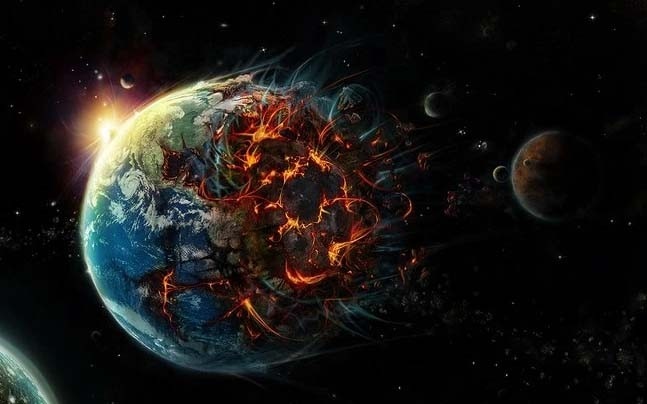
The Amazon is burning. This is what the end of the world looks like. Oh, and there’ll be more forests burn, more forests felled by chainsaws, more wetlands drained, more rivers dammed, more grasslands plowed, oceans further toxified and emptied of fish.
And each of these is what the end of the world looks like.
The end of the world looks like factory trawlers pulling in net after net full to bursting with fish — the fish’s eyes popping out from the pressure of all those bodies squeezed together. It looks like puffins starving to death. It looks like emaciated polar bears. It looks like whales washing up on shore and walruses not finding ice on which to rest.
The end of the world looks like plows digging into grasslands, turning over soil and killing all who live there, even down to bacteria. It looks like rows of mono-crops, as far as the eye can see.
The end of the world looks like humans staring at screens, clucking their tongues at the destruction of forests far away, never noticing that they themselves — whether they’re in London, New York, Paris, Rome, Athens, Beirut, Beijing or Baghdad — are standing in clear-cuts.
The end of the world looks like cities, with most of their residents never giving a thought to who and what was killed to build that city, never giving a thought to who and what was killed to mine, manufacture and move everything they consider necessary to their lives, and never thinking about what is necessary to life and what is not.
The end of the world looks like humans turning the planet to human use. Or rather attempting to, because it’s not possible to turn this wild and fecund Earth totally to human use, and this attempting is itself what is causing the end of the world.
From the beginning of this culture, it has been so. When you think of Iraq, is the first thing you think of cedar forests so thick that sunlight never touches the ground? That’s what it was like, prior to the beginning of this culture. The first written myth of Western civilization is Gilgamesh deforesting the hills and valleys of Iraq to make a great city.
Have you heard of Mesopotamian elephants? Most of us haven’t. They were exterminated to make way for this culture. And when you think of the Arabian Peninsula, do you think of oak savannas? These forests were cut for export to fuel the economy, to build cities.
The Near East was heavily forested. We’ve all heard of the cedars of Lebanon. They still have one on their flag. The great forests of North Africa were felled to make the Phoenician and Egyptian navies. Greece was heavily forested. So was Italy. So was France. The great forests of Britain came down to make the navy that allowed the sun never to set on the British Empire.
This is what this culture does. Forests precede us and deserts dog our heels.
The end of the world was not written into human existence. For most of our species’ time on Earth, we’ve lived sustainably. The Tolowa Indians lived where I live now for at least 12,500 years, and when the dominant culture arrived, salmon still ran so thick they turned entire rivers “black and roiling” with their bodies. There was no such thing as “ancient redwood forests.” There was only “home” — a home filled with trees thousands of years old, a home filled with nonhumans in abundance most of us literally cannot conceptualize.
Can you imagine — and this moves us across the continent — flocks of passenger pigeons so large they darken the sky for days at a time, flying 60 miles per hour and sounding like rolling thunder? Can you imagine so many whales that the air looks foggy, just from their breath? Can you imagine fish in such abundance that they slow the passage of ships? Can you imagine entire islands so full of great auks that one European explorer said they could load every ship in France and it would not make a dent? Well, they did, and it did, and the last great auk was killed in the 19th century.
How did the world get to be so full of life in the first place? By each creature making the world richer by living and dying. Salmon make forests stronger by their lives and deaths. Redwood trees do the same. Buffalo make grasslands stronger by their lives and deaths. Wolves do the same. And humans can do the same. But not living the way we do.
The Tolowa were not alone in their sustainability. There have been sustainable cultures the world over. The San of southern Africa, for example, evolved in place. They have lived there, in human terms, forever.
And how have humans lived sustainably in place? Simple. By not destroying the places where they lived, and by not destroying other places either. By improving the habitat on its own terms by their presence. The Tolowa made land-use decisions, just as all other beings on the land do, and just as we make land-use decisions. But the Tolowa made these land-use decisions on the assumption they would be living in a place for the next 500 years. That assumption changes everything about how you make decisions and how you live. It is the difference between life and death, between sustainability and the end of the world.
The end of the world was not written into human existence. It was, however, written into the story of Gilgamesh. The end of the world is written into this way of life of converting the Earth solely to human use. It was written into existence with the plow, and with the cities the plow makes possible.
The logic is simple and inescapable. If you convert the land that previously grew bushes and trees that fed elephants into wheat that feeds humans, you can grow more humans per hectare. Many of these humans can become a standing army. And you can use those trees you cut down to build ships of war. You now have a competitive military advantage over those who live sustainably, over those who do not destroy their land base. Further, because you’ve degraded your own land base, you must expand into other land bases. But fortunately for you, you’ve got a standing military.
This is the last 6,000 years of history. This is the story of the end of the world.
More than 90% of forests on the planet have been destroyed. The same is true for wetlands, grasslands, seagrass beds, large schools of fish, wildlife populations in general.
This culture is killing the planet. It doesn’t have to be this way. Not every culture has lived this way. Not every culture has killed the planet.
Recently, more and more people are talking about the possibility of human extinction. That possibility has entered our consciousness enough that, in December 2018, The New York Times published an op-ed asking whether it would be better for the Earth if humans went extinct.
As the Amazon burns, here’s the thing that haunts me. How is it that this culture can contemplate the end of the Amazon rainforest, contemplate the end of elephants, great apes, insects, fish in the oceans? How is it that it can blithely destroy life on Earth? How is it that it can with not much horror contemplate human extinction, but cannot contemplate stopping this way of life?
If aliens came from outer space and did to Earth what this culture is doing — change the climate; burn the Amazon; deforest the planet; vacuum the oceans and put dioxin in every mother’s breastmilk; and bathe the world in plastics, endocrine disrupters and neurotoxin — we would know exactly what to do. We would resist. We would fight as though our lives depend on it. We would destroy the aliens’ infrastructure that allows them to wage war on the planet that is our only home.
Or, put another way, if the Amazon could take on human manifestation, what would it do? If salmon could take on human manifestation, how long would dams stand? If humans from the future could come to our time, how would they act?
As the writer Lierre Keith often says, “If there are any humans left 100 years from now, they are going to ask what the fuck was wrong with us that we didn’t fight like hell when the world was going down.”
Many of us who know history might have fantasies of how we would have acted were we alive under German occupation in World War II or under British colonial rule. Right now, we are facing the end of the world. We have the opportunity and the honor to protect the planet that gave us our lives.
The time is now. Roll up your sleeves and get to work. Life on this planet needs you.
Saturday, April 21, 2018
2887. Damage to Great Barrier Reef From Global Warming Is Irreversible, Scientists Say
By Jacqueline Williams, The New York Times, April 19, 2018
 |
A diver surveying damaged coral in the Great Barrier Reef after a mass bleaching in 2016. Photo:
XL Catlin Seaview Survey, via Agence France-Presse — Getty Images |
SYDNEY, Australia — An underwater heat wave that damaged huge sections of Australia’s Great Barrier Reef two years ago spurred a die-off of coral so severe that scientists say the natural wonder will never look the same again.
Scientists said nearly one-third of the reef’s coral were killed when ocean temperatures spiked in 2016, a result of global warming, according to a study published Wednesday in the journal Nature.
The damage to the reef, one of the world’s largest living structures, has also radically altered the mix of its coral species, scientists said.
“The reef is changing faster than anyone thought it would,” said Terry P. Hughes, the lead author of the study and the director of a government-funded center for coral reef studies at James Cook University in Queensland.
“One thing we can be sure about is the reef isn’t going to look the same again,” Professor Hughes said.
The reef is home to thousands of species, including sharks, turtles and whales. Australia relies on it for about 70,000 jobs and billions of dollars annually in tourism revenue, all now threatened by years of accumulated damage.
The study’s authors estimated how much coral had died in the immediate aftermath of the 2016 heat wave, and then returned nine months later to discern how many corals had regained their color — a sign of restored health — and how many had died. Their report describes a catastrophic die-off on the northern part of the reef, impacting the mix of coral species.
Professor Hughes said scientists had predicted a mass die-off resulting from global warming, but “what the paper shows is that it’s well underway.” He added, “That transition is happening here and now.”
Corals require warm water to thrive, but they are extremely sensitive to heat, and an increase of two or three degrees Fahrenheit above normal can kill them.
Scientists said that if nations honored global commitments in the Paris climate accord aimed at preventing temperatures from rising more than 2 degrees Celsius, Australia would still have the Great Barrier Reef in 50 years. It would still look very different from today.
But if greenhouse gas emissions continue on their current trajectory, the reef will be unrecognizable, they said.
“We’re in unchartered territory,” Professor Hughes said, adding, “Where we end up depends completely on how well or how badly we deal with climate change.”
The Great Barrier Reef has bleached four times since 1998, according to scientists.
Record high temperatures in 2016 were followed by another bleaching event last year.
“We’re now at a point where we’ve lost close to half of the corals in shallow-water habitats across the northern two-thirds of the Great Barrier Reef due to back-to-back bleaching over two consecutive years,” said Sean Connolly, also with the center for coral reef studies at James Cook University.
“We’re now at a point where we’ve lost close to half of the corals in shallow-water habitats across the northern two-thirds of the Great Barrier Reef due to back-to-back bleaching over two consecutive years,” said Sean Connolly, also with the center for coral reef studies at James Cook University.
Monday, April 16, 2018
2883. Gulf Stream Disruptions Can Set Off Deeper Ecological Crisis

Serious disruption to the Gulf Stream ocean currents that are crucial in controlling global climate must be avoided “at all costs”, senior scientists have warned. The alert follows the revelation this week that the system is at its weakest ever recorded.
Past collapses of the giant network have seen some of the most extreme impacts in climate history, with western Europe particularly vulnerable to a descent into freezing winters. A significantly weakened system is also likely to cause more severe storms in Europe, faster sea level rise on the east coast of the US and increasing drought in the Sahel in Africa.
The new research worries scientists because of the huge impact global warming has already had on the currents and the unpredictability of a future “tipping point”.
The currents that bring warm Atlantic water northwards towards the pole, where they cool, sink and return southwards, is the most significant control on northern hemisphere climate outside the atmosphere. But the system, formally called the Atlantic Meridional Overturning Circulation (Amoc), has weakened by 15% since 1950, thanks to melting Greenland ice and ocean warming making seawater less dense and more buoyant.
This represents a massive slowdown – equivalent to halting all the world’s rivers three times over, or stopping the greatest river, the Amazon, 15 times. Such weakening has not been seen in at least the last 1,600 years, which is as far back as researchers have analysed so far. Furthermore, the new analyses show the weakening is accelerating.
“From the study of past climate, we know changes in the Amoc have been some of the most abrupt and impactful events in the history of climate,” said Prof Stefan Rahmstorf, at the Potsdam Institute for Climate Impact Research in Germany and one of the world’s leading oceanographers, who led some of the new research. During the last Ice Age, winter temperatures changed by up to 10C within three years in some places.
“We are dealing with a system that in some aspects is highly non-linear, so fiddling with it is very dangerous, because you may well trigger some surprises,” he said. “I wish I knew where this critical tipping point is, but that is unfortunately just what we don’t know. We should avoid disrupting the Amoc at all costs. It is one more reason why we should stop global warming as soon as possible.”
Oceanographer Peter Spooner, at University College London, shares the concern: “The extent of the changes we have discovered comes as a surprise to many, including myself, and points to significant changes in the future.”
A collapse in the Amoc would mean far less heat reaching western Europe and plunge the region into very severe winters, the kind of scenario depicted in an extreme fashion in the movie The Day After Tomorrow. A widespread collapse of deep-sea ecosystems has also been seen in the past.
But as the Amoc weakens, it might actually increase summer heatwaves. That is because it takes time for the cooling of the northern waters to also cause cooling over the adjacent lands. However, the cooler waters affect the atmosphere in a way that helps warm air to flood into Europe from the south, a situation already seen in 2015.
Other new research this week showed that Greenland’s massive ice cap is melting at the fastest rate for at least 450 years. This influx will continue to weaken the Amoc into the future until human-caused climate change is halted, but scientists do not not know how fast the weakening will be or when it reaches the point of collapse.
“Many people have tried to check that with computer models,” said Rahmstorf. “But they differ a lot because it depends on a very subtle balance of density – that is temperature and salinity distribution in the ocean. We are not able to model this with any confidence right now.”
“We are hoping to somehow make some headway, but I have been in this area for more than 20 years now and we still don’t understand why the models differ so much in the sensitivity of the Amoc,” he said.
However, Rahmstorf said the international climate deal agreed in 2015 offers some hope if its ambition is increased and achieved: “If we can keep the temperature rise to well below 2C as agreed in the Paris agreement, I think we run a small risk of crossing this collapse tipping point.”
Saturday, January 13, 2018
2793. The Islamic Republic's Endgame: On the Recent Protests in Iran
By Kamran Nayeri, January 12, 2018
 |
| Protesters in Mashhad on December 28, 2017. |
Introduction
Street protests that began in the northeastern city of Mashhad (pop. 2.8 million) in Iran (pop. 80 million) on December 28 and spread to some 80 cities, towns, and some villages, have been suppressed or otherwise ended by January 3 when the Revolution Guards (incorrectly translated as the Revolutionary Guards) were sent to the remaining trouble spots in Isfahan, Hamadan, and Lorestan to quell any protest. At least 21 protestors were killed and according to a member of parliament, more than 3,500 have been jailed. On January 3, the government also organized demonstrations of tens of thousands of supporters of the Islamic Republic to politically isolate the protesters. Meanwhile, Internet access for selected regions was disrupted and access of the social messing site Telegraph with 40 million subscribers in Iran was cut off. Still, the protests have captured the imagination of many Iranians and the international community.
In what follows, I will outline some basic facts about these protests in section 1. These are collected from news articles and commentaries about the protests. However, much of these fails to place the protests in their historical context which includes the rise and demise of the 1979 revolution and the role of Shi'ite clergy in it. Sections 2 will deal with the historical context, including the role of the Shi'ite clergy. Section 3, will outline the counter-revolutionary role of Ayatollah Khomeini and the Islamic Republic that destroyed the 1979 revolution against Shah's autocracy by imposing a theocratic capitalist regime in its place, now opposed even in the urban poor and some rural population. In section 4, I will argue that the recent protest marks the beginning of the end of the theocratic capitalist regime and suggest a way forward for the radicalizing youth and working people in Iran drawing on the historical experience of Iranian people as well as the current social and ecological crisis in Iran and the world.
In what follows, I will outline some basic facts about these protests in section 1. These are collected from news articles and commentaries about the protests. However, much of these fails to place the protests in their historical context which includes the rise and demise of the 1979 revolution and the role of Shi'ite clergy in it. Sections 2 will deal with the historical context, including the role of the Shi'ite clergy. Section 3, will outline the counter-revolutionary role of Ayatollah Khomeini and the Islamic Republic that destroyed the 1979 revolution against Shah's autocracy by imposing a theocratic capitalist regime in its place, now opposed even in the urban poor and some rural population. In section 4, I will argue that the recent protest marks the beginning of the end of the theocratic capitalist regime and suggest a way forward for the radicalizing youth and working people in Iran drawing on the historical experience of Iranian people as well as the current social and ecological crisis in Iran and the world.
1. Some facts about the recent protests
Governmental factional struggle sparked the protests
According to the New York Times reporter in Iran, Thomas Erdbrink, in November President Hassan Rouhani had leaked the draft government budget that including its traditionally secret portion which showed how much money is being allocated to the religious institutions. For the first time, the public learned that “billions of dollars were going to hard-line organizations, the military, the Islamic Revolutionary Guards Corps, and religious foundations that enrich the clerical elite. At the same time, the budget proposed to end cash subsidies for millions of citizens, increase fuel prices and privatize public schools.” As the public learned about it resentment began to build up. A young man told Erdbrink: “There were all these religious organs that received high budgets, while we struggle with constant unemployment.”
In a maneuver to turn the public anger away from the “hardliners” towards the President and the “reformist” wing of the Islamic Republic, a demonstration was organized in the city of Mashhad that blamed the economic problems on the Rouhani government (I will explain what these factions represent later). But the genuinely angry protestors chanted not only “death of Rouhani” but also “death to the dictator” (that is the Supreme Leader Ayatollah Khamenei). According to Erdbrink, the prominent hardliner Friday prayer leader of Mashhad, Ahmad Alamolhoda, was summoned by Iran’s National Security Council to explain his role in the demonstration. In a subsequent article, Erdbrink cites Iran’s Prosecutor General, Mohammad Jafar Montazeri, who on a television appearance included the former President Mahmoud Ahmadinejad among the international and domestic forces behind the unrest. In his second term as president, Ahmadinejad, a hardliner, came into conflict with the Supreme Leader, Ayatollah Khamenei, and in the last presidential election, he was disqualified as a candidate. Ahmadinejad is a religious disciple of the extremist cleric Mohammad Taghi Meshbah-Yazdi, who openly opposes the democratic rule, whose Islamic foundation was to receive eight times more funds in the proposed government budget than a decade ago.
Thus, the Mashhad protest that was probably organized by the hardliners to target the reformists got out of control, denouncing the Supreme Leader, hence the Islamic Republic. The news of this protest provoked sympathy protests across the country where similar resentments of the Islamic Republic are widespread.
Mostly poor young working people in small towns protested
Reports confirm that the bulk of the protestors were young low-income working people in smaller cities, towns and some villages. At the time of the 1979 revolution, two-thirds of the population of 35 million was rural. Today, two-thirds of the 80 million population lives in urban settings defined as municipalities with 5,000 or more. The traditional rural population has historically been the bedrock of Shi’ite clergy. Thus, urbanization has loosened the religious influence on the current generation that has either migrated into nearby town or have been part of the urbanization of the old villages. Of course, some urban working class youth, as well as university students and unemployed college graduates, also participated in the protests. Young people make up half the Iran’s population and those arrested have an average age of under 25. Most analysts believe that unemployment among youth runs at about 40% while inflation is about 15%. Reza Fiyouzat cites a report by the head of Imam Khomeini Relief Foundation, Parviz Fattah, that said (link in Farsi) that between 10 to 12 million Iranians live in absolute poverty. He also draws attention to a World Bank 2016 report that praises Iran’s implementation of its structural adjustment program. Of course, neoliberal policies and structural adjustment programs have been central to government economic policies since the presidency of Akbar Hashemi Rafsanjani (1989-1997). Promoted by the IMF and the World Bank, these programs have been widely criticized for their adverse impact of the working people, including by increasing poverty (for brief accessible review see, Anup Shah, 2013, for more detailed studies, see Joseph E. Stiglitz).
The politics of the protests
The revolt against the Islamic Republic is not surprising in a theocracy where political protest is routinely discouraged and suppressed. There is no legal political party operating in Iran; even the Islamic Republic party organized by Khomeini’s lieutenants was dissolved in the late 1980s. Thus, economic, social, cultural, and political grievances cannot be aired by the population in a systematic and organized fashion much less democratically discussed. When people protest they risk arrest, prison, torture, and even execution. The Islamic Republic’s 38 year history includes coup attempts by various highly placed individuals, sharp conflicts resulting in imprisonment or house arrest of its statesmen (a former prime minister, Mir Hossein Mousavi, and a former speaker of the parliament, Mehdi Karroubi, who were presidential candidates in the disputed 2009 elections have been under house arrest since). Thus, protests in Iran tend to be explosive. In addition, the recent protests were mostly spontaneous, small (a few hundred to a few thousand), and scattered as they did not gain active support from the middle-class Iranians in larger cities. They included political demands such as freedom for political prisoners and demands for economic equality. One slogan that was repeated in a number of protests was “work, bread, freedom,” (kaar, naan, aazaadi). Mina Khanlarzadeh cites a statement by a coalition of some of the small but independent labor groups that is worth noting:
“Today, we see the eruption of the accumulation of working class people’s rage due to, on the one hand, looting and defalcation of milliards by highest officials, people, and financial institutions that are related to the government and, on the other hand, poverty and misery of millions of people, unemployment of millions of workers and youths, the beatings of street vendors and the killings of Kurdish koolbars [porters who carry commodities on their backs commuting between Iran and Iraq border], the imposition of wages several times below poverty level on workers, and the imprisonment and torture in response to any demands of social justice and freedom.”
Intervention by the imperialist and rightists forces
Ayatollah Khamenei has placed the blame for the protests on foreign powers without naming anyone. Montazeri in his TV appearance names the United States, Israel, and Saudi Arabia, longtime enemies of the Iranian revolution of 1979 who have worked for decades to replace the Islamic Republic with a regime friendly to them. The Trump administration has used the protests to push its goal of derailing the nuclear agreement which Israel and Saudi regime also oppose without any success (for a discussion of the nuclear agreement, see, Nayeri, 2015). Their Iranian cronies, Reza Pahlavi, the son of the deposed Shah who lives in the Washington area, and the Mujahedin who are based in France and funded by the Saudis, joined the fray. Although these reactionary forces are a shadow of their former selves, the defeat of the Iranian revolution by the Islamic Republic, and its oppressive theocratic capitalist policies continue to make some Iranian vulnerable to the imperialist and rightist campaigns. Thus, in the Green Movement of 2009 as well as the recent protests there were slogans that counterposed the aid given to Palestinians and other Arabs to the economic needs of the Iranian people. Thus, I find Fiyouzat’s argument unconvincing that the slogan “Not Gaza, Not Lebanon; I give my life for Iran!” chanted in a few protests is actually a criticism of the Islamic Republic policy that like the Arab regimes uses Palestinian, Lebanese, and Syrian peoples’ crisis for its own end. He has no way to verify this claim and anti-Arab prejudice in Iran is as prevalent as the well-documented anti-Afghani prejudice. These are both the leftover from the Fars (Persian) chauvinism of the Shah’s time. Similarly, I think Fiyouzat is mistaken to dismiss the calls for the return of “Reza Shah.”
Fiyouzat, like all other commentators I have read, does not place the recent protests in the context of the 1979 revolution and its defeat. But before I take that up it is necessary to briefly recall what Shi’ite Islam represents in the Iranian society and history.
2. Placing the protests in the historical context
Shi’ite Islam in the class and state formations
To understand the clerical capitalist Islamic Republic regime, it is necessary to understand the role of Shi’ite Islam in class and state formations in Iran. The ascendence of Shi’ism to the official religion of Iran originated in the Safavid dynasty (1501-1722) that also inaugurated the modern Iranian nation-state. Thus, Shi’ism became the state-sponsored religion and remained so until the rise of the Islamic Republic in which the relationship was reversed, it is now the state that is sponsored by the Shi’ite hierarchy. I will get back to this soon.
For over 2,000 years, Iran was an agrarian economy based on the village (deh). Under the Safavids, there were three primary forms of private landholdings (amlāk) that include at least one but typically many villages. These were (1) private estates of large landlords; (2) the private estates of the reigning Shah considered separately from the estates owned by the crown and called amlāk-e ḵāṣṣa or amlāk-e ḵāleṣa; and (3) private estates set aside in special trusts by owners for the permanent benefit of heirs and descendants in accordance with Shi'ite legal principles and known as waqf-e ḵāṣṣ. Thus, the Shi'ite clergy has been tied to land ownership and the royal court for centuries. However, in the late nineteenth century, European ideas of Enlightenment and modernity penetrated Iran which laid the intellectual basis for the Constitutional Revolution (1906-11). In the twentieth century, this landownership system became an impediment to the development of capitalism in Iran and increasingly questionable politically. To facilitate the former and to undermine his enemies on the right and the left, Shah Mohammad Reza Pahlavi carried out a program of land reform.
"By 1962 a land reform law was enacted. This law, which was implemented in stages over a decade, effectively abolished amlāk by making it unlawful for a single landowner to possess agricultural property in excess of one village. Landlords were required to sell all surplus villages to the government, which in turn arranged for their resale to the peasants who held cultivating rights. A by-product of this program was the virtual disappearance of all the traditional dues and servitudes the peasants had rendered to landlords. As a consequence of the land reform program, amlāk, which had been a characteristic feature of Iranian land tenure patterns for more than two thousand years, virtually ceased to exist." (Hooglund, 1989).
The Shi’ite clergy has been closely tied with the bazaar merchants who in turn were linked with their supplier both artisans and agricultural producers in Iran and abroad.
“The bāzār was and is a social institution, comprising religious, commercial, political, and social elements. The bāzār is the center par excellence of personal transactions, commerce, and communication in urban life; thus one needs to understand the bāzār’s function within its context, the city. In Iran, the city forms a political, commercial, cultural, and religious center for its hinterland. The bāzār has played a very important role in this relationship, reflecting the character of the Muslim city.” (Floor, 1989)
The bazaar also had had a political function:
“The Friday mosque—the main religious and political center of the city—and the bāzār are always found together. In the mosque the population prayed in congregation, came to hear proclamations of its rulers, and gave vent to feelings about the ruler’s policies.” (ibid.)
The merchant class has had a tense relationship with the royal court and some prominent merchant have supported mass protests in the 20th century, yet they have consistently served as a conservative force. Thus, while the bazaar merchants participated in the Constitution Revolution, they did so in sit-in at the British embassy. It was not unusual for big merchants to have dual Russian citizenship as it helped with their overseas trading practices and offered them a measure of protection against the royal court.
Thus, the Shah’s modernization programs, which included the extension of the right to vote to women and land reform, directly threatened the interests of the Shi’ite hierarchy and its landowning and merchant allies resulting in the June 1963 revolt organized by Khomeini and other clerics. The revolt was crushed and Khomeini imprisoned. His life was spared and he was exiled to Iraq only after key Shi’ite clerics conferred him the title of Ayatollah raising the risk of any harm to him by the government. Ayatollah Khomeini who had already positioned himself as an anti-American and anti-Israeli politician who wants to “protect” society from “decadence” went on be become the leader of a section of Shi’ite clergy that opposed the Shah and played a key role in the mass movement that overthrew him in the 1979 revolution.
The social function of the Shi’ite clergy
It is also important to understand how the organizational form of the Shi'ite clergy and its social function. The current organizational form of Shi’ite clergy and its social function is through Marja or the system of emulation of a religious authority. This was founded in the 1830s when Mohammed Hassan Najafi became the first transnational Shi’ite religious authority (marja) in Najaf, Iraq. Najafi created a universal patronage network through which he received religious taxes and endowment incomes, and appointed religious representatives from Shi’ite cities from Iraq to India.
“In the 16th Century, Shi’ite jurists [mujtahids] had established a new conceptual theory describing the relationship between [Shi’ite] community leaders and Shi’ite worshipers. According to the theory, each worshiper should either reach the highest educational level in Shi’ite jurisprudence (ijtihad) or follow a living person who has attained such a level. The theory of ‘following’ (taqlid) was intertwined with another significant theory, which permitted Shi’ite jurists to receive religious taxes on behalf of the infallible and hidden twelfth Shi’ite Imam. It is believed that this Imam will return at the end of time to establish a just global government. Thereafter, a new form of Shi’ite leadership emerged that both provided the monarchy with legitimacy and was protected by it, but was also financially independent from it.” (Khalaji, no date)
Thus, in addition to their waqf landholding (described above), the Shi’ite mujtahids also benefitted from taxes they collected. There are two forms of such taxes. Khums (Arabic for a fifth) is a tax paid equal to a fifth of the surplus from the income left after annual expenses of a Muslim’s that is paid to a mujtahid. Zakat is a tax on income-generating property or asset paid to a mujtahid. The mujtahid is supposed to spend such revenue for the welfare of the Shi’ite community such as orphaned children and for religious affairs, such as scholarships for a new crop of talabeh (seminary students) recruited from adolescent boys usually from the villages.
The Islamic Republic added to these sources of revenue for the Shi’ite clergy portions of the state’s revenue which is given to the religious institutions as part of the secret annual government budgets.
3. The Islamic Republic as the counter-revolution
We can now understand the counter-revolutionary role played by Ayatollah Khomeini and the Islamic Republic in crushing of the February 1979 revolution that overthrow the U.S.-installed and U.S.-backed dictatorship of Shah Mohammad Reza Pahlavi. Alireza Nassab and I have outlined this elsewhere (Nayeri and Nassab, 2006). Here it is helpful to outline the major junctures in the rise and fall of the February 1979 revolution.
The revolution had a humble beginning in the clash between Tehran shantytown dwellers who were defending their homes from demolishment with the police in the summer of 1977. Like todays’ protestors, they had come to the cities, many to Tehran, in search of work because of the Shah’s land reform that had improvised large sections of the peasantry who were deprived of any access to land or had lost their land due to inadequate support for small family farmers. Despite the defeat of the shantytown dwellers, social protests continued and by February 1978 a million people marched in the city of Tabriz chanting anti-Shah slogans. Despite much brutality by the regime, by October 1978 the oil workers had capped a national wave of strikes with their own general strike that shut off the flow of oil to the Shah’s regime while distributing it to the population. By November 1978, many millions of Iranian (one account put it at 17 million out of the population of 35 million) took to the streets of major cities. On January 16, 1979, the Shah and his family fled the country leaving behind a caretaker government headed by the bourgeois nationalist Shahpour Bakhtiar. By February 1, Ayatollah Khomeini who enjoyed massive support because of his opposition to the Shah’s regime since 1963 returned and appointed a Muslim nationalist, Mehdi Bazargan, the head of the Freedom Movement (Nehzat-e Azadi), to form a provisional government. On February 11, the youth and armed urban guerrillas joined a garrison of air force technicians in east Tehran who had just pledged their support for the revolution to ward off an attack on the technicians by the elite Imperial Guard. Almost all of Tehran mobilized and the youth and working people laid siege to the Shah’s armed forces, police, and prisons. By the end of the day, the Shah’s caretaker government had collapsed. In the next two days, all of the Shah’s army, police, gendarmerie, and secret police were crushed in the entire country. Political prisoners who were still in jail were freed. National television and radio stations were in the hands of the people as were all newspapers. The Iranian working people had armed themselves and taken control of every lever of power. The capitalist and landlord classes with ties to the regime as well as the top brass and state bureaucrats had left the country or were in hiding, or have been detained. A lion share of the economy and social and cultural affairs were in the hands of the working people who began a council movement in workplaces, schools, and universities, in villages, among the oppressed nationalities, in neighborhoods, and even in what was left of the armed forces. Given the anti-capitalist dynamics of the revolution, workers and peasants could have moved towards forming their own government.
Instead, they handed over the power to Ayatollah Khomeini. But Ayatollah Khomeini opposed the Shah from the standpoint of the Shi’ite clergy, not from the standpoint of the interests of the working people. What followed made this abundantly clear. Within 48 hours, Akbar Hashemi Rafsanjani headed a group of armed supporters to take over the national TV and Radio stations from its employees to impose an Islamic censorship on the news and programming (Rafsanjani says in his memoir that he wanted to make sure the national radio and TV spoke of the ISLAMIC revolution, not revolution). As the International Women’s Day was approaching, Ayatollah Khomeini issued an edict that required women to wear the Islamic hijab. When women opposed this and protested, their gatherings and march were attacked by semi-fascist Hezbollah gangs armed with stick, knives, and chains. A few years later, a cleric member of the Islamic Consultive Assembly (parliament) revealed that he had organized the Hezbollah goons. By Iranian New Year (March 21) the air force was bombing Turkmen Sahra on the Caspian sea where the oppressed Turkmen nationality lives and they had organized peasants shoras (councils) to take over the land they cultivated. On March 30 and 31, Khomeini staged an undemocratic referendum in which the population was given the choice of continuing with the monarchy which they had just overthrown or the undefined Islamic Republic. The voters rejected the monarchy by over 98% majority giving Khomeini and his allies the opportunity to claim that such huge majority actually wanted a theocracy in place of autocracy! By the summer, instead of a constituent assembly organized by the grassroots movements of the working people, Khomeini organized an Islamic Constitutional Assembly of the clergy that drafted a constitution that was crowned by Vilayat-e Faqih (Guardianship of the Islamic Jurist) which gave absolute power to one man (or group of them) over the affairs of the country. Before the year’s end, this theocratic capitalist constitution was put to a vote and approved. Meanwhile, all freedoms that were won by the people in the February revolution such as freedom of the press, freedom of association, freedom of religion, freedom of assembly and protest were suppressed. In April, a mass-circulation daily, Ayandegan, which was critical of Khomeini, was shut down. This was followed by a war waged against the Kurdish people who have been struggling for self-determination for decades. At the same time, armed Hezbollah gangs were used to ransack headquarters of socialist parties and 40 newspapers were shut down.
It took until the end of 1982 to co-opt or crush all grassroots movements, opposition parties (liberal and socialist) and consolidate the Islamic Republic. By the summer of 1988, Khomeini decided to purge the prisons of the remaining socialist and Mujahedin supporters. A wave of mass execution followed. Amnesty International estimated “over 4,482 disappeared prisoners during this time.” This crime of the Islamic Republic was so horrendous that Grand Ayatollah Hossein Ali Montazeri who was picked by Khomeini himself as his successor publicly condemned it. Khomeini was outraged and placed Montazeri under house arrest where he remained until his death.
Hardliners and reformists
Clever politicians, Khomeini, and his lieutenants began to build a new state structure instead of relying on those left by the Shah. They also created their own party, the Islamic Republic party. By the end of the 1980s the Islamic Republic party was dissolved and in effect, Iran became a country without any well-known and mass-based political party. But the clergy was far from united in their views of the best policies to pursue and many factions emerge, united, split, and disappeared in the past 38 years of theocracy. What has become consistent is a two-camp political system where “hardliners” and “reformists’ (sometimes called “moderates”) vie for power. The roots of this division go back at least to the Constitutional Revolution when the clergy was split between the Mašrūṭa and mašrūʿa factions.
From the outset, the ʿolamāʾ [Shi’ite hierarchy, KN] had stressed the necessity for compatibility between constitutional demands and Islamic principles. There was a consensus that restraining the ruler’s power and creating a consultative council would preserve the “substance of Islam” (bayża-ye Eslām) against domestic tyranny and European domination. What remained in dispute, however, was the role of the ʿolamāʾ. Islamic constitutionalists claimed a leading role for the clergy in the new order. As early as 1324/1906 Ḥājī Mīrzā Ebrāhīm Šīrāzī had defended the authority of the ʿolamāʾ against the secular intellectuals. Addressing Moḥammad-ʿAlī Mīrzā, then crown prince, he declared: “Up to now our opinion was that the government consists of the men of the state and learned politicians, and not of unripened Westernizers, rotten materialists, and dried-up newspaper readers who [only] learned [to criticize] the despotic absolutist government. Yet Persia is an Islamic republic (jomhūrī-e eslāmī), for from earlier times to the present the ʿolamāʾ of every people and every city rebelled against the provincial governors, and the [central] government dismissed the governors with the blessing of the [leaders] of the public . . . Therefore, our republic is the envy of France and America” (Tārīḵ-e bīdārī I, pp. 395-97). On the other hand, Shaikh Fażl-Allāh Nūrī saw the mašrūṭa, the growth of secularism in the Majles, and anti-ʿolamāʾ sentiments in the anjomans and in the press as detrimental to the Šarīʿa and the supremacy of its representatives. Many ʿolamāʾ agreed. Nūrī’s opposition to mašrūṭa was also provoked by the influence and popularity of his chief rival, Behbahānī. (Amanat, 1992)
Of course, today’s “hardliners” and “reformists” articulate their policies in the context of a much different world than that in the late nineteenth century and early 20th century. Still, it is not difficult to trace their conceptions of the Islamic Republic to those held by Shaikh Fażl-Allāh Nūrī or Ḥājī Mīrzā Ebrāhīm Šīrāzī. Add to this ideological differences, the fact that the “hardliners” have controlled the Revolution Guard Corp (Revolutionary Guards Corp), and the Bassij Mobilization Corp ( The Organization for Mobilization of the Oppressed), the judiciary, and the national TV and radio stations where their ideological views are expressed and implemented daily. Given that the Revolution Guard Corp and some religious foundations controlled by “hardliners” hold a significant part of the economic and financial assets, they are somewhat less willing to support neoliberal policies that the “reformists” typically embrace. Still, both camps by and large have agreed to implement structural adjustment programs that has shifted the social base of the Islamic Republic. Meanwhile, the economy and the state remain, 38 years after the revolution, still dependent on revenue from oil and gas.
Where the two camps differ most clearly is with their relation to the civil society and relations with the West. The “reformists” are willing to tolerate secular Iranians and enter into agreements with the West as long as they do not pose a threat to the Islamic Republic. The “hardliners” view secularists and Western values as dangerous to the Islamic Republic. Needless to say, their anti-Western views are not anti-imperialism. Khomeini’s slogan was “Neither the West nor the East, Islamic Republic.”
4. The road forward
The sociopolitical base of the Islamic Republic narrows
Let’ recall that the recent protests were largely by the young low-income working people who live in smaller towns and some villages with a recent or still some ties to the land. While relatively small, scattered, disorganized, and proved easily repressed, this wave of protests has signaled an important shift in politics in Iran. Let me explain why.
Because of its anti-democratic and anti-working class nature, the Islamic Republic quickly lost its support among the more class-conscious workers, especially the industrial working class, and among much of the modern, but not traditional, middle class. Still, when the counter-revolutionary Iraqi invasion of Iran began on September 22, 1980, the population rallied in support of the defensive war effort. In 18 months, Khorramshahr, the last city that was still occupied by the Iraqi forces, was liberated at the expense of the lives of 30,000 Iranians; Saddam Hussein’s army was cleared off the Iranian territory except for a few narrow bands along the border. It was high time to sue for peace and negotiate for an end to the hostilities. As Fidel Castro put it, it was a fratricidal war; it was instigated by the megalomanic Saddam Hussein who was supported by imperialism as well as the Soviet Union that provided it with military hardware. Instead, Khomeini campaigned for the “liberation of Karbala,” the Shi’ite holy site in Iraq, with the slogan of “The road to Jerusalem goes through Karbala.” The revolutionary defensive war degenerated into a Shi’ite Iran vs. Sunni Arabs struggle. The Islamic Republic used imagery of the Hidden Imam to urge World War I human wave attacks by Iranian volunteers resulting in massive human losses. The war quickly lost its popular backing in Tehran and other larger cities and among the working class and middle classes, especially as the Islamic Republic used the war to militarize workplaces and society to suppress the grassroots movements and its political opponents. What enabled Khomeini to pursue his repressive anti-democratic and anti-working class policies and the war effort was the backing of the traditional middle class in the urban centers and rural and small-town population. Thus the war dragged on until August 1988 when Khomeini finally accepted a ceasefire and a negotiated settlement. Over one million Iraqis and Iranians had fallen victim to the policies of Saddam Hussein and Ayatollah Khomeini, with untold economic and social devastation for both countries.
The recent protests showed that at least a section of Iran’s rural population who have moved into the smaller towns no longer supports the Islamic Republic and some actively oppose it. This spells trouble for the future of the Islamic Republic. Its social base has been narrowing. The Shah’s autocracy was toppled despite his military might, and large-scale use of the police, secret police (SAVAK), prisons, and torture and executions, because its political base narrowed sufficiently by the fall of 1978. A similar process may be at work in Iran today.
A new radicalization, a new generation
The Islamic Republic counter-revolution demoralized the generation that made the 1979 revolution. It took until the July 1999 student protests in Tehran and other cities demanding basic democratic that a new generation began to radicalize (Nayeri, 1999; Nayeri, 2000). This was followed by a resurgence of the labor movement that demanded independent workers’ organizations spearheaded by the Syndicate of Workers of the United Bus Company of Tehran and Suburbs (UBCTS) with 17,000 employees, including some 10,000 bus drivers. Although the Islamic Republic labor law does not provide for the right to strike the bus drivers staged a strike for their union in December 2005 (Nayeri and Khosroshahi, 2006). Other union organizing efforts followed such as the strike by the Haft-Tapeh sugar cane workers in southern Iran in 2007.
In 2010, up to three million supporters of the “reformist” candidates Mir-Hossein Mousavi and Mehdi Karroubi, protested the outcome of the presidential election that declared Mahmoud Ahmadinejad, the “hardliner’ incumbent the winner. Becoming known as the Green Movement, these protests shook the Islamic Republic regime because of the split it caused between the “hardliners” and “reformists” in the streets. Yet, it differed dramatically with the student and workers struggles preceding it because the latter strived for universal democratic and labor rights without giving political support to any section of the theocratic capitalist Islamic Republic. Those who joined the Green Movement politically supported Mousavi who was Khomeini’s prime minister (1981-89) when the decisive blows to the revolution were delivered or Karoubi who was the Speaker of the parliament (2000-04) and both still supported and continued to support the Islamic Republic. Significantly, the recent protests not only did not appeal to the Green Movement but equally protested “hardliners” and “reformists” by taking a position against the Islamic Republic. Further, while some of the former Green Movement spokespersons (such as Behzad Nabavi) have belittled the recent protests, the independent labor movement organizations have stood up in solidarity with them (see, the statement by the Bus workers’ syndicate of Tehran and sugarcane workers’ syndicate of Haft Tapeh). Similarly, some university students joined the protests or supported them and a list of 50 college students arrested has been published.
For an ecocentric ecological socialist Iran
A recent statement about the Iranian protests recalled Karl Marx’s motto in Class Struggle in France: “The revolution is dead! Long live the revolution!” The new generation of radicalized youth and working people could similarly exclaim: “The 1979 Revolution was betrayed! Long live the coming revolution!” It is hard to imagine that the coming Iranian revolution will not build on the lessons of the February 1979 revolution, in particular, the grassroots mass organizations, the shora (council) movement, the only leadership that could guarantee both democracy and socialism. Both theory and history have proved that neither is possible and sustainable without self-organization and self-activity of the working people.
However, at least some in the new generation also know something the generation who made the 1979 revolution did not know—the ecological crisis that has been simmering in Iran and worldwide. A seldom noticed part of Thomas Erdbrink report in the January 2 issue of the New York Times tells us:
“For decades, those living in Iran’s provincial towns and villages were regarded as the backbone of the country’s Islamic regime. They tended to be conservative, averse to change and pious followers of the sober Islamic lifestyle promoted by the state.
“In less than a decade, all that has changed. A 14-year drought has emptied villages, with residents moving to nearby cities where they often struggle to find jobs. Access to satellite television and, more important, the mobile internet has widened their world.”
In his excellent article, “The Role of Water Crisis in the Recent Iran Protests,” Louis Proyect discusses how the drought, capitalist agriculture, and state mismanagement have contributed to the water crisis in Iran which in turn has added to the socioeconomic crisis in rural regions which as Edrbrink and I noted has been the bedrock of support for the Islamic Republic.
As Proyect notes the water crisis also contributed to a similar political crisis in Syria and the brutal war that followed. The Israeli occupation of increasing regions of Palestine also is motivated in part by the water crisis. In fact, the water crisis is a world phenomenon. Here are some United Nations figures:
- 2.1 billion people lack access to safely managed drinking water services. (WHO/UNICEF 2017)
- 4.5 billion people lack safely managed sanitation services. (WHO/UNICEF 2017)
- 340,000 children under five die every year from diarrhoeal diseases. (WHO/UNICEF 2015)
- Water scarcity already affects four out of every 10 people. (WHO)
- 90% of all natural disasters are water-related. (UNISDR)
- 80% of wastewater flows back into the ecosystem without being treated or reused (UNESCO, 2017).
- Around two-thirds of the world’s transboundary rivers do not have a cooperative management framework. (SIWI)
- Agriculture accounts for 70% of global water withdrawal. (FAO)
- Roughly 75% of all industrial water withdrawals are used for energy production. (UNESCO, 2014)
But the world water crisis is part of an integrated social and planetary crisis caused by the anthropocentric industrial capitalist civilization that includes three existential threats to the humanity and much of life on Earth: climate change, the Sixth Extinction, and nuclear war now being threatened against North Korea by the United States. Thus, the challenge the new generation of radicalized youth and working people in Iran face is not simply to replace the Islamic Republic with a democratic republic of working people but one that can join others across the globe to replace the anthropocentric industrial capitalist civilization with an ecocentric ecological socialist mode of production that will ensure social harmony as well as ecological harmony with the rest of nature. As part of a growing ecological socialist movement, I have discussed our current predicament and the possible road forward (Nayeri 2013A; Nayeri 2013B; Nayeri 2017). The interested reader may find convincing evidence and argument for a truly radical change in society, economy, and culture. Needless to say, given the existential threat we face time is of the essence. The future of the world depends on the youth and working people of Iran and the world.
Reference:
Algar, Hamid. “Shiʿism in Iran Since the Safavids.” Encyclopædia Iranica, 2006.
Amanat, Ahmad. “Consitutional Revolution: Intellectual Background.” Encyclopædia Iranica, 1992.
Balland, Daniel, and Marcel Bazin. “Deh,” Encyclopædia Iranica, 1994.
Erdbrink, Thomas. “Hard-Liners and Reformers Tapped Iranians’ Ire. Now, Both Are Protest Targets.” The New York Times, January 2, 2018.
—————————. “As Iran Erupts in Protest, Tehran Is Notably Quiet,” The New York Time, January 3, 2018.
—————————-. “Iran Lashes Out at Its Enemies, at Home and Abroad, Amid Protests.” The New York Times, January 4, 2018.
Fiyouzat, Reza. “The Iranian People’s Uprising,” The North Star, republished in Our Place in the World: A Journal of Ecosocialism, January 3, 2018.
Floor, Willem. “Bāzār: Organization and Function,” Encyclopædia Iranica, 1989.
Hooglund, Eric. “Amlāk,” Encyclopædia Iranica, 1989.
Iranian Workers' Solidarity Network. “Haft Tapeh Sugar Cane workers in southern Iran go on strike.” In Defense of Marxism, October 2007.
Khallaji, Mehdi. “The Shi’ite Clerical Establishment,” no date.
Khanlarzadeh, Mina. “Iran's Streets Again,” Z-blog, republished in our Place in the World: A Journal of Ecosocialism, January 4, 2018.
Matthee, Rudi. “Safavid Dynasty,” Encyclopædia Iranica, 2008.
Nayeri, Kamran. "Student Protests in Iran." Socialist Action, December 1999. Republished in Our Place in the World: A Journal of Ecosocialism.
-------------------. "Students Protests Resume in Iran." Socialist Action, February 2000.
-------------------. "Economics, Socialism, and Ecology: A Critical Outline, Part 1." Philosphers for Change. Republished in Our Place in the World: A Journal of Ecosocialism. July 2013A.
-------------------. "Economics, Socialism, and Ecology: A Critical Outline, Part 2." Philosphers for Change. Republished in Our Place in the World: A Journal of Ecosocialism. October 2013B.
Nayeri, Kamran. "Student Protests in Iran." Socialist Action, December 1999. Republished in Our Place in the World: A Journal of Ecosocialism.
-------------------. "Students Protests Resume in Iran." Socialist Action, February 2000.
-------------------. "Economics, Socialism, and Ecology: A Critical Outline, Part 1." Philosphers for Change. Republished in Our Place in the World: A Journal of Ecosocialism. July 2013A.
-------------------. "Economics, Socialism, and Ecology: A Critical Outline, Part 2." Philosphers for Change. Republished in Our Place in the World: A Journal of Ecosocialism. October 2013B.
-------------------. “Heads They Win, Tails We Lose: On Iran Nuclear Agreement,” Our Place in the World: A Journal of Ecosocialism. August 2015.
-------------------. "To Be or Not to Be: Ecocentric Ecological Socialism as the Solution to the World Social and Planetary Crisis." Our Place in the World: A Journal of Ecosocialism. July 2017.
-------------------. "To Be or Not to Be: Ecocentric Ecological Socialism as the Solution to the World Social and Planetary Crisis." Our Place in the World: A Journal of Ecosocialism. July 2017.
Nayeri, Kamran, and Yadullah Khosroshahi. “Tehran Bus Drivers Strike Marks Revival of Iranian Labor Movement.” Our Place in the World: A Journal of Ecosocialism. February 2006.
Nayeri, Kamran, and Alireza Nassab. "The Rise and Fall of the 1979 Iranian Revolution" Its Lessons for Today." III Conferencia Internacional La Obra de Carlos Marx y Los desafíos del Siglo XXI (The Third Conference on the Work of Karl Marx and the Challenges of the 21st Century). Republished in Our Place in the World: A Journal of Ecosocialism. April 2006.
Proyect, Louis. “The Role of Water Crisis in the Recent Iran Protests,” The Unrepentant Marxist, January 2018. Republished in Our Place in the World: A Journal of Ecosocialism.
Nayeri, Kamran, and Alireza Nassab. "The Rise and Fall of the 1979 Iranian Revolution" Its Lessons for Today." III Conferencia Internacional La Obra de Carlos Marx y Los desafíos del Siglo XXI (The Third Conference on the Work of Karl Marx and the Challenges of the 21st Century). Republished in Our Place in the World: A Journal of Ecosocialism. April 2006.
Proyect, Louis. “The Role of Water Crisis in the Recent Iran Protests,” The Unrepentant Marxist, January 2018. Republished in Our Place in the World: A Journal of Ecosocialism.
The Syndicate of Workers of Tehran and Suburbs Bus Company and the Syndicate of Workers of Haft Tapeh Sugarcane Company. “Tehran Bus Workers & Haft Tapeh Sugarcane Workers Defend Iran's Protestors.” Our Place in the World: A Journal of Ecosocialism. January 2018.
Subscribe to:
Posts (Atom)