Showing posts with label animal welfare. Show all posts

Wednesday, May 31, 2017

2620. Blood Center to Pay Towards Care for Chimpanzees It Used For Hepatitis B Research

By James Gorman, The New York Times, May 30, 2017
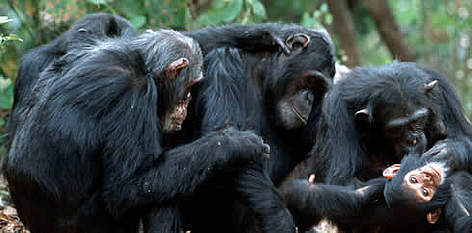
Chimpanzees once used in blood center research is a sanctuary in Liberia. Photo: Zoom Dosso/Agence France-Presse--Getty Images
Two years after the New York Blood Center set off a storm of protest from animal welfare advocates by withdrawing support for a colony of chimpanzees used for biomedical research, the organization has joined with the Humane Society of the United States to guarantee their future care, pledging $6 million.

In a joint announcement on Tuesday, the two groups said the blood center would donate the money to the Humane Society, which will assume responsibility for the lifetime care of the chimps. In captivity, chimps can live 50 to 60 years.

In the statement, Dr. Christopher D. Hillyer, head of the blood center, said he was “pleased that we have found a capable organization to take care of the chimpanzees for their lifetime.” He said the agreement would allow the blood center to concentrate on ensuring the blood supply.

The donation amounts to roughly half the estimated cost of caring for the animals on their island sanctuary in Liberia, said Wayne Pacelle, the head of the Humane Society of the United States. Mr. Pacelle said he was delighted that the two groups had “found a path forward.”

Until now, that path had been hard to find.

Beginning in the 1970s, the blood center used the chimps for research on a hepatitis B vaccine, which ended in 2006. The animals were owned by the government of Liberia.

The center supported the chimps until the spring of 2015, when it cut off funds. Officials said negotiations with the Liberian government had not been productive.

At the time, Victoria O’Neill, a spokeswoman for the blood center, said that the organization “never had any obligation for care for the chimps, contractual or otherwise.”

Primatologists and animal welfare advocates reacted with outrage.

“I have studied great apes for 20 years in all contexts across the globe — labs, zoos, sanctuaries, the wild,” Brian Hare, an anthropologist and primatologist at Duke University, wrote in an email at the time. “Never, ever have I seen anything even remotely as disgusting as this.”

Protests were held at the blood center’s headquarters in New York. The Humane Society began supporting the chimps and pressuring the blood center to take on some of the financial burden.

The Humane Society and the blood center have been negotiating off and on for the last few years. The Humane Society gained the help of Bill Richardson, a former governor of New Mexico, and other prominent people in talking to the blood center, which Mr. Pacelle said had been “incredibly resistant.”

He described the agreement as “a real turnaround for the blood center” and said “the sensible voices within their organization prevailed.”

“We’re very pleased,” Mr. Pacelle added.

Robert Purvis, a spokesman for the blood center, said reaching an agreement was a complicated process. “The blood center has been looking for an organization to take on the care of the chimpanzees for the last 10 years,” he said.

Fortunately, he said, “Nobody gave up.”

Tuesday, April 4, 2017

2599. Cuba’s Cockfighters Resist Police Ban

By Osmel Ramirez Alvarez, Havana Times,  April 3, 2017
Photo: Reynaldo La O
We ordinary Cubans have very few entertainment options left, in spite of the fact that statistics show the national market being second after Canada at Cuban tourist facilities. Tourism and the few other options that exist, remain exclusively for the elite. For thousands of people in Mayari, just like across the nation, cockfighting is one of the few forms of entertainment that exist here; but it has been illegal since the Revolution’s early years.

The ban had and still has to do with betting money. The Cuban system began with the idea (which is only kept in theory) that games, bets, raffles and the lottery were harmful because they created expectations of uncertain, random improvements, relating to luck and far-removed from personal efforts. However, they could never eliminate the cockfighting or lottery traditions here completely.

Ever since I was a child, when social control used to be three times more efficient than now, every once in a while we used to hear about the police chasing after breeders of fighting cocks and taking them to trial. Two or three-year prison sentences were the norm.

Today, nobody is locked up for cockfighting or breeding them or secretly grooming them; but it’s still banned. People have even dared to build rustic pens in labyrinth-like ranches. These are almost always located on riverbeds or the edge of streams so they can sidestep their responsibility in these activities before the authorities, because legally-speaking, the landowner has no jurisdiction over the 10 meters from the shore. The amount of people who march along deer trails and narrow paths, on foot, motorbikes or small carts is incredible. All kinds of people, including professionals, teachers, doctors, engineers, etc. Cockfighting isn’t a marginal bad habit; it’s a kind of sport and tradition.

Relatively close-by to my home, for some years now, there is a pen for fighting cocks and during fight season, there are tournaments every Saturday. We’re in the middle of one right now. Normally, the police turn a blind eye so as not to put people out too much, as they have enough stress with Cuban socialism and its permanent crisis.

However, they do scare them from time to time, so that they don’t forget that it’s a banned activity. On Friday March 10th, a group of policemen went to the pen and burned it down, leaving messages in the area, mentioning “that no more illegal activities will be allowed here.”

They didn’t dare to do this on a Saturday so as to avoid greater confrontation. However, when everybody expected people to get frightened off, the complete opposite happened. Nobody was impressed by the police’s display of force. Just like always, hundreds of people put the pen back together with rustic materials that they had lying around or whatever was left from the fire. Motorbikes and small carts also offered their dangerous transportation services.

“I don’t know why the State has to get involved in this silliness, which doesn’t hurt them in any way. It’s the only fun we have on the weekend and they want to take it away from us, they might as well give us a rope to hang ourselves with,” a fighting cock breeder told me who was walking along with two others, his cock in his arms, in a special bag designed to carry them.

The other said, “Raul’s always liked cocks and cockfighting, why do they ban us from doing it? This isn’t fair. He has pens and his cocks are famous breeds; here people have to pay a lot of money for the cocks that come here from Biran, from Raul’s breed. Whenever he comes to visit, he even attends the fights, everybody knows it.”

I asked them if they were afraid that the police would come back and they told me: “If we become afraid of them, then they definitely will take this away from us. That’s why, if they break the pen, we’ll build it again, this is the only entertainment we have and we can’t lose it. Plus we aren’t hurting anybody, we’re only having a bit of fun to try and forget our own problems.”

It’s also worth noting that, in addition to betting, a kind of fair also forms around the pen: food sellers, soft drinks, sweets, sandwich and beer sellers also benefit; as well as the aforementioned transport drivers. It’s quite an event!

While it’s true that because this is an illegal activity and there aren’t any police around, fights sometimes break out; but it isn’t the main thing going on here, and it isn’t any worse than what happens at other fairs that do have police present.

Cockfighting seems especially awful to me and I hate to see how these animals get cruelly hurt, and sometimes the outcome is lethal. However, I am the exception here in my town, the majority of people love it and it’s a very deeply-rooted tradition. That’s why I respect it and, going beyond my own disapproval of the “sport”, I have also seen and denounced government’s injustice and hypocrisy.

Luck has come back, this time in the shape of a tournament, nearly the only way we have of understanding how a better life in Cuba came about or could come about: making a plan is useless, much less a logical plan, based on personal efforts.

What difference is there between lotteries and, for example, betting everything on emigrating and reaching the US alive by dodging sharks and mafias? Or trusting a foreign partner which “you fought for,” praying he isn’t a human trafficker or organ seller. Or putting all your hopes on a family member leaving Cuba and that they won’t forget you, so you can get remittances. Or the hope you get chose at work to go on a mission abroad and while you’ll still be doing semi-slave work, earn a little more than you would here in Cuba. Or being lucky and your company becomes a joint venture company which pays a bonus, and other things like this, which are almost always related with “foreigners”.

Within this context, it’s very hypocritical to criminalize a tradition by referring to the harmfulness of chance and much less certain moral values which were lost by the Cuban system’s politics a long time ago (they have never argued against the cockfights because of empathy towards animals).

Still worse, it’s a practice which we all know is to our president’s liking and who engages in it in his free time. That’s why breeders of fighting cocks have taken a stand and fights continued every Saturday under the shadow of the promised police intervention hanging in the air.

Saturday, August 13, 2016

2414. Stop Killing Coyotes

By Dan Flores, The New York Times, August 11, 2016


One morning in the late 1930s, the biologist Adolph Murie stood near a game trail in Yellowstone National Park and watched a passing coyote joyously toss a sprig of sagebrush in the air with its mouth, adroitly catch it, and repeat the act every few yards. At the time, Mr. Murie was conducting a federal study intended to prove, definitively, that the coyote was “the archpredator of our time.” But Mr. Murie, whose work ultimately exonerated the animals, was more impressed by that sprig-tossing — proof, he believed, of the joy a wild coyote took in being alive in the world.

Today, more than 80 years later, coyotes are the most common large predators in America, and an increasingly common sight in our cities and suburbs. If we paid attention, we might share Mr. Murie’s fascination with an intelligent, playful creature. Instead, according to Project Coyote, an animal-welfare organization, we kill roughly half a million of them a year.

No other wild animal in American history has suffered the kind of deliberate, and casual, persecution we have rained down on coyotes. For a long stretch of the 20th century, coyotes were, along with gray and red wolves, the rare native American species designated by the federal government for eradication.

In 1931, just a handful of years after the extirpation of gray wolves in Yellowstone, the federal Animal Damage Control Act appropriated $10 million for the erasure of coyotes in America. From 1945 to 1972, when a presidential proclamation by Richard M. Nixon curtailed the war of extermination, a Department of Agriculture agency now called Wildlife Services collected the carcasses of 3.6 million coyotes. Many in the agency believed its poisons had killed an additional three million coyotes whose bodies were never found.

Amid this coyote war, a pair of biologists, Fred Knowlton and Guy Connolly, published a study explaining how it was possible for coyotes to withstand such withering, scorched-earth warfare. “The Effects of Control on Coyote Populations” was a mind-bending revelation. Under persecution, the biologists argued, evolved colonizing mechanisms kicked in for coyotes. They have larger litters. If alpha females die, beta females breed. Pressured, they engage an adaptation called fission-fusion, with packs breaking up and pairs and individuals scattering to the winds and colonizing new areas. In full colonization mode, the scientists found, coyotes could withstand as much as a 70 percent yearly kill rate without suffering any decline in their total population.
As modern studies in places like Yellowstone have shown, when coyotes are left alone, their populations stabilize. The only real effect a half-century of coyote killing produced, then, was to introduce coyote Manifest Destiny, as they spread out of the West and into the East and South and big cities.

Despite Nixon’s decision, Wildlife Services continues its pursuit, spending $140 million a year to kill coyotes and other “undesirable” animals. The agency exists to serve one constituency, a dwindling American sheep industry, for which it still sends planes and helicopters after 80,000 coyotes a year. On behalf of our nation’s sheep, from 2006 to 2011 the agency “retired” 512,710 coyotes.

The government isn’t the only one going after coyotes. Hundreds die each year in weekend hunting “competitions,” often for prizes or gambling pots, that are promoted as a way to attract young people to hunting. Their victims are not only coyotes but the very image of rural America, tarnished by widespread photos of beefy, middle-aged men in camouflage, with guns in hand and dead animals no one is ever going to eat piled up in the backs of pickups.

Coyotes are not endangered, and they don’t need our help to survive as a species (though recovering populations of wolves, which are often mistaken for coyotes during hunts, could use it). But there is something perverse in the government, and society, marking a species for death, setting it outside the bounds of even our wildlife protection laws.

We know coyotes are intelligent, social creatures. They do not enjoy death. No thoughtful human being, considerate of other life, should sacrifice for pleasure or a bet an animal like the one Adolph Murie observed in Yellowstone in the 1930s. Doing so is immoral — not in a religious sense, but in reference to morality’s origins, the evolution of a sense of fairness among members of a social species, which early on came to include a human recognition that other creatures enjoy being alive and that depriving them of life is a very serious matter. Over 2,000 years ago, the philosopher Bion of Borysthenes elucidated why modern, competitive hunts for coyotes are an absolutely abominable idea: “Though boys throw stones at frogs in sport, the frogs die not in sport, but in earnest.”

Killing an animal that for five million years has had an important role to play in nature is an act of adolescence. As long as urbanites keep their dogs and cats inside at night, coyotes pose no unique or overwhelming danger, certainly no more than other wild predators. So why do we continue to mark them as targets for our blood sports?


Dan Flores is the author, most recently, of “Coyote America: A Natural and Supernatural History.”

Thursday, September 17, 2015

2023. Frantic Evacuation in California Left Animals to Face Wildfire Alone

By Kirk Johnson, The New York TimesSeptember 15, 2015
A horse with singed mane and whiskers from wildfire in Middletown, California, on Tuesday. Photo: Talia Herman for the New York Times. 

MIDDLETOWN, Calif. — When the Valley Fire blew up in this rural area 100 miles north of San Francisco last weekend, many residents fled with only the clothes they were wearing. The suddenness of the fire’s surge — half an hour from warning to life-threatening conflagration in many parts of Lake County — sent people scattering, their homes undefended and possessions left to fate or luck.

And in a drought-parched state, that luck was bad. The blaze, 30 percent contained after consuming 67,200 acres, has killed one person and injured four others, with 585 homes destroyed and the state of hundreds more uncertain, according to state fire officials. More than 7,600 structures remained threatened. Financial and personal losses, still uncounted, will be unquestionably staggering.

Many vineyard and farmworkers were also displaced by the damage to housing, raising questions about whether they will stay around through what could be a long economic recovery. The effect on fruit trees that often burn more readily than water-saturated grape vines — Lake County is at the heart of California’s pear-growing region — remains uncertain as well.

Prevailing winds have so far mostly spared grape harvests south of the fires, in Napa County, though growers there say they are not out of danger.

But the rural nature of this part of California added another pain to the equation for thousands of evacuated residents: the animals that people had to leave behind. Those animals included pets but also hundreds of horses for breeding or show, goats and sheep that are financially important in a farming economy.

Crews of volunteers and veterinarians, aided by animal control officers on loan from nearby counties — and besieged by evacuated residents who have bombarded animal shelters with anguished questions and pleas — have begun an arduous task of triage and organization. Even as the fire continues to rage and evacuees try to find out if they still have homes, volunteers are rescuing and healing animals, dispatching crews with food and water to aid stranded animals and then reconnecting them with their owners.

Bob Young, who lives near Hidden Valley Lake, had time, and a trailer big enough, to take all of his horses but two. “That was very hard,” he said. On Tuesday, he was back and felt lucky, he said, that both horses had survived, though with injuries.

Horses have been found wandering down the highway, dazed disaster survivors with cuts and scrapes from the fences they broke through or jumped. Cats, perhaps more prone to panic, were seen dashing into burning homes, and certain death. A dog apparently sheltered her two 8-week-old pups, and all three survived, though the mother had smoke inhalation injuries. Pets from bearded dragons to cockatoos have been brought in.

Some of the survivor stories that animal rescue workers are telling hint at luck or fate, or maybe some animal intelligence.

On Monday, for example, volunteers stumbled on a kind of sanctuary: Five horses, two donkeys and seven goats had found shelter in a tiny depression of earth about 20 feet wide by 50 feet long as fire burned everything around them. Corrals were melted. A school bus was gutted nearby. But the animals, hunkered down in the middle of the inferno in the one place that did not burn, were barely scathed.

“They’re herd animals; they followed each other in there,” said Milt Fletcher, a volunteer from nearby Yolo County, shaking his head as he told the story.
Others were less fortunate.

One wandering horse was struck by a vehicle and killed, and at least three died of smoke or fire in a pasture they could not escape. A badly burned goat was euthanized at the animal hospital, as was at least one cow. Burned kittens were evacuated to a bigger hospital at the University of California, Davis, where students were volunteering to help with treatment.

“There’s a cow right in there we found yesterday,” said John Madigan, a professor of epidemiology at the university’s veterinary school who was volunteering here. He slowed his pickup truck in front of a gutted, charred barn. Animals that were confined there died, he said, while those that were not confined survived.

Professor Madigan, who trains students in emergency animal rescue, said some places prepared better than others for the nonhuman implications of disaster. Texas A & M University, for example, has an extensive animal rescue training program, he said, because of hurricane threats. Southern California has also faced far more fire than these northern woods, and residents there know that evacuation plans should include animals. But the roaring pace of the blaze here set a clock, he said, that no one could keep up with.

“When you have something that explodes in the middle of the night and people don’t have a chance to respond, this is what you’re ended up with: The owners have left, and the animals are left behind,” Professor Madigan said. “There’s probably 400 unburned houses here that could have animals in them, and there’s no one to care for them.”

At Middletown Animal Hospital, workers are preparing identification sheets for each animal found. Facebook pages will be set up, Teresa Axthelm, the hospital’s practice manager, said, “when the chaos has lifted a bit.”


Water is an urgent need, said Jeffrey J. Smith, the hospital’s owner. Many homes and farms depend on wells, and the power failures that are widespread because of downed electrical lines have crippled the ability to pump water. As a result, volunteers have been hauling out buckets from swimming pools, the water still hot from the flames.

Thursday, August 27, 2015

1996. New Zealand Adopts Animal Welfare Law

By Sophie McAdam, True Activist, June 3, 2015
Would the sheep be spared? 
New Zealand has just set a great example to the world by recognizing what animal lovers have known forever- that our furry friends are as sentient as we are, and (obviously, dur) they have feelings just like we do. It’s a theme we have covered time and again here at True Activist, but this landmark ruling by NZ is the first time this shift in perception and policy has been extended to all animals, not just chimpanzees, orangutans, or dolphins.

The Animal Welfare Amendment Bill, passed last month, aims to make it easier to prosecute people in animal cruelty cases, as well as banning animal testing and research.

Animal rights activists have celebrated the decision. “To say that animals are sentient is to state explicitly that they can experience both positive and negative emotions, including pain and distress,” said Dr Virginia Williams, chair of the National Animal Ethics Advisory Committee. “The explicitness is what is new and marks another step along the animal welfare journey.”

New Zealand Veterinary Association president Dr Steve Merchant said the bill greater clarity, transparency and enforceability of animal welfare laws, according to the country’s regional newspaper the Nelson Mail.

“Expectations on animal welfare have been rapidly changing, and practices that were once commonplace for pets and farm stock are no longer acceptable or tolerated,” he said. “The bill brings legislation in line with our nation’s changing attitude on the status of animals in society.”

You can read the entire Bill here. Let’s hope the rest of the world follows suit!

Tuesday, June 16, 2015

1883. The Exterminator: The Case of the Dutch and the Graylag Geese

By Kamran Nayeri, June 16, 2015
Arie den Hertog rounds up graylag geese for extermination
The gas chamber
Arie den Hertog is an ordinary 40 year old Dutchman.  Until recently, he was just an “exterminator” responding to calls to eradicate foxes, birds, and other “pests” from people’s homes and property.  But lately, Mr. Den Hertog captures and gas graylag geese for a living and has attracted some unwanted public attention.  Andrew Higgs of the New York Times recently observed him doing it: 
“The hiss of gas, released by a red lever turned by Arie den Hertog in the back of his white van, signaled the start of the massacre. The victims, crammed into a sealed, coffin-like wooden case, squawked as they struggled to breathe. Then, after barely two minutes, they fell silent.
“Glancing at the timer on his cellphone, Mr. Den Hertog declared the deed done. ‘Now it is all over,’ he said proudly of his gruesomely efficient handiwork, on a gloriously sunny day beneath a row of poplar trees on the banks of the Lower Rhine.” (Andrew Higgs, The New York Times, June 14, 2015)
Since he first started this new extermination job in 2008, he estimates that he has killed 50,000 to 60,000 graylag geese, 25,000 around Amsterdam’s Schiphol Airport alone.  The massacre is done during the geese molting period, a few weeks each year when they shed old feathers on their wings to make way for new ones. Unable to fly, they gather in water for protection from predators.  

“In small boats, Mr. Den Hertog and Mr. Spitzen, the ranger, approached geese relaxing in a canal off the Lower Rhine from opposite sides, a pincer operation intended to drive them toward the river bank, where Mr. Den Hertog, his son and other helpers had set up a kind of chute to funnel the geese to the gas chamber.
“A few, as if sensing doom, appeared to be suddenly gripped by wild panic and somehow found a will to fly, fleeing before it was too late on their sparsely feathered wings.Mr. Den Hertog then round them up into an enclosed location and began his task of preparing them for the gas chamber.” (ibid.) 
The Dutch authorities hired Mr. Den Hertog for exterminating graylag geese because the they eat the grass on pastures meant for cows and may collide into planes taking off from the airport, a major hub in Europe.  

On June 1, Mr. Den Hertog’s work picked up following a decision by the European Chemicals Agency to formally approve the use of carbon dioxide as a biocide, a ruling that lifted a cloud of uncertainty about the legality of Mr. Den Hertog’s approach.  On a recent outing, to Wijik bij Duurstede village in Ultrecht region southwest of Amsterdam, he killed 579 graylag geese in his portable gas chamber, fitted with two big canisters of carbon dioxide. This brought his death toll to more than 7,000 for the week.

About the graylag geese
Graylag geese are fully migratory although some populations in temperate regions are sedentary or locally dispersive. The species breeds from May or April in loose colonies after which flocks gather to undertake molt migrations to favored areas with good feeding opportunities and access to safe roosting sites to undergo a flightless molting period lasting a month. The species is highly gregarious outside of the breeding season with large concentrations forming during the post-breeding molt and before the autumn migration (e.g. flocks of up to 25,000 individuals). The species feeds diurnally, especially during the morning and evening, although non-breeding birds may also feed at night. It roosts at night and during the middle of the day on open water (source: Birdlife).

Graylag geese are threatened by considerable hunting across much of its range and is susceptible to poisoning from lead shot ingestion. The species is also persecuted by farmers as it can cause considerable crop damage. The destruction and degradation of wetland habitats due to drainage, conversion to agriculture, petroleum pollution, peat-extraction, changing wetland management practices (e.g. decreased grazing and mowing in meadows leading to scrub over-growth) and the burning and mowing of reeds is also a threat, especially in breeding areas. The species is susceptible to avian influenza so may be threatened by future outbreaks of the virus. (ibid.)

Geese population in the Netherlands has skyrocketed partly because of a 1999 ban on hunting them and partly because of farmers’ increasing use of nitrogen-rich fertilizer, which geese apparently love and partly because of the expansion of protected nature areas. “That combination, plus an abundance of rivers and canals has made the country a “goose El Dorado.” said Julia Stahl, head of research at Sovon, a group that monitors wild bird populations in the Netherlands.” (Higgs, The New York Times)  As a result, more graylag geese tend to stay in the Netherlands than migrate to the arctic Russia in the summer time.  They account for three quarter of the Dutch geese population of about 800,000.  Netherlands which has 18.8 million people is densely populated with 498 persons per square kilometer in 2013. 

Ethics of extermination
Mr. Den Hertog justify his activity by arguing that geese are not human so gassing them en mass is not an ethical problem. He thinks people who sympathize with the geese are unjustifiably “emotional.” “‘A lot of people are too emotional about animals,’ Mr. Den Hertog said, scoffing at what he dismissed as sentimental attitudes shaped by modern urban living. ‘They give them names and think they are humans. But nature itself is very hard. When a bird gets sick, a fox will see it and kill it immediately. But if humans see it, they want to take it to a hospital.’” (ibid.)  

Mr. Bart Krol who is a vice governor of the Utrecht region responsible for geese extermination policy does not like killing them but he says he is “implementing what our democracy has decided is the policy for dealing with this problem.”

The animal rights movement
From the New York Times report it appears that the main opposition to the campaign to eradicate the graylag geese is from the Animal Liberation Front with its tactics of sending hate mail to Mr. Den Hertog and Mr. Krol and physically disrupt their work.

Culture and nature
Of course, the problem is rooted in the clash of culture and nature.  The Dutch are protecting their way of life—farming and flying in airplane—against the way of life of the graylag geese.  Mr. Den Hertog’s job as an exterminator is a socially accepted norm for the Western industrial societies—even the Animal Liberation Front does not object to ordinary extermination of “pests” who are essentially other species getting into our way of life.  The clash between human culture, in modern times largely the capitalist culture, and nature constantly is resolved with our eradication of wildness as we shape nature to fit our designs whether for profits (like clearing forests for wood or pasture) or simply to satisfy our fancy (as gardeners do when they uproot a landscape to install one more likable). 

This clash of human culture and nature lays at the roots of the planetary crisis we face today.  The capitalist civilization we live in perpetuates this assault on ever large scale and with faster pace destroying natural habitats, ecosystem and untold number of species.  To reduce our field of vision to the gruesome work of Mr. Den Hertog is to lose sight of the magnitude of the problem and proper way to search for a solution to it.  The solution should include overcoming and transcending the anthropocentric capitalist culture by building an ecological socialist society that can live happily in harmony with the rest of nature. 

Sunday, June 14, 2015

1879. U.S. Will Call All Chimps ‘Endangered’

By Nicholas St. Fleur, The New York Times, June 12, 2015


All chimpanzees will be designated as endangered under the Endangered Species Act, the United States Fish and Wildlife Service announced Friday.

The move follows a petition filed in 2010 by Jane Goodall, The Humane Society of the United States and other groups to eliminate a longstanding distinction between the legal status of captive chimpanzees, which were previously listed as “threatened,” and their wild counterparts, which have been deemed “endangered” for decades.

With the new designations, chimpanzees held in captivity in the United States will receive the same protections as wild chimps under the Endangered Species Act. Biomedical research, interstate trade, and export and import of captive chimpanzees will now require permits issued by the Fish and Wildlife Service. The new rules will become official on June 16 and will go into effect after a 90-day grace period on Sept. 14.

The regulations do not require that people who privately own chimpanzees obtain a permit to keep them, nor do they require permits to use chimpanzees in the entertainment industry, according to Dan Ashe, the United States Fish and Wildlife Service’s director. He said that the previous distinctions sent a mixed signal to the public and created the impression that chimpanzees were not in dire need of help.

“At the time we thought it was important to encourage breeding of captive chimps to expand their numbers,” said Mr. Ashe. “But we expanded a culture of treating these animals as a commodity for research, sale, import and export, and entertainment. That has undermined the conservation of chimpanzees in the wild.”

Chimpanzees once numbered about a million in the early 1900s, but widespread habitat loss and poaching have caused their numbers to decline. Currently, there are estimated to be between 172,000 and 300,000 worldwide, according to the Jane Goodall Institute.

The changes will create barriers to biomedical research, according to Mr. Ashe. There are 730 chimpanzees in the custody of biomedical laboratories, according to chimpcare.org, and the changes require that any research that might harm or harass chimpanzees requires a permit.

Scientists will also need a permit to sell chimpanzee blood or tissue across state borders. In order to obtain a permit, biomedical researchers must “demonstrate that their research would be directly and substantially supporting the conservation of chimpanzees in the wild,” Mr. Ashe said.

That could include making donations to chimpanzee conservation efforts, he said. “It’s a substantial burden; it’s not just a matter of writing a check,” said Mr. Ashe.
Wayne Pacelle, chief executive of The Humane Society, said that the announcement, paired with an initiative by the National Institutes of Health in 2013 to retire government-owned chimpanzees from labs to sanctuaries, creates “an incredible one-two punch for chimpanzee conservation.”

“This rule change will help put an end to the exploitation of chimpanzees and we are happy about that,” said Erika Fleury of the North American Primate Sanctuary Alliance, a group of eight primate sanctuaries in the United States and Canada that cares for close to 600 chimpanzees and monkeys.

She cautioned that if the changes result in more chimpanzees retiring to sanctuaries, they should be accompanied by more funding for sanctuaries. “This is a big step,” she said. “It’s years in the making and we’re very happy to see this come to fruition.”

Friday, May 29, 2015

1864. On Animal Rights in Cuba

By Yenisel Rodríguez Pérez, Havana Times, May 28, 2015


HAVANA TIMES – I recall how, back in primary school, we used to shower white herons with rocks while heading back home from school. Poor things, they’ve never been anything but “worthless” to common people in Cuba.

I also remember the death-squads made up of little boys and girls from my block. They took the whole thing very seriously.

They took to the street with a mental inventory of potential victims: reptiles, insects, mammals, plants and even someone’s younger brother. A child guerrilla at war with nature. What were the adults doing in the meantime?

Well, they were preparing snacks and telling the kids to do their homework, indifferent to the “bio-technology lab” the little ones had set up in front of their homes.
Then, there’s the question as to the media, schools, NGOs and other social institutions that deal with the issue. Very little of what these institutions do actually reach primary schoolers.

Speeches alone do not change people’s behavior. Rather, they tend to define positions and give what people have already defined in their imaginaries a name or a path to follow. Sensitivity towards animal life usually exists prior to receiving an educational message about this, and such empathy towards animals is painfully missing in Cuba.
The point of departure must be the individual’s life-world. Society must take part in this, but it must do so from the daily life of people, from the notions these people have of their surroundings.

Much is said about progress made by First World countries in the area of animal protection, but it all basically boils down to obeying the law.

The point is that fulfilling the law does not necessarily entail any sense of the dignity of animals, a central tenet of ecological thinking. It rather works as a preventive measure or expresses the fear of being punished by the authorities.

This isn’t to say that an animal protection law wouldn’t help make the situation of animal rights on the island less precarious, but it wouldn’t be a solution to the problem, particularly when we bear in mind that any implementation of such norms would leave a lot to be desired in terms of the efficiency of control mechanisms.

Something needs to be set in motion in our country; we must start somewhere – by supporting the work that animal protection organizations (such as ANIPLANT) have been doing for quite some time, for instance.

We shouldn’t continue to accept violence against animals by people of any age.
We must put an end to those terrible scenes of extreme violence, and we must also eliminate this other form of concealed violence, such as those armies of children who attack pigeons at parks and squares with the consent of adults.

If these are the boys and girls who represent the world’s hope, then we can only hope for a future world that is profoundly cruel towards animal life. Let us then pray for the white herons.

Wednesday, April 22, 2015

1820. On Bestiality (Zoophilia)

By Kamran Nayeri, April 22, 2015
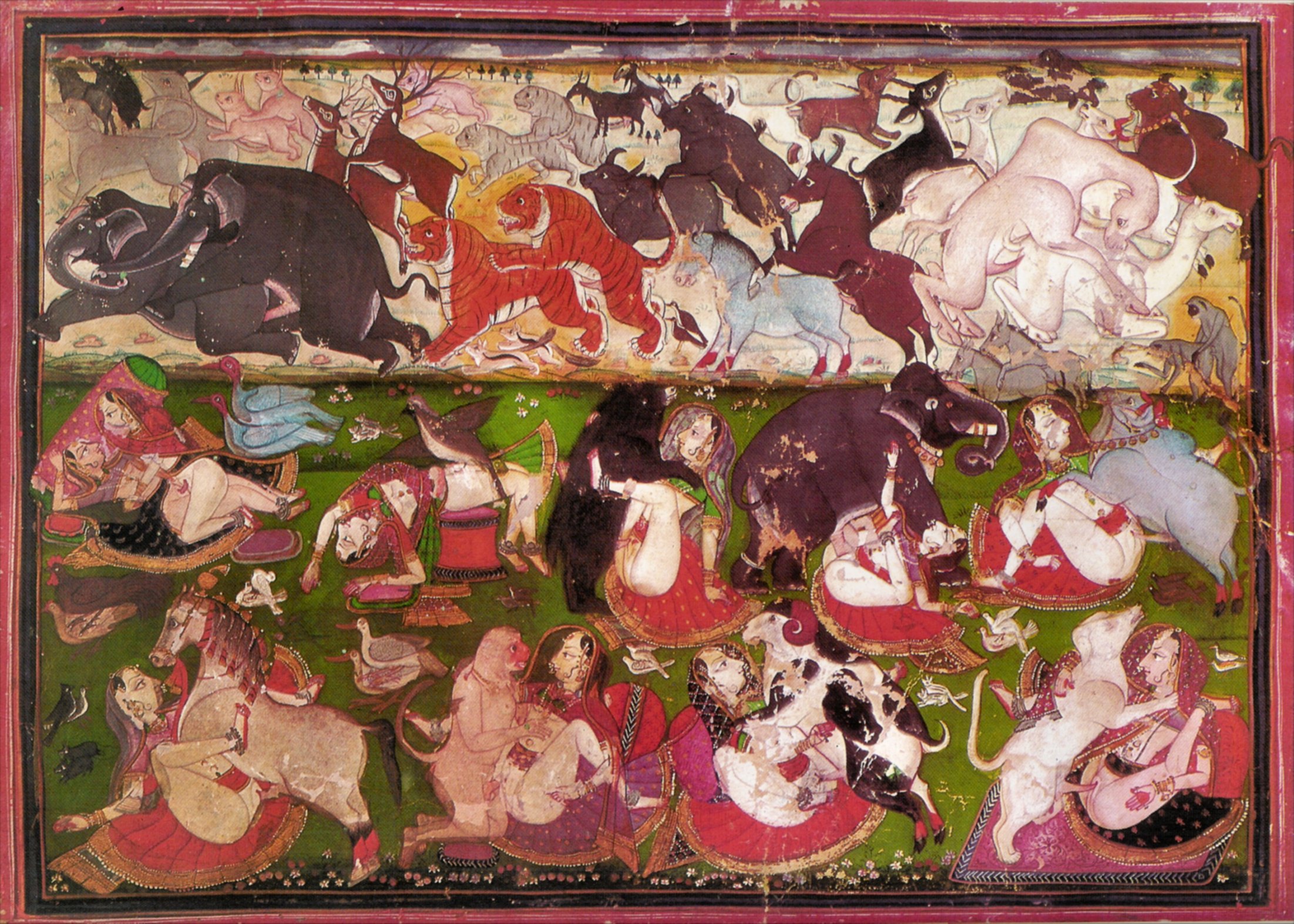
An 18th century Indian miniature depicting women engaged in bestiality in the bottom register.
On Tuesday, April 21, Denmark banned bestiality (zoophilia), that is, sex with non-human animals.  The law was passed because of pressure from animal rights groups and to discourage animal-sex tourism. It amended a previous law that banned sex with non-human animals that was deemed harmful to them. Dan Jorgensen, Danish Farm Minister, argued that the previous ban required proof of animal suffering during the sexual act that is hard to establish. “[T]hat is why we must give the animal the benefit of the doubt,” he said.  Bestiality has been banned in Germany, Norway, Sweden and Britain.  A 2011 Danish Justice Ministry report found that 17% of veterinarians who were surveyed suspected that a human had sex with an animal they treated. 

The attitude towards bestiality has been to despise and ignore it as acts of sexually frustrated farmers.  In fact, zoophilia is far more common and involve people from all walks of life and all over the world across history.  Because it has been swept under the rug it has never become subject of civil discourse.  Only recently a public discussion of bestiality has emerged in the mass media and among public officials in Western societies. Not all participants in this discussion agree on the moral standing of bestiality and what if anything should be done about it.  For example, in “What It’s Is Like to Date a Horse,” New York Times Magazine, November 20, 2014, Alexa Tsoulis-Reay, provides a service to the needed public discussion by publishing an interview with a married man, who also has sex with other men, about his “love affairs” with horses, mares and stallions.  

This sympathetic interview includes the interviewee defense of bestiality and why it should become legal.  His arguments center on the question of sexual consent.  First, he argues that in farming animal consent is not an issue in artificial insemination and semen collection which he says “are very sexual acts.”  “You put your arm inside the cow, and you masturbate the bull. So obviously consent is not really the issue.”

“Second, if someone is mute and can’t write or give you a verbal response, are you allowed to have sex with them? Even if they are an adult and mentally sound? Are words the only way to get consent? I don’t know how often this comes up when a mute wants to have sex, but that’s another way of looking at it.”

Finally, he argues that he approaches his horses the same way any human approaches a non-human animal by sensing if that she/he is willing to be touched. 

“No smart person does that because the dog could bite your hand. If he’s perky and happy you go in for the pet; if he’s not you don’t want to interfere with him. So for me that’s a good way to make people understand that an animal doesn’t need words to consent to being touched.”

While the interviewer does not challenge these assertions it should be obvious that domesticated animals have been bred to allow human control. Their docility makes them valuable to humans either as food or their body parts (such as fur) or for their labor or as “pets,” among many other things including bestiality. In Man’s Dominion, in biblical terms, there is no equality between humans and other animals, much less those who have been enslaved to us.  Humanism has carried the germ this same idea to this day in its bourgeois and socialism forms. 

The fact that billions of animals are raised and slaughtered each year for food, that include using artificial insemination and forced collection of semen, does not make bestiality moral.  The entire meat industry and domestication of animals for human purpose is immoral (see my essay, “How Veganism Can Help Save the World,” June 12, 2014).

In the same vein, if there is a human person who cannot give consent to having sex, it is immoral to have sex with him/her. Consensual  sex is moral percisely because it is a relationship between two free and able persons. The same cannot be said about having sex with a domesticated animal because of the very nature of domestication.  

Finally, if the dog wag his tail it is because of a long history of domestication and artificial selection that has made him willing to subject of our whims. That does not mean he is consenting to become subject of bestiality. 

Bestiality itself is a symptom of a much larger problem with human species: speciesism (anthropocentrism or presumption of human moral superiority). Speciesism presumes that all that exists is to serve our whims including sexual ones.  It is a basic deformity in civilized humans that makes us lower in moral status, rather than higher, compared to other animals in the same sense that slave owners were of lower moral status than their slaves.  It is also the underlying cause of the crisis of civilization from the beginning. Anthropocentric capitalist civilization has brought us the planetary crisis in just 250 years. It is high time to rid ourselves of speciesism (anthropocentrism) and all its manifestation including bestiality.  For this not only we need an ecological socialist revolution to transcend the capitalist civilization but also an ecocentric cultural revolution that will prepare us to truly love and respect all beings, not as objects of our whims but as subjects of their own lives (for more detailed discussion see my "Economics, Socialism, and Ecology: A Critical Outline, Part 2)